tow Alfa Romeo Giulia 2018 User Guide
[x] Cancel search | Manufacturer: ALFA ROMEO, Model Year: 2018, Model line: Giulia, Model: Alfa Romeo Giulia 2018Pages: 260, PDF Size: 6 MB
Page 105 of 260
Researchhas shown that seat belts save
lives, and they can reduce the seriousness
of injuries in a collision. Some of the worst
injuries happen when people are thrown
from the vehicle. Seat belts reduce the
possibility of ejection and the risk of injury
caused by striking the inside of the
vehicle. Everyone in a motor vehicle
should be belted at all times.
Enhanced Seat Belt Use Reminder
System (BeltAlert)
Driver and Passenger BeltAlert
(if equipped)
BeltAlert is a feature intended to
remind the driver and outboard front seat
passenger (if equipped with outboard
front passenger seat BeltAlert) to buckle
their seat belts. The Belt Alert feature is
active whenever the ignition switch is in
the START or ON/RUN position.
Initial Indication
If the driver is unbuckled when the
ignition switch is first in the START or
ON/RUN position, a chime will signal for a
few seconds. If the driver or outboard
front seat passenger (if equipped with
outboard front passenger seat BeltAlert)
is unbuckled when the ignition switch is
first in the START or ON/RUN position
the Seat Belt Reminder Light will turn on
and remain on until both outboard front
seat belts are buckled. The outboard
front passenger seat BeltAlert is not
active when an outboard front passenger
seat is unoccupied. BeltAlert Warning Sequence
The BeltAlert warning sequence is
activated when the vehicle is moving
above a specified vehicle speed range
and the driver or outboard front seat
passenger is unbuckled (if equipped with
outboard front passenger seat BeltAlert)
(the outboard front passenger seat
BeltAlert is not active when the outboard
front passenger seat is unoccupied).
The BeltAlert warning sequence starts by
blinking the Seat Belt Reminder Light and
sounding an intermittent chime. Once the
BeltAlert warning sequence has
completed, the Seat Belt Reminder Light
will remain on until the seat belts are
buckled. The BeltAlert warning sequence
may repeat based on vehicle speed until
the driver and occupied outboard front
seat passenger seat belts are buckled.
The driver should instruct all occupants
to buckle their seat belts.
Change of Status
If the driver or outboard front seat
passenger (if equipped with outboard
front passenger seat BeltAlert)
unbuckles their seat belt while the
vehicle is traveling, the BeltAlert warning
sequence will begin until the seat belts
are buckled again.
The outboard front passenger seat
BeltAlert is not active when the outboard
front passenger seat is unoccupied.
BeltAlert may be triggered when an
animal or other items are placed on the
outboard front passenger seat or when
the seat is folded flat (if equipped). It is
recommended that pets be restrained in
the rear seat (if equipped) in pet
harnesses or pet carriers that are
secured by seat belts, and cargo is
properly stowed.
Lap/Shoulder Belts
All seating positions in your vehicle are
equipped with lap/shoulder belts.
The seat belt webbing retractor will lock
only during very sudden stops or
collisions. This feature allows the
shoulder part of the seat belt to move
freely with you under normal conditions.
However, in a collision the seat belt will
lock and reduce your risk of striking the
inside of the vehicle or being thrown out
of the vehicle.
Warning!
Relying on the air bags alone could lead to
more severe injuries in a collision. The air
bags work with your seat belt to restrain
you properly. In some collisions, the air bags
won’t deploy at all. Always wear your seat
belt even though you have air bags.
In a collision, you and your passengers can
suffer much greater injuries if you are not
properly buckled up. You can strike the
interior of your vehicle or other passengers,
or you can be thrown out of the vehicle.
Always be sure you and others in your
vehicle are buckled up properly.
103
Page 107 of 260
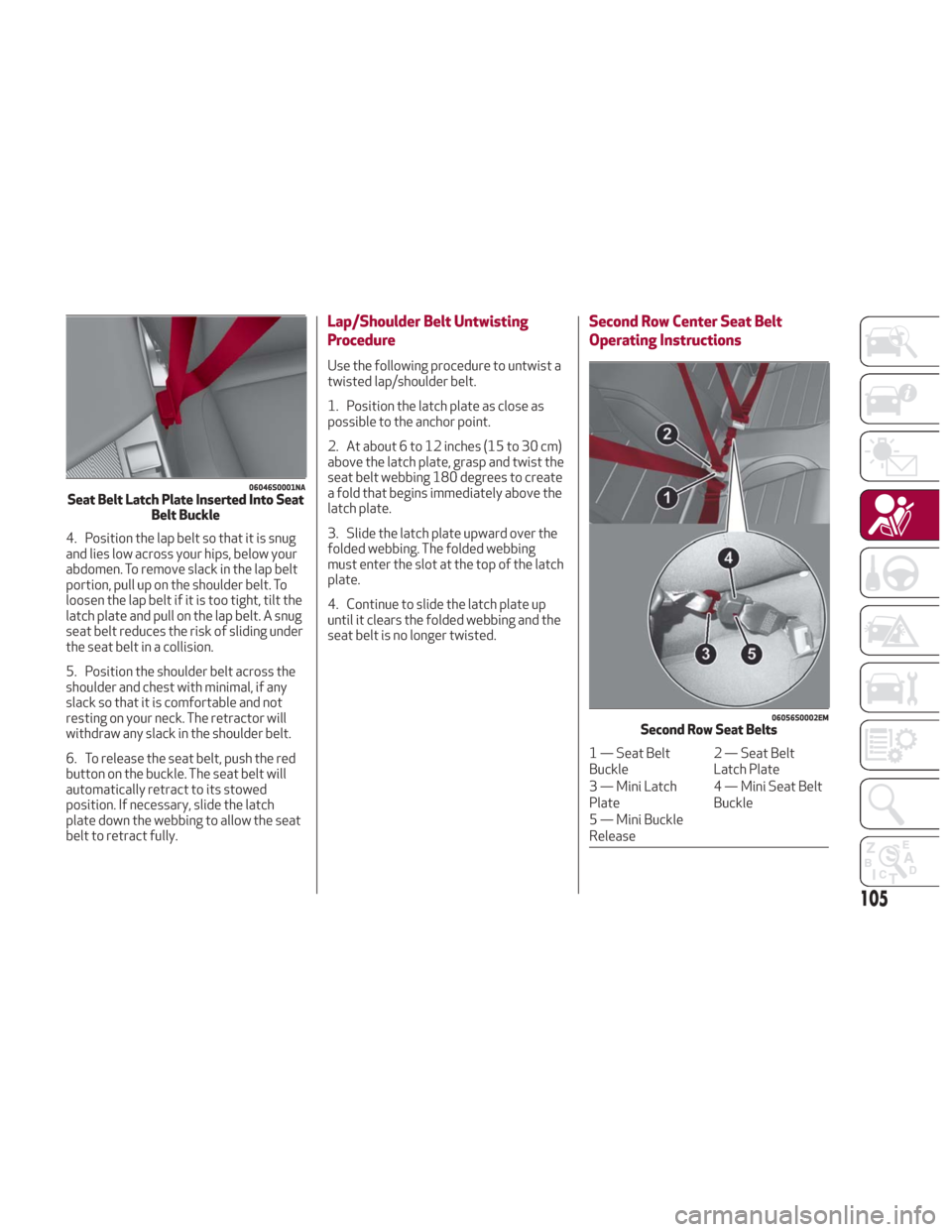
4. Position the lap belt so that it is snug
and lies low across your hips, below your
abdomen. To remove slack in the lap belt
portion, pull up on the shoulder belt. To
loosen the lap belt if it is too tight, tilt the
latch plate and pull on the lap belt. A snug
seat belt reduces the risk of sliding under
the seat belt in a collision.
5. Position the shoulder belt across the
shoulder and chest with minimal, if any
slack so that it is comfortable and not
resting on your neck. The retractor will
withdraw any slack in the shoulder belt.
6. To release the seat belt, push the red
button on the buckle. The seat belt will
automatically retract to its stowed
position. If necessary, slide the latch
plate down the webbing to allow the seat
belt to retract fully.
Lap/Shoulder Belt Untwisting
Procedure
Use the following procedure to untwist a
twisted lap/shoulder belt.
1. Position the latch plate as close as
possible to the anchor point.
2. At about 6 to 12 inches (15 to 30 cm)
above the latch plate, grasp and twist the
seat belt webbing 180 degrees to create
a fold that begins immediately above the
latch plate.
3. Slide the latch plate upward over the
folded webbing. The folded webbing
must enter the slot at the top of the latch
plate.
4. Continue to slide the latch plate up
until it clears the folded webbing and the
seat belt is no longer twisted.
Second Row Center Seat Belt
Operating Instructions
06046S0001NASeat Belt Latch Plate Inserted Into SeatBelt Buckle
06056S0002EMSecond Row Seat Belts
1 — Seat Belt
Buckle 2 — Seat Belt
Latch Plate
3 — Mini Latch
Plate 4 — Mini Seat Belt
Buckle
5 — Mini Buckle
Release
105
Page 108 of 260
The second row center seat belt features
a seat belt with a mini-latch plate and
buckle, which allows the seat belt to
detach from the lower anchor when the
seat is folded. The mini-latch plate and
regular latch plate can then be stored out
of the way in the parcel tray for added
convenience to open up utilization of the
storage areas behind the front seats
when the seat is not occupied.
1. Remove the mini-latch plate and
regular latch plate from its stowed
position in the right rear side trim panel.
2. Grasp the mini-latch plate and pull the
seat belt over the seat.
3. Route the shoulder belt to the inside
of the right head restraint.
4. When the seat belt is long enough to
fit, insert the mini-latch plate into the
mini-buckle until you hear a “click.”
5.
Sit back in seat. Slide the regular latch
plate up the webbing as far as necessary to
allow the seat belt to go around your lap.
6. When the seat belt is long enough to
fit, insert the latch plate into the buckle
until you hear a “click.”
7. Position the lap belt so that it is snug
and lies low across your hips, below your
abdomen. To remove slack in the lap belt
portion, pull up on the shoulder belt. To loosen the lap belt if it is too tight, pull
on the lap belt. A snug seat belt reduces
the risk of sliding under the seat belt in a
collision.
8. Position the shoulder belt on your
chest so that it is comfortable and not
resting on your neck. The retractor will
withdraw any slack in the seat belt.
9. To release the seat belt, push the red
button on the buckle.
10. To disengage the mini-latch plate
from the mini-buckle for storage, insert
the regular latch plate into the black
button on the top of the mini-buckle. The
seat belt will automatically retract to its
stowed position. If necessary, slide the
latch plate down the webbing to allow the
seat belt to retract fully. Insert the
mini-latch plate and regular latch plate
into its stowed position.
Warning!
If the mini-latch plate and mini-buckle are
not properly connected when the seat belt is
used by an occupant, the seat belt will not
be able to provide proper restraint and will
increase the risk of injury in a collision.
When reattaching the mini-latch plate and
mini-buckle, ensure the seat belt webbing is
not twisted. If the webbing is twisted, follow
the preceding procedure to detach the
mini-latch plate and mini-buckle, untwist the
webbing, and reattach the mini-latch plate
and mini-buckle.
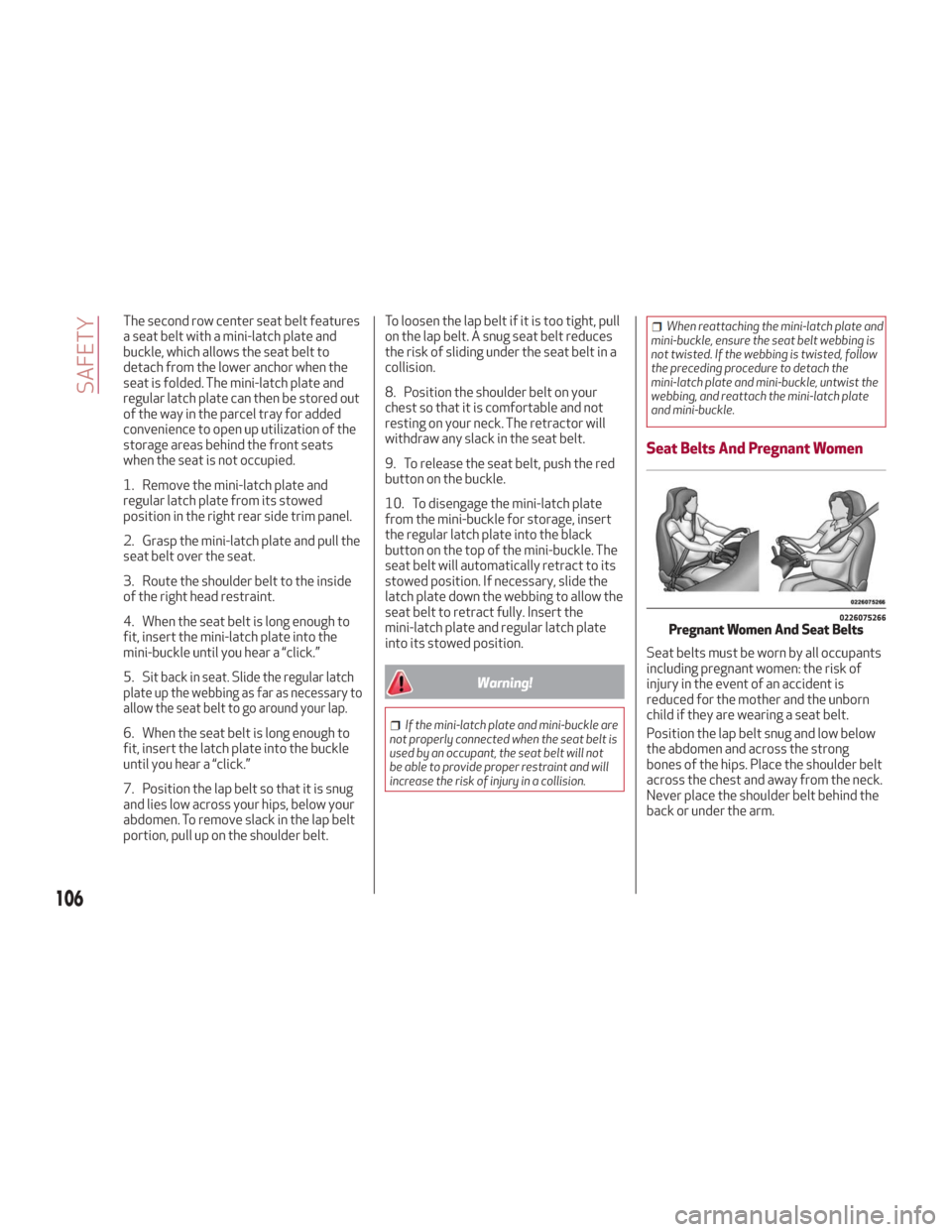
Seat Belts And Pregnant Women
Seat belts must be worn by all occupants
including pregnant women: the risk of
injury in the event of an accident is
reduced for the mother and the unborn
child if they are wearing a seat belt.
Position the lap belt snug and low below
the abdomen and across the strong
bones of the hips. Place the shoulder belt
across the chest and away from the neck.
Never place the shoulder belt behind the
back or under the arm.
0226075266Pregnant Women And Seat Belts
106
SAFETY
Page 125 of 260
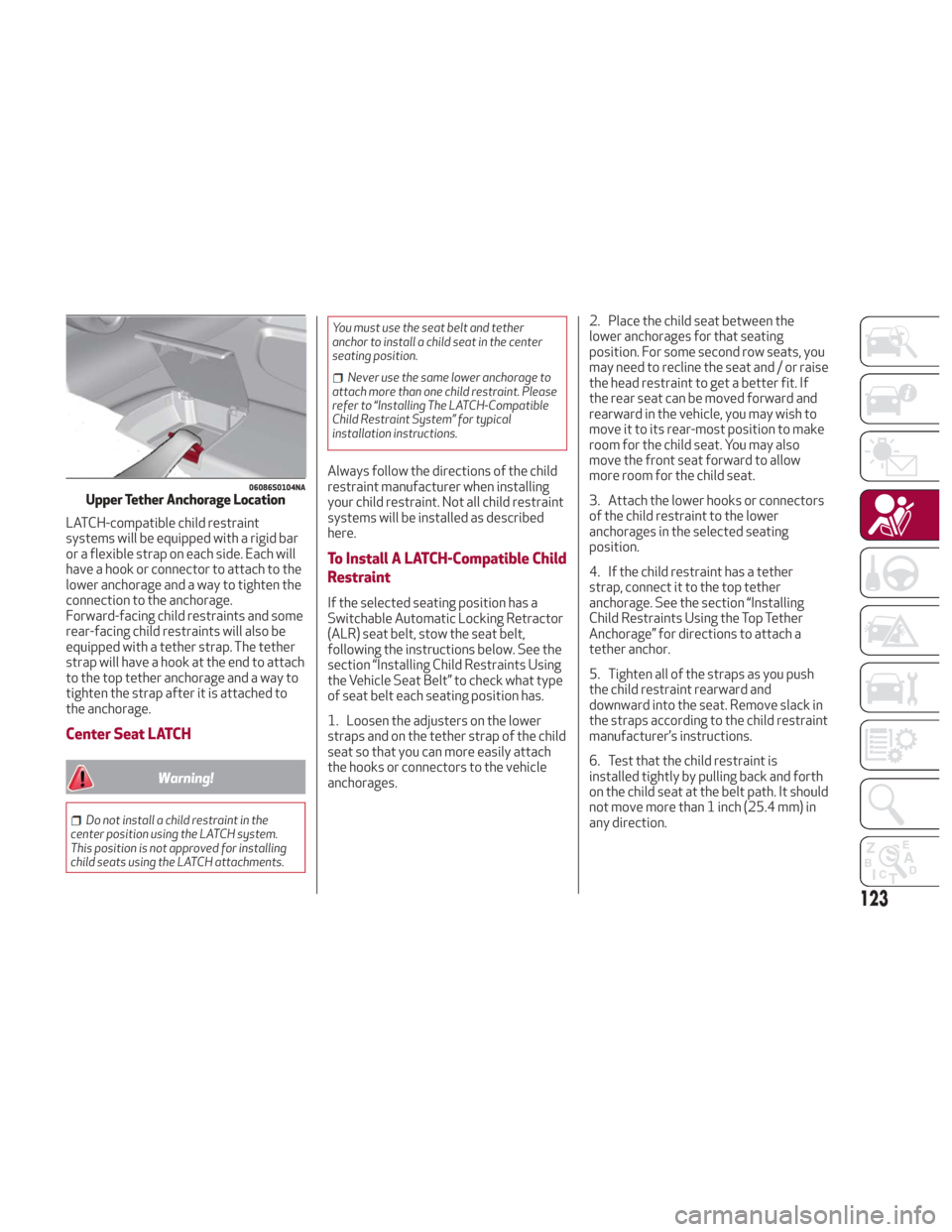
LATCH-compatible child restraint
systems will be equipped with a rigid bar
or a flexible strap on each side. Each will
have a hook or connector to attach to the
lower anchorage and a way to tighten the
connection to the anchorage.
Forward-facing child restraints and some
rear-facing child restraints will also be
equipped with a tether strap. The tether
strap will have a hook at the end to attach
to the top tether anchorage and a way to
tighten the strap after it is attached to
the anchorage.
Center Seat LATCH
Warning!
Do not install a child restraint in the
center position using the LATCH system.
This position is not approved for installing
child seats using the LATCH attachments. You must use the seat belt and tether
anchor to install a child seat in the center
seating position.
Never use the same lower anchorage to
attach more than one child restraint. Please
refer to “Installing The LATCH-Compatible
Child Restraint System” for typical
installation instructions.
Always follow the directions of the child
restraint manufacturer when installing
your child restraint. Not all child restraint
systems will be installed as described
here.
To Install A LATCH-Compatible Child
Restraint
If the selected seating position has a
Switchable Automatic Locking Retractor
(ALR) seat belt, stow the seat belt,
following the instructions below. See the
section “Installing Child Restraints Using
the Vehicle Seat Belt” to check what type
of seat belt each seating position has.
1. Loosen the adjusters on the lower
straps and on the tether strap of the child
seat so that you can more easily attach
the hooks or connectors to the vehicle
anchorages. 2. Place the child seat between the
lower anchorages for that seating
position. For some second row seats, you
may need to recline the seat and / or raise
the head restraint to get a better fit. If
the rear seat can be moved forward and
rearward in the vehicle, you may wish to
move it to its rear-most position to make
room for the child seat. You may also
move the front seat forward to allow
more room for the child seat.
3. Attach the lower hooks or connectors
of the child restraint to the lower
anchorages in the selected seating
position.
4. If the child restraint has a tether
strap, connect it to the top tether
anchorage. See the section “Installing
Child Restraints Using the Top Tether
Anchorage” for directions to attach a
tether anchor.
5. Tighten all of the straps as you push
the child restraint rearward and
downward into the seat. Remove slack in
the straps according to the child restraint
manufacturer’s instructions.
6. Test that the child restraint is
installed tightly by pulling back and forth
on the child seat at the belt path. It should
not move more than 1 inch (25.4 mm) in
any direction.
06086S0104NAUpper Tether Anchorage Location
123
Page 126 of 260
How To Stow An Unused
Switchable-ALR (ALR) Seat Belt:
When using the LATCH attaching system
to install a child restraint, stow all ALR
seat belts that are not being used by
other occupants or being used to secure
child restraints. An unused belt could
injure a child if they play with it and
accidentally lock the seat belt retractor.
Before installing a child restraint using
the LATCH system, buckle the seat belt
behind the child restraint and out of the
child’s reach. If the buckled seat belt
interferes with the child restraint
installation, instead of buckling it behind
the child restraint, route the seat belt
through the child restraint belt path and
then buckle it. Do not lock the seat belt.
Remind all children in the vehicle that the
seat belts are not toys and that they
should not play with them.
Warning!
Improper installation of a child restraint
to the LATCH anchorages can lead to failure
of the restraint. The child could be badly
injured or killed. Follow the child restraint
manufacturer’s directions exactly when
installing an infant or child restraint.
Child restraint anchorages are designed
to withstand only those loads imposed by
correctly-fitted child restraints. Under no
circumstances are they to be used for adult
seat belts, harnesses, or for attaching other
items or equipment to the vehicle.
Installing Child Restraints Using
The Vehicle Seat Belt
Child restraint systems are designed to
be secured in vehicle seats by lap belts or
the lap belt portion of a lap/shoulder belt.
Warning!
Improper installation or failure to
properly secure a child restraint can lead to
failure of the restraint. The child could be
badly injured or killed.
Follow the child restraint manufacturer’s
directions exactly when installing an infant
or child restraint.
The seat belts in the passenger seating
positions are equipped with a Switchable
Automatic Locking Retractor (ALR) that
is designed to keep the lap portion of the
seat belt tight around the child restraint
so that it is not necessary to use a locking
clip. The ALR retractor can be “switched”
into a locked mode by pulling all of the
webbing out of the retractor and then letting the webbing retract back into the
retractor. If it is locked, the ALR will make
a clicking noise while the webbing is
pulled back into the retractor.
Refer to the “Automatic Locking Mode”
description in “Switchable Automatic
Locking Retractors (ALR)” under
“Occupant Restraint Systems” for
additional information on ALR.
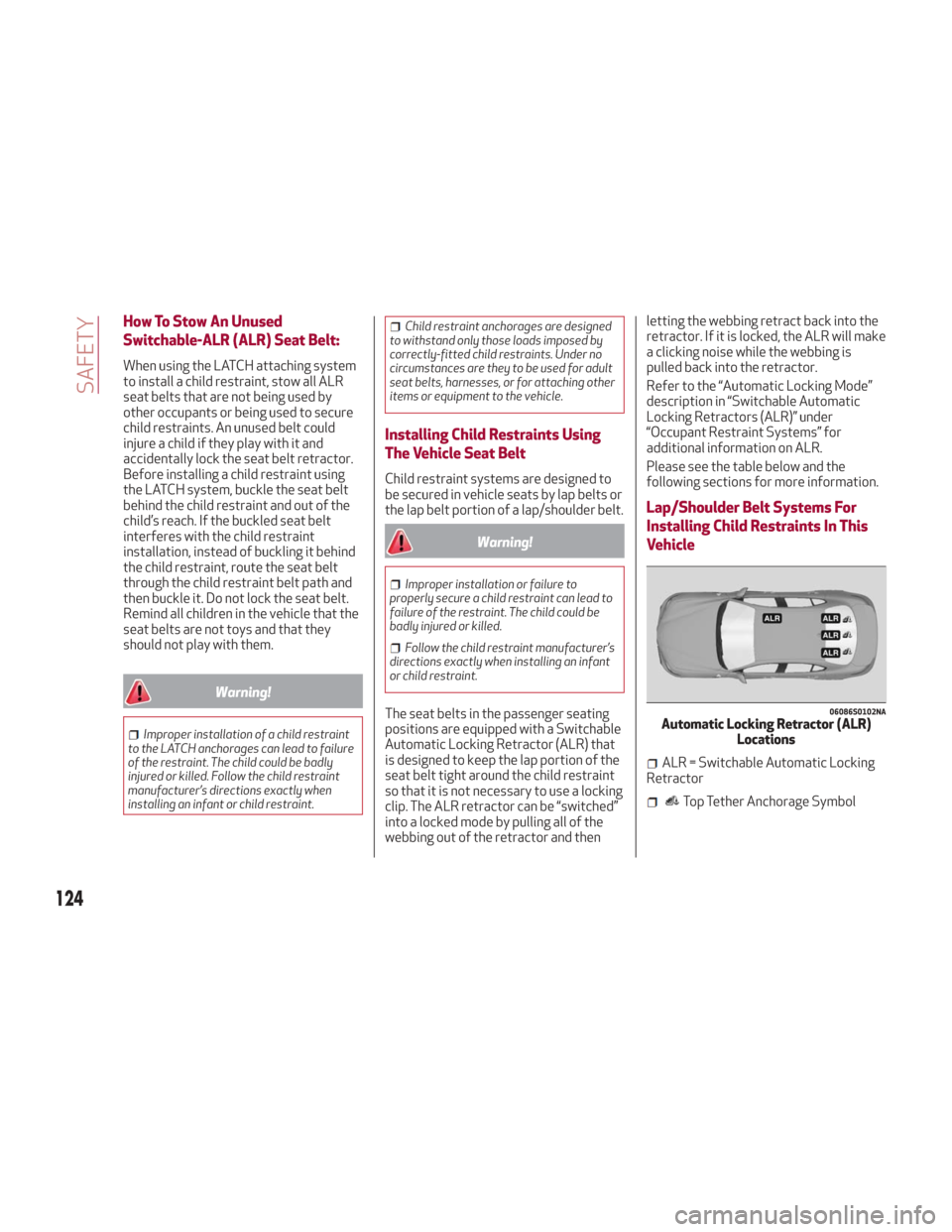
Please see the table below and the
following sections for more information.
Lap/Shoulder Belt Systems For
Installing Child Restraints In This
Vehicle
06086S0102NAAutomatic Locking Retractor (ALR)
Locations
ALR = Switchable Automatic Locking
Retractor
Top Tether Anchorage Symbol
124
SAFETY
Page 130 of 260
Safety Checks You Should Make Inside
The Vehicle
Seat Belts
Inspect the seat belt system periodically,
checking for cuts, frays, and loose parts.
Damaged parts must be replaced
immediately. Do not disassemble or
modify the system.
Front seat belt assemblies must be
replaced after a collision. Rear seat belt
assemblies must be replaced after a
collision if they have been damaged
(i.e., bent retractor, torn webbing, etc.).
If
there is any question regarding seat belt
or retractor condition, replace the seat belt.
Air Bag Warning Light
The Air Bag warning lightwill turn on
for four to eight seconds as a bulb check
when the ignition switch is first turned to
ON/RUN. If the light is either not on
during starting, stays on, or turns on while
driving, have the system inspected at
your authorized dealer as soon as
possible. After the bulb check, this light
will illuminate with a single chime when a
fault with the Air Bag System has been
detected. It will stay on until the fault is
removed. If the light comes on
intermittently or remains on while
driving, have your authorized dealer
service the vehicle immediately.
Refer to “Occupant Restraint Systems” in
“Safety” for further information.
Defroster
Check operation by selecting the defrost
mode and place the blower control on
high speed. You should be able to feel the
air directed against the windshield. See
your authorized dealer for service if your
defroster is inoperable.
Floor Mat Safety Information
Always use floor mats designed to fit
your vehicle. Only use a floor mat that
does not interfere with the operation of
the accelerator, brake or clutch pedals.
Only use a floor mat that is securely
attached using the floor mat fasteners so
it cannot slip out of position and interfere
with the accelerator, brake or clutch
pedals or impair safe operation of your
vehicle in other ways.
Warning!
An improperly attached, damaged, folded, or
stacked floor mat, or damaged floor mat
fasteners may cause your floor mat to
interfere with the accelerator, brake, or
clutch pedals and cause a loss of vehicle
control. To prevent SERIOUS INJURY or
DEATH:
ALWAYS securely attachyour floor
mat using the floor mat fasteners. DO NOT
install your floor mat upside down or turn
your floor mat over. Lightly pull to confirm
mat is secured using the floor mat fasteners
on a regular basis.
ALWAYS REMOVE THE EXISTING FLOOR
MAT FROM THE VEHICLEbefore
installing any other floor mat. NEVER install
or stack an additional floor mat on top of an
existing floor mat.
ONLY install floor mats designed to fit
your vehicle. NEVER install a floor mat that
cannot be properly attached and secured to
your vehicle. If a floor mat needs to be
replaced, only use a FCA approved floor mat
for the specific make, model, and year of
your vehicle.
ONLY use the driver’s side floor mat on
the driver’s side floor area. To check for
interference, with the vehicle properly
parked with the engine off, fully depress the
accelerator, the brake, and the clutch pedal
(if present) to check for interference. If your
floor mat interferes with the operation of
any pedal, or is not secure to the floor,
remove the floor mat from the vehicle and
place the floor mat in your trunk.
ONLY use the passenger’s side floor mat
on the passenger’s side floor area.
ALWAYS make sure objects cannot fall or
slide into the driver’s side floor area when
the vehicle is moving. Objects can become
trapped under accelerator, brake, or clutch
pedals and could cause a loss of vehicle
control.
NEVER place any objects under the floor
mat (e.g., towels, keys, etc.). These objects
could change the position of the floor mat
and may cause interference with the
accelerator, brake, or clutch pedals.
128
SAFETY
Page 133 of 260
STARTING AND OPERATING
Let’s get to the core of the vehicle, and
see how you can explore its fullest
potential. We’ll look at how to drive
safely in any situation, making it a
welcome companion with our comfort
and wallets in mind.STARTING THE ENGINE........132
ELECTRIC PARK BRAKE ........135
AUTOMATIC TRANSMISSION .....137
ALFA DNA PRO SELECTOR ......143
ALFA ACTIVE SUSPENSION (AAS) . .146
STOP/START SYSTEM .........146
SPEED LIMITER .............148
SPEED CONTROL
(CRUISE CONTROL) ..........149
ADAPTIVE CRUISE CONTROL
(ACC) — IF EQUIPPED .........151
PARK SENSORS SYSTEM .......158
LANE DEPARTURE WARNING (LDW)
SYSTEM — IF EQUIPPED .......161
REAR BACK-UP CAMERA / DYNAMIC
GRIDLINES .............. .163
REFUELING THE VEHICLE .......165
VEHICLE LOADING ...........166
TRAILER TOWING ............167
SUGGESTIONS FOR DRIVING .....168
131
Page 134 of 260
STARTING THE ENGINE
Before starting the engine, be sure to
adjust the seat, the interior rear view
mirrors, and the door mirrors, and fasten
the seat belt correctly.
Never press the accelerator pedal before
starting the engine.
If necessary, messages indicating the
starting procedure can be shown in the
display.
Warning!
When leaving the vehicle, always remove
the key fob from the vehicle and lock your
vehicle.
Never leave children alone in a vehicle, or
with access to an unlocked vehicle.
Allowing children to be in a vehicle
unattended is dangerous for a number of
reasons. A child or others could be seriously
or fatally injured. Children should be warned
not to touch the parking brake, brake pedal
or the transmission gear selector.
Do not leave the key fob in or near the
vehicle, or in a location accessible to
children. A child could operate power
windows, other controls, or move the
vehicle.
Do not leave children or animals inside
parked vehicles in hot weather. Interior heat
build-up may cause serious injury or death.
Starting Procedure
Proceed as follows:
1. Apply the electric park brake and set
the gear selector to PARK (P) or
NEUTRAL (N).
2. Fully depress the brake pedal without
touching the accelerator.
3. Briefly push the ignition button.
4. If the engine doesn't start within a
few seconds, you need to repeat the
procedure.
If the problem persists, contact an
authorized dealer.
Warning!
Never pour fuel or other flammable liquid
into the throttle body air inlet opening in an
attempt to start the vehicle. This could
result in flash fire causing serious personal
injury.
Do not attempt to push or tow your
vehicle to get it started. Vehicles equipped
with an automatic transmission cannot be
started this way. Unburned fuel could enter
the catalytic converter and once the engine
has started, ignite and damage the
converter and vehicle.
If the vehicle has a discharged battery,
booster cables may be used to obtain a
start from a booster battery or the battery
in another vehicle. This type of start can be
dangerous if done improperly. Refer to
“Jump Starting” in “In Case Of Emergency”
for further information.
Caution!
To prevent damage to the starter, do not
continuously crank the engine for more than
25 seconds at a time. Wait 60 seconds
before trying again.
Remote Starting System
This system uses the key fob to start the
engine conveniently from outside the
vehicle while still maintaining security.
The system has a range of at least
300 feet (91 meters).
The remote starting system also
activates the climate control
(if equipped), the heated seats
(if equipped), and the heated steering
wheel (if equipped), depending on
temperatures outside and inside of
the vehicle.
Note:
Obstructions between the vehicle
and key fob may reduce this range.
132
STARTING AND OPERATING
Page 135 of 260
How to use Remote Start
All of the following conditions must be
met before the engine will remote start:
Gear selector in PARK (P).
Doors closed.
Hood closed.
Trunk closed.
Hazard switch off.
Brake switch inactive (brake pedal not
pressed).
Battery at an acceptable charge level.
PANIC button not pushed.
System not disabled from previous
remote start event.
Vehicle alarm system indicator
flashing.
Ignition in the OFF mode.
Fuel level meets minimum requirement.
Remote Start Comfort Systems —
If Equipped
When Remote Start is activated, the
heated steering wheel and driver heated
seat features will automatically turn on in
cold weather.
These features will stay on through the
duration of remote start also until the
ignition is cycled to the ON/RUN mode. Remote Start Windshield Wiper De–Icer
Activation — If Equipped
When remote start is active and the
outside ambient temperature is less than
39°F (4°C), the Windshield Wiper De-Icer
will be enabled. Exiting remote start will
resume previous operation, except if the
Windshield Wiper De-Icer is active.
The Windshield Wiper De-Icer timer and
operation will continue.
Extended Park Starting
If the vehicle has not been started or
driven for at least 35 days, it is advisable
to follow the indications below.
To start the engine, proceed as follows:
1. Briefly push the ignition button
2. If the engine does not start, wait five
seconds and let the starter cool down and
then repeat the starting procedure
3. If the engine does not start after eight
attempts, let the starter cool down for at
least 10 seconds, and then repeat the
starting procedure
If the problem persists, contact your
authorized dealer.
Note:
After prolonged vehicle inactivity,
very difficult starting, that can be noticed
through rapid fatigue of the starter,
might also be due to a discharged
battery. In this case, see the "Jump
Starting" section in the "In Case Of
Emergency" chapter.
If Engine Fails To Start
Starting the Engine with Key Fob
Battery Run Down or Drained
If the ignition does not respond when the
button is pushed, the key fob battery
might be run down or drained. Therefore,
the system does not detect the presence
of the key fob in the vehicle, and will
display a dedicated message.
In this case, follow the instructions
outlined in "Starting With A Discharged
Key Fob Battery" in the "Getting To Know
Your Vehicle" chapter, and start the
engine normally.
Warning!
Never pour fuel or other flammable liquid
into the throttle body air inlet opening in an
attempt to start the vehicle. This could
result in flash fire causing serious personal
injury.
Do not attempt to push or tow your
vehicle to get it started. Vehicles equipped
with an automatic transmission cannot be
started this way. Unburned fuel could enter
the catalytic converter and once the engine
has started, ignite and damage the
converter and vehicle.
133
Page 140 of 260
Display
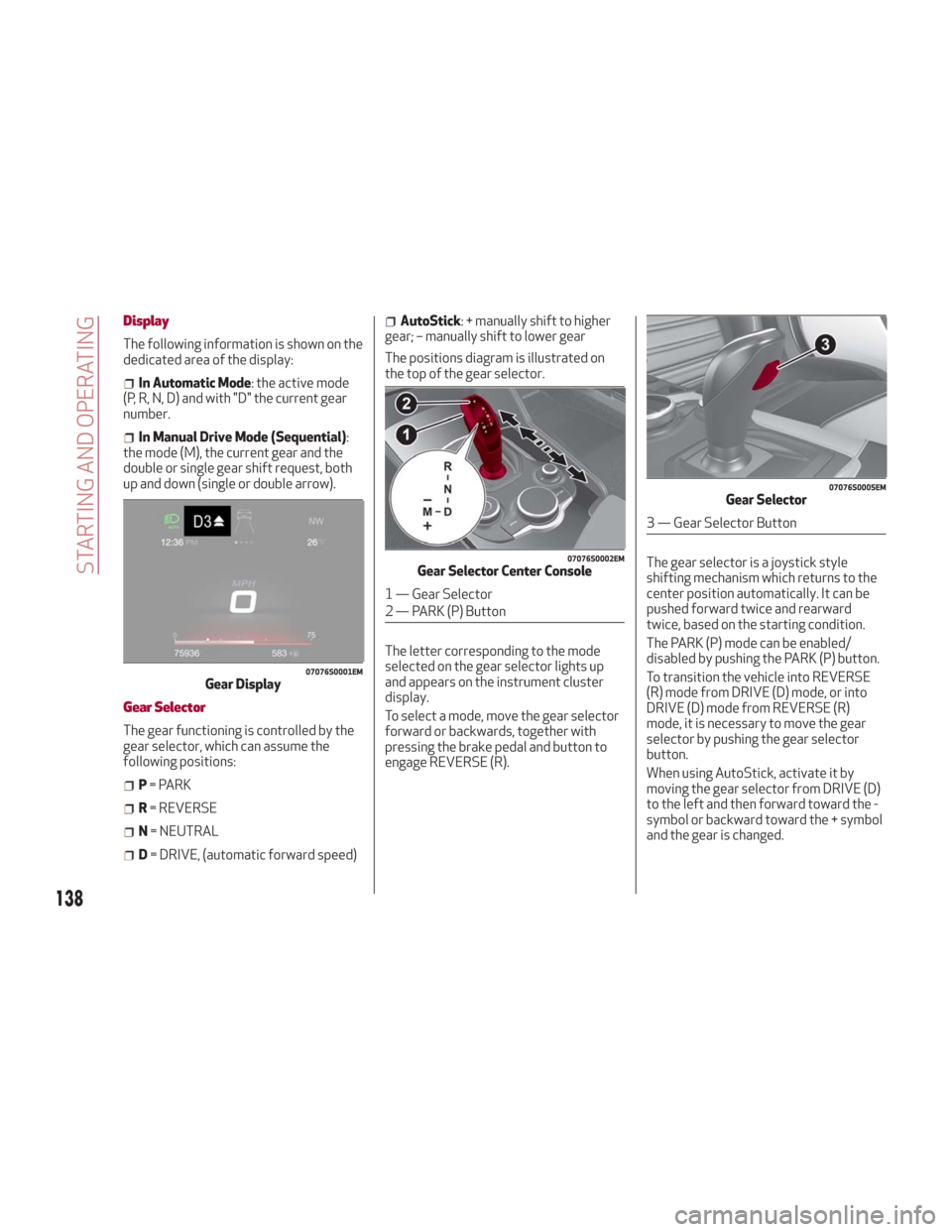
The following information is shown on the
dedicated area of the display:
In Automatic Mode: the active mode
(P, R, N, D) and with "D" the current gear
number.
In Manual Drive Mode (Sequential) :
the mode (M), the current gear and the
double or single gear shift request, both
up and down (single or double arrow).
Gear Selector
The gear functioning is controlled by the
gear selector, which can assume the
following positions:
P = PARK
R = REVERSE
N = NEUTRAL
D= DRIVE, (automatic forward speed)
AutoStick: + manually shift to higher
gear; – manually shift to lower gear
The positions diagram is illustrated on
the top of the gear selector.
The letter corresponding to the mode
selected on the gear selector lights up
and appears on the instrument cluster
display.
To select a mode, move the gear selector
forward or backwards, together with
pressing the brake pedal and button to
engage REVERSE (R). The gear selector is a joystick style
shifting mechanism which returns to the
center position automatically. It can be
pushed forward twice and rearward
twice, based on the starting condition.
The PARK (P) mode can be enabled/
disabled by pushing the PARK (P) button.
To transition the vehicle into REVERSE
(R) mode from DRIVE (D) mode, or into
DRIVE (D) mode from REVERSE (R)
mode, it is necessary to move the gear
selector by pushing the gear selector
button.
When using AutoStick, activate it by
moving the gear selector from DRIVE (D)
to the left and then forward toward the -
symbol or backward toward the + symbol
and the gear is changed.
07076S0001EMGear Display
07076S0002EMGear Selector Center Console
1 — Gear Selector
2 — PARK (P) Button
07076S0005EMGear Selector
3 — Gear Selector Button
138
STARTING AND OPERATING