cooling ALFA ROMEO GIULIA 2021 User Guide
[x] Cancel search | Manufacturer: ALFA ROMEO, Model Year: 2021, Model line: GIULIA, Model: ALFA ROMEO GIULIA 2021Pages: 284, PDF Size: 8.87 MB
Page 223 of 284
221
Check the front part of the condenser to check
for any build-up of insects, leaves or other
debris. Should it be dirty, clean it by spraying
delicately with water.
Check the hoses of the engine/intercooler
cooling system to ensure that the rubber has
not deteriorated and that there are no cracks,
tears, cuts or obstructions in the expansion
tank side and radiator side connectors. Should
there be any doubt regarding leaks from the
system (e.g. if frequent top ups are required),
have the seal checked at an authorized
dealer.
With the engine off and at normal operating
temperature, check that the cooling system
radiator cap is closed properly.
NOTE:
Before removing the coolant reservoir cap,
wait for the system to cool down.Topping Up / Draining / Flushing The Engine/
Intercooler Coolant
If the engine coolant (antifreeze) is dirty, have
cleaning and flushing carried out at an autho
-
rized dealer.
For the correct servicing intervals
Ú
page 204.
NOTE:
For topping up, use a fluid with the same
characteristics as those indicated on
Ú
page 267.
Do not use pure water, alcohol-based cool -
ants, corrosions inhibitors or additional
anti-rust products because they may be
incompatible with the engine coolant and
cause the clogging of the radiator. The use
of propylene glycol-based coolant is also not
recommended.
Engine Cooling/Intercooler System Cap
To prevent loss of engine coolant, make sure
that the expansion tank cap is closed. If it is
open, screw it completely until you reach/hear
the click.
Periodically check the cap and clean it from
any foreign bodies that may have deposited on
the external surface. Disposal Of Used Coolant
Disposal of engine/intercooler coolant is
subject to legal requirements: consult the
appropriate local regulations.
NOTE:
To prevent the fluid from being ingested by
children or animals, do not keep it in open
containers or pour it on the ground. If
ingested, contact a doctor immediately.
Eliminate any traces of fluid from the
ground immediately.
When the vehicle stops after a short trip,
steam may be seen coming out from front of
the hood. This is a normal phenomenon which
is due to the presence of rain, snow or a lot of
moisture on the surface of the radiator.
With engine and system cold, do not top up
with coolant beyond the maximum level
indicated on the reservoir in the engine
compartment.
WARNING!
Do not open hot engine cooling system.
Never add engine coolant (antifreeze) when
the engine is overheated. Do not loosen or
remove the cap to cool an overheated
engine. Heat causes pressure to build up in
the cooling system. To prevent scalding or
injury, do not remove the pressure cap while
the system is hot or under pressure.
Do not use a pressure cap other than the
one specified for your vehicle. Personal
injury or engine damage may result.
WARNING!
Never add coolant with the engine hot or
overheated.
Do not attempt to cool an overheated
engine by loosening or removing the cap.
The heat causes a considerable increase
in pressure in the cooling system.
To prevent damage to the engine, only use
the engine cooling circuit caps provided.
21_GA_OM_EN_USC_t.book Page 221
Page 253 of 284
251
If the battery is not disconnected from the
electrical system, check its state of charge
every 30 days.
Clean and protect the painted parts using
protective wax.
Clean and protect the shiny metal parts
using special compounds available
commercially.
Sprinkle talcum powder on the windshield
wiper rubber blades, and lift them off the
glass.
Cover the vehicle with a fabric or perforated
plastic sheet, paying particular care not to
damage the painted surface by dragging
any dust that may have accumulated on it.
Do not use compact plastic sheets, as they
do not allow humidity to evaporate from the
surface of the vehicle.
Inflate tires to +7.25 psi (+0.5 bar) above
the standard prescribed pressure and
check it periodically.
Do not drain the engine cooling system.
Any time the vehicle is left inactive for two
weeks or more, operate the air conditioning
system with engine idling for at least five
minutes, setting external air and with fan
set to maximum speed. This operation will
ensure appropriate lubrication for the
system, thus minimizing the possibility of
damage to the compressor when the
system is operated again.
NOTE:
After placing the ignition in STOP and having
closed the driver side door, wait at least one
minute before disconnecting the electrical
supply from the battery. When reconnecting
the electrical supply to the battery, make sure
that the ignition is in the STOP position and the
driver side door is closed. Manual Trunk Opening Device
Proceed as follows if the battery needs to be
disconnected:
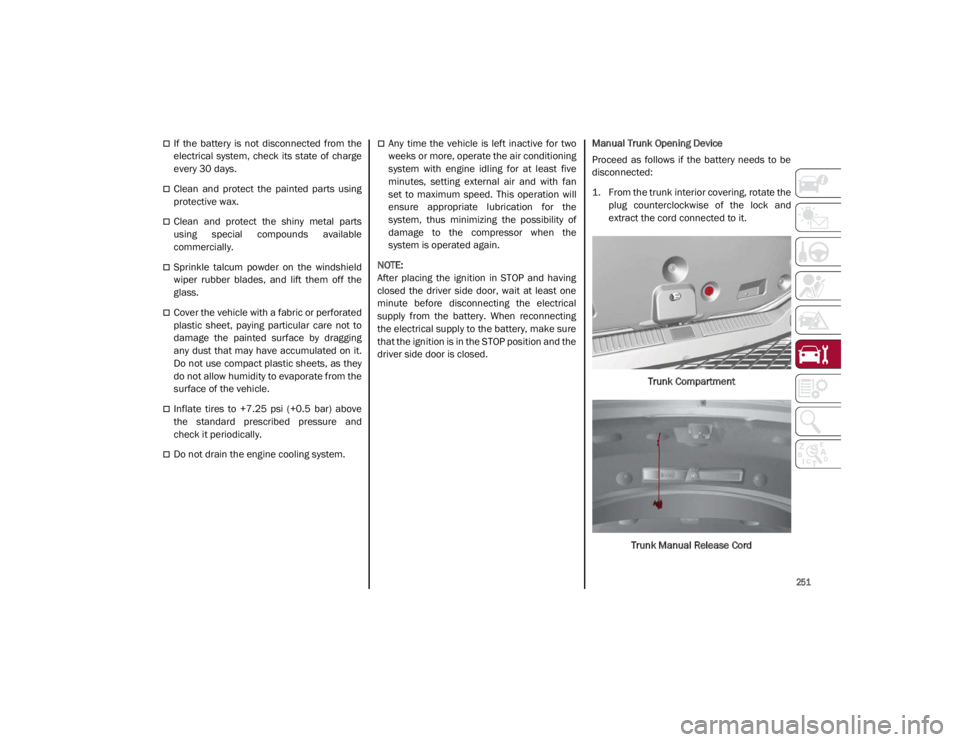
1. From the trunk interior covering, rotate the
plug counterclockwise of the lock and
extract the cord connected to it.
Trunk Compartment
Trunk Manual Release Cord
21_GA_OM_EN_USC_t.book Page 251
Page 267 of 284
265
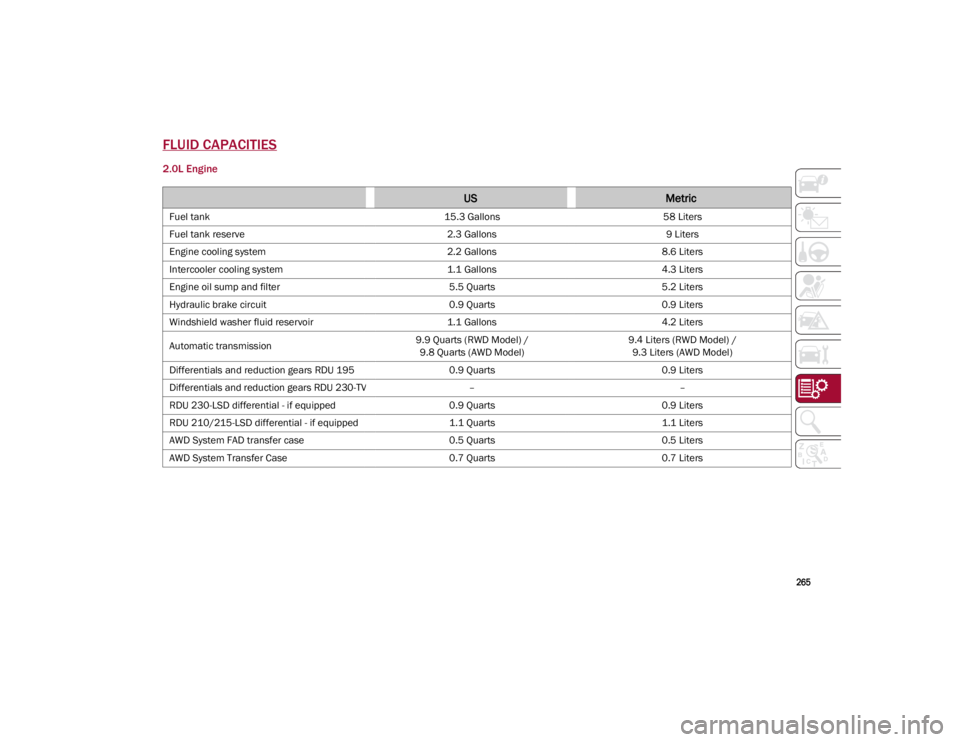
FLUID CAPACITIES
2.0L Engine
USMetric
Fuel tank15.3 Gallons58 Liters
Fuel tank reserve 2.3 Gallons9 Liters
Engine cooling system 2.2 Gallons8.6 Liters
Intercooler cooling system 1.1 Gallons4.3 Liters
Engine oil sump and filter 5.5 Quarts5.2 Liters
Hydraulic brake circuit 0.9 Quarts0.9 Liters
Windshield washer fluid reservoir 1.1 Gallons4.2 Liters
Automatic transmission 9.9 Quarts (RWD Model) /
9.8 Quarts (AWD Model) 9.4 Liters (RWD Model) /
9.3 Liters (AWD Model)
Differentials and reduction gears RDU 195 0.9 Quarts0.9 Liters
Differentials and reduction gears RDU 230-TV ––
RDU 230-LSD differential - if equipped 0.9 Quarts0.9 Liters
RDU 210/215-LSD differential - if equipped 1.1 Quarts1.1 Liters
AWD System FAD transfer case 0.5 Quarts0.5 Liters
AWD System Transfer Case 0.7 Quarts0.7 Liters
21_GA_OM_EN_USC_t.book Page 265
Page 268 of 284
TECHNICAL SPECIFICATIONS
266
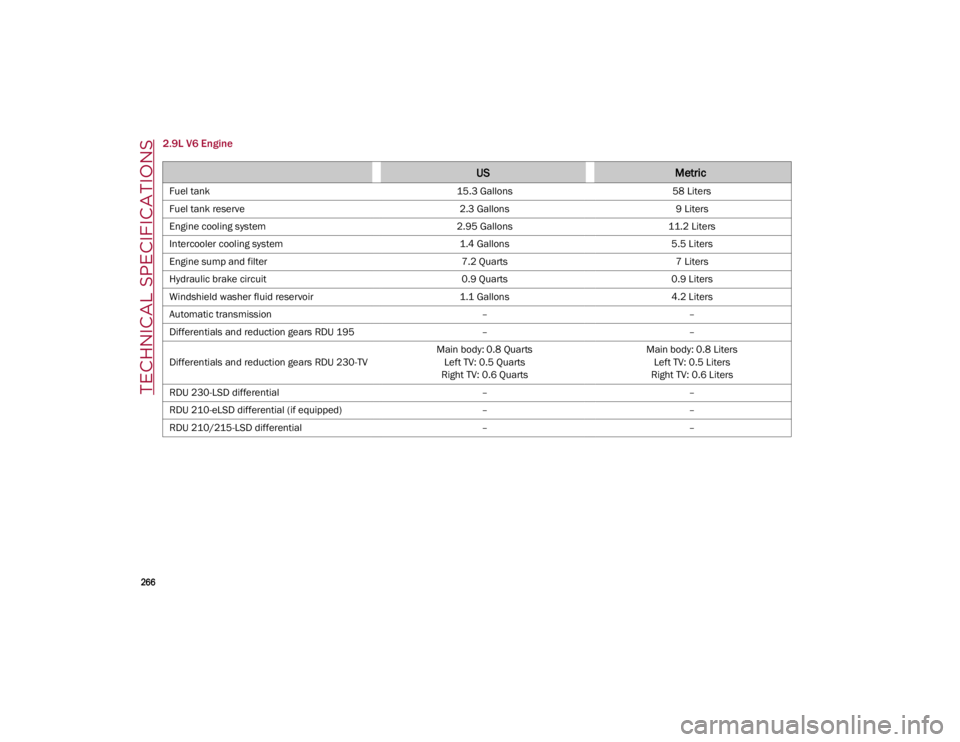
2.9L V6 Engine
USMetric
Fuel tank15.3 Gallons58 Liters
Fuel tank reserve 2.3 Gallons9 Liters
Engine cooling system 2.95 Gallons11.2 Liters
Intercooler cooling system 1.4 Gallons5.5 Liters
Engine sump and filter 7.2 Quarts7 Liters
Hydraulic brake circuit 0.9 Quarts0.9 Liters
Windshield washer fluid reservoir 1.1 Gallons4.2 Liters
Automatic transmission ––
Differentials and reduction gears RDU 195 ––
Differentials and reduction gears RDU 230-TV Main body: 0.8 Quarts
Left TV: 0.5 Quarts
Right TV: 0.6 Quarts Main body: 0.8 Liters
Left TV: 0.5 Liters
Right TV: 0.6 Liters
RDU 230-LSD differential ––
RDU 210-eLSD differential (if equipped) ––
RDU 210/215-LSD differential ––
21_GA_OM_EN_USC_t.book Page 266