steering ALFA ROMEO GIULIA 2021 Repair Manual
[x] Cancel search | Manufacturer: ALFA ROMEO, Model Year: 2021, Model line: GIULIA, Model: ALFA ROMEO GIULIA 2021Pages: 284, PDF Size: 8.87 MB
Page 217 of 284
215
(Continued)
NOTE:
After the battery is disconnected, the steering
must be initialized. The warning light on the
instrument panel switches on to indicate this.
To carry out this procedure, simply turn the
steering wheel all the way from one end to the
other, and then turn it back to the central posi-
tion.
Battery
The battery does not require the electrolyte to
be topped up with distilled water. A periodic
check carried out at an authorized dealer,
however, is necessary to check efficiency.
Follow the battery manufacturer's instructions
for maintenance.
Replacing The Battery
If necessary, replace the battery with another
original battery with the same specifications.
Follow the battery manufacturer’s instructions
for maintenance.
NOTE:
It will not be possible to open the trunk with a
key or by pushing the button in the passenger
compartment when the battery is discon
-
nected. So, always position the manual trunk
opening strap on the trunk lock before discon -
necting the battery
Ú
page 250.
Pressure Washing
Cleaning the engine compartment with a high
pressure washer is not recommended.
BATTERY RECHARGING
Important Notes
NOTE:
Before using the charging device, always
make sure that it is appropriate for the
installed battery, with constant voltage
(below 14.8 Volts) and low amperage
(maximum 15 Amps).
Recharge the battery in a well ventilated
environment.
Before using any devices to charge or to
maintain the charge of the battery, carefully
follow the instructions provided with the
device in order to properly and safely
connect it to the car battery.
WARNING!
Battery acid is a corrosive solution and
can burn or even blind you. Do not allow
battery acid to contact your eyes, skin, or
clothing. Do not lean over a battery when
attaching clamps
Ú
page 199. If acid
splashes in eyes or on skin, flush the area
immediately with large amounts of water.
Battery gas is flammable and explosive.
Keep flame or sparks away from the
battery. Do not use a booster battery or
any other booster source with an output
greater than 12 Volts. Do not allow cable
clamps to touch each other.
Battery posts, terminals, and related
accessories contain lead and lead
compounds. Wash hands after handling.
CAUTION!
Precautions have been taken to safeguard
all parts and connections however, the
pressures generated by these machines is
such that complete protection against
water ingress cannot be guaranteed.
WARNING! (Continued)
WARNING!
Never charge or recharge a frozen battery:
it may explode because of the nitrogen
trapped inside the ice crystals.
At all times while charging or recharging
the battery, make sure that any sparks or
open flames are kept sufficiently far away
from the battery.
21_GA_OM_EN_USC_t.book Page 215
Page 225 of 284
223
(Continued)
Replacing The Battery
If necessary, replace the battery with another
battery with the same specifications. It is
advised to contact an authorized dealer for
replacement.
Follow the battery manufacturer's instructions
for maintenance.
NOTE:
It will not be possible to open the trunk with a
key or by pressing the button in the passenger
compartment when the battery is discon-
nected. So, always position the manual trunk
opening strap on the trunk lock before discon -
necting the battery
Ú
page 250.
FUSES
General Information
The fuses protect electrical systems against
excessive current.
When a device does not work, you must check
the electrical circuit inside of the fuse for a
break/melt.
Also, please be aware that using power outlets
for extended periods of time with the engine
off may result in vehicle battery discharge. Blade Fuses
J-CASE Fuse
WARNING!
When replacing a blown fuse, always use
an appropriate replacement fuse with the
same amp rating as the original fuse.
Never replace a fuse with another fuse of
higher amp rating. Never replace a blown
fuse with metal wires or any other mate -
rial. Do not place a fuse inside a circuit
breaker cavity or vice versa. Failure to use
proper fuses may result in serious
personal injury, fire and/or property
damage.
Before replacing a fuse, make sure that
the ignition is off and that all the other
services are switched off and/or disen -
gaged.
If the replaced fuse blows again, contact
an authorized dealer.
If a general protection fuse for safety
systems (air bag system, braking system),
power unit systems (engine system, trans -
mission system) or steering system blows,
contact an authorized dealer.
WARNING! (Continued)
1 — Electrical Circuit
2 — Blade Fuse With Good Electrical Circuit
3 — Blade Fuse With Bad Electrical Circuit
1 — Electrical Circuit
2 — Case Fuse With Good Electrical Circuit
3 — Case Fuse With Bad Electrical Circuit
21_GA_OM_EN_USC_t.book Page 223
Page 243 of 284
241
(Continued)
Tires — General Information
Tire Pressure
Proper tire inflation pressure is essential to
the safe and satisfactory operation of your
vehicle. Four primary areas are affected by
improper tire pressure:
Safety
Fuel Economy
Tread Wear
Ride Comfort and Vehicle Stability
Safety Both underinflation and overinflation affect
the stability of the vehicle and can produce a
feeling of sluggish response or over respon
-
siveness in the steering.
NOTE:
Unequal tire pressures from side to side
may cause erratic and unpredictable
steering response.
Unequal tire pressure from side to side may
cause the vehicle to drift left or right.
Fuel Economy
Underinflated tires will increase tire rolling
resistance resulting in higher fuel consump -
tion.
Tread Wear
Improper cold tire inflation pressures can
cause abnormal wear patterns and reduced
tread life, resulting in the need for earlier tire
replacement. Ride Comfort And Vehicle Stability
Proper tire inflation contributes to a comfort
-
able ride. Overinflation produces a jarring and
uncomfortable ride.
Tire Inflation Pressures
The proper cold tire inflation pressure is listed
on the driver's side B-pillar or rear edge of the
driver's side door.
At least once a month:
Check and adjust tire pressure with a good
quality pocket-type pressure gauge. Do not
make a visual judgment when determining
proper inflation. Tires may look properly
inflated even when they are under-inflated.
Inspect tires for signs of tire wear or visible
damage.
WARNING!
Improperly inflated tires are dangerous
and can cause collisions.
Underinflation increases tire flexing and
can result in overheating and tire failure.
Overinflation reduces a tire's ability to
cushion shock. Objects on the road and
chuckholes can cause damage that result
in tire failure.
Overinflated or underinflated tires can
affect vehicle handling and can fail
suddenly, resulting in loss of vehicle
control.
Unequal tire pressures can cause steering
problems. You could lose control of your
vehicle.
Unequal tire pressures from one side of
the vehicle to the other can cause the
vehicle to drift to the right or left.
Always drive with each tire inflated to the
recommended cold tire inflation pressure.
WARNING! (Continued)
CAUTION!
After inspecting or adjusting the tire
pressure, always reinstall the valve stem
cap. This will prevent moisture and dirt from
entering the valve stem, which could
damage the valve stem.
21_GA_OM_EN_USC_t.book Page 241
Page 247 of 284
245
(Continued)
These indicators are molded into the bottom
of the tread grooves. They will appear as
bands when the tread depth becomes a 1/16
of an inch (1.6 mm). When the tread is worn to
the tread wear indicators, the tire should be
replaced.
For further information
Ú
page 245.
Life Of Tire
The service life of a tire is dependent upon
varying factors including, but not limited to:
Driving style.
Tire pressure - Improper cold tire inflation
pressures can cause uneven wear patterns
to develop across the tire tread. These
abnormal wear patterns will reduce tread
life, resulting in the need for earlier tire
replacement.
Distance driven.
Performance tires, tires with a speed rating
of V or higher, and Summer tires typically
have a reduced tread life. Rotation of these
tires per the vehicle scheduled mainte -
nance is highly recommended.
NOTE:
Wheel valve stem must be replaced as well
when installing new tires due to wear and tear
in existing tires.
Keep dismounted tires in a cool, dry place with
as little exposure to light as possible. Protect
tires from contact with oil, grease, and gaso
-
line.
Replacement Tires
The tires on your new vehicle provide a
balance of many characteristics. They should
be inspected regularly for wear and correct
cold tire inflation pressures. FCA US LLC
strongly recommends that you use tires equiv -
alent to the originals in size, quality and perfor -
mance when replacement is needed
Ú
page 244. Refer to the Tire and Loading
Information placard or the Vehicle Certifica -
tion Label for the size designation of your tire.
The Load Index and Speed Symbol for your tire
will be found on the original equipment tire
sidewall. For more information relating to the Load
Index and Speed Symbol of a tire
Ú
page 234.
It is recommended to replace the two front
tires or two rear tires as a pair. Replacing just
one tire can seriously affect your vehicle’s
handling. If you ever replace a wheel, make
sure that the wheel’s specifications match
those of the original wheels.
It is recommended you contact an authorized
tire dealer or original equipment dealer with
any questions you may have on tire specifica -
tions or capability. Failure to use equivalent
replacement tires may adversely affect the
safety, handling, and ride of your vehicle.
WARNING!
Tires and the spare tire should be replaced
after six years, regardless of the remaining
tread. Failure to follow this warning can
result in sudden tire failure. You could lose
control and have a collision resulting in
serious injury or death.
WARNING!
Do not use a tire, wheel size, load rating,
or speed rating other than that specified
for your vehicle. Some combinations of
unapproved tires and wheels may change
suspension dimensions and performance
characteristics, resulting in changes to
steering, handling, and braking of your
vehicle. This can cause unpredictable
handling and stress to steering and
suspension components. You could lose
control and have a collision resulting in
serious injury or death. Use only the tire
and wheel sizes with load ratings
approved for your vehicle.
21_GA_OM_EN_USC_t.book Page 245
Page 251 of 284
249
Tire Rotation Recommendations
Tires on the front and rear axles of vehicles
operate at different loads and perform
different steering, driving, and braking func-
tions. For these reasons, they wear at unequal
rates. These effects can be reduced by timely
rotation of tires. Rotation will increase tread
life, maintain traction levels and contribute to
a smooth, quiet ride.
To resolve this problem, tires should be
rotated at each service interval (approximately
every 10,000 miles [16,000km]). More
frequent rotation is permissible if desired. The
reasons for any rapid or unusual wear should
be corrected prior to rotation being performed.
Tire Rotations Not Recommended — If
Equipped
Due to different size tires and wheels on front
and rear axles tire rotation is not possible for:
2.0T GME Engine Equipped with a 225/
40R19 front and 255/35R19 rear tires
2.9L V6 Engine Equipped with 19” tires and
wheels
Tire rotation contributes to the preservation of
the grip and traction performance on wet,
muddy or snowy roads, guaranteeing optimal
driveability of the vehicle.
In the case of irregular wear of the tires iden -
tify the cause and correct it as soon as
possible, by contacting an authorized dealer.
Tire Rotation for Directional Tires — If
Equipped
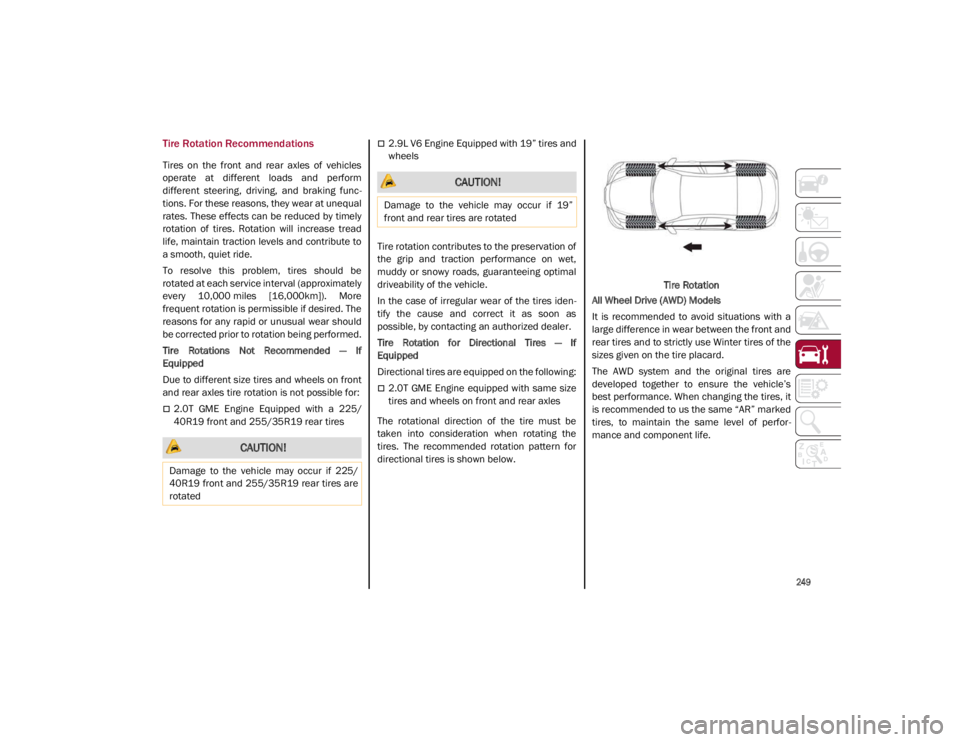
Directional tires are equipped on the following:
2.0T GME Engine equipped with same size
tires and wheels on front and rear axles
The rotational direction of the tire must be
taken into consideration when rotating the
tires. The recommended rotation pattern for
directional tires is shown below. Tire Rotation
All Wheel Drive (AWD) Models
It is recommended to avoid situations with a
large difference in wear between the front and
rear tires and to strictly use Winter tires of the
sizes given on the tire placard.
The AWD system and the original tires are
developed together to ensure the vehicle’s
best performance. When changing the tires, it
is recommended to us the same “AR” marked
tires, to maintain the same level of perfor -
mance and component life.
CAUTION!
Damage to the vehicle may occur if 225/
40R19 front and 255/35R19 rear tires are
rotated
CAUTION!
Damage to the vehicle may occur if 19”
front and rear tires are rotated
21_GA_OM_EN_USC_t.book Page 249
Page 261 of 284
259
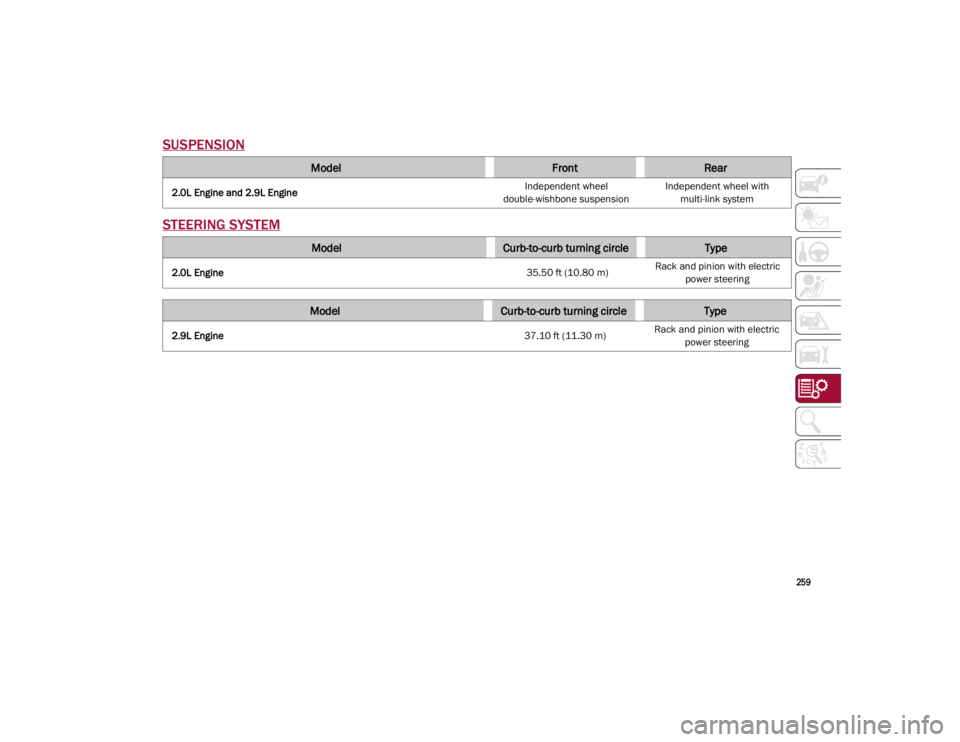
SUSPENSION
STEERING SYSTEM
ModelFrontRear
2.0L Engine and 2.9L EngineIndependent wheel
double-wishbone suspension Independent wheel with
multi-link system
ModelCurb-to-curb turning circleType
2.0L Engine 35.50 ft (10.80 m)Rack and pinion with electric
power steering
ModelCurb-to-curb turning circleType
2.9L Engine 37.10 ft (11.30 m)Rack and pinion with electric
power steering
21_GA_OM_EN_USC_t.book Page 259
Page 277 of 284

275
Door Ajar ................................................ 78, 79
Door Ajar Light ....................................... 78, 79
Door LocksAutomatic ................................................. 26
Door Opener, Garage ................................... 38
Drive Train Control (DTC) System ..............142
Driving Modes .............................................. 99
Dynamic Steering Torque (DST) System ... 142
E
Electric Park Brake....................................... 90
Electronic Speed Control
(Cruise Control) ..........................................105
Electronic Stability Control (ESC)
System ........................................................142
Electronic Throttle Control Warning
Light .............................................................. 78
Emergency In Case Of ......................................190, 194
SOS Emergency Call .............................. 190
Emergency, In Case Of Jump Starting .........................................198
Overheating ............................................ 200
Tow Hooks ..............................................202
Towing.....................................................201
Emission Control System Maintenance...... 85
Engine ......................................................... 256 Block Heater............................................. 89
Engine Coolant Level .............................214
Exhaust Gas Caution .............................189
Fuel Requirements ................................ 263Jump Starting .........................................199
Overheating ............................................ 200
Engine Compartment .................................211
Engine Compartment (Washing) ...............253 Engine Oil
Level Check............................................ 213
Enhanced Accident Response
Feature .............................................. 172, 203
Ethanol ....................................................... 263
Exhaust Gas Cautions ............................... 189
Exhaust System ......................................... 189
Exterior Lights ............................ 42, 188, 231
F
Flashers Turn Signals .................................... 77, 188
Fluid Leaks ................................................. 188
Fog Lights, Rear ........................................... 44
Forward Collision Warning ........................ 151
Fuel Additives................................................. 264
Clean Air ................................................. 263
Ethanol ................................................... 263
Light .......................................................... 79
Materials Added .................................... 264
Methanol ................................................ 263
Fuses ................................................. 223, 224
G
Garage Door Opener (HomeLink) ............... 38
Gasoline, Clean Air .................................... 263
Gasoline, Reformulated ............................ 263
Gauges Engine Oil Temperature .......................... 67
Fuel ........................................................... 68
Speedometer ........................................... 68
Tachometer .............................................. 67 Glove Compartment Storage .......................55
GVWR ......................................................... 137
H
Hazard Warning Flashers.......................... 190
Head Restraints............................................35
Head Rests ...................................................35
Headlights .....................................................42 Automatic..................................................42
Delay .........................................................43
High Beam ................................................42
Switch .......................................................42
Headlights (Cleaning) ................................ 253
Heated Mirrors..............................................38
Heated Seats ......................................... 33, 34
Heated Steering Wheel ................................27
Heater, Engine Block.................................... 89
Hill Start Assist (HSA) System ................... 143
HomeLink (Garage Door Opener) ................38
Hood Closing ......................................................62Opening.....................................................62
Hood Release ...............................................62
I
Ignition ..........................................................19 Switch .......................................................19
Immobilizer (Sentry Key) ..............................18
In Case Of Emergency ............................... 190
Installing Electrical/Electronic Devices......... 3
Instrument Cluster Descriptions..............................................77
Display ......................................................68
21_GA_OM_EN_USC_t.book Page 275
Page 279 of 284

277
R
Radial Ply Tires ...........................................244
Radio Transmitters And Mobile Phones ....... 4
Rear Camera ..............................................134
Rear Cross Path .........................................145
Reformulated Gasoline .............................. 263
Refueling Procedure ..................................135
Refueling The Vehicle ................................ 135
Refuelling.................................................... 265
Reminder, Seat Belt ...................................160
Remote ControlStarting System........................................ 20
Remote Keyless Entry .................................. 16
Remote Starting Exit Remote Start Mode .......................... 21
Remote Starting System ....................... 20, 86
Remote Trunk Release ................................ 63
Replacement Bulbs..................228, 231, 232
Replacement Tires ..................................... 245
Reporting Safety Defects ...........................272
Restraints, Child .........................................174
Rims And Tires ...........................................234
S
Safety Checks Inside Vehicle ....................187
Safety Checks Outside Vehicle.................. 188
Safety Defects, Reporting ..........................272
Safety Information, Tire .............................234
Safety Tips ..................................................187
Safety, Exhaust Gas ...................................189
Saving Fuel .................................................138
Scheduled Servicing ..................................204 Scheduled Servicing Program
(2.0 T4 MAir Engine Versions) .................. 205
Scheduled Servicing Program
(2.9 V6 Gasoline Engine Versions) ........... 208
Seat Belt Reminder ..................................... 75
Seat Belts .......................................... 159, 187
Child Restraints ..................................... 174
Energy Management Feature ............... 164
Front Seat ..................................... 159, 160
Inspection .............................................. 187
Lap/Shoulder Belt Untwisting............... 162
Lap/Shoulder Belts ............................... 160
Pregnant Women ................................... 163
Pretensioners......................................... 164
Rear Seat ............................................... 160
Reminder................................................ 160
Seat Belt Pretensioner .......................... 164Untwisting Procedure ............................ 162
Seats.......................................................29, 32 Adjustment .........................................29, 32
Head Restraints ....................................... 35
Heated................................................33, 34
Power........................................................ 32
Security Alarm .............................................. 21
Service Assistance ..................................... 270
Service Contract......................................... 271
Service Manuals ........................................ 272
Servicing Procedures ................................. 217
Shoulder Belts............................................ 160
Signals, Turn ....................................... 77, 188
Snow Chains .............................................. 248
Snow Tires .................................................. 247 Spare Tires ................................................. 246
Speed Control
Accel/Decel .................................. 106, 107
Accel/Decel (ACC Only) ......................... 110
Cancel .................................................... 107Distance Setting (ACC Only).................. 111
Resume.................................................. 107
Set .......................................................... 106
Speed Control (Cruise Control) ................. 105
Starting Button .......................................................19Cold Weather ............................................87
Remote .....................................................20
Starting The Engine ......................................86
Steering Tilt Column................................................26
Wheel, Heated .......................................... 27
Wheel, Tilt ................................................. 26
Steering System ........................................ 259
Stop/Start System ..................................... 102
Storage Console .....................................................56
Glove Compartment .................................55
Suggestions For Driving ............................ 138
Sun Roof ................................................ 60, 61
Sun Visor .......................................................37
Supplemental Restraint System –
Air Bag ........................................................ 166
Suspension ................................................ 259
System, Remote Starting ............................. 20
21_GA_OM_EN_USC_t.book Page 277