transmission ALFA ROMEO GIULIA 2021 Owners Manual
[x] Cancel search | Manufacturer: ALFA ROMEO, Model Year: 2021, Model line: GIULIA, Model: ALFA ROMEO GIULIA 2021Pages: 284, PDF Size: 8.87 MB
Page 3 of 284

1
Dear Customer,
We would like to congratulate and thank you for choosing Alfa Romeo.
We have written this Owner’s Manual to help you get to know all of the features of your vehicle and use it in the best possible way. Please take the
necessary time to familiarize yourself with all the dynamic features of your vehicle.
Here you will find important information and warnings regarding the use of your vehicle, and how to achieve the best performance from the
technical features of your Alfa Romeo.
You are advised to read through the Owner’s Manual before taking it on the road for the first time. It is important to become familiar with the
controls of your vehicle, especially with sections concerning the brakes, handling, transmission, and vehicle behavior on different road surfaces.
This Owner’s Manual also provides a description of special features and tips, as well as essential information for the safe driving, care, and
maintenance of your Alfa Romeo over time.
We are sure that these will help you to get in touch with and appreciate both your new vehicle and the service provided by the people at Alfa Romeo.
For questions or comments pertaining to your vehicle, please contact:
Alfa Romeo Customer Care Center:
P.O. Box 21–8004 Auburn Hills, MI
48321–8004
Phone: 1-844-Alfa-USA
(1-844-253-2872)
Alfa Romeo Customer Care (Canada):
P.O. Box 1621
Windsor, Ontario N9A 4H6
Phone: 1-877-230-0563 (English)
Phone: 1-877-515-9112 (French)
21_GA_OM_EN_USC_t.book Page 1
Page 4 of 284
READ THIS CAREFULLY
2
READ THIS CAREFULLY
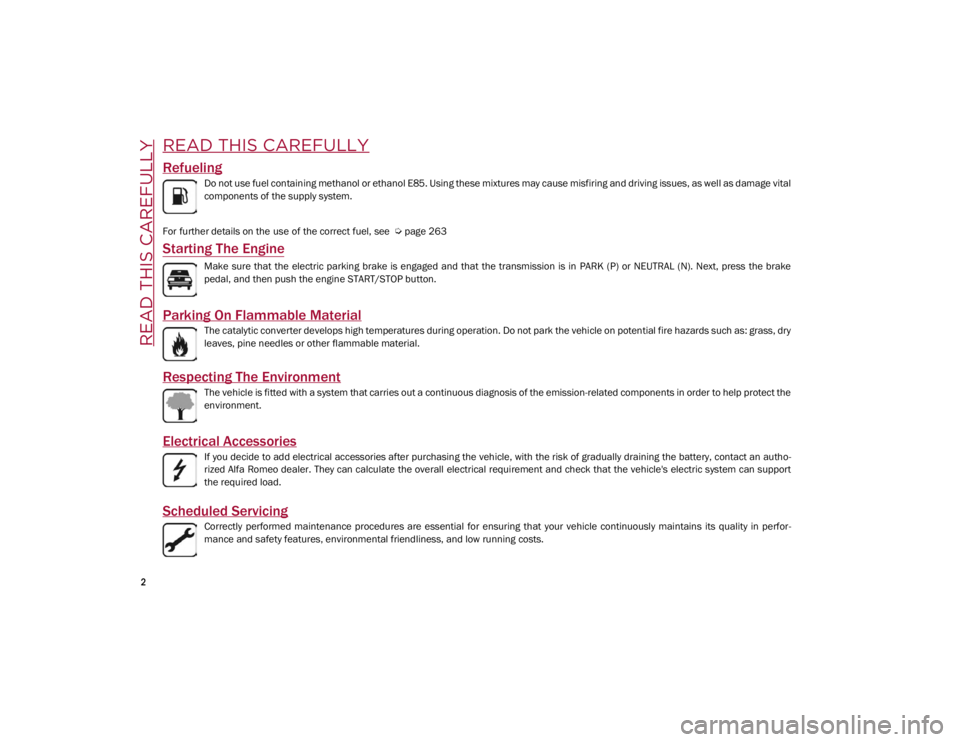
Refueling
Do not use fuel containing methanol or ethanol E85. Using these mixtures may cause misfiring and driving issues, as well as damage vital
components of the supply system.For
further details on the use of the correct fuel, see
Ú
page 263
Starting The Engine
Make sure that the electric parking brake is engaged and that the transmission is in PARK (P) or NEUTRAL (N). Next, press the brake
pedal, and then push the engine START/STOP button.
Parking On Flammable Material
The catalytic converter develops high temperatures during operation. Do not park the vehicle on potential fire hazards such as: grass, dry
leaves, pine needles or other flammable material.
Respecting The Environment
The vehicle is fitted with a system that carries out a continuous diagnosis of the emission-related components in order to help protect the
environment.
Electrical Accessories
If you decide to add electrical accessories after purchasing the vehicle, with the risk of gradually draining the battery, contact an autho -
rized Alfa Romeo dealer. They can calculate the overall electrical requirement and check that the vehicle's electric system can support
the required load.
Scheduled Servicing
Correctly performed maintenance procedures are essential for ensuring that your vehicle continuously maintains its quality in perfor -
mance and safety features, environmental friendliness, and low running costs.
21_GA_OM_EN_USC_t.book Page 2
Page 6 of 284
![ALFA ROMEO GIULIA 2021 Owners Manual VEHICLE CHANGES / ALTERATIONS
4
Radio Transmitters And Mobile Phones
Radio transmitter equipment (vehicle mobile phones, CB [Citizen Band] radios, amateur radio, etc.) cannot be used](/img/27/58637/w960_58637-5.png "ALFA ROMEO GIULIA 2021 Owners Manual VEHICLE CHANGES / ALTERATIONS
4
Radio Transmitters And Mobile Phones
Radio transmitter equipment (vehicle mobile phones, CB [Citizen Band] radios, amateur radio, etc.) cannot be used")
VEHICLE CHANGES / ALTERATIONS
4
Radio Transmitters And Mobile Phones
Radio transmitter equipment (vehicle mobile phones, CB [Citizen Band] radios, amateur radio, etc.) cannot be used inside the vehicle unless a
separate antenna is mounted externally.
Transmission and reception of these devices may be affected by the shielding effect of the vehicle body. As far as the use of approved mobile
phones is concerned, follow the usage instructions provided by the mobile phone manufacturer.
CAUTION!
The use of these devices inside the passenger compartment (without an external antenna) may cause the electrical systems to malfunction.
This could compromise the safety of the vehicle in addition to constituting a potential hazard for passengers' health.
If mobile phones/laptops/smartphones/tablets are inside the vehicle and/or close to the electronic key, a reduced performance of the Passive
Entry/Keyless Start system may occur may occur.
21_GA_OM_EN_USC_t.book Page 4
Page 12 of 284

10
AUTOMATIC TRANSMISSION....................92
Display .................................................... 93
Gear Selector ......................................... 94
Transmission Operating Modes ............ 94
Automatic Transmission Limp Home
Mode....................................................... 97 Brake/Transmission Shift
Interlock (BTSI) System ......................... 97 Important Notes ..................................... 97
ALFA DNA / PRO SELECTOR ....................99
Alfa DNA System .................................... 99
Driving Modes ........................................ 99
ALFA ACTIVE SUSPENSION (AAS) —
IF EQUIPPED .......................................... 102STOP/START SYSTEM ........................... 102
Stop/Start System ............................... 102
Operating Mode ...................................102
System Manual Activation/
Deactivation .........................................103 Possible Reasons The Engine Does
Not Autostop ........................................103 Engine Restarting Conditions .............103
Safety Functions ..................................103
Irregular Operation .............................. 104
Vehicle Inactivity ..................................104
SPEED LIMITER ..................................... 104
Description ...........................................104
Activation..............................................104
Speed Limit Programming...................105
Exceeding The Programmed Speed ... 105
Programmed Speed Icon Flashing .....105
Deactivation .........................................105
CRUISE CONTROL SYSTEMS ................. 105
Cruise Control — If Equipped .............. 105
Adaptive Cruise Control (ACC) —
If Equipped ........................................... 107
HIGHWAY ASSIST SYSTEM (HAS) —
IF EQUIPPED........................................... 115
To Activate/Deactivate........................ 116
Operation ............................................. 116
Indications On The Display ................. 117
System Status...................................... 117
Limited System Availability/
Operation ............................................. 118
TRAFFIC JAM ASSIST (TJA) SYSTEM —
IF EQUIPPED........................................... 119
To Activate/Deactivate........................ 119
Operation ............................................. 120
Indications On The Display ................. 121
System Status...................................... 121
Limited System Availability/
Operation ............................................. 122
TRAFFIC SIGN RECOGNITION (TSR)
SYSTEM — IF EQUIPPED ........................ 123
To Activate/Deactivate........................ 123
Indications On The Display ................. 123
INTELLIGENT SPEED CONTROL (ISC)
SYSTEM — IF EQUIPPED ........................ 124
To Activate/Deactivate........................ 124
Indications On The Display ................. 124
Acceptance/Rejection Of The
Suggested Speed ................................ 125
PARKSENSE FRONT/REAR PARK ASSIST
SYSTEM — IF EQUIPPED ........................ 125
ParkSense Sensors ............................. 126
ParkSense Display............................... 126 Enabling And Disabling ParkSense .... 127
ParkSense Warning Display ............... 127
ParkSense System Usage
Precautions ......................................... 128
LANE DEPARTURE WARNING (LDW)
SYSTEM — IF EQUIPPED........................ 128
Lane Departure Warning
Operation ............................................. 128 Turning Lane Departure Warning On
Or Off .................................................... 129 Lane Departure Warning Message .... 129
Changing Lane Departure Warning
Status................................................... 130
LANE KEEPING ASSIST (LKA) SYSTEM —
IF EQUIPPED .......................................... 130
Turning Lane Keeping Assist On
Or Off .................................................... 131 Lane Keeping Assist Warning
Message .............................................. 131
REAR BACK UP CAMERA / DYNAMIC
GRIDLINES ............................................. 134 REFUELING THE VEHICLE ..................... 135
Refueling The Vehicle ......................... 135
Refueling Procedure .......................... 135
VEHICLE LOADING ................................ 136
Certification Label ............................... 136
TRAILER TOWING .................................. 138 SUGGESTIONS FOR DRIVING ............... 138
Saving Fuel .......................................... 138
Driving Style......................................... 138
Conditions Of Use................................ 138
Transporting Passengers .................... 139
Transporting Animals .......................... 139
Exhaust Gas......................................... 139
Performance — Quadrifoglio............... 139
21_GA_OM_EN_USC_t.book Page 10
Page 13 of 284

11
SAFETY
ACTIVE SAFETY SYSTEMS ..................... 141
Anti-Lock Brake System (ABS) ........... 141
Active Torque Vectoring (ATV) —
If Equipped ...........................................142 Dynamic Steering Torque (DST) .........142
Drive Train Control (DTC) System —
If Equipped ...........................................142 Electronic Stability Control (ESC) ........142
Hill Start Assist (HSA)...........................143
Panic Brake Assist (PBA) .....................143
Traction Control System (TCS) ............144
AUXILIARY DRIVING SYSTEMS .............. 144
Blind Spot Monitoring (BSM) System —
If Equipped ..........................................145 Active Blind Spot Assist (ABSA) System —
If Equipped ..........................................147 Driver Attention Assist (DAA) System —
If Equipped ...........................................150 Forward Collision Warning (FCW)
System ..................................................151 Tire Pressure Monitoring
System (TPMS) ..................................... 156
OCCUPANT RESTRAINT SYSTEMS ....... 159
Occupant Restraint Systems
Features ..............................................159 Important Safety Precautions .............159
Seat Belt Systems ............................... 159
Supplemental Restraint
Systems (SRS)...................................... 165 Child Restraints....................................174
SAFETY TIPS .......................................... 187
Transporting Passengers .................... 187
Transporting Pets ............................... 187
Safety Checks You Should Make
Inside The Vehicle .............................. 187 Periodic Safety Checks You Should
Make Outside The Vehicle .................. 188 Exhaust Gas ......................................... 189
Carbon Monoxide Warnings................ 189
IN CASE OF EMERGENCY
HAZARD WARNING FLASHERS ............. 190SOS - EMERGENCY CALL ...................... 190
TIRE SERVICE KIT .................................. 194
Description ........................................... 194
Inflation Procedure .............................. 195
Checking And Restoring Tire
Pressure ............................................... 197 Sealant Cartridge Replacement ......... 197
JUMP STARTING .................................... 198
Remote Battery Connection Posts ..... 198
Jump Starting....................................... 199
Bump Starting...................................... 200
IF YOUR ENGINE OVERHEATS ............... 200
MANUAL PARK RELEASE ....................... 201
TOWING A DISABLED VEHICLE ............. 201
Rear Wheel Drive (RWD) Models........ 202
All Wheel Drive (AWD) Models ............ 202
TOW EYES............................................... 202ENHANCED ACCIDENT
RESPONSE SYSTEM (EARS) .................. 203EVENT DATA RECORDER (EDR) ............ 203 SERVICING AND MAINTENANCE
SCHEDULED SERVICING ....................... 204
Periodic Checks................................... 204
Heavy Usage Of The Vehicle............... 204
Maintenance Plan — 2.0L Engine ...... 205
Maintenance Plan — 2.9L Engine ...... 208
ENGINE COMPARTMENT....................... 211
Checking Levels — 2.0L Engine ......... 211
Checking Levels — 2.9L Engine ........ 212
Engine Oil............................................. 213
Engine Coolant .................................... 214
Washer Fluid For Windshield/
Headlights............................................ 214 Brake Fluid .......................................... 214
Automatic Transmission Activation
System Oil ............................................ 214 Useful Advice For Extending
The Life Of Your Battery ...................... 214 Battery ................................................. 215
Pressure Washing ............................... 215
BATTERY RECHARGING......................... 215
Important Notes .................................. 215
VEHICLE MAINTENANCE ....................... 217
Engine Oil............................................. 217
Engine Oil Filter ................................... 217
Engine Air Cleaner............................... 217
Air Conditioning System
Maintenance ....................................... 217 Lubricating Moving Parts Of
The Bodywork ...................................... 218 Windshield Wiper ................................ 218
21_GA_OM_EN_USC_t.book Page 11
Page 14 of 284

12
Exhaust System ...................................220
Engine Cooling System ........................ 220
Braking System ....................................222
Automatic Transmission ......................222
Replacing The Battery ......................... 223
FUSES ..................................................223
BULB REPLACEMENT ..........................228
TIRES ...................................................... 234
Tire Safety Information ....................... 234
Tires — General Information ...............241
Spare Tires — If Equipped .................. 246
Wheel And Wheel Trim Care ...............246
Tire Types ............................................. 247
Snow Traction Devices ........................ 248
Tire Rotation Recommendations ........249
DEPARTMENT OF TRANSPORTATION
UNIFORM TIRE QUALITY GRADES ........ 250
Treadwear ............................................ 250
Traction Grades ...................................250
Temperature Grades ...........................250
STORING THE VEHICLE ........................ 250
BODYWORK ........................................... 252
Protection Against Atmospheric
Agents ................................................... 252 Corrosion Warranty .............................. 252
Preserving The Bodywork ....................252
INTERIORS ............................................. 253
Seats And Fabric Parts ........................ 253
Leather Seats....................................... 254
Plastic And Coated Parts .....................254
Alcantara Parts — If Equipped.............254
Genuine Leather Surfaces —
If Equipped ...........................................254 Carbon Fiber Parts ............................... 254
TECHNICAL SPECIFICATIONS
VEHICLE IDENTIFICATION
NUMBER (VIN)........................................ 255
Vehicle Identification Number (VIN)
Plate ..................................................... 255
ENGINE ................................................... 256
POWER SUPPLY ..................................... 257
TRANSMISSION...................................... 258 BRAKES .................................................. 258SUSPENSION.......................................... 259
STEERING SYSTEM ................................ 259
DIMENSIONS — 2.0L ENGINE ............... 260
DIMENSIONS — 2.9L Engine ................. 261
WEIGHTS — 2.0L ENGINE ...................... 262
WEIGHTS — 2.9L ENGINE ...................... 262
FUEL REQUIREMENTS ........................... 263
Reformulated Gasoline ...................... 263
Gasoline/Oxygenate Blends ............... 263
CNG And LP Fuel System
Modifications ....................................... 263 Methylcyclopentadienyl Manganese
Tricarbonyl (MMT) In Gasoline ............ 263 Materials Added To Fuel ..................... 264
Fuel System Cautions ......................... 264
FLUID CAPACITIES.................................. 265
2.0L Engine.......................................... 265
2.9L V6 Engine .................................... 266
ENGINE FLUIDS AND LUBRICANTS ....... 267CHASSIS FLUIDS AND LUBRICANTS ..... 268
PERFORMANCE — 2.0L ENGINE ........... 269
PERFORMANCE — 2.9L ENGINE ........... 269 CUSTOMER ASSISTANCE
SUGGESTIONS FOR OBTAINING SERVICE
FOR YOUR VEHICLE .............................. 270
Prepare For The Appointment ............ 270
Prepare A List ...................................... 270
Be Reasonable With Requests........... 270
IF YOU NEED ASSISTANCE ................... 270
Alfa Romeo Customer Center............. 270
Alfa Romeo Customer Care
(Canada) .............................................. 270 Customer Assistance For The Hearing
Or Speech Impaired (TDD/TTY) .......... 271 Service Contract ................................. 271
WARRANTY INFORMATION .................. 272
REPORTING SAFETY DEFECTS ............. 272
In The 50 United States And
Washington, D.C. ................................. 272 In Canada ............................................ 272
PUBLICATION ORDER FORMS .............. 272General Information .............................. 273
21_GA_OM_EN_USC_t.book Page 12
Page 15 of 284
13
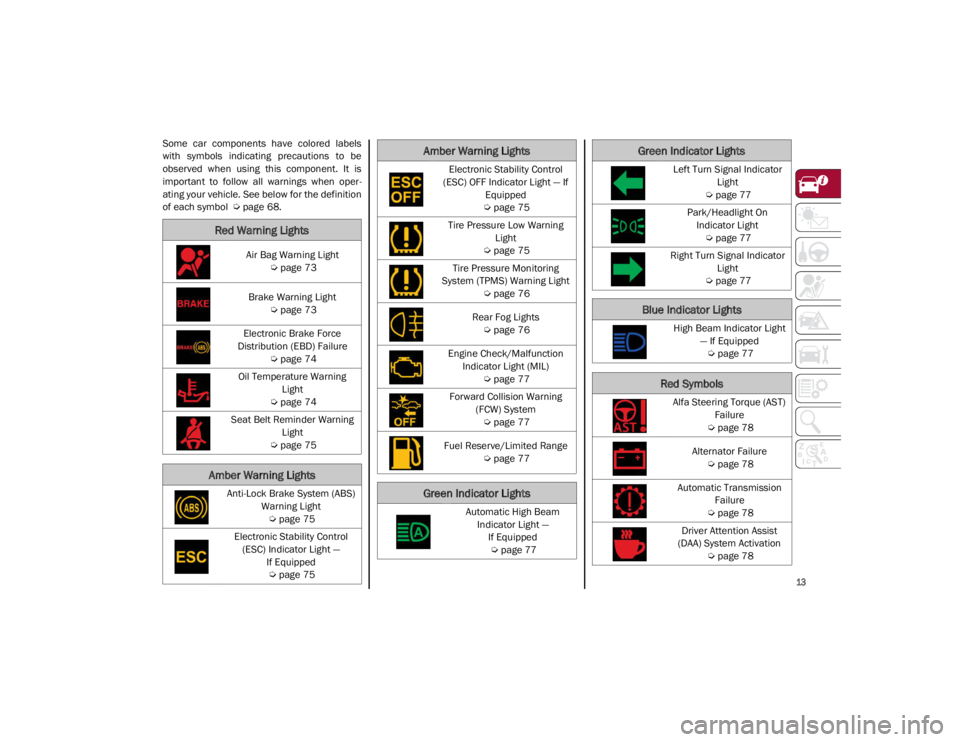
Some car components have colored labels
with symbols indicating precautions to be
observed when using this component. It is
important to follow all warnings when oper-
ating your vehicle. See below for the definition
of each symbol
Ú
page 68.
Red Warning Lights
Air Bag Warning Light
Ú
page 73
Brake Warning Light
Ú
page 73
Electronic Brake Force
Distribution (EBD) Failure
Ú
page 74
Oil Temperature Warning Light
Ú
page 74
Seat Belt Reminder Warning Light
Ú
page 75
Amber Warning Lights
Anti-Lock Brake System (ABS)
Warning Light
Ú
page 75
Electronic Stability Control (ESC) Indicator Light — If Equipped
Ú
page 75
Electronic Stability Control
(ESC) OFF Indicator Light — If Equipped
Ú
page 75
Tire Pressure Low Warning Light
Ú
page 75
Tire Pressure Monitoring
System (TPMS) Warning Light
Ú
page 76
Rear Fog Lights
Ú
page 76
Engine Check/Malfunction Indicator Light (MIL)
Ú
page 77
Forward Collision Warning (FCW) System
Ú
page 77
Fuel Reserve/Limited Range
Ú
page 77
Green Indicator Lights
Automatic High Beam
Indicator Light — If Equipped
Ú
page 77
Amber Warning Lights
Left Turn Signal Indicator
Light
Ú
page 77
Park/Headlight On Indicator Light
Ú
page 77
Right Turn Signal Indicator Light
Ú
page 77
Blue Indicator Lights
High Beam Indicator Light
— If Equipped
Ú
page 77
Red Symbols
Alfa Steering Torque (AST)
Failure
Ú
page 78
Alternator Failure
Ú
page 78
Automatic Transmission Failure
Ú
page 78
Driver Attention Assist
(DAA) System Activation
Ú
page 78
Green Indicator Lights
21_GA_OM_EN_USC_t.book Page 13
Page 16 of 284
SYMBOL GLOSSARY
14
Door Open
Ú
page 78
Power Steering Failure
Ú
page 78
Electronic Throttle Control (ETC) Warning Light
Ú
page 78
Engine Coolant
Temperature Too High
Ú
page 78
Hood Cap Not Properly Shut
Ú
page 79
Insufficient Engine Oil Level
Ú
page 79
Low Engine Oil Pressure
Ú
page 79
Trunk Lid Not Properly Shut
Ú
page 79
Amber Symbols
Engine Immobilizer Failure/
Break-In Attempt
Ú
page 79
Red Symbols
Fuel Cut-Off Indicator Light
Ú
page 79
Park Sensors System Failure
Ú
page 79
Engine Oil Change
Required— If Equipped
Ú
page 80
Engine Oil Pressure Sensor Failure
Ú
page 80
Engine Oil Level Sensor Failure
Ú
page 80
Forward Collision Warning (FCW) System Failure — If Equipped
Ú
page 80
Stop/Start System Failure
Ú
page 80
Rain Sensor Failure
Ú
page 80
Dusk Sensor Failure
Ú
page 80
Amber Symbols
Blind Spot Monitoring
System Failure — If Equipped
Ú
page 80
Fuel Level Sensor Failure
Ú
page 80
Exterior Lights Failure
Ú
page 81
Keyless System Failure
Ú
page 81
Fuel Cut-Off System Failure
Ú
page 81
Lane Departure Warning (LDW) System Failure — If Equipped
Ú
page 81
Automatic High Beam Headlights Failure — If Equipped
Ú
page 81
Automatic Transmission Fluid Overheating
Ú
page 81
Audio System Failure
Ú
page 81
Amber Symbols
21_GA_OM_EN_USC_t.book Page 14
Page 25 of 284
23
Locking The Doors With A Depleted Battery
Proceed as follows to lock the doors if the
vehicle battery is depleted.
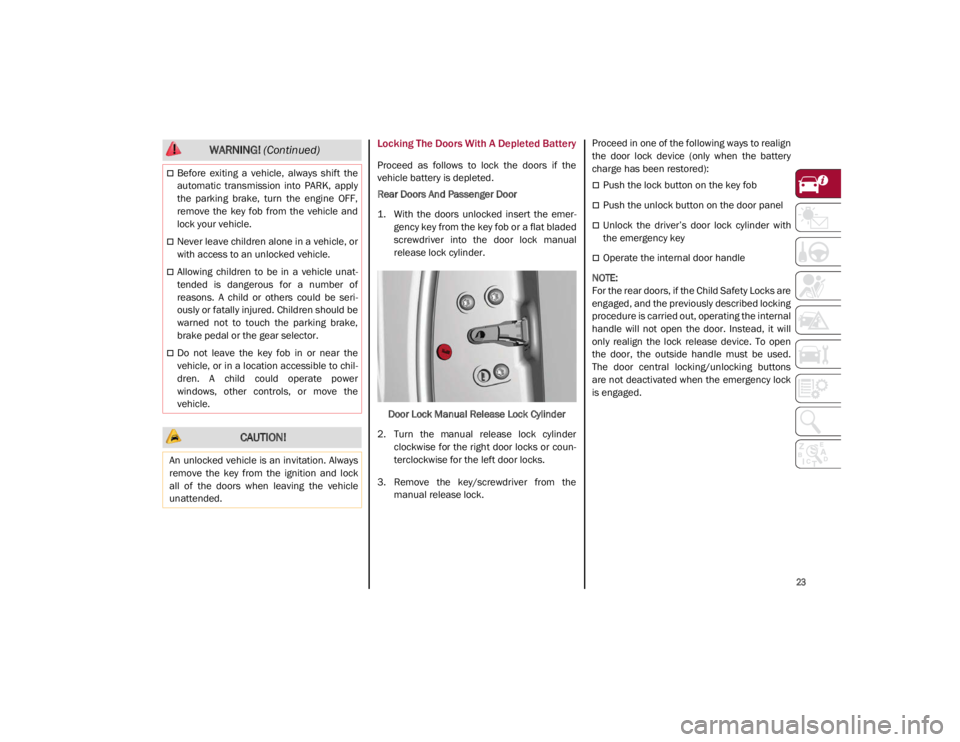
Rear Doors And Passenger Door
1. With the doors unlocked insert the emer-
gency key from the key fob or a flat bladed
screwdriver into the door lock manual
release lock cylinder.
Door Lock Manual Release Lock Cylinder
2. Turn the manual release lock cylinder clockwise for the right door locks or coun -
terclockwise for the left door locks.
3. Remove the key/screwdriver from the manual release lock. Proceed in one of the following ways to realign
the door lock device (only when the battery
charge has been restored):
Push the lock button on the key fob
Push the unlock button on the door panel
Unlock the driver’s door lock cylinder with
the emergency key
Operate the internal door handle
NOTE:
For the rear doors, if the Child Safety Locks are
engaged, and the previously described locking
procedure is carried out, operating the internal
handle will not open the door. Instead, it will
only realign the lock release device. To open
the door, the outside handle must be used.
The door central locking/unlocking buttons
are not deactivated when the emergency lock
is engaged.
Before exiting a vehicle, always shift the
automatic transmission into PARK, apply
the parking brake, turn the engine OFF,
remove the key fob from the vehicle and
lock your vehicle.
Never leave children alone in a vehicle, or
with access to an unlocked vehicle.
Allowing children to be in a vehicle unat -
tended is dangerous for a number of
reasons. A child or others could be seri -
ously or fatally injured. Children should be
warned not to touch the parking brake,
brake pedal or the gear selector.
Do not leave the key fob in or near the
vehicle, or in a location accessible to chil -
dren. A child could operate power
windows, other controls, or move the
vehicle.
CAUTION!
An unlocked vehicle is an invitation. Always
remove the key from the ignition and lock
all of the doors when leaving the vehicle
unattended.
WARNING! (Continued)
21_GA_OM_EN_USC_t.book Page 23
Page 42 of 284
GETTING TO KNOW YOUR VEHICLE
40
Rolling Code Garage Door Opener Final Steps
NOTE:
You have 30 seconds in which to initiate rolling
code final step 2, after completing rolling code
final step 1.
1. At the garage door opener motor (in thegarage), locate the “LEARN” or “TRAIN”
button. This can usually be found where
the hanging antenna wire is attached to
the garage door opener motor. Firmly push
and release the “LEARN” or “TRAIN”
button.
2. Return to the vehicle and push the programmed HomeLink® button three
times (holding the button for two seconds
each time). If the garage door opener
motor operates, programming is complete.
3. Push the programmed HomeLink® button to confirm that the garage door opener
motor operates. If the garage door opener
motor does not operate, repeat the final
steps for the rolling code procedure. Non-Rolling Code Garage Door Opener Final
Steps
1. Push and hold the programmed HomeLink®
button and observe the HomeLink®
indicator light. If the HomeLink® indicator
light stays on constantly, programming is
complete.
2. Push the programmed HomeLink® button to confirm that the garage door opener
motor operates. If the garage door opener
motor does not operate, repeat the steps
from the beginning.Programming HomeLink® To A
Miscellaneous Device
Follow the procedure on programming
HomeLink® to a garage door opener
Ú
page 39.
Be sure to determine if the device has a rolling
code, or non-rolling code before beginning the
programming process.
NOTE:
Canadian radio frequency laws require trans -
mitter signals to time-out (or quit) after several
seconds of transmission, which may not be
long enough for HomeLink® to pick up the
signal during programming. Similar to this
Canadian law, some U.S. gate operators are
designed to time-out in the same manner. The
procedure may need to be performed multiple
times to successfully pair the device to your
HomeLink® buttons.
Reprogramming A Single HomeLink®
Button
To reprogram a single HomeLink® button that
has been previously trained, without erasing
all the channels, follow the procedure below.
Be sure to determine whether the new device
you want to program the HomeLink® button to
has a Rolling Code, or Non-rolling Code.
WARNING!
Your motorized door or gate will open and
close while you are programming the
universal transceiver. Do not program the
transceiver if people or pets are in the
path of the door or gate.
Do not run your vehicle in a closed garage or
confined area while programming the trans -
ceiver. Exhaust gas from your vehicle
contains Carbon Monoxide (CO) which is
odorless and colorless. Carbon Monoxide is
poisonous when inhaled and can cause you
and others to be severely injured or killed.
21_GA_OM_EN_USC_t.book Page 40