light ALFA ROMEO GIULIA 2023 Owners Manual
[x] Cancel search | Manufacturer: ALFA ROMEO, Model Year: 2023, Model line: GIULIA, Model: ALFA ROMEO GIULIA 2023Pages: 248, PDF Size: 9.62 MB
Page 209 of 248
207
Tire Sizing Chart
EXAMPLE:
Example Size Designation: P215/65R15XL 95H, 215/65R15 96H, LT235/85R16C, T145/80D18 103M, 31x10.5 R15 LT
P
= Passenger car tire size based on US design standards, or
"....blank...." = Passenger car tire based on European design standards, or
LT = Light truck tire based on US design standards, or
T or S = Temporary spare tire or
31 = Overall diameter in inches (in)
215, 235, 145 = Section width in millimeters (mm)
65, 85, 80 = Aspect ratio in percent (%)
Ratio of section height to section width of tire, or
10.5 = Section width in inches (in)
R = Construction code
"R" means radial construction, or
"D" means diagonal or bias construction
15, 16, 18 = Rim diameter in inches (in)
Service Description:
95 = Load Index
A numerical code associated with the maximum load a tire can carry
H = Speed Symbol
A symbol indicating the range of speeds at which a tire can carry a load corresponding to its load index under certain operating conditions
The maximum speed corresponding to the speed symbol should only be achieved under specified operating conditions (i.e., tire pressure, vehicle
loading, road conditions, and posted speed limits)
Load Identification:
Absence of the following load identification symbols on the sidewall of the tire indicates a Standard Load (SL) tire:
XL = Extra load (or reinforced) tire, or
LL = Light load tire or
C, D, E, F, G = Load range associated with the maximum load a tire can carry at a specified pressure
23_GA_OM_EN_USC_t.book Page 207
Page 217 of 248
215
(Continued)
Tread Wear Indicators
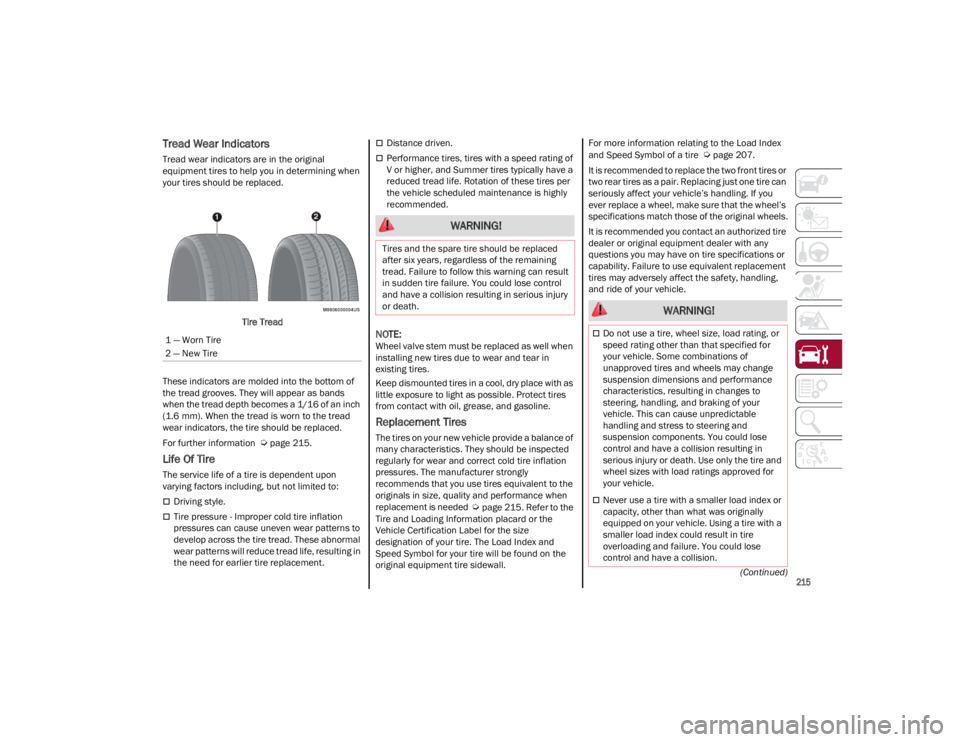
Tread wear indicators are in the original
equipment tires to help you in determining when
your tires should be replaced.Tire Tread
These indicators are molded into the bottom of
the tread grooves. They will appear as bands
when the tread depth becomes a 1/16 of an inch
(1.6 mm). When the tread is worn to the tread
wear indicators, the tire should be replaced.
For further information
Ú
page 215.
Life Of Tire
The service life of a tire is dependent upon
varying factors including, but not limited to:
Driving style.
Tire pressure - Improper cold tire inflation
pressures can cause uneven wear patterns to
develop across the tire tread. These abnormal
wear patterns will reduce tread life, resulting in
the need for earlier tire replacement.
Distance driven.
Performance tires, tires with a speed rating of
V or higher, and Summer tires typically have a
reduced tread life. Rotation of these tires per
the vehicle scheduled maintenance is highly
recommended.
NOTE:
Wheel valve stem must be replaced as well when
installing new tires due to wear and tear in
existing tires.
Keep dismounted tires in a cool, dry place with as
little exposure to light as possible. Protect tires
from contact with oil, grease, and gasoline.
Replacement Tires
The tires on your new vehicle provide a balance of
many characteristics. They should be inspected
regularly for wear and correct cold tire inflation
pressures. The manufacturer strongly
recommends that you use tires equivalent to the
originals in size, quality and performance when
replacement is needed
Ú
page 215. Refer to the
Tire and Loading Information placard or the
Vehicle Certification Label for the size
designation of your tire. The Load Index and
Speed Symbol for your tire will be found on the
original equipment tire sidewall. For more information relating to the Load Index
and Speed Symbol of a tire
Ú
page 207.
It is recommended to replace the two front tires or
two rear tires as a pair. Replacing just one tire can
seriously affect your vehicle’s handling. If you
ever replace a wheel, make sure that the wheel’s
specifications match those of the original wheels.
It is recommended you contact an authorized tire
dealer or original equipment dealer with any
questions you may have on tire specifications or
capability. Failure to use equivalent replacement
tires may adversely affect the safety, handling,
and ride of your vehicle.
1 — Worn Tire
2 — New Tire
WARNING!
Tires and the spare tire should be replaced
after six years, regardless of the remaining
tread. Failure to follow this warning can result
in sudden tire failure. You could lose control
and have a collision resulting in serious injury
or death.
WARNING!
Do not use a tire, wheel size, load rating, or
speed rating other than that specified for
your vehicle. Some combinations of
unapproved tires and wheels may change
suspension dimensions and performance
characteristics, resulting in changes to
steering, handling, and braking of your
vehicle. This can cause unpredictable
handling and stress to steering and
suspension components. You could lose
control and have a collision resulting in
serious injury or death. Use only the tire and
wheel sizes with load ratings approved for
your vehicle.
Never use a tire with a smaller load index or
capacity, other than what was originally
equipped on your vehicle. Using a tire with a
smaller load index could result in tire
overloading and failure. You could lose
control and have a collision.
23_GA_OM_EN_USC_t.book Page 215
Page 222 of 248
SERVICING AND MAINTENANCE
220
actual conditions of their use, however,
and may depart significantly from the
norm due to variations in driving habits,
service practices, and differences in
road characteristics and climate.
TRACTION GRADES
The Traction grades, from highest to
lowest, are AA, A, B, and C. These
grades represent the tire's ability to
stop on wet pavement, as measured
under controlled conditions on
specified government test surfaces of
asphalt and concrete. A tire marked C
may have poor traction performance.
TEMPERATURE GRADES
The temperature grades are A (the
highest), B, and C, representing the
tire's resistance to the generation of
heat and its ability to dissipate heat,
when tested under controlled
conditions on a specified indoor
laboratory test wheel. Sustained high
temperature can cause the material of
the tire to degenerate and reduce tire life, and excessive temperature can
lead to sudden tire failure. The grade C
corresponds to a level of performance,
which all passenger vehicle tires must
meet under the Federal Motor Vehicle
Safety Standard No. 109. Grades B and
A represent higher levels of
performance on the laboratory test
wheel, than the minimum required by
law.
STORING THE VEHICLE
If the vehicle is left inactive for longer than a
month, the following precautions should be
observed:
Park the vehicle in an area that is covered and
dry, and well-ventilated if possible. Slightly
open the windows.
Check that the Electric Park Brake is not
activated.
Carry out the procedure: “manual trunk
opening device” procedure described in this
paragraph.
Disconnect the negative battery terminal and
check the battery charge. Repeat this check
once every three months during storage.
If the battery is not disconnected from the
electrical system, check its state of charge
every 30 days.
Clean and protect the painted parts using
protective wax.
Clean and protect the shiny metal parts using
special compounds available commercially.
Sprinkle talcum powder on the windshield wiper
rubber blades, and lift them off the glass.
Cover the vehicle with a fabric or perforated
plastic sheet, paying particular care not to
damage the painted surface by dragging any
dust that may have accumulated on it. Do not
use compact plastic sheets, as they do not
allow humidity to evaporate from the surface
of the vehicle.
Inflate tires to +7.25 psi (+0.5 bar) above the
standard prescribed pressure and check it
periodically.
Do not drain the engine cooling system.
Any time the vehicle is left inactive for two
weeks or more, operate the air conditioning
system with engine idling for at least five
minutes, setting external air and with fan set to
maximum speed. This operation will ensure
appropriate lubrication for the system, thus
minimizing the possibility of damage to the
compressor when the system is operated again.
NOTE:
After placing the ignition in STOP and having
closed the driver side door, wait at least one
minute before disconnecting the electrical supply
from the battery. When reconnecting the elec
-
trical supply to the battery, make sure that the
ignition is in the STOP position and the driver side
door is closed.
WARNING!
The traction grade assigned to this tire is
based on straight-ahead braking traction
tests, and does not include acceleration,
cornering, hydroplaning, or peak traction
characteristics.
WARNING!
The temperature grade for this tire is
established for a tire that is properly inflated
and not overloaded. Excessive speed,
underinflation, or excessive loading, either
separately or in combination, can cause heat
buildup and possible tire failure.
23_GA_OM_EN_USC_t.book Page 220
Page 224 of 248
SERVICING AND MAINTENANCE
222
To correctly wash the vehicle, follow these
instructions:
If high pressure jets or cleaners are used to
wash the vehicle, keep a distance of at least
15 inches (40 cm) from the bodywork to avoid
damage or alteration. Build up of water could
cause damage to the vehicle in the long term.
To make it easier to remove any dirt deposits
in the area where the blades are normally
located it is recommended to position the
windshield wipers vertically (service position).
Wash the bodywork using a low pressure jet of
water if possible.
Wipe a sponge with a slightly soapy solution
over the bodywork, frequently rinsing the
sponge.
Rinse well with water and dry with a leather
chamois.
Dry the less visible parts (e.g. door frames, hood,
headlight frames, etc.) with special care, as water
may stagnate more easily in these areas. Do not
wash the car after it has been left in the sun or
with the hood hot: this may alter the shine of the
paintwork.
Exterior plastic parts must be cleaned in the
same way as the rest of the vehicle.
If washing the car in a service that moves the car,
for cars with automatic transmissions, PARK (P)
must be cut out. You have to shut off the engine
in the following conditions: car stopped,
transmission in NEUTRAL (N), push the starter
button for at least three seconds.
NOTE:
Avoid parking under trees; the resin dropped by
trees makes the paintwork go opaque and
increases the possibility of corrosion. Windows
Use specific detergents and clean cloths to
prevent scratching or altering the transparency.
Front Headlights
Use a soft cloth soaked in water and detergent for
washing cars.
NOTE:
Never use aromatic substances (e.g. gasoline)
or ketones (e.g. acetone) for cleaning the
plastic lenses of the headlights.
When cleaning with a pressure washer, keep
the pressure washer at least eight inches
(20 cm) away from the headlights.
Engine Compartment
At the end of every Winter, wash the engine
compartment thoroughly, taking care not to aim
the jet of water directly at the electronic control
units or at the windshield wiper motors. Have this
operation performed at a specialized workshop.
For further information
Ú
page 191.
NOTE:
The washing should take place with the engine
cold and the ignition device in the STOP position.
After the washing operation, make sure that the
various protections (e.g. rubber caps and guards)
have not been removed or damaged.
INTERIORS
Periodically check the cleanliness of the interior,
beneath the mats, which could cause oxidation of
the sheet metal.
SEATS AND FABRIC PARTS
Remove dust with a soft brush or a vacuum
cleaner. Rub the seats with a sponge moistened
with a solution of water and neutral detergent.
Cleaning heat press images on seats —
if equipped:
Due to the color, opacity and wear-resistant
protection with which the heat press images on
some seats are made, they may be subject to
temporary scratching if they are touched by finger
nails, keys, or other hard objects. In such cases, the
visible signs do not impair the profiled images, and
can easily be removed by wiping the affected area
with a microfiber cloth moistened with water (not
dry) to restore the seat to its original condition. The
microfiber cloth must not have been previously
soaked in other substances or detergents.
LEATHER SEATS
Remove the dry dirt with a chamois or slightly
damp cloth, without exerting too much pressure.
Remove any liquid or grease stains using an
absorbent dry cloth, without rubbing. Then clean
with a soft cloth or buckskin cloth dampened with
water and mild soap. If the stain persists, use
specific products and observe the instructions
carefully.
NOTE:
Never use alcohol. Make sure that the cleaning
products used contain no alcohol or alcohol deriv -
atives, even in small quantities.
CAUTION!
Wipe the rear window inside gently with a cloth
following the direction of the filaments to avoid
damaging the heating device.
23_GA_OM_EN_USC_t.book Page 222
Page 225 of 248
223
PLASTIC AND COATED PARTS
Clean interior plastic parts with a damp cloth (if
possible made from microfiber), and a solution of
water and neutral, non-abrasive detergent.
To clean oily or persistent stains, use specific
products free from solvents and designed to
maintain the original appearance and color of the
components.
Remove any dust using a microfiber cloth, if
necessary moistened with water. The use of
paper tissues is not recommended as these may
leave residues.
ALCANTARA PARTS — IF EQUIPPED
Alcantara parts maintenance procedure:
Treat the surface with a microfiber cloth
moistened with mild Marseille soap and water,
taking care to apply a uniform light pressure
over the entire area (do not rub vigorously).
Rinse and wring out the microfiber cloth, and
pass it over the entire area again.
Let it dry, and then brush gently with a soft
brush.
GENUINE LEATHER SURFACES —
I
F EQUIPPED
Use only water and mild soap to clean these
parts. Never use alcohol or alcohol-based
products.
Before using a specific product for cleaning
interiors, make sure that it does not contain
alcohol and/or alcohol based substances.
CARBON FIBER PARTS
To eliminate small scratches and marks on the
carbon, contact an authorized dealer. An
improperly performed operation may irreparably
damage the carbon. CAUTION!
Do not use “hard” synthetic brushes as they
can damage the fabric.
Do not clean small areas because it could
cause “aesthetic” differences between
treated and untreated areas.
Do not use alcohol or acetone-based
solvents.
23_GA_OM_EN_USC_t.book Page 223
Page 232 of 248
TECHNICAL SPECIFICATIONS
230
FUEL REQUIREMENTS
These engines are designed to meet all
emission regulations, and provide
satisfactory fuel economy and
performance when using high-quality
unleaded regular gasoline having a posted
octane number of 87 as specified by the
(R+M)/2 method. For optimal performance the
use of 91 or higher octane premium gasoline is
recommended in these engines.
While operating on gasoline with the required
octane number, hearing a light knocking sound
from the engine is not a cause for concern.
However, if the engine is heard making a heavy
knocking sound, see your dealer immediately.
Use of gasoline with a lower than recommended
octane number can cause engine failure and may
void or not be covered by the New Vehicle Limited
Warranty.
Poor quality gasoline can cause problems such
as hard starting, stalling, and hesitations. If you
experience these symptoms, try another brand of
gasoline before considering service for the
vehicle.
REFORMULATED GASOLINE
Many areas of the country require the use of
cleaner burning gasoline referred to as
“reformulated gasoline”. Reformulated gasoline
contains oxygenates and are specifically blended
to reduce vehicle emissions and improve air
quality.
The use of reformulated gasoline is
recommended. Properly blended reformulated
gasoline will provide improved performance and
durability of engine and fuel system components.
GASOLINE/OXYGENATE BLENDS
Some fuel suppliers blend unleaded gasoline
with oxygenates such as ethanol.
Problems that result from using gasoline
containing more than 15% ethanol (E-15) or
gasoline containing methanol are not the respon -
sibility of the manufacturer and not covered
under New Vehicle Limited Warranty.
CNG AND LP FUEL SYSTEM
M
ODIFICATIONS
Modifications that allow the engine to run on
Compressed Natural Gas (CNG) or Liquid
Propane (LP) may result in damage to the engine,
emissions, and fuel system components.
Problems that result from running CNG or LP are
not the responsibility of the manufacturer and not
covered under the New Vehicle Limited Warranty.
METHYLCYCLOPENTADIENYL MANGANESE
T
RICARBONYL (MMT) IN GASOLINE
MMT is a manganese-containing metallic
additive that is blended into some gasoline to
increase octane. Gasoline blended with MMT
provides no performance advantage beyond
gasoline of the same octane number without
MMT. Gasoline blended with MMT reduces spark
plug life and reduces emissions system
performance in some vehicles. The manufacturer
recommends that gasoline without MMT be used
in your vehicle. The MMT content of gasoline may
not be indicated on the gasoline pump; therefore,
you should ask your gasoline retailer whether the
gasoline contains MMT. MMT is prohibited in
Federal and California reformulated gasoline.
MATERIALS ADDED TO FUEL
Besides using unleaded gasoline with the proper
octane rating, gasolines that contain detergents,
corrosion and stability additives are
recommended. Using gasolines that have these
additives will help improve fuel economy, reduce
emissions, and maintain vehicle performance.
Designated TOP TIER Detergent Gasoline
contains a higher level of detergents to
further aide in minimizing engine and fuel
system deposits. When available, the
usage of TOP TIER Detergent Gasoline is
recommended. Visit
www.toptiergas.com
for a list
of TOP TIER Detergent Gasoline retailers.
Indiscriminate use of fuel system cleaning agents
should be avoided. Many of these materials
intended for gum and varnish removal may
contain active solvents or similar ingredients.
These can harm fuel system gasket and
diaphragm materials.
CAUTION!
DO NOT use E-85, gasoline containing metha -
nol, or gasoline containing more than 15%
ethanol (E-15). Use of these blends may result
in starting and drivability problems, damage
critical fuel system components, cause emis -
sions to exceed the applicable standard, and/
or cause the Malfunction Indicator Light to illu -
minate. Please observe pump labels as they
should clearly communicate if a fuel contains
greater than 15% ethanol (E-15).
23_GA_OM_EN_USC_t.book Page 230
Page 233 of 248
231
FUEL SYSTEM CAUTIONS
NOTE:
Intentional tampering with the emissions control system can result in civil penalties being assessed against you.
FLUID CAPACITIES
2.0L ENGINE
CAUTION!
Follow these guidelines to maintain your vehicle’s performance:
The use of leaded gasoline is prohibited by Federal law. Using leaded gasoline can impair engine performance and damage the emissions control
system.
An out-of-tune engine or certain fuel or ignition malfunctions can cause the catalytic converter to overheat. If you notice a pungent burning odor or some
light smoke, your engine may be out of tune or malfunctioning and may require immediate service. Contact an authorized dealer for service assistance.
The use of fuel additives, which are now being sold as octane enhancers, is not recommended. Most of these products contain high concentrations of
methanol. Fuel system damage or vehicle performance problems resulting from the use of such fuels or additives is not the responsibility of the
manufacturer and may void or not be covered under the New Vehicle Limited Warranty.
ComponentUSMetric
Fuel Tank15.3 gal58 L
Fuel Tank Reserve 2.3 gal9 L
Engine Cooling Cystem 2.2 gal8.6 L
Intercooler Cooling System 1.1 gal4.3 L
Engine Oil Sump And Filter 5.5 qt5.2 L
Hydraulic Brake Circuit 0.9 qt0.9 L
Windshield Washer Fluid Reservoir 1.1 gal4.2 L
Automatic Transmission 9.9 qt (RWD Model) /
9.8 qt (AWD Model) 9.4 L (RWD Model) /
9.3 L (AWD Model)
Differentials And Reduction Gears RDU 195 0.9 qt0.9 L
23_GA_OM_EN_USC_t.book Page 231
Page 240 of 248
CUSTOMER ASSISTANCE
238
We appreciate that you have made a major
investment when you purchased the vehicle. An
authorized dealer has also made a major
investment in facilities, tools, and training to
assure that you are absolutely delighted with the
ownership experience.
WARRANTY INFORMATION
See the Warranty Information available online,
for the terms and provisions of FCA US LLC and
FCA Canada Inc. warranties applicable to this
vehicle and market.
Use this QR code to access your
digital experience.
REPORTING SAFETY
DEFECTS
IN THE 50 UNITED STATES AND
W
ASHINGTON, D.C.
If you believe that your vehicle has a
defect that could cause a crash or
cause injury or death, you should
immediately inform the National
Highway Traffic Safety Administration
(NHTSA) in addition to notifying FCA US
LLC.
If NHTSA receives similar complaints, it
may open an investigation, and if it
finds that a safety defect exists in a
group of vehicles, it may order a recall
and remedy campaign. However,
NHTSA cannot become involved in
individual problems between you, an
authorized dealer or FCA US LLC.
To contact NHTSA, you may call the
Vehicle Safety Hotline toll free at
1-888-327-4236 (TTY:
1-800-424-9153); or go to
http://
www.safercar.gov
; or write to: Adminis -
trator, NHTSA, 1200 New Jersey
Avenue, SE., West Building,
Washington, D.C. 20590. You can also
obtain other information about motor
vehicle safety from
http://
www.safercar.gov
.
IN CANADA
If you believe that your vehicle has a
safety defect, you should contact the
Customer Service Department
immediately. Canadian customers who
wish to report a safety defect to the
Canadian government should contact
Transport Canada, Motor Vehicle
Defect Investigations and Recalls at
1-800-333-0510 or go to
wwwapps.tc.gc.ca/Saf-Sec-Sur/7/
PCDB-BDPP
.
PUBLICATION ORDER
FORMS
To order the following manuals, you may use either
the website or the phone numbers listed below.
Service Manuals
These comprehensive Service Manuals provide a
complete working knowledge of the vehicle,
system, and/or components and is written in
straightforward language with illustrations,
diagrams, and charts.
Diagnostic Procedure Manuals
Diagnostic Procedure Manuals are filled with
diagrams, charts and detailed illustrations. These
manuals make it easy to find and fix problems on
computer-controlled vehicle systems and
features. They show exactly how to find and
correct problems, using step-by-step trouble -
shooting and drivability procedures, proven
diagnostic tests and a complete list of all tools
and equipment.
WARNING!
Engine exhaust (internal combustion engines
only), some of its constituents, and certain
vehicle components contain, or emit,
chemicals known to the State of California to
cause cancer and birth defects, or other
reproductive harm. In addition, certain fluids
contained in vehicles and certain products of
component wear contain, or emit, chemicals
known to the State of California to cause
cancer and birth defects, or other reproductive
harm.
23_GA_OM_EN_USC_t.book Page 238
Page 242 of 248

240
INDEX
A
Accessories Purchased By The Owner.......... 4
Active Blind Spot Assist .............................134
Active Safety Systems ................................ 129
Active Torque Vectoring (ATV) System ......129
Adaptive Cruise Control (ACC)
(Cruise Control) ............................................ 97Off ........................................................... 101
On............................................................101
Additives, Fuel ............................................ 230
Adjust Forward.............................................. 31, 34
Rearward ........................................... 31, 34
Air Bag......................................................... 150 Air Bag Operation ...................................152Air Bag Warning Light ............................150
Driver Knee Air Bag................................ 152Enhanced Accident Response .....155, 181
Event Data Recorder (EDR) ...................181
Front Air Bag...........................................150
If Deployment Occurs ............................155
Knee Impact Bolsters ............................152
Maintaining Your Air Bag System.......... 157
Maintenance ..........................................157
Redundant Air Bag Warning Light.........150
Side Air Bags ..........................................153
Transporting Pets...................................166
Air Bag Light ......................................150, 167
Air Pressure Tires ........................................................212
Alarm Security Alarm .......................................... 24
Alfa Active Suspension (AAS)....................... 94
Alfa DNA System .......................................... 91
Anti-Lock Braking (ABS) System ................ 129 Anti-Lock Warning Light ...............................72
Automatic Door Locks ..................................28
Automatic Headlights ...................................43
Automatic Temperature Control (ATC) ........49
Automatic Transmission ..............................86
Auxiliary Driving Systems .......................... 132
B
Back-Up Camera ........................................ 123
Battery ..................................................74, 190 Charging System Light .............................74
Battery Recharging .................................... 191
Belts, Seat .................................................. 167
Blind Spot Monitoring ............................... 132
Bodywork (Cleaning And Maintenance) ... 221
B-Pillar Location......................................... 209
Brake System Warning Light .................................... 71, 72
Brakes ........................................................ 226 Brake Fluid Level................................... 190
Bulbs, Light ................................................ 168
C
Camera, Rear ............................................. 123
Carbon Monoxide Warning ....................... 168
Cargo Tie-Downs ...........................................62
Certification Label ..................................... 125
Chart, Tire Sizing........................................ 207
Check Engine Light (Malfunction
Indicator Light)..............................................80
Checking Levels ................................ 187, 188
Checking Your Vehicle For Safety............. 166
Checks, Safety ........................................... 166
Child Restraint ........................................... 158 Child Restraints
Booster Seats ........................................ 159
Child Seat Installation ........................... 165
How To Stow An unused ALR SeatBelt ..................................................... 163
Infant And Child Restraints ................... 159
LATCH Positions ..................................... 161
Lower Anchors And Tethers For Children .............................................. 161
Older Children And Child Restraints ..... 159
Seating Positions ................................... 160
Using The Top Tether Anchorage.......... 165
Clean Air Gasoline ..................................... 230
Cleaning Wheels.................................................... 217
Climate Control ......................................48, 54
Compact Spare Tire ................................... 216
Contract, Service........................................ 237
Cruise Control (Speed Control) ................... 97
Customer Assistance ................................. 236
D
Daytime Running Lights .............................. 43
Deck Lid Power Release ......................................... 61
Defroster, Windshield ................................ 167
Dimmer Switch Headlight .................................................. 46
Door Ajar.................................................75, 76
Door Ajar Light .......................................75, 76
Door Locks Automatic ................................................. 28
Door Opener, Garage................................... 39
23_GA_OM_EN_USC_t.book Page 240
Page 243 of 248

241
Drive Train Control (DTC) System ..............130
Driving Modes .............................................. 92
Dynamic Steering Torque (DST) System ... 130
E
Electric Park Brake....................................... 84
Electronic Speed Control (Cruise Control) .. 97
Electronic Stability Control (ESC)
System ........................................................130
Electronic Throttle Control Warning Light... 75
Emergency In Case Of ......................................169, 171
SOS Emergency Call .............................. 169
Emergency, In Case Of Jump Starting .........................................175
Overheating ............................................ 178
Tow Hooks ..............................................180
Towing.....................................................179
Emission Control System Maintenance...... 80
Engine ......................................................... 224 Block Heater............................................. 83
Engine Coolant Level .............................189
Exhaust Gas Caution .............................168
Fuel Requirements ................................ 230Jump Starting .........................................177
Overheating ............................................ 178
Engine Compartment .................................187
Engine Compartment (Washing) ...............222
Engine Oil Level Check ............................................ 188
Enhanced Accident Response
Feature...............................................155, 181
Ethanol........................................................230 Exhaust Gas Cautions ............................... 168
Exhaust System ......................................... 168
Exterior Lights .............................42, 168, 203
F
Flashers
Turn Signals .....................................74, 168
Fluid Leaks ................................................. 168
Fog Lights, Rear ............................................44
Forward Collision Warning ........................ 138
Fuel Additives ................................................ 230
Clean Air................................................. 230
Ethanol ................................................... 230
Light ..........................................................76
Materials Added .................................... 230
Methanol................................................ 230
Fuses ................................................. 197, 198
G
Garage Door Opener (HomeLink) ................39
Gasoline, Clean Air .................................... 230
Gasoline, Reformulated ............................ 230
Gauges Engine Oil Temperature ...........................65
Fuel ...........................................................66
Speedometer ............................................66
Tachometer............................................... 65
Glove Compartment Storage .......................55
GVWR ......................................................... 126
H
Hazard Warning Flashers .......................... 169
Head Restraints ............................................36 Head Rests ................................................... 36
Headlights .................................................... 42
Automatic ................................................. 43
Delay......................................................... 44
High Beam ............................................... 43
Switch ....................................................... 42
Headlights (Cleaning) ................................ 222
Heated Mirrors ............................................. 39
Heated Seats ............................................... 35
Heated Steering Wheel ............................... 30
Heater, Engine Block ................................... 83
Highway Assist System .............................. 106
Hill Start Assist (HSA) System ................... 131
HomeLink (Garage Door Opener) ............... 39
Hood Closing ...................................................... 60Opening .................................................... 60
Hood Release ............................................... 60
I
Ignition .......................................................... 22 Switch ....................................................... 22
Immobilizer (Sentry Key) ............................. 21
In Case Of Emergency ............................... 169
Installing Electrical/Electronic Devices ......... 4
Instrument Cluster ....................................... 64 Descriptions ............................................. 74
Display ...................................................... 66
Instrument Panel Features ................................................... 64
Intelligent Speed Control System ............. 114
Interior And Instrument Lights .................... 46
Interior Lights ...................................... 45, 204
Interiors (Cleaning) .................................... 222
Internal Equipment ...................................... 55
23_GA_OM_EN_USC_t.book Page 241