seats ALFA ROMEO GIULIA 2023 Owner's Manual
[x] Cancel search | Manufacturer: ALFA ROMEO, Model Year: 2023, Model line: GIULIA, Model: ALFA ROMEO GIULIA 2023Pages: 248, PDF Size: 9.62 MB
Page 160 of 248
SAFETY
158
To read data recorded by an EDR, special
equipment is required, and access to the vehicle
or the EDR is needed. In addition to the vehicle
manufacturer, other parties, such as law
enforcement, that have the special equipment,
can read the information if they have access to
the vehicle or the EDR.
CHILD RESTRAINTS
Everyone in your vehicle needs to be buckled up
at all times, including babies and children. Every
state in the United States, and every Canadian
province, requires that small children ride in
proper restraint systems. This is the law, and you
can be prosecuted for ignoring it.
Children 12 years or younger should ride properly
buckled up in a rear seat, if available. According
to crash statistics, children are safer when
properly restrained in the rear seats rather than
in the front.
There are different sizes and types of restraints
for children from newborn size to the child almost
large enough for an adult safety belt. Always
check the child seat Owner’s Manual to make
sure you have the correct seat for your child. Carefully read and follow all the instructions and
warnings in the child restraint Owner’s Manual
and on all the labels attached to the child
restraint.
Before buying any restraint system, make sure
that it has a label certifying that it meets all
applicable Safety Standards. You should also
make sure that you can install it in the vehicle
where you will use it.
NOTE:
For additional information, refer to
http://
www.nhtsa.gov/parents-and-caregivers
or call:
1–888–327–4236
Canadian residents should refer to Transport
Canada’s website for additional information:
http://www.tc.gc.ca/en/services/road/
child-car-seat-safety.html
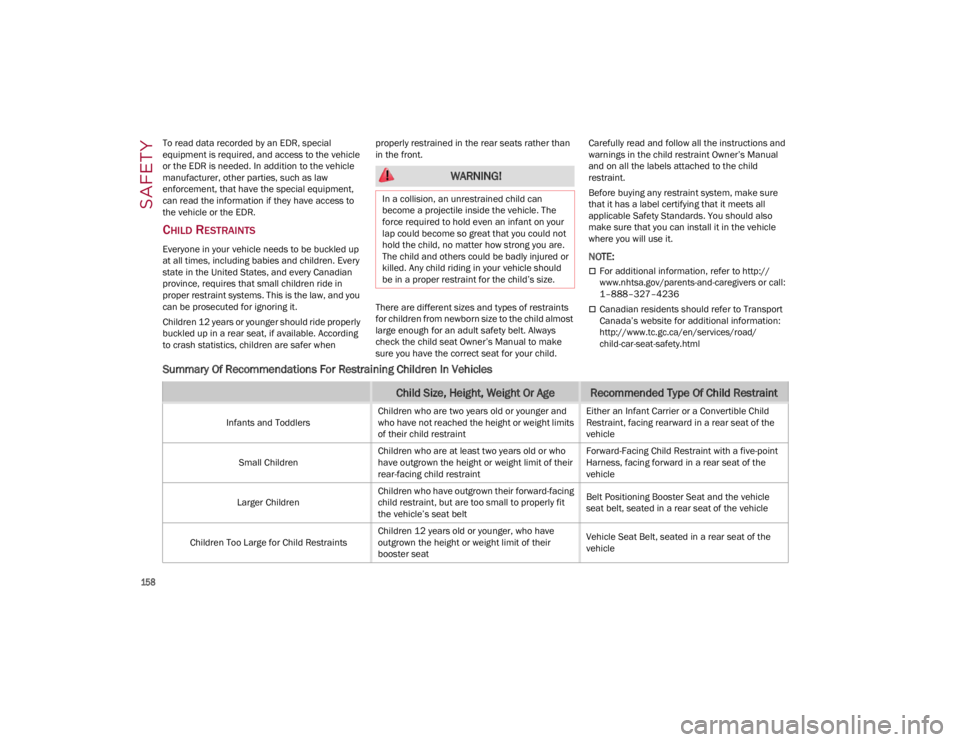
Summary Of Recommendations For Restraining Children In Vehicles
WARNING!
In a collision, an unrestrained child can
become a projectile inside the vehicle. The
force required to hold even an infant on your
lap could become so great that you could not
hold the child, no matter how strong you are.
The child and others could be badly injured or
killed. Any child riding in your vehicle should
be in a proper restraint for the child’s size.
Child Size, Height, Weight Or AgeRecommended Type Of Child Restraint
Infants and Toddlers Children who are two years old or younger and
who have not reached the height or weight limits
of their child restraint Either an Infant Carrier or a Convertible Child
Restraint, facing rearward in a rear seat of the
vehicle
Small Children Children who are at least two years old or who
have outgrown the height or weight limit of their
rear-facing child restraint Forward-Facing Child Restraint with a five-point
Harness, facing forward in a rear seat of the
vehicle
Larger Children Children who have outgrown their forward-facing
child restraint, but are too small to properly fit
the vehicle’s seat belt Belt Positioning Booster Seat and the vehicle
seat belt, seated in a rear seat of the vehicle
Children Too Large for Child Restraints Children 12 years old or younger, who have
outgrown the height or weight limit of their
booster seat Vehicle Seat Belt, seated in a rear seat of the
vehicle
23_GA_OM_EN_USC_t.book Page 158
Page 161 of 248
159
(Continued)
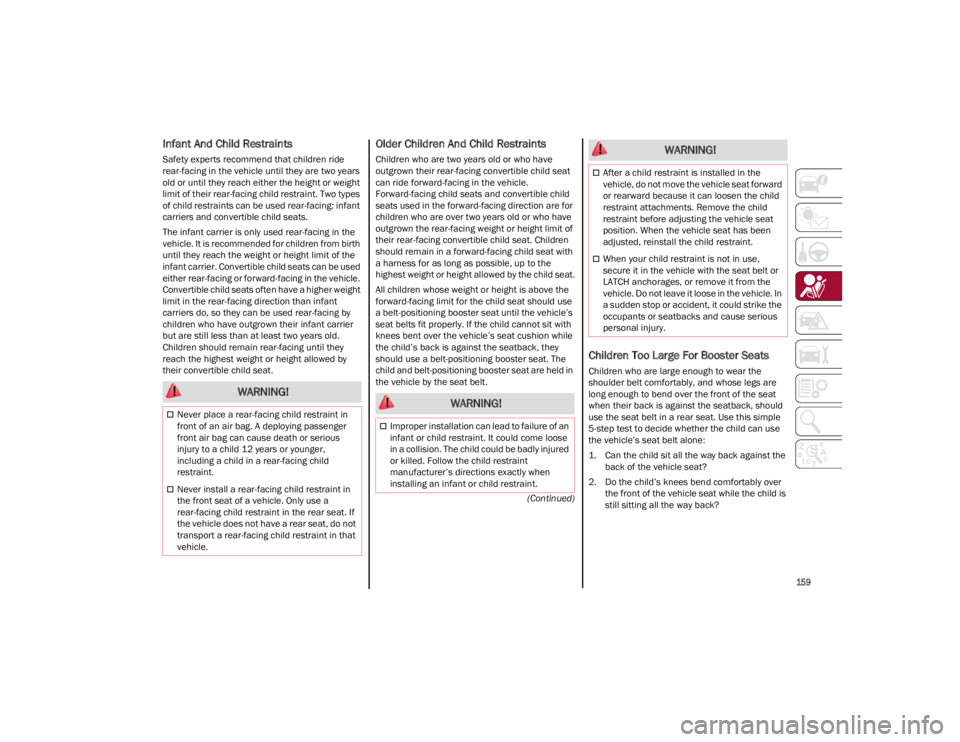
Infant And Child Restraints
Safety experts recommend that children ride
rear-facing in the vehicle until they are two years
old or until they reach either the height or weight
limit of their rear-facing child restraint. Two types
of child restraints can be used rear-facing: infant
carriers and convertible child seats.
The infant carrier is only used rear-facing in the
vehicle. It is recommended for children from birth
until they reach the weight or height limit of the
infant carrier. Convertible child seats can be used
either rear-facing or forward-facing in the vehicle.
Convertible child seats often have a higher weight
limit in the rear-facing direction than infant
carriers do, so they can be used rear-facing by
children who have outgrown their infant carrier
but are still less than at least two years old.
Children should remain rear-facing until they
reach the highest weight or height allowed by
their convertible child seat.
Older Children And Child Restraints
Children who are two years old or who have
outgrown their rear-facing convertible child seat
can ride forward-facing in the vehicle.
Forward-facing child seats and convertible child
seats used in the forward-facing direction are for
children who are over two years old or who have
outgrown the rear-facing weight or height limit of
their rear-facing convertible child seat. Children
should remain in a forward-facing child seat with
a harness for as long as possible, up to the
highest weight or height allowed by the child seat.
All children whose weight or height is above the
forward-facing limit for the child seat should use
a belt-positioning booster seat until the vehicle’s
seat belts fit properly. If the child cannot sit with
knees bent over the vehicle’s seat cushion while
the child’s back is against the seatback, they
should use a belt-positioning booster seat. The
child and belt-positioning booster seat are held in
the vehicle by the seat belt.
Children Too Large For Booster Seats
Children who are large enough to wear the
shoulder belt comfortably, and whose legs are
long enough to bend over the front of the seat
when their back is against the seatback, should
use the seat belt in a rear seat. Use this simple
5-step test to decide whether the child can use
the vehicle’s seat belt alone:
1. Can the child sit all the way back against the back of the vehicle seat?
2. Do the child’s knees bend comfortably over the front of the vehicle seat while the child is
still sitting all the way back?
WARNING!
Never place a rear-facing child restraint in
front of an air bag. A deploying passenger
front air bag can cause death or serious
injury to a child 12 years or younger,
including a child in a rear-facing child
restraint.
Never install a rear-facing child restraint in
the front seat of a vehicle. Only use a
rear-facing child restraint in the rear seat. If
the vehicle does not have a rear seat, do not
transport a rear-facing child restraint in that
vehicle.
WARNING!
Improper installation can lead to failure of an
infant or child restraint. It could come loose
in a collision. The child could be badly injured
or killed. Follow the child restraint
manufacturer’s directions exactly when
installing an infant or child restraint.
After a child restraint is installed in the
vehicle, do not move the vehicle seat forward
or rearward because it can loosen the child
restraint attachments. Remove the child
restraint before adjusting the vehicle seat
position. When the vehicle seat has been
adjusted, reinstall the child restraint.
When your child restraint is not in use,
secure it in the vehicle with the seat belt or
LATCH anchorages, or remove it from the
vehicle. Do not leave it loose in the vehicle. In
a sudden stop or accident, it could strike the
occupants or seatbacks and cause serious
personal injury.
WARNING!
23_GA_OM_EN_USC_t.book Page 159
Page 163 of 248
161
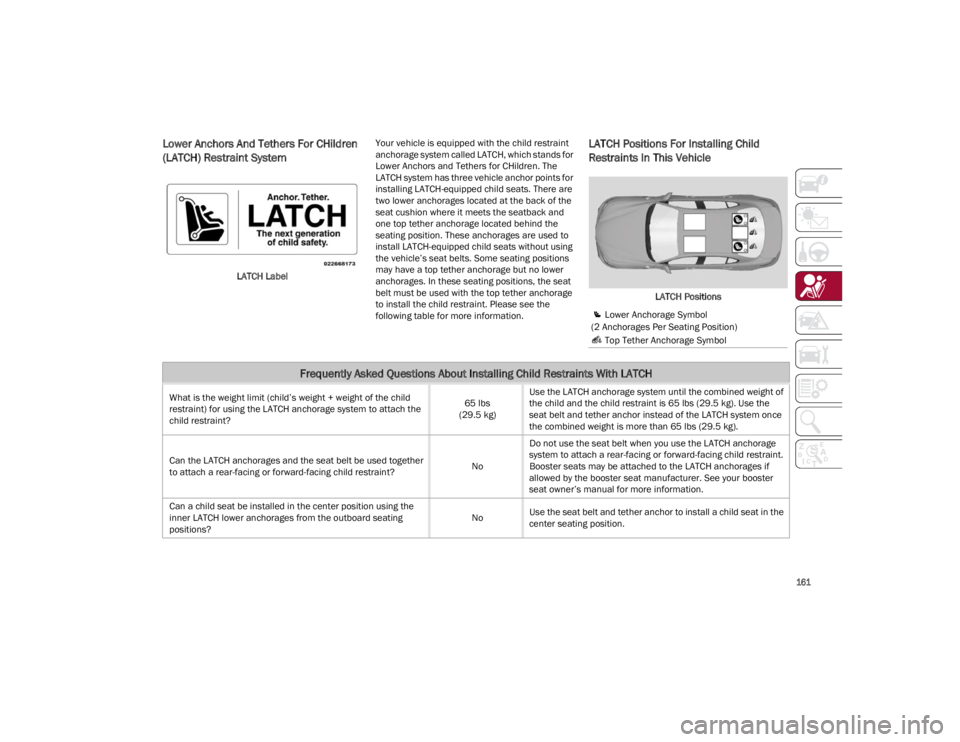
Lower Anchors And Tethers For CHildren
(LATCH) Restraint System
LATCH LabelYour vehicle is equipped with the child restraint
anchorage system called LATCH, which stands for
Lower Anchors and Tethers for CHildren. The
LATCH system has three vehicle anchor points for
installing LATCH-equipped child seats. There are
two lower anchorages located at the back of the
seat cushion where it meets the seatback and
one top tether anchorage located behind the
seating position. These anchorages are used to
install LATCH-equipped child seats without using
the vehicle’s seat belts. Some seating positions
may have a top tether anchorage but no lower
anchorages. In these seating positions, the seat
belt must be used with the top tether anchorage
to install the child restraint. Please see the
following table for more information.
LATCH Positions For Installing Child
Restraints In This Vehicle
LATCH Positions
Lower Anchorage Symbol
(2 Anchorages Per Seating Position)
Top Tether Anchorage Symbol
Frequently Asked Questions About Installing Child Restraints With LATCH
What is the weight limit (child’s weight + weight of the child
restraint) for using the LATCH anchorage system to attach the
child restraint? 65 lbs
(29.5 kg) Use the LATCH anchorage system until the combined weight of
the child and the child restraint is 65 lbs (29.5 kg). Use the
seat belt and tether anchor instead of the LATCH system once
the combined weight is more than 65 lbs (29.5 kg).
Can the LATCH anchorages and the seat belt be used together
to attach a rear-facing or forward-facing child restraint? NoDo not use the seat belt when you use the LATCH anchorage
system to attach a rear-facing or forward-facing child restraint. Booster seats may be attached to the LATCH anchorages if
allowed by the booster seat manufacturer. See your booster
seat owner’s manual for more information.
Can a child seat be installed in the center position using the
inner LATCH lower anchorages from the outboard seating
positions? No
Use the seat belt and tether anchor to install a child seat in the
center seating position.
23_GA_OM_EN_USC_t.book Page 161
Page 164 of 248
SAFETY
162
(Continued)
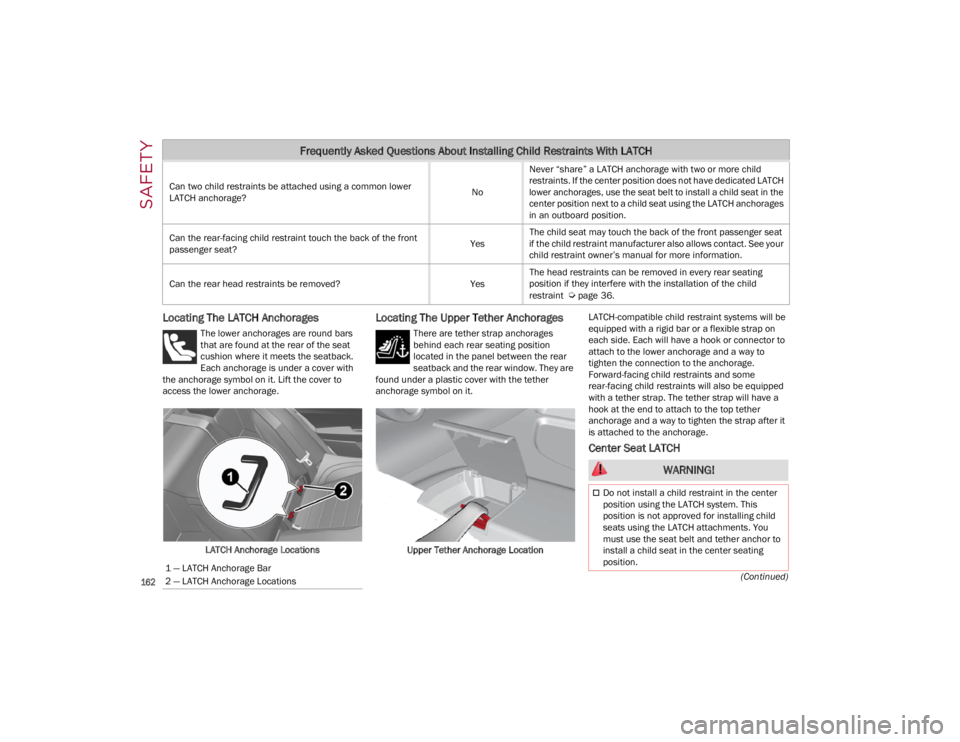
Locating The LATCH Anchorages
The lower anchorages are round bars
that are found at the rear of the seat
cushion where it meets the seatback.
Each anchorage is under a cover with
the anchorage symbol on it. Lift the cover to
access the lower anchorage.
LATCH Anchorage Locations
Locating The Upper Tether Anchorages
There are tether strap anchorages
behind each rear seating position
located in the panel between the rear
seatback and the rear window. They are
found under a plastic cover with the tether
anchorage symbol on it.
Upper Tether Anchorage Location LATCH-compatible child restraint systems will be
equipped with a rigid bar or a flexible strap on
each side. Each will have a hook or connector to
attach to the lower anchorage and a way to
tighten the connection to the anchorage.
Forward-facing child restraints and some
rear-facing child restraints will also be equipped
with a tether strap. The tether strap will have a
hook at the end to attach to the top tether
anchorage and a way to tighten the strap after it
is attached to the anchorage.
Center Seat LATCH
Can two child restraints be attached using a common lower
LATCH anchorage? NoNever “share” a LATCH anchorage with two or more child
restraints. If the center position does not have dedicated LATCH
lower anchorages, use the seat belt to install a child seat in the
center position next to a child seat using the LATCH anchorages
in an outboard position.
Can the rear-facing child restraint touch the back of the front
passenger seat? YesThe child seat may touch the back of the front passenger seat
if the child restraint manufacturer also allows contact. See your
child restraint owner’s manual for more information.
Can the rear head restraints be removed? YesThe head restraints can be removed in every rear seating
position if they interfere with the installation of the child
restraint
Ú
page 36.
Frequently Asked Questions About Installing Child Restraints With LATCH
1 — LATCH Anchorage Bar
2 — LATCH Anchorage Locations
WARNING!
Do not install a child restraint in the center
position using the LATCH system. This
position is not approved for installing child
seats using the LATCH attachments. You
must use the seat belt and tether anchor to
install a child seat in the center seating
position.
23_GA_OM_EN_USC_t.book Page 162
Page 165 of 248
163
Always follow the directions of the child restraint
manufacturer when installing your child restraint.
Not all child restraint systems will be installed as
described here.
To Install A LATCH-Compatible Child
Restraint
If the selected seating position has a Switchable
Automatic Locking Retractor (ALR) seat belt, stow
the seat belt, following the instructions below.
See
Ú
page 163 to check what type of seat belt
each seating position has.
1. Loosen the adjusters on the lower straps and on the tether strap of the child seat so that
you can more easily attach the hooks or
connectors to the vehicle anchorages.
2. Place the child seat between the lower anchorages for that seating position. If the
second row seat can be reclined, you may
recline the seat and/or raise the head
restraint (if adjustable) to get a better fit. If
the rear seat can be moved forward and rear -
ward in the vehicle, you may wish to move it
to its rear-most position to make room for the
child seat. You may also move the front seat
forward to allow more room for the child seat. 3. Attach the lower hooks or connectors of the
child restraint to the lower anchorages in the
selected seating position.
4. If the child restraint has a tether strap, connect it to the top tether anchorage. See
Ú
page 165 for directions to attach a tether
anchor.
5. Tighten all of the straps as you push the child restraint rearward and downward into the
seat. Remove slack in the straps according to
the child restraint manufacturer’s instruc -
tions.
6. Test that the child restraint is installed tightly by pulling back and forth on the child seat at
the belt path. It should not move more than
1 inch (25.4 mm) in any direction.
How To Stow An Unused Switchable-ALR
(ALR) Seat Belt:
When using the LATCH attaching system to install
a child restraint, stow all ALR seat belts that are
not being used by other occupants or being used
to secure child restraints. An unused belt could
injure a child if they play with it and accidentally
lock the seat belt retractor. Before installing a
child restraint using the LATCH system, buckle
the seat belt behind the child restraint and out of
the child’s reach. If the buckled seat belt
interferes with the child restraint installation,
instead of buckling it behind the child restraint,
route the seat belt through the child restraint belt
path and then buckle it. Do not lock the seat belt.
Remind all children in the vehicle that the seat
belts are not toys and that they should not play
with them.
Installing Child Restraints Using The
Vehicle Seat Belt
Child restraint systems are designed to be
secured in vehicle seats by lap belts or the lap
belt portion of a lap/shoulder belt.
Never use the same lower anchorage to
attach more than one child restraint. See
Ú
page 163 for typical installation
instructions.
WARNING! WARNING!
Improper installation of a child restraint to
the LATCH anchorages can lead to failure of
the restraint. The child could be badly injured
or killed. Follow the child restraint
manufacturer’s directions exactly when
installing an infant or child restraint.
Child restraint anchorages are designed to
withstand only those loads imposed by
correctly-fitted child restraints. Under no
circumstances are they to be used for adult
seat belts, harnesses, or for attaching other
items or equipment to the vehicle.
WARNING!
Improper installation or failure to properly
secure a child restraint can lead to failure of
the restraint. The child could be badly injured
or killed.
Follow the child restraint manufacturer’s
directions exactly when installing an infant or
child restraint.
23_GA_OM_EN_USC_t.book Page 163
Page 167 of 248
165
Installing A Child Restraint With A
Switchable Automatic Locking Retractor
(ALR):
Child restraint systems are designed to be
secured in vehicle seats by lap belts or the lap
belt portion of a lap/shoulder belt.
1. Place the child seat in the center of the seating position. If the second row seat can
be reclined, you may recline the seat and/or
raise the head restraint (if adjustable) to get
a better fit. If the rear seat can be moved
forward and rearward in the vehicle, you may
wish to move it to its rear-most position to
make room for the child seat. You may also
move the front seat forward to allow more
room for the child seat.
2. Pull enough of the seat belt webbing from the retractor to pass it through the belt path of
the child restraint. Do not twist the belt
webbing in the belt path. 3. Slide the latch plate into the buckle until you
hear a “click.”
4. Pull on the webbing to make the lap portion tight against the child seat.
5. To lock the seat belt, pull down on the shoulder part of the belt until you have pulled
all the seat belt webbing out of the retractor.
Then, allow the webbing to retract back into
the retractor. As the webbing retracts, you will
hear a clicking sound. This means the seat
belt is now in the Automatic Locking mode.
6. Try to pull the webbing out of the retractor. If it is locked, you should not be able to pull out
any webbing. If the retractor is not
locked,
repeat step 5.
7. Finally, pull up on any excess webbing to tighten the lap portion around the child
restraint while you push the child restraint
rearward and downward into the vehicle seat.
8. If the child restraint has a top tether strap and the seating position has a top tether
anchorage, connect the tether strap to the
anchorage and tighten the tether strap. See
Ú
page 165 for directions to attach a tether
anchor.
9. Test that the child restraint is installed tightly by pulling back and forth on the child seat at
the belt path. It should not move more than
1 inch (25.4 mm) in any direction.
Any seat belt system will loosen with time, so
check the belt occasionally, and pull it tight if
necessary.
Installing Child Restraints Using The Top
Tether Anchorage:
1. Look behind the seating position where you plan to install the child restraint to find the
tether anchorage. You may need to move the
seat forward to provide better access to the
tether anchorage. If there is no top tether
anchorage for that seating position, move the
child restraint to another position in the
vehicle if one is available.
WARNING!
Improper installation or failure to properly
secure a child restraint can lead to failure of
the restraint. The child could be badly injured
or killed.
Follow the child restraint manufacturer’s
directions exactly when installing an infant or
child restraint.
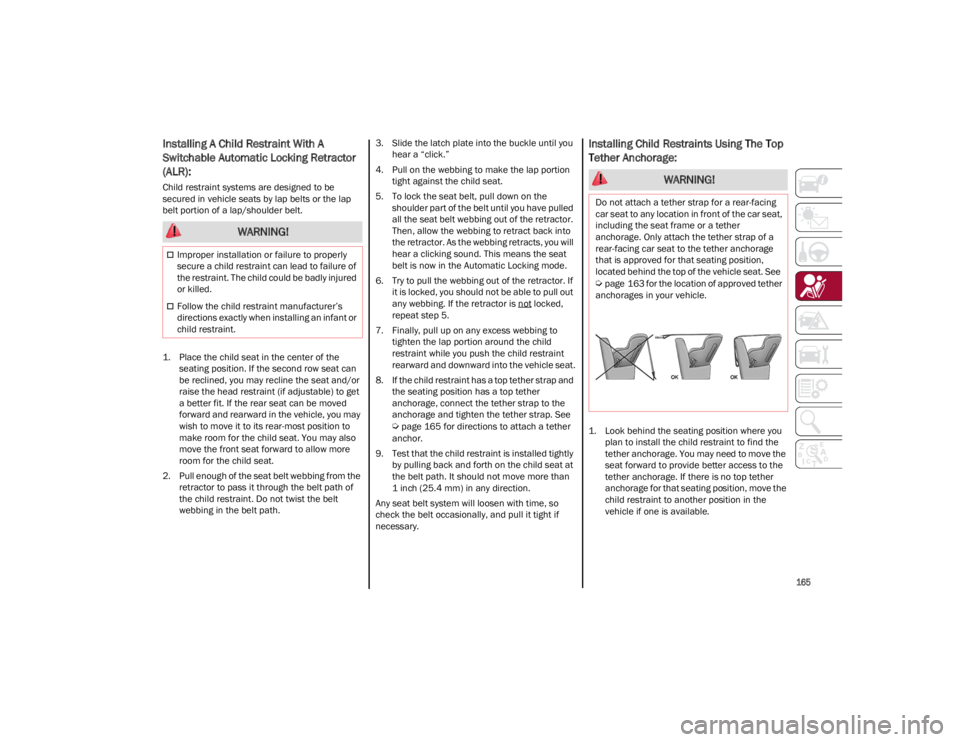
WARNING!
Do not attach a tether strap for a rear-facing
car seat to any location in front of the car seat,
including the seat frame or a tether
anchorage. Only attach the tether strap of a
rear-facing car seat to the tether anchorage
that is approved for that seating position,
located behind the top of the vehicle seat. See
Ú
page 163 for the location of approved tether
anchorages in your vehicle.
23_GA_OM_EN_USC_t.book Page 165
Page 168 of 248
SAFETY
166
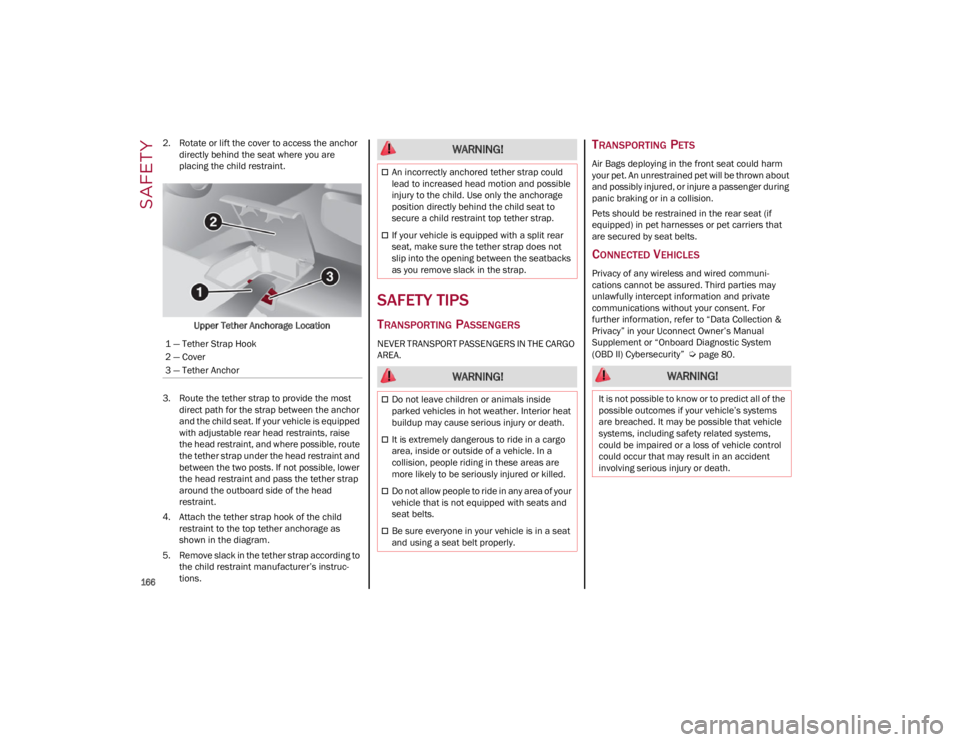
2. Rotate or lift the cover to access the anchor directly behind the seat where you are
placing the child restraint.
Upper Tether Anchorage Location
3. Route the tether strap to provide the most direct path for the strap between the anchor
and the child seat. If your vehicle is equipped
with adjustable rear head restraints, raise
the head restraint, and where possible, route
the tether strap under the head restraint and
between the two posts. If not possible, lower
the head restraint and pass the tether strap
around the outboard side of the head
restraint.
4. Attach the tether strap hook of the child restraint to the top tether anchorage as
shown in the diagram.
5. Remove slack in the tether strap according to the child restraint manufacturer’s instruc -
tions.
SAFETY TIPS
TRANSPORTING PASSENGERS
NEVER TRANSPORT PASSENGERS IN THE CARGO
AREA.
TRANSPORTING PETS
Air Bags deploying in the front seat could harm
your pet. An unrestrained pet will be thrown about
and possibly injured, or injure a passenger during
panic braking or in a collision.
Pets should be restrained in the rear seat (if
equipped) in pet harnesses or pet carriers that
are secured by seat belts.
CONNECTED VEHICLES
Privacy of any wireless and wired communi -
cations cannot be assured. Third parties may
unlawfully intercept information and private
communications without your consent. For
further information, refer to “Data Collection &
Privacy” in your Uconnect Owner’s Manual
Supplement or “Onboard Diagnostic System
(OBD II) Cybersecurity”
Ú
page 80.
1 — Tether Strap Hook
2 — Cover
3 — Tether Anchor
WARNING!
An incorrectly anchored tether strap could
lead to increased head motion and possible
injury to the child. Use only the anchorage
position directly behind the child seat to
secure a child restraint top tether strap.
If your vehicle is equipped with a split rear
seat, make sure the tether strap does not
slip into the opening between the seatbacks
as you remove slack in the strap.
WARNING!
Do not leave children or animals inside
parked vehicles in hot weather. Interior heat
buildup may cause serious injury or death.
It is extremely dangerous to ride in a cargo
area, inside or outside of a vehicle. In a
collision, people riding in these areas are
more likely to be seriously injured or killed.
Do not allow people to ride in any area of your
vehicle that is not equipped with seats and
seat belts.
Be sure everyone in your vehicle is in a seat
and using a seat belt properly.
WARNING!
It is not possible to know or to predict all of the
possible outcomes if your vehicle’s systems
are breached. It may be possible that vehicle
systems, including safety related systems,
could be impaired or a loss of vehicle control
could occur that may result in an accident
involving serious injury or death.
23_GA_OM_EN_USC_t.book Page 166
Page 224 of 248
SERVICING AND MAINTENANCE
222
To correctly wash the vehicle, follow these
instructions:
If high pressure jets or cleaners are used to
wash the vehicle, keep a distance of at least
15 inches (40 cm) from the bodywork to avoid
damage or alteration. Build up of water could
cause damage to the vehicle in the long term.
To make it easier to remove any dirt deposits
in the area where the blades are normally
located it is recommended to position the
windshield wipers vertically (service position).
Wash the bodywork using a low pressure jet of
water if possible.
Wipe a sponge with a slightly soapy solution
over the bodywork, frequently rinsing the
sponge.
Rinse well with water and dry with a leather
chamois.
Dry the less visible parts (e.g. door frames, hood,
headlight frames, etc.) with special care, as water
may stagnate more easily in these areas. Do not
wash the car after it has been left in the sun or
with the hood hot: this may alter the shine of the
paintwork.
Exterior plastic parts must be cleaned in the
same way as the rest of the vehicle.
If washing the car in a service that moves the car,
for cars with automatic transmissions, PARK (P)
must be cut out. You have to shut off the engine
in the following conditions: car stopped,
transmission in NEUTRAL (N), push the starter
button for at least three seconds.
NOTE:
Avoid parking under trees; the resin dropped by
trees makes the paintwork go opaque and
increases the possibility of corrosion. Windows
Use specific detergents and clean cloths to
prevent scratching or altering the transparency.
Front Headlights
Use a soft cloth soaked in water and detergent for
washing cars.
NOTE:
Never use aromatic substances (e.g. gasoline)
or ketones (e.g. acetone) for cleaning the
plastic lenses of the headlights.
When cleaning with a pressure washer, keep
the pressure washer at least eight inches
(20 cm) away from the headlights.
Engine Compartment
At the end of every Winter, wash the engine
compartment thoroughly, taking care not to aim
the jet of water directly at the electronic control
units or at the windshield wiper motors. Have this
operation performed at a specialized workshop.
For further information
Ú
page 191.
NOTE:
The washing should take place with the engine
cold and the ignition device in the STOP position.
After the washing operation, make sure that the
various protections (e.g. rubber caps and guards)
have not been removed or damaged.
INTERIORS
Periodically check the cleanliness of the interior,
beneath the mats, which could cause oxidation of
the sheet metal.
SEATS AND FABRIC PARTS
Remove dust with a soft brush or a vacuum
cleaner. Rub the seats with a sponge moistened
with a solution of water and neutral detergent.
Cleaning heat press images on seats —
if equipped:
Due to the color, opacity and wear-resistant
protection with which the heat press images on
some seats are made, they may be subject to
temporary scratching if they are touched by finger
nails, keys, or other hard objects. In such cases, the
visible signs do not impair the profiled images, and
can easily be removed by wiping the affected area
with a microfiber cloth moistened with water (not
dry) to restore the seat to its original condition. The
microfiber cloth must not have been previously
soaked in other substances or detergents.
LEATHER SEATS
Remove the dry dirt with a chamois or slightly
damp cloth, without exerting too much pressure.
Remove any liquid or grease stains using an
absorbent dry cloth, without rubbing. Then clean
with a soft cloth or buckskin cloth dampened with
water and mild soap. If the stain persists, use
specific products and observe the instructions
carefully.
NOTE:
Never use alcohol. Make sure that the cleaning
products used contain no alcohol or alcohol deriv -
atives, even in small quantities.
CAUTION!
Wipe the rear window inside gently with a cloth
following the direction of the filaments to avoid
damaging the heating device.
23_GA_OM_EN_USC_t.book Page 222
Page 242 of 248

240
INDEX
A
Accessories Purchased By The Owner.......... 4
Active Blind Spot Assist .............................134
Active Safety Systems ................................ 129
Active Torque Vectoring (ATV) System ......129
Adaptive Cruise Control (ACC)
(Cruise Control) ............................................ 97Off ........................................................... 101
On............................................................101
Additives, Fuel ............................................ 230
Adjust Forward.............................................. 31, 34
Rearward ........................................... 31, 34
Air Bag......................................................... 150 Air Bag Operation ...................................152Air Bag Warning Light ............................150
Driver Knee Air Bag................................ 152Enhanced Accident Response .....155, 181
Event Data Recorder (EDR) ...................181
Front Air Bag...........................................150
If Deployment Occurs ............................155
Knee Impact Bolsters ............................152
Maintaining Your Air Bag System.......... 157
Maintenance ..........................................157
Redundant Air Bag Warning Light.........150
Side Air Bags ..........................................153
Transporting Pets...................................166
Air Bag Light ......................................150, 167
Air Pressure Tires ........................................................212
Alarm Security Alarm .......................................... 24
Alfa Active Suspension (AAS)....................... 94
Alfa DNA System .......................................... 91
Anti-Lock Braking (ABS) System ................ 129 Anti-Lock Warning Light ...............................72
Automatic Door Locks ..................................28
Automatic Headlights ...................................43
Automatic Temperature Control (ATC) ........49
Automatic Transmission ..............................86
Auxiliary Driving Systems .......................... 132
B
Back-Up Camera ........................................ 123
Battery ..................................................74, 190 Charging System Light .............................74
Battery Recharging .................................... 191
Belts, Seat .................................................. 167
Blind Spot Monitoring ............................... 132
Bodywork (Cleaning And Maintenance) ... 221
B-Pillar Location......................................... 209
Brake System Warning Light .................................... 71, 72
Brakes ........................................................ 226 Brake Fluid Level................................... 190
Bulbs, Light ................................................ 168
C
Camera, Rear ............................................. 123
Carbon Monoxide Warning ....................... 168
Cargo Tie-Downs ...........................................62
Certification Label ..................................... 125
Chart, Tire Sizing........................................ 207
Check Engine Light (Malfunction
Indicator Light)..............................................80
Checking Levels ................................ 187, 188
Checking Your Vehicle For Safety............. 166
Checks, Safety ........................................... 166
Child Restraint ........................................... 158 Child Restraints
Booster Seats ........................................ 159
Child Seat Installation ........................... 165
How To Stow An unused ALR SeatBelt ..................................................... 163
Infant And Child Restraints ................... 159
LATCH Positions ..................................... 161
Lower Anchors And Tethers For Children .............................................. 161
Older Children And Child Restraints ..... 159
Seating Positions ................................... 160
Using The Top Tether Anchorage.......... 165
Clean Air Gasoline ..................................... 230
Cleaning Wheels.................................................... 217
Climate Control ......................................48, 54
Compact Spare Tire ................................... 216
Contract, Service........................................ 237
Cruise Control (Speed Control) ................... 97
Customer Assistance ................................. 236
D
Daytime Running Lights .............................. 43
Deck Lid Power Release ......................................... 61
Defroster, Windshield ................................ 167
Dimmer Switch Headlight .................................................. 46
Door Ajar.................................................75, 76
Door Ajar Light .......................................75, 76
Door Locks Automatic ................................................. 28
Door Opener, Garage................................... 39
23_GA_OM_EN_USC_t.book Page 240
Page 243 of 248
241
Drive Train Control (DTC) System ..............130
Driving Modes .............................................. 92
Dynamic Steering Torque (DST) System ... 130
E
Electric Park Brake....................................... 84
Electronic Speed Control (Cruise Control) .. 97
Electronic Stability Control (ESC)
System ........................................................130
Electronic Throttle Control Warning Light... 75
Emergency In Case Of ......................................169, 171
SOS Emergency Call .............................. 169
Emergency, In Case Of Jump Starting .........................................175
Overheating ............................................ 178
Tow Hooks ..............................................180
Towing.....................................................179
Emission Control System Maintenance...... 80
Engine ......................................................... 224 Block Heater............................................. 83
Engine Coolant Level .............................189
Exhaust Gas Caution .............................168
Fuel Requirements ................................ 230Jump Starting .........................................177
Overheating ............................................ 178
Engine Compartment .................................187
Engine Compartment (Washing) ...............222
Engine Oil Level Check ............................................ 188
Enhanced Accident Response
Feature...............................................155, 181
Ethanol........................................................230 Exhaust Gas Cautions ............................... 168
Exhaust System ......................................... 168
Exterior Lights .............................42, 168, 203
F
Flashers
Turn Signals .....................................74, 168
Fluid Leaks ................................................. 168
Fog Lights, Rear ............................................44
Forward Collision Warning ........................ 138
Fuel Additives ................................................ 230
Clean Air................................................. 230
Ethanol ................................................... 230
Light ..........................................................76
Materials Added .................................... 230
Methanol................................................ 230
Fuses ................................................. 197, 198
G
Garage Door Opener (HomeLink) ................39
Gasoline, Clean Air .................................... 230
Gasoline, Reformulated ............................ 230
Gauges Engine Oil Temperature ...........................65
Fuel ...........................................................66
Speedometer ............................................66
Tachometer............................................... 65
Glove Compartment Storage .......................55
GVWR ......................................................... 126
H
Hazard Warning Flashers .......................... 169
Head Restraints ............................................36 Head Rests ................................................... 36
Headlights .................................................... 42
Automatic ................................................. 43
Delay......................................................... 44
High Beam ............................................... 43
Switch ....................................................... 42
Headlights (Cleaning) ................................ 222
Heated Mirrors ............................................. 39
Heated Seats ............................................... 35
Heated Steering Wheel ............................... 30
Heater, Engine Block ................................... 83
Highway Assist System .............................. 106
Hill Start Assist (HSA) System ................... 131
HomeLink (Garage Door Opener) ............... 39
Hood Closing ...................................................... 60Opening .................................................... 60
Hood Release ............................................... 60
I
Ignition .......................................................... 22 Switch ....................................................... 22
Immobilizer (Sentry Key) ............................. 21
In Case Of Emergency ............................... 169
Installing Electrical/Electronic Devices ......... 4
Instrument Cluster ....................................... 64 Descriptions ............................................. 74
Display ...................................................... 66
Instrument Panel Features ................................................... 64
Intelligent Speed Control System ............. 114
Interior And Instrument Lights .................... 46
Interior Lights ...................................... 45, 204
Interiors (Cleaning) .................................... 222
Internal Equipment ...................................... 55
23_GA_OM_EN_USC_t.book Page 241