Fuel Alfa Romeo Giulietta 2014 Owner's Guide
[x] Cancel search | Manufacturer: ALFA ROMEO, Model Year: 2014, Model line: Giulietta, Model: Alfa Romeo Giulietta 2014Pages: 280, PDF Size: 6.65 MB
Page 126 of 280
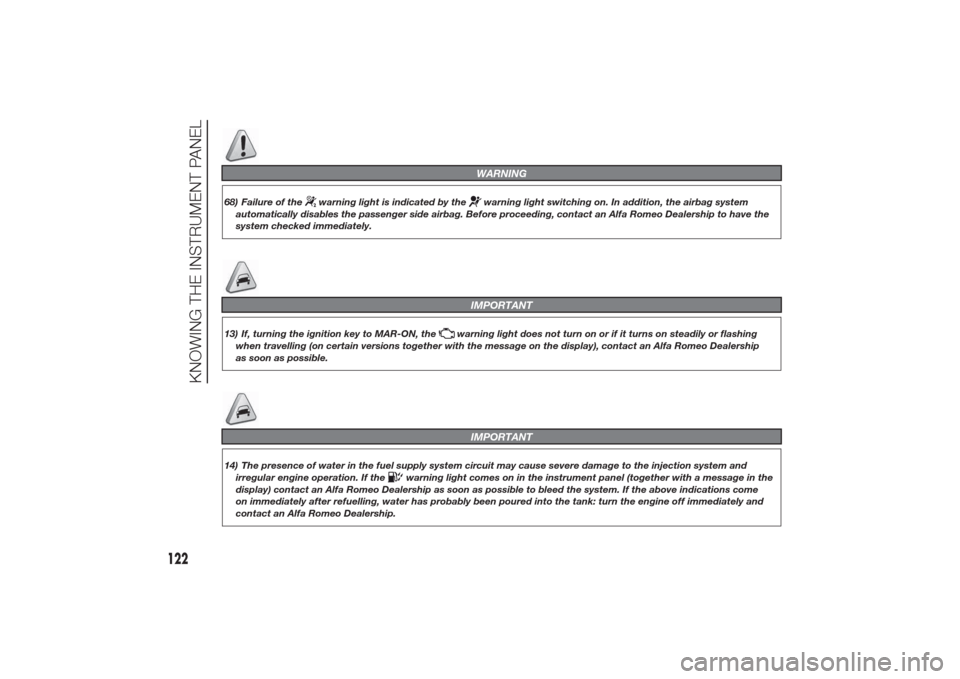
WARNING
68) Failure of the
warning light is indicated by the
warning light switching on. In addition, the airbag system
automatically disables the passenger side airbag. Before proceeding, contact an Alfa Romeo Dealership to have the
system checked immediately.
IMPORTANT
13) If, turning the ignition key to MAR-ON, the
warning light does not turn on or if it turns on steadily or flashing
when travelling (on certain versions together with the message on the display), contact an Alfa Romeo Dealership
as soon as possible.
IMPORTANT
14) The presence of water in the fuel supply system circuit may cause severe damage to the injection system and
irregular engine operation. If the
warning light comes on in the instrument panel (together with a message in the
display) contact an Alfa Romeo Dealership as soon as possible to bleed the system. If the above indications come
on immediately after refuelling, water has probably been poured into the tank: turn the engine off immediately and
contact an Alfa Romeo Dealership.
122
KNOWING THE INSTRUMENT PANEL
Page 129 of 280
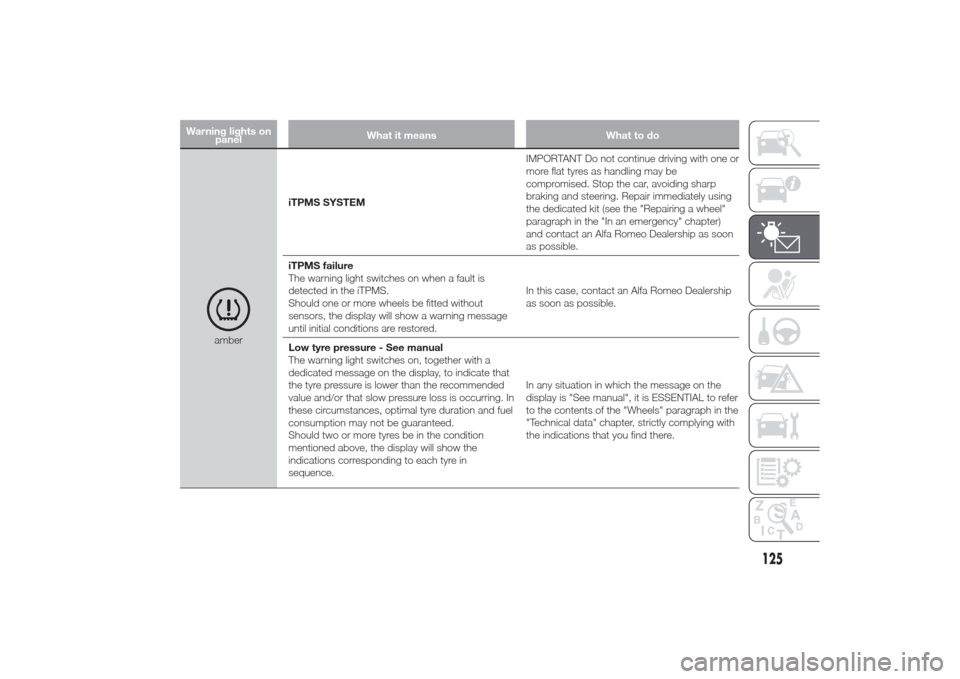
Warning lights on
panelWhat it means What to do
amberiTPMS SYSTEMIMPORTANT Do not continue driving with one or
more flat tyres as handling may be
compromised. Stop the car, avoiding sharp
braking and steering. Repair immediately using
the dedicated kit (see the "Repairing a wheel"
paragraph in the "In an emergency" chapter)
and contact an Alfa Romeo Dealership as soon
as possible.
iTPMS failure
The warning light switches on when a fault is
detected in the iTPMS.
Should one or more wheels be fitted without
sensors, the display will show a warning message
until initial conditions are restored.In this case, contact an Alfa Romeo Dealership
as soon as possible.
Low tyre pressure - See manual
The warning light switches on, together with a
dedicated message on the display, to indicate that
the tyre pressure is lower than the recommended
value and/or that slow pressure loss is occurring. In
these circumstances, optimal tyre duration and fuel
consumption may not be guaranteed.
Should two or more tyres be in the condition
mentioned above, the display will show the
indications corresponding to each tyre in
sequence.In any situation in which the message on the
display is "See manual", it is ESSENTIAL to refer
to the contents of the "Wheels" paragraph in the
"Technical data" chapter, strictly complying with
the indications that you find there.
125
Page 133 of 280
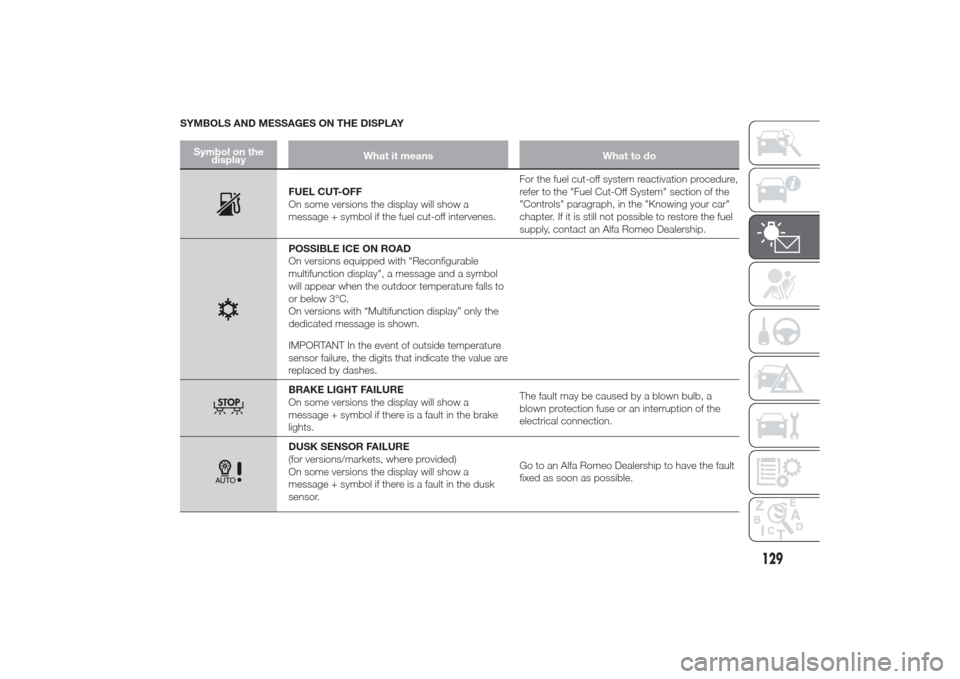
SYMBOLS AND MESSAGES ON THE DISPLAY
Symbol on the
displayWhat it means What to do
FUEL CUT-OFF
On some versions the display will show a
message + symbol if the fuel cut-off intervenes.For the fuel cut-off system reactivation procedure,
refer to the "Fuel Cut-Off System" section of the
"Controls" paragraph, in the "Knowing your car"
chapter. If it is still not possible to restore the fuel
supply, contact an Alfa Romeo Dealership.POSSIBLE ICE ON ROAD
On versions equipped with "Reconfigurable
multifunction display", a message and a symbol
will appear when the outdoor temperature falls to
or below 3°C.
On versions with “Multifunction display” only the
dedicated message is shown.
IMPORTANT In the event of outside temperature
sensor failure, the digits that indicate the value are
replaced by dashes.BRAKE LIGHT FAILURE
On some versions the display will show a
message + symbol if there is a fault in the brake
lights.The fault may be caused by a blown bulb, a
blown protection fuse or an interruption of the
electrical connection.DUSK SENSOR FAILURE
(for versions/markets, where provided)
On some versions the display will show a
message + symbol if there is a fault in the dusk
sensor.Go to an Alfa Romeo Dealership to have the fault
fixed as soon as possible.
129
Page 157 of 280
STARTING AND DRIVING
Let’s get to the "heart" of the car:
seeing how you can exploit all of its
potential to the full.
We’ll look at how to drive it in any
situation, so that it can be a welcome
companion, with our comfort and
our wallets in mind.STARTING THE ENGINE ................15
PARKING ........................................155
USING THE GEARBOX ...................15
ALFA TCT .......................................157
SAVING FUEL .................................164
TOWING TRAILERS ........................16
SNOW TYRES ................................167
SNOW CHAINS...............................167
STORING THE CAR ........................168
153
6
6 4
Page 159 of 280
STOPPING THE ENGINE
Turn the ignition key to STOP while the
engine is idling.
IMPORTANT After a demanding drive,
before turning the engine off you should
let it idle so that the temperature in the
engine compartment decreases.
WARNING
100) It is dangerous to run the
engine in enclosed areas. The
engine takes in oxygen and
releases carbon dioxide, carbon
monoxide and other toxic gases.
101) The brake servo is not active
until the engine is started, so
you would need to apply much
more force than usual to the
brake pedal.
102) Do not start the engine by
pushing, towing or driving
downhill. These manoeuvres may
damage the catalytic converter.
IMPORTANT
16) In the first period of use, we
recommend not to demand
maximum performance from the
car (for instance excessive
accelerations, extended travel at
maximum speed, sudden braking,
etc.).
17) With the engine off, do not leave
the key in the ignition switch on
MAR-ON to prevent draining
the battery.
18) A quick burst on the accelerator
before turning off the engine
serves absolutely no practical
purpose; it wastes fuel and is
especially damaging to
turbocharged engines.
19) If the
warning light flashes
for about 1 minute after starting
or during prolonged cranking, this
indicates a fault in the glow plug
preheating system. If the engine
starts, you may use the car
normally, but should contact an
Alfa Romeo Dealership as soon as
possible.
PARKINGAlways remove the ignition key when
leaving the car.
When parking and leaving the car,
proceed as follows:
❒engage a gear (1st gear if parked
uphill or reverse if facing downhill)
and leave the wheels turned;
❒stop the engine and engage the
handbrake.
Block the wheels with a wedge or a
stone if the car is parked on a steep
slope.
On versions equipped with Alfa TCT
transmission, before releasing the brake
pedal, wait for letter P to be displayed.
IMPORTANTNEVERleave the car
with the gearbox in neutral (or, on
versions equipped with Alfa TCT
transmission, before placing the gear
lever at P).
155
Page 168 of 280
If reverse (R) is engaged, only engage
the 1
stgear (or vice versa) when the car
is completely stopped.
Although it is highly inadvisable, if you
are driving downhill and, for unexpected
reasons, you let the car move forward
with the transmission in neutral (N),
when there is a request to engage
a gear, depending on the speed of the
car, the system will automatically
engage the best gear for the correct
transmission of drive torque to the
wheels.
107)IMPORTANT
21) If the car is on a gradient, always
pull the handbrake BEFORE
placing the gear lever in P.
22) Engage reverse only with the car
stationary, engine at idling speed
and accelerator fully released.
WARNING
106) Using the levers incorrectly
(levers pushed towards the
dashboard, see fig. 137) could
break them.
107) Never leave children
unattended in the car. Always
remove the ignition key when
leaving the car and take the key
with you.
SAVING FUELHere are some suggestions which can
help you to save fuel and lower harmful
emissions.
GENERAL
CONSIDERATIONS
Car maintenance
Checks and adjustments should be
carried out in accordance with the
“Scheduled Servicing Plan” (see
chapter “Maintenance and care”).
Tyres
Check the tyre pressures at least once
every four weeks: if the pressure is
too low, consumption levels increase as
resistance to rolling is higher.
Unnecessary loads
Do not travel with an overloaded boot.
The weight of the car and its
arrangement greatly affect fuel
consumption and stability.
164
STARTING AND DRIVING
Page 169 of 280
Roof rack/ski rack
Remove the roof rack or the ski rack
from the roof after use. These
accessories lower aerodynamic
penetration and adversely affect
consumption levels. When transporting
particularly large objects, use a trailer
if possible.
Electrical devices
Use the electrical devices only for the
necessary amount of time. The heated
rear window, additional headlights,
screen wipers and heater fan require a
considerable amount of energy;
increasing the current uptake increases
fuel consumption (by up to +25% in
an urban cycle).
Climate control system
Using the climate control system will
increase consumption: use the air vents
when the temperature outside permits.
Devices for
aerodynamic control
The use of non-certified devices for
aerodynamic control may adversely
affect air drag and fuel consumption.DRIVING STYLE
Starting
Do not warm up the engine at low or
high revs when the car is stationary;
this causes the engine to warm up
more slowly, thereby increasing fuel
consumption and emissions. It is
therefore advisable to move off
immediately, slowly, avoiding high
speeds: in this way the engine will
warm up more quickly.
Unnecessary actions
Avoid accelerating when stopped at
traffic lights or before switching off the
engine. The latter action, as well as
double-declutching, is unnecessary and
causes increased fuel consumption
and pollution.
Gear selection
Use a high gear when traffic and road
conditions allow it. Using a low gear for
faster acceleration will increase fuel
consumption. In the same way
improper use of a high gear increases
consumption, emissions and engine
wear.Maximum speed
Fuel consumption considerably
increases as speed increases. Maintain
a constant speed, avoiding
unnecessary braking and acceleration,
which cost in terms of both fuel
consumption and emissions.
Acceleration
Accelerating violently severely affects
consumption and emissions:
acceleration should be gradual and
should not exceed the maximum
torque.
165
Page 170 of 280
CONDITIONS OF USE
Cold starting
Short distances and frequent cold
start-ups will prevent the engine from
reaching optimal running temperature.
This results in a significant increase
in consumption levels (from +15 to
+30% on the urban cycle) and
emissions.
Traffic and road
conditions
High fuel consumption is caused by
heavy traffic, for instance when
travelling in a queue with frequent use
of low gears or in large towns with
many traffic lights. Winding mountain
roads and rough road surfaces also
adversely affect consumption.
Stops in traffic
During prolonged hold-ups (e.g. level
crossings) switch off the engine.
TOWING TRAILERSIMPORTANT
The vehicle must be provided with a
type-approved tow hook and adequate
electrical system to tow caravans or
trailers. Installation must be carried out
by a specialist.
Fit any specific and/or additional rear
view mirrors as specified by the
Highway Code.
Remember that when towing a trailer,
steep hills are harder to climb, the
braking spaces increase and overtaking
takes longer depending on the overall
weight.
Engage a low gear when driving
downhill, rather than constantly using
the brake.
The weight of the trailer reduces the
load capacity of the car by the same
amount. Consider the weight at full
load, including accessories and
luggage, to make sure you do not
exceed the maximum towable weight
(shown in the registration document).
Do not exceed the speed limits specific
to each country you are driving in, in
the case of vehicles towing trailers.
In any case do not exceed 100 km/h.INSTALLING A TOW
HOOK
Contact an Alfa Romeo Dealership to
install a tow hook.
108) 109)
WARNING
108) The ABS with which the car is
equipped will not control the
braking system of the trailer.
Particular caution is therefore
required when travelling on
slippery roads.
109) Never modify the braking
system of the car to control the
trailer brake. The trailer braking
system must be fully independent
from the hydraulic system of the
car.
166
STARTING AND DRIVING
Page 174 of 280
STARTING THE
ENGINEContact the Alfa Romeo Dealership
immediately if the warning light
stays on constantly on the
instrument panel.
JUMP STARTING
If the battery is flat, start the engine
using an auxiliary battery with the same
capacity or a little higher than the flat
one.
24) 25)
111)
Proceed as follows to start the car:
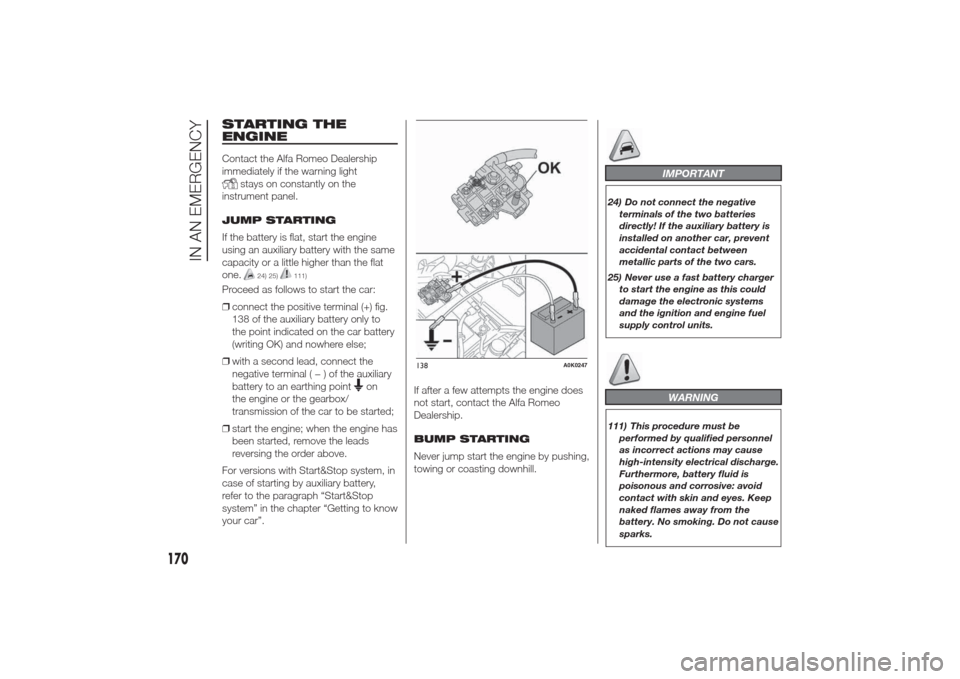
❒connect the positive terminal (+) fig.
138 of the auxiliary battery only to
the point indicated on the car battery
(writing OK) and nowhere else;
❒with a second lead, connect the
negative terminal(−)oftheauxiliary
battery to an earthing point
on
the engine or the gearbox/
transmission of the car to be started;
❒start the engine; when the engine has
been started, remove the leads
reversing the order above.
For versions with Start&Stop system, in
case of starting by auxiliary battery,
refer to the paragraph “Start&Stop
system” in the chapter “Getting to know
your car”.If after a few attempts the engine does
not start, contact the Alfa Romeo
Dealership.
BUMP STARTING
Never jump start the engine by pushing,
towing or coasting downhill.
IMPORTANT
24) Do not connect the negative
terminals of the two batteries
directly! If the auxiliary battery is
installed on another car, prevent
accidental contact between
metallic parts of the two cars.
25) Never use a fast battery charger
to start the engine as this could
damage the electronic systems
and the ignition and engine fuel
supply control units.
WARNING
111) This procedure must be
performed by qualified personnel
as incorrect actions may cause
high-intensity electrical discharge.
Furthermore, battery fluid is
poisonous and corrosive: avoid
contact with skin and eyes. Keep
naked flames away from the
battery. No smoking. Do not cause
sparks.
138
A0K0247
170
IN AN EMERGENCY
Page 195 of 280
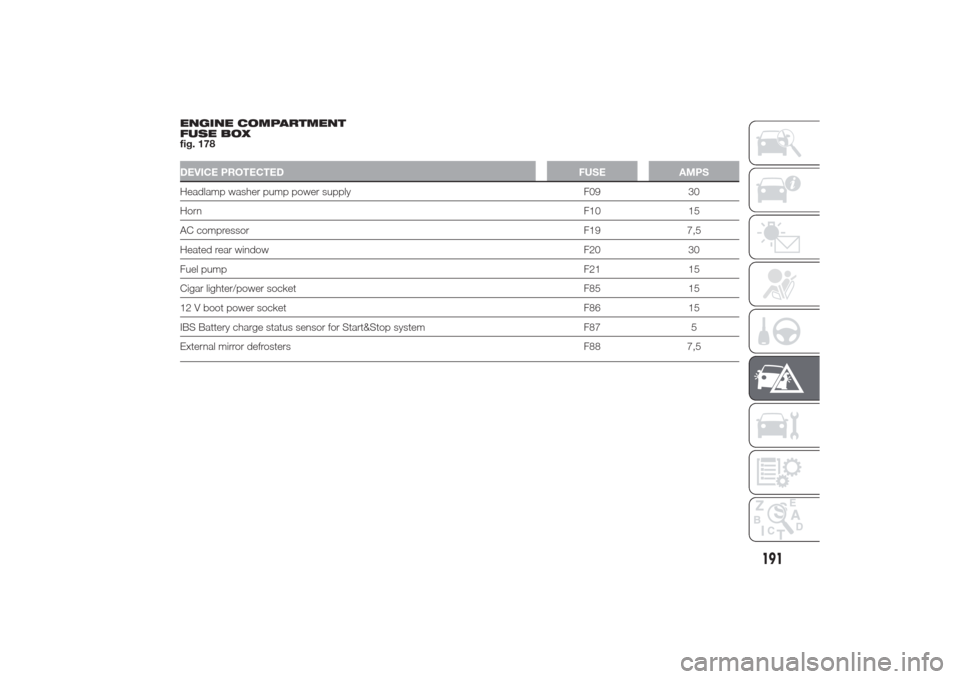
ENGINE COMPARTMENT
FUSE BOX
fig. 178DEVICE PROTECTED FUSE AMPSHeadlamp washer pump power supply F09 30
HornF10 15
AC compressorF19 7,5
Heated rear window F20 30
Fuel pumpF21 15
Cigar lighter/power socket F85 15
12 V boot power socket F86 15
IBS Battery charge status sensor for Start&Stop system F87 5
External mirror defrosters F88 7,5
191