ESP Alfa Romeo Giulietta 2016 User Guide
[x] Cancel search | Manufacturer: ALFA ROMEO, Model Year: 2016, Model line: Giulietta, Model: Alfa Romeo Giulietta 2016Pages: 288, PDF Size: 7.34 MB
Page 49 of 288
CENTRAL LOCKING
Operation
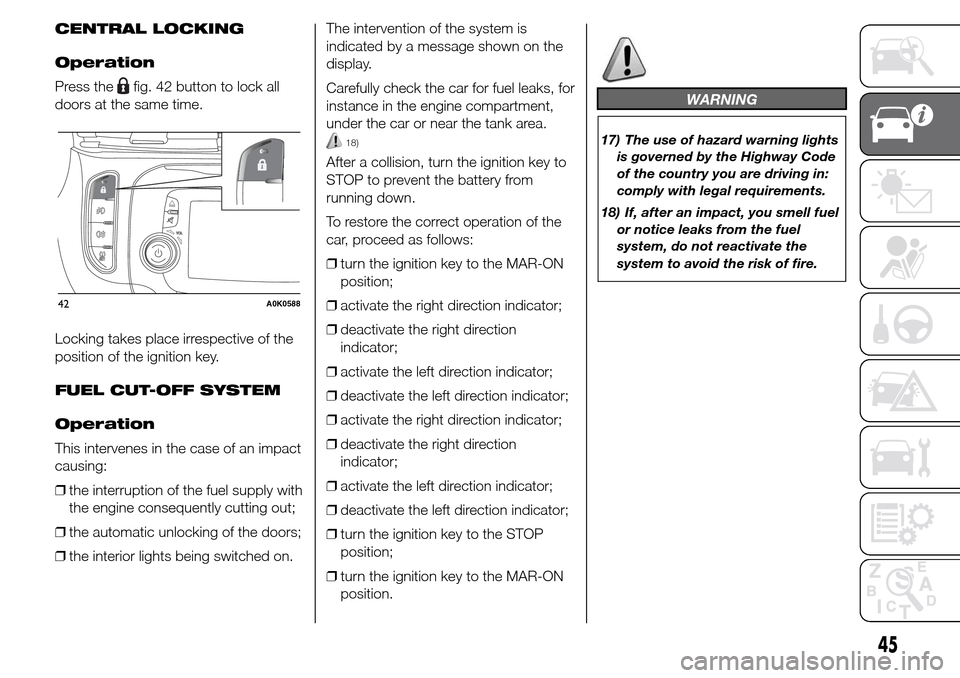
Press the
fig. 42 button to lock all
doors at the same time.
Locking takes place irrespective of the
position of the ignition key.
FUEL CUT-OFF SYSTEM
Operation
This intervenes in the case of an impact
causing:
❒the interruption of the fuel supply with
the engine consequently cutting out;
❒the automatic unlocking of the doors;
❒the interior lights being switched on.The intervention of the system is
indicated by a message shown on the
display.
Carefully check the car for fuel leaks, for
instance in the engine compartment,
under the car or near the tank area.
18)
After a collision, turn the ignition key to
STOP to prevent the battery from
running down.
To restore the correct operation of the
car, proceed as follows:
❒turn the ignition key to the MAR-ON
position;
❒activate the right direction indicator;
❒deactivate the right direction
indicator;
❒activate the left direction indicator;
❒deactivate the left direction indicator;
❒activate the right direction indicator;
❒deactivate the right direction
indicator;
❒activate the left direction indicator;
❒deactivate the left direction indicator;
❒turn the ignition key to the STOP
position;
❒turn the ignition key to the MAR-ON
position.
WARNING
17) The use of hazard warning lights
is governed by the Highway Code
of the country you are driving in:
comply with legal requirements.
18) If, after an impact, you smell fuel
or notice leaks from the fuel
system, do not reactivate the
system to avoid the risk of fire.
42A0K0588
45
Page 64 of 288
WARNING
26) For safety reasons, the bonnet
must always be properly closed
while driving. Therefore, make
sure that the bonnet is properly
closed and that the lock is
engaged. If you discover that the
bonnet is not perfectly closed
during travel, stop immediately
and close the bonnet in the
correct manner.
27) Perform these operations only
when the car is stationary.
ROOF RACK/SKI
RACK
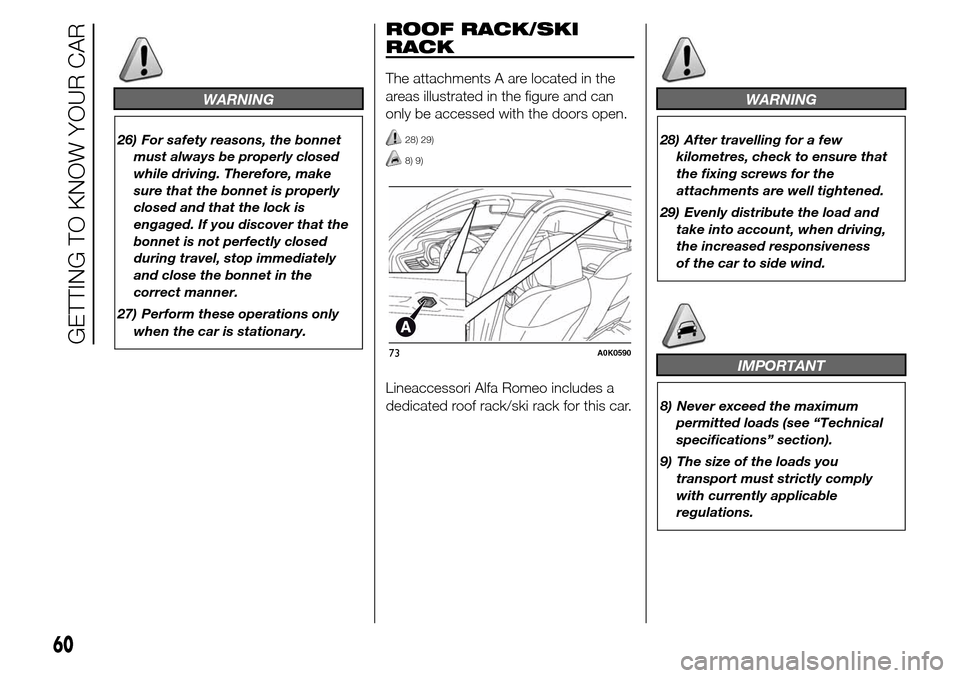
The attachments A are located in the
areas illustrated in the figure and can
only be accessed with the doors open.
28) 29)
8) 9)
Lineaccessori Alfa Romeo includes a
dedicated roof rack/ski rack for this car.
WARNING
28) After travelling for a few
kilometres, check to ensure that
the fixing screws for the
attachments are well tightened.
29) Evenly distribute the load and
take into account, when driving,
the increased responsiveness
of the car to side wind.
IMPORTANT
8) Never exceed the maximum
permitted loads (see “Technical
specifications” section).
9) The size of the loads you
transport must strictly comply
with currently applicable
regulations.
73A0K0590
60
GETTING TO KNOW YOUR CAR
Page 66 of 288
ESC SYSTEM
IN BRIEF
The ESC system improves the
directional control and stability of the
car in various driving conditions.
The ESC system corrects the car’s
understeer and oversteer, distributing
the brake force on the appropriate
wheels. The torque supplied by
the engine can also be reduced in
order to maintain control of the car.
30) 31) 32) 33) 34)
The ESC system uses sensors installed
on the car to determine the trajectory
that the driver intends to follow and
compares it with the car’s effective
trajectory. When the real trajectory
deviates from the desired trajectory, the
ESC system intervenes to counter the
car’s understeer or oversteer.
❒Oversteer: occurs when the car is
turning more than it should according
to the angle of the steering wheel.
❒Understeer: occurs when the car is
turning less than it should according
to the angle of the steering wheel.The ESC system also includes the
following systems:
❒EBD
❒ABS
❒CBC
❒ASR
❒HILL HOLDER
❒HBA
❒MSR
❒DST
❒“ELECTRONIC Q2” (“E-Q2”)
❒"PRE-FILL" (RAB - Ready Alert
Brake)
SYSTEM ACTIVATION
The ESC system switches on
automatically when the engine is
started and cannot be switched off.
SYSTEM INTERVENTION
This is indicated by the flashing of the
warning light on the instrument
panel, to inform the driver that the car is
in critical stability and grip conditions.EBD SYSTEM
The EBD system is an integral part of
the ESC system and intervenes during
braking, distributing the brake force
optimally between front and rear
wheels.
This guarantees greater braking stability
for the car, preventing sudden locking
of the rear wheels and the consequent
instability of the car.
ABS
This system, which is an integral part of
the braking system, prevents one or
more wheels from locking and slipping
in all road surface conditions,
irrespective of the intensity of the
braking action, ensuring that the car
can be controlled even during
emergency braking and optimising
stopping distances.
The system intervenes when braking
and the wheels are about to lock,
typically in emergency braking or
low-grip conditions, when locking may
be more frequent.
The system also improves control and
stability of the car when braking on a
surface where the grip of the left and
right wheels varies, or on corners.
62
GETTING TO KNOW YOUR CAR
Page 68 of 288
IMPORTANT There may be situations
on small gradients (less than 8%),
with car laden, in which the Hill Holder
system may not activate, causing a
slight reversing motion and increasing
the risk of collision with another vehicle
or object. The driver is, in any case,
responsible for safe driving.
HBA (Hydraulic Brake
Assist) SYSTEM
45) 46) 47)
The HBA system is designed to
improve the car's braking capacity
during emergency braking. The system
detects emergency braking by
monitoring the speed and force with
which the brake pedal is pressed, and
consequently applies the optimal brake
pressure. This can reduce the braking
distance: the HBA system therefore
completes the ABS.
Maximum assistance from the HBA
system is obtained by pressing the
brake pedal very quickly. In addition,
the brake pedal should be pressed
continuously during braking, avoiding
intermittent presses, to get the most
out of the system.
Do not reduce pressure on the brake
pedal until braking is not necessary
anymore.The HBA system is deactivated when
the brake pedal is released.
MSR (Motor
Schleppmoment
Regelung) SYSTEM
This system is an integral part of the
ABS, that intervenes, if there is a
sudden downshifting, restoring torque
to the engine, thereby preventing
excessive drive at the drive wheels
which, especially in poor grip
conditions, could lead to a loss in
stability of the car.
DST SYSTEM (Dynamic
Steering Torque)
This function integrates Dual Pinion
active steering into the operation of
ESC. For particular manoeuvres, the
ESC system controls the steering
to actuate a steering torque and assist
the driver in the best possible way.
The system operates the brakes and
steering in a coordinated manner to
increase the suspension and safety
level of the car as a whole. The steering
provides additional torque on the
steering wheel.“ELECTRONIC Q2”
SYSTEM (“E-Q2”)
The "Electronic Q2" system intervenes
during acceleration on corners, braking
the inner drive wheel and thus
increasing the traction of the outer
wheel (which bears more of the car’s
weight): the torque is thus distributed
optimally between the drive wheels
in accordance with the driving
conditions and road surface, permitting
particularly effective, sporty driving.
"PRE-FILL" SYSTEM
(RAB - Ready Alert
Brake)
(only with 'Dynamic" mode activated)
This function activates automatically
if the accelerator pedal is released
rapidly, reducing the brake pad travel
(both at front and back), with the aim of
preparing the braking system and
enhancing its responsiveness, thus
reducing the stopping distance in the
event of subsequent braking.
64
GETTING TO KNOW YOUR CAR
Page 69 of 288
WARNING
30) The ESC system can’t alter the
natural laws of physics, and can’t
increase grip which depends on
the condition of the road.
31) The ESC system cannot prevent
accidents, including those due to
excessive speed on corners,
driving on low-grip surfaces or
aquaplaning.
32) The capability of the ESC system
must never be tested irresponsibly
and dangerously, in such a way
as to compromise personal safety
and the safety of others.
33) For the correct operation of the
ASR system, the tyres must of
necessity be the same make and
type on all wheels, in perfect
condition and, above all, of the
prescribed type and dimensions.
34) The performance of the ESC
and ASR systems must not
encourage the driver to take
unnecessary risks. Your driving
style must always be suited to the
road conditions, visibility and
traffic. The driver is always
responsible for road safety.35) When the ABS intervenes and
you feel the brake pedal pulsating,
do not reduce the pressure, but
hold it down firmly and
confidently; in doing so you will
brake in the shortest distance
possible, depending on the
current road conditions.
36) For maximum efficiency of the
braking system, a bedding-in
period of about 500 km is
required: during this period it is
advisable to avoid sharp, repeated
and prolonged braking.
37) If the ABS intervenes, this
indicates that the grip of the tyres
on the road is nearing its limit:
you must slow down to a speed
compatible with the available grip.
38) The ABS can’t overrule the
natural laws of physics, and can’t
increase the grip available
according to the condition of the
road.
39) The ABS cannot prevent
accidents, including those due to
excessive speed on corners,
driving on low-grip surfaces or
aquaplaning.
40) The capability of the ABS must
never be tested irresponsibly and
dangerously, in such a way as
to compromise personal safety
and the safety of others.41) For the correct operation of the
ABS, the tyres must of necessity
be the same make and type on all
wheels, in perfect condition and,
above all, of the prescribed type
and dimensions.
42) The ASR system can’t overrule
the natural laws of physics, and
can’t increase the grip available
according to the condition of
the road.
43) The ASR system cannot prevent
accidents, including those due to
excessive speed on corners,
driving on low-grip surfaces or
aquaplaning.
44) The capability of the ASR system
must never be tested irresponsibly
and dangerously, in such a way
as to compromise personal safety
and the safety of others.
45) The HBA system can’t alter the
natural laws of physics, and can’t
increase grip which depends on
the condition of the road.
46) The HBA system cannot prevent
accidents, including those due to
excessive speed on corners,
driving on low-grip surfaces or
aquaplaning.
65
Page 70 of 288
47) The capability of the HBA system
must never be tested irresponsibly
and dangerously, in such a way
as to compromise the safety of
the driver, the other occupants of
the car or any other road user.“Alfa DNA” SYSTEM
(Car dynamic
control system)
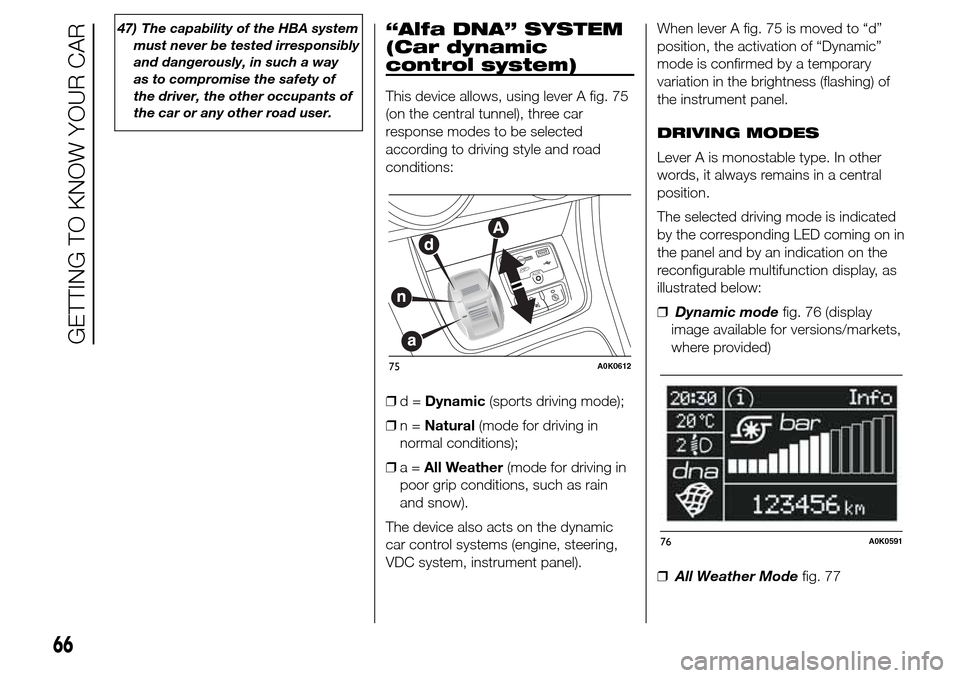
This device allows, using lever A fig. 75
(on the central tunnel), three car
response modes to be selected
according to driving style and road
conditions:
❒d=Dynamic(sports driving mode);
❒n=Natural(mode for driving in
normal conditions);
❒a=All Weather(mode for driving in
poor grip conditions, such as rain
and snow).
The device also acts on the dynamic
car control systems (engine, steering,
VDC system, instrument panel).When lever A fig. 75 is moved to “d”
position, the activation of “Dynamic”
mode is confirmed by a temporary
variation in the brightness (flashing) of
the instrument panel.
DRIVING MODES
Lever A is monostable type. In other
words, it always remains in a central
position.
The selected driving mode is indicated
by the corresponding LED coming on in
the panel and by an indication on the
reconfigurable multifunction display, as
illustrated below:
❒Dynamic modefig. 76 (display
image available for versions/markets,
where provided)
❒All Weather Modefig. 77
75A0K0612
76A0K0591
66
GETTING TO KNOW YOUR CAR
Page 71 of 288
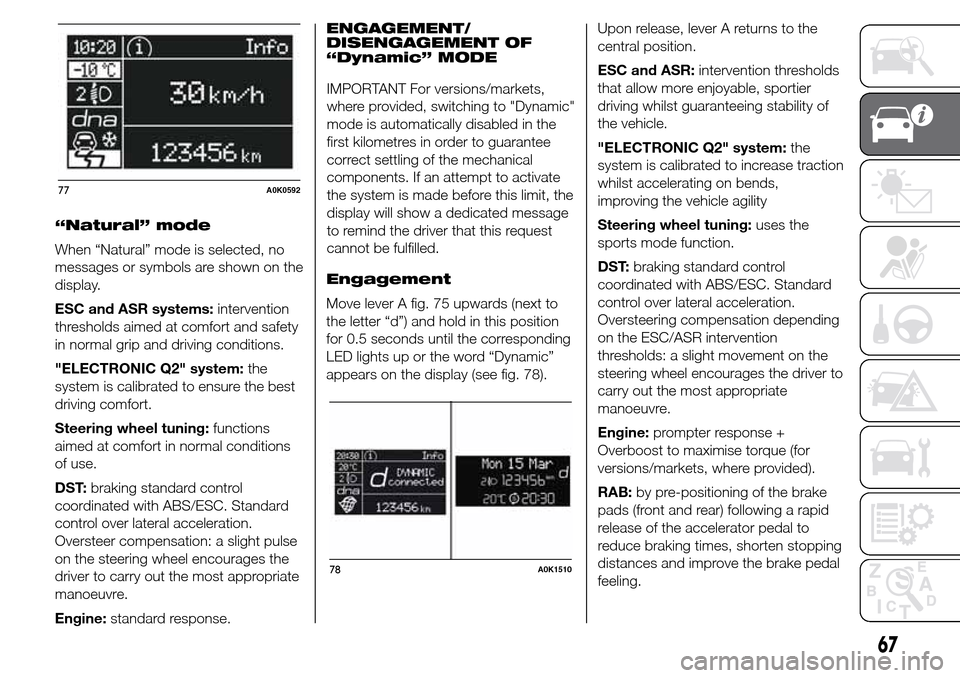
“Natural” mode
When “Natural” mode is selected, no
messages or symbols are shown on the
display.
ESC and ASR systems:intervention
thresholds aimed at comfort and safety
in normal grip and driving conditions.
"ELECTRONIC Q2" system:the
system is calibrated to ensure the best
driving comfort.
Steering wheel tuning:functions
aimed at comfort in normal conditions
of use.
DST:braking standard control
coordinated with ABS/ESC. Standard
control over lateral acceleration.
Oversteer compensation: a slight pulse
on the steering wheel encourages the
driver to carry out the most appropriate
manoeuvre.
Engine:standard response.ENGAGEMENT/
DISENGAGEMENT OF
“Dynamic” MODE
Engagement
Move lever A fig. 75 upwards (next to
the letter “d”) and hold in this position
for 0.5 seconds until the corresponding
LED lights up or the word “Dynamic”
appears on the display (see fig. 78).Upon release, lever A returns to the
central position.
ESC and ASR:intervention thresholds
that allow more enjoyable, sportier
driving whilst guaranteeing stability of
the vehicle.
"ELECTRONIC Q2" system:the
system is calibrated to increase traction
whilst accelerating on bends,
improving the vehicle agility
Steering wheel tuning:uses the
sports mode function.
DST:braking standard control
coordinated with ABS/ESC. Standard
control over lateral acceleration.
Oversteering compensation depending
on the ESC/ASR intervention
thresholds: a slight movement on the
steering wheel encourages the driver to
carry out the most appropriate
manoeuvre.
Engine:prompter response +
Overboost to maximise torque (for
versions/markets, where provided).
RAB:by pre-positioning of the brake
pads (front and rear) following a rapid
release of the accelerator pedal to
reduce braking times, shorten stopping
distances and improve the brake pedal
feeling.
77A0K0592
78A0K1510
67
IMPORTANT For versions/markets,
where provided, switching to "Dynamic"
mode is automatically disabled in the
first kilometres in order to guarantee
correct settling of the mechanical
components. If an attempt to activate
the system is made before this limit, the
display will show a dedicated message
to remind the driver that this request
cannot be fulfilled.
Page 72 of 288
The activation of the Dynamic mode is
also shown by the change in the
instrument panel lighting that, after
decreasing, reaches the highest
luminosity and then returns to the
previously set values.
Disengagement
To deactivate “Dynamic” mode and
return to “Natural”, repeat the same
movement of the lever within the same
times. In this case, the LED
corresponding to “Natural” mode will
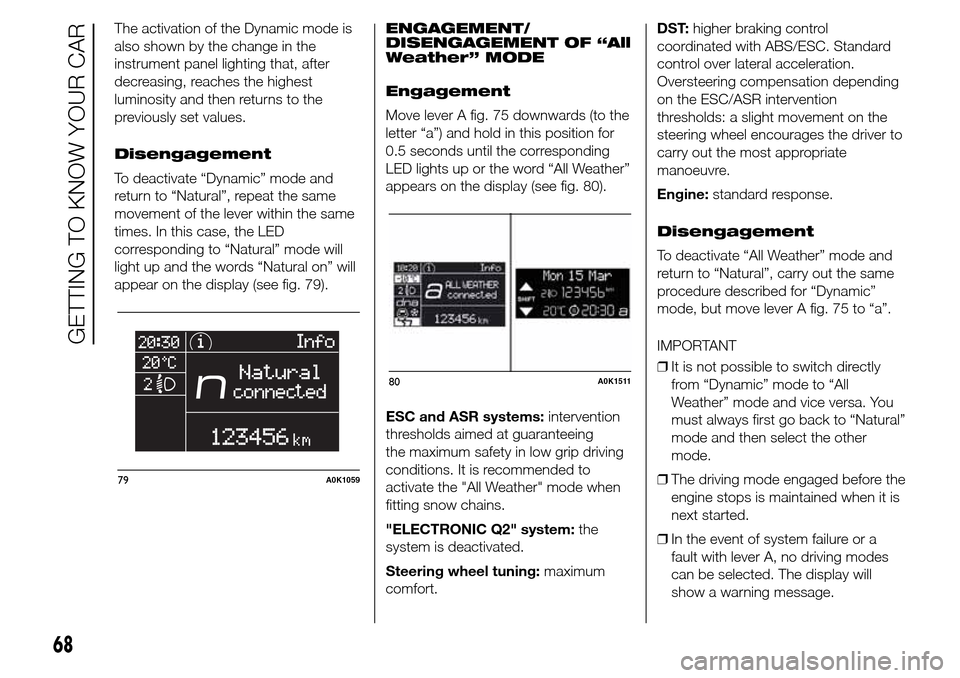
light up and the words “Natural on” will
appear on the display (see fig. 79).ENGAGEMENT/
DISENGAGEMENT OF “All
Weather” MODE
Engagement
Move lever A fig. 75 downwards (to the
letter “a”) and hold in this position for
0.5 seconds until the corresponding
LED lights up or the word “All Weather”
appears on the display (see fig. 80).
ESC and ASR systems:intervention
thresholds aimed at guaranteeing
the maximum safety in low grip driving
conditions. It is recommended to
activate the "All Weather" mode when
fitting snow chains.
"ELECTRONIC Q2" system:the
system is deactivated.
Steering wheel tuning:maximum
comfort.DST:higher braking control
coordinated with ABS/ESC. Standard
control over lateral acceleration.
Oversteering compensation depending
on the ESC/ASR intervention
thresholds: a slight movement on the
steering wheel encourages the driver to
carry out the most appropriate
manoeuvre.
Engine:standard response.
Disengagement
To deactivate “All Weather” mode and
return to “Natural”, carry out the same
procedure described for “Dynamic”
mode, but move lever A fig. 75 to “a”.
IMPORTANT
❒It is not possible to switch directly
from “Dynamic” mode to “All
Weather” mode and vice versa. You
must always first go back to “Natural”
mode and then select the other
mode.
❒The driving mode engaged before the
engine stops is maintained when it is
next started.
❒In the event of system failure or a
fault with lever A, no driving modes
can be selected. The display will
show a warning message.
79A0K1059
80A0K1511
68
GETTING TO KNOW YOUR CAR
Page 73 of 288
START&STOP
SYSTEM
(for versions/markets, where provided)
IN BRIEF
The Start&Stop system automatically
stops the engine each time the car
is stationary and starts it again when
the driver wants to move off.
In this way, the efficiency of the car is
increased, by reducing consumption,
emissions of harmful gases and
noise pollution.
OPERATING MODES
Engine stopping mode
With the car stopped, the engine stops
with gearbox in neutral and clutch
pedal released.
NOTE The engine can only be stopped
automatically after exceeding about
10 km/h, to prevent the engine from
being repeatedly stopped when driving
at walking pace.
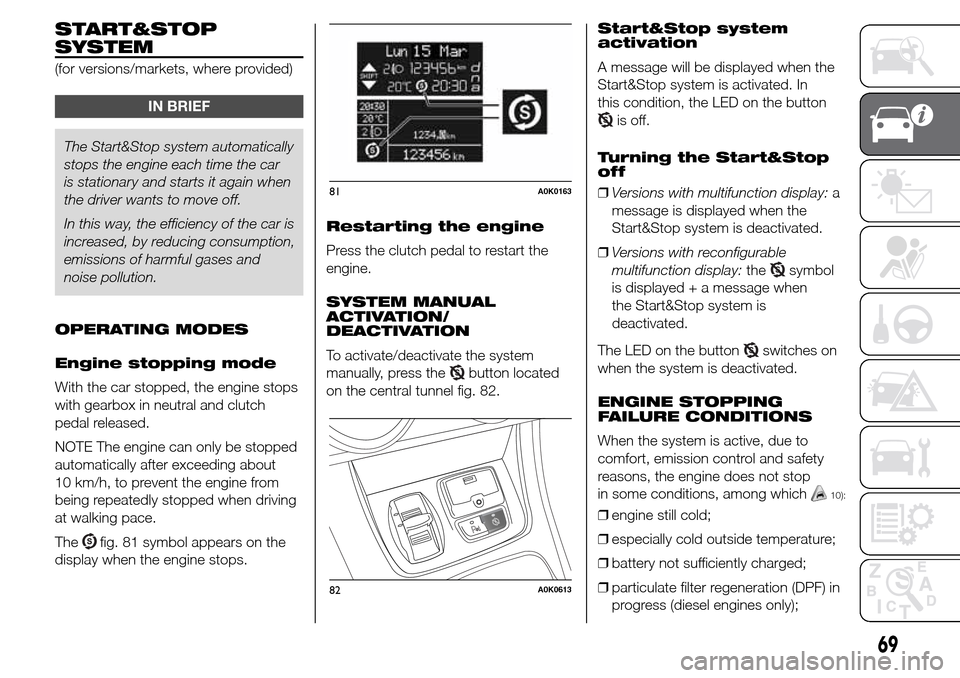
The
fig. 81 symbol appears on the
display when the engine stops.Restarting the engine
Press the clutch pedal to restart the
engine.
SYSTEM MANUAL
ACTIVATION/
DEACTIVATION
To activate/deactivate the system
manually, press the
button located
on the central tunnel fig. 82.Start&Stop system
activation
A message will be displayed when the
Start&Stop system is activated. In
this condition, the LED on the button
is off.
Turning the Start&Stop
off
❒Versions with multifunction display:a
message is displayed when the
Start&Stop system is deactivated.
❒Versions with reconfigurable
multifunction display:the
symbol
is displayed + a message when
the Start&Stop system is
deactivated.
The LED on the button
switches on
when the system is deactivated.
ENGINE STOPPING
FAILURE CONDITIONS
When the system is active, due to
comfort, emission control and safety
reasons, the engine does not stop
in some conditions, among which
10):
❒engine still cold;
❒especially cold outside temperature;
❒battery not sufficiently charged;
❒particulate filter regeneration (DPF) in
progress (diesel engines only);
81A0K0163
82A0K0613
69
Page 82 of 288
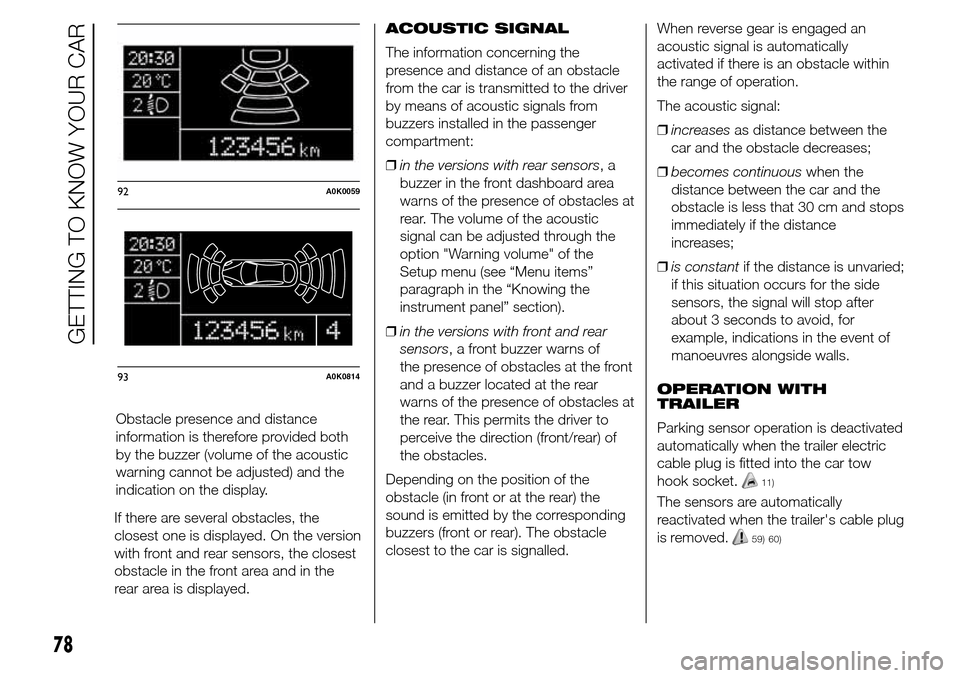
If there are several obstacles, the
closest one is displayed. On the version
with front and rear sensors, the closest
obstacle in the front area and in the
rear area is displayed.ACOUSTIC SIGNAL
The information concerning the
presence and distance of an obstacle
from the car is transmitted to the driver
by means of acoustic signals from
buzzers installed in the passenger
compartment:
❒in the versions with rear sensors,a
buzzer in the front dashboard area
warns of the presence of obstacles at
rear. The volume of the acoustic
signal can be adjusted through the
option "Warning volume" of the
Setup menu (see “Menu items”
paragraph in the “Knowing the
instrument panel” section).
❒in the versions with front and rear
sensors, a front buzzer warns of
the presence of obstacles at the front
and a buzzer located at the rear
warns of the presence of obstacles at
the rear. This permits the driver to
perceive the direction (front/rear) of
the obstacles.
Depending on the position of the
obstacle (in front or at the rear) the
sound is emitted by the corresponding
buzzers (front or rear). The obstacle
closest to the car is signalled.When reverse gear is engaged an
acoustic signal is automatically
activated if there is an obstacle within
the range of operation.
The acoustic signal:
❒increasesas distance between the
car and the obstacle decreases;
❒becomes continuouswhen the
distance between the car and the
obstacle is less that 30 cm and stops
immediately if the distance
increases;
❒is constantif the distance is unvaried;
if this situation occurs for the side
sensors, the signal will stop after
about 3 seconds to avoid, for
example, indications in the event of
manoeuvres alongside walls.
OPERATION WITH
TRAILER
Parking sensor operation is deactivated
automatically when the trailer electric
cable plug is fitted into the car tow
hook socket.
11)
The sensors are automatically
reactivated when the trailer's cable plug
is removed.
59) 60)
92A0K0059
93A0K0814
78
GETTING TO KNOW YOUR CAR
Obstacle presence and distance
information is therefore provided both
by the buzzer (volume of the acoustic
warning cannot be adjusted) and the
indication on the display.