ESP Alfa Romeo Giulietta 2016 Owner's Guide
[x] Cancel search | Manufacturer: ALFA ROMEO, Model Year: 2016, Model line: Giulietta, Model: Alfa Romeo Giulietta 2016Pages: 288, PDF Size: 7.34 MB
Page 84 of 288
60) Parking and other dangerous
manoeuvres are, however, always
the driver’s responsibility. While
carrying out these manoeuvres,
always make sure that no people
(especially children) or animals are
in the area concerned. The
parking sensors are an aid for the
driver, but the driver must never
allow their attention to lapse
during potentially dangerous
manoeuvres, even those executed
at low speeds.REFUELLING THE
CAR
Stop the engine before refuelling.
PETROL ENGINES
Only use unleaded petrol 95 R.O.N.
compliant with the European
specification EN228. The petrol octane
rating (R.O.N.) must not be lower than
95. In order to prevent damage to
the catalytic converter never introduce
even the smallest amount of leaded
petrol, even in the event of an
emergency.
DIESEL ENGINES
Use only diesel fuel compliant with
European specification EN590. The use
of other products or mixtures may
damage the engine beyond repair and
consequently invalidate the warranty,
due to the damage caused.
Operation at low
temperatures
If the outside temperature is very low,
the diesel thickens due to the formation
of paraffin clots with consequent
defective operation of the fuel supply
system.In order to avoid these problems,
different types of diesel are distributed
according to the season: summer type,
winter type and arctic type (cold,
mountain areas).
If refuelling with diesel whose
specifications are not suitable for the
usage temperature, it is advisable
to mix TUTELA DIESEL ART additive in
the proportions shown on the container
with the fuel. Pour the additive into
the tank before the fuel.
When using or parking the car for a
long time in the mountains or cold
areas, it is advisable to refuel using
locally available fuel. In this case, it is
also advisable to keep the tank over
50% full.
FILLING THE TANK
To fill the tank completely, top-up twice
after the first click of the fuel supply
gun. Further top-ups could cause faults
in the fuel feeding system.
FUEL TANK CAP
The fuel flap is unlocked when the
central locking system is released and
automatically locked when the central
locking system is applied.
80
GETTING TO KNOW YOUR CAR
Page 124 of 288
Warning lights on
panelWhat it means What to do
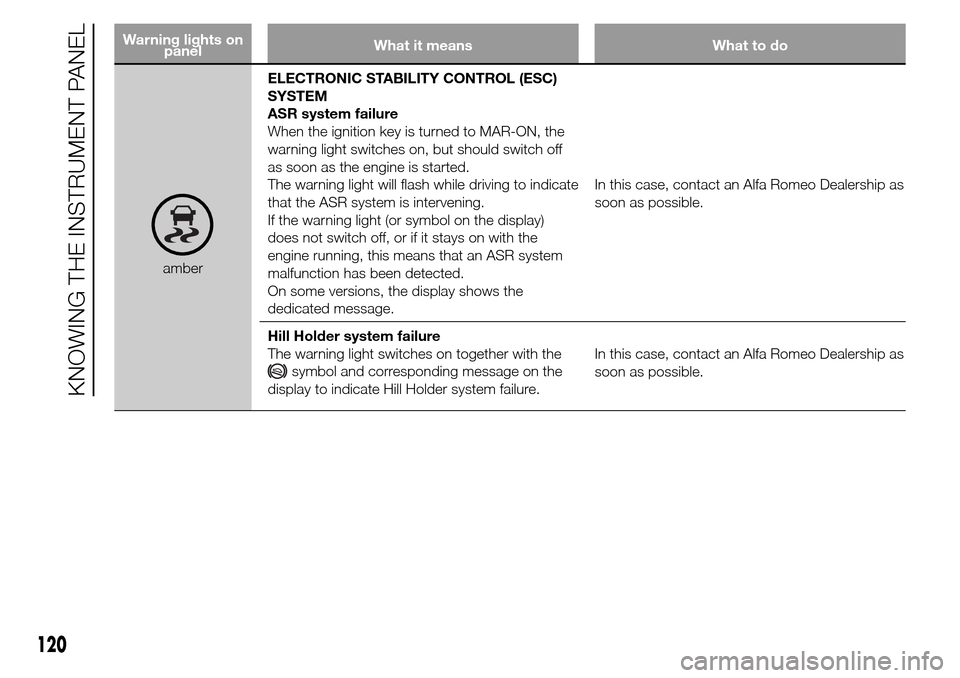
amberELECTRONIC STABILITY CONTROL (ESC)
SYSTEM
ASR system failure
When the ignition key is turned to MAR-ON, the
warning light switches on, but should switch off
as soon as the engine is started.
The warning light will flash while driving to indicate
that the ASR system is intervening.
If the warning light (or symbol on the display)
does not switch off, or if it stays on with the
engine running, this means that an ASR system
malfunction has been detected.
On some versions, the display shows the
dedicated message.In this case, contact an Alfa Romeo Dealership as
soon as possible.
Hill Holder system failure
The warning light switches on together with the
symbol and corresponding message on the
display to indicate Hill Holder system failure.In this case, contact an Alfa Romeo Dealership as
soon as possible.
120
KNOWING THE INSTRUMENT PANEL
Page 135 of 288
PRETENSIONERS
The car is equipped with front seat belt
pretensioners, which draw back the
seat belts by several centimetres in the
event of a violent frontal impact. This
guarantees the perfect adherence
of the seat belts to the occupants’
bodies before the restraining action
begins.
It is evident that the pretensioners have
been activated when the belt withdraws
towards the reel.
The car is also equipped with a second
pretensioner (in the kick plate area).
Its activation is signalled by the
shortening of the metal cable.
A slight discharge of smoke may be
produced during the activation of the
pretensioner. This is not harmful and
does not indicate the start of a fire.
IMPORTANT To obtain the highest
degree of protection from the action of
the pretensioner, wear the seat belt
tight to the chest and pelvis.The pretensioner does not require any
maintenance or lubrication: any
changes to its original conditions will
invalidate its efficiency. If, due to
unusual natural events (floods, sea
storms, etc.), the device has been
affected by water and/or mud, contact
an Alfa Romeo Dealership to have it
replaced.
LOAD LIMITERS
To increase protection, the front seat
belt reels contain a load limiter which
controls the force acting on the chest
and shoulders during the belt
restraining action in the event of a
head-on collision.
73)
15)
GENERAL
INSTRUCTIONS FOR
USING THE SEAT BELTS
Respect and ensure that all the other
occupants of the car respect the local
laws in force regarding the use of seat
belts. Always fasten the seat belts
before starting off.
74) 75) 76)
Seat belts must also be worn by
pregnant women: the risk of injury in
the event of an accident is reduced for
them and the unborn child if they are
wearing a seat belt.
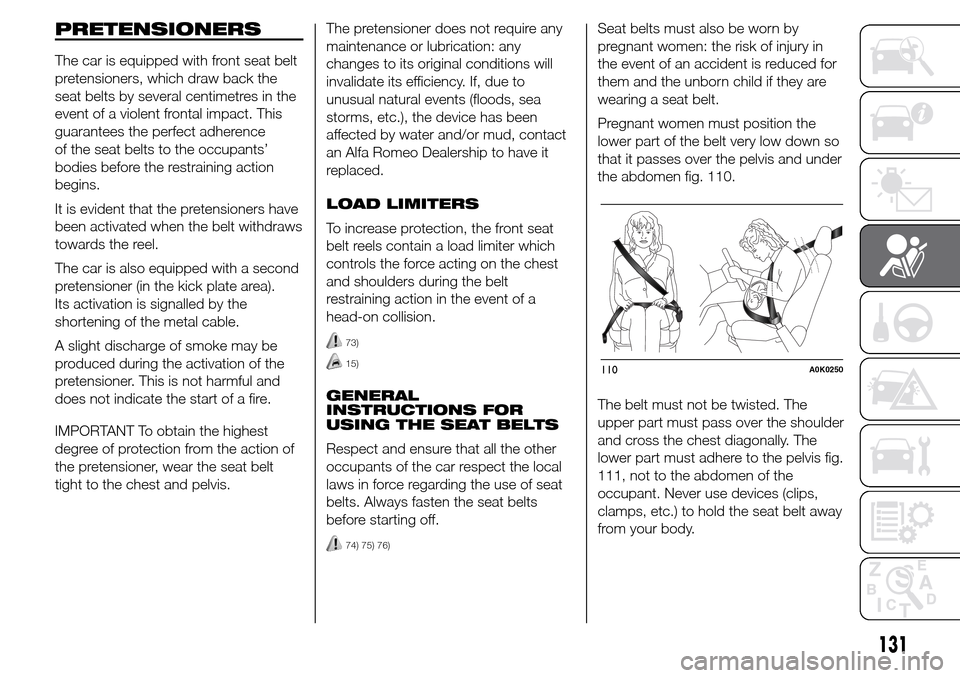
Pregnant women must position the
lower part of the belt very low down so
that it passes over the pelvis and under
the abdomen fig. 110.
The belt must not be twisted. The
upper part must pass over the shoulder
and cross the chest diagonally. The
lower part must adhere to the pelvis fig.
111, not to the abdomen of the
occupant. Never use devices (clips,
clamps, etc.) to hold the seat belt away
from your body.
110A0K0250
131
Page 139 of 288
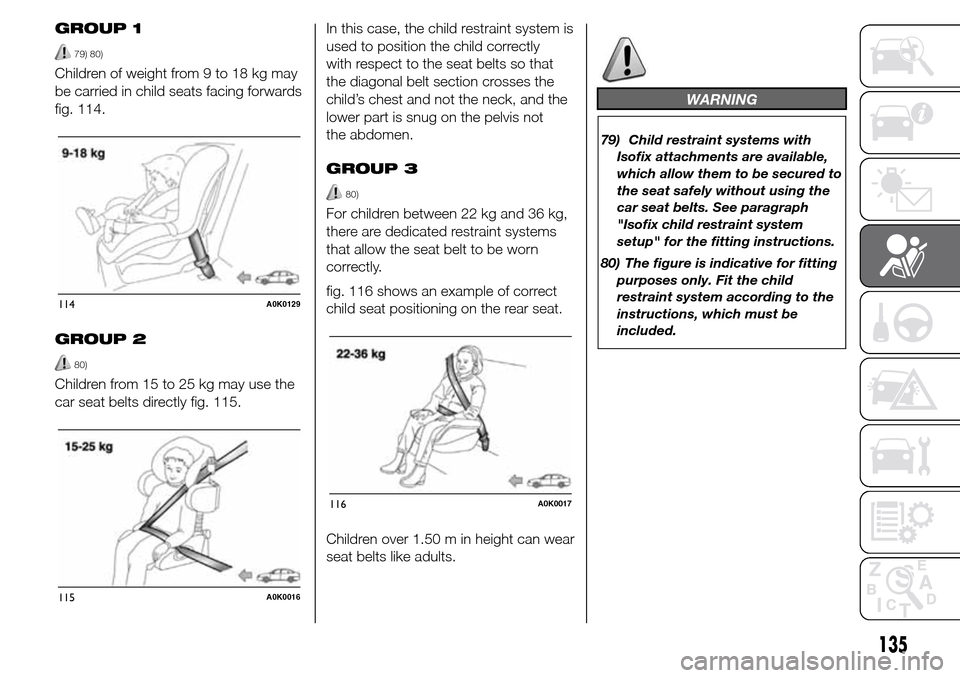
GROUP 1
79) 80)
Children of weight from 9 to 18 kg may
be carried in child seats facing forwards
fig. 114.
GROUP 2
80)
Children from 15 to 25 kg may use the
car seat belts directly fig. 115.In this case, the child restraint system is
used to position the child correctly
with respect to the seat belts so that
the diagonal belt section crosses the
child’s chest and not the neck, and the
lower part is snug on the pelvis not
the abdomen.
GROUP 3
80)
For children between 22 kg and 36 kg,
there are dedicated restraint systems
that allow the seat belt to be worn
correctly.
fig. 116 shows an example of correct
child seat positioning on the rear seat.
Children over 1.50 m in height can wear
seat belts like adults.
WARNING
79) Child restraint systems with
Isofix attachments are available,
which allow them to be secured to
the seat safely without using the
car seat belts. See paragraph
"Isofix child restraint system
setup" for the fitting instructions.
80) The figure is indicative for fitting
purposes only. Fit the child
restraint system according to the
instructions, which must be
included.
114A0K0129
115A0K0016
116A0K0017
135
Page 144 of 288
FRONT AIRBAGS
“SMART BAG” SYSTEM
(MULTISTAGE FRONT
AIRBAGS)
The car features multistage front
airbags (“Smart bag”) for driver and
passenger.
The front (driver and passenger) airbags
protect occupants in the event of
head-on crashes of medium-high
severity, by placing the a cushion
between the occupant and the steering
wheel or dashboard.
Therefore non-deployment in other
types of impacts (side impacts, rear
shunts, roll-overs, etc.) does not
indicate a system malfunction.
Airbags are not a replacement of but
complementary to the seat belts, which
you are recommended to always wear.
In the event of impact, those not
wearing a seat belt are projected
forwards and may come into contact
with the bag which is still inflating. The
protection offered by the bag is
compromised in these circumstances.
85) 86) 88)
Front airbags may not activate in the
following situations:❒frontal impacts against highly
deformable objects not involving the
front surface of the car (e.g. wing
collision against guard rail, etc.);
❒jamming of the car underneath other
vehicles or protective barriers (e.g.
underneath a truck or a guard rail) as,
in this case, the bags would offer no
additional protection with respect
to the seat belt and their deployment
would be inappropriate. In these
cases, non-deployment does not
indicate a system malfunction.
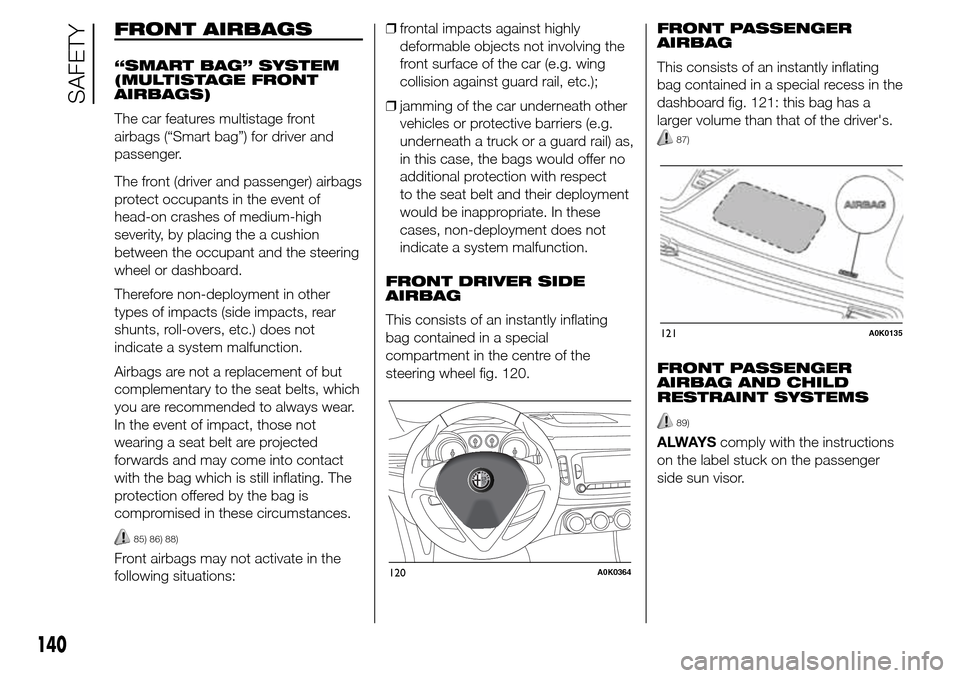
FRONT DRIVER SIDE
AIRBAG
This consists of an instantly inflating
bag contained in a special
compartment in the centre of the
steering wheel fig. 120.FRONT PASSENGER
AIRBAG
This consists of an instantly inflating
bag contained in a special recess in the
dashboard fig. 121: this bag has a
larger volume than that of the driver's.
87)
FRONT PASSENGER
AIRBAG AND CHILD
RESTRAINT SYSTEMS
89)
ALWAYScomply with the instructions
on the label stuck on the passenger
side sun visor.
120A0K0364
121A0K0135
140
SAFETY
Page 153 of 288
IMPORTANT
16) In the first period of use, we
recommend not to demand
maximum performance from the
car (for instance excessive
accelerations, extended travel at
maximum speed, sudden braking,
etc.).
17) With the engine off, do not leave
the key in the ignition switch on
MAR-ON to prevent draining
the battery.
18) A quick burst on the accelerator
before turning off the engine
serves absolutely no practical
purpose; it wastes fuel and is
especially damaging to
turbocharged engines.
19) If the
warning light flashes
for about 1 minute after starting
or during prolonged cranking, this
indicates a fault in the glow plug
preheating system. If the engine
starts, you may use the car
normally, but should contact an
Alfa Romeo Dealership as soon as
possible.
PARKING
Always remove the ignition key when
leaving the car.
When parking and leaving the car,
proceed as follows:
❒engage a gear (1st gear if parked
uphill or reverse if facing downhill)
and leave the wheels turned;
❒stop the engine and engage the
handbrake.
Block the wheels with a wedge or a
stone if the car is parked on a steep
slope.
On versions equipped with Alfa TCT
transmission, before releasing the brake
pedal, wait for letter P to be displayed.
IMPORTANTNEVERleave the car
with the gearbox in neutral (or, on
versions equipped with Alfa TCT
transmission, before placing the gear
lever at P).
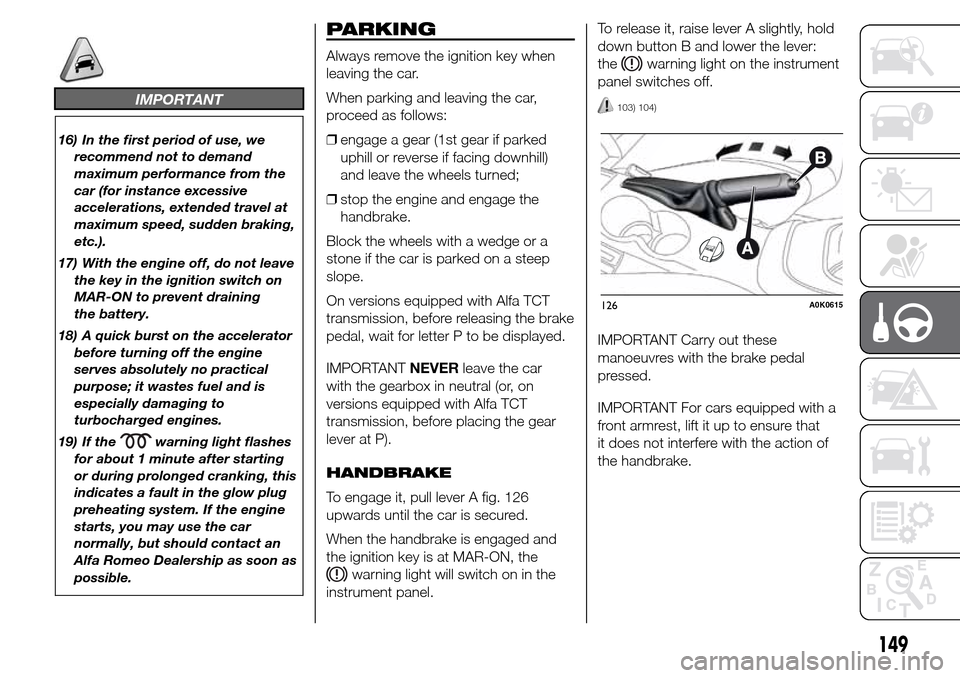
HANDBRAKE
To engage it, pull lever A fig. 126
upwards until the car is secured.
When the handbrake is engaged and
the ignition key is at MAR-ON, the
warning light will switch on in the
instrument panel.To release it, raise lever A slightly, hold
down button B and lower the lever:
the
warning light on the instrument
panel switches off.
103) 104)
IMPORTANT Carry out these
manoeuvres with the brake pedal
pressed.
IMPORTANT For cars equipped with a
front armrest, lift it up to ensure that
it does not interfere with the action of
the handbrake.
126A0K0615
149
Page 156 of 288
POSITIONS OF THE
LEVER
Park (P)
Position P corresponds to the neutral
position of the transmission and locks
drive wheels mechanically.
It should only be engaged with the car
stationary and the handbrake should be
applied, if necessary.
With the ignition key at MAR-ON or with
engine running, or when the engine
switches off, if the gear lever is not
correctly positioned in P, letter P starts
flashing on the gear lever trim.
In this case, move the lever correctly to
position P.
21)
The ignition key can be removed only
when the lever is in position P. Moving
the lever from P to D must be
performed only when the car is
stationary and the engine at idling
speed.
Shifting from P to any other position of
the selector lever, with ignition key in
MAR-ON position, must be made
pressing the brake pedal and using the
button on the gear lever (see paragraph
"Selector lever").
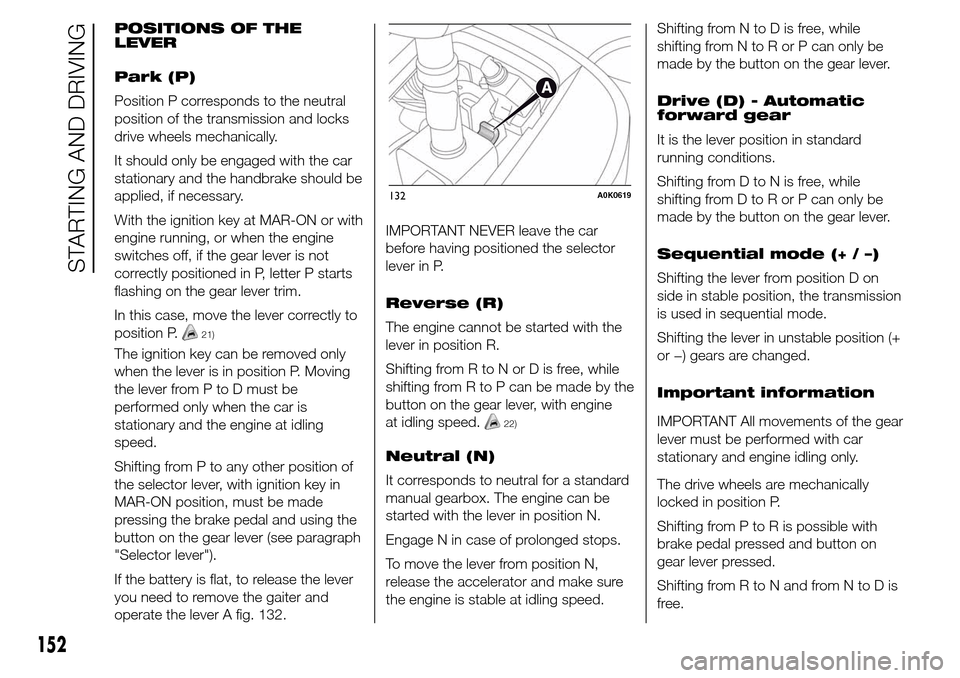
If the battery is flat, to release the lever
you need to remove the gaiter and
operate the lever A fig. 132.IMPORTANT NEVER leave the car
before having positioned the selector
lever in P.
Reverse (R)
The engine cannot be started with the
lever in position R.
Shifting from R to N or D is free, while
shifting from R to P can be made by the
button on the gear lever, with engine
at idling speed.
22)
Neutral (N)
It corresponds to neutral for a standard
manual gearbox. The engine can be
started with the lever in position N.
Engage N in case of prolonged stops.
To move the lever from position N,
release the accelerator and make sure
the engine is stable at idling speed.Shifting from N to D is free, while
shifting from N to R or P can only be
made by the button on the gear lever.
Drive (D) - Automatic
forward gear
It is the lever position in standard
running conditions.
Shifting from D to N is free, while
shifting from D to R or P can only be
made by the button on the gear lever.
Sequential mode (+ / –)
Shifting the lever from position D on
side in stable position, the transmission
is used in sequential mode.
Shifting the lever in unstable position (+
or −) gears are changed.
Important information
IMPORTANT All movements of the gear
lever must be performed with car
stationary and engine idling only.
The drive wheels are mechanically
locked in position P.
Shifting from P to R is possible with
brake pedal pressed and button on
gear lever pressed.
Shifting from R to N and from N to D is
free.
132A0K0619
152
STARTING AND DRIVING
Page 158 of 288
In both cases, if the described
conditions and times are not respected,
the ignition key will be automatically
locked.
To remove the key, turn it to MAR-ON
and then to STOP.
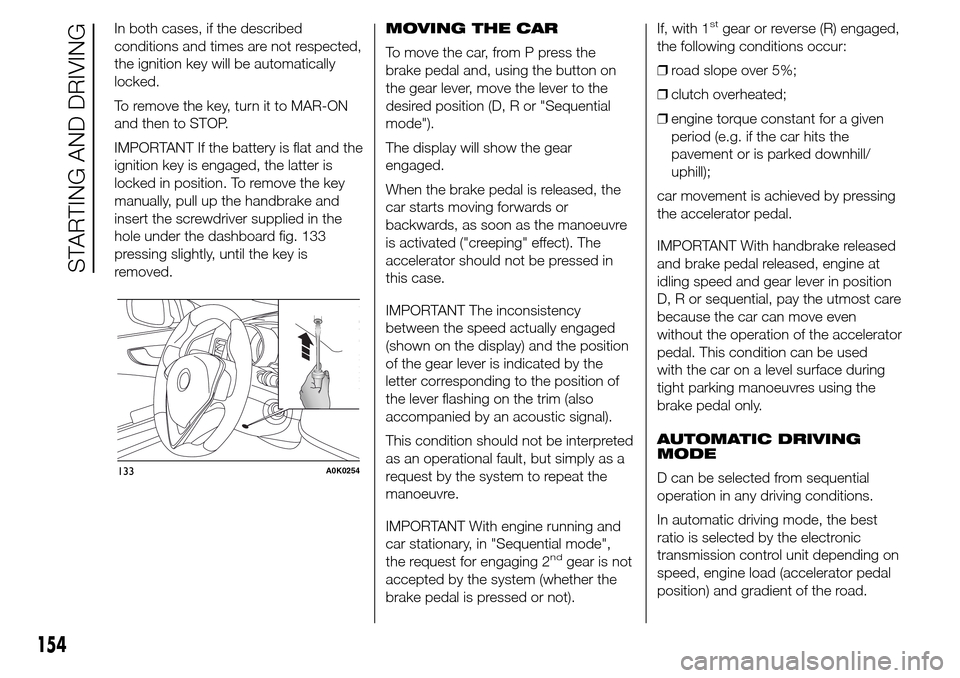
IMPORTANT If the battery is flat and the
ignition key is engaged, the latter is
locked in position. To remove the key
manually, pull up the handbrake and
insert the screwdriver supplied in the
hole under the dashboard fig. 133
pressing slightly, until the key is
removed.MOVING THE CAR
To move the car, from P press the
brake pedal and, using the button on
the gear lever, move the lever to the
desired position (D, R or "Sequential
mode").
The display will show the gear
engaged.
When the brake pedal is released, the
car starts moving forwards or
backwards, as soon as the manoeuvre
is activated ("creeping" effect). The
accelerator should not be pressed in
this case.
IMPORTANT The inconsistency
between the speed actually engaged
(shown on the display) and the position
of the gear lever is indicated by the
letter corresponding to the position of
the lever flashing on the trim (also
accompanied by an acoustic signal).
This condition should not be interpreted
as an operational fault, but simply as a
request by the system to repeat the
manoeuvre.
IMPORTANT With engine running and
car stationary, in "Sequential mode",
the request for engaging 2
ndgear is not
accepted by the system (whether the
brake pedal is pressed or not).If, with 1
stgear or reverse (R) engaged,
the following conditions occur:
❒road slope over 5%;
❒clutch overheated;
❒engine torque constant for a given
period (e.g. if the car hits the
pavement or is parked downhill/
uphill);
car movement is achieved by pressing
the accelerator pedal.
IMPORTANT With handbrake released
and brake pedal released, engine at
idling speed and gear lever in position
D, R or sequential, pay the utmost care
because the car can move even
without the operation of the accelerator
pedal. This condition can be used
with the car on a level surface during
tight parking manoeuvres using the
brake pedal only.
AUTOMATIC DRIVING
MODE
D can be selected from sequential
operation in any driving conditions.
In automatic driving mode, the best
ratio is selected by the electronic
transmission control unit depending on
speed, engine load (accelerator pedal
position) and gradient of the road.
133A0K0254
154
STARTING AND DRIVING
Page 160 of 288
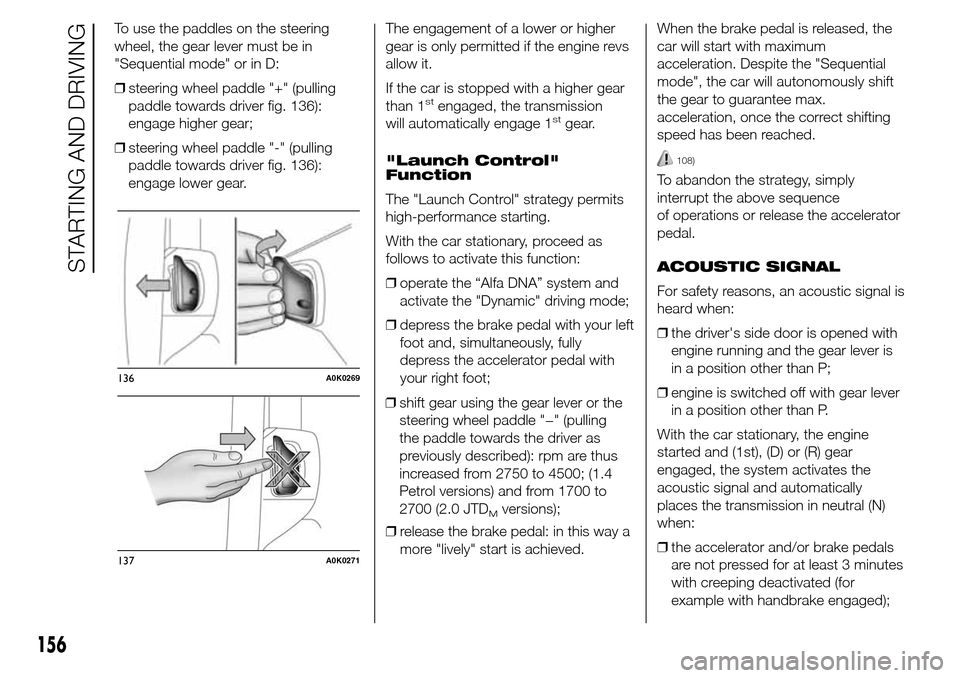
To use the paddles on the steering
wheel, the gear lever must be in
"Sequential mode" or in D:
❒steering wheel paddle "+" (pulling
paddle towards driver fig. 136):
engage higher gear;
❒steering wheel paddle "-" (pulling
paddle towards driver fig. 136):
engage lower gear.The engagement of a lower or higher
gear is only permitted if the engine revs
allow it.
If the car is stopped with a higher gear
than 1
stengaged, the transmission
will automatically engage 1stgear.
"Launch Control"
Function
The "Launch Control" strategy permits
high-performance starting.
With the car stationary, proceed as
follows to activate this function:
❒operate the “Alfa DNA” system and
activate the "Dynamic" driving mode;
❒depress the brake pedal with your left
foot and, simultaneously, fully
depress the accelerator pedal with
your right foot;
❒release the brake pedal: in this way a
more "lively" start is achieved.When the brake pedal is released, the
car will start with maximum
acceleration. Despite the "Sequential
mode", the car will autonomously shift
the gear to guarantee max.
acceleration, once the correct shifting
speed has been reached.
108)
To abandon the strategy, simply
interrupt the above sequence
of operations or release the accelerator
pedal.
ACOUSTIC SIGNAL
For safety reasons, an acoustic signal is
heard when:
❒the driver's side door is opened with
engine running and the gear lever is
in a position other than P;
❒engine is switched off with gear lever
in a position other than P.
With the car stationary, the engine
started and (1st), (D) or (R) gear
engaged, the system activates the
acoustic signal and automatically
places the transmission in neutral (N)
when:
❒the accelerator and/or brake pedals
are not pressed for at least 3 minutes
with creeping deactivated (for
example with handbrake engaged);
136A0K0269
137A0K0271
156
STARTING AND DRIVING
❒shift gear using the gear lever or the
steering wheel paddle "−" (pulling
the paddle towards the driver as
previously described): rpm are thus
increased from 2750 to 4500; (1.4
Petrol versions) and from 1700 to
2700 (2.0 JTD
Mversions);
Page 162 of 288
WARNING
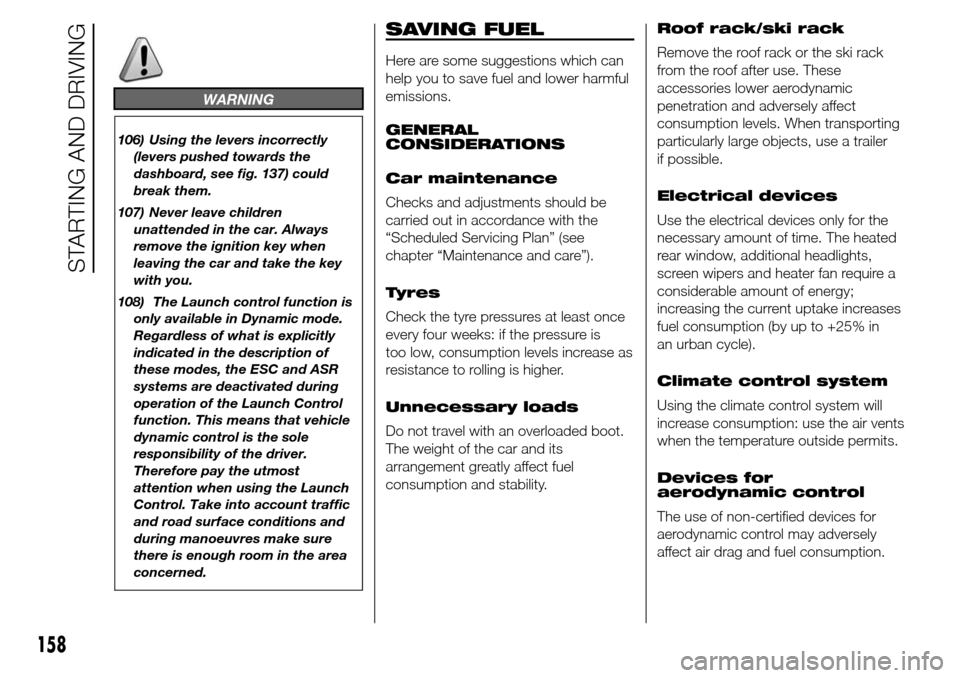
106) Using the levers incorrectly
(levers pushed towards the
dashboard, see fig. 137) could
break them.
107) Never leave children
unattended in the car. Always
remove the ignition key when
leaving the car and take the key
with you.
108) The Launch control function is
only available in Dynamic mode.
Regardless of what is explicitly
indicated in the description of
these modes, the ESC and ASR
systems are deactivated during
operation of the Launch Control
function. This means that vehicle
dynamic control is the sole
responsibility of the driver.
Therefore pay the utmost
attention when using the Launch
Control. Take into account traffic
and road surface conditions and
during manoeuvres make sure
there is enough room in the area
concerned.
SAVING FUEL
Here are some suggestions which can
help you to save fuel and lower harmful
emissions.
GENERAL
CONSIDERATIONS
Car maintenance
Checks and adjustments should be
carried out in accordance with the
“Scheduled Servicing Plan” (see
chapter “Maintenance and care”).
Tyres
Check the tyre pressures at least once
every four weeks: if the pressure is
too low, consumption levels increase as
resistance to rolling is higher.
Unnecessary loads
Do not travel with an overloaded boot.
The weight of the car and its
arrangement greatly affect fuel
consumption and stability.Roof rack/ski rack
Remove the roof rack or the ski rack
from the roof after use. These
accessories lower aerodynamic
penetration and adversely affect
consumption levels. When transporting
particularly large objects, use a trailer
if possible.
Electrical devices
Use the electrical devices only for the
necessary amount of time. The heated
rear window, additional headlights,
screen wipers and heater fan require a
considerable amount of energy;
increasing the current uptake increases
fuel consumption (by up to +25% in
an urban cycle).
Climate control system
Using the climate control system will
increase consumption: use the air vents
when the temperature outside permits.
Devices for
aerodynamic control
The use of non-certified devices for
aerodynamic control may adversely
affect air drag and fuel consumption.
158
STARTING AND DRIVING