ESP Alfa Romeo Giulietta 2016 Owner's Guide
[x] Cancel search | Manufacturer: ALFA ROMEO, Model Year: 2016, Model line: Giulietta, Model: Alfa Romeo Giulietta 2016Pages: 288, PDF Size: 7.34 MB
Page 164 of 288
TOWING TRAILERS
IMPORTANT
The vehicle must be provided with a
type-approved tow hook and adequate
electrical system to tow caravans or
trailers. Installation must be carried out
by a specialist.
Fit any specific and/or additional rear
view mirrors as specified by the
Highway Code.
Remember that when towing a trailer,
steep hills are harder to climb, the
braking spaces increase and overtaking
takes longer depending on the overall
weight.
Engage a low gear when driving
downhill, rather than constantly using
the brake.
The weight of the trailer reduces the
load capacity of the car by the same
amount. Consider the weight at full
load, including accessories and
luggage, to make sure you do not
exceed the maximum towable weight
(shown in the registration document).
Do not exceed the speed limits specific
to each country you are driving in, in
the case of vehicles towing trailers.
In any case do not exceed 100 km/h.INSTALLING A TOW
HOOK
Contact an Alfa Romeo Dealership to
install a tow hook.
109) 110)
WARNING
109) The ABS with which the car is
equipped will not control the
braking system of the trailer.
Particular caution is therefore
required when travelling on
slippery roads.
110) Never modify the braking
system of the car to control the
trailer brake. The trailer braking
system must be fully independent
from the hydraulic system of the
car.
SNOW TYRES
Use snow tyres of the same size as the
normal tyres provided with the car:
the Alfa Romeo Dealership will be able
to advise you on the most appropriate
tyre to use.
Only use these tyres in the event of ice
or snow on the roads.
111)
For the type of tyre to be used, inflation
pressures and the specifications of
snow tyres, follow the instructions given
in the "Wheels" paragraph in the
"Technical specifications" chapter.
The winter performance of these tyres
is considerably reduced when the tread
thickness is less than 4 mm. Replace
them in this case.
Due to the specific characteristics of
snow tyres, in normal weather
conditions or on long motorway
journeys, the performance of these
tyres is lower than that of standard
tyres. Their usage should therefore be
restricted in accordance with their
type approval.
All four tyres should be the same (brand
and track) to ensure greater safety
when driving and braking as well as
making the car more responsive. It is
inadvisable to change the rotation
direction of tyres.
160
STARTING AND DRIVING
Page 177 of 288
123) Always indicate that the tyre
was repaired using the quick
tyre repair kit. Give the booklet to
the technicians who will be
handling the tyre that was treated
using the kit.
124) Repair is not possible if the
wheel rim is damaged (groove
is deformed, causing air to
escape). Do not remove foreign
bodies (screws or nails) from the
tyre.
125) Do not operate the compressor
for longer than 20 minutes
consecutively. Risk of
overheating. The kit is not suitable
for definitive repairs, so the
repaired tyres may only be used
temporarily.126) The bottle contains ethylene
glycol and latex: it may cause
an allergic reaction. It is harmful if
swallowed. It is irritant for the
eyes. It may cause sensitisation if
inhaled or on contact. Avoid
contact with eyes, skin and
clothes. In the event of contact,
rinse immediately with plenty
of water. If ingested, do not
induce vomiting. Rinse out your
mouth, drink large quantities
of water and seek immediate
medical attention. Keep out of the
reach of children. The product
must not be used by asthmatics.
Do not inhale the vapours during
insertion and suction. Call a
doctor immediately if allergic
reactions are noted. Store the
bottle in its proper compartment,
away from sources of heat. The
sealant fluid has an expiry date.
Replace the bottle containing
out-of-date sealant fluid.CHANGING A BULB
28)
127) 128) 129)
GENERAL
INSTRUCTIONS
❒Before changing a bulb check the
contacts for oxidation;
❒replace blown bulbs with others of
the same type and power;
❒after replacing a headlight bulb,
always check its alignment;
❒when a light is not working, check
that the corresponding fuse is intact
before changing the bulb. For the
location of fuses, refer to the
paragraph “If a fuse blows” in this
chapter.
173
Page 178 of 288
IMPORTANT When the weather is cold
or damp or after heavy rain or washing,
the surface of headlights or rear lights,
may steam up and/or form drops of
condensation on the inside. This is
a natural phenomenon due to the
difference in temperature and humidity
between the inside and the outside
of the glass which does not indicate a
fault and does not compromise the
normal operation of lighting devices.
The mist disappears quickly when the
lights are turned on, starting from
the centre of the diffuser, extending
progressively towards the edges.
IMPORTANT
28) Halogen bulbs must be handled
by holding the metallic part only.
Touching the transparent part
of the bulb with your fingers may
reduce the intensity of the
emitted light and even reduce the
lifespan of the bulb. In the case
of accidental contact, rub the
lamp with a cloth and spirit and
leave to dry.
WARNING
127) Changes or repairs to the
electrical system carried out
incorrectly and without due
consideration for the technical
specifications of the system may
lead to malfunctioning and
generate a fire hazard.
128) Halogen bulbs contain
pressurised gas. If they break,
glass fragments could fly
everywhere.
129) Due to the high supply voltage,
gas discharge bulbs (Bi-Xenon)
should only be replaced by
specialised personnel: danger of
death! Contact an Alfa Romeo
Dealership.
174
IN AN EMERGENCY
Page 187 of 288
FUSE LOCATION
Fuses are grouped together in three
fuse boxes located in the engine
compartment, dashboard and luggage
compartment.
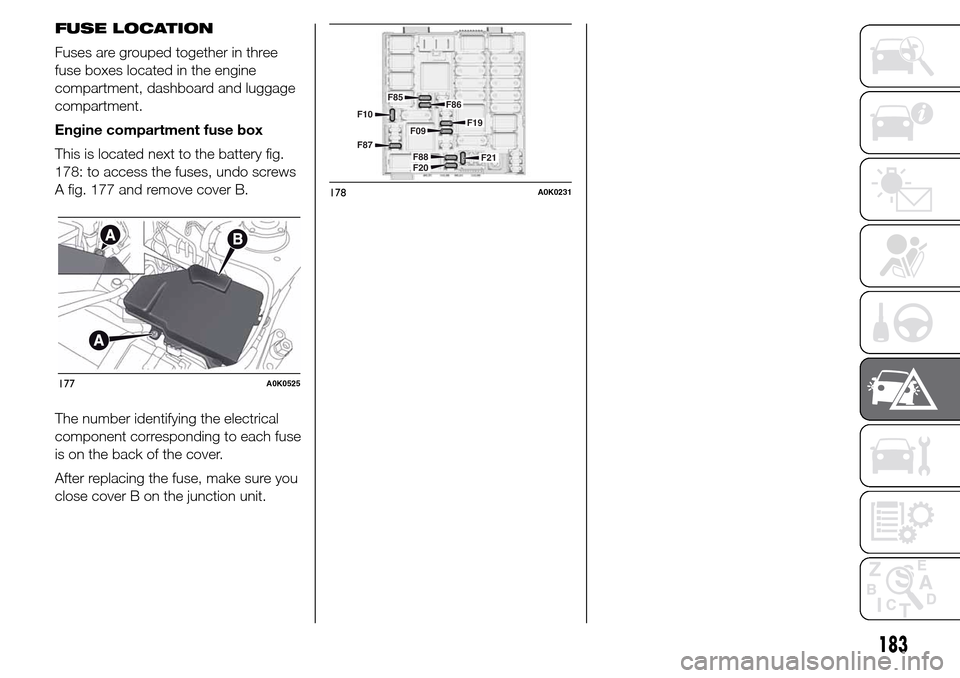
Engine compartment fuse box
This is located next to the battery fig.
178: to access the fuses, undo screws
A fig. 177 and remove cover B.
The number identifying the electrical
component corresponding to each fuse
is on the back of the cover.
After replacing the fuse, make sure you
close cover B on the junction unit.
177A0K0525
F10
F87F85
F86
F19
F09
F21 F88
F20
178A0K0231
183
Page 197 of 288
136) Remember that the brake servo
and the electromechanical power
steering will not work while
towing the car. You will therefore
need to apply more force on the
brake pedal and steering wheel.
Do not use wires for towing. Do
not jerk. During towing, make sure
that the trailer hitch does not
damage any components it
is touching. When towing the car,
you must comply with all specific
traffic regulations and adopt an
appropriate driving behaviour. Do
not start the engine while towing
the car. Before tightening the
ring, clean the threaded housing
thoroughly. Make sure that the
ring is fully fastened in the
housing before towing the car.137) The front and rear tow hooks
should be used only for
emergencies on the road. You are
allowed to tow the vehicle for
short distances using an
appropriate device in accordance
with the highway code (a rigid
bar), to move the vehicle on the
road in readiness for towing or
transport via a tow truck. Tow
hooks MUST NOT be used to tow
vehicles off the road or where
there are obstacles and/or for
towing operations using cables or
other non-rigid devices.
Respecting the above conditions,
towing must take place with two
vehicles (one towing, the other
towed) aligned as much as
possible along the same centre
line.
193
Page 226 of 288
IDENTIFICATION
DATA
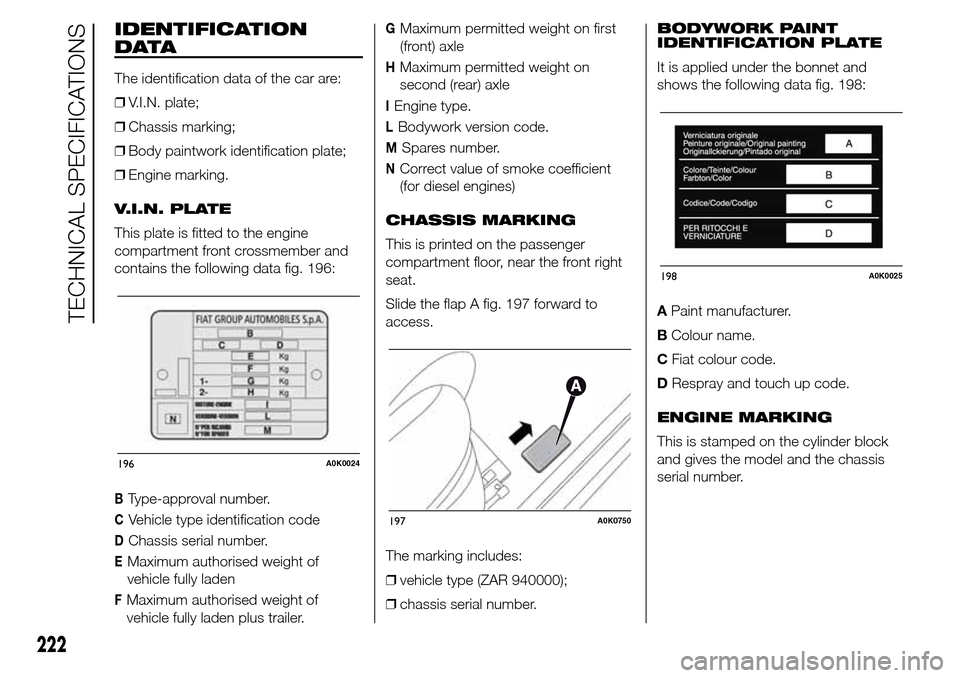
The identification data of the car are:
❒V.I.N. plate;
❒Chassis marking;
❒Body paintwork identification plate;
❒Engine marking.
V.I.N. PLATE
This plate is fitted to the engine
compartment front crossmember and
contains the following data fig. 196:
BType-approval number.
CVehicle type identification code
DChassis serial number.
EMaximum authorised weight of
vehicle fully laden
FMaximum authorised weight of
vehicle fully laden plus trailer.
GMaximum permitted weight on first
(front) axle
HMaximum permitted weight on
second (rear) axle
IEngine type.
LBodywork version code.
MSpares number.
NCorrect value of smoke coefficient
(for diesel engines)
CHASSIS MARKING
This is printed on the passenger
compartment floor, near the front right
seat.
Slide the flap A fig. 197 forward to
access.
The marking includes:
❒vehicle type (ZAR 940000);
❒chassis serial number.BODYWORK PAINT
IDENTIFICATION PLATE
It is applied under the bonnet and
shows the following data fig. 198:
APaint manufacturer.
BColour name.
CFiat colour code.
DRespray and touch up code.
ENGINE MARKING
This is stamped on the cylinder block
and gives the model and the chassis
serial number.
196A0K0024
197A0K0750
198A0K0025
222
TECHNICAL SPECIFICATIONS
Page 230 of 288
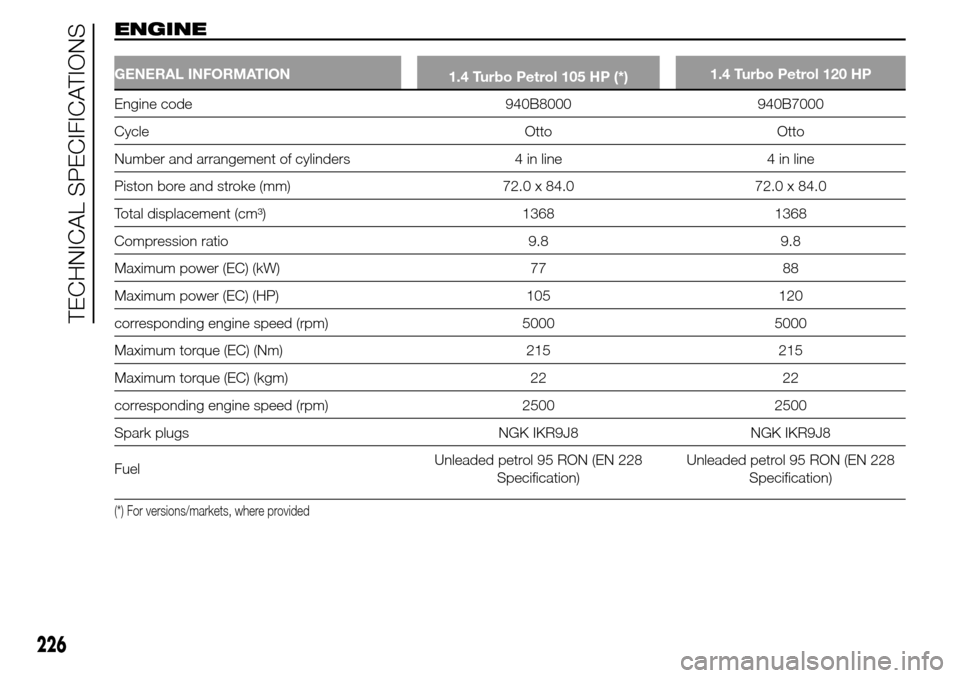
ENGINE
GENERAL INFORMATION
1.4 Turbo Petrol 105 HP (*)1.4 Turbo Petrol 120 HP
Engine code 940B8000 940B7000
Cycle Otto Otto
Number and arrangement of cylinders 4 in line 4 in line
Piston bore and stroke (mm) 72.0 x 84.0 72.0 x 84.0
Total displacement (cm³) 1368 1368
Compression ratio 9.8 9.8
Maximum power (EC) (kW) 77 88
Maximum power (EC) (HP) 105 120
corresponding engine speed (rpm) 5000 5000
Maximum torque (EC) (Nm) 215 215
Maximum torque (EC) (kgm) 22 22
corresponding engine speed (rpm) 2500 2500
Spark plugs NGK IKR9J8 NGK IKR9J8
FuelUnleaded petrol 95 RON (EN 228
Specification)Unleaded petrol 95 RON (EN 228
Specification)
(*) For versions/markets, where provided
226
TECHNICAL SPECIFICATIONS
Page 231 of 288
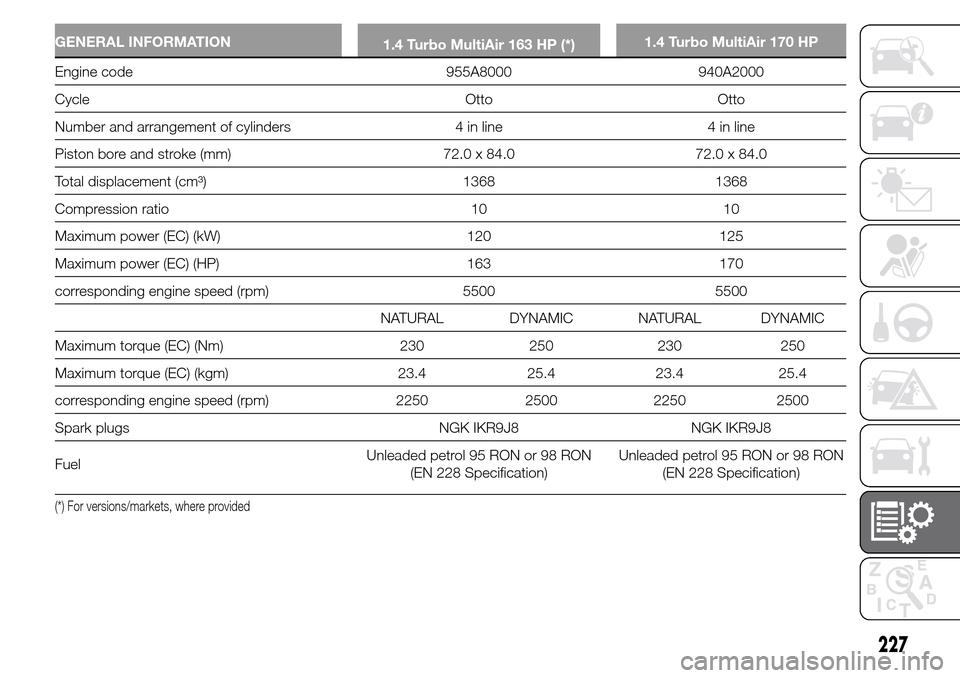
GENERAL INFORMATION
1.4 Turbo MultiAir 163 HP (*)1.4 Turbo MultiAir 170 HP
Engine code 955A8000 940A2000
Cycle Otto Otto
Number and arrangement of cylinders 4 in line 4 in line
Piston bore and stroke (mm) 72.0 x 84.0 72.0 x 84.0
Total displacement (cm³) 1368 1368
Compression ratio 10 10
Maximum power (EC) (kW) 120 125
Maximum power (EC) (HP) 163 170
corresponding engine speed (rpm) 5500 5500
NATURAL DYNAMIC NATURAL DYNAMIC
Maximum torque (EC) (Nm) 230 250 230 250
Maximum torque (EC) (kgm) 23.4 25.4 23.4 25.4
corresponding engine speed (rpm) 2250 2500 2250 2500
Spark plugs NGK IKR9J8 NGK IKR9J8
FuelUnleaded petrol 95 RON or 98 RON
(EN 228 Specification)Unleaded petrol 95 RON or 98 RON
(EN 228 Specification)
(*) For versions/markets, where provided
227
Page 232 of 288
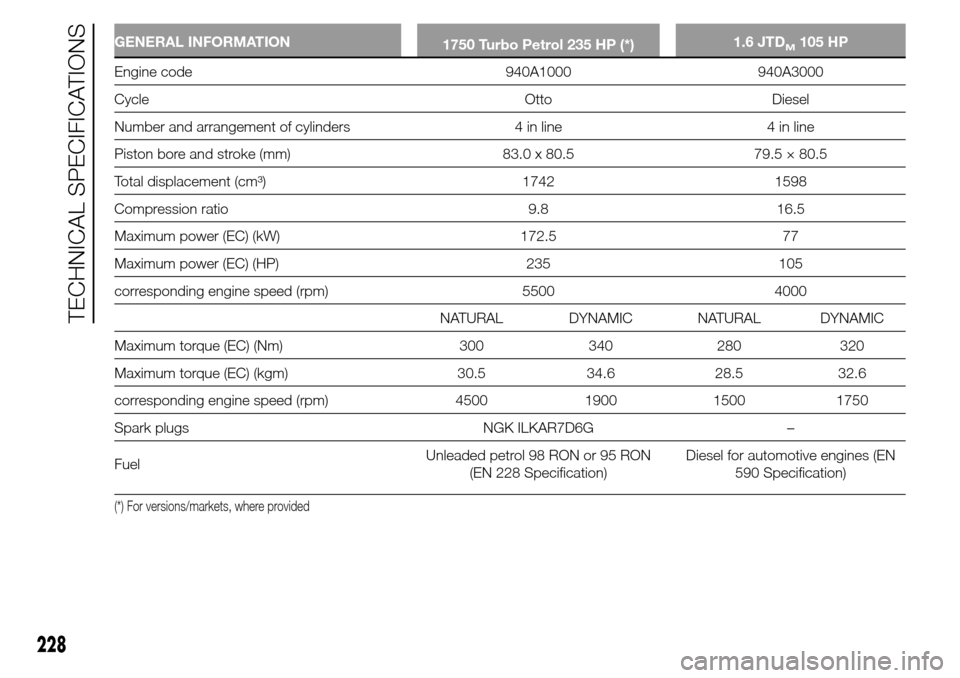
GENERAL INFORMATION
1750 Turbo Petrol 235 HP (*)1.6 JTDM105 HP
Engine code 940A1000 940A3000
Cycle Otto Diesel
Number and arrangement of cylinders 4 in line 4 in line
Piston bore and stroke (mm) 83.0 x 80.5 79.5 × 80.5
Total displacement (cm³) 1742 1598
Compression ratio 9.8 16.5
Maximum power (EC) (kW) 172.5 77
Maximum power (EC) (HP) 235 105
corresponding engine speed (rpm) 5500 4000
NATURAL DYNAMIC NATURAL DYNAMIC
Maximum torque (EC) (Nm) 300 340 280 320
Maximum torque (EC) (kgm) 30.5 34.6 28.5 32.6
corresponding engine speed (rpm) 4500 1900 1500 1750
Spark plugs NGK ILKAR7D6G –
FuelUnleaded petrol 98 RON or 95 RON
(EN 228 Specification)Diesel for automotive engines (EN
590 Specification)
(*) For versions/markets, where provided
228
TECHNICAL SPECIFICATIONS
Page 233 of 288
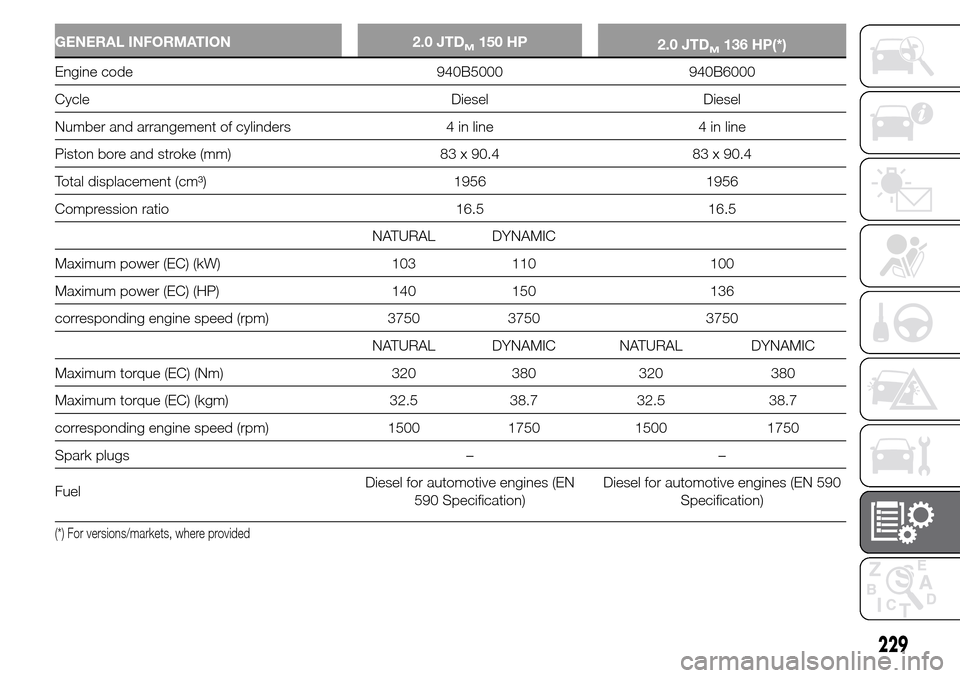
GENERAL INFORMATION 2.0 JTDM150 HP
2.0 JTDM136 HP(*)
Engine code 940B5000 940B6000
Cycle Diesel Diesel
Number and arrangement of cylinders 4 in line 4 in line
Piston bore and stroke (mm) 83 x 90.4 83 x 90.4
Total displacement (cm³) 1956 1956
Compression ratio 16.5 16.5
NATURAL DYNAMIC
Maximum power (EC) (kW) 103 110 100
Maximum power (EC) (HP) 140 150 136
corresponding engine speed (rpm) 3750 3750 3750
NATURAL DYNAMIC NATURAL DYNAMIC
Maximum torque (EC) (Nm) 320 380 320 380
Maximum torque (EC) (kgm) 32.5 38.7 32.5 38.7
corresponding engine speed (rpm) 1500 1750 1500 1750
Spark plugs – –
FuelDiesel for automotive engines (EN
590 Specification)Diesel for automotive engines (EN 590
Specification)
(*) For versions/markets, where provided
229