lock Alfa Romeo Giulietta 2016 Owner's Guide
[x] Cancel search | Manufacturer: ALFA ROMEO, Model Year: 2016, Model line: Giulietta, Model: Alfa Romeo Giulietta 2016Pages: 288, PDF Size: 7.34 MB
Page 110 of 288
Warning lights on
panelWhat it means What to do
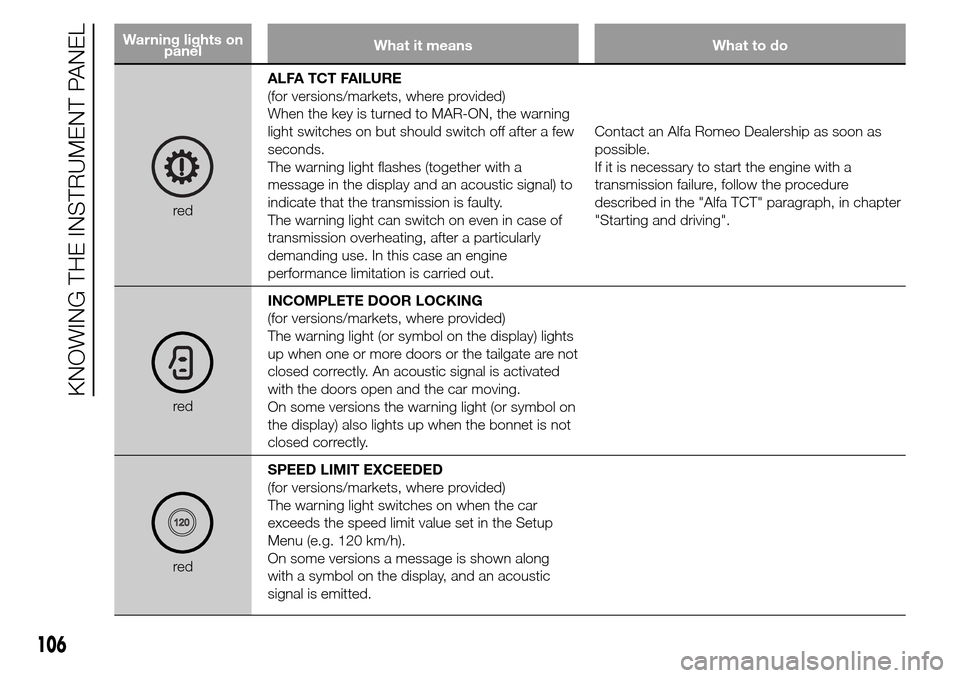
redALFA TCT FAILURE
(for versions/markets, where provided)
When the key is turned to MAR-ON, the warning
light switches on but should switch off after a few
seconds.
The warning light flashes (together with a
message in the display and an acoustic signal) to
indicate that the transmission is faulty.
The warning light can switch on even in case of
transmission overheating, after a particularly
demanding use. In this case an engine
performance limitation is carried out.Contact an Alfa Romeo Dealership as soon as
possible.
If it is necessary to start the engine with a
transmission failure, follow the procedure
described in the "Alfa TCT" paragraph, in chapter
"Starting and driving".
redINCOMPLETE DOOR LOCKING
(for versions/markets, where provided)
The warning light (or symbol on the display) lights
up when one or more doors or the tailgate are not
closed correctly. An acoustic signal is activated
with the doors open and the car moving.
On some versions the warning light (or symbol on
the display) also lights up when the bonnet is not
closed correctly.
redSPEED LIMIT EXCEEDED
(for versions/markets, where provided)
The warning light switches on when the car
exceeds the speed limit value set in the Setup
Menu (e.g. 120 km/h).
On some versions a message is shown along
with a symbol on the display, and an acoustic
signal is emitted.
106
KNOWING THE INSTRUMENT PANEL
Page 132 of 288
SEAT BELTS
USING THE SEAT BELTS
The belt should be worn keeping the
torso straight and rested against the
backrest.
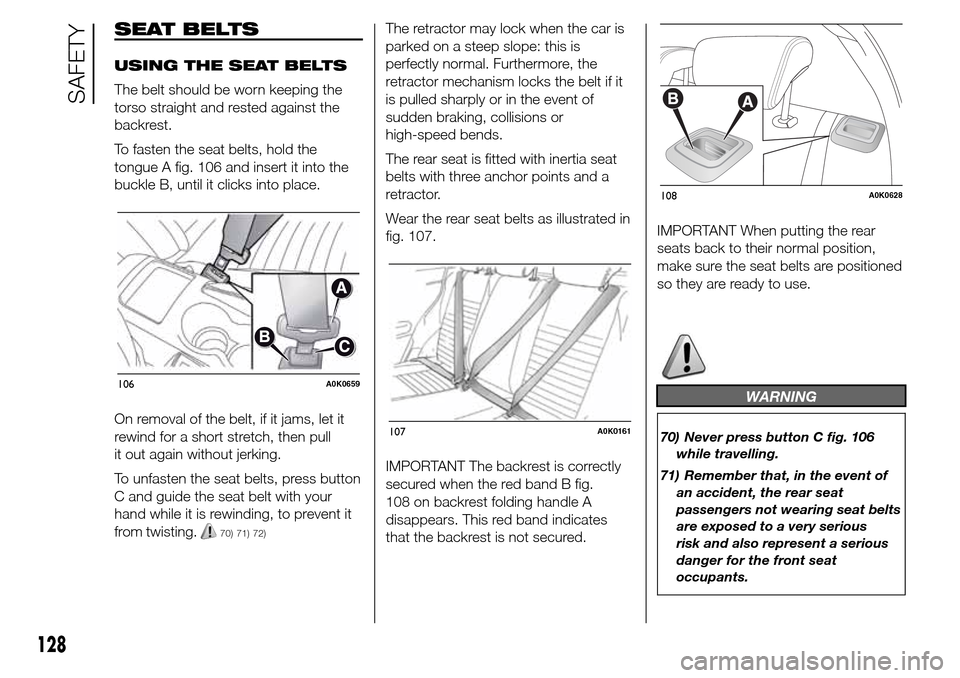
To fasten the seat belts, hold the
tongue A fig. 106 and insert it into the
buckle B, until it clicks into place.
On removal of the belt, if it jams, let it
rewind for a short stretch, then pull
it out again without jerking.
To unfasten the seat belts, press button
C and guide the seat belt with your
hand while it is rewinding, to prevent it
from twisting.
70) 71) 72)
The retractor may lock when the car is
parked on a steep slope: this is
perfectly normal. Furthermore, the
retractor mechanism locks the belt if it
is pulled sharply or in the event of
sudden braking, collisions or
high-speed bends.
The rear seat is fitted with inertia seat
belts with three anchor points and a
retractor.
Wear the rear seat belts as illustrated in
fig. 107.
IMPORTANT The backrest is correctly
secured when the red band B fig.
108 on backrest folding handle A
disappears. This red band indicates
that the backrest is not secured.IMPORTANT When putting the rear
seats back to their normal position,
make sure the seat belts are positioned
so they are ready to use.
WARNING
70) Never press button C fig. 106
while travelling.
71) Remember that, in the event of
an accident, the rear seat
passengers not wearing seat belts
are exposed to a very serious
risk and also represent a serious
danger for the front seat
occupants.
106A0K0659
107A0K0161
108A0K0628
128
SAFETY
Page 153 of 288
IMPORTANT
16) In the first period of use, we
recommend not to demand
maximum performance from the
car (for instance excessive
accelerations, extended travel at
maximum speed, sudden braking,
etc.).
17) With the engine off, do not leave
the key in the ignition switch on
MAR-ON to prevent draining
the battery.
18) A quick burst on the accelerator
before turning off the engine
serves absolutely no practical
purpose; it wastes fuel and is
especially damaging to
turbocharged engines.
19) If the
warning light flashes
for about 1 minute after starting
or during prolonged cranking, this
indicates a fault in the glow plug
preheating system. If the engine
starts, you may use the car
normally, but should contact an
Alfa Romeo Dealership as soon as
possible.
PARKING
Always remove the ignition key when
leaving the car.
When parking and leaving the car,
proceed as follows:
❒engage a gear (1st gear if parked
uphill or reverse if facing downhill)
and leave the wheels turned;
❒stop the engine and engage the
handbrake.
Block the wheels with a wedge or a
stone if the car is parked on a steep
slope.
On versions equipped with Alfa TCT
transmission, before releasing the brake
pedal, wait for letter P to be displayed.
IMPORTANTNEVERleave the car
with the gearbox in neutral (or, on
versions equipped with Alfa TCT
transmission, before placing the gear
lever at P).
HANDBRAKE
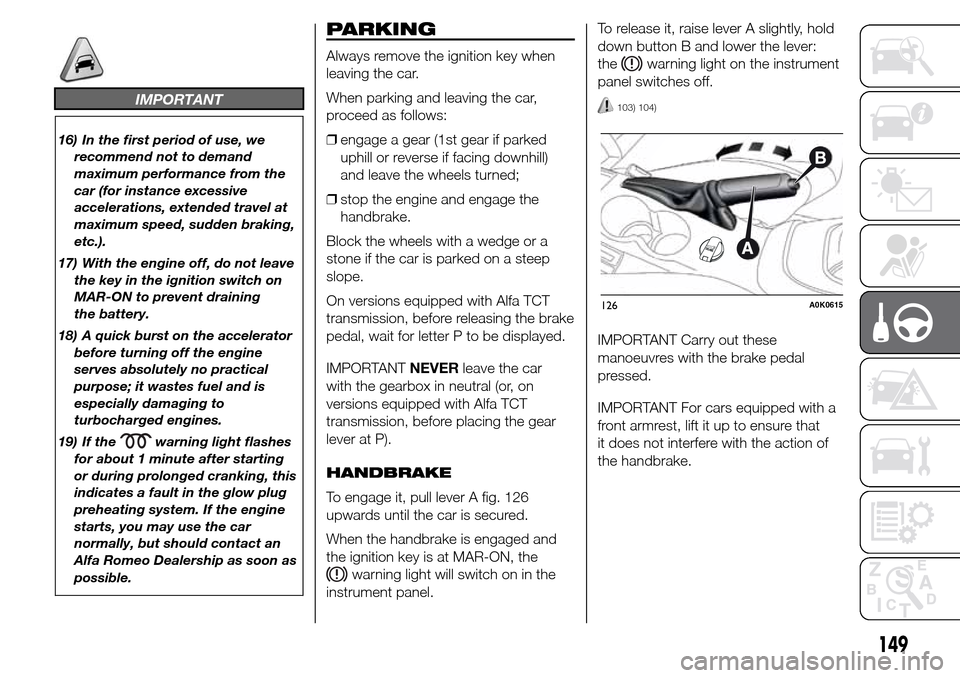
To engage it, pull lever A fig. 126
upwards until the car is secured.
When the handbrake is engaged and
the ignition key is at MAR-ON, the
warning light will switch on in the
instrument panel.To release it, raise lever A slightly, hold
down button B and lower the lever:
the
warning light on the instrument
panel switches off.
103) 104)
IMPORTANT Carry out these
manoeuvres with the brake pedal
pressed.
IMPORTANT For cars equipped with a
front armrest, lift it up to ensure that
it does not interfere with the action of
the handbrake.
126A0K0615
149
Page 154 of 288
WARNING
103) Never leave children
unattended in the car. Always
remove the key from the ignition
device when leaving the car and
take it with you.
104) The car must be locked after a
few clicks of the parking brake: if
this is not so, contact an Alfa
Romeo Dealership to have it
adjusted. Always park the car
safely as indicated by the
Highway Code and as described
above.
USING THE
GEARBOX
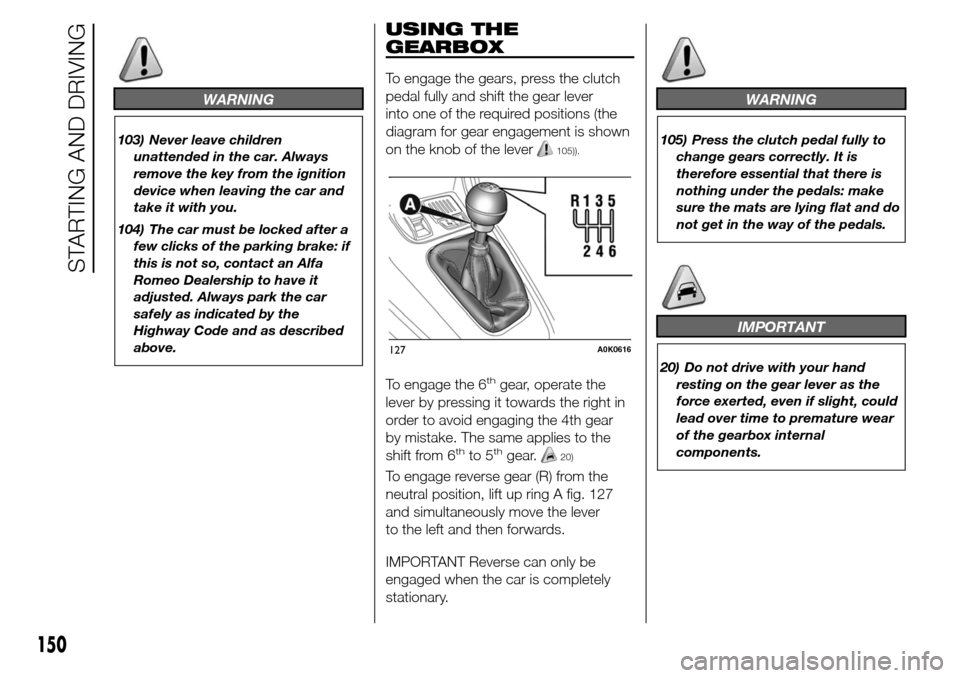
To engage the gears, press the clutch
pedal fully and shift the gear lever
into one of the required positions (the
diagram for gear engagement is shown
on the knob of the lever
105)).
To engage the 6thgear, operate the
lever by pressing it towards the right in
order to avoid engaging the 4th gear
by mistake. The same applies to the
shift from 6
thto 5thgear.20)
To engage reverse gear (R) from the
neutral position, lift up ring A fig. 127
and simultaneously move the lever
to the left and then forwards.
IMPORTANT Reverse can only be
engaged when the car is completely
stationary.
WARNING
105) Press the clutch pedal fully to
change gears correctly. It is
therefore essential that there is
nothing under the pedals: make
sure the mats are lying flat and do
not get in the way of the pedals.
IMPORTANT
20) Do not drive with your hand
resting on the gear lever as the
force exerted, even if slight, could
lead over time to premature wear
of the gearbox internal
components.
127A0K0616
150
STARTING AND DRIVING
Page 156 of 288
POSITIONS OF THE
LEVER
Park (P)
Position P corresponds to the neutral
position of the transmission and locks
drive wheels mechanically.
It should only be engaged with the car
stationary and the handbrake should be
applied, if necessary.
With the ignition key at MAR-ON or with
engine running, or when the engine
switches off, if the gear lever is not
correctly positioned in P, letter P starts
flashing on the gear lever trim.
In this case, move the lever correctly to
position P.
21)
The ignition key can be removed only
when the lever is in position P. Moving
the lever from P to D must be
performed only when the car is
stationary and the engine at idling
speed.
Shifting from P to any other position of
the selector lever, with ignition key in
MAR-ON position, must be made
pressing the brake pedal and using the
button on the gear lever (see paragraph
"Selector lever").
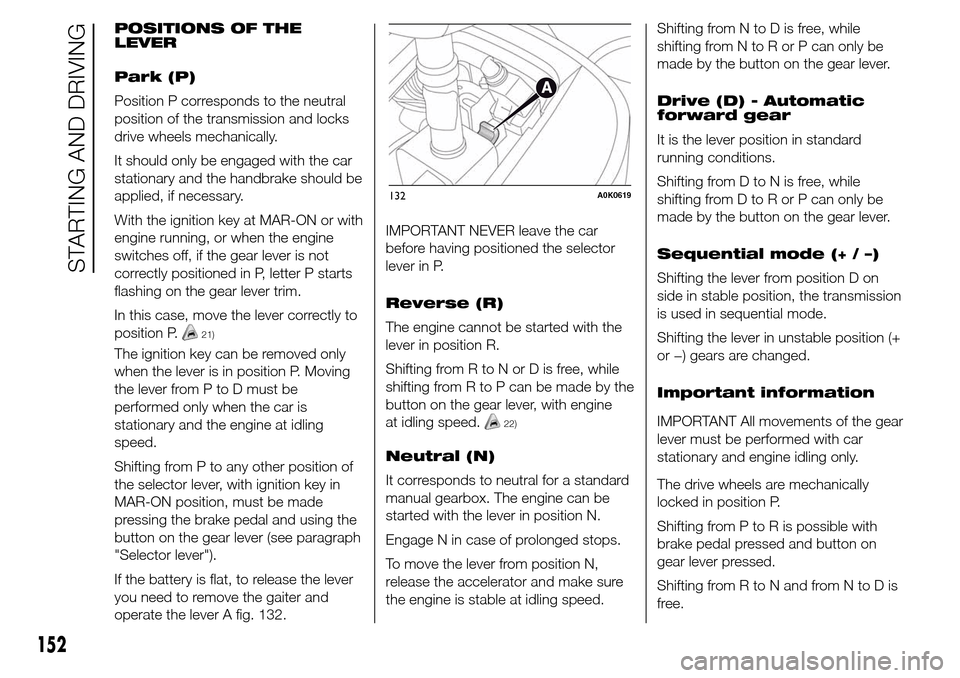
If the battery is flat, to release the lever
you need to remove the gaiter and
operate the lever A fig. 132.IMPORTANT NEVER leave the car
before having positioned the selector
lever in P.
Reverse (R)
The engine cannot be started with the
lever in position R.
Shifting from R to N or D is free, while
shifting from R to P can be made by the
button on the gear lever, with engine
at idling speed.
22)
Neutral (N)
It corresponds to neutral for a standard
manual gearbox. The engine can be
started with the lever in position N.
Engage N in case of prolonged stops.
To move the lever from position N,
release the accelerator and make sure
the engine is stable at idling speed.Shifting from N to D is free, while
shifting from N to R or P can only be
made by the button on the gear lever.
Drive (D) - Automatic
forward gear
It is the lever position in standard
running conditions.
Shifting from D to N is free, while
shifting from D to R or P can only be
made by the button on the gear lever.
Sequential mode (+ / –)
Shifting the lever from position D on
side in stable position, the transmission
is used in sequential mode.
Shifting the lever in unstable position (+
or −) gears are changed.
Important information
IMPORTANT All movements of the gear
lever must be performed with car
stationary and engine idling only.
The drive wheels are mechanically
locked in position P.
Shifting from P to R is possible with
brake pedal pressed and button on
gear lever pressed.
Shifting from R to N and from N to D is
free.
132A0K0619
152
STARTING AND DRIVING
Page 157 of 288
Shifting from D to "Sequential mode" is
free.
Shifting from "Sequential mode" to D is
free.
Shifting from D to N is free.
Shifting from N to R is possible only
with button on gear lever pressed.
Shifting from R to P is possible only
with button on gear lever pressed.
STARTING THE ENGINE
Starting is only permitted with gear
lever in position P or N (with or without
brake pedal pressed).
On starting, the system is at N or P (the
latter means neutral, but with the car’s
wheels locked mechanically).
Start&Stop system
With car at a standstill and Start&Stop
system activated, the engine switches
off if the gear lever is in a position
other than R.
The Start&Stop system does not
operate when the gear lever is in R, for
making parking manoeuvres easier.
In the event of stops uphill, the engine
switching off is disabled to activate
the "Hill Holder" function (works only
with running engine).The engine restarts automatically if:
❒the brake pedal is released (and the
lever is not at N or P)
❒the lever is shifted to an unstable
position: +, − or R
❒the lever is shifted from D to the left
in "Sequential mode"
❒by the "+" or "–" paddles on the
steering wheel (for versions/markets,
where provided)
During the engine stop and start
sequence, the system passes through
the automatic engagement of neutral:
the display shows N.
IMPORTANT In some conditions (for
example with small gradients and brake
pedal not fully depressed), engine
switching off is not deactivated. In this
case, fully depress the brake pedal
to make the "Hill Holder" function
available and restart the engine, using
the gear lever or the paddles on the
steering wheel (for versions/markets,
where provided) as described
previously.ENGINE SWITCHING OFF
Engine can be switched off in any
position of the gear lever.
Versions with
Start&Stop system
To switch the engine off, you need to
stop the car by pressing the brake
pedal properly; if the pressure is not
enough, the engine will not be switched
off.
This feature can be exploited so that
the engine does not switch off in
particular traffic conditions.
Ignition key removal
The ignition key can be removed only if
the gear lever is in position P:
❒if the engine is switched off with the
gear lever in position P: the ignition
key can be removed within 30
seconds;
❒if the engine is switched off with the
gear lever in a position other than P:
the P letter on the display and on
the gear lever trim flashes for 5
seconds and an acoustic signal will
be emitted at the same time. Move
the lever to P within 5 seconds; then
it will be possible to remove the
ignition key for about 30 seconds.
153
Page 158 of 288
In both cases, if the described
conditions and times are not respected,
the ignition key will be automatically
locked.
To remove the key, turn it to MAR-ON
and then to STOP.
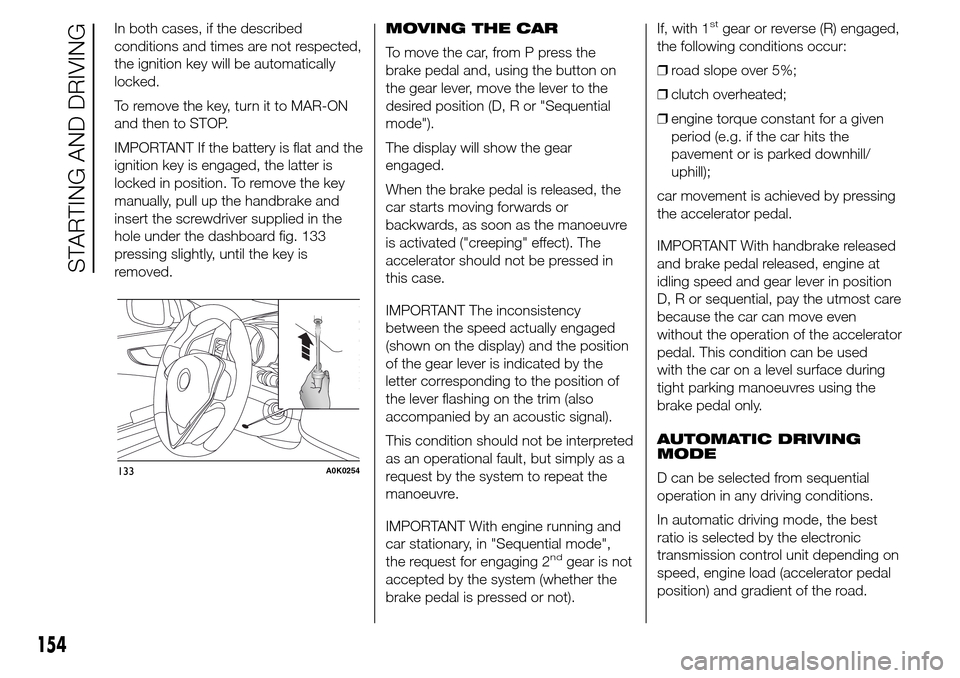
IMPORTANT If the battery is flat and the
ignition key is engaged, the latter is
locked in position. To remove the key
manually, pull up the handbrake and
insert the screwdriver supplied in the
hole under the dashboard fig. 133
pressing slightly, until the key is
removed.MOVING THE CAR
To move the car, from P press the
brake pedal and, using the button on
the gear lever, move the lever to the
desired position (D, R or "Sequential
mode").
The display will show the gear
engaged.
When the brake pedal is released, the
car starts moving forwards or
backwards, as soon as the manoeuvre
is activated ("creeping" effect). The
accelerator should not be pressed in
this case.
IMPORTANT The inconsistency
between the speed actually engaged
(shown on the display) and the position
of the gear lever is indicated by the
letter corresponding to the position of
the lever flashing on the trim (also
accompanied by an acoustic signal).
This condition should not be interpreted
as an operational fault, but simply as a
request by the system to repeat the
manoeuvre.
IMPORTANT With engine running and
car stationary, in "Sequential mode",
the request for engaging 2
ndgear is not
accepted by the system (whether the
brake pedal is pressed or not).If, with 1
stgear or reverse (R) engaged,
the following conditions occur:
❒road slope over 5%;
❒clutch overheated;
❒engine torque constant for a given
period (e.g. if the car hits the
pavement or is parked downhill/
uphill);
car movement is achieved by pressing
the accelerator pedal.
IMPORTANT With handbrake released
and brake pedal released, engine at
idling speed and gear lever in position
D, R or sequential, pay the utmost care
because the car can move even
without the operation of the accelerator
pedal. This condition can be used
with the car on a level surface during
tight parking manoeuvres using the
brake pedal only.
AUTOMATIC DRIVING
MODE
D can be selected from sequential
operation in any driving conditions.
In automatic driving mode, the best
ratio is selected by the electronic
transmission control unit depending on
speed, engine load (accelerator pedal
position) and gradient of the road.
133A0K0254
154
STARTING AND DRIVING
Page 169 of 288
REPLACING A
WHEEL
GENERAL
INSTRUCTIONS
The car is equipped with the “Fix&Go
Automatic Kit”: see the paragraph
“Fix&Go Automatic Kit” for how to use
this device.
As an alternative to the “Fix&Go
Automatic Kit” the car may be
requested with a space-saver wheel:
see the instructions on the following
pages for changing the wheel.
113) 114) 115) 116) 117)
JACK
Please note that:
❒the jack weight is 1.76 kg;
❒the jack requires no adjustment;
❒the jack cannot be repaired and in
the event of a fault it must be
replaced by another original one;
❒no tool other than its cranking device
may be fitted on the jack.
To change a wheel, proceed as follows:❒stop the car in a position that is not
dangerous for oncoming traffic
where you can change the wheel
safely. The ground should be flat
if possible, and sufficiently firm;
❒switch off the engine, pull up the
handbrake and engage the 1
stgear
or reverse. Wear the reflective safety
jacket (compulsory by law) before
getting out of the car;
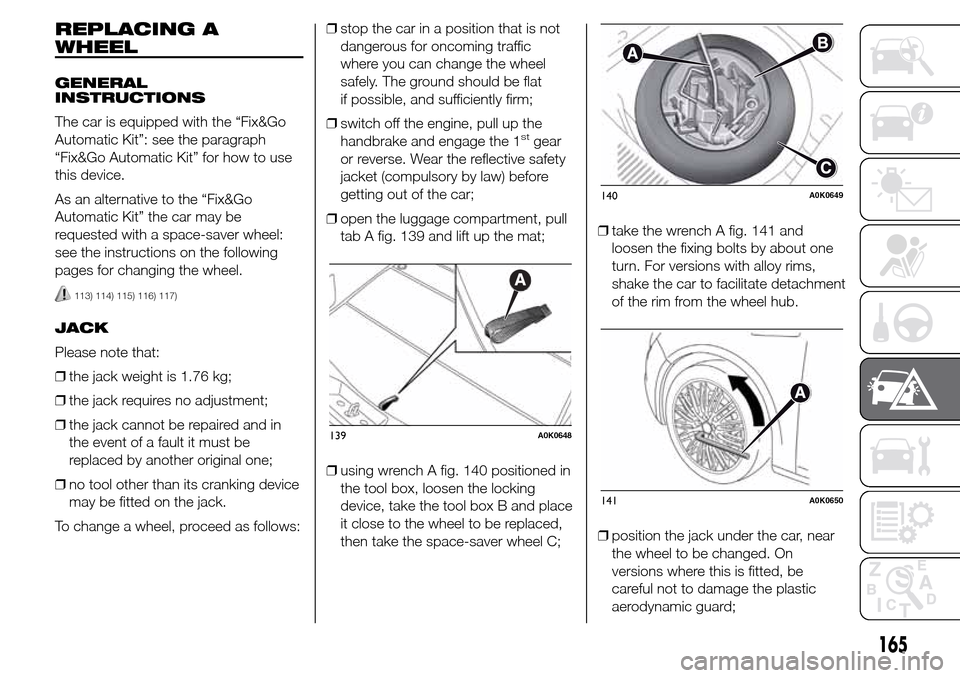
❒open the luggage compartment, pull
tab A fig. 139 and lift up the mat;
❒using wrench A fig. 140 positioned in
the tool box, loosen the locking
device, take the tool box B and place
it close to the wheel to be replaced,
then take the space-saver wheel C;❒take the wrench A fig. 141 and
loosen the fixing bolts by about one
turn. For versions with alloy rims,
shake the car to facilitate detachment
of the rim from the wheel hub.
❒position the jack under the car, near
the wheel to be changed. On
versions where this is fitted, be
careful not to damage the plastic
aerodynamic guard;
139A0K0648
140A0K0649
141A0K0650
165
Page 171 of 288
Subwoofer and space-
saver spare wheel
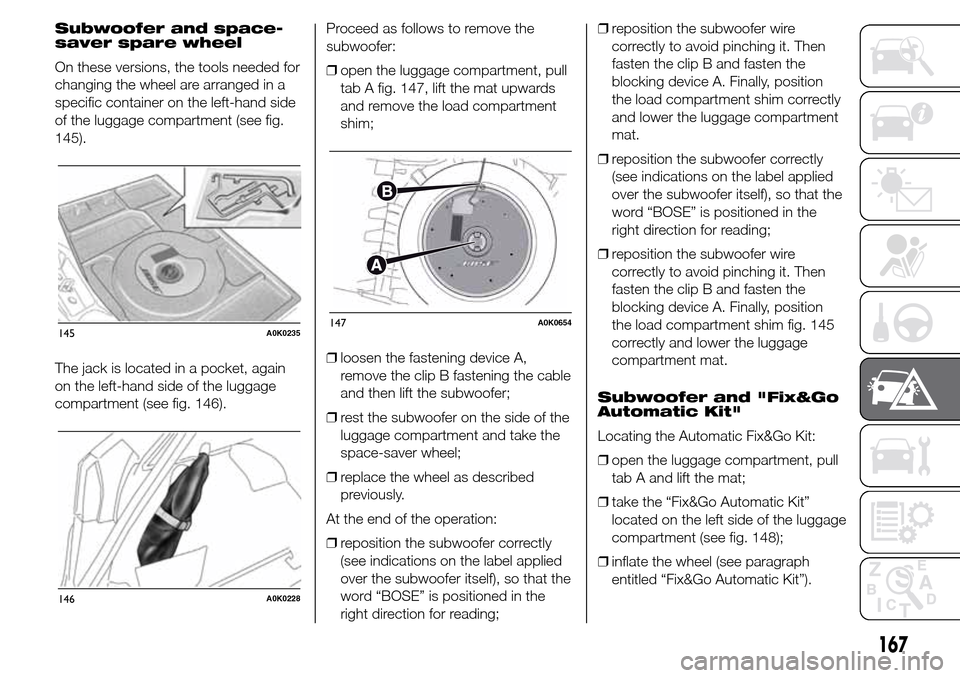
On these versions, the tools needed for
changing the wheel are arranged in a
specific container on the left-hand side
of the luggage compartment (see fig.
145).
The jack is located in a pocket, again
on the left-hand side of the luggage
compartment (see fig. 146).Proceed as follows to remove the
subwoofer:
❒open the luggage compartment, pull
tab A fig. 147, lift the mat upwards
and remove the load compartment
shim;
❒loosen the fastening device A,
remove the clip B fastening the cable
and then lift the subwoofer;
❒rest the subwoofer on the side of the
luggage compartment and take the
space-saver wheel;
❒replace the wheel as described
previously.
At the end of the operation:
❒reposition the subwoofer correctly
(see indications on the label applied
over the subwoofer itself), so that the
word “BOSE” is positioned in the
right direction for reading;❒reposition the subwoofer wire
correctly to avoid pinching it. Then
fasten the clip B and fasten the
blocking device A. Finally, position
the load compartment shim correctly
and lower the luggage compartment
mat.
❒reposition the subwoofer correctly
(see indications on the label applied
over the subwoofer itself), so that the
word “BOSE” is positioned in the
right direction for reading;
❒reposition the subwoofer wire
correctly to avoid pinching it. Then
fasten the clip B and fasten the
blocking device A. Finally, position
the load compartment shim fig. 145
correctly and lower the luggage
compartment mat.
Subwoofer and "Fix&Go
Automatic Kit"
Locating the Automatic Fix&Go Kit:
❒open the luggage compartment, pull
tab A and lift the mat;
❒take the “Fix&Go Automatic Kit”
located on the left side of the luggage
compartment (see fig. 148);
❒inflate the wheel (see paragraph
entitled “Fix&Go Automatic Kit”).
145A0K0235
146A0K0228
147A0K0654
167
Page 176 of 288
REPLACING THE BOTTLE
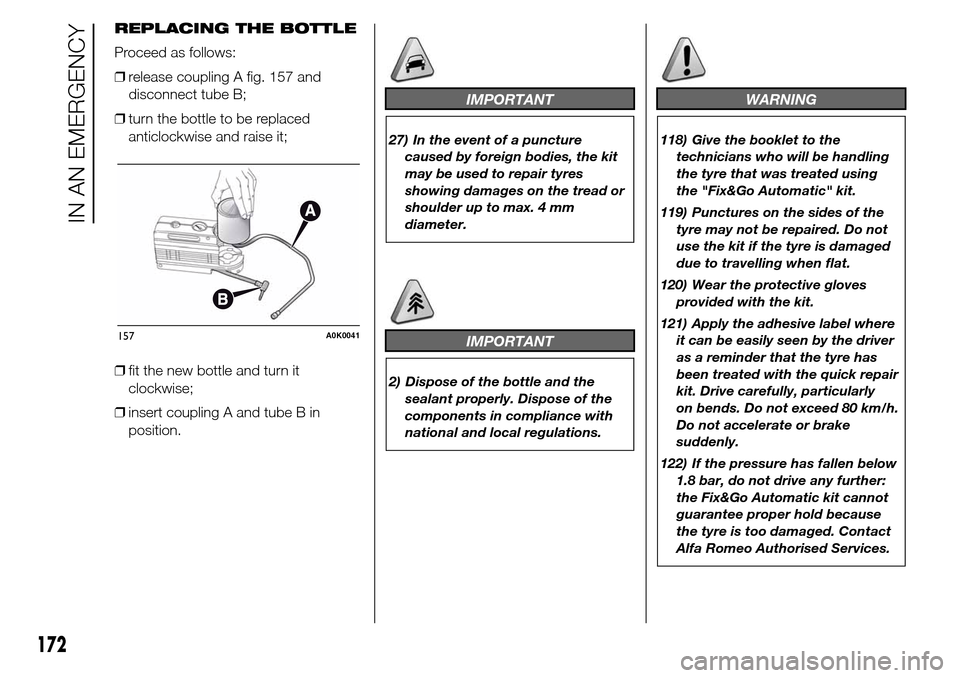
Proceed as follows:
❒release coupling A fig. 157 and
disconnect tube B;
❒turn the bottle to be replaced
anticlockwise and raise it;
❒fit the new bottle and turn it
clockwise;
❒insert coupling A and tube B in
position.
IMPORTANT
27) In the event of a puncture
caused by foreign bodies, the kit
may be used to repair tyres
showing damages on the tread or
shoulder up to max. 4 mm
diameter.
IMPORTANT
2) Dispose of the bottle and the
sealant properly. Dispose of the
components in compliance with
national and local regulations.
WARNING
118) Give the booklet to the
technicians who will be handling
the tyre that was treated using
the "Fix&Go Automatic" kit.
119) Punctures on the sides of the
tyre may not be repaired. Do not
use the kit if the tyre is damaged
due to travelling when flat.
120) Wear the protective gloves
provided with the kit.
121) Apply the adhesive label where
it can be easily seen by the driver
as a reminder that the tyre has
been treated with the quick repair
kit. Drive carefully, particularly
on bends. Do not exceed 80 km/h.
Do not accelerate or brake
suddenly.
122) If the pressure has fallen below
1.8 bar, do not drive any further:
the Fix&Go Automatic kit cannot
guarantee proper hold because
the tyre is too damaged. Contact
Alfa Romeo Authorised Services.
157A0K0041
172
IN AN EMERGENCY