stop Alfa Romeo Giulietta 2016 Owner's Guide
[x] Cancel search | Manufacturer: ALFA ROMEO, Model Year: 2016, Model line: Giulietta, Model: Alfa Romeo Giulietta 2016Pages: 288, PDF Size: 7.34 MB
Page 76 of 288
WARNING
48) When replacing the battery,
always contact an Alfa Romeo
Dealership. The replacement
battery should be of the same
type (HEAVY DUTY) and should
have the same characteristics.
49) Before opening the bonnet,
make sure that the engine is off
and that the ignition key is in
the STOP position. Follow the
instructions on the dedicated
label on the front crossmember
(fig. 85). We recommend that you
remove the key from the ignition if
other people remain in the car.
The car should always be left after
the key has been removed or
turned to the STOP position.
During refuelling, make sure that
the engine is off (and that the
ignition key is in the STOP
position).
iTPMS (indirect Tyre
Pressure
Monitoring System)
(for versions/markets, where provided)
DESCRIPTION
The car can be equipped with the
iTPMS (indirect Tyre Pressure
Monitoring System) which monitors the
tyre inflation status thanks to wheel
speed sensors.
The system warns the driver if one or
more tyres are flat by the dedicated
warning light
continuously on and a
warning message on the display.
If one tyre only is flat, the system can
indicate its position: it is anyway
recommended to check the pressure
on all four tyres.
This indication is displayed also when
turning the engine off and on again until
the RESET procedure is carried out.
RESET PROCEDURE
The iTPMS system needs an initial
"self-learning" phase (with length
depending on the driving style and road
conditions: optimal conditions being
RESET procedure is carried out.❒whenever the tyre pressure is
modified;
❒when even only one tyre is changed;
❒when tyres are rotated/inverted;
❒when the space-saver wheel is fitted.
Before carrying out the RESET, inflate
the tyres to the rated pressure values
specified in the inflation pressure table
(see "Wheels" paragraph in the
"Technical specifications" section).
If the RESET is not carried out, in all
above cases, the warning lightmay
give false indications on one or more
tyres.
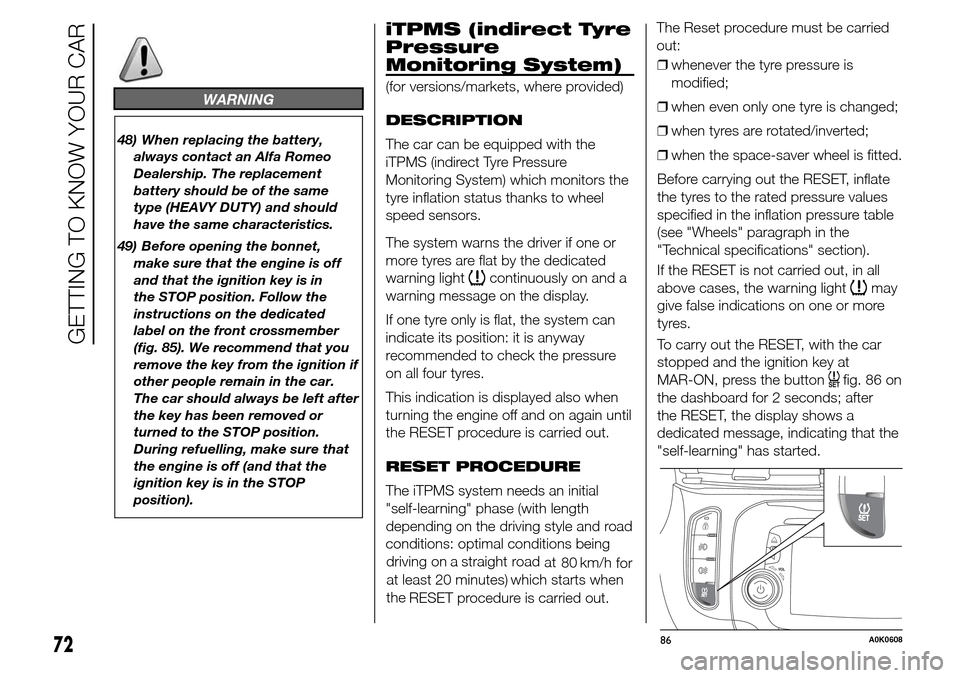
To carry out the RESET, with the car
stopped and the ignition key at
MAR-ON, press the button
fig. 86 on
the dashboard for 2 seconds; after
the RESET, the display shows a
dedicated message, indicating that the
"self-learning" has started.
86A0K060872
GETTING TO KNOW YOUR CAR
The Reset procedure must be carried
out:
which starts when driving
on
a
straight
road
at
80
km/h
for
at least 20 minutes)
the
Page 77 of 288
OPERATING CONDITIONS
50) 51) 52) 53) 54) 55)
The system is active for speeds above
15 km/h.
In a few situations such as sporty
driving, particular conditions of the road
surface (e.g. icy, snowy, unsurfaced
roads) the signalling may be delayed
Under special conditions (e.g. car
loaded asymmetrically on one side,
towing a trailer, damaged or worn tyre,
fitting the space-saver wheel, use of the
"Fix&Go Automatic" kit, fitting snow
chains, fitting different tyres on the
axles) the system may give false
indications or be temporarily
deactivated.
If the system is temporarily deactivated
the
warning light flashes for about
75 seconds and then is continuously
on; at the same time, the display shows
a dedicated message.
This indication is displayed also after
the engine has been switched off and
then on again if the correct operating
conditions are not restored.IMPORTANT
INFORMATION
WARNING
50) If the system signals a pressure
decrease on a specific tyre, it is
recommended to check the
pressure on all four tyres.
51) iTPMS does not relieve the
driver from the obligation to check
the tyre pressure every month; it
is not even to be considered a
replacing system for maintenance
or a safety system.
52) Tyre pressure must be checked
with tyres cold. Should it become
necessary for whatever reason
to check pressure with warm
tyres, do not reduce pressure
even though it is higher than the
prescribed value, but repeat the
check when tyres are cold.
53) The iTPMS cannot indicate
sudden tyre pressure drops (for
example when a tyre bursts).
In this case, stop the car, braking
with caution and avoiding abrupt
steering.54) The system only warns that the
tyre pressure is low: it is not able
to inflate them.
55) An insufficient tyre inflation
increases fuel consumption,
reduces the tread duration and
may affect the capacity of driving
safely.
73
or partial in detecting the contemporary
deflation of more than one tyre.
Page 82 of 288
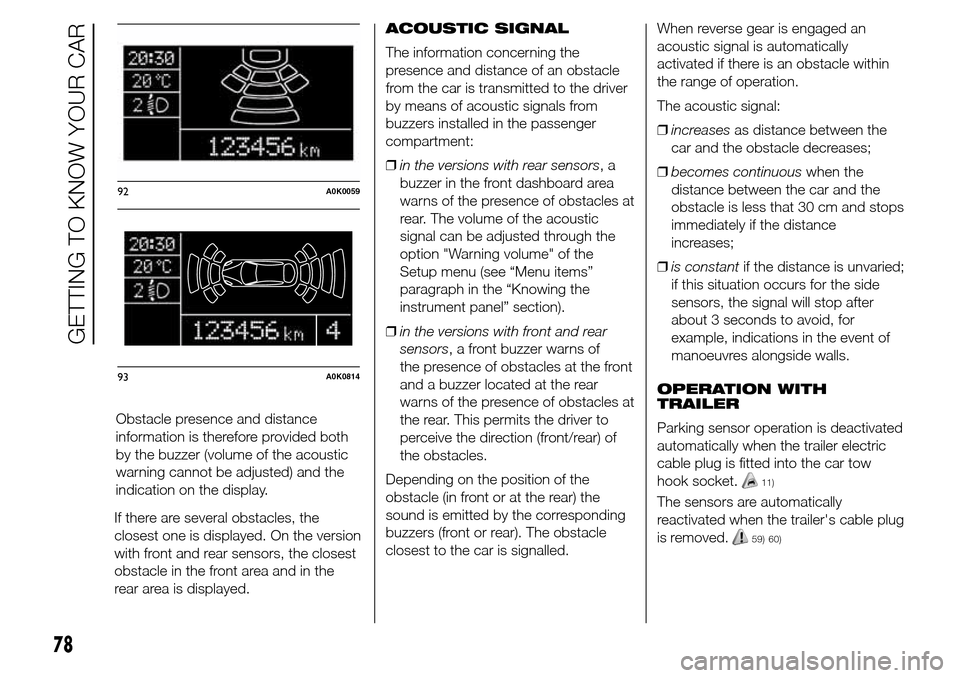
If there are several obstacles, the
closest one is displayed. On the version
with front and rear sensors, the closest
obstacle in the front area and in the
rear area is displayed.ACOUSTIC SIGNAL
The information concerning the
presence and distance of an obstacle
from the car is transmitted to the driver
by means of acoustic signals from
buzzers installed in the passenger
compartment:
❒in the versions with rear sensors,a
buzzer in the front dashboard area
warns of the presence of obstacles at
rear. The volume of the acoustic
signal can be adjusted through the
option "Warning volume" of the
Setup menu (see “Menu items”
paragraph in the “Knowing the
instrument panel” section).
❒in the versions with front and rear
sensors, a front buzzer warns of
the presence of obstacles at the front
and a buzzer located at the rear
warns of the presence of obstacles at
the rear. This permits the driver to
perceive the direction (front/rear) of
the obstacles.
Depending on the position of the
obstacle (in front or at the rear) the
sound is emitted by the corresponding
buzzers (front or rear). The obstacle
closest to the car is signalled.When reverse gear is engaged an
acoustic signal is automatically
activated if there is an obstacle within
the range of operation.
The acoustic signal:
❒increasesas distance between the
car and the obstacle decreases;
❒becomes continuouswhen the
distance between the car and the
obstacle is less that 30 cm and stops
immediately if the distance
increases;
❒is constantif the distance is unvaried;
if this situation occurs for the side
sensors, the signal will stop after
about 3 seconds to avoid, for
example, indications in the event of
manoeuvres alongside walls.
OPERATION WITH
TRAILER
Parking sensor operation is deactivated
automatically when the trailer electric
cable plug is fitted into the car tow
hook socket.
11)
The sensors are automatically
reactivated when the trailer's cable plug
is removed.
59) 60)
92A0K0059
93A0K0814
78
GETTING TO KNOW YOUR CAR
Obstacle presence and distance
information is therefore provided both
by the buzzer (volume of the acoustic
warning cannot be adjusted) and the
indication on the display.
Page 84 of 288
60) Parking and other dangerous
manoeuvres are, however, always
the driver’s responsibility. While
carrying out these manoeuvres,
always make sure that no people
(especially children) or animals are
in the area concerned. The
parking sensors are an aid for the
driver, but the driver must never
allow their attention to lapse
during potentially dangerous
manoeuvres, even those executed
at low speeds.REFUELLING THE
CAR
Stop the engine before refuelling.
PETROL ENGINES
Only use unleaded petrol 95 R.O.N.
compliant with the European
specification EN228. The petrol octane
rating (R.O.N.) must not be lower than
95. In order to prevent damage to
the catalytic converter never introduce
even the smallest amount of leaded
petrol, even in the event of an
emergency.
DIESEL ENGINES
Use only diesel fuel compliant with
European specification EN590. The use
of other products or mixtures may
damage the engine beyond repair and
consequently invalidate the warranty,
due to the damage caused.
Operation at low
temperatures
If the outside temperature is very low,
the diesel thickens due to the formation
of paraffin clots with consequent
defective operation of the fuel supply
system.In order to avoid these problems,
different types of diesel are distributed
according to the season: summer type,
winter type and arctic type (cold,
mountain areas).
If refuelling with diesel whose
specifications are not suitable for the
usage temperature, it is advisable
to mix TUTELA DIESEL ART additive in
the proportions shown on the container
with the fuel. Pour the additive into
the tank before the fuel.
When using or parking the car for a
long time in the mountains or cold
areas, it is advisable to refuel using
locally available fuel. In this case, it is
also advisable to keep the tank over
50% full.
FILLING THE TANK
To fill the tank completely, top-up twice
after the first click of the fuel supply
gun. Further top-ups could cause faults
in the fuel feeding system.
FUEL TANK CAP
The fuel flap is unlocked when the
central locking system is released and
automatically locked when the central
locking system is applied.
80
GETTING TO KNOW YOUR CAR
Page 87 of 288
KNOWING THE INSTRUMENT PANEL
This section of the booklet gives you all
the information you need to
understand, interpret and use the
instrument panel correctly.DISPLAY ......................................... 84
MENU ITEMS .................................. 87
CONTROL PANEL AND
INSTRUMENTS ............................... 94
TRIP COMPUTER ........................... 96
WARNING LIGHTS AND
MESSAGES ................................... 99
- LOW BRAKE FLUID/HANDBRAKE
ENGAGED .......................................... 99
- EBD FAILURE .................................. 100
- AIRBAG FAILURE ............................. 100
- SEAT BELTS NOT FASTENED .......... 100
- ALTERNATOR FAILURE ................... 101
- LOW ENGINE OIL PRESSURE ......... 102
-DEGRADED ENGINE OIL (for
versions/markets, where provided) ..... 103
- ENGINE COOLANT TEMPERATURE
TOO HIGH .......................................... 105
- ALFA TCT FAILURE .......................... 106
-INCOMPLETE DOOR LOCKING ........ 106
-SPEED LIMIT EXCEEDED ................. 106
- DUAL PINION ACTIVE STEERING
FAILURE ............................................. 107
- ALFA ROMEO CODE SYSTEM
FAILURE/ALARM FAILURE ................. 107
- FUEL RESERVE/LIMITED RANGE .... 108
- GENERAL FAILURE ......................... 109
- GENERAL FAILURE ......................... 110
-REAR FOG LIGHTS ........................... 111
- ABS FAILURE ................................... 112
-BRAKE PAD WEAR ........................... 112
- PASSENGER SIDE AIRBAG
DEACTIVATED .................................... 112
- INJECTION/EOBD SYSTEM
FAILURE ............................................. 113
- GLOW PLUG HEATING/GLOW
PLUG HEATING FAILURE (diesel
versions) ............................................. 114-WATER IN DIESEL FILTER (diesel
versions) ............................................. 114
- DPF CLEANING (particulate trap) in
progress (diesel versions with DPF
only) ................................................... 116
- iTPMS SYSTEM ............................... 117
- ELECTRONIC STABILITY CONTROL
(ESC) SYSTEM ................................... 119
- ELECTRONIC STABILITY CONTROL
(ESC) SYSTEM ................................... 120
- CRUISE CONTROL (for
versions/markets, where provided) ..... 121
- SIDE LIGHTS ................................... 121
- FOLLOW ME HOME ........................ 121
- DIPPED BEAM HEADLIGHTS .......... 121
- FOG LIGHTS .................................... 121
- LEFT-HAND DIRECTION
- RIGHT-HAND DIRECTION
INDICATOR ........................................ 122
- MAIN BEAM HEADLIGHTS .............. 122
-FUEL CUT-OFF SYSTEM ................... 123
- POSSIBLE ICE ON ROAD ................ 123
- BRAKE LIGHT FAILURE ................... 123
- DUSK SENSOR FAILURE ................. 123
- RAIN SENSOR FAILURE .................. 124
- PARKING SENSOR FAILURE ........... 124
-START&STOP SYSTEM
ACTIVATION/DEACTIVATION (for
versions/markets, where provided) ..... 125
-START&STOP FAILURE .................... 125
- DISPLAY OF SELECTED DRIVING
MODE (“Alfa DNA” system) ................. 126
83
INDICATOR.......................................... 122
Page 88 of 288
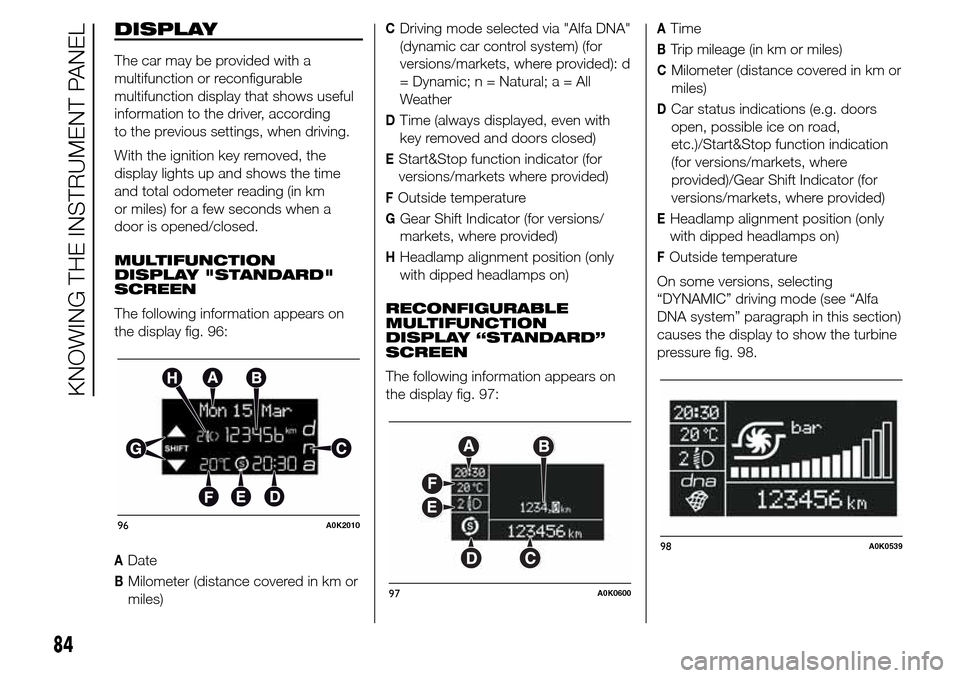
DISPLAY
The car may be provided with a
multifunction or reconfigurable
multifunction display that shows useful
information to the driver, according
to the previous settings, when driving.
With the ignition key removed, the
display lights up and shows the time
and total odometer reading (in km
or miles) for a few seconds when a
door is opened/closed.
MULTIFUNCTION
DISPLAY "STANDARD"
SCREEN
The following information appears on
the display fig. 96:
ADate
BMilometer (distance covered in km or
miles)
CDriving mode selected via "Alfa DNA"
(dynamic car control system) (for
versions/markets, where provided): d
= Dynamic; n = Natural;a=All
Weather
DTime (always displayed, even with
key removed and doors closed)
EStart&Stop function indicator (for
versions/markets where provided)
FOutside temperature
GGear Shift Indicator (for versions/
markets, where provided)
HHeadlamp alignment position (only
with dipped headlamps on)
RECONFIGURABLE
MULTIFUNCTION
DISPLAY “STANDARD”
SCREEN
The following information appears on
the display fig. 97:
ATime
BTrip mileage (in km or miles)
CMilometer (distance covered in km or
miles)
DCar status indications (e.g. doors
open, possible ice on road,
etc.)/Start&Stop function indication
(for versions/markets, where
provided)/Gear Shift Indicator (for
versions/markets, where provided)
EHeadlamp alignment position (only
with dipped headlamps on)
FOutside temperature
On some versions, selecting
“DYNAMIC” driving mode (see “Alfa
DNA system” paragraph in this section)
causes the display to show the turbine
pressure fig. 98.
96A0K2010
97A0K0600
98A0K0539
84
KNOWING THE INSTRUMENT PANEL
Page 89 of 288
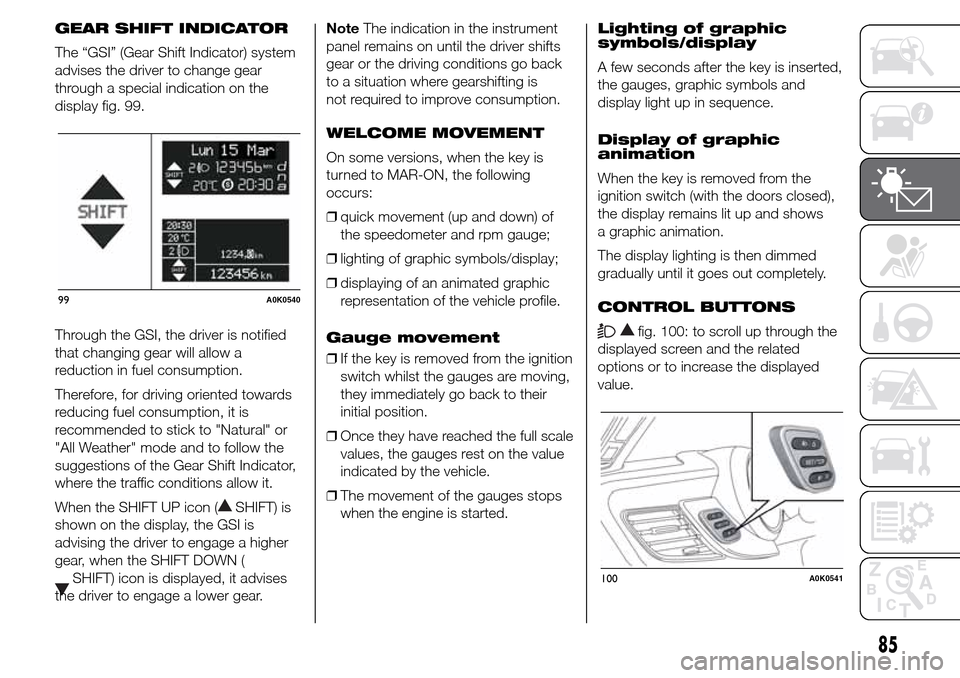
GEAR SHIFT INDICATOR
The “GSI” (Gear Shift Indicator) system
advises the driver to change gear
through a special indication on the
display fig. 99.
Through the GSI, the driver is notified
that changing gear will allow a
reduction in fuel consumption.
Therefore, for driving oriented towards
reducing fuel consumption, it is
recommended to stick to "Natural" or
"All Weather" mode and to follow the
suggestions of the Gear Shift Indicator,
where the traffic conditions allow it.
When the SHIFT UP icon (
SHIFT) is
shown on the display, the GSI is
advising the driver to engage a higher
gear, when the SHIFT DOWN (
SHIFT) icon is displayed, it advises
the driver to engage a lower gear.NoteThe indication in the instrument
panel remains on until the driver shifts
gear or the driving conditions go back
to a situation where gearshifting is
not required to improve consumption.
WELCOME MOVEMENT
On some versions, when the key is
turned to MAR-ON, the following
occurs:
❒quick movement (up and down) of
the speedometer and rpm gauge;
❒lighting of graphic symbols/display;
❒displaying of an animated graphic
representation of the vehicle profile.
Gauge movement
❒If the key is removed from the ignition
switch whilst the gauges are moving,
they immediately go back to their
initial position.
❒Once they have reached the full scale
values, the gauges rest on the value
indicated by the vehicle.
❒The movement of the gauges stops
when the engine is started.Lighting of graphic
symbols/display
A few seconds after the key is inserted,
the gauges, graphic symbols and
display light up in sequence.
Display of graphic
animation
When the key is removed from the
ignition switch (with the doors closed),
the display remains lit up and shows
a graphic animation.
The display lighting is then dimmed
gradually until it goes out completely.
CONTROL BUTTONS
fig. 100: to scroll up through the
displayed screen and the related
options or to increase the displayed
value.
99A0K0540
100A0K0541
85
Page 100 of 288
SPEEDOMETER (SPEED
INDICATOR)
This shows the speed of the car.
REV COUNTER
This indicates the engine rpm.
FUEL LEVEL GAUGE
This shows the amount of fuel left in the
fuel tank.
The warning light in the gauge lights up
when there are only 8 to 10 litres of
fuel remaining in the tank; if this
happens, refuel as soon as possible.
Do not travel with the fuel tank almost
empty: any gaps in fuel delivery could
damage the catalytic converter.ENGINE COOLANT
TEMPERATURE
INDICATOR
The needle shows the temperature of
the engine coolant and starts supplying
indications when the fluid temperature
exceeds approx. 50°C.
Under normal conditions, the needle
assumes different positions within
the scale depending on the usage
conditions.
The warning light turns on to indicate
an overheating of the engine coolant. In
this case, stop the engine and contact
an Alfa Romeo Dealership.TRIP COMPUTER
IN BRIEF
The Trip computer is used to display
information on car operation when
the key is turned to MAR.
This function is characterised by two
separate memories, called "Trip A"
and "Trip B", where the car's
"complete missions" (journeys) are
recorded in a reciprocally
independent manner.
Both memories can be reset: i.e. start
of a new journey.
“Trip A” is used to display the figures
relating to:
❒Range
❒Distance travelled
❒Average fuel consumption
❒Instant fuel consumption
❒Average speed
❒Trip time (driving time).
“Trip B” may be used to display the
figures relating to:
❒Distance travelled B
❒Average consumption B
96
KNOWING THE INSTRUMENT PANEL
Page 106 of 288
Warning lights on
panelWhat it means What to do
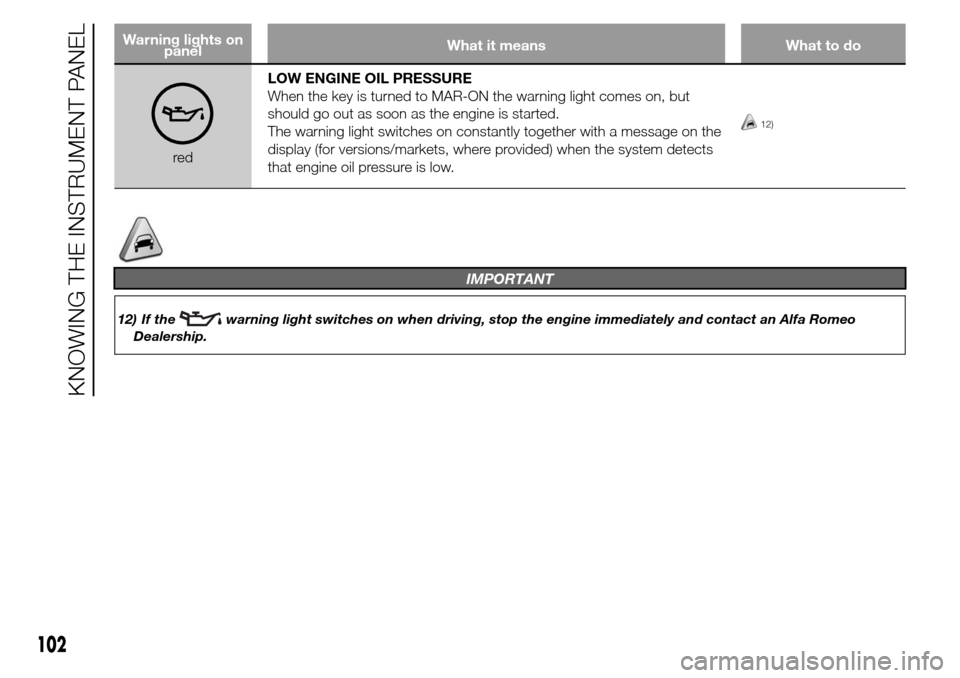
redLOW ENGINE OIL PRESSURE
When the key is turned to MAR-ON the warning light comes on, but
should go out as soon as the engine is started.
The warning light switches on constantly together with a message on the
display (for versions/markets, where provided) when the system detects
that engine oil pressure is low.
12)
IMPORTANT
12) If thewarning light switches on when driving, stop the engine immediately and contact an Alfa Romeo
Dealership.
102
KNOWING THE INSTRUMENT PANEL
Page 109 of 288
Warning lights on
panelWhat it means What to do
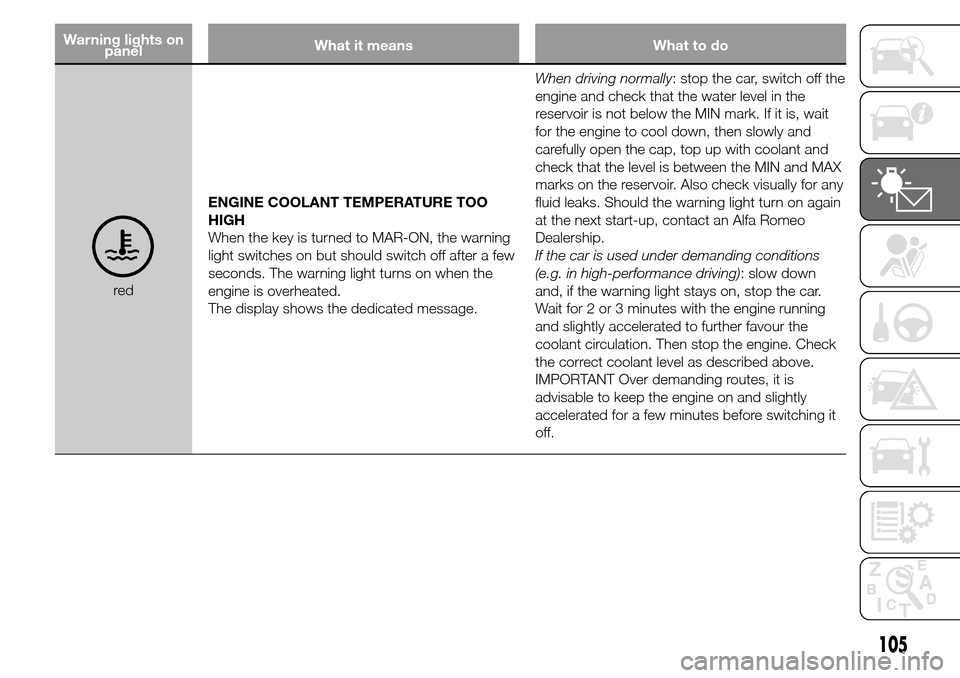
redENGINE COOLANT TEMPERATURE TOO
HIGH
When the key is turned to MAR-ON, the warning
light switches on but should switch off after a few
seconds. The warning light turns on when the
engine is overheated.
The display shows the dedicated message.When driving normally: stop the car, switch off the
engine and check that the water level in the
reservoir is not below the MIN mark. If it is, wait
for the engine to cool down, then slowly and
carefully open the cap, top up with coolant and
check that the level is between the MIN and MAX
marks on the reservoir. Also check visually for any
fluid leaks. Should the warning light turn on again
at the next start-up, contact an Alfa Romeo
Dealership.
If the car is used under demanding conditions
(e.g. in high-performance driving): slow down
and, if the warning light stays on, stop the car.
Wait for 2 or 3 minutes with the engine running
and slightly accelerated to further favour the
coolant circulation. Then stop the engine. Check
the correct coolant level as described above.
IMPORTANT Over demanding routes, it is
advisable to keep the engine on and slightly
accelerated for a few minutes before switching it
off.
105