stop Alfa Romeo Giulietta 2016 Service Manual
[x] Cancel search | Manufacturer: ALFA ROMEO, Model Year: 2016, Model line: Giulietta, Model: Alfa Romeo Giulietta 2016Pages: 288, PDF Size: 7.34 MB
Page 113 of 288
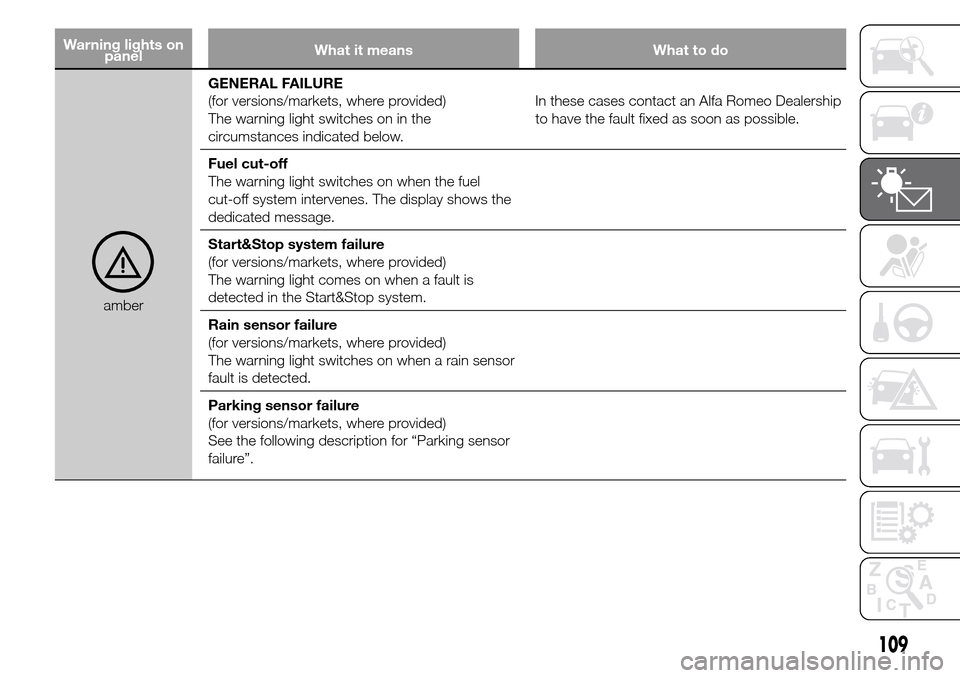
Warning lights on
panelWhat it means What to do
amberGENERAL FAILURE
(for versions/markets, where provided)
The warning light switches on in the
circumstances indicated below.In these cases contact an Alfa Romeo Dealership
to have the fault fixed as soon as possible.
Fuel cut-off
The warning light switches on when the fuel
cut-off system intervenes. The display shows the
dedicated message.
Start&Stop system failure
(for versions/markets, where provided)
The warning light comes on when a fault is
detected in the Start&Stop system.
Rain sensor failure
(for versions/markets, where provided)
The warning light switches on when a rain sensor
fault is detected.
Parking sensor failure
(for versions/markets, where provided)
See the following description for “Parking sensor
failure”.
109
Page 117 of 288
Warning lights on
panelWhat it means What to do
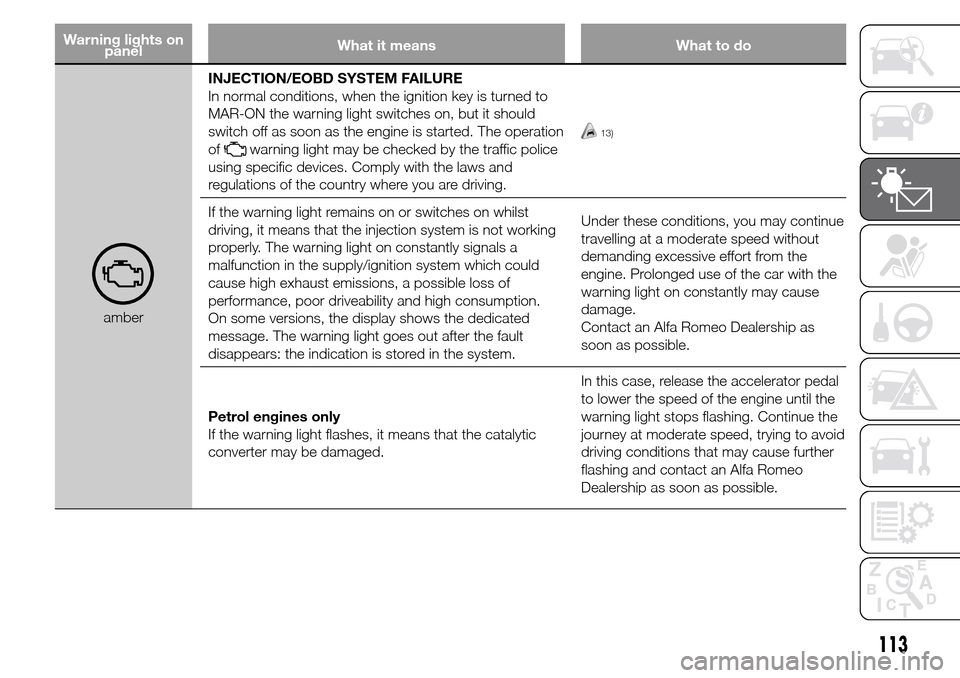
amberINJECTION/EOBD SYSTEM FAILURE
In normal conditions, when the ignition key is turned to
MAR-ON the warning light switches on, but it should
switch off as soon as the engine is started. The operation
of
warning light may be checked by the traffic police
using specific devices. Comply with the laws and
regulations of the country where you are driving.
13)
If the warning light remains on or switches on whilst
driving, it means that the injection system is not working
properly. The warning light on constantly signals a
malfunction in the supply/ignition system which could
cause high exhaust emissions, a possible loss of
performance, poor driveability and high consumption.
On some versions, the display shows the dedicated
message. The warning light goes out after the fault
disappears: the indication is stored in the system.Under these conditions, you may continue
travelling at a moderate speed without
demanding excessive effort from the
engine. Prolonged use of the car with the
warning light on constantly may cause
damage.
Contact an Alfa Romeo Dealership as
soon as possible.
Petrol engines only
If the warning light flashes, it means that the catalytic
converter may be damaged.In this case, release the accelerator pedal
to lower the speed of the engine until the
warning light stops flashing. Continue the
journey at moderate speed, trying to avoid
driving conditions that may cause further
flashing and contact an Alfa Romeo
Dealership as soon as possible.
113
Page 120 of 288
Warning lights on
panelWhat it means What to do
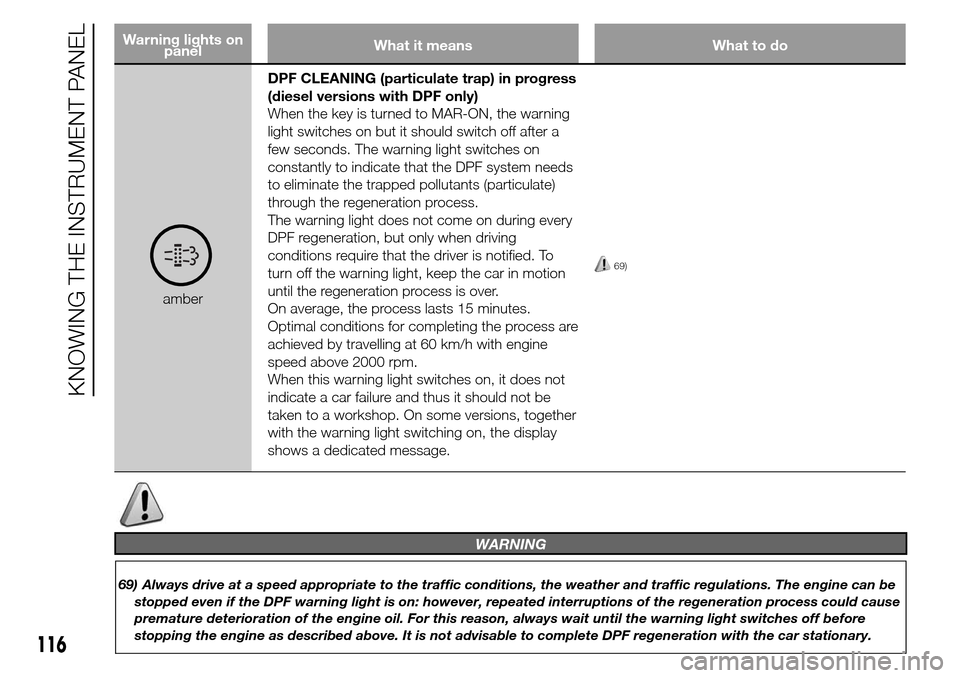
amberDPF CLEANING (particulate trap) in progress
(diesel versions with DPF only)
When the key is turned to MAR-ON, the warning
light switches on but it should switch off after a
few seconds. The warning light switches on
constantly to indicate that the DPF system needs
to eliminate the trapped pollutants (particulate)
through the regeneration process.
The warning light does not come on during every
DPF regeneration, but only when driving
conditions require that the driver is notified. To
turn off the warning light, keep the car in motion
until the regeneration process is over.
On average, the process lasts 15 minutes.
Optimal conditions for completing the process are
achieved by travelling at 60 km/h with engine
speed above 2000 rpm.
When this warning light switches on, it does not
indicate a car failure and thus it should not be
taken to a workshop. On some versions, together
with the warning light switching on, the display
shows a dedicated message.
69)
116
KNOWING THE INSTRUMENT PANEL
WARNING
69) Always drive at a speed appropriate to the traffic conditions, the weather and traffic regulations. The engine can be
stopped even if the DPF warning light is on: however, repeated interruptions of the regeneration process could cause
premature deterioration of the engine oil. For this reason, always wait until the warning light switches off before
stopping the engine as described above. It is not advisable to complete DPF regeneration with the car stationary.
Page 121 of 288
Warning lights on
panelWhat it means What to do
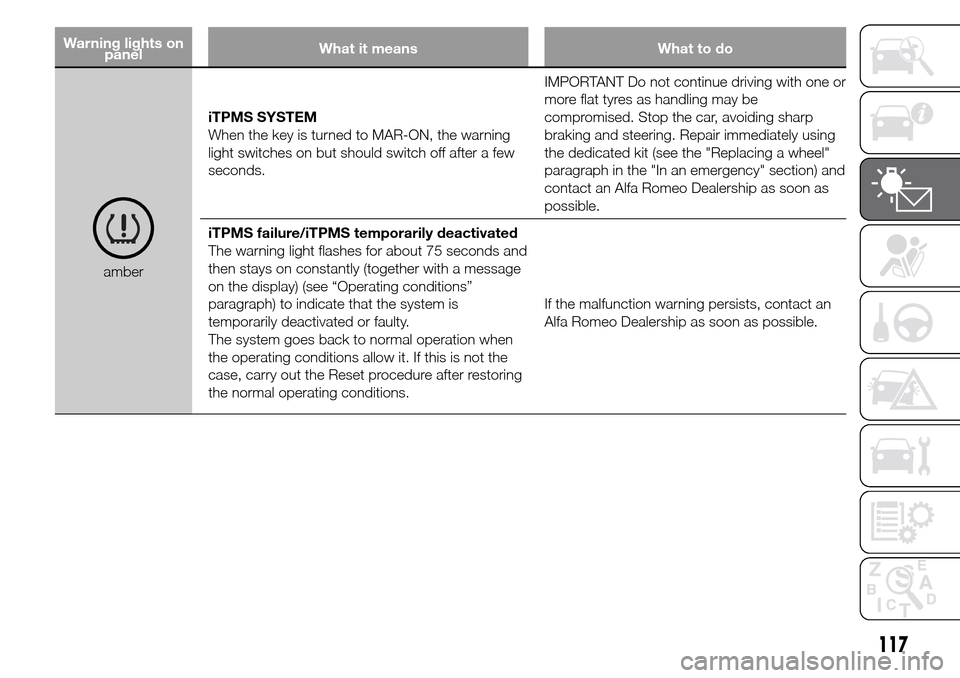
amberiTPMS SYSTEM
When the key is turned to MAR-ON, the warning
light switches on but should switch off after a few
seconds.IMPORTANT Do not continue driving with one or
more flat tyres as handling may be
compromised. Stop the car, avoiding sharp
braking and steering. Repair immediately using
the dedicated kit (see the "Replacing a wheel"
paragraph in the "In an emergency" section) and
contact an Alfa Romeo Dealership as soon as
possible.
iTPMS failure/iTPMS temporarily deactivated
The warning light flashes for about 75 seconds and
then stays on constantly (together with a message
on the display) (see “Operating conditions”
paragraph) to indicate that the system is
temporarily deactivated or faulty.
The system goes back to normal operation when
the operating conditions allow it. If this is not the
case, carry out the Reset procedure after restoring
the normal operating conditions.If the malfunction warning persists, contact an
Alfa Romeo Dealership as soon as possible.
117
Page 122 of 288
Warning lights on
panelWhat it means What to do
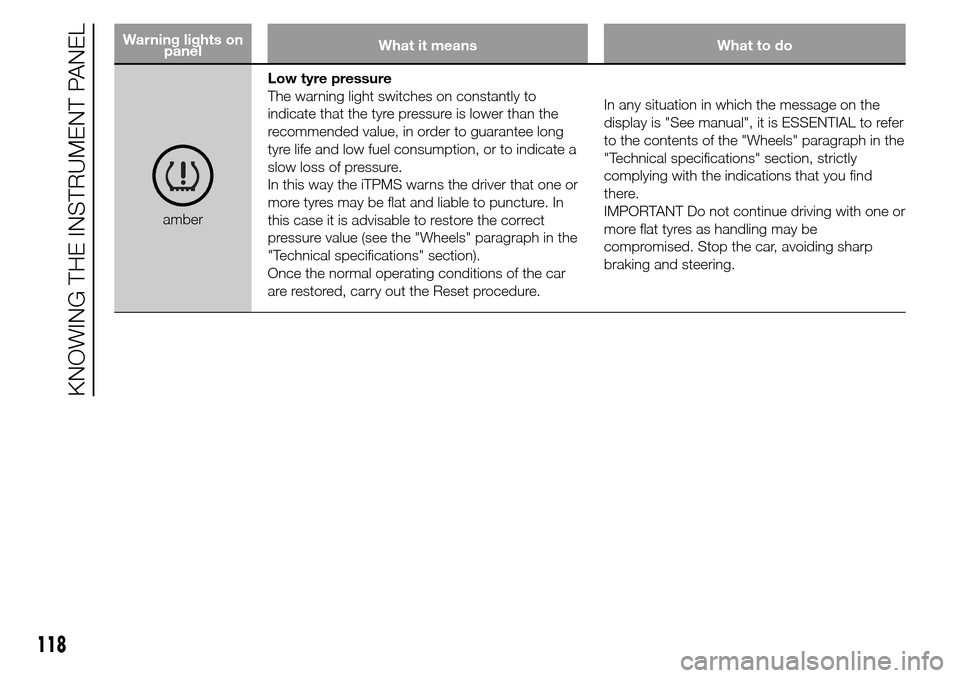
amberLow tyre pressure
The warning light switches on constantly to
indicate that the tyre pressure is lower than the
recommended value, in order to guarantee long
tyre life and low fuel consumption, or to indicate a
slow loss of pressure.
In this way the iTPMS warns the driver that one or
more tyres may be flat and liable to puncture. In
this case it is advisable to restore the correct
pressure value (see the "Wheels" paragraph in the
"Technical specifications" section).
Once the normal operating conditions of the car
are restored, carry out the Reset procedure.In any situation in which the message on the
display is "See manual", it is ESSENTIAL to refer
to the contents of the "Wheels" paragraph in the
"Technical specifications" section, strictly
complying with the indications that you find
there.
IMPORTANT Do not continue driving with one or
more flat tyres as handling may be
compromised. Stop the car, avoiding sharp
braking and steering.
118
KNOWING THE INSTRUMENT PANEL
Page 129 of 288
Symbol on the
displayWhat it means What to do
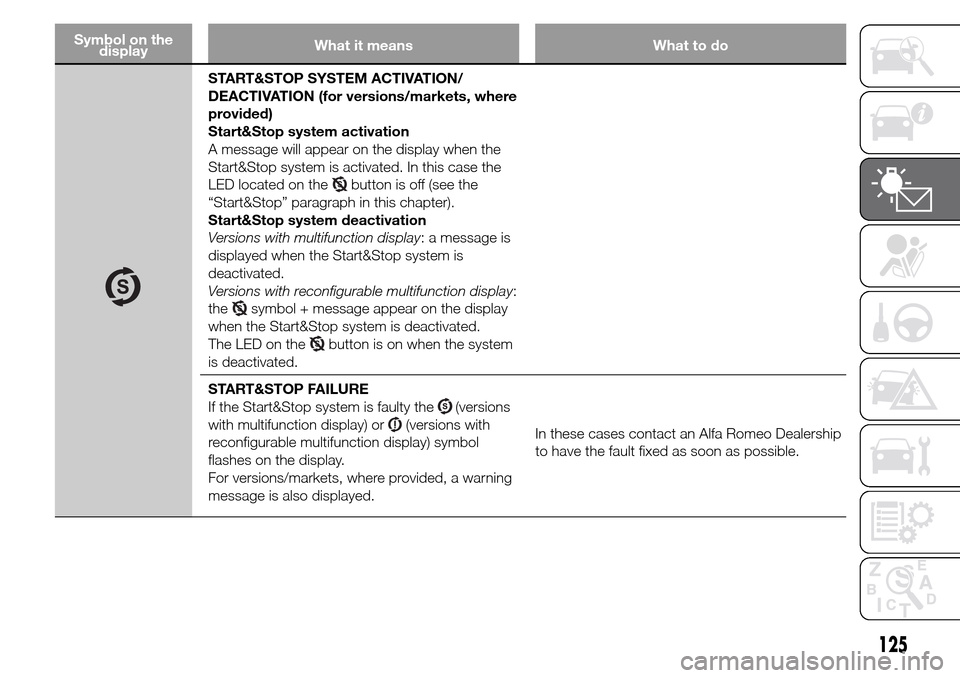
START&STOP SYSTEM ACTIVATION/
DEACTIVATION (for versions/markets, where
provided)
Start&Stop system activation
A message will appear on the display when the
Start&Stop system is activated. In this case the
LED located on the
button is off (see the
“Start&Stop” paragraph in this chapter).
Start&Stop system deactivation
Versions with multifunction display: a message is
displayed when the Start&Stop system is
deactivated.
Versions with reconfigurable multifunction display:
the
symbol + message appear on the display
when the Start&Stop system is deactivated.
The LED on the
button is on when the system
is deactivated.
START&STOP FAILURE
If the Start&Stop system is faulty the
(versions
with multifunction display) or
(versions with
reconfigurable multifunction display) symbol
flashes on the display.
For versions/markets, where provided, a warning
message is also displayed.In these cases contact an Alfa Romeo Dealership
to have the fault fixed as soon as possible.
125
Page 134 of 288
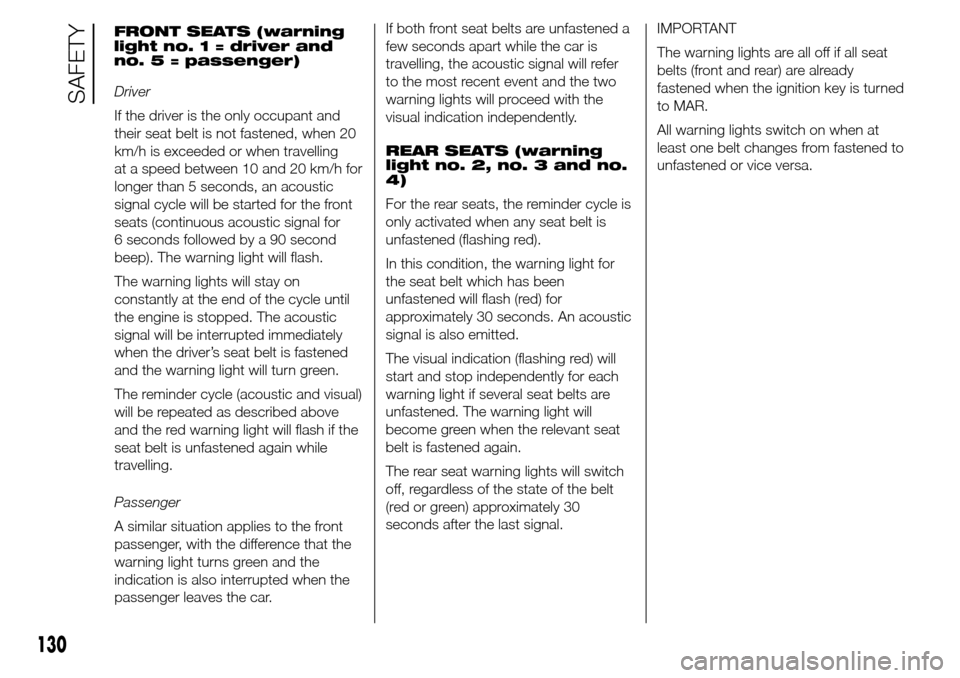
Driver
If the driver is the only occupant and
their seat belt is not fastened, when 20
km/h is exceeded or when travelling
at a speed between 10 and 20 km/h for
longer than 5 seconds, an acoustic
signal cycle will be started for the front
seats (continuous acoustic signal for
6 seconds followed by a 90 second
beep). The warning light will flash.
The warning lights will stay on
constantly at the end of the cycle until
the engine is stopped. The acoustic
signal will be interrupted immediately
when the driver’s seat belt is fastened
and the warning light will turn green.
The reminder cycle (acoustic and visual)
will be repeated as described above
and the red warning light will flash if the
seat belt is unfastened again while
travelling.
Passenger
A similar situation applies to the front
passenger, with the difference that the
warning light turns green and the
indication is also interrupted when the
passenger leaves the car.If both front seat belts are unfastened a
few seconds apart while the car is
travelling, the acoustic signal will refer
to the most recent event and the two
warning lights will proceed with the
visual indication independently.
REAR SEATS (warning
light no. 2, no. 3 and no.
4)
For the rear seats, the reminder cycle is
only activated when any seat belt is
unfastened (flashing red).
In this condition, the warning light for
the seat belt which has been
unfastened will flash (red) for
approximately 30 seconds. An acoustic
signal is also emitted.
The visual indication (flashing red) will
start and stop independently for each
warning light if several seat belts are
unfastened. The warning light will
become green when the relevant seat
belt is fastened again.
The rear seat warning lights will switch
off, regardless of the state of the belt
(red or green) approximately 30
seconds after the last signal.IMPORTANT
The warning lights are all off if all seat
belts (front and rear) are already
fastened when the ignition key is turned
to MAR.
All warning lights switch on when at
least one belt changes from fastened to
unfastened or vice versa.
130
SAFETY
FRONT SEATS (warning
light no. 1 = driver and
no. 5 = passenger)
Page 150 of 288
96) When the ignition key is in and
turned in the MAR-ON position
and the engine is off, the airbags
may deploy if the car is crashed
by another moving vehicle.
Therefore, even if the car is
stationary, when an active
passenger airbag is fitted, DO
NOT install rear facing child
restraint systems on the front
passenger seat. Deployment of
the airbag following an impact
could cause fatal injuries to the
child. Therefore, always
deactivate the passenger airbag
when a rear facing child restraint
system is installed on the front
passenger seat. The front
passenger seat must also be
positioned back as far as possible
in order to avoid the child
restraint system from coming into
contact with the dashboard.
Immediately reactivate the
passenger airbag as soon as the
child restraint system has been
removed. Also remember that,
if the key is turned to STOP, none
of the safety devices (airbags or
pretensioners) will be deployed in
the event of a collision. Non-
deployment in such cases does
not indicate a system malfunction.97) When the ignition key is turned
to MAR-ON, the
warning light
turns on (front airbag on
passenger's side enabled) and
blinks for a few seconds to remind
that the passenger airbag will
activate in the event of a collision.
Then it turns off.
98) The front airbags deploy in the
event of more severe collisions
than those required for deploying
the pretensioners. When the
impact is between the two
deployment thresholds, it is
normal that pretensioners only are
engaged.
99) The airbag does not replace seat
belts, but increases their
efficiency. Because front airbags
are not deployed for low-speed
crashes, side collisions, rear-end
shunts or rollovers, occupants are
protected, in addition to any side
bags, only by their seat belts,
which must therefore always be
fastened.
146
SAFETY
Page 152 of 288
STARTING THE
ENGINE
PROCEDURE FOR
PETROL VERSIONS
Proceed as follows:
❒engage the handbrake and place the
gear lever in neutral;
❒fully depress the clutch pedal,
without touching the accelerator;
❒turn the ignition key to AVV and
release it as soon as the engine
starts.
IMPORTANT INFORMATION
100) 101)
102)
16) 17) 18)
❒If the engine does not start at the first
attempt, return the ignition key to
STOP before repeating the starting
procedure.
❒If, when the ignition key is at
MAR-ON, the
instrument panel
warning light (or the symbol on the
display) stays on together with the
warning light, turn the key to
STOP and then back to MAR-ON. If
the warning light (or the symbol on
the display) remains on, try with
the other keys provided with the car.
Contact an Alfa Romeo Dealership
if the engine still does not start.❒Never leave the ignition key at MAR
when the engine is stopped.
PROCEDURE FOR DIESEL
VERSIONS
Proceed as follows:
19)
❒engage the handbrake and place the
gear lever in neutral;
❒turn the ignition key to MAR-ON: the
warning lights
andon the
instrument panel will turn on (for
versions/markets, where provided);
❒wait for the warning lights to switch
off;
❒fully depress the clutch pedal,
without touching the accelerator;
❒turn the ignition key to AVV as soon
as warning light
switches off.
Waiting too long will waste the
heating work carried out by the glow
plugs. Release the key as soon as
the engine starts.
WARMING UP THE
ENGINE JUST AFTER IT
HAS STARTED
Proceed as follows:
❒drive off slowly, letting the engine turn
at medium speed without
accelerating abruptly;❒do not demand full performance at
first. It is advisable to wait until the
engine coolant temperature indicator
starts moving.
STOPPING THE ENGINE
Turn the ignition key to STOP while the
engine is idling.
IMPORTANT After a demanding drive,
before turning the engine off you should
let it idle so that the temperature in the
engine compartment decreases.
WARNING
100) It is dangerous to run the
engine in enclosed areas. The
engine takes in oxygen and
releases carbon dioxide, carbon
monoxide and other toxic gases.
101) The brake servo is not active
until the engine is started, so
you would need to apply much
more force than usual to the
brake pedal.
102) Do not start the engine by
pushing, towing or driving
downhill. These manoeuvres may
damage the catalytic converter.
148
STARTING AND DRIVING
Page 153 of 288
IMPORTANT
16) In the first period of use, we
recommend not to demand
maximum performance from the
car (for instance excessive
accelerations, extended travel at
maximum speed, sudden braking,
etc.).
17) With the engine off, do not leave
the key in the ignition switch on
MAR-ON to prevent draining
the battery.
18) A quick burst on the accelerator
before turning off the engine
serves absolutely no practical
purpose; it wastes fuel and is
especially damaging to
turbocharged engines.
19) If the
warning light flashes
for about 1 minute after starting
or during prolonged cranking, this
indicates a fault in the glow plug
preheating system. If the engine
starts, you may use the car
normally, but should contact an
Alfa Romeo Dealership as soon as
possible.
PARKING
Always remove the ignition key when
leaving the car.
When parking and leaving the car,
proceed as follows:
❒engage a gear (1st gear if parked
uphill or reverse if facing downhill)
and leave the wheels turned;
❒stop the engine and engage the
handbrake.
Block the wheels with a wedge or a
stone if the car is parked on a steep
slope.
On versions equipped with Alfa TCT
transmission, before releasing the brake
pedal, wait for letter P to be displayed.
IMPORTANTNEVERleave the car
with the gearbox in neutral (or, on
versions equipped with Alfa TCT
transmission, before placing the gear
lever at P).
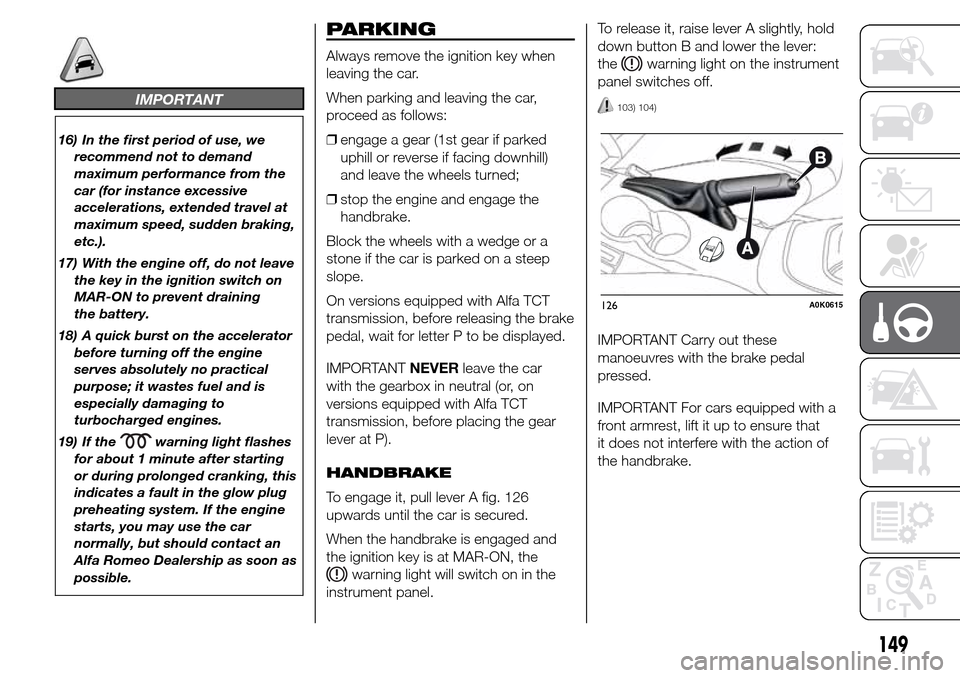
HANDBRAKE
To engage it, pull lever A fig. 126
upwards until the car is secured.
When the handbrake is engaged and
the ignition key is at MAR-ON, the
warning light will switch on in the
instrument panel.To release it, raise lever A slightly, hold
down button B and lower the lever:
the
warning light on the instrument
panel switches off.
103) 104)
IMPORTANT Carry out these
manoeuvres with the brake pedal
pressed.
IMPORTANT For cars equipped with a
front armrest, lift it up to ensure that
it does not interfere with the action of
the handbrake.
126A0K0615
149