battery Alfa Romeo Giulietta 2017 User Guide
[x] Cancel search | Manufacturer: ALFA ROMEO, Model Year: 2017, Model line: Giulietta, Model: Alfa Romeo Giulietta 2017Pages: 212, PDF Size: 4.56 MB
Page 84 of 212
STARTING THE ENGINE
Before starting the engine, adjust the
seat, the interior rear view mirrors, the
door mirrors and fasten the seat belt
correctly.
Never press the accelerator pedal for
starting the engine.
If necessary, messages indicating the
starting procedure can be shown on the
display.
ENGINE STARTING PROCEDURE
92) 93) 94)
21) 22) 23)
Proceed as follows:
engage the handbrake and place the
gear lever in neutral;
turn the ignition key to the MAR-ON
position. ONLY FOR DIESEL VERSIONS:
The instrument panel
warning light
comes on and the
icon appears on
the display.
wait for the warning lights to switch
off;
fully depress the clutch pedal, without
touching the accelerator;
turn the ignition key to AVV and
release it as soon as the engine starts.
If, with the ignition key turned to MAR,
the icon
on the display stays on
together with the warning light
, turn
the key to STOP and then back to MAR. If
the icon continues to stay on, try with the
other keys provided with the car. Contact
an Alfa Romeo Dealership if the engine
still does not start.
Never leave the ignition key in
MAR-ON position when the engine is
stopped.
ENGINE MINIMUM OIL LEVEL
INDICATION
(where provided)
When the ignition key is turned to MAR
the display shows a warning message, for
a few seconds, if the engine oil is at the
minimum level.
IMPORTANT To perform the engine oil
reading correctly, after turning the
ignition key to MAR wait for about
2 seconds before starting the engine.
WARNING
92)It is dangerous to run the engine in
enclosed areas. The engine takes in oxygen
and releases carbon dioxide, carbon
monoxide and other toxic gases.
93)The brake servo is not active until the
engine is started, so you would need to apply
much more force than usual to the brake
pedal.94)Do not start the engine by pushing,
towing or driving downhill. These
manoeuvres may damage the catalytic
converter.
IMPORTANT
21)We recommend that during the initial
period, or during the first 1600 km
(1000 miles), you do not drive to full car
performance (e.g. excessive acceleration,
long journeys at top speed, sharp braking,
etc.).
22)When the engine is switched off never
leave the ignition device in the MAR position
to prevent useless current absorption from
draining the battery.
23)A quick burst on the accelerator before
turning off the engine serves absolutely no
practical purpose; it wastes fuel and is
damaging for the engine.
24)Warning light
will flash after starting
or during prolonged cranking to indicate a
fault with the glow plug heating system. If
the engine starts, the vehicle can be regularly
used, but an Alfa Romeo Dealership must be
contacted as soon as possible.
82
STARTING AND DRIVING
Page 90 of 212
MISSED ENGINE STOPPING
CONDITIONS
When the system is active, for a higher
comfort and safety, and to reduce
emissions, the engine does not stop in
certain ambient conditions, engine
conditions, with the doors not closed and
seat belts unfastened.
30)
ENGINE RESTARTING CONDITIONS
Due to comfort, emission control and
safety reasons, the engine can restart
automatically without any action by the
driver, when the vehicle and the climate
control system are in certain conditions,
such as:
With gear engaged, automatic engine
restarting is possible only by fully
pressing the clutch pedal. The driver is
informed by the displaying of a message
on the display and - for versions/markets,
where provided - by the flashing of the
symbol
.
SAFETY FUNCTIONS
When the engine is stopped by the
Start&Stop system, if the driver releases
his/her seat belt and opens the driver's or
passenger's door, the engine can be
restarted only by the ignition key.
The driver is informed by a buzzer and by
the flashing of the symbol
on the
display (on some versions, a message is
displayed as well).
"ENERGY SAVING" FUNCTION(for versions/markets, where provided)
If, following the automatic engine
restarting, the driver does not carry out
any action on the vehicle for over
3 minutes, the Start&Stop system stops
the engine definitely, to prevent fuel
consumption. In these cases, the engine
can be restarted only using the ignition
key.
NOTE In any case, it is possible to keep
the engine running by deactivating the
Start&Stop system.
IRREGULAR OPERATION
In the event of malfunction, the
Stop/Start system is deactivated.
The driver is informed of the fault by the
flashing of the symbol
.For
versions/markets, where provided, a
warning message will also appear on the
display.
In this case, contact an Alfa Romeo
Dealership.
VEHICLE INACTIVITY
In the event of vehicle inactivity (or if the
battery is replaced), special attention
must be paid to the disconnection of the
battery power supply.
100)
IMPORTANT
30)If climate comfort is to be favoured, the
Stop/Start system can be deactivated, for a
continuous operation of the climate control
system.
WARNING
100)When replacing the battery, always
contact an Alfa Romeo Dealership. Replace
the battery with one of the same type
(HEAVY DUTY) and with the same
specifications.
88
STARTING AND DRIVING
Page 104 of 212
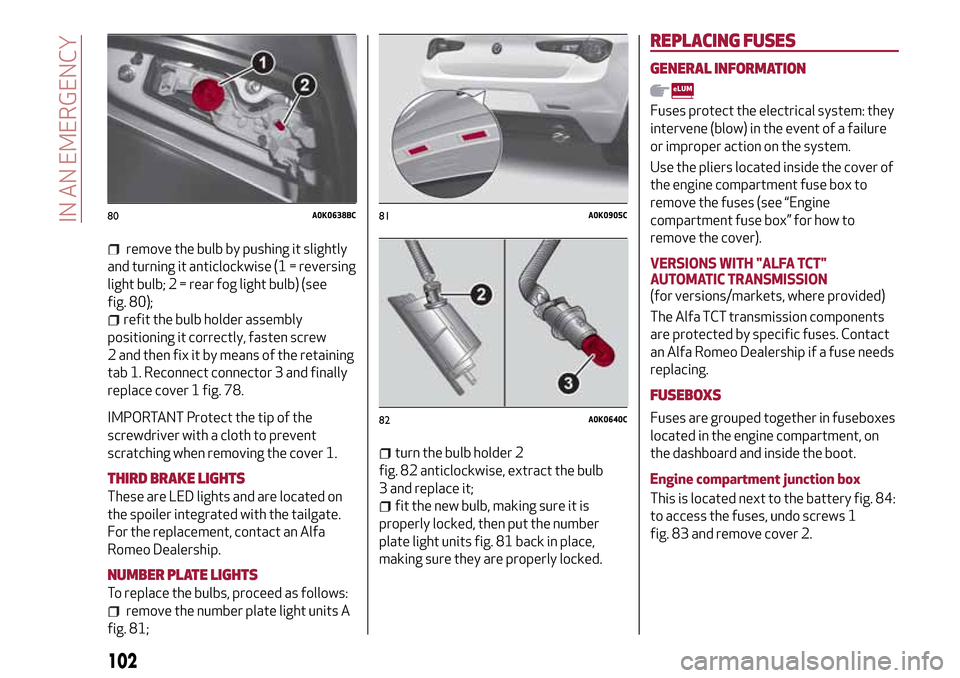
remove the bulb by pushing it slightly
and turning it anticlockwise (1 = reversing
light bulb; 2 = rear fog light bulb) (see
fig. 80);
refit the bulb holder assembly
positioning it correctly, fasten screw
2 and then fix it by means of the retaining
tab 1. Reconnect connector 3 and finally
replace cover 1 fig. 78.
IMPORTANT Protect the tip of the
screwdriver with a cloth to prevent
scratching when removing the cover 1.
THIRD BRAKE LIGHTS
These are LED lights and are located on
the spoiler integrated with the tailgate.
For the replacement, contact an Alfa
Romeo Dealership.
NUMBER PLATE LIGHTS
To replace the bulbs, proceed as follows:
remove the number plate light units A
fig. 81;
turn the bulb holder 2
fig. 82 anticlockwise, extract the bulb
3 and replace it;
fit the new bulb, making sure it is
properly locked, then put the number
plate light units fig. 81 back in place,
making sure they are properly locked.
REPLACING FUSES
GENERAL INFORMATION
Fuses protect the electrical system: they
intervene (blow) in the event of a failure
or improper action on the system.
Use the pliers located inside the cover of
the engine compartment fuse box to
remove the fuses (see “Engine
compartment fuse box” for how to
remove the cover).
VERSIONS WITH "ALFA TCT"
AUTOMATIC TRANSMISSION
(for versions/markets, where provided)
The Alfa TCT transmission components
are protected by specific fuses. Contact
an Alfa Romeo Dealership if a fuse needs
replacing.
FUSEBOXS
Fuses are grouped together in fuseboxes
located in the engine compartment, on
the dashboard and inside the boot.
Engine compartment junction box
This is located next to the battery fig. 84:
to access the fuses, undo screws 1
fig. 83 and remove cover 2.
80A0K0638BC81A0K0905C
82A0K0640C
102
IN AN EMERGENCY
Page 110 of 212
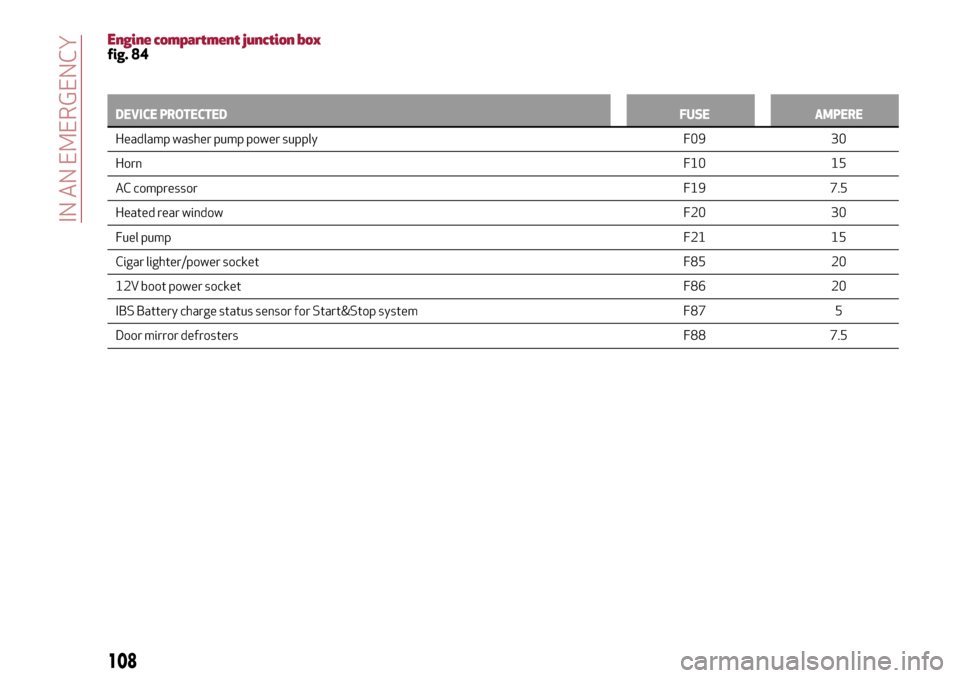
Engine compartment junction boxfig. 84
DEVICE PROTECTEDFUSE AMPERE
Headlamp washer pump power supply F09 30
HornF10
15
AC compressorF19 7.5
Heated rear windowF20 30
Fuel pumpF21 15
Cigar lighter/power socketF85 20
12V boot power socketF86 20
IBS Battery charge status sensor for Start&Stop system F87 5
Door mirror defrostersF88 7.5
108
IN AN EMERGENCY
Page 118 of 212
JUMP STARTING
STARTING THE ENGINE
If the iconstays on constantly on the
instrument panel, contact the Alfa
Romeo Dealership immediately.
JUMP STARTING
If the battery is flat, start the engine
using an auxiliary battery with the same
capacity or a little higher than the flat
one.
38) 39)125)
Proceed as follows to start the vehicle:
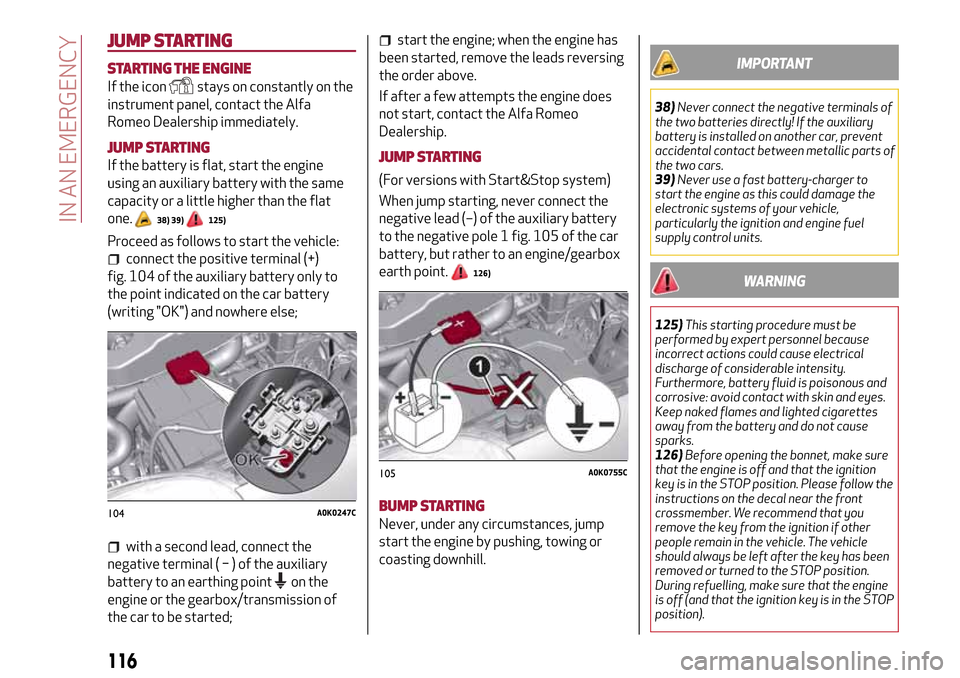
connect the positive terminal (+)
fig. 104 of the auxiliary battery only to
the point indicated on the car battery
(writing "OK") and nowhere else;
with a second lead, connect the
negative terminal(−)oftheauxiliary
battery to an earthing point
on the
engine or the gearbox/transmission of
the car to be started;
start the engine; when the engine has
been started, remove the leads reversing
the order above.
If after a few attempts the engine does
not start, contact the Alfa Romeo
Dealership.
JUMP STARTING
(For versions with Start&Stop system)
When jump starting, never connect the
negative lead (–) of the auxiliary battery
to the negative pole 1 fig. 105 of the car
battery, but rather to an engine/gearbox
earth point.
126)
BUMP STARTING
Never, under any circumstances, jump
start the engine by pushing, towing or
coasting downhill.
IMPORTANT
38)Never connect the negative terminals of
the two batteries directly! If the auxiliary
battery is installed on another car, prevent
accidental contact between metallic parts of
the two cars.
39)Never use a fast battery-charger to
start the engine as this could damage the
electronic systems of your vehicle,
particularly the ignition and engine fuel
supply control units.
WARNING
125)This starting procedure must be
performed by expert personnel because
incorrect actions could cause electrical
discharge of considerable intensity.
Furthermore, battery fluid is poisonous and
corrosive: avoid contact with skin and eyes.
Keep naked flames and lighted cigarettes
away from the battery and do not cause
sparks.
126)Before opening the bonnet, make sure
that the engine is off and that the ignition
key is in the STOP position. Please follow the
instructions on the decal near the front
crossmember. We recommend that you
remove the key from the ignition if other
people remain in the vehicle. The vehicle
should always be left after the key has been
removed or turned to the STOP position.
During refuelling, make sure that the engine
is off (and that the ignition key is in the STOP
position).
104A0K0247C
105A0K0755C
116
IN AN EMERGENCY
Page 119 of 212
FUEL CUT-OFFSYSTEM
Operation
This intervenes in the case of an impact
causing:
the fuel supply cut-off with the engine
consequently switching off;
the automatic unlocking of the doors;
the switching on of the interior lights.
The intervention of the system is
indicated by a message shown on the
display.
Carefully check the vehicle for fuel leaks,
for instance in the engine compartment,
under the vehicle or near the tank area.
127)
After a collision, turn the ignition key to
STOP to prevent the battery from
running down.
To restore the correct operation of the
car, proceed as follows:
turn the ignition key to the MAR
position;
activate the right direction indicator;
deactivate the right direction
indicator;
activate the left direction indicator;
deactivate the left direction indicator;
activate the right direction indicator;
deactivate the right direction
indicator;
activate the left direction indicator;
deactivate the left direction indicator;
ignition key turned to the OFF
position;
turn the ignition key to the MAR-ON
position.
WARNING
127)If, after an impact, you smell fuel or
notice leaks from the fuel system, do not
reactivate the system to avoid the risk of
fire.
TCT TRANSMISSION - KEY
REMOVAL
The ignition key can be removed only if
the gear lever is in position P (Park).
If the battery is flat and the ignition key is
engaged, the latter is locked in position.
To remove the key manually, proceed as
follows:
apply the handbrake;
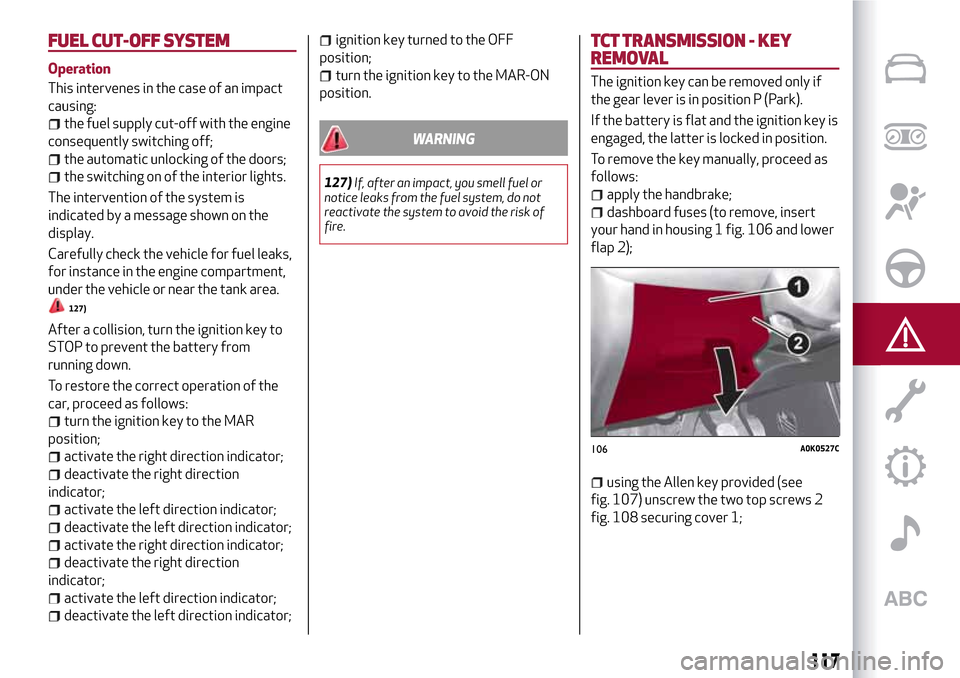
dashboard fuses (to remove, insert
your hand in housing 1 fig. 106 and lower
flap 2);
using the Allen key provided (see
fig. 107) unscrew the two top screws 2
fig. 108 securing cover 1;
106A0K0527C
117
Page 123 of 212
Correct maintenance permits the performance of the car to be
maintained over time, as well as limited running costs and
safeguarding the efficiency of the safety systems.
This chapter explains how.
SERVICING AND MAINTENANCE
SCHEDULED SERVICING.........................122
SCHEDULED MAINTENANCE PLAN..................123
PERIODIC CHECKS............................130
DEMANDING USE OF THE CAR.....................130
CHECKING LEVELS ............................131
BATTERY RECHARGING .........................136
AIR CLEANER/POLLEN FILTER/DIESEL FILTER...........137
NOZZLES..................................137
HEADLIGHT WASHERS..........................138
BATTERY..................................138
LIFTING THE VEHICLE . .........................140
BODYWORK.................................140
INTERIOR..................................141
Page 132 of 212

PERIODIC CHECKS
Every 1,000 km or before long journeys,
check and, if necessary, top up the
following:
engine coolant, brake fluid and
windscreen washer fluid level;
tyre inflation pressure and condition;
operation of lighting system
(headlights, direction indicators, hazard
warning lights, etc.);
operation of screen wash/wipe system
and positioning/wear of windscreen/
rearscreen wiper blades
Check and top up, if required, the engine
oil level every 3,000 km.
IMPORTANT To find out the correct oil
quantity, always check using the dipstick.
Carry out the check with the vehicle
parked on level ground.
DEMANDING USE OF THE CAR
If the vehicle is used mainly under one of
the following conditions:
towing a trailer or caravan;
dusty roads;
short, repeated journeys (less than
7-8 km) at sub-zero outside
temperatures;
engine often idling or driving long
distances at low speeds or long periods
of inactivity;
the following checks must be carried out
more often than indicated in the
Scheduled Servicing Plan:
check front disc brake pad condition
and wear;
check cleanliness of bonnet and
luggage compartment locks, cleanliness
and lubrication of linkage;
visually inspect condition of: engine,
gearbox, transmission, pipes and hoses
(exhaust - fuel system - brakes) and
rubber elements (boots - sleeves - bushes
- etc.);
check battery charge and battery fluid
level (electrolyte);
visually inspect conditions of the
accessory drive belts;
check and, if necessary, change engine
oil and replace oil filter;
check and, if necessary, replace pollen
filter;
check and, if necessary, replace air
cleaner.
130
SERVICING AND MAINTENANCE
Page 138 of 212
134)The cooling system is pressurised. If
necessary, only replace the plug with
another original or the operation of the
system may be adversely affected. Do not
remove the reservoir plug when the engine is
hot: you risk scalding yourself.
135)Do not travel with the windscreen
washer fluid reservoir empty: the
windscreen washer is essential for
improving visibility. Repeated operation of
the system without fluid could damage or
cause rapid deterioration of some system
components.
136)Some commercial additives for
windscreen washer fluid are flammable. The
engine compartment contains hot
components which may start a fire.
137)Brake fluid is poisonous and highly
corrosive. In the event of accidental contact,
immediately wash the affected parts with
water and mild soap. Then rinse thoroughly.
Call a doctor immediately if swallowed.
138)The symbol
, on the brake fluid
container indicates if a brake fluid is
synthetic or mineral-based. Use of mineral
type fluids will damage the special rubber
seals of the braking system beyond repair.
IMPORTANT
3)Used engine oil and oil filters contain
substances which are harmful to the
environment. To change the oil and filters, we
advise you to contact an Alfa Romeo
Dealership.
4)Used transmission fluid contains
substances that are harmful to the
environment. You are advised to contact an
Alfa Romeo Dealership for oil changes.
BATTERY RECHARGING
IMPORTANT The battery recharging
procedure is given as information only. To
carry out this operation contact an Alfa
Romeo Dealership.
IMPORTANT After turning the ignition
key to STOP and having closed the
driver's side door, wait at least one
minute before disconnecting and then
reconnecting the electrical supply to the
battery.
Charging should be slow at a low ampere
rating for approximately 24 hours.
Charging for a longer time may damage
the battery.
IMPORTANT The cables of the electrical
system must be correctly reconnected to
the battery, i.e. the positive cable (+) to
the positive terminal and the negative
cable (–) to the negative terminal. The
battery terminals are marked with the
positive (+) and negative (–) symbols, and
are shown on the battery cover. The
battery terminals must also be
corrosion-free and firmly secured to the
terminals. If a "quick-type" battery
charger is used with the battery fitted on
the vehicle, before connecting it
disconnect both cables of the battery
itself. Do not use a "quick-type" battery
charger to provide the starting voltage.The cables of the electrical system must
be correctly reconnected to the battery,
i.e. the positive cable (+) to the positive
terminal and the negative cable (–) to the
negative terminal. The battery terminals
are marked with the positive (+) and
negative (–) symbols, and are shown on
the battery cover. The battery terminals
must also be corrosion-free and firmly
secured to the terminals.
VERSIONS WITHOUT START&STOP
SYSTEM
(for versions/markets, where provided)
To recharge, proceed as follows:
disconnect the terminal from the
negative battery pole;
connect the charger cables to the
battery terminals, observing the polarity;
turn on the charger;
when it is recharged, turn the charger
off before disconnecting it from the
battery;
reconnect the terminal to the negative
battery pole.
VERSIONS WITH START&STOP
SYSTEM
(for versions/markets, where provided)
To recharge, proceed as follows:
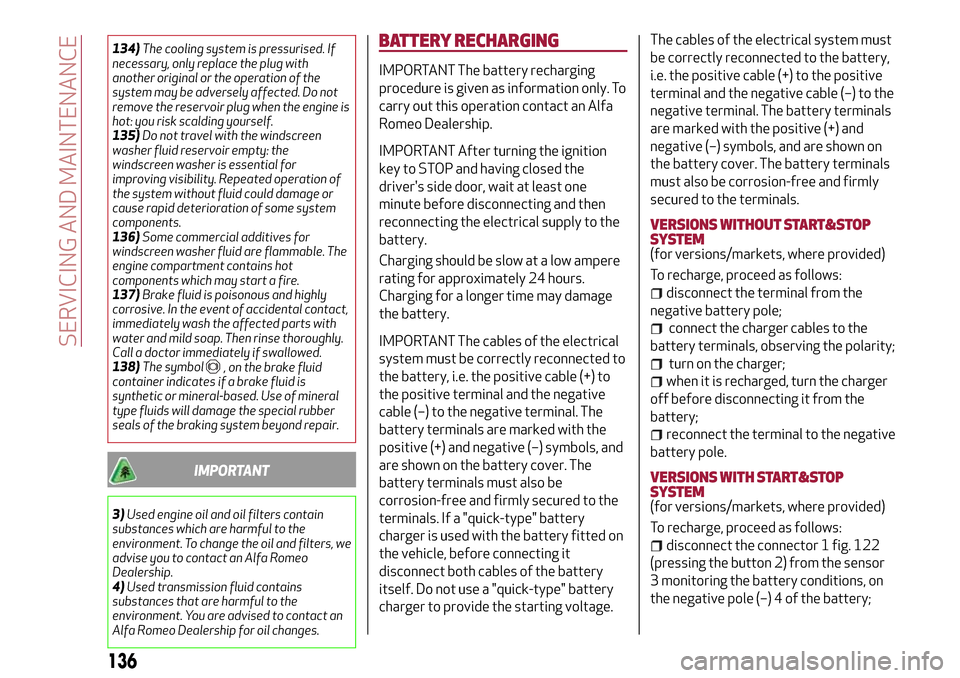
disconnect the connector 1 fig. 122
(pressing the button 2) from the sensor
3 monitoring the battery conditions, on
the negative pole (–) 4 of the battery;
136
SERVICING AND MAINTENANCE
Page 139 of 212

connect the positive cable (+) of the
battery charger to the positive battery
terminal 5 and the negative cable (–) to
sensor terminal 4 as shown in fig. 123;
turn on the battery charger. At the end
of the charging process, switch the
battery charger off;
after having disconnected the
charging device, reconnect connector
1 to the sensor 3 as shown.
AIR CLEANER/POLLEN
FILTER/DIESEL FILTER
For filter replacement, contact an Alfa
Romeo Dealership.
NOZZLES
139)
46)
Windscreen washer
The window washer nozzles are fixed. If
there is no jet of fluid, first check that
there is some fluid in the reservoir (see
paragraph "Checking fluid levels"). Then
check that the nozzle holes are not
clogged, if necessary use a needle.
WARNING In versions with sun roof,
make sure that the roof is closed before
operating the windscreen washer
nozzles.
Rear window washer
The nozzle holder is on the rear window.
The rear window washer jets are fixed.
122A0K0530AC
123A0K0530BC
137