fluid Alfa Romeo Giulietta 2017 User Guide
[x] Cancel search | Manufacturer: ALFA ROMEO, Model Year: 2017, Model line: Giulietta, Model: Alfa Romeo Giulietta 2017Pages: 212, PDF Size: 4.56 MB
Page 137 of 212
ENGINE OIL
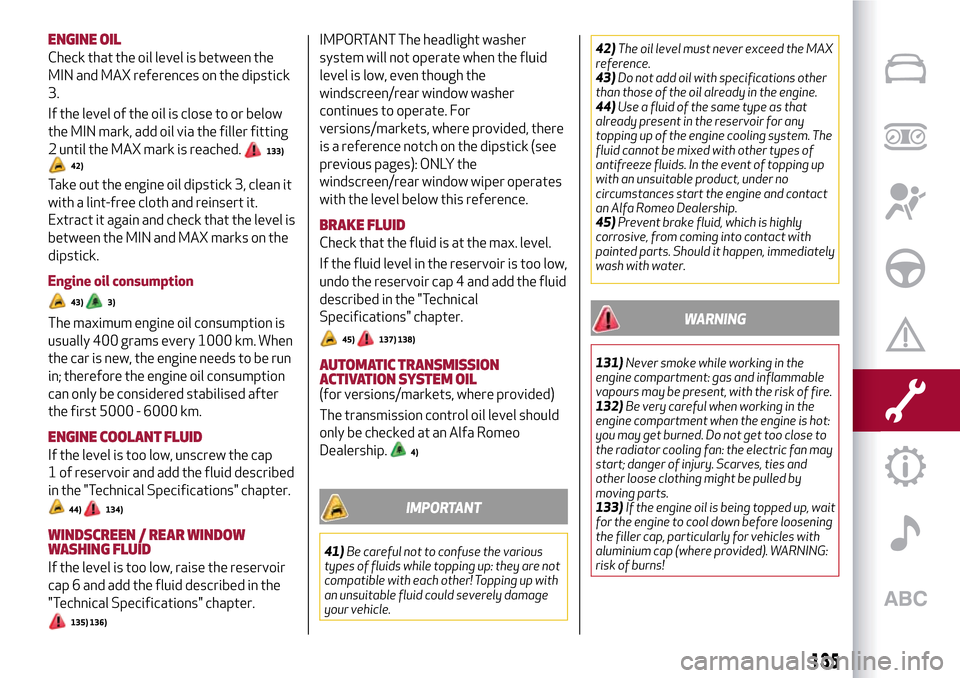
Check that the oil level is between the
MIN and MAX references on the dipstick
3.
If the level of the oil is close to or below
the MIN mark, add oil via the filler fitting
2 until the MAX mark is reached.
133)42)
Take out the engine oil dipstick 3, clean it
with a lint-free cloth and reinsert it.
Extract it again and check that the level is
between the MIN and MAX marks on the
dipstick.
Engine oil consumption
43)3)
The maximum engine oil consumption is
usually 400 grams every 1000 km. When
the car is new, the engine needs to be run
in; therefore the engine oil consumption
can only be considered stabilised after
the first 5000 - 6000 km.
ENGINE COOLANT FLUID
If the level is too low, unscrew the cap
1 of reservoir and add the fluid described
in the "Technical Specifications" chapter.
44)134)
WINDSCREEN / REAR WINDOW
WASHING FLUID
If the level is too low, raise the reservoir
cap 6 and add the fluid described in the
"Technical Specifications" chapter.
135) 136)
IMPORTANT The headlight washer
system will not operate when the fluid
level is low, even though the
windscreen/rear window washer
continues to operate. For
versions/markets, where provided, there
is a reference notch on the dipstick (see
previous pages): ONLY the
windscreen/rear window wiper operates
with the level below this reference.
BRAKE FLUID
Check that the fluid is at the max. level.
If the fluid level in the reservoir is too low,
undo the reservoir cap 4 and add the fluid
described in the "Technical
Specifications" chapter.
45)137) 138)
AUTOMATIC TRANSMISSION
ACTIVATIONSYSTEM OIL
(for versions/markets, where provided)
The transmission control oil level should
only be checked at an Alfa Romeo
Dealership.
4)
IMPORTANT
41)Be careful not to confuse the various
types of fluids while topping up: they are not
compatible with each other! Topping up with
an unsuitable fluid could severely damage
your vehicle.42)The oil level must never exceed the MAX
reference.
43)Do not add oil with specifications other
than those of the oil already in the engine.
44)Use a fluid of the same type as that
already present in the reservoir for any
topping up of the engine cooling system. The
fluid cannot be mixed with other types of
antifreeze fluids. In the event of topping up
with an unsuitable product, under no
circumstances start the engine and contact
an Alfa Romeo Dealership.
45)Prevent brake fluid, which is highly
corrosive, from coming into contact with
painted parts. Should it happen, immediately
wash with water.
WARNING
131)Never smoke while working in the
engine compartment: gas and inflammable
vapours may be present, with the risk of fire.
132)Be very careful when working in the
engine compartment when the engine is hot:
you may get burned. Do not get too close to
the radiator cooling fan: the electric fan may
start; danger of injury. Scarves, ties and
other loose clothing might be pulled by
moving parts.
133)If the engine oil is being topped up, wait
for the engine to cool down before loosening
the filler cap, particularly for vehicles with
aluminium cap (where provided). WARNING:
risk of burns!
135
Page 138 of 212
134)The cooling system is pressurised. If
necessary, only replace the plug with
another original or the operation of the
system may be adversely affected. Do not
remove the reservoir plug when the engine is
hot: you risk scalding yourself.
135)Do not travel with the windscreen
washer fluid reservoir empty: the
windscreen washer is essential for
improving visibility. Repeated operation of
the system without fluid could damage or
cause rapid deterioration of some system
components.
136)Some commercial additives for
windscreen washer fluid are flammable. The
engine compartment contains hot
components which may start a fire.
137)Brake fluid is poisonous and highly
corrosive. In the event of accidental contact,
immediately wash the affected parts with
water and mild soap. Then rinse thoroughly.
Call a doctor immediately if swallowed.
138)The symbol
, on the brake fluid
container indicates if a brake fluid is
synthetic or mineral-based. Use of mineral
type fluids will damage the special rubber
seals of the braking system beyond repair.
IMPORTANT
3)Used engine oil and oil filters contain
substances which are harmful to the
environment. To change the oil and filters, we
advise you to contact an Alfa Romeo
Dealership.
4)Used transmission fluid contains
substances that are harmful to the
environment. You are advised to contact an
Alfa Romeo Dealership for oil changes.
BATTERY RECHARGING
IMPORTANT The battery recharging
procedure is given as information only. To
carry out this operation contact an Alfa
Romeo Dealership.
IMPORTANT After turning the ignition
key to STOP and having closed the
driver's side door, wait at least one
minute before disconnecting and then
reconnecting the electrical supply to the
battery.
Charging should be slow at a low ampere
rating for approximately 24 hours.
Charging for a longer time may damage
the battery.
IMPORTANT The cables of the electrical
system must be correctly reconnected to
the battery, i.e. the positive cable (+) to
the positive terminal and the negative
cable (–) to the negative terminal. The
battery terminals are marked with the
positive (+) and negative (–) symbols, and
are shown on the battery cover. The
battery terminals must also be
corrosion-free and firmly secured to the
terminals. If a "quick-type" battery
charger is used with the battery fitted on
the vehicle, before connecting it
disconnect both cables of the battery
itself. Do not use a "quick-type" battery
charger to provide the starting voltage.The cables of the electrical system must
be correctly reconnected to the battery,
i.e. the positive cable (+) to the positive
terminal and the negative cable (–) to the
negative terminal. The battery terminals
are marked with the positive (+) and
negative (–) symbols, and are shown on
the battery cover. The battery terminals
must also be corrosion-free and firmly
secured to the terminals.
VERSIONS WITHOUT START&STOP
SYSTEM
(for versions/markets, where provided)
To recharge, proceed as follows:
disconnect the terminal from the
negative battery pole;
connect the charger cables to the
battery terminals, observing the polarity;
turn on the charger;
when it is recharged, turn the charger
off before disconnecting it from the
battery;
reconnect the terminal to the negative
battery pole.
VERSIONS WITH START&STOP
SYSTEM
(for versions/markets, where provided)
To recharge, proceed as follows:
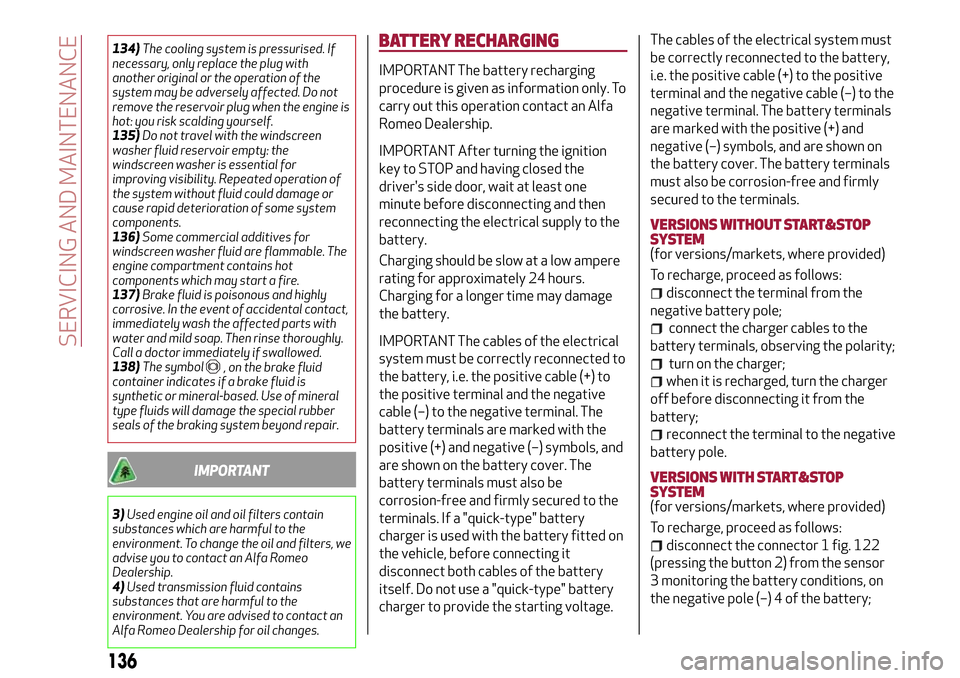
disconnect the connector 1 fig. 122
(pressing the button 2) from the sensor
3 monitoring the battery conditions, on
the negative pole (–) 4 of the battery;
136
SERVICING AND MAINTENANCE
Page 139 of 212

connect the positive cable (+) of the
battery charger to the positive battery
terminal 5 and the negative cable (–) to
sensor terminal 4 as shown in fig. 123;
turn on the battery charger. At the end
of the charging process, switch the
battery charger off;
after having disconnected the
charging device, reconnect connector
1 to the sensor 3 as shown.
AIR CLEANER/POLLEN
FILTER/DIESEL FILTER
For filter replacement, contact an Alfa
Romeo Dealership.
NOZZLES
139)
46)
Windscreen washer
The window washer nozzles are fixed. If
there is no jet of fluid, first check that
there is some fluid in the reservoir (see
paragraph "Checking fluid levels"). Then
check that the nozzle holes are not
clogged, if necessary use a needle.
WARNING In versions with sun roof,
make sure that the roof is closed before
operating the windscreen washer
nozzles.
Rear window washer
The nozzle holder is on the rear window.
The rear window washer jets are fixed.
122A0K0530AC
123A0K0530BC
137
Page 141 of 212
do not keep accessories (e.g. radio,
hazard warning lights, etc.) switched on
for a long time when the engine is not
running;
before performing any operation on
the electrical system, disconnect the
negative battery cable.
IMPORTANT Every time the battery is
disconnected, the steering must be
initialised. This is indicated by the
appearance of the icon
. To carry out
this procedure, simply turn the steering
wheel all the way from one end to the
other or drive in a straight line for about a
hundred metres.
IMPORTANT If the charge level remains
under 50% for a long time, the battery is
damaged by sulphation, reducing its
capacity and efficiency at start-up.
The battery will also be more at risk of
freezing (this can happen as early as
-10°C). Refer to the "Vehicle inactivity"
paragraph in "Starting and driving"
chapter if the vehicle is left parked for a
long time.If, after purchasing the car, you wish to
install electrical accessories which
require permanent electrical supply (e.g.
alarm, etc.) or accessories which
influence the electrical supply
requirements, contact an Alfa Romeo
Dealership, whose qualified staff will
evaluate the overall electrical
consumption.
WARNING
140)Battery fluid is poisonous and
corrosive. Avoid contact with the skin and
eyes. Keep open flames away from the
battery and do not use objects that might
create sparks: risk of explosion and fire.
141)Using the battery with insufficient
fluid irreparably damages the battery and
may cause an explosion.
142)If the vehicle must remain unused for a
long time at a very low temperature, remove
the battery and take it to a warm place, to
avoid freezing.
143)When performing any operation on the
battery or near it, always protect your eyes
with special goggles.
IMPORTANT
47)Incorrect installation of electric and
electronic devices may cause severe damage
to your car. After purchasing your vehicle, if
you wish to install any accessories (e.g.
anti-theft, radio phone, etc.), go to an Alfa
Romeo Dealership, which will suggest the
most suitable devices and advise you
whether a higher capacity battery needs to
be installed.
IMPORTANT
5)Batteries contain substances which are
very dangerous for the environment. For
battery replacement, contact an Alfa Romeo
Dealership.
139
Page 143 of 212
Front headlights
Use a soft cloth soaked in water and
detergent for washing cars.
IMPORTANT Never use aromatic
substances (e.g. petrol) or ketones (e.g.
acetone) for cleaning the plastic lenses
of the headlights.
IMPORTANT When cleaning with a
pressure washer, keep the water jet at
least 20 cm away from the headlights.
Engine compartment
At the end of every winter, wash the
engine compartment thoroughly, taking
care not to aim the jet of water directly at
the electronic control units or at the
windscreen wiper motors. Have this
operation performed at a specialised
workshop.
IMPORTANT The washing should take
place with the engine cold and the
ignition key in the STOP position. After
the washing operation, make sure that
the various protections (e.g. rubber caps
and guards) have not been removed or
damaged.
IMPORTANT
6)Detergents pollute the environment. Only
wash your vehicle in areas equipped to
collect and treat wastewater from this type
of activity.
IMPORTANT
48)In order to preserve the aesthetic
appearance of the paint abrasive products
and/or polishes should not be used for
cleaning the vehicle.
49)Avoid washing with rollers and/or
brushes in washing stations. Wash the
vehicle only by hand using neutral pH
detergents; dry it with a wet chamois leather.
Abrasive products and/or polishes should
not be used for cleaning the car. Bird
droppings must be washed off immediately
and thoroughly as the acid they contain is
particularly aggressive. Avoid (if at all
possible) parking the vehicle under trees;
remove vegetable resins immediately as,
when dried, it may only be possible to remove
them with abrasive products and/or polishes,
which is highly inadvisable as they could alter
the typical opaqueness of the paint. Do not
use pure windscreen washer fluid for
cleaning the front windscreen and rear
window; dilute it min. 50% with water. Only
use pure screen washer fluid when strictly
necessary due to outside temperature
conditions.
INTERIOR
144) 145) 146)
Periodically check the cleanliness of the
interior, beneath the mats, which could
cause oxidation of the sheet metal.
SEATS AND FABRIC PARTS
Remove dust with a soft brush or a
vacuum cleaner. It is advisable to use a
moist brush on velvet upholstery. Rub the
seats with a sponge moistened with a
solution of water and neutral detergent.
LEATHER SEATS
(for versions/markets, where provided)
Remove the dry dirt with a chamois or
slightly damp cloth, without exerting too
much pressure. Remove any liquid or
grease stains using an absorbent dry
cloth, without rubbing. Then clean with a
soft cloth or buckskin cloth dampened
with water and mild soap. If the stain
persists, use specific products and
observe the instructions carefully.
IMPORTANT Never use alcohol. Make
sure that the cleaning products used
contain no alcohol or alcohol derivatives,
even in small quantities.
141
Page 145 of 212
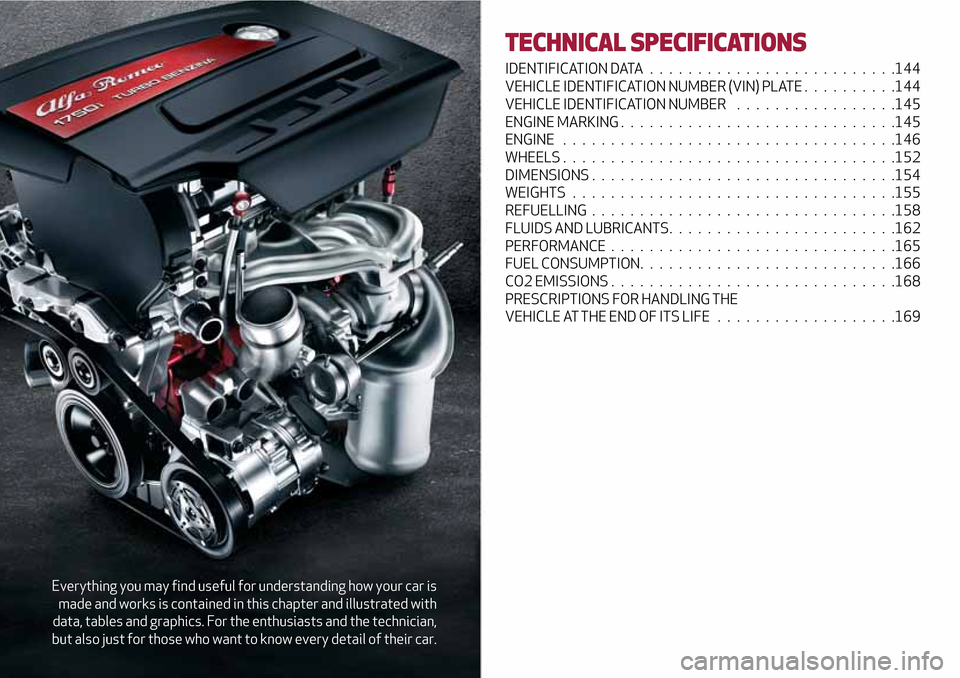
Everything you may find useful for understanding how your car is
made and works is contained in this chapter and illustrated with
data, tables and graphics. For the enthusiasts and the technician,
but also just for those who want to know every detail of their car.
TECHNICAL SPECIFICATIONS
IDENTIFICATION DATA..........................144
VEHICLE IDENTIFICATION NUMBER (VIN) PLATE..........144
VEHICLE IDENTIFICATION NUMBER.................145
ENGINE MARKING.............................145
ENGINE...................................146
WHEELS...................................152
DIMENSIONS................................154
WEIGHTS..................................155
REFUELLING................................158
FLUIDS AND LUBRICANTS........................162
PERFORMANCE..............................165
FUEL CONSUMPTION...........................166
CO2 EMISSIONS..............................168
PRESCRIPTIONS FOR HANDLING THE
VEHICLE AT THE END OF ITS LIFE...................169
Page 157 of 212
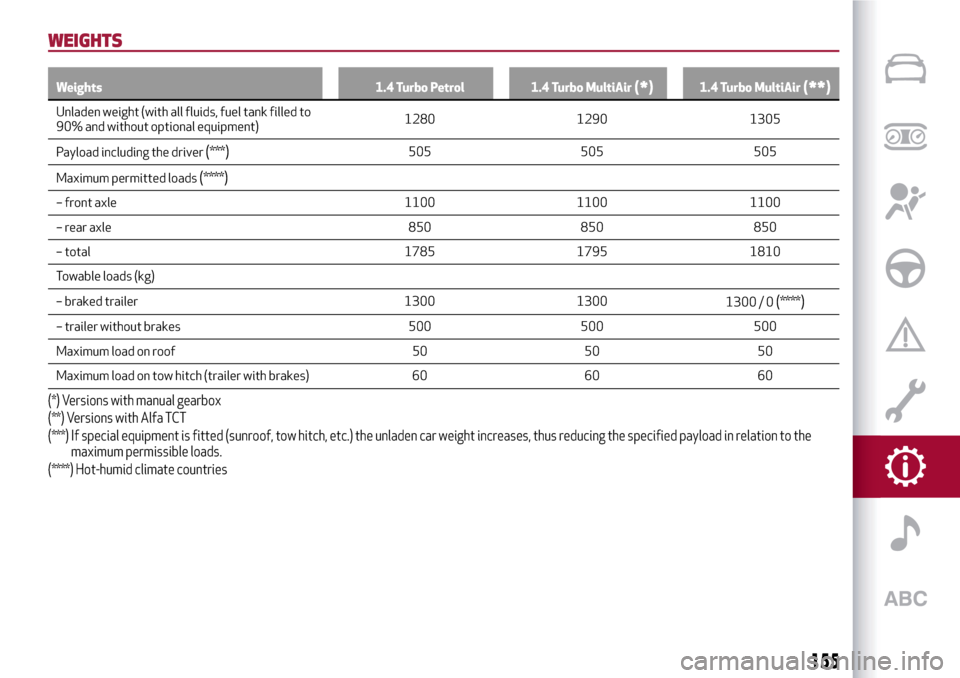
WEIGHTS
Weights 1.4 Turbo Petrol 1.4 Turbo MultiAir(*)1.4 Turbo MultiAir(**)
Unladen weight (with all fluids, fuel tank filled to
90% and without optional equipment)1280 1290 1305
Payload including the driver
(***)505 505 505
Maximum permitted loads
(****)
– front axle 1100 1100 1100
– rear axle 850 850 850
– total 1785 1795 1810
Towable loads (kg)
– braked trailer 1300 1300
1300 / 0
(****)
– trailer without brakes 500 500 500
Maximum load on roof 50 50 50
Maximum load on tow hitch (trailer with brakes) 60 60 60
(*) Versions with manual gearbox
(**) Versions with Alfa TCT
(***) If special equipment is fitted (sunroof, tow hitch, etc.) the unladen car weight increases, thus reducing the specified payload in relation to the
maximum permissible loads.
(****) Hot-humid climate countries
155
Page 158 of 212
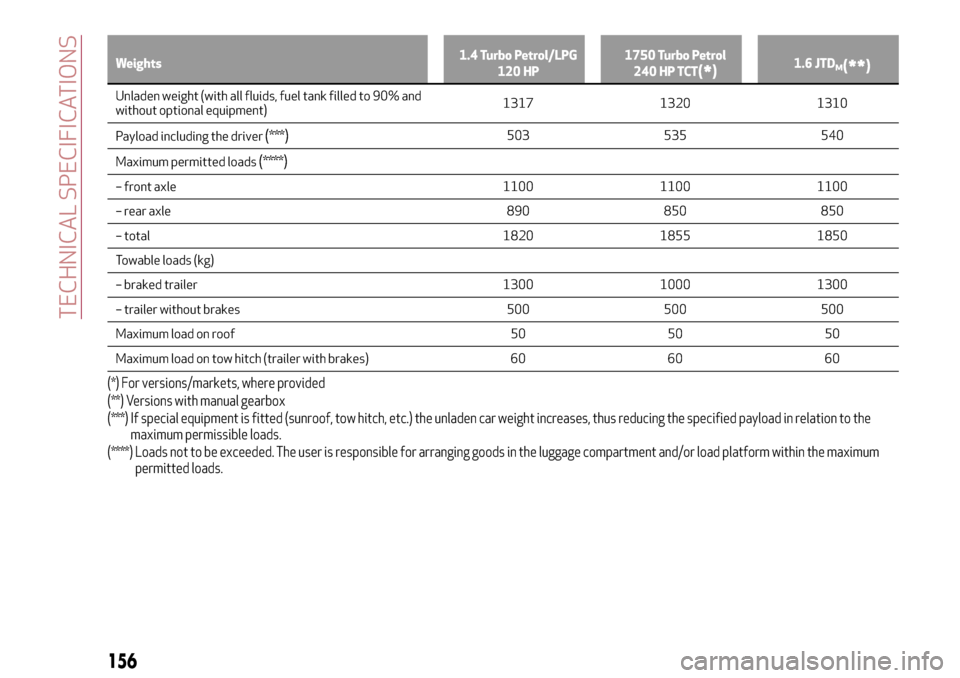
Weights1.4 Turbo Petrol/LPG
120 HP1750 Turbo Petrol
240 HP TCT(*)1.6 JTDM(**)
Unladen weight (with all fluids, fuel tank filled to 90% and
without optional equipment)1317 1320 1310
Payload including the driver
(***)503 535 540
Maximum permitted loads
(****)
– front axle 1100 1100 1100
– rear axle 890 850 850
– total 1820 1855 1850
Towable loads (kg)
– braked trailer 1300 1000 1300
– trailer without brakes 500 500 500
Maximum load on roof 50 50 50
Maximum load on tow hitch (trailer with brakes) 60 60 60
(*) For versions/markets, where provided
(**) Versions with manual gearbox
(***) If special equipment is fitted (sunroof, tow hitch, etc.) the unladen car weight increases, thus reducing the specified payload in relation to the
maximum permissible loads.
(****) Loads not to be exceeded. The user is responsible for arranging goods in the luggage compartment and/or load platform within the maximum
permitted loads.
156
TECHNICAL SPECIFICATIONS
Page 159 of 212
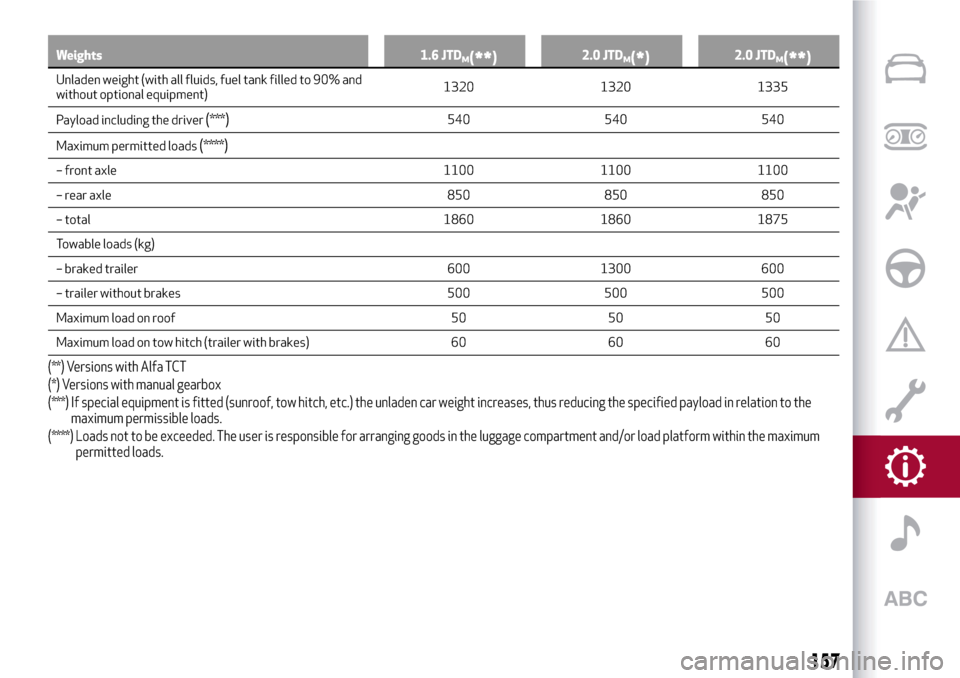
Weights 1.6 JTDM(**)2.0 JTDM(*)2.0 JTDM(**)
Unladen weight (with all fluids, fuel tank filled to 90% and
without optional equipment)1320 1320 1335
Payload including the driver
(***)540 540 540
Maximum permitted loads
(****)
– front axle 1100 1100 1100
– rear axle 850 850 850
– total 1860 1860 1875
Towable loads (kg)
– braked trailer 600 1300 600
– trailer without brakes 500 500 500
Maximum load on roof 50 50 50
Maximum load on tow hitch (trailer with brakes) 60 60 60
(**) Versions with Alfa TCT
(*) Versions with manual gearbox
(***) If special equipment is fitted (sunroof, tow hitch, etc.) the unladen car weight increases, thus reducing the specified payload in relation to the
maximum permissible loads.
(****) Loads not to be exceeded. The user is responsible for arranging goods in the luggage compartment and/or load platform within the maximum
permitted loads.
157
Page 160 of 212
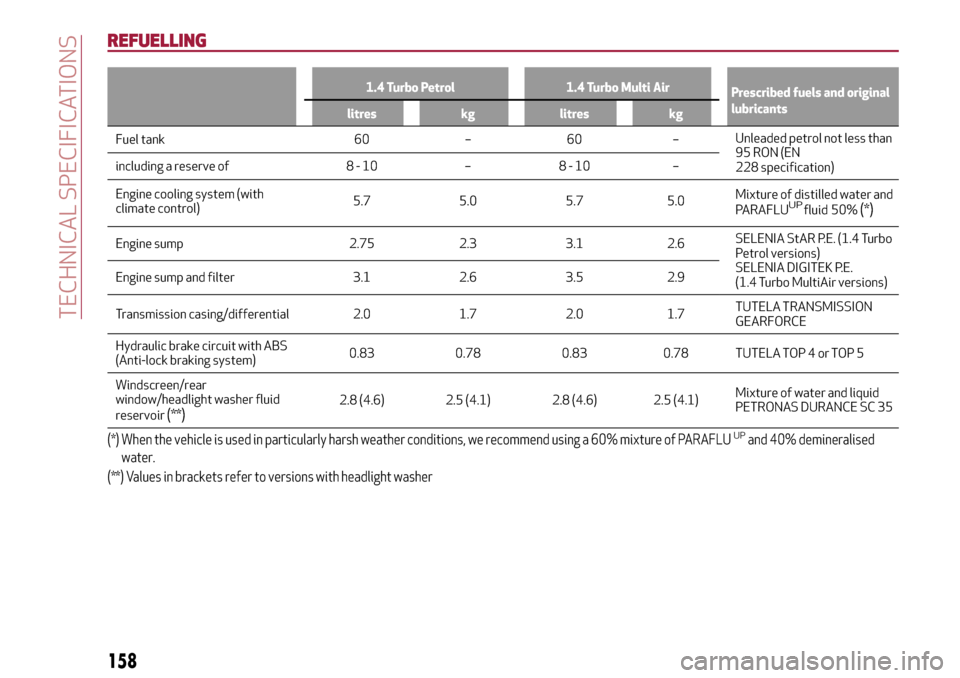
REFUELLING
1.4 Turbo Petrol 1.4 Turbo Multi Air
Prescribed fuels and original
lubricants
litres kg litres kg
Fuel tank 60 – 60 –Unleaded petrol not less than
95 RON (EN
228 specification) including a reserve of 8 - 10 – 8 - 10 –
Engine cooling system (with
climate control)5.7 5.0 5.7 5.0Mixture of distilled water and
PARAFLU fluid
UP50%(*)
Engine sump 2.75 2.3 3.1 2.6SELENIA StAR P.E. (1.4 Turbo
Petrol versions)
SELENIA DIGITEK P.E.
(1.4 Turbo MultiAir versions) Engine sump and filter 3.1 2.6 3.5 2.9
Transmission casing/differential 2.0 1.7 2.0 1.7TUTELA TRANSMISSION
GEARFORCE
Hydraulic brake circuit with ABS
(Anti-lock braking system)0.83 0.78 0.83 0.78 TUTELA TOP 4 or TOP 5
Windscreen/rear
window/headlight washer fluid
reservoir
(**)2.8 (4.6) 2.5 (4.1) 2.8 (4.6) 2.5 (4.1)Mixture of water and liquid
PETRONAS DURANCE SC 35
(*) When the vehicle is used in particularly harsh weather conditions, we recommend using a 60% mixture of PARAFLUUPand 40% demineralised
water.
(**) Values in brackets refer to versions with headlight washer
158
TECHNICAL SPECIFICATIONS