tow Alfa Romeo Giulietta 2017 User Guide
[x] Cancel search | Manufacturer: ALFA ROMEO, Model Year: 2017, Model line: Giulietta, Model: Alfa Romeo Giulietta 2017Pages: 212, PDF Size: 4.56 MB
Page 65 of 212
when the space-saver wheel is fitted.
Before carrying out the RESET, inflate
the tyres to the rated pressure values
specified in the inflation pressure table
(see "Wheels" paragraph in the "Technical
specifications" chapter).
If the RESET is not carried out, in all
above cases, the
warning light may
give false indications on one or more
tyres.
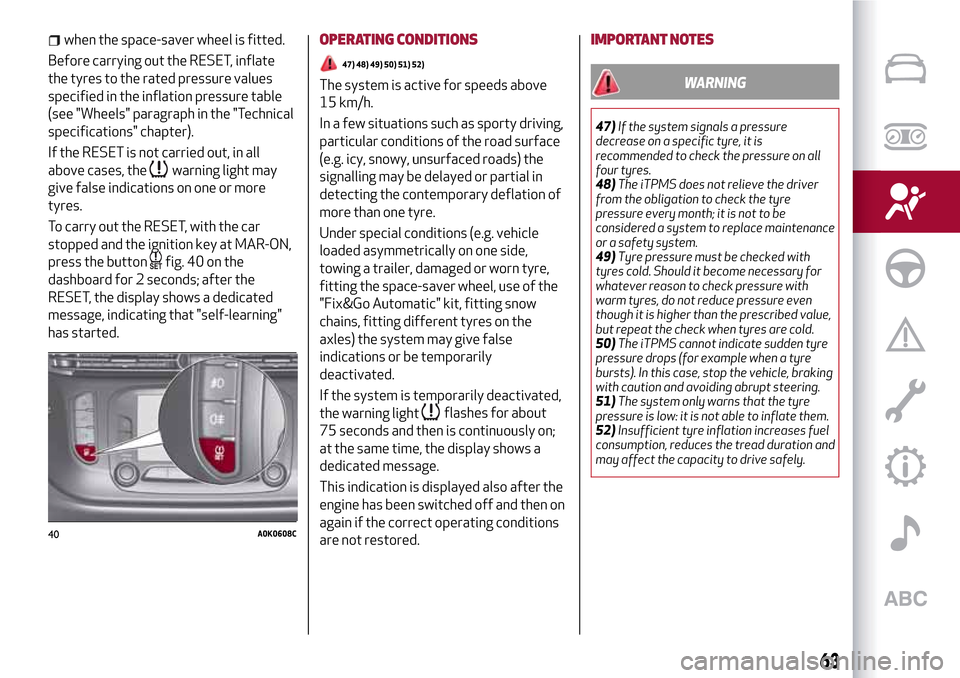
To carry out the RESET, with the car
stopped and the ignition key at MAR-ON,
press the button
fig. 40 on the
dashboard for 2 seconds; after the
RESET, the display shows a dedicated
message, indicating that "self-learning"
has started.
OPERATING CONDITIONS
47) 48) 49) 50) 51) 52)
The system is active for speeds above
15 km/h.
In a few situations such as sporty driving,
particular conditions of the road surface
(e.g. icy, snowy, unsurfaced roads) the
signalling may be delayed or partial in
detecting the contemporary deflation of
more than one tyre.
Under special conditions (e.g. vehicle
loaded asymmetrically on one side,
towing a trailer, damaged or worn tyre,
fitting the space-saver wheel, use of the
"Fix&Go Automatic" kit, fitting snow
chains, fitting different tyres on the
axles) the system may give false
indications or be temporarily
deactivated.
If the system is temporarily deactivated,
the warning light
flashes for about
75 seconds and then is continuously on;
at the same time, the display shows a
dedicated message.
This indication is displayed also after the
engine has been switched off and then on
again if the correct operating conditions
are not restored.
IMPORTANT NOTES
WARNING
47)If the system signals a pressure
decrease on a specific tyre, it is
recommended to check the pressure on all
four tyres.
48)The iTPMS does not relieve the driver
from the obligation to check the tyre
pressure every month; it is not to be
considered a system to replace maintenance
or a safety system.
49)Tyre pressure must be checked with
tyres cold. Should it become necessary for
whatever reason to check pressure with
warm tyres, do not reduce pressure even
though it is higher than the prescribed value,
but repeat the check when tyres are cold.
50)The iTPMS cannot indicate sudden tyre
pressure drops (for example when a tyre
bursts). In this case, stop the vehicle, braking
with caution and avoiding abrupt steering.
51)The system only warns that the tyre
pressure is low: it is not able to inflate them.
52)Insufficient tyre inflation increases fuel
consumption, reduces the tread duration and
may affect the capacity to drive safely.
40A0K0608C
63
Page 68 of 212
After about 30 seconds from the last
indication, the warning lights for rear
seats will switch off, irrespective of the
belt conditions (red or green).
IMPORTANT NOTES
All warning lights will remain off if all the
seat belts (front and rear) are already
fastened when the key it turned to MAR.
All the warning lights will come on when
at least one belt changes from fastened
to unfastened status or vice versa.PRE-TENSIONERS
56) 57)
The vehicle is equipped with front seat
belt pretensioners, which draw back the
seat belts by several centimetres in the
event of a strong frontal impact. This
guarantees the perfect adherence of the
seat belts to the occupant's bodies
before the retention action begins.
It is evident that the pretensioners have
operated when the belt withdraws
toward the retractor.
This car is also equipped with a second
pretensioner (fitted in the kick plate
area). Its activation is signalled by the
shortening of the metal cable.
A slight discharge of smoke may be
produced during the activation of the
pretensioner which is not harmful and
does not involve any fire hazard.
IMPORTANT To obtain the highest
degree of protection from the action of
the pretensioner, wear the seat belt tight
to the chest and pelvis.
The pretensioner does not require any
maintenance or lubrication: any changes
to its original conditions will invalidate its
efficiency. If, due to unusual natural
events (floods, sea storms, etc.), the
device has been affected by water and/or
mud, contact an Alfa Romeo Dealership
to have it replaced.
LOAD LIMITERS
To increase passenger safety, the front
seat belt reels contain a load limiter
which allows the force acting on the chest
and shoulders to be modulated during the
belt restraining action in the event of a
frontal impact.
GENERAL INSTRUCTIONS FOR USING
THE SEAT BELTS
Respect and ensure that all the other
occupants of the vehicle comply with the
local laws in force regarding the use of
seat belts. Always fasten the seat belts
before starting off.
58) 59)
Seat belts must also be worn by pregnant
women: the risk of injury in the event of
an accident is reduced for them and the
unborn child if they are wearing a seat
belt.
Pregnant women must position the lower
part of the belt very low down so that it
passes over the pelvis and under the
abdomen fig. 45.
66
SAFETY
Page 83 of 212
Let’s get to the core of the vehicle: seeing how you can exploit all
of its potential to the full.
We’ll look at how to drive it safely in any situation, so that it can be
a welcome companion, with our comfort and our wallets in mind.
STARTING AND DRIVING
STARTING THE ENGINE . .........................82
WHEN PARKED................................83
TWIN CLUTCH TRANSMISSION......................83
MANUAL TRANSMISSION . . .......................86
START&STOP SYSTEM...........................87
CRUISE CONTROL ..............................89
PARKING SENSORS.............................90
TOWING TRAILERS.............................92
REFUELLING THE CAR...........................92
Page 84 of 212
STARTING THE ENGINE
Before starting the engine, adjust the
seat, the interior rear view mirrors, the
door mirrors and fasten the seat belt
correctly.
Never press the accelerator pedal for
starting the engine.
If necessary, messages indicating the
starting procedure can be shown on the
display.
ENGINE STARTING PROCEDURE
92) 93) 94)
21) 22) 23)
Proceed as follows:
engage the handbrake and place the
gear lever in neutral;
turn the ignition key to the MAR-ON
position. ONLY FOR DIESEL VERSIONS:
The instrument panel
warning light
comes on and the
icon appears on
the display.
wait for the warning lights to switch
off;
fully depress the clutch pedal, without
touching the accelerator;
turn the ignition key to AVV and
release it as soon as the engine starts.
If, with the ignition key turned to MAR,
the icon
on the display stays on
together with the warning light
, turn
the key to STOP and then back to MAR. If
the icon continues to stay on, try with the
other keys provided with the car. Contact
an Alfa Romeo Dealership if the engine
still does not start.
Never leave the ignition key in
MAR-ON position when the engine is
stopped.
ENGINE MINIMUM OIL LEVEL
INDICATION
(where provided)
When the ignition key is turned to MAR
the display shows a warning message, for
a few seconds, if the engine oil is at the
minimum level.
IMPORTANT To perform the engine oil
reading correctly, after turning the
ignition key to MAR wait for about
2 seconds before starting the engine.
WARNING
92)It is dangerous to run the engine in
enclosed areas. The engine takes in oxygen
and releases carbon dioxide, carbon
monoxide and other toxic gases.
93)The brake servo is not active until the
engine is started, so you would need to apply
much more force than usual to the brake
pedal.94)Do not start the engine by pushing,
towing or driving downhill. These
manoeuvres may damage the catalytic
converter.
IMPORTANT
21)We recommend that during the initial
period, or during the first 1600 km
(1000 miles), you do not drive to full car
performance (e.g. excessive acceleration,
long journeys at top speed, sharp braking,
etc.).
22)When the engine is switched off never
leave the ignition device in the MAR position
to prevent useless current absorption from
draining the battery.
23)A quick burst on the accelerator before
turning off the engine serves absolutely no
practical purpose; it wastes fuel and is
damaging for the engine.
24)Warning light
will flash after starting
or during prolonged cranking to indicate a
fault with the glow plug heating system. If
the engine starts, the vehicle can be regularly
used, but an Alfa Romeo Dealership must be
contacted as soon as possible.
82
STARTING AND DRIVING
Page 85 of 212
WHEN PARKED
Always remove the ignition key when
leaving the car.
When parking and leaving the car,
proceed as follows:
engage a gear (1st gear if facing uphill
or reverse if facing downhill) and leave
the wheels turned;
stop the engine and engage the
handbrake.
Block the wheels with a wedge or a stone
if the car is parked on a steep slope.
On versions equipped with Alfa TCT
transmission, before releasing the brake
pedal, wait for letter P to be displayed.
IMPORTANTNEVERleave the car with
the gearbox in neutral (or, on versions
equipped with Alfa TCT transmission,
before placing the gear lever at P).
HANDBRAKE
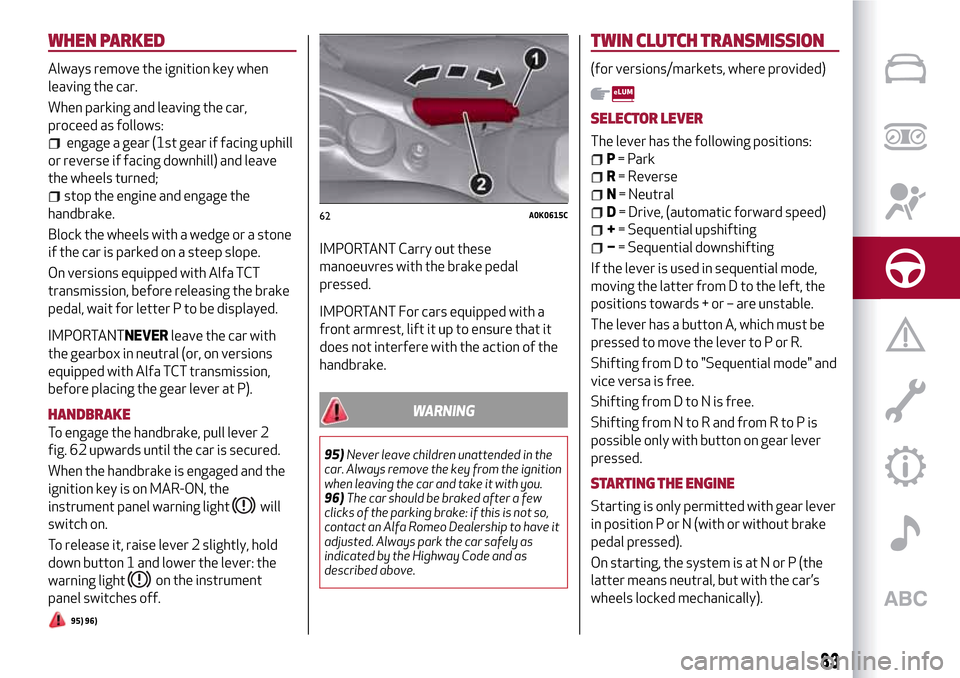
To engage the handbrake, pull lever 2
fig. 62 upwards until the car is secured.
When the handbrake is engaged and the
ignition key is on MAR-ON, the
instrument panel warning light
will
switch on.
To release it, raise lever 2 slightly, hold
down button 1 and lower the lever: the
warning light
on the instrument
panel switches off.
95) 96)
IMPORTANT Carry out these
manoeuvres with the brake pedal
pressed.
IMPORTANT For cars equipped with a
front armrest, lift it up to ensure that it
does not interfere with the action of the
handbrake.
WARNING
95)Never leave children unattended in the
car. Always remove the key from the ignition
when leaving the car and take it with you.
96)The car should be braked after a few
clicks of the parking brake: if this is not so,
contact an Alfa Romeo Dealership to have it
adjusted. Always park the car safely as
indicated by the Highway Code and as
described above.
TWIN CLUTCH TRANSMISSION
(for versions/markets, where provided)
SELECTOR LEVER
The lever has the following positions:
P= Park
R= Reverse
N= Neutral
D= Drive, (automatic forward speed)
+= Sequential upshifting
−= Sequential downshifting
If the lever is used in sequential mode,
moving the latter from D to the left, the
positions towards + or – are unstable.
The lever has a button A, which must be
pressed to move the lever to P or R.
Shifting from D to "Sequential mode" and
vice versa is free.
Shifting from D to N is free.
Shifting from N to R and from R to P is
possible only with button on gear lever
pressed.
STARTING THE ENGINE
Starting is only permitted with gear lever
in position P or N (with or without brake
pedal pressed).
On starting, the system is at N or P (the
latter means neutral, but with the car’s
wheels locked mechanically).
62A0K0615C
83
Page 87 of 212
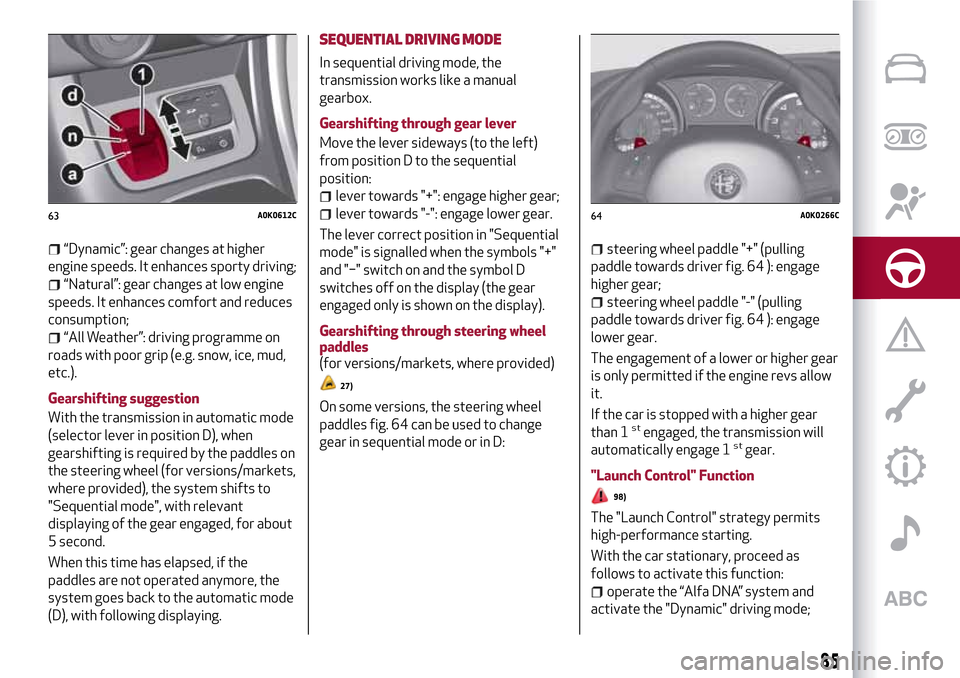
“Dynamic”: gear changes at higher
engine speeds. It enhances sporty driving;
“Natural”: gear changes at low engine
speeds. It enhances comfort and reduces
consumption;
“All Weather”: driving programme on
roads with poor grip (e.g. snow, ice, mud,
etc.).
Gearshifting suggestion
With the transmission in automatic mode
(selector lever in position D), when
gearshifting is required by the paddles on
the steering wheel (for versions/markets,
where provided), the system shifts to
"Sequential mode", with relevant
displaying of the gear engaged, for about
5 second.
When this time has elapsed, if the
paddles are not operated anymore, the
system goes back to the automatic mode
(D), with following displaying.
SEQUENTIAL DRIVING MODE
In sequential driving mode, the
transmission works like a manual
gearbox.
Gearshifting through gear lever
Move the lever sideways (to the left)
from position D to the sequential
position:
lever towards "+": engage higher gear;
lever towards "-": engage lower gear.
The lever correct position in "Sequential
mode" is signalled when the symbols "+"
and "−" switch on and the symbol D
switches off on the display (the gear
engaged only is shown on the display).
Gearshifting through steering wheel
paddles
(for versions/markets, where provided)
27)
On some versions, the steering wheel
paddles fig. 64 can be used to change
gear in sequential mode or in D:
steering wheel paddle "+" (pulling
paddle towards driver fig. 64 ): engage
higher gear;
steering wheel paddle "-" (pulling
paddle towards driver fig. 64 ): engage
lower gear.
The engagement of a lower or higher gear
is only permitted if the engine revs allow
it.
If the car is stopped with a higher gear
than 1
stengaged, the transmission will
automatically engage 1stgear.
"Launch Control" Function
98)
The "Launch Control" strategy permits
high-performance starting.
With the car stationary, proceed as
follows to activate this function:
operate the “Alfa DNA” system and
activate the "Dynamic" driving mode;
63A0K0612C64A0K0266C
85
Page 88 of 212
depress the brake pedal with your left
foot and, simultaneously, fully depress
the accelerator pedal with your right
foot;
shift gear using the gear lever or the
steering wheel paddle "−" (pulling the
paddle towards the driver as previously
described): rpm are thus increased from
2750 to 4500; (1.4 Petrol versions) and
from 1700 to 2700 (2.0 JTD
Mversions)
and from 3000 to 3750 (1750 Turbo
petrol version);
release the brake pedal: in this way a
more "lively" start is achieved.
When the brake pedal is released, the car
will start with maximum acceleration.
Despite the "Sequential mode", the car
will autonomously shift the gear to
guarantee max. acceleration, once the
correct shifting speed has been reached.
To abandon the strategy, simply interrupt
the above sequence of operations or
release the accelerator pedal.
IMPORTANT
25)If the car is on a gradient, always engage
the electric parking brake BEFORE placing
the gear lever in P.
26)Engage reverse only with the car
stationary, engine at idling speed and
accelerator pedal fully released.27)Using the paddles incorrectly (paddles
pushed towards the dashboard ) could break
them.
28)It is advisable to contact an Alfa Romeo
Dealership to have the refitting procedure
carried out. If you would like to proceed
autonomously, special attention must be
paid to the correct coupling of the retaining
clips. Otherwise, noise might be heard due to
an incorrect fastening of the lower cover
with the upper cover.
WARNING
97)Never leave children unattended in the
car. Always remove the ignition key when
leaving the car and take the key with you.
98)While the Launch Control function is
being used, the ESC and ASR systems are
deactivated. This means that vehicle
dynamic control is the sole responsibility of
the driver. Therefore pay the utmost
attention when using the Launch Control.
Take into account traffic and road surface
conditions and during manoeuvres make
sure there is enough room in the area
concerned.
MANUAL TRANSMISSION
99)
29)
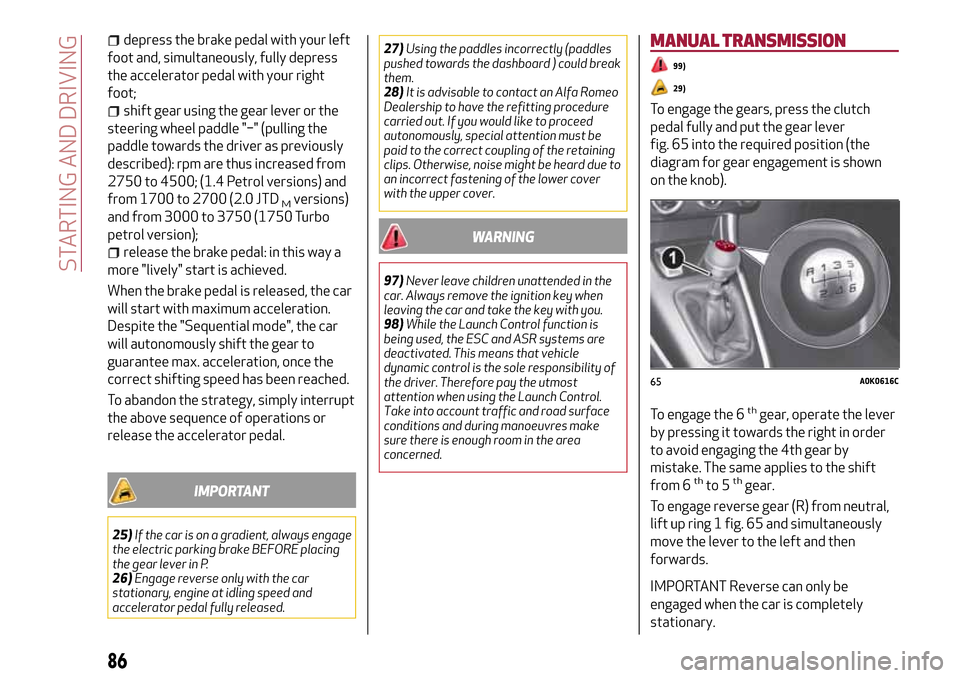
To engage the gears, press the clutch
pedal fully and put the gear lever
fig. 65 into the required position (the
diagram for gear engagement is shown
on the knob).
To engage the 6
thgear, operate the lever
by pressing it towards the right in order
to avoid engaging the 4th gear by
mistake. The same applies to the shift
from 6
thto 5thgear.
To engage reverse gear (R) from neutral,
lift up ring 1 fig. 65 and simultaneously
move the lever to the left and then
forwards.
IMPORTANT Reverse can only be
engaged when the car is completely
stationary.
65A0K0616C
86
STARTING AND DRIVING
Page 91 of 212
CRUISE CONTROL
(for versions/markets, where provided)
This is an electronically controlled driving
assistance device that allows the desired
vehicle speed to be maintained, without
having to press the accelerator pedal.
This device can be used at a speed above
30 km/h on long stretches of dry, straight
roads with few variations (e.g.
motorways). It is therefore not
recommended to use this device on
extra-urban roads with traffic. Do not use
it in town.
ACTIVATING THE DEVICE
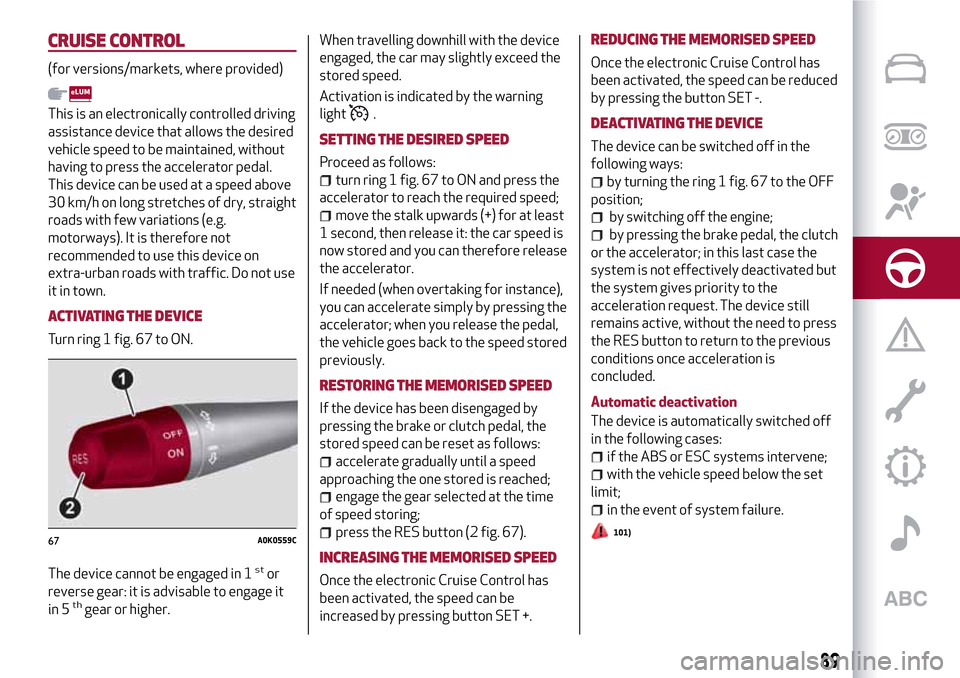
Turn ring 1 fig. 67 to ON.
The device cannot be engaged in 1
stor
reverse gear: it is advisable to engage it
in 5
thgear or higher.When travelling downhill with the device
engaged, the car may slightly exceed the
stored speed.
Activation is indicated by the warning
light
.
SETTING THE DESIRED SPEED
Proceed as follows:
turn ring 1 fig. 67 to ON and press the
accelerator to reach the required speed;
move the stalk upwards (+) for at least
1 second, then release it: the car speed is
now stored and you can therefore release
the accelerator.
If needed (when overtaking for instance),
you can accelerate simply by pressing the
accelerator; when you release the pedal,
the vehicle goes back to the speed stored
previously.
RESTORING THE MEMORISED SPEED
If the device has been disengaged by
pressing the brake or clutch pedal, the
stored speed can be reset as follows:
accelerate gradually until a speed
approaching the one stored is reached;
engage the gear selected at the time
of speed storing;
press the RES button (2 fig. 67).
INCREASING THE MEMORISED SPEED
Once the electronic Cruise Control has
been activated, the speed can be
increased by pressing button SET +.
REDUCING THE MEMORISED SPEED
Once the electronic Cruise Control has
been activated, the speed can be reduced
by pressing the button SET -.
DEACTIVATING THE DEVICE
The device can be switched off in the
following ways:
by turning the ring 1 fig. 67 to the OFF
position;
by switching off the engine;
by pressing the brake pedal, the clutch
or the accelerator; in this last case the
system is not effectively deactivated but
the system gives priority to the
acceleration request. The device still
remains active, without the need to press
the RES button to return to the previous
conditions once acceleration is
concluded.
Automatic deactivation
The device is automatically switched off
in the following cases:
if the ABS or ESC systems intervene;
with the vehicle speed below the set
limit;
in the event of system failure.
101)67A0K0559C
89
Page 93 of 212
When reverse gear is engaged an
acoustic signal is automatically activated
if there is an obstacle within the range of
operation.
The acoustic signal:
increasesas distance between the car
and the obstacle decreases;
becomes continuouswhen the
distance between the car and the
obstacle is less that 30 cm and stops
immediately if the distance increases;
is constantif the distance is unvaried;
if this situation occurs for the side
sensors, the signal will stop after about
3 seconds to avoid, for example,
indications in the event of manoeuvres
alongside walls.
OPERATION WITH A TRAILER
Parking sensor operation is automatically
turned off when the trailer electric cable
plug is fitted into the car tow hook
socket.
31)
The sensors are automatically
reactivated when the trailer's cable plug
is removed.
103) 104)
IMPORTANT NOTES
During parking manoeuvres, pay the
utmost attention to any obstacles that
could be located above or below the
sensors.
Objects set close to the car rear, under
certain circumstances are not detected and
could therefore cause damage to the car or
be damaged.
The following conditions may influence the
performance of the parking assistance
system:
reduced sensor sensitivity and a
reduction in the parking assistance
system performance could be due to the
presence on the surface of the sensor of:
ice, snow, mud, thick paint
The sensors may detect a non-existent
obstacle (echo interference) due to
mechanical interference, for example when
washing the car, in rain (strong wind), hail.
The signals sent by the sensors can also
be altered by the presence of ultrasonic
systems (e.g. pneumatic brake systems or
pneumatic drills) near the vehicle.
sensor performance can also be
influenced by the position of the sensors.
For example by a change in the ride setting
(caused by the wear of the shock
absorbers, suspension), overloading the car
and carrying out specific tuning operations
that require the car to be lowered;
The detection of obstacles at the top
part of the car may not be guaranteed
because the system detects obstacles that
could cause an impact with the car in the
bottom part.
IMPORTANT
31)The sensor must be free of mud, dirt,
snow or ice in order for the system to work.
Be careful not to scratch or damage the
sensors while cleaning them. Avoid using dry,
rough or hard cloths. The sensors must be
washed using clean water, with the addition
of vehicle shampoo if necessary. When using
special washing equipment such as high
pressure jets or steam cleaning, clean the
sensors very quickly keeping the jet more
than 10 cm away.
WARNING
103)Only have the bumpers repainted or
any retouches to the paintwork in the area of
the sensors carried out by an Alfa Romeo
Dealership. Incorrect paint application could
affect the operation of the parking sensors.
104)Parking and other dangerous
manoeuvres are, however, always the
driver’s responsibility. While carrying out
these manoeuvres, always make sure that
no people (especially children) or animals are
in the area concerned. The parking sensors
are an aid for the driver, but the driver must
never allow their attention to lapse during
potentially dangerous manoeuvres, even
those executed at low speeds.
91
Page 94 of 212
TOWING TRAILERS
IMPORTANT NOTES
The car must be provided with a
type-approved tow hook and adequate
electric system to tow caravans or
trailers. Installation must be carried out
by a specialist.
Install any specific and/or additional door
mirrors as specified by the Highway
Code.
Remember that when towing a trailer,
steep hills are harder to climb, the
braking spaces increase and overtaking
takes longer depending on the overall
weight.
Engage a low gear when driving downhill,
rather than constantly using the brake.
The weight of the trailer reduces the load
capacity of the car by the same amount.
Consider the weight at full load, including
accessories and luggage, to make sure
you do not exceed the maximum towable
weight (shown in the registration
document).
Do not exceed the speed limits specific
to each country you are driving in, in the
case of vehicles towing trailers. In any
case do not exceed 100 km/h.
INSTALLING A TOW HOOK
Contact an Alfa Romeo Dealership to
install a tow hook.
105) 106)
WARNING
105)The ABS with which the car is equipped
will not control the braking system of the
trailer. Particular caution is therefore
required on slippery roads.
106)Do not, under any circumstances,
modify the vehicle's braking system to
control the trailer breaking system. The
towing braking system must be completely
independent of the vehicle's hydraulic
system.
REFUELLING THE CAR
Stop the engine before refuelling.
PETROL ENGINES
Only use unleaded petrol 95 R.O.N.
compliant with the European
specification EN228. The petrol octane
rating (RON) must not be lower than 95.
In order to prevent damage to the
catalytic converter never introduce even
the smallest amount of leaded petrol,
even in the event of an emergency.
DIESEL ENGINES
Only use diesel fuel compliant with
European specification EN590. The use
of other products or mixtures may
damage the engine beyond repair and
consequently invalidate the warranty,
due to the damage caused.
Operation at low temperatures
If the outside temperature is very low,
diesel thickens due to the formation of
paraffin clots with consequent defective
operation of the fuel supply system.
In order to avoid these problems,
different types of Diesel are distributed
according to the season: summer type,
winter type and arctic type (cold,
mountain areas).
If refuelling with diesel whose
specifications are not suitable for the
usage temperature, it is advisable to mix
92
STARTING AND DRIVING