lock Alfa Romeo Giulietta 2017 Owner's Guide
[x] Cancel search | Manufacturer: ALFA ROMEO, Model Year: 2017, Model line: Giulietta, Model: Alfa Romeo Giulietta 2017Pages: 212, PDF Size: 4.56 MB
Page 66 of 212
SEAT BELTS
USING THE SEAT BELTS
The belt should be worn keeping the
torso straight and rested against the
backrest.
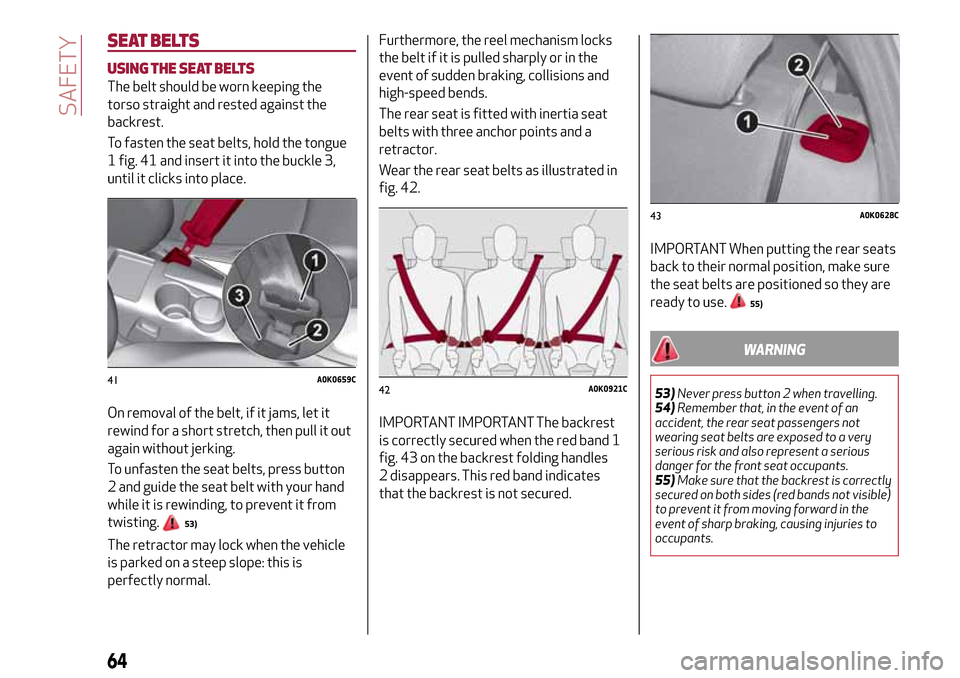
To fasten the seat belts, hold the tongue
1 fig. 41 and insert it into the buckle 3,
until it clicks into place.
On removal of the belt, if it jams, let it
rewind for a short stretch, then pull it out
again without jerking.
To unfasten the seat belts, press button
2 and guide the seat belt with your hand
while it is rewinding, to prevent it from
twisting.
53)
The retractor may lock when the vehicle
is parked on a steep slope: this is
perfectly normal.Furthermore, the reel mechanism locks
the belt if it is pulled sharply or in the
event of sudden braking, collisions and
high-speed bends.
The rear seat is fitted with inertia seat
belts with three anchor points and a
retractor.
Wear the rear seat belts as illustrated in
fig. 42.
IMPORTANT IMPORTANT The backrest
is correctly secured when the red band 1
fig. 43 on the backrest folding handles
2 disappears. This red band indicates
that the backrest is not secured.IMPORTANT When putting the rear seats
back to their normal position, make sure
the seat belts are positioned so they are
ready to use.
55)
WARNING
53)Never press button 2 when travelling.
54)Remember that, in the event of an
accident, the rear seat passengers not
wearing seat belts are exposed to a very
serious risk and also represent a serious
danger for the front seat occupants.
55)Make sure that the backrest is correctly
secured on both sides (red bands not visible)
to prevent it from moving forward in the
event of sharp braking, causing injuries to
occupants.41A0K0659C42A0K0921C
43A0K0628C
64
SAFETY
Page 85 of 212
WHEN PARKED
Always remove the ignition key when
leaving the car.
When parking and leaving the car,
proceed as follows:
engage a gear (1st gear if facing uphill
or reverse if facing downhill) and leave
the wheels turned;
stop the engine and engage the
handbrake.
Block the wheels with a wedge or a stone
if the car is parked on a steep slope.
On versions equipped with Alfa TCT
transmission, before releasing the brake
pedal, wait for letter P to be displayed.
IMPORTANTNEVERleave the car with
the gearbox in neutral (or, on versions
equipped with Alfa TCT transmission,
before placing the gear lever at P).
HANDBRAKE
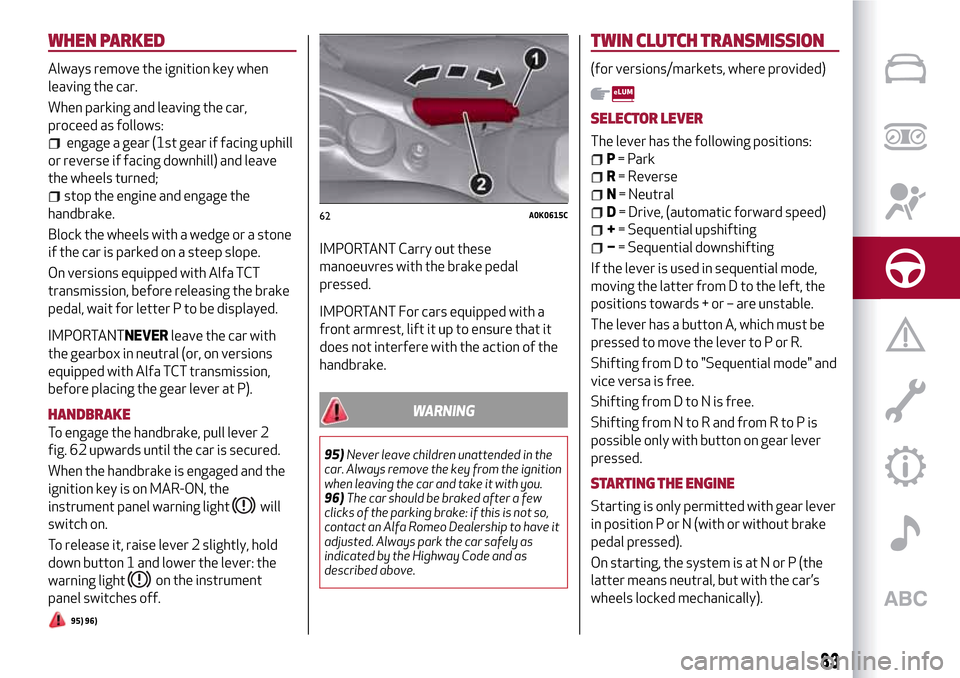
To engage the handbrake, pull lever 2
fig. 62 upwards until the car is secured.
When the handbrake is engaged and the
ignition key is on MAR-ON, the
instrument panel warning light
will
switch on.
To release it, raise lever 2 slightly, hold
down button 1 and lower the lever: the
warning light
on the instrument
panel switches off.
95) 96)
IMPORTANT Carry out these
manoeuvres with the brake pedal
pressed.
IMPORTANT For cars equipped with a
front armrest, lift it up to ensure that it
does not interfere with the action of the
handbrake.
WARNING
95)Never leave children unattended in the
car. Always remove the key from the ignition
when leaving the car and take it with you.
96)The car should be braked after a few
clicks of the parking brake: if this is not so,
contact an Alfa Romeo Dealership to have it
adjusted. Always park the car safely as
indicated by the Highway Code and as
described above.
TWIN CLUTCH TRANSMISSION
(for versions/markets, where provided)
SELECTOR LEVER
The lever has the following positions:
P= Park
R= Reverse
N= Neutral
D= Drive, (automatic forward speed)
+= Sequential upshifting
−= Sequential downshifting
If the lever is used in sequential mode,
moving the latter from D to the left, the
positions towards + or – are unstable.
The lever has a button A, which must be
pressed to move the lever to P or R.
Shifting from D to "Sequential mode" and
vice versa is free.
Shifting from D to N is free.
Shifting from N to R and from R to P is
possible only with button on gear lever
pressed.
STARTING THE ENGINE
Starting is only permitted with gear lever
in position P or N (with or without brake
pedal pressed).
On starting, the system is at N or P (the
latter means neutral, but with the car’s
wheels locked mechanically).
62A0K0615C
83
Page 95 of 212
TUTELA DIESEL ART additive in the
proportions shown on the container with
the fuel. Pour the additive into the tank
before the fuel.
When using or parking the car for a long
time in the mountains or cold areas, it is
advisable to refuel using locally available
fuel. In this case, it is also advisable to
keep the tank over 50% full.
LPG ENGINES
The gas filler is located next to the petrol
filler cap. It has a "non return", located in
the filler body itself.
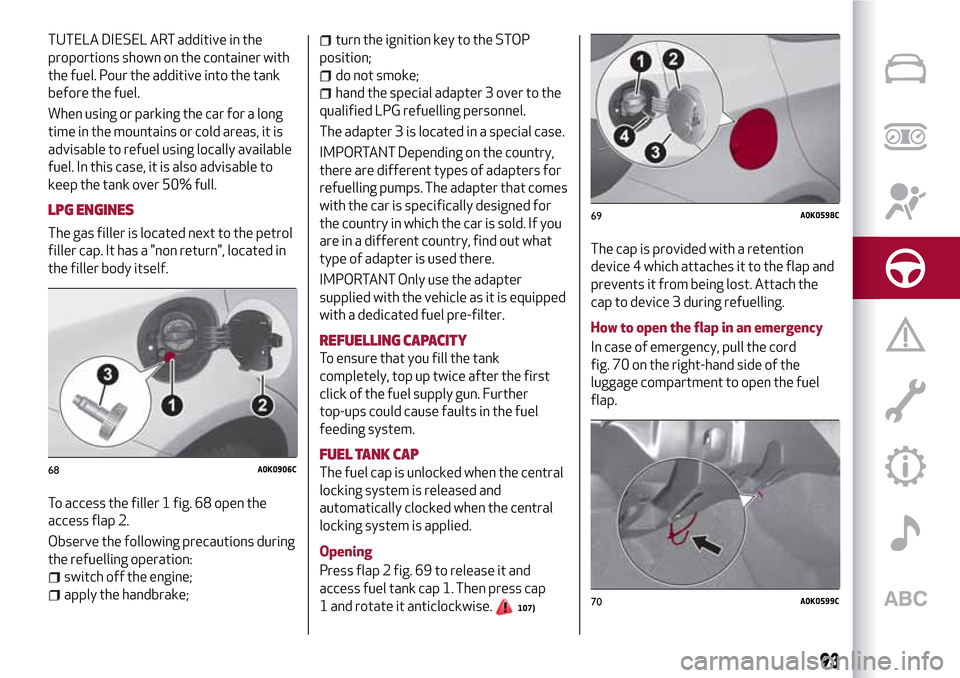
To access the filler 1 fig. 68 open the
access flap 2.
Observe the following precautions during
the refuelling operation:
switch off the engine;
apply the handbrake;
turn the ignition key to the STOP
position;
do not smoke;
hand the special adapter 3 over to the
qualified LPG refuelling personnel.
The adapter 3 is located in a special case.
IMPORTANT Depending on the country,
there are different types of adapters for
refuelling pumps. The adapter that comes
with the car is specifically designed for
the country in which the car is sold. If you
are in a different country, find out what
type of adapter is used there.
IMPORTANT Only use the adapter
supplied with the vehicle as it is equipped
with a dedicated fuel pre-filter.
REFUELLING CAPACITY
To ensure that you fill the tank
completely, top up twice after the first
click of the fuel supply gun. Further
top-ups could cause faults in the fuel
feeding system.
FUEL TANK CAP
The fuel cap is unlocked when the central
locking system is released and
automatically clocked when the central
locking system is applied.
Opening
Press flap 2 fig. 69 to release it and
access fuel tank cap 1. Then press cap
1 and rotate it anticlockwise.
107)
The cap is provided with a retention
device 4 which attaches it to the flap and
prevents it from being lost. Attach the
cap to device 3 during refuelling.
How to open the flap in an emergency
In case of emergency, pull the cord
fig. 70 on the right-hand side of the
luggage compartment to open the fuel
flap.
68A0K0906C
69A0K0598C
70A0K0599C
93
Page 96 of 212
Pulling the cord releases the flap lock: the
flap can then can be opened by pressing
it.
Closing
Release cap 1 from device 3 and insert it
in its housing. Then tighten the cap
clockwise until one or more clicks are
heard. Finally, close flap A checking that
it is correctly locked.
The sealing may cause a slight pressure
increase in the tank. A little breathing off,
while slackening the cap is absolutely
normal.
Fuel - Vehicle compatibility
identification Graphic symbol for
informing consumers in accordance
with EN16942
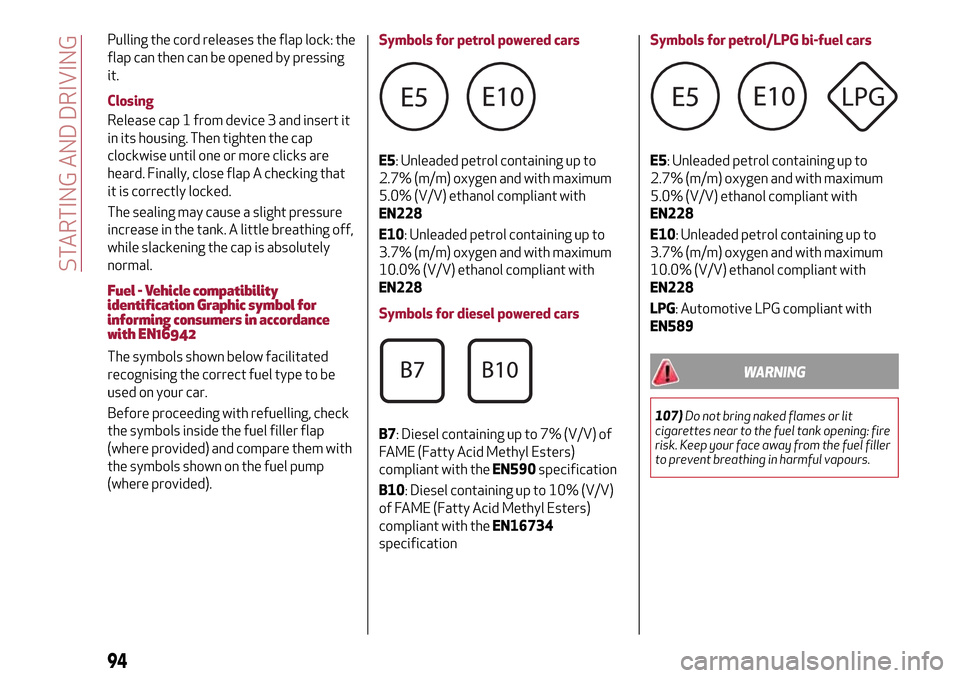
The symbols shown below facilitated
recognising the correct fuel type to be
used on your car.
Before proceeding with refuelling, check
the symbols inside the fuel filler flap
(where provided) and compare them with
the symbols shown on the fuel pump
(where provided).Symbols for petrol powered cars
E5: Unleaded petrol containing up to
2.7% (m/m) oxygen and with maximum
5.0% (V/V) ethanol compliant with
EN228
E10: Unleaded petrol containing up to
3.7% (m/m) oxygen and with maximum
10.0% (V/V) ethanol compliant with
EN228
Symbols for diesel powered cars
B7: Diesel containing up to 7% (V/V) of
FAME (Fatty Acid Methyl Esters)
compliant with theEN590specification
B10: Diesel containing up to 10% (V/V)
of FAME (Fatty Acid Methyl Esters)
compliant with theEN16734
specificationSymbols for petrol/LPG bi-fuel cars
E5: Unleaded petrol containing up to
2.7% (m/m) oxygen and with maximum
5.0% (V/V) ethanol compliant with
EN228
E10: Unleaded petrol containing up to
3.7% (m/m) oxygen and with maximum
10.0% (V/V) ethanol compliant with
EN228
LPG: Automotive LPG compliant with
EN589WARNING
107)Do not bring naked flames or lit
cigarettes near to the fuel tank opening: fire
risk. Keep your face away from the fuel filler
to prevent breathing in harmful vapours.
94
STARTING AND DRIVING
Page 99 of 212
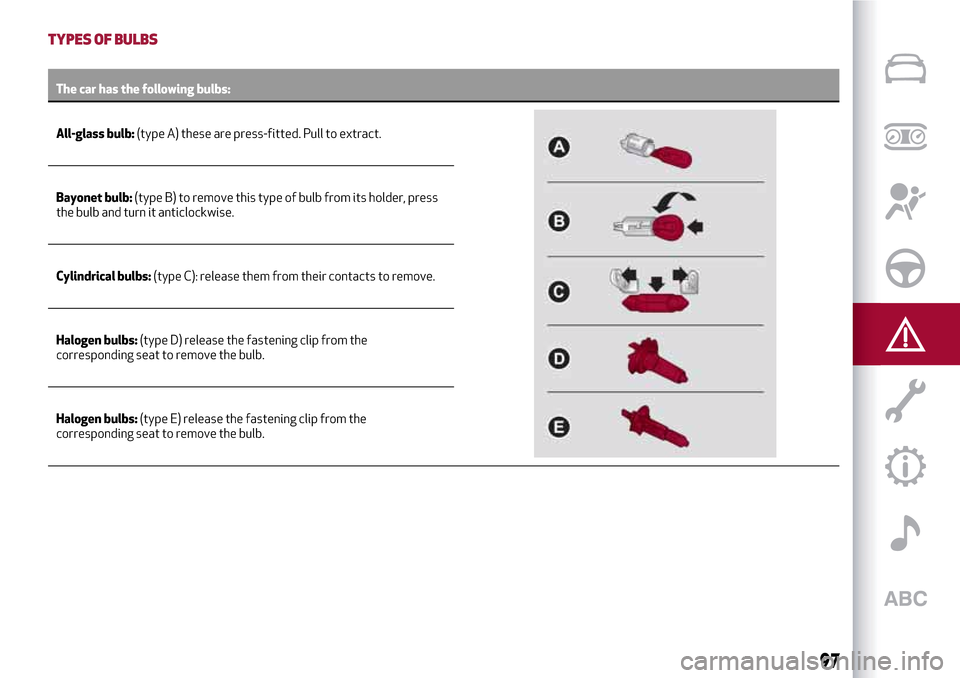
TYPES OF BULBS
The car has the following bulbs:
All-glass bulb:(type
A) these are press-fitted. Pull to extract.
Bayonet bulb:(type B) to remove this type of bulb from its holder, press
the bulb and turn it anticlockwise.
Cylindrical bulbs:(type C): release them from their contacts to remove.
Halogen bulbs:(type D) release the fastening clip from the
corresponding seat to remove the bulb.
Halogen bulbs:(type E) release the fastening clip from the
corresponding seat to remove the bulb.
97
Page 102 of 212
REPLACING AN EXTERIOR BULB
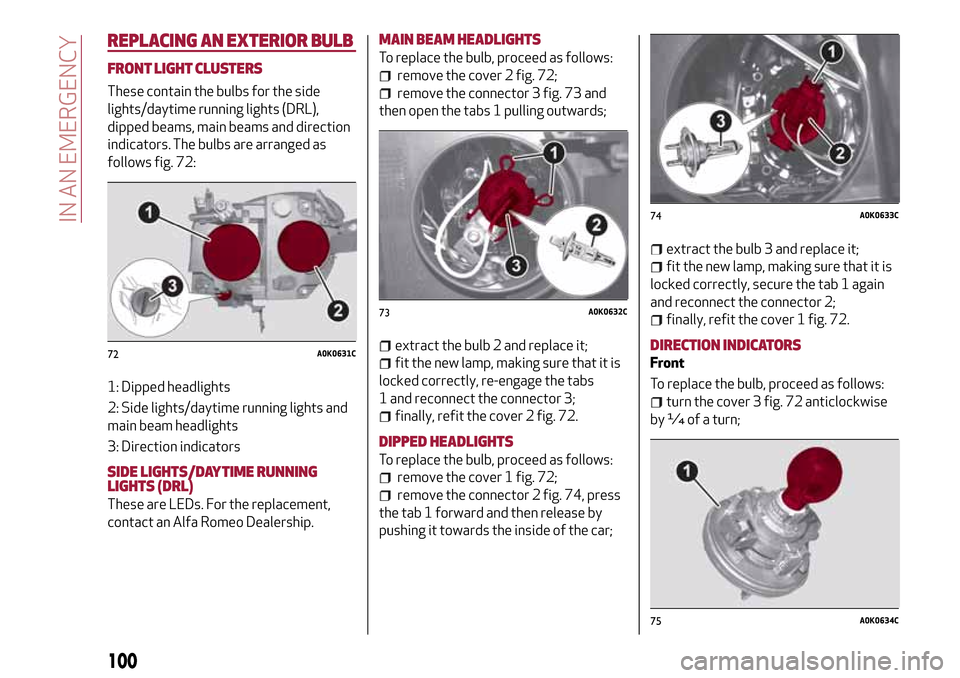
FRONT LIGHT CLUSTERS
These contain the bulbs for the side
lights/daytime running lights (DRL),
dipped beams, main beams and direction
indicators. The bulbs are arranged as
follows fig. 72:
1: Dipped headlights
2: Side lights/daytime running lights and
main beam headlights
3: Direction indicators
SIDE LIGHTS/DAYTIME RUNNING
LIGHTS (DRL)
These are LEDs. For the replacement,
contact an Alfa Romeo Dealership.
MAIN BEAM HEADLIGHTS
To replace the bulb, proceed as follows:
remove the cover 2 fig. 72;
remove the connector 3 fig. 73 and
then open the tabs 1 pulling outwards;
extract the bulb 2 and replace it;
fit the new lamp, making sure that it is
locked correctly, re-engage the tabs
1 and reconnect the connector 3;
finally, refit the cover 2 fig. 72.
DIPPED HEADLIGHTS
To replace the bulb, proceed as follows:
remove the cover 1 fig. 72;
remove the connector 2 fig. 74, press
the tab 1 forward and then release by
pushing it towards the inside of the car;
extract the bulb 3 and replace it;
fit the new lamp, making sure that it is
locked correctly, secure the tab 1 again
and reconnect the connector 2;
finally, refit the cover 1 fig. 72.
DIRECTION INDICATORS
Front
To replace the bulb, proceed as follows:
turn the cover 3 fig. 72 anticlockwise
by ¼ of a turn;
72A0K0631C
73A0K0632C
74A0K0633C
75A0K0634C
100
IN AN EMERGENCY
Page 104 of 212
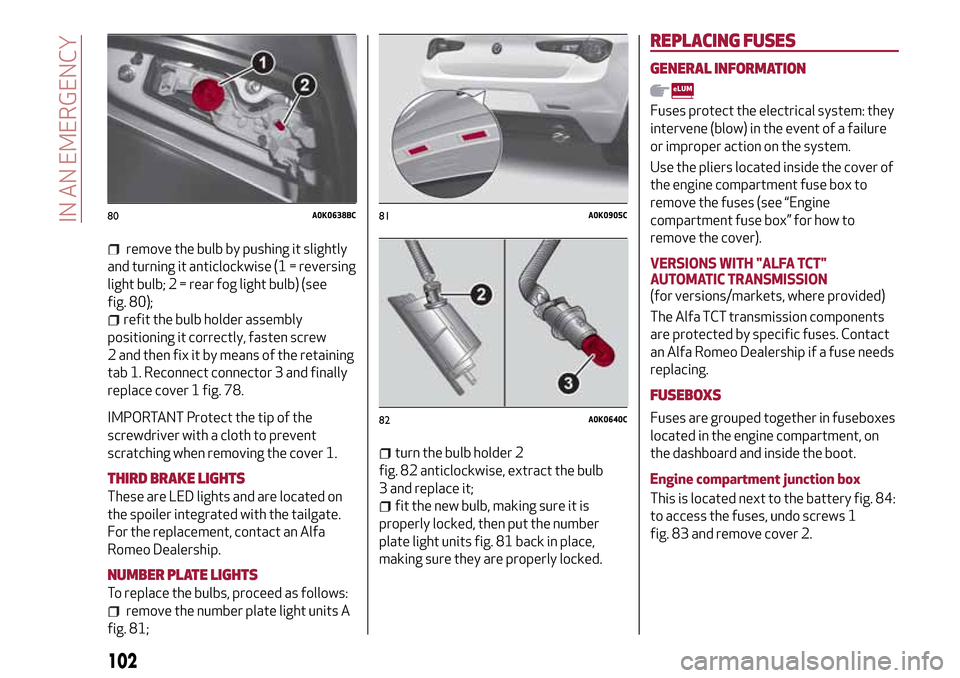
remove the bulb by pushing it slightly
and turning it anticlockwise (1 = reversing
light bulb; 2 = rear fog light bulb) (see
fig. 80);
refit the bulb holder assembly
positioning it correctly, fasten screw
2 and then fix it by means of the retaining
tab 1. Reconnect connector 3 and finally
replace cover 1 fig. 78.
IMPORTANT Protect the tip of the
screwdriver with a cloth to prevent
scratching when removing the cover 1.
THIRD BRAKE LIGHTS
These are LED lights and are located on
the spoiler integrated with the tailgate.
For the replacement, contact an Alfa
Romeo Dealership.
NUMBER PLATE LIGHTS
To replace the bulbs, proceed as follows:
remove the number plate light units A
fig. 81;
turn the bulb holder 2
fig. 82 anticlockwise, extract the bulb
3 and replace it;
fit the new bulb, making sure it is
properly locked, then put the number
plate light units fig. 81 back in place,
making sure they are properly locked.
REPLACING FUSES
GENERAL INFORMATION
Fuses protect the electrical system: they
intervene (blow) in the event of a failure
or improper action on the system.
Use the pliers located inside the cover of
the engine compartment fuse box to
remove the fuses (see “Engine
compartment fuse box” for how to
remove the cover).
VERSIONS WITH "ALFA TCT"
AUTOMATIC TRANSMISSION
(for versions/markets, where provided)
The Alfa TCT transmission components
are protected by specific fuses. Contact
an Alfa Romeo Dealership if a fuse needs
replacing.
FUSEBOXS
Fuses are grouped together in fuseboxes
located in the engine compartment, on
the dashboard and inside the boot.
Engine compartment junction box
This is located next to the battery fig. 84:
to access the fuses, undo screws 1
fig. 83 and remove cover 2.
80A0K0638BC81A0K0905C
82A0K0640C
102
IN AN EMERGENCY
Page 108 of 212
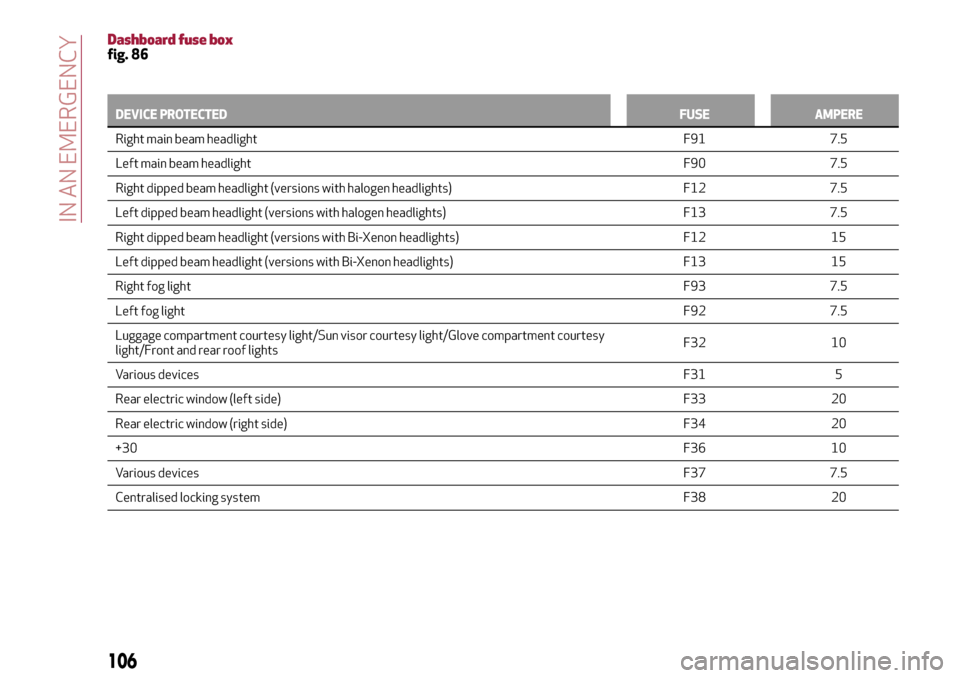
Dashboard fuse boxfig. 86
DEVICE PROTECTEDFUSE AMPERE
Right main beam headlightF91
7.5
Left main beam headlightF90 7.5
Right dipped beam headlight (versions with halogen headlights) F12 7.5
Left dipped beam headlight (versions with halogen headlights) F13 7.5
Right dipped beam headlight (versions with Bi-Xenon headlights) F12 15
Left dipped beam headlight (versions with Bi-Xenon headlights) F13 15
Right fog lightF93 7.5
Left fog lightF92 7.5
Luggage compartment courtesy light/Sun visor courtesy light/Glove compartment courtesy
light/Front and rear roof lightsF32 10
Various devicesF31 5
Rear electric window (left side) F33 20
Rear electric window (right side) F34 20
+30F36 10
Various devicesF37 7.5
Centralised locking systemF38 20
106
IN AN EMERGENCY
Page 112 of 212

CHANGING A WHEEL
JACK
117) 118) 119) 120) 121) 122)
Please note that:
the jack weight is 1.76 kg;
the jack requires no adjustment;
the jack cannot be repaired and in the
event of a fault it must be replaced by
another genuine one;
no tool other than its cranking device
may be fitted on the jack.
Jack maintenance:
prevent any dirt from depositing on
the "worm screw";
keep the "worm screw" lubricated;
never modify the jack.
Conditions in which not to use the jack:
temperature below -40°C
on sandy or muddy ground
on uneven ground
on steep roads
in extreme weather conditions:
thunderstorms, typhoons, hurricanes,
blizzards, storms, etc.
in direct contact with the engine or to
carry out repairs under the vehicle
on boats.
To change a wheel, proceed as follows:
stop the car in a position that is not
dangerous for oncoming traffic where
you can change the wheel safely.The ground must be flat and sufficiently
compact;
switch off the engine, pull up the
handbrake and engage the 1stgear or
reverse. Wear the reflective safety jacket
(compulsory by law) before getting out of
the vehicle;
open the luggage compartment, lift
the mat using the tab provided;
using wrench 1 fig. 90 located in the
tool box, loosen the locking device, take
the tool box 2 and place it close to the
wheel to be replaced, then take the
space-saver wheel 3;
take the wrench 1 fig. 91 and loosen
the fixing bolts by about one turn. For
versions with alloy rims, shake the car to
facilitate detachment of the rim from the
wheel hub;
position the jack under the car, near
the wheel to be changed. On versions
where this is fitted, be careful not to
damage the plastic aerodynamic guard;
operate the device 1 fig. 92 so as to
raise the jack, until the upper part is
correctly inserted in the side member at
the point indicated by the arrow
fig. 92. The lifting points 3 are shown
in fig. 93.
90A0K0649C
91A0K0650C
92A0K0651C
110
IN AN EMERGENCY
Page 114 of 212
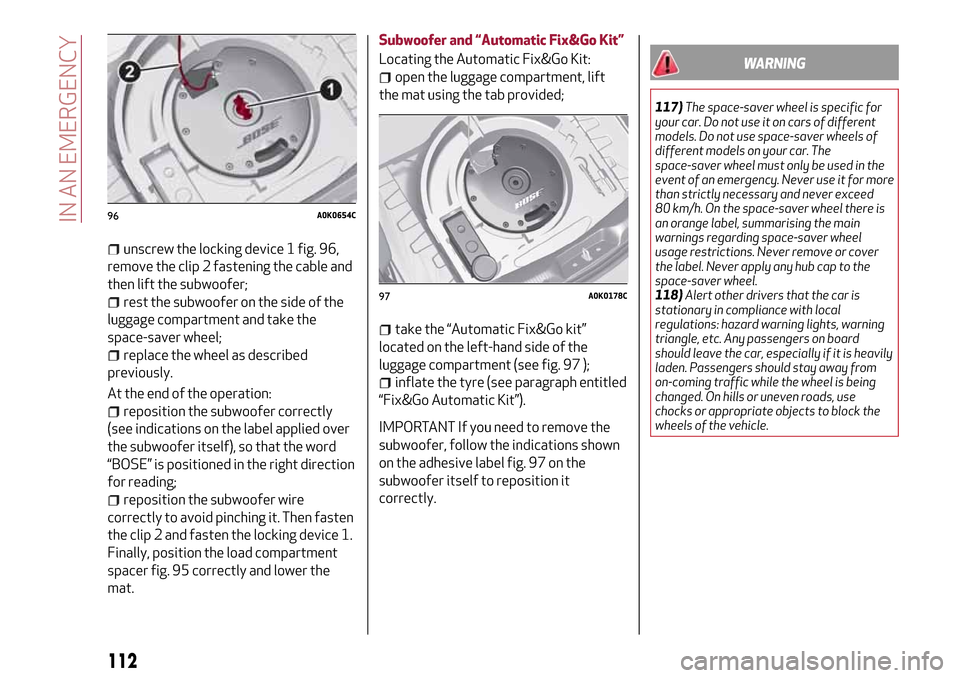
unscrew the locking device 1 fig. 96,
remove the clip 2 fastening the cable and
then lift the subwoofer;
rest the subwoofer on the side of the
luggage compartment and take the
space-saver wheel;
replace the wheel as described
previously.
At the end of the operation:
reposition the subwoofer correctly
(see indications on the label applied over
the subwoofer itself), so that the word
“BOSE” is positioned in the right direction
for reading;
reposition the subwoofer wire
correctly to avoid pinching it. Then fasten
the clip 2 and fasten the locking device 1.
Finally, position the load compartment
spacer fig. 95 correctly and lower the
mat.Subwoofer and “Automatic Fix&Go Kit”
Locating the Automatic Fix&Go Kit:
open the luggage compartment, lift
the mat using the tab provided;
take the “Automatic Fix&Go kit”
located on the left-hand side of the
luggage compartment (see fig. 97 );
inflate the tyre (see paragraph entitled
“Fix&Go Automatic Kit”).
IMPORTANT If you need to remove the
subwoofer, follow the indications shown
on the adhesive label fig. 97 on the
subwoofer itself to reposition it
correctly.
WARNING
117)The space-saver wheel is specific for
your car. Do not use it on cars of different
models. Do not use space-saver wheels of
different models on your car. The
space-saver wheel must only be used in the
event of an emergency. Never use it for more
than strictly necessary and never exceed
80 km/h. On the space-saver wheel there is
an orange label, summarising the main
warnings regarding space-saver wheel
usage restrictions. Never remove or cover
the label. Never apply any hub cap to the
space-saver wheel.
118)Alert other drivers that the car is
stationary in compliance with local
regulations: hazard warning lights, warning
triangle, etc. Any passengers on board
should leave the car, especially if it is heavily
laden. Passengers should stay away from
on-coming traffic while the wheel is being
changed. On hills or uneven roads, use
chocks or appropriate objects to block the
wheels of the vehicle.
96A0K0654C
97A0K0178C
112
IN AN EMERGENCY