ABS Alfa Romeo Giulietta 2017 Owner's Manual
[x] Cancel search | Manufacturer: ALFA ROMEO, Model Year: 2017, Model line: Giulietta, Model: Alfa Romeo Giulietta 2017Pages: 212, PDF Size: 4.56 MB
Page 5 of 212
USE OF THE OWNER HANDBOOK
Each time direction instructions (left/right or forwards/backwards) about the vehicle are given, these must be understood as
regarding an occupant in the driver's seat. Special cases not complying with this rule will be specified as appropriate in the text.
The figures in the Owner Handbook are provided by way of example only: this might imply that some details of the image do not
correspond to the actual arrangement of your vehicle. In addition, the Handbook has been conceived considering vehicles with
steering wheel on the left side; it is therefore possible that on vehicles with steering wheel on the right side, the position or
construction of some controls is not exactly mirror-like with respect to the figure.
To identify the chapter with the information needed you can consult the index at the end of this Owner Handbook.
Chapters can be rapidly identified with dedicated graphic tabs, at the side of each odd page. A few pages further there is a key for
getting to know the chapter order and the relevant symbols in the tabs. There is in any case a textual indication of the current chapter
at the side of each even page.
Page 12 of 212
Deactivation
Move the steering wheel slightly and turn
the ignition key to MAR.
4) 5)
WARNING
2)If the ignition device has been tampered
with (e.g. an attempted theft), have it
checked over by the Alfa Romeo Dealership
before driving again.
3)Always remove the key when you leave
your car to prevent someone from
accidentally operating the controls.
Remember to engage the handbrake.
Engage first gear if the vehicle is parked
uphill or reverse if the vehicle is parked
downhill. Never leave children unattended in
the vehicle.
4)It is absolutely forbidden to carry out any
after-market operation involving steering
system or steering column modifications
(e.g. installation of anti-theft device) that
could adversely affect performance and
safety, invalidate the warranty and also
result in the car not meeting type-approval
requirements.
5)Never remove the key while the car is
moving. The steering wheel will
automatically lock as soon as it is turned.
This holds true for cars being towed as well.
ALFA ROMEO CODESYSTEM
The Alfa Romeo Code prevents
unauthorised use of the vehicle, disabling
engine starting.
1)
Operation
Each time the car is started by turning
the ignition key to MAR, the Alfa Romeo
CODE system control unit sends an
acknowledgement code to the
Powertrain Control Module to deactivate
the inhibitor.
The code is sent only if the Alfa Romeo
CODE system control unit has recognised
the code transmitted by the key.
Each time the ignition key is turned to
STOP, the Alfa Romeo CODE system
deactivates the functions of the
Powertrain Control Module.
Irregular operation
If, during starting, the code is not
correctly recognised, the icon
appears on the instrument panel.
In this case, turn the key to STOP and
then to MAR-ON; if it is still locked, try
again with the other keys that come with
the car. If it is still not possible to start
the engine, contact an Alfa Romeo
Dealership.Activation of warning light while
driving
If the iconappears on the display,
this means that the system is running a
self-diagnosis (for example due to a
voltage drop).
If the iconcontinues to be
displayed, contact an Alfa Romeo
Dealership.
IMPORTANT
1)The electronic components inside the key
may be damaged if the key is subjected to
strong shocks. In order to ensure complete
efficiency of the electronic devices inside the
key, it should never be exposed to direct
sunlight.
10
GETTING TO KNOW YOUR CAR
Page 13 of 212
ALARMSYSTEM
(for versions/markets, where provided)
ALARM ACTIVATION
Activation of the alarm triggers the
acoustic warning and the direction
indicators.
IMPORTANT The alarm is adapted by the
Manufacturer to meet the requirements
of the various countries where the
vehicle is marketed.
SWITCHING ON THE ALARM
With the doors, bonnet and tailgate
closed and the ignition key either turned
to STOP or removed, point the key with
remote control towards the car and press
and release the button
.
Except on some versions for specific
markets, the system produces a visual
and acoustic warning and enables door
locking.
ALARM SELF-ACTIVATION(for versions/markets, where provided)
If the alarm has not been activated using
the remote control, approximately
30 seconds after the key is turned to the
STOP position and the last time one of
the doors or tailgate was opened and
reclosed, the alarm is activated
automatically.This condition is indicated by the
intermittent illumination of the LED on
the alarm deactivation button on the roof
light and by the activation indications
described previously.
To deactivate the alarm, press the button
on the remote control.
Alarm self-activation also occurs when
the doors are closed by turning the metal
insert of the key in the driver door lock. If
the alarm is self-activated, the doors will
not be locked.
TURNING THE ALARM OFF
IMPORTANT Activating the central
opening using the key's metal insert does
not turn the alarm off.
DOORS
DOOR CENTRAL LOCKING/UNLOCKING
Locking from the outside
With the doors closed, press the
button on the key or fit and then turn
the metal insert (located inside the key)
in the driver side door lock.
The door locking function is operated:
with all the doors closed;
with all the doors closed and boot
open.
Door unlocking from the outside
Press the
button on the key or turn the
metal insert (located inside the key) in
the driver side door lock.
Door locking/unlocking from the inside
Press the
button on the dashboard.
IMPORTANT With central locking active,
pulling the internal opening lever of the
passenger side door unlocks the door
itself. Pulling the internal opening lever
of the driver side door activates central
unlocking.
IMPORTANT The rear doors cannot be
opened from the inside when the child
lock device is engaged.
In the absence of electrical power supply
(e.g. blown fuse, battery disconnected,
etc.) it is still possible to lock the doors
manually.
11
Page 18 of 212
WARNING
10)All adjustments must be carried out only
with the car stationary and engine off.
11)It is absolutely forbidden to carry out
any after-market operation involving
steering system or steering column
modifications (e.g. installation of anti-theft
device) that could adversely affect
performance and safety, invalidate the
warranty and also result in the car not
meeting type-approval requirements.
REAR VIEW MIRRORS
INTERIOR MIRROR
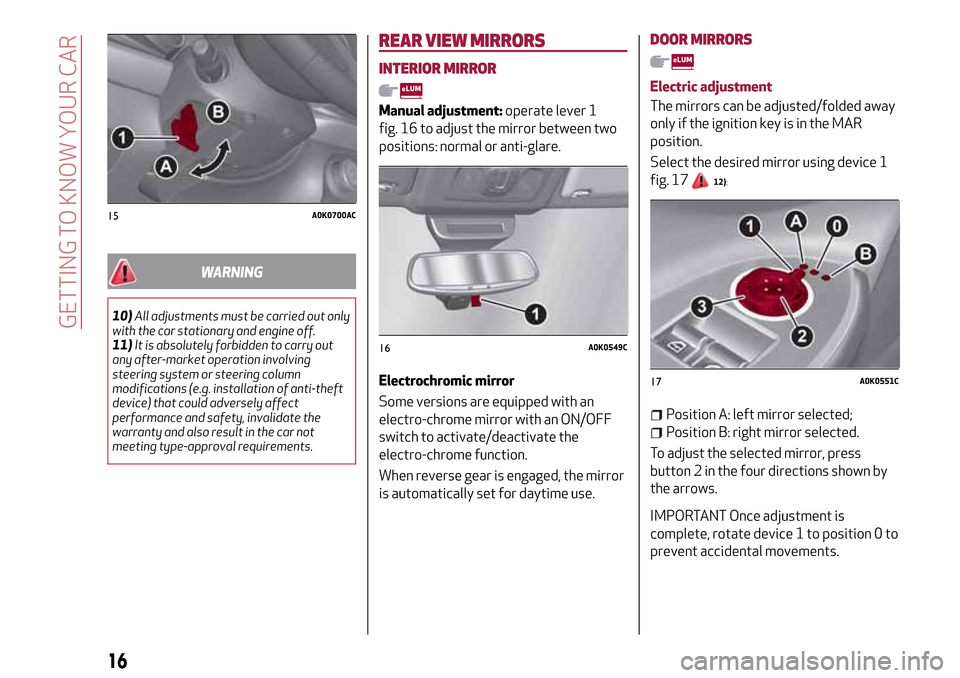
Manual adjustment:operate lever 1
fig. 16 to adjust the mirror between two
positions: normal or anti-glare.
Electrochromic mirror
Some versions are equipped with an
electro-chrome mirror with an ON/OFF
switch to activate/deactivate the
electro-chrome function.
When reverse gear is engaged, the mirror
is automatically set for daytime use.
DOOR MIRRORS
Electric adjustment
The mirrors can be adjusted/folded away
only if the ignition key is in the MAR
position.
Select the desired mirror using device 1
fig. 17
12):
Position A: left mirror selected;
Position B: right mirror selected.
To adjust the selected mirror, press
button 2 in the four directions shown by
the arrows.
IMPORTANT Once adjustment is
complete, rotate device 1 to position 0 to
prevent accidental movements.
15A0K0700AC
16A0K0549C
17A0K0551C
16
GETTING TO KNOW YOUR CAR
Page 31 of 212
ENGINE BONNET
OPENING
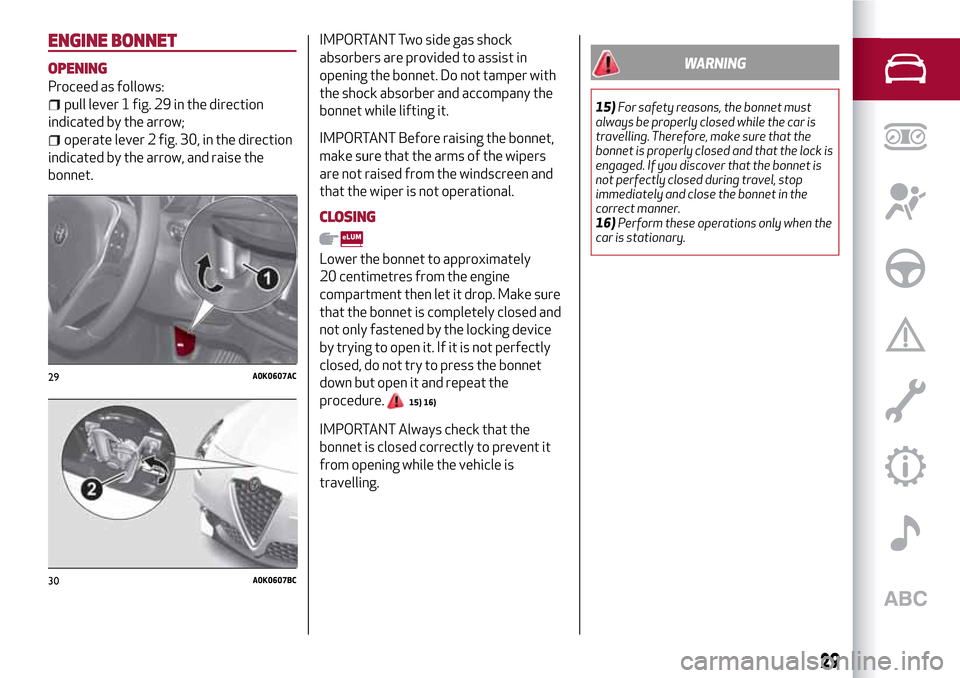
Proceed as follows:
pull lever 1 fig. 29 in the direction
indicated by the arrow;
operate lever 2 fig. 30, in the direction
indicated by the arrow, and raise the
bonnet.
IMPORTANT Two side gas shock
absorbers are provided to assist in
opening the bonnet. Do not tamper with
the shock absorber and accompany the
bonnet while lifting it.
IMPORTANT Before raising the bonnet,
make sure that the arms of the wipers
are not raised from the windscreen and
that the wiper is not operational.
CLOSING
Lower the bonnet to approximately
20 centimetres from the engine
compartment then let it drop. Make sure
that the bonnet is completely closed and
not only fastened by the locking device
by trying to open it. If it is not perfectly
closed, do not try to press the bonnet
down but open it and repeat the
procedure.
15) 16)
IMPORTANT Always check that the
bonnet is closed correctly to prevent it
from opening while the vehicle is
travelling.
WARNING
15)For safety reasons, the bonnet must
always be properly closed while the car is
travelling. Therefore, make sure that the
bonnet is properly closed and that the lock is
engaged. If you discover that the bonnet is
not perfectly closed during travel, stop
immediately and close the bonnet in the
correct manner.
16)Perform these operations only when the
car is stationary.
29A0K0607AC
30A0K0607BC
29
Page 36 of 212
IMPORTANT
10)The car is equipped with a specifically
designed gaseous LPG injection system: it is
therefore absolutely forbidden to alter the
configuration of the system or its
components. The use of other components or
materials could cause malfunctions and lead
to a reduction in safety; therefore, in the
case of problems, contact an Alfa Romeo
Dealership. When towing or lifting the
vehicle, follow the instructions in the main
handbook under the paragraph on "Towing
the vehicle" to prevent damage to the gas
system parts.
11)The system operates at temperatures
ranging between -20°C and 100°C.
12)When using a painting oven, the LPG
tank should be removed from the car and
later carefully refitted at an Alfa Romeo
Dealership. Although the LPG system has
numerous safety features, it is advisable to
proceed as follows every time the vehicle is
not in use for a long period or moved in an
emergency as a result of a breakdown or
accident: unscrew the devices fastening the
cover of the LPG tank, then remove it. Close
the LPG cock rotating the ring nut clockwise
(see "Passive safety / active safety"). Refit
the cover and retighten the fastening
devices.13)Only use LPG for motor vehicles.
14)It is strictly forbidden to use any additive
in the LPG. Periodically (at least once every
six months) it is advisable to let the LPG in
the tank run out and, at the first refuelling, to
check that it does not exceed the maximum
capacity of 38 litres (reserve included) (with
a tolerance of 2 litres excess). If the level is
above 38 litres (reserve included) contact an
Alfa Romeo Dealership immediately.
15)When switching is requested, metallic
noise from the valves which pressurise the
circuit can be heard. For the switching logic
described above, a delay between the valve
ticking and the switching off of the
instrument panel indication is completely
normal.
16)In particular usage conditions, such as
starting and operation at low ambient
temperature or LPG supply with low propane
content, the system may switch temporarily
to petrol operation, without a visual
indication of switching on the instrument
panel. In the event of low LPG levels in the
tank or request for high performance (e.g.
overtaking, car fully laden, steep hills) the
system may automatically switch to petrol
operation to guarantee the engine power
requested; the green warning light on the
instrument panel switches on to indicate this.
When the above conditions are no longer
present, the system automatically restores
LPG operation; the green warning light
switches off. To achieve the automatic
switching described above, make sure that
there is always enough fuel in the petrol tank.
34
GETTING TO KNOW YOUR CAR
Page 49 of 212
Warning lights on
panelWhat it means What to do
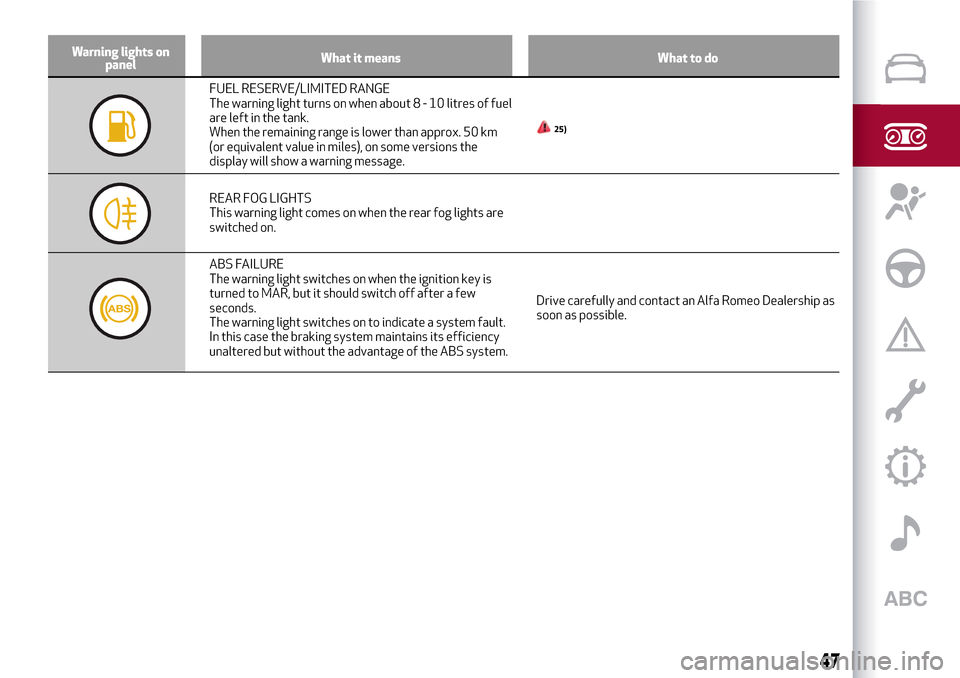
FUEL RESERVE/LIMITED RANGE
The warning light turns on when about8-10litres of fuel
are left in the tank.
When the remaining range is lower than approx. 50 km
(or equivalent value in miles), on some versions the
display will show a warning message.
25)
REAR FOG LIGHTS
This warning light comes on when the rear fog lights are
switched on.
ABS FAILURE
The warning light switches on when the ignition key is
turned to MAR, but it should switch off after a few
seconds.
The warning light switches on to indicate a system fault.
In this case the braking system maintains its efficiency
unaltered but without the advantage of the ABS system.Drive carefully and contact an Alfa Romeo Dealership as
soon as possible.
47
Page 62 of 212
ACTIVE SAFETYSYSTEMS
ABS SYSTEM
This system, which is an integral part of
the braking system, prevents one or more
wheels from locking and slipping in all
road surface conditions, irrespective of
the intensity of the braking action,
ensuring that the vehicle can be
controlled even during emergency
braking and optimising stopping
distances.
System intervention
The driver can feel that the ABS system
has come into action because the brake
pedal pulsates slightly and the system
gets noisier: this is entirely normal with
the system operating.
33) 34) 35) 36) 37) 38) 39)
ASR (AntiSlip Regulation)SYSTEM
40) 41) 42)
This is an integral part of the ESC system
and automatically operates in the event
of one or both drive wheels slipping, loss
of grip on wet roads (aquaplaning) and
acceleration on slippery, snowy or icy
roads, etc.System intervention
The system operates on the engine
power and brakes.
This is indicated by the flashing of the
warning light
on the instrument panel,
to inform the driver that the car is in
critical stability and grip conditions.
MSR (Motor Schleppmoment
Regelung)SYSTEM
The system prevents the drive wheels
from possibly locking, which could
happen, for example, if the accelerator
pedal is released suddenly or in the case
of a sudden downshifting in conditions of
poor grip.
In this conditions, the engine braking
effect could cause the drive wheels to
slip, resulting in a loss of vehicle stability.
In these situations, the system
intervenes, restoring torque to the
engine in order to conserve vehicle
stability and increase vehicle safety.
HBA (Hydraulic Brake Assist)SYSTEM
43) 44) 45)
The HBA system is designed to improve
the car’s braking capacity during
emergency braking: the HBA system
therefore completes the ABS system.
Maximum assistance from the HBA
system is obtained by continuously
pressing the brake pedal very quickly.
DST SYSTEM (Dynamic Steering
Torque)
46)
The DST function uses the integration of
the ESC system with the electric power
steering to increase the safety level of
the whole vehicle.
In critical situations (braking on surfaces
with different grip conditions), through
the DST function the ESC system
controls the steering to implement an
additional torque contribution on the
steering wheel, to suggest the most
correct manoeuvre to the driver.
The coordinated action of the brakes and
steering increases the sensation of
safety and control of the vehicle.
EBD SYSTEM
The EBD system is an integral part of the
ESC system and intervenes during
braking, distributing the brake force
optimally between front and rear wheels.
This guarantees greater braking stability
for the car, preventing sudden locking of
the rear wheels and the consequent
instability of the car.
ESC SYSTEM
The ESC system improves the directional
control and stability of the car in various
driving conditions.
60
SAFETY
Page 63 of 212
The ESC system corrects the car’s
understeer and oversteer, distributing
the brake force on the appropriate
wheels. The torque supplied by the
engine can also be reduced in order to
maintain control of the vehicle.
28) 29) 30) 31) 32)
The ESC system comprises the active
safety systems such as: ABS, EBD, ASR,
HILL HOLDER, etc.
The ESC system switches on
automatically when the engine is started
and cannot be switched off.
System intervention
This is indicated by the flashing of the
warning light
on the instrument panel,
to inform the driver that the car is in
critical stability and grip conditions.
CBC (Cornering Brake Control)SYSTEM
This system acts when braking on
corners, optimising the distribution of
brake pressure on the four wheels: the
system prevents the wheels on the inside
of the corner (less affected by the weight
of the car) from locking, ensuring better
stability and direction for the car.
HILL HOLDERSYSTEM
This is an integral part of the ESC system
and facilitates starting on uphill or
downhill slopes by operating the brakes:
IMPORTANT The Hill Holder system is
not a parking brake; therefore, never
leave the car without having engaged the
handbrake, turned the engine off and
engaged first gear, so that it is parked in
safe conditions (for further information
read the "Parking" paragraph in the
"Starting and driving" chapter).
IMPORTANT There may be situations on
small gradients (less than 8%), with car
laden, in which the Hill Holder system
may not activate, causing a slight
reversing motion and increasing the risk
of collision with another vehicle or object.
The driver is, in any case, responsible for
safe driving.
“ELECTRONIC Q2”SYSTEM (“E-Q2”)
The "Electronic Q2" system intervenes
during acceleration on corners, braking
the inner drive wheel and thus increasing
the traction of the outer wheel (which
bears more of the car’s weight): the
torque is thus distributed optimally
between the drive wheels in accordance
with the driving conditions and road
surface, permitting particularly effective,
sporty driving.
"PRE-FILL"SYSTEM (RAB - Ready Alert
Brake)
(only with 'Dynamic" mode activated)
This function activates automatically if
the accelerator pedal is released rapidly,
reducing the brake pad travel (both at
front and back), with the aim of preparing
the braking system and enhancing its
responsiveness, thus reducing the
stopping distance in the event of
subsequent braking.
WARNING
28)The ESC system cannot alter the natural
laws of physics, and cannot increase grip,
which depends on the condition of the road.
29)The ESC system cannot prevent
accidents, including those due to excessive
speed on corners, driving on low-grip
surfaces or aquaplaning.
30)The capability of the ESC system must
never be tested irresponsibly and
dangerously, in such a way as to compromise
personal safety and the safety of others.
31)For the correct operation of the ASR
system, the tyres must of necessity be the
same make and type on all wheels, in perfect
condition and, above all, of the prescribed
type and dimensions.
32)Do not take unnecessary risks, even if
your vehicle is fitted with the ESC and ASR
systems. Your driving style must always be
suited to the road conditions, visibility and
traffic. The driver is always responsible for
road safety.
61
Page 64 of 212
33)When the ABS intervenes and you feel
the brake pedal pulsating, do not reduce the
pressure, but hold it down firmly and
confidently; in doing so you will brake in the
shortest distance possible, depending on the
current road conditions.
34)To obtain the maximum efficiency of the
braking system, a bedding-in period of about
500 km is needed: during this period it is
better to avoid sharp, repeated and
prolonged braking.
35)If the ABS intervenes, this indicates that
the grip of the tyres on the road is nearing its
limit: you must slow down to a speed
compatible with the available grip.
36)The ABS cannot overrule the natural
laws of physics, and cannot increase the grip
available according to the condition of the
road.
37)The ABS cannot prevent accidents,
including those due to excessive speed on
corners, driving on low-grip surfaces or
aquaplaning.
38)The capability of the ABS must never be
tested irresponsibly and dangerously, in
such a way as to compromise personal
safety and the safety of others.
39)For the correct operation of the ABS, the
tyres must of necessity be the same make
and type on all wheels, in perfect condition
and, above all, of the prescribed type and
dimensions.
40)The ASR cannot overrule the natural
laws of physics, and cannot increase the grip
available according to the condition of the
road.
41)The ASR system cannot prevent
accidents, including those due to excessive
speed on corners, driving on low-grip
surfaces or aquaplaning.42)The capability of the ASR must never be
tested irresponsibly and dangerously, in
such a way as to compromise personal
safety and the safety of others.
43)The HBA system can’t overrule the
natural laws of physics, and can’t increase
the grip available according to the condition
of the road.
44)The HBA system cannot prevent
accidents, including those due to excessive
speed on corners, driving on low-grip
surfaces or aquaplaning.
45)The features of the HBA system must
never be tested in imprudent or dangerous
ways, with the possibility of putting the
safety of the driver, occupants or other road
users at risk.
46)DST is an aid for driving and does not
relieve the driver of responsibility for driving
the vehicle.iTPMS System (indirect Tyre
Pressure Monitoring System)
(for versions/markets, where provided)
DESCRIPTION
The car can be equipped with the iTPMS
(indirect Tyre Pressure Monitoring
System) which monitors the tyre inflation
status thanks to wheel speed sensors.
The system warns the driver if one or
more tyres are flat by the dedicated
warning light
continuously on and a
warning message on the display.
If one tyre only is flat, the system can
indicate its position: it is in any case
recommended to check the pressure on
all four tyres.
This indication is displayed also when
turning the engine off and on again until
the RESET procedure is carried out.
RESET PROCEDURE
The iTPMS needs an initial "self-learning"
phase (with length depending on the
driving style and road conditions: optimal
conditions being driving on a straight
road at 80 km/h for at least 20 minutes)
which starts when the RESET procedure
is carried out.
The Reset procedure must be carried out:
each time tyre pressure is modified;
when even only one tyre is changed;
when tyres are rotated/inverted;
62
SAFETY