weight Alfa Romeo Giulietta 2017 Owner's Manual
[x] Cancel search | Manufacturer: ALFA ROMEO, Model Year: 2017, Model line: Giulietta, Model: Alfa Romeo Giulietta 2017Pages: 212, PDF Size: 4.56 MB
Page 63 of 212
The ESC system corrects the car’s
understeer and oversteer, distributing
the brake force on the appropriate
wheels. The torque supplied by the
engine can also be reduced in order to
maintain control of the vehicle.
28) 29) 30) 31) 32)
The ESC system comprises the active
safety systems such as: ABS, EBD, ASR,
HILL HOLDER, etc.
The ESC system switches on
automatically when the engine is started
and cannot be switched off.
System intervention
This is indicated by the flashing of the
warning light
on the instrument panel,
to inform the driver that the car is in
critical stability and grip conditions.
CBC (Cornering Brake Control)SYSTEM
This system acts when braking on
corners, optimising the distribution of
brake pressure on the four wheels: the
system prevents the wheels on the inside
of the corner (less affected by the weight
of the car) from locking, ensuring better
stability and direction for the car.
HILL HOLDERSYSTEM
This is an integral part of the ESC system
and facilitates starting on uphill or
downhill slopes by operating the brakes:
IMPORTANT The Hill Holder system is
not a parking brake; therefore, never
leave the car without having engaged the
handbrake, turned the engine off and
engaged first gear, so that it is parked in
safe conditions (for further information
read the "Parking" paragraph in the
"Starting and driving" chapter).
IMPORTANT There may be situations on
small gradients (less than 8%), with car
laden, in which the Hill Holder system
may not activate, causing a slight
reversing motion and increasing the risk
of collision with another vehicle or object.
The driver is, in any case, responsible for
safe driving.
“ELECTRONIC Q2”SYSTEM (“E-Q2”)
The "Electronic Q2" system intervenes
during acceleration on corners, braking
the inner drive wheel and thus increasing
the traction of the outer wheel (which
bears more of the car’s weight): the
torque is thus distributed optimally
between the drive wheels in accordance
with the driving conditions and road
surface, permitting particularly effective,
sporty driving.
"PRE-FILL"SYSTEM (RAB - Ready Alert
Brake)
(only with 'Dynamic" mode activated)
This function activates automatically if
the accelerator pedal is released rapidly,
reducing the brake pad travel (both at
front and back), with the aim of preparing
the braking system and enhancing its
responsiveness, thus reducing the
stopping distance in the event of
subsequent braking.
WARNING
28)The ESC system cannot alter the natural
laws of physics, and cannot increase grip,
which depends on the condition of the road.
29)The ESC system cannot prevent
accidents, including those due to excessive
speed on corners, driving on low-grip
surfaces or aquaplaning.
30)The capability of the ESC system must
never be tested irresponsibly and
dangerously, in such a way as to compromise
personal safety and the safety of others.
31)For the correct operation of the ASR
system, the tyres must of necessity be the
same make and type on all wheels, in perfect
condition and, above all, of the prescribed
type and dimensions.
32)Do not take unnecessary risks, even if
your vehicle is fitted with the ESC and ASR
systems. Your driving style must always be
suited to the road conditions, visibility and
traffic. The driver is always responsible for
road safety.
61
Page 70 of 212
CARRYING CHILDREN SAFELY
For optimal protection in the event of an
impact, all occupants must be seated and
wearing adequate restraint systems,
including newborn and other children!
This prescription is compulsory in all EC
countries according to EC Directive
2003/20/EC.
Children below the height of 1.50 metres
and up to 12 years must be protected
with suitable restraint systems and be
seated on the rear seats. Statistics on
accidents indicate that the rear seats
offer greater safety for children.
Compared with an adult, a child's head is
larger and heavier in proportion to their
body and the child's muscular and bone
structures are not fully developed.
Therefore, correct restraint systems
other than adult seat belts are necessary
to reduce as much as possible the risk of
injuries in case of accident, braking or
sudden manoeuvre.
Children must be seated safely and
comfortably. Depending on the
characteristics of the child restraint
systems used, you are advised to keep
children in rearward facing child restraint
systems for as long as possible (at least
until 3-4 years old), since this is the most
protected position in the event of an
impact.
60) 61) 62) 63)
The choice of the most suitable child
restraint device depends on the weight of
the child; there are various types of child
restraint systems and you are advised
always to choose the one that is most
suitable for the child.
When over 1.50 m in height, from the
point of view of restraint systems,
children are considered as adults and
wear seat belts normally.
In Europe the characteristics of child
restraint systems are ruled by the
regulation ECE-R44, dividing them into
five weight groups:
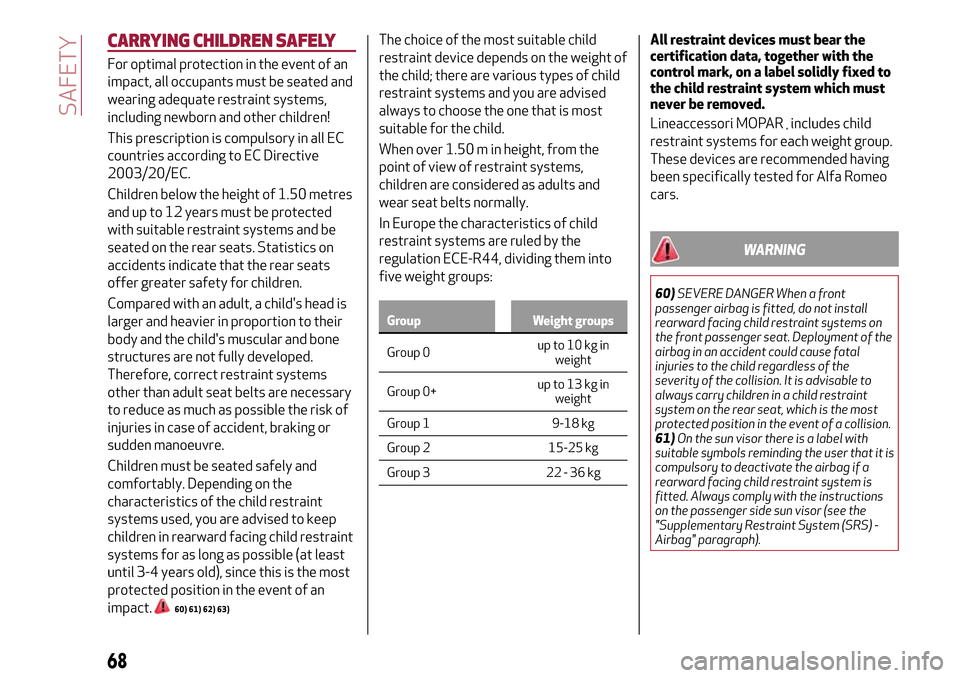
Group Weight groups
Group 0upto 10 kg in
weight
Group 0+up to 13 kg in
weight
Group 1 9-18 kg
Group 2 15-25 kg
Group 3 22 - 36 kg
All restraint devices must bear the
certification data, together with the
control mark, on a label solidly fixed to
the child restraint system which must
never be removed.
Lineaccessori MOPAR
®includes child
restraint systems for each weight group.
These devices are recommended having
been specifically tested for Alfa Romeo
cars.
WARNING
60)SEVERE DANGER When a front
passenger airbag is fitted, do not install
rearward facing child restraint systems on
the front passenger seat. Deployment of the
airbag in an accident could cause fatal
injuries to the child regardless of the
severity of the collision. It is advisable to
always carry children in a child restraint
system on the rear seat, which is the most
protected position in the event of a collision.
61)On the sun visor there is a label with
suitable symbols reminding the user that it is
compulsory to deactivate the airbag if a
rearward facing child restraint system is
fitted. Always comply with the instructions
on the passenger side sun visor (see the
"Supplementary Restraint System (SRS) -
Airbag" paragraph).
68
SAFETY
Page 71 of 212
62)Should it be necessary to carry a child on
the passenger side front seat in a rear facing
child restraint system, the passenger side
front airbag and side bag must be
deactivated through the display main menu
(see the "Display" paragraph, "Knowing the
instrument panel" chapter), verifying
deactivation by checking whether the
OFF LED has switched on in the trim
located on the dashboard. Move the
passenger's seat as far back as possible to
avoid contact between the child seat and the
dashboard.
63)Do not move the front or rear seat if a
child is seated on it or on the dedicated child
restraint system
FITTING "UNIVERSAL" CHILD
RESTRAINTSYSTEM (with seat
belts)
GROUP 0 and 0+
65) 66) 67) 68) 69)
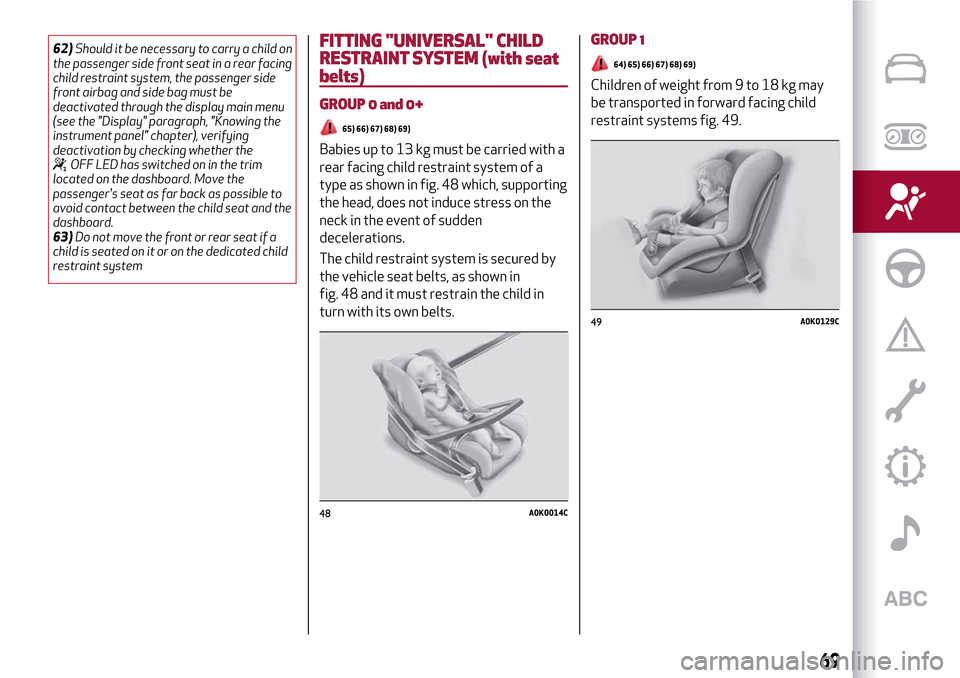
Babies up to 13 kg must be carried with a
rear facing child restraint system of a
type as shown in fig. 48 which, supporting
the head, does not induce stress on the
neck in the event of sudden
decelerations.
The child restraint system is secured by
the vehicle seat belts, as shown in
fig. 48 and it must restrain the child in
turn with its own belts.
GROUP 1
64) 65) 66) 67) 68) 69)
Children of weight from 9 to 18 kg may
be transported in forward facing child
restraint systems fig. 49.
48A0K0014C
49A0K0129C
69
Page 73 of 212
PASSENGER SEAT COMPLIANCE WITH REGULATIONS ON UNIVERSAL CHILD RESTRAINTSYSTEM USE
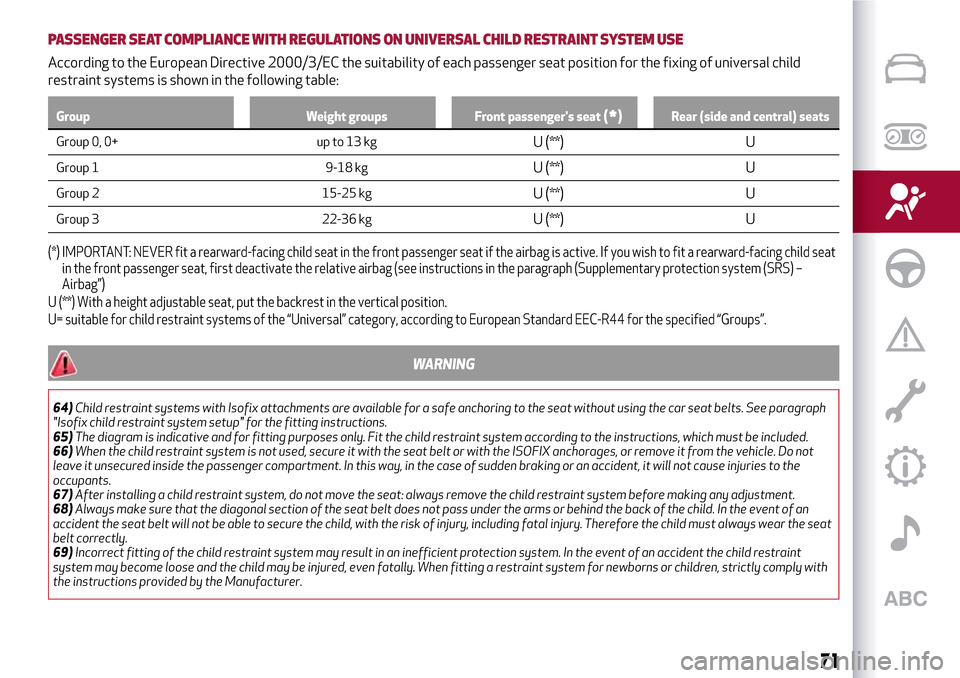
According to the European Directive 2000/3/EC the suitability of each passenger seat position for the fixing of universal child
restraint systems is shown in the following table:
Group Weight groups Front passenger's seat(*)Rear (side and central) seats
Group 0, 0+ up to 13 kgU (**) U
Group 1 9-18 kgU (**) U
Group 2 15-25 kgU (**) U
Group 3 22-36 kgU (**) U
(*) IMPORTANT: NEVER fit a rearward-facing child seat in the front passenger seat if the airbag is active. If you wish to fit a rearward-facing child seat
in the front passenger seat, first deactivate the relative airbag (see instructions in the paragraph (Supplementary protection system (SRS) –
Airbag”)
U (**) With a height adjustable seat, put the backrest in the vertical position.
U= suitable for child restraint systems of the “Universal” category, according to European Standard EEC-R44 for the specified “Groups”.
WARNING
64)Child restraint systems with Isofix attachments are available for a safe anchoring to the seat without using the car seat belts. See paragraph
"Isofix child restraint system setup" for the fitting instructions.
65)The diagram is indicative and for fitting purposes only. Fit the child restraint system according to the instructions, which must be included.
66)When the child restraint system is not used, secure it with the seat belt or with the ISOFIX anchorages, or remove it from the vehicle. Do not
leave it unsecured inside the passenger compartment. In this way, in the case of sudden braking or an accident, it will not cause injuries to the
occupants.
67)After installing a child restraint system, do not move the seat: always remove the child restraint system before making any adjustment.
68)Always make sure that the diagonal section of the seat belt does not pass under the arms or behind the back of the child. In the event of an
accident the seat belt will not be able to secure the child, with the risk of injury, including fatal injury. Therefore the child must always wear the seat
belt correctly.
69)Incorrect fitting of the child restraint system may result in an inefficient protection system. In the event of an accident the child restraint
system may become loose and the child may be injured, even fatally. When fitting a restraint system for newborns or children, strictly comply with
the instructions provided by the Manufacturer.
71
Page 74 of 212
ISOFIX CHILD RESTRAINT
SYSTEM SETUP
The vehicle is equipped with ISOFIX
anchorages, a new standard which makes
fitting a child restraint system quick,
simple and safe.
Traditional child restraint systems can be
fitted alongside Isofix child restraint
systems on different seats in the same
car.
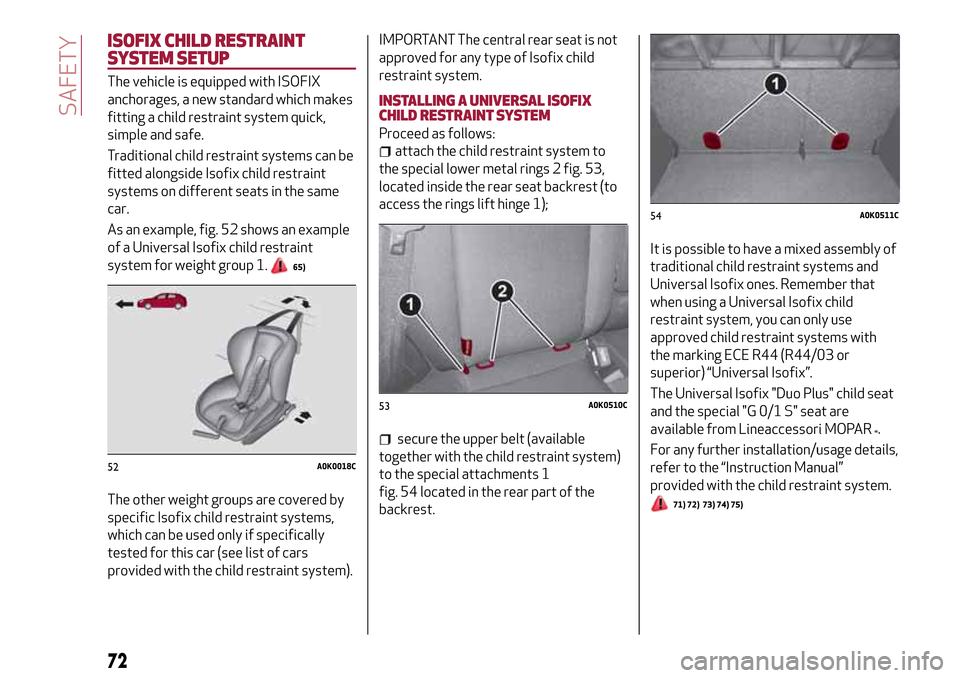
As an example, fig. 52 shows an example
of a Universal Isofix child restraint
system for weight group 1.
65)
The other weight groups are covered by
specific Isofix child restraint systems,
which can be used only if specifically
tested for this car (see list of cars
provided with the child restraint system).
IMPORTANT The central rear seat is not
approved for any type of Isofix child
restraint system.
INSTALLING A UNIVERSAL ISOFIX
CHILD RESTRAINTSYSTEM
Proceed as follows:
attach the child restraint system to
the special lower metal rings 2 fig. 53,
located inside the rear seat backrest (to
access the rings lift hinge 1);
secure the upper belt (available
together with the child restraint system)
to the special attachments 1
fig. 54 located in the rear part of the
backrest.It is possible to have a mixed assembly of
traditional child restraint systems and
Universal Isofix ones. Remember that
when using a Universal Isofix child
restraint system, you can only use
approved child restraint systems with
the marking ECE R44 (R44/03 or
superior) “Universal Isofix”.
The Universal Isofix "Duo Plus" child seat
and the special "G 0/1 S" seat are
available from Lineaccessori MOPAR®.
For any further installation/usage details,
refer to the “Instruction Manual”
provided with the child restraint system.
71) 72) 73) 74) 75)
52A0K0018C
53A0K0510C
54A0K0511C
72
SAFETY
Page 75 of 212
SUITABILITY OF PASSENGER SEATS FOR ISOFIX CHILD RESTRAINTSYSTEM USE
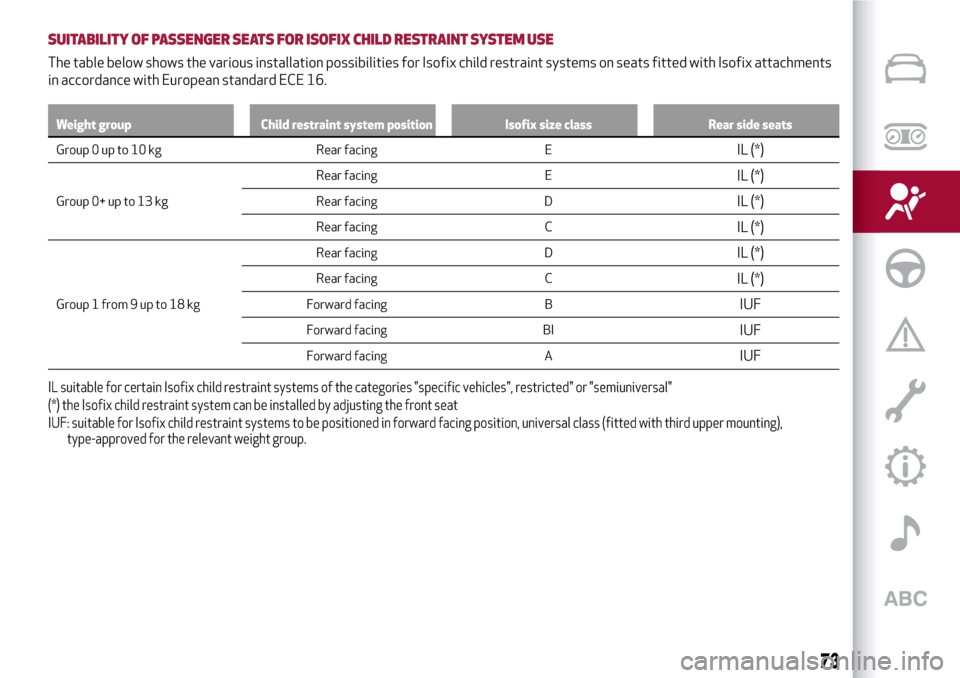
The table below shows the various installation possibilities for Isofix child restraint systems on seats fitted with Isofix attachments
in accordance with European standard ECE 16.
Weight group Child restraint system position Isofix size class Rear side seats
Group 0 up to 10 kg Rear facing EIL (*)
Group 0+ up to 13 kgRear facing E
IL (*)
Rear facing DIL (*)
Rear facing CIL (*)
Group 1 from 9 up to 18 kgRear facing D
IL (*)
Rear facing CIL (*)
Forward facing BIUF
Forward facing BIIUF
Forward facing AIUF
IL suitable for certain Isofix child restraint systems of the categories "specific vehicles", restricted" or "semiuniversal"
(*) the Isofix child restraint system can be installed by adjusting the front seat
IUF: suitable for Isofix child restraint systems to be positioned in forward facing position, universal class (fitted with third upper mounting),
type-approved for the relevant weight group.
73
Page 94 of 212
TOWING TRAILERS
IMPORTANT NOTES
The car must be provided with a
type-approved tow hook and adequate
electric system to tow caravans or
trailers. Installation must be carried out
by a specialist.
Install any specific and/or additional door
mirrors as specified by the Highway
Code.
Remember that when towing a trailer,
steep hills are harder to climb, the
braking spaces increase and overtaking
takes longer depending on the overall
weight.
Engage a low gear when driving downhill,
rather than constantly using the brake.
The weight of the trailer reduces the load
capacity of the car by the same amount.
Consider the weight at full load, including
accessories and luggage, to make sure
you do not exceed the maximum towable
weight (shown in the registration
document).
Do not exceed the speed limits specific
to each country you are driving in, in the
case of vehicles towing trailers. In any
case do not exceed 100 km/h.
INSTALLING A TOW HOOK
Contact an Alfa Romeo Dealership to
install a tow hook.
105) 106)
WARNING
105)The ABS with which the car is equipped
will not control the braking system of the
trailer. Particular caution is therefore
required on slippery roads.
106)Do not, under any circumstances,
modify the vehicle's braking system to
control the trailer breaking system. The
towing braking system must be completely
independent of the vehicle's hydraulic
system.
REFUELLING THE CAR
Stop the engine before refuelling.
PETROL ENGINES
Only use unleaded petrol 95 R.O.N.
compliant with the European
specification EN228. The petrol octane
rating (RON) must not be lower than 95.
In order to prevent damage to the
catalytic converter never introduce even
the smallest amount of leaded petrol,
even in the event of an emergency.
DIESEL ENGINES
Only use diesel fuel compliant with
European specification EN590. The use
of other products or mixtures may
damage the engine beyond repair and
consequently invalidate the warranty,
due to the damage caused.
Operation at low temperatures
If the outside temperature is very low,
diesel thickens due to the formation of
paraffin clots with consequent defective
operation of the fuel supply system.
In order to avoid these problems,
different types of Diesel are distributed
according to the season: summer type,
winter type and arctic type (cold,
mountain areas).
If refuelling with diesel whose
specifications are not suitable for the
usage temperature, it is advisable to mix
92
STARTING AND DRIVING
Page 112 of 212

CHANGING A WHEEL
JACK
117) 118) 119) 120) 121) 122)
Please note that:
the jack weight is 1.76 kg;
the jack requires no adjustment;
the jack cannot be repaired and in the
event of a fault it must be replaced by
another genuine one;
no tool other than its cranking device
may be fitted on the jack.
Jack maintenance:
prevent any dirt from depositing on
the "worm screw";
keep the "worm screw" lubricated;
never modify the jack.
Conditions in which not to use the jack:
temperature below -40°C
on sandy or muddy ground
on uneven ground
on steep roads
in extreme weather conditions:
thunderstorms, typhoons, hurricanes,
blizzards, storms, etc.
in direct contact with the engine or to
carry out repairs under the vehicle
on boats.
To change a wheel, proceed as follows:
stop the car in a position that is not
dangerous for oncoming traffic where
you can change the wheel safely.The ground must be flat and sufficiently
compact;
switch off the engine, pull up the
handbrake and engage the 1stgear or
reverse. Wear the reflective safety jacket
(compulsory by law) before getting out of
the vehicle;
open the luggage compartment, lift
the mat using the tab provided;
using wrench 1 fig. 90 located in the
tool box, loosen the locking device, take
the tool box 2 and place it close to the
wheel to be replaced, then take the
space-saver wheel 3;
take the wrench 1 fig. 91 and loosen
the fixing bolts by about one turn. For
versions with alloy rims, shake the car to
facilitate detachment of the rim from the
wheel hub;
position the jack under the car, near
the wheel to be changed. On versions
where this is fitted, be careful not to
damage the plastic aerodynamic guard;
operate the device 1 fig. 92 so as to
raise the jack, until the upper part is
correctly inserted in the side member at
the point indicated by the arrow
fig. 92. The lifting points 3 are shown
in fig. 93.
90A0K0649C
91A0K0650C
92A0K0651C
110
IN AN EMERGENCY
Page 145 of 212
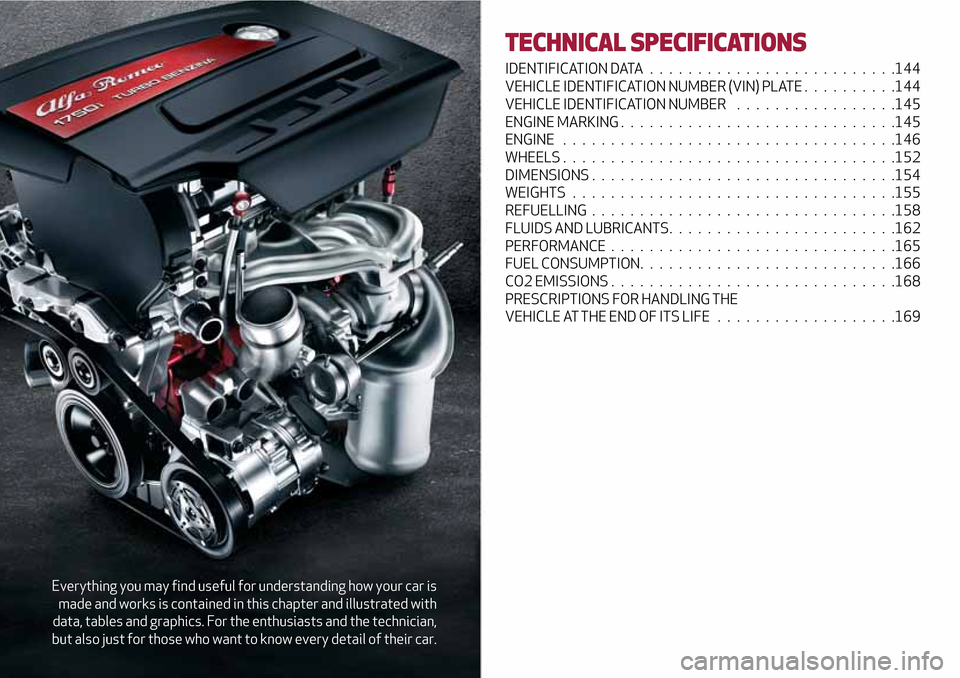
Everything you may find useful for understanding how your car is
made and works is contained in this chapter and illustrated with
data, tables and graphics. For the enthusiasts and the technician,
but also just for those who want to know every detail of their car.
TECHNICAL SPECIFICATIONS
IDENTIFICATION DATA..........................144
VEHICLE IDENTIFICATION NUMBER (VIN) PLATE..........144
VEHICLE IDENTIFICATION NUMBER.................145
ENGINE MARKING.............................145
ENGINE...................................146
WHEELS...................................152
DIMENSIONS................................154
WEIGHTS..................................155
REFUELLING................................158
FLUIDS AND LUBRICANTS........................162
PERFORMANCE..............................165
FUEL CONSUMPTION...........................166
CO2 EMISSIONS..............................168
PRESCRIPTIONS FOR HANDLING THE
VEHICLE AT THE END OF ITS LIFE...................169
Page 146 of 212
IDENTIFICATION DATA
The identification data of the vehicle are:
VIN plate;
Chassis marking;
Bodywork paint identification plate;
Engine marking.
VEHICLE IDENTIFICATION
NUMBER (VIN) PLATE
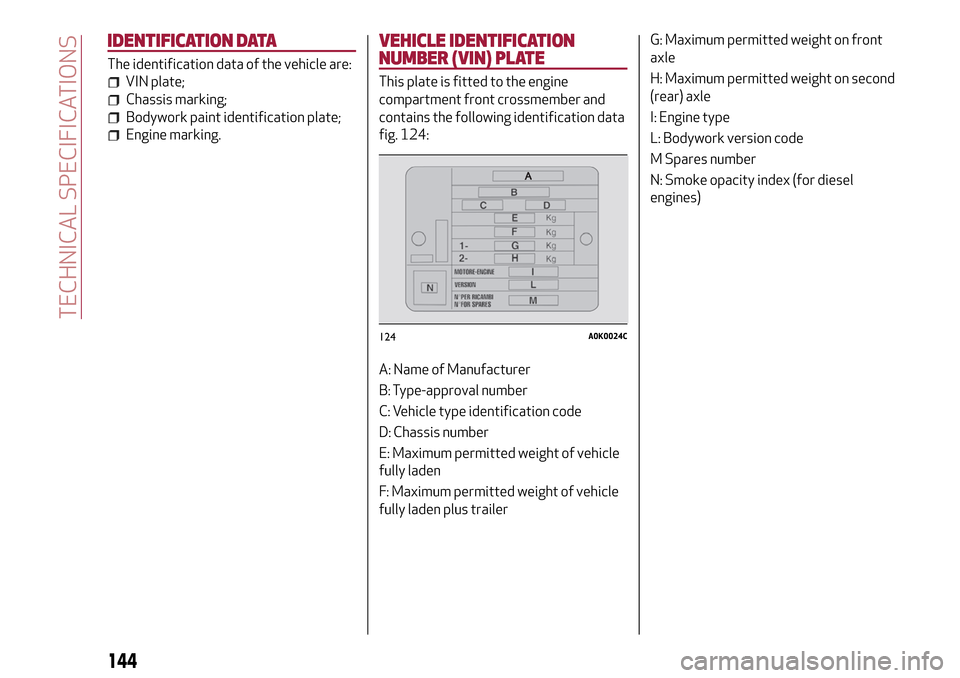
This plate is fitted to the engine
compartment front crossmember and
contains the following identification data
fig. 124:
B: Type-approval number
C: Vehicle type identification code
D: Chassis number
E: Maximum permitted weight of vehicle
fully laden
F: Maximum permitted weight of vehicle
fully laden plus trailerG: Maximum permitted weight on front
axle
H: Maximum permitted weight on second
(rear) axle
I: Engine type
L: Bodywork version code
M Spares number
N: Smoke opacity index (for diesel
engines)
124A0K0024C
144
TECHNICAL SPECIFICATIONS
A: Name of Manufacturer