headlight Alfa Romeo MiTo 2014 User Guide
[x] Cancel search | Manufacturer: ALFA ROMEO, Model Year: 2014, Model line: MiTo, Model: Alfa Romeo MiTo 2014Pages: 280, PDF Size: 8.79 MB
Page 159 of 280
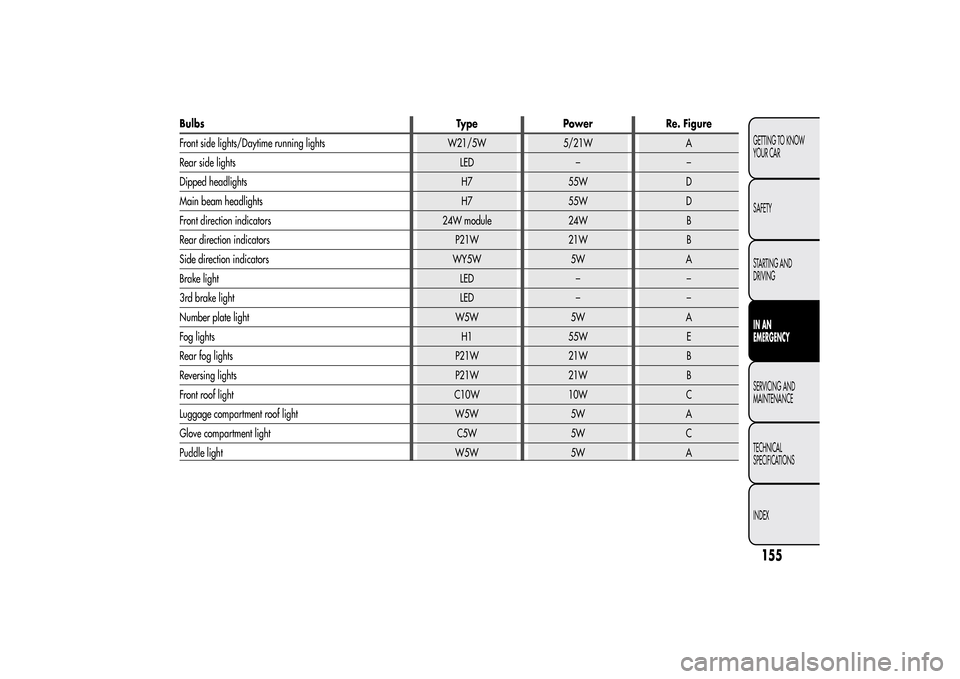
Bulbs Type Power Re. Figure
Front side lights/Daytime running lights W21/5W 5/21W A
Rear side lights LED – –
Dipped headlights H7 55W D
Main beam headlights H7 55W D
Front direction indicators 24W module 24W B
Rear direction indicators P21W 21W B
Side direction indicators WY5W 5W A
Brake light LED – –
3rd brake light LED – –
Number plate light W5W 5W A
Fog lights H1 55W E
Rear fog lights P21W 21W B
Reversing lights P21W 21W B
Front roof light C10W 10W C
Luggage compartment roof light W5W 5W A
Glove compartment light C5W 5W C
Puddle light W5W 5W A
155GETTING TO KNOW
YOUR CAR
SAFETY
STARTING AND
DRIVINGIN AN
EMERGENCYSERVICING AND
MAINTENANCE
TECHNICAL
SPECIFICATIONS
INDEX
Page 160 of 280
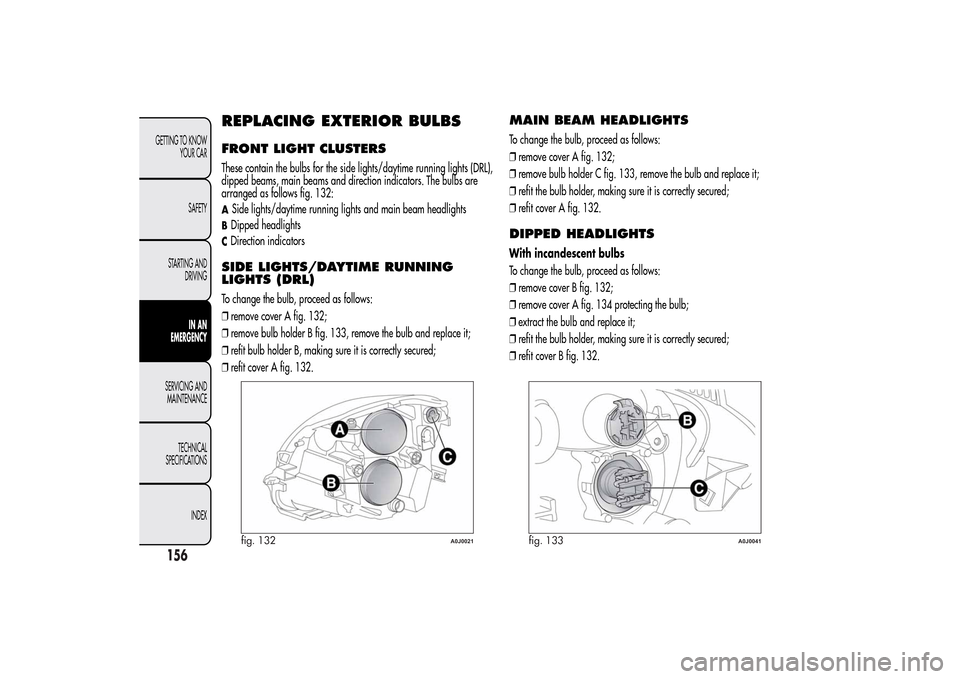
REPLACING EXTERIOR BULBSFRONT LIGHT CLUSTERSThese contain the bulbs for the side lights/daytime running lights (DRL),
dipped beams, main beams and direction indicators. The bulbs are
arranged as follows fig. 132:ASide lights/daytime running lights and main beam headlightsBDipped headlightsCDirection indicatorsSIDE LIGHTS/DAYTIME RUNNING
LIGHTS (DRL)To change the bulb, proceed as follows:
❒remove cover A fig. 132;
❒remove bulb holder B fig. 133, remove the bulb and replace it;
❒refit bulb holder B, making sure it is correctly secured;
❒refit cover A fig. 132.
MAIN BEAM HEADLIGHTSTo change the bulb, proceed as follows:
❒remove cover A fig. 132;
❒remove bulb holder C fig. 133, remove the bulb and replace it;
❒refit the bulb holder, making sure it is correctly secured;
❒refit cover A fig. 132.DIPPED HEADLIGHTSWith incandescent bulbs
To change the bulb, proceed as follows:
❒remove cover B fig. 132;
❒remove cover A fig. 134 protecting the bulb;
❒extract the bulb and replace it;
❒refit the bulb holder, making sure it is correctly secured;
❒refit cover B fig. 132.
fig. 132
A0J0021
fig. 133
A0J0041
156GETTING TO KNOW
YOUR CAR
SAFETY
STARTING AND
DRIVING
IN AN
EMERGENCY
SERVICING AND
MAINTENANCE
TECHNICAL
SPECIFICATIONS
INDEX
Page 171 of 280
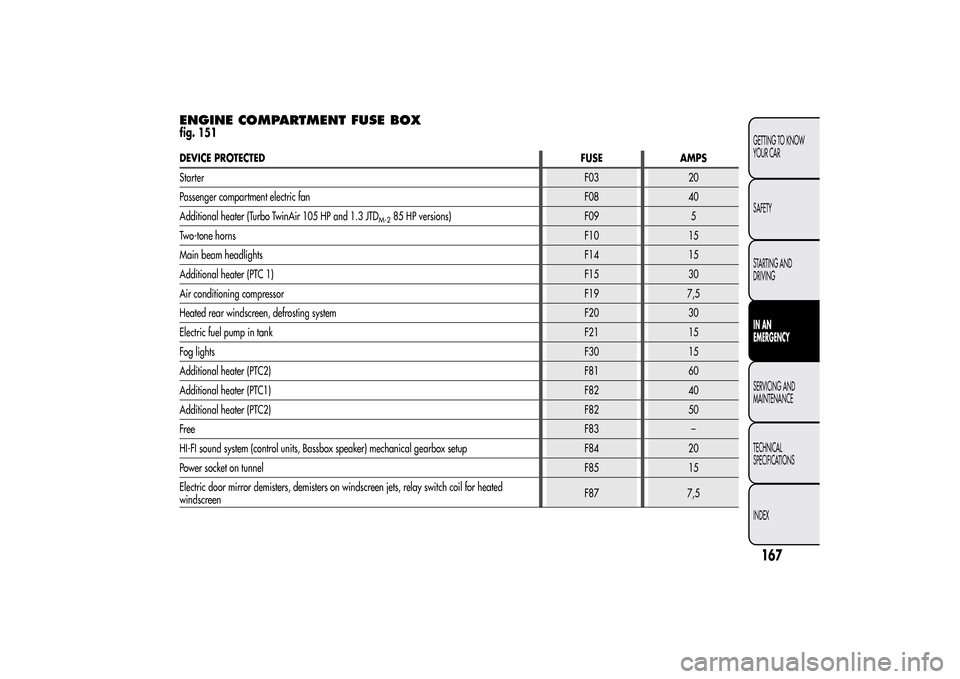
ENGINE COMPARTMENT FUSE BOXfig. 151DEVICE PROTECTEDFUSE AMPS
StarterF03 20
Passenger compartment electric fan F08 40
Additional heater (Turbo TwinAir 105 HP and 1.3 JTD
M-2
85 HP versions) F09 5
Two-tone hornsF10 15
Main beam headlightsF14 15
Additional heater (PTC 1)F15 30
Air conditioning compressorF19 7,5
Heated rear windscreen, defrosting system F20 30
Electric fuel pump in tankF21 15
Fog lightsF30 15
Additional heater (PTC2)F81 60
Additional heater (PTC1)F82 40
Additional heater (PTC2)F82 50
FreeF83 –
HI-FI sound system (control units, Bassbox speaker) mechanical gearbox setup F84 20
Power socket on tunnelF85 15
Electric door mirror demisters, demisters on windscreen jets, relay switch coil for heated
windscreenF87 7,5
167GETTING TO KNOW
YOUR CAR
SAFETY
STARTING AND
DRIVINGIN AN
EMERGENCYSERVICING AND
MAINTENANCE
TECHNICAL
SPECIFICATIONS
INDEX
Page 172 of 280
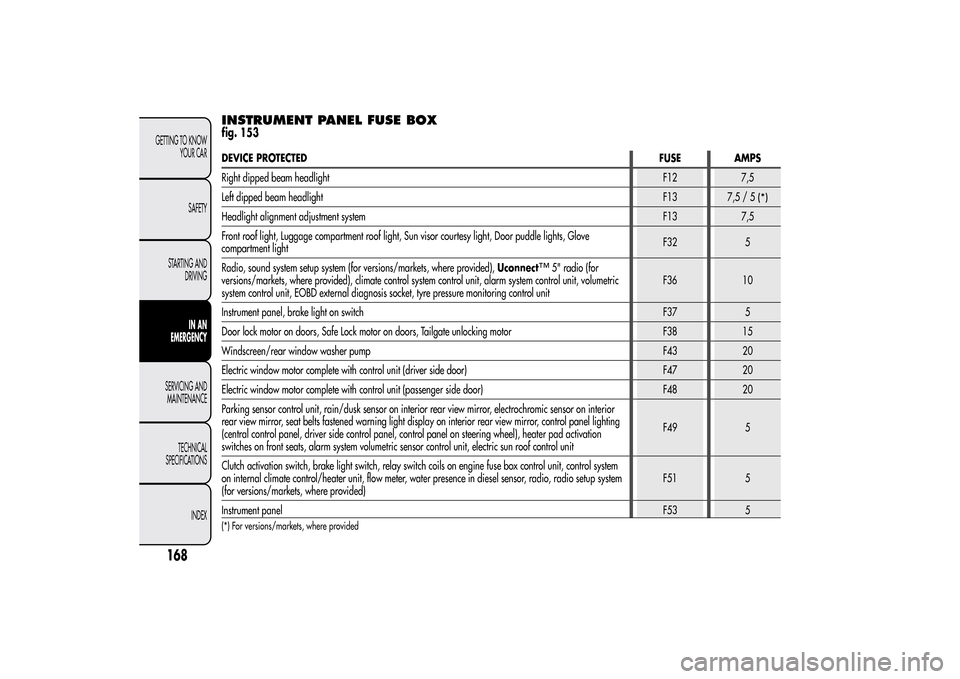
INSTRUMENT PANEL FUSE BOXfig. 153DEVICE PROTECTEDFUSE AMPS
Right dipped beam headlightF12 7,5
Left dipped beam headlightF13
7,5/5
(*)
Headlight alignment adjustment systemF13 7,5
Front roof light, Luggage compartment roof light, Sun visor courtesy light, Door puddle lights, Glove
compartment lightF32 5
Radio, sound system setup system (for versions/markets, where provided),Uconnect
™
5" radio (for
versions/markets, where provided), climate control system control unit, alarm system control unit, volumetric
system control unit, EOBD external diagnosis socket, tyre pressure monitoring control unitF36 10
Instrument panel, brake light on switchF37 5
Door lock motor on doors, Safe Lock motor on doors, Tailgate unlocking motor F38 15
Windscreen/rear window washer pumpF43 20
Electric window motor complete with control unit (driver side door) F47 20
Electric window motor complete with control unit (passenger side door) F48 20
Parking sensor control unit, rain/dusk sensor on interior rear view mirror, electrochromic sensor on interior
rear view mirror, seat belts fastened warning light display on interior rear view mirror, control panel lighting
(central control panel, driver side control panel, control panel on steering wheel), heater pad activation
switches on front seats, alarm system volumetric sensor control unit, electric sun roof control unitF49 5
Clutch activation switch, brake light switch, relay switch coils on engine fuse box control unit, control system
on internal climate control/heater unit, flow meter, water presence in diesel sensor, radio, radio setup system
(for versions/markets, where provided)F51 5
Instrument panelF53 5
(*) For versions/markets, where provided
168GETTING TO KNOW
YOUR CAR
SAFETY
STARTING AND
DRIVING
IN AN
EMERGENCY
SERVICING AND
MAINTENANCE
TECHNICAL
SPECIFICATIONS
INDEX
Page 196 of 280
SPRAY NOZZLESWindscreen washer
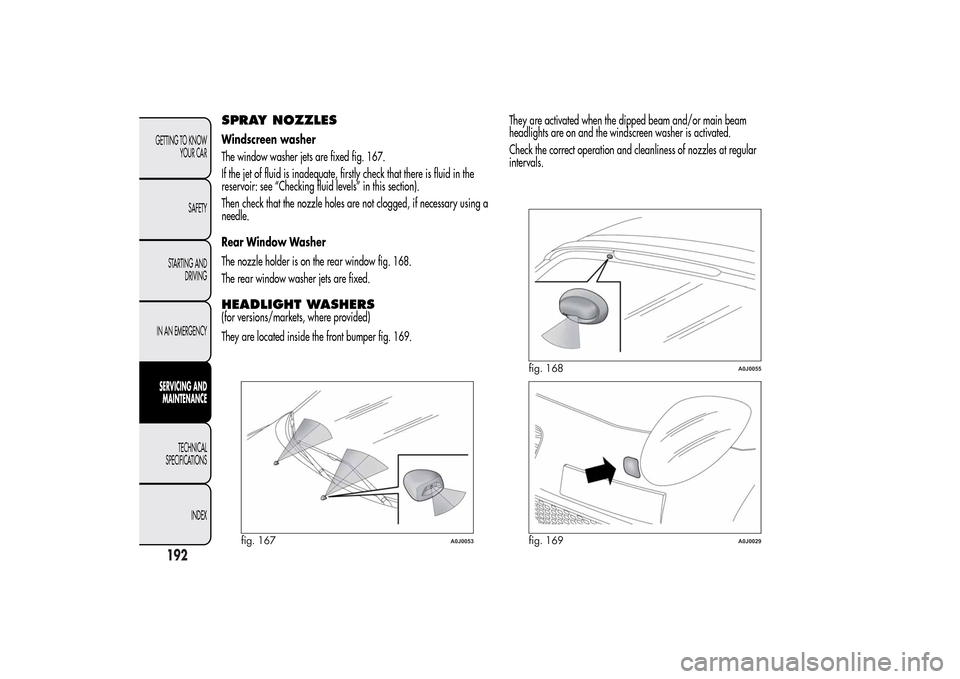
The window washer jets are fixed fig. 167.
If the jet of fluid is inadequate, firstly check that there is fluid in the
reservoir: see “Checking fluid levels” in this section).
Then check that the nozzle holes are not clogged, if necessary using a
needle.
Rear Window Washer
The nozzle holder is on the rear window fig. 168.
The rear window washer jets are fixed.HEADLIGHT WASHERS(for versions/markets, where provided)
They are located inside the front bumper fig. 169.They are activated when the dipped beam and/or main beam
headlights are on and the windscreen washer is activated.
Check the correct operation and cleanliness of nozzles at regular
intervals.
fig. 167
A0J0053
fig. 168
A0J0055
fig. 169
A0J0029
192GETTING TO KNOW
YOUR CAR
SAFETY
STARTING AND
DRIVING
IN AN EMERGENCYSERVICING AND
MAINTENANCE
TECHNICAL
SPECIFICATIONS
INDEX
Page 197 of 280
BODYWORKPROTECTION AGAINST ATMOSPHERIC
AGENTSThe car is equipped with the best available technological solutions to
effectively protect the bodywork against corrosion.
These are the most important:
❒painting products and systems which give the car resistance to
corrosion and abrasion
❒use of galvanised (or pretreated) steel sheets, with high resistance to
corrosion;
❒spraying of plastic parts, with a protective function in the more
exposed points: underdoor, inner wing, edges, etc;
❒use of “open” boxed sections to prevent condensation and pockets of
moisture which could favour the formation of rust inside;
❒use of special films to protect against abrasion in exposed areas
(e.g. rear wing, doors, etc.).BODY AND UNDERBODY WARRANTYThe car is covered by warranty against perforation due to corrosion of
any original element of the structure or body. For the general terms
of this warranty, refer to the Warranty Booklet.PRESERVING THE BODYWORKPaint
Touch up abrasions and scratches immediately to prevent the formation
of rust.Maintenance of paintwork consists of washing the car: the frequency
depends on the conditions and environment where the car is used. For
example, it is advisable to wash the car more often in areas with
high levels of atmospheric pollution or salted roads.
To correctly wash the car, follow these instruction:
❒remove the aerial from the roof when using a carwash;
❒if high pressure jets or cleaners are used to wash the car, maintain a
distance of at least 40 cm from the bodywork to avoid damage or
alteration. Bear in mind that a build up of water could cause
damage to the car in the long term.
❒wash the body using a low pressure jet of water;
❒wipe a sponge with a slightly soapy solution over the bodywork,
frequently rinsing the sponge;
❒rinse well with water and dry with a jet of air or a chamois leather.
Dry the less visible parts (e.g. door frames, bonnet, headlight frames
etc.) with special care, as water may stagnate more easily in these
areas. Do not wash the car after it has been left in the sun or with the
bonnet hot: this may alter the shine of the paintwork.
Exterior plastic parts must be cleaned in the same way as the rest of
the car.
Detergents pollute the environment. Only wash your car in
areas equipped to collect and treat wastewater from this
type of activity.In order to preserve the aesthetic properties of the
paintwork, abrasive products and/or polishes should not
be used to clean the car.
193GETTING TO KNOW
YOUR CAR
SAFETY
STARTING AND
DRIVING
IN AN EMERGENCYSERVICING AND
MAINTENANCETECHNICAL
SPECIFICATIONS
INDEX
Page 198 of 280
IMPORTANT
Avoid parking under trees; the resin dropped by trees makes the
paintwork go opaque and increases the possibility of corrosion.
Bird droppings must be washed off immediately and thoroughly as the
acid they contain is particularly aggressive.
Windows
Use specific detergents and clean cloths to prevent scratching or
altering the transparency.
IMPORTANT Wipe the inside surface of the rear window gently with a
cloth in the direction of the filaments to avoid damaging the heating
device.
Front headlights
Use a soft, damp cloth soaked in water and detergent for washing
cars.
IMPORTANT Never use aromatic substances (e.g. petrol) or ketenes
(e.g. acetone) for cleaning the plastic lenses of the front headlights.
IMPORTANT When cleaning the car with a pressure washer, keep the
water jet at least 20 cm away from the headlights.
Engine compartment
At the end of every winter, wash the engine compartment thoroughly,
taking care not to aim the jet of water directly at the electronic control
units or at the windscreen wiper motors. Have this operation
performed at a specialised workshop.
IMPORTANT The washing should take place with the engine cold and
the ignition key in the STOP position. After washing, make sure that the
various protective devices (e.g. rubber caps and guards) have not
been removed or damaged.
INTERIORSPeriodically check for water puddles under the mats that could cause
the panels to rust.
Never use flammable products, such as petrol ether or
rectified petrol to clean the inside of the car. The
electrostatic charges which are generated by rubbing
during the cleaning operation may cause a fire.Do not keep aerosol cans in the car: they might
explode. Aerosol cans must not be exposed to a
temperature exceeding 50°C. When the car is exposed
to sunlight, the internal temperature can greatly exceed this
value.
SEATS AND FABRIC PARTSRemove dust with a soft brush or a vacuum cleaner. It is advisable to
use a moist brush on velvet upholstery. Rub the seats with a sponge
soaked in a solution of neutral detergent and water.
194GETTING TO KNOW
YOUR CAR
SAFETY
STARTING AND
DRIVING
IN AN EMERGENCYSERVICING AND
MAINTENANCE
TECHNICAL
SPECIFICATIONS
INDEX
Page 225 of 280
REFUELLING
221GETTING TO KNOW
YOUR CAR
SAFETY
STARTING AND
DRIVING
IN AN EMERGENCY
SERVICING AND
MAINTENANCETECHNICAL
SPECIFICATIONSINDEX
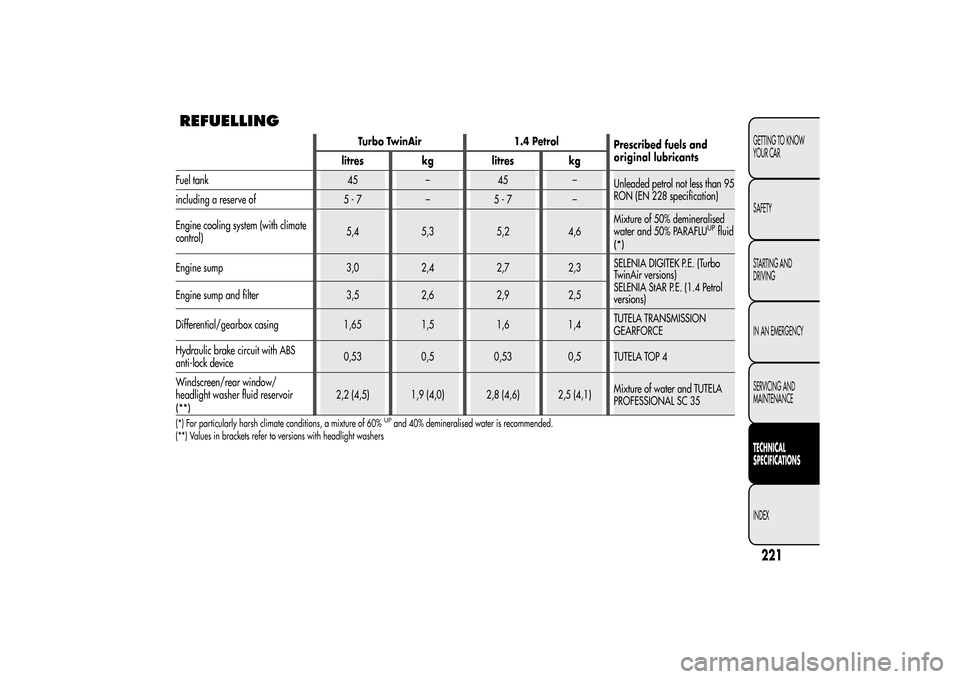
Turbo TwinAir 1.4 Petrol
Prescribed fuels and
litres kg litres kg
Fuel tank 45 – 45 –
Unleaded petrol not less than 95
RON (EN 228 specification)
including a reserve of 5 - 7 – 5 - 7 –
Engine cooling system (with climate
control)5,4 5,3 5,2 4,6Mixture of 50% demineralised
water and 50% PARAFLU
UPfluid
(*)
Engine sump 3,0 2,4 2,7 2,3SELENIA DIGITEK P.E. (Turbo
TwinAir versions)
SELENIA StAR P.E. (1.4 Petrol
versions) Engine sump and filter 3,5 2,6 2,9 2,5
Differential/gearbox casing 1,65 1,5 1,6 1,4TUTELA TRANSMISSION
GEARFORCE
Hydraulic brake circuit with ABS
anti-lock device0,53 0,5 0,53 0,5 TUTELA TOP 4
Windscreen/rear window/
headlight washer fluid reservoir(**)
2,2 (4,5) 1,9 (4,0) 2,8 (4,6) 2,5 (4,1)Mixture of water and TUTELA
PROFESSIONAL SC 35
(*) For particularly harsh climate conditions, a mixture of 60%
UPand 40% demineralised water is recommended.
(**) Values in brackets refer to versions with headlight washers
originallubricants
Page 226 of 280
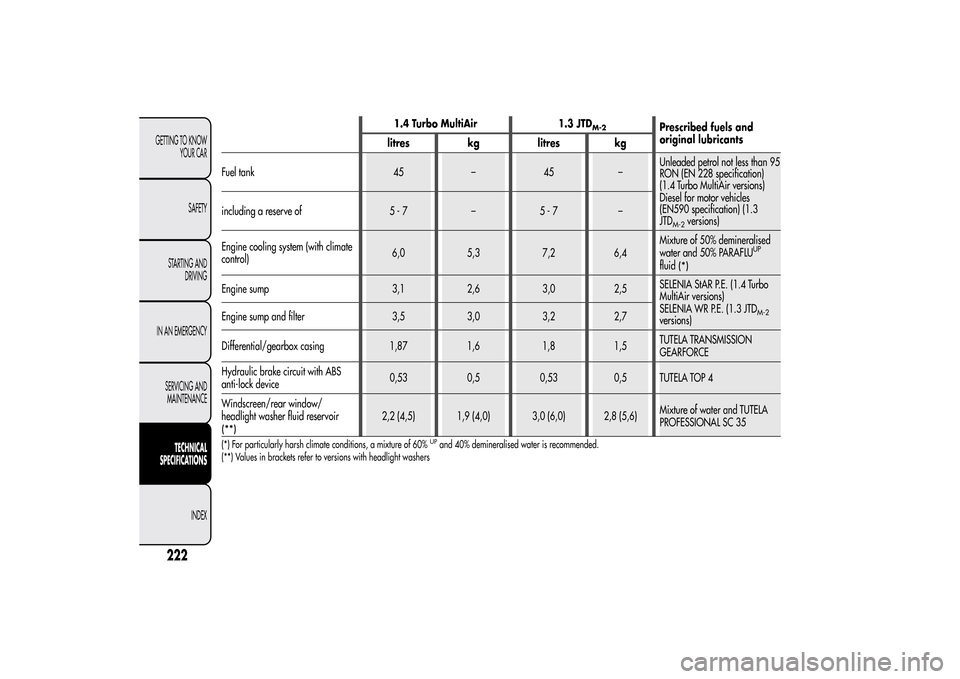
1.4 Turbo MultiAir 1.3 JTD
M-2
Prescribed fuels and
original lubricants
litres kg litres kg
Fuel tank 45 – 45 –Unleaded petrol not less than 95
RON (EN 228 specification)
(1.4 Turbo MultiAir versions)
Diesel for motor vehicles
(EN590 specification) (1.3
JTD
M-2
versions) including a reserve of 5 - 7 – 5 - 7 –
Engine cooling system (with climate
control)6,0 5,3 7,2 6,4Mixture of 50% demineralised
water and 50% PARAFLU
UP
fluid
(*)
Engine sump 3,1 2,6 3,0 2,5SELENIA StAR P.E. (1.4 Turbo
MultiAir versions)
SELENIA WR P.E. (1.3 JTD
M-2
versions) Engine sump and filter 3,5 3,0 3,2 2,7
Differential/gearbox casing 1,87 1,6 1,8 1,5TUTELA TRANSMISSION
GEARFORCE
Hydraulic brake circuit with ABS
anti-lock device0,53 0,5 0,53 0,5 TUTELA TOP 4
Windscreen/rear window/
headlight washer fluid reservoir
(**)
2,2 (4,5) 1,9 (4,0) 3,0 (6,0) 2,8 (5,6)Mixture of water and TUTELA
PROFESSIONAL SC 35
(*) For particularly harsh climate conditions, a mixture of 60%
UPand 40% demineralised water is recommended.
(**) Values in brackets refer to versions with headlight washers
222GETTING TO KNOW
YOUR CAR
SAFETY
STARTING AND
DRIVING
IN AN EMERGENCY
SERVICING AND
MAINTENANCE
TECHNICAL
SPECIFICATIONS
INDEX
Page 227 of 280
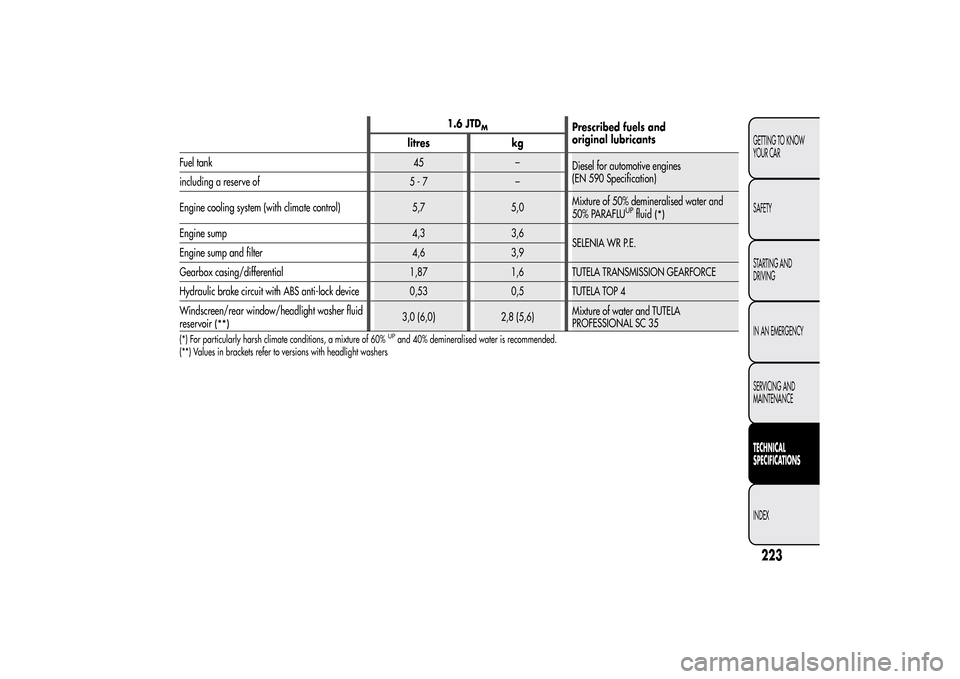
1.6 JTD
M
Prescribed fuels and
original lubricants
litres kg
Fuel tank 45 –
Diesel for automotive engines
(EN 590 Specification)
including a reserve of 5 - 7 –
Engine cooling system (with climate control) 5,7 5,0Mixture of 50% demineralised water and
50% PARAFLU
UPfluid
(*)
Engine sump 4,3 3,6
SELENIA WR P.E.
Engine sump and filter 4,6 3,9
Gearbox casing/differential 1,87 1,6 TUTELA TRANSMISSION GEARFORCE
Hydraulic brake circuit with ABS anti-lock device 0,53 0,5 TUTELA TOP 4
Windscreen/rear window/headlight washer fluid
reservoir
(**)
3,0 (6,0) 2,8 (5,6)Mixture of water and TUTELA
PROFESSIONAL SC 35
(*) For particularly harsh climate conditions, a mixture of 60%
UPand 40% demineralised water is recommended.
(**) Values in brackets refer to versions with headlight washers
223GETTING TO KNOW
YOUR CAR
SAFETY
STARTING AND
DRIVING
IN AN EMERGENCY
SERVICING AND
MAINTENANCETECHNICAL
SPECIFICATIONSINDEX