lock Alfa Romeo MiTo 2014 Owner's Guide
[x] Cancel search | Manufacturer: ALFA ROMEO, Model Year: 2014, Model line: MiTo, Model: Alfa Romeo MiTo 2014Pages: 280, PDF Size: 8.79 MB
Page 76 of 280
FOG LIGHTS(for versions/markets, where provided)
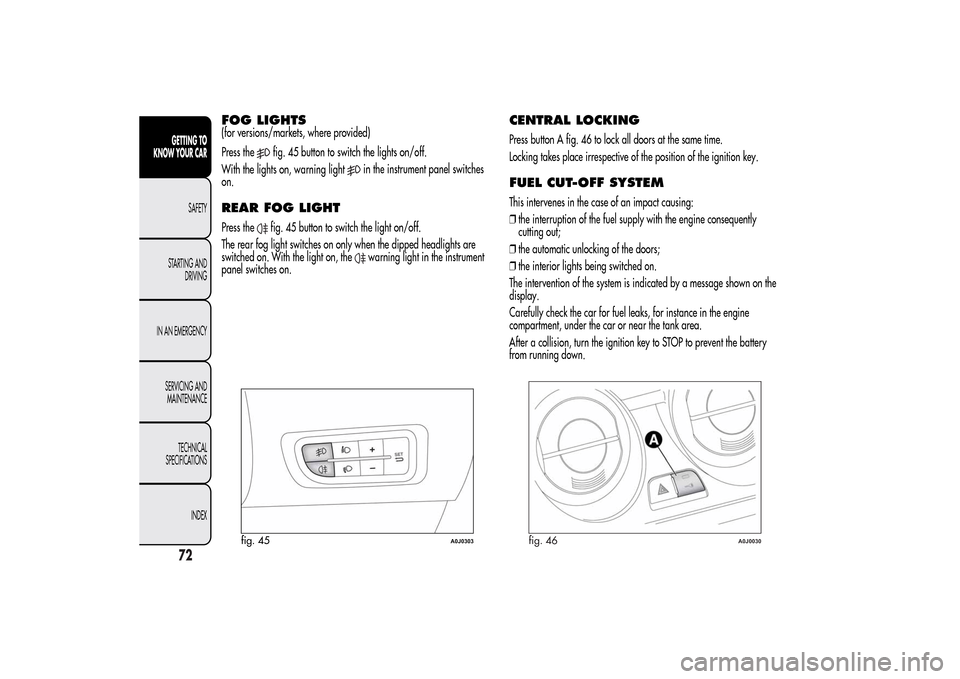
Press the
fig. 45 button to switch the lights on/off.
With the lights on, warning light
in the instrument panel switches
on.
REAR FOG LIGHTPress the
fig. 45 button to switch the light on/off.
The rear fog light switches on only when the dipped headlights are
switched on. With the light on, the
warning light in the instrument
panel switches on.
CENTRAL LOCKINGPress button A fig. 46 to lock all doors at the same time.
Locking takes place irrespective of the position of the ignition key.FUEL CUT-OFF SYSTEMThis intervenes in the case of an impact causing:
❒the interruption of the fuel supply with the engine consequently
cutting out;
❒the automatic unlocking of the doors;
❒the interior lights being switched on.
The intervention of the system is indicated by a message shown on the
display.
Carefully check the car for fuel leaks, for instance in the engine
compartment, under the car or near the tank area.
After a collision, turn the ignition key to STOP to prevent the battery
from running down.
fig. 45
A0J0303
fig. 46
A0J0030
72GETTING TO
KNOW YOUR CAR
SAFETY
STARTING AND
DRIVING
IN AN EMERGENCY
SERVICING AND
MAINTENANCE
TECHNICAL
SPECIFICATIONS
INDEX
Page 83 of 280
INITIALISATION PROCEDUREAfter the battery has been disconnected or a fuse has blown, the
operation of the sun roof must be initialised again.
Proceed as follows:
❒press button B fig. 54 until the roof is completely closed. Release the
button;
❒press B button and keep it pressed for at least 10 seconds and/or
until the glass panel clicks forwards. Release the button at this point;
❒within 5 seconds of the previous operation, press button B and hold
it down: the front glass panel will complete a full opening and
closing cycle. Only release the button at the end of this cycle.
MAINTENANCE/EMERGENCYIn the event of emergency or maintenance, the roof can be moved
manually when there is no power supply (opening/closing of the front
glass panel) by carrying out the following operations:
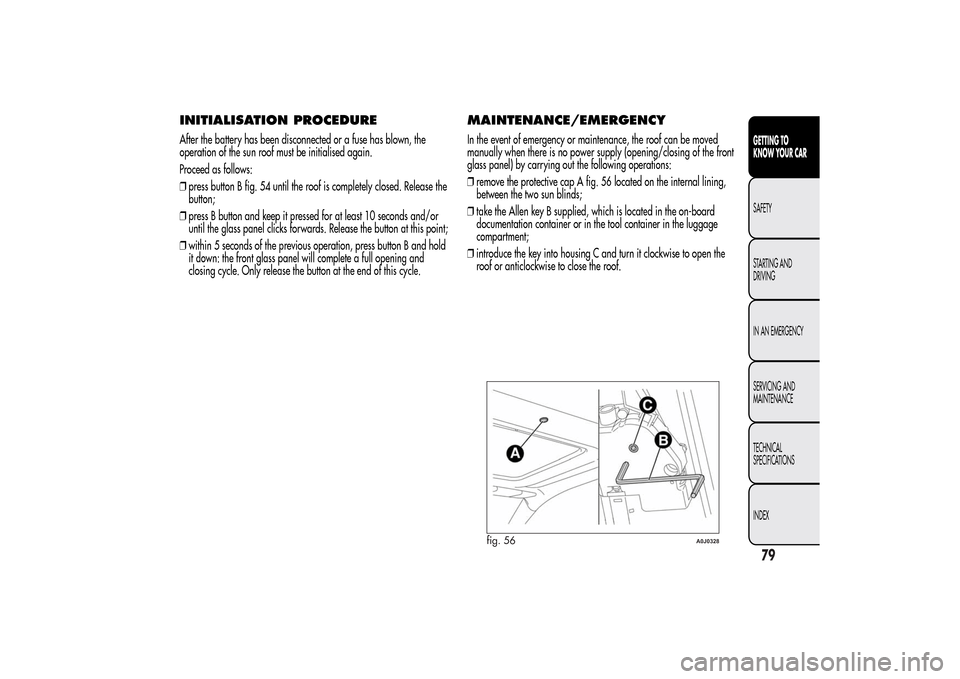
❒remove the protective cap A fig. 56 located on the internal lining,
between the two sun blinds;
❒take the Allen key B supplied, which is located in the on-board
documentation container or in the tool container in the luggage
compartment;
❒introduce the key into housing C and turn it clockwise to open the
roof or anticlockwise to close the roof.
fig. 56
A0J0328
79GETTING TO
KNOW YOUR CARSAFETY
STARTING AND
DRIVING
IN AN EMERGENCY
SERVICING AND
MAINTENANCE
TECHNICAL
SPECIFICATIONS
INDEX
Page 84 of 280
DOORSDOOR CENTRAL LOCKING/
UNLOCKINGLocking from the outside
With the doors closed, press the
button on the key or turn the metal
insert (located inside the key) in the driver side door lock.
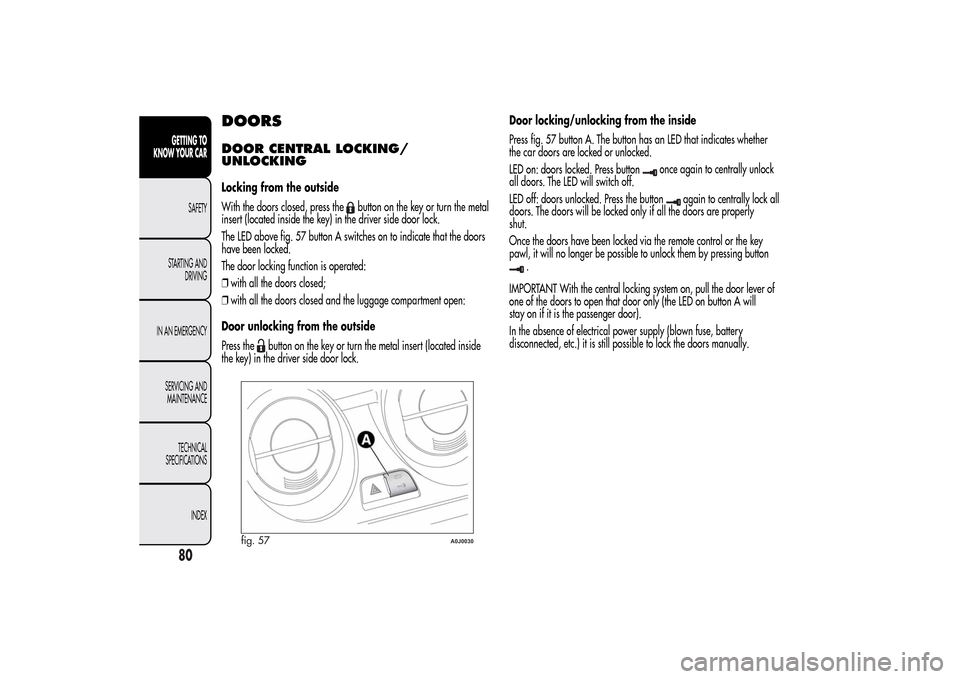
The LED above fig. 57 button A switches on to indicate that the doors
have been locked.
The door locking function is operated:
❒with all the doors closed;
❒with all the doors closed and the luggage compartment open:
Door unlocking from the outside
Press the
button on the key or turn the metal insert (located inside
the key) in the driver side door lock.Door locking/unlocking from the inside
Press fig. 57 button A. The button has an LED that indicates whether
the car doors are locked or unlocked.
LED on: doors locked. Press button
once again to centrally unlock
all doors. The LED will switch off.
LED off: doors unlocked. Press the button
again to centrally lock all
doors. The doors will be locked only if all the doors are properly
shut.
Once the doors have been locked via the remote control or the key
pawl, it will no longer be possible to unlock them by pressing button
.
IMPORTANT With the central locking system on, pull the door lever of
one of the doors to open that door only (the LED on button A will
stay on if it is the passenger door).
In the absence of electrical power supply (blown fuse, battery
disconnected, etc.) it is still possible to lock the doors manually.
fig. 57
A0J0030
80GETTING TO
KNOW YOUR CAR
SAFETY
STARTING AND
DRIVING
IN AN EMERGENCY
SERVICING AND
MAINTENANCE
TECHNICAL
SPECIFICATIONS
INDEX
Page 85 of 280
PASSENGER SIDE EMERGENCY FRONT
DOOR LOCKING DEVICEThe front passenger side door has a device to lock it when there is no
current.
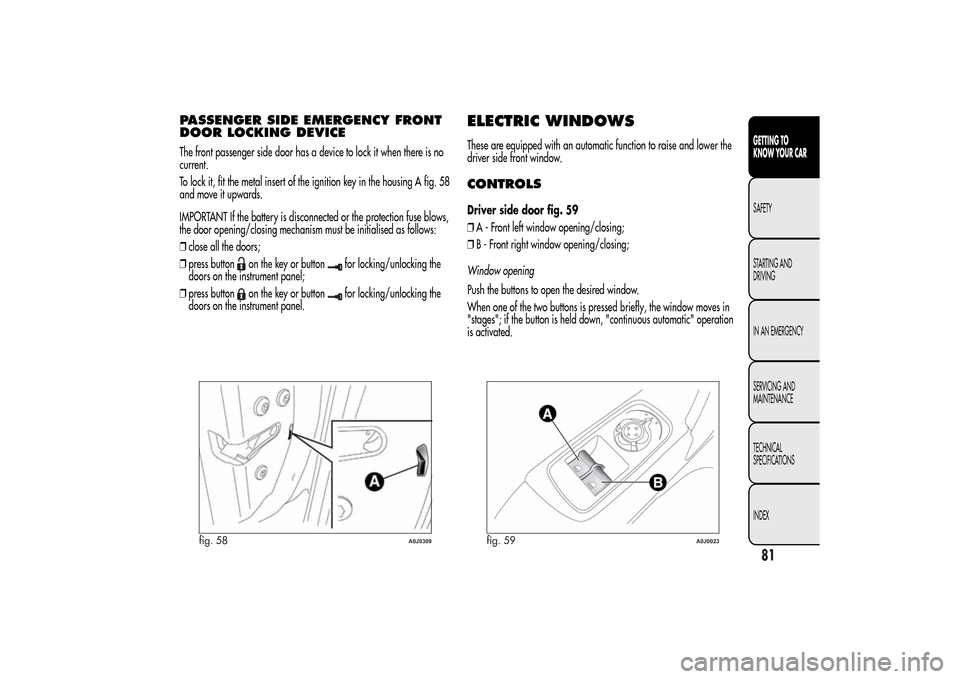
To lock it, fit the metal insert of the ignition key in the housing A fig. 58
and move it upwards.
IMPORTANT If the battery is disconnected or the protection fuse blows,
the door opening/closing mechanism must be initialised as follows:
❒close all the doors;
❒press button
on the key or button
for locking/unlocking the
doors on the instrument panel;
❒press button
on the key or button
for locking/unlocking the
doors on the instrument panel.
ELECTRIC WINDOWSThese are equipped with an automatic function to raise and lower the
driver side front window.CONTROLSDriver side door fig. 59
❒A - Front left window opening/closing;
❒B - Front right window opening/closing;
Window opening
Push the buttons to open the desired window.
When one of the two buttons is pressed briefly, the window moves in
"stages"; if the button is held down, "continuous automatic" operation
is activated.
fig. 58
A0J0309
fig. 59
A0J0023
81GETTING TO
KNOW YOUR CARSAFETY
STARTING AND
DRIVING
IN AN EMERGENCY
SERVICING AND
MAINTENANCE
TECHNICAL
SPECIFICATIONS
INDEX
Page 87 of 280
Incorrect use of the electric windows may be
dangerous. Before and during operation, always check
that no passenger is at risk of being injured directly
by the moving window or by objects getting caught in or
dragged by the window. When leaving the car, always remove
the key from the ignition to prevent accidental operation of the
electric windows from being a hazard for those still on board.
Electric window system initialisation
The system must be re-initialised after disconnecting the battery or if
the relevant protection fuse is blown.
Initialisation procedure:
❒fully close the window to initialise with manual operation;
❒after the window has reached the upper end of travel, hold down
the closing control for at least 1 second.
For versions/markets where provided, after a break in power supply
for the control units (battery replaced or disconnected or protective
fuses for the electric window control units replaced), the automatic
operation of the windows must be restored.
The restoration procedure must be performed as described below with
the doors closed:
❒completely open the driver's door window, holding the operating
button down for at least three seconds after the (lower) end of travel
position;
❒completely raise the driver side window and hold the button down
for at least 3 seconds once the (upper) end of travel position has
been reached;❒proceed in the same way as described in points 1 and 2 for the
passenger side door;
❒make sure that the initialisation is correct by checking that the
windows work automatically.
IMPORTANT With the central locking on, pulling the internal opening
lever for one of the doors switches the locking off for all the doors.
In the absence of electrical power supply (blown fuse, battery
disconnected, etc.) it is still possible to lock the doors manually. In this
case, the automatic lowering function of the windows is not available.
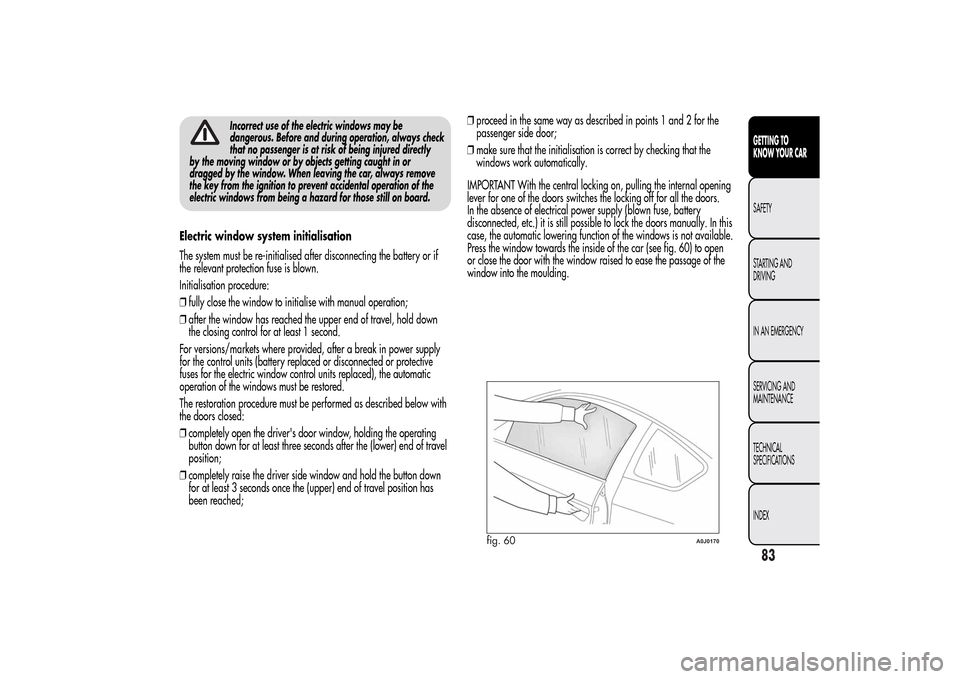
Press the window towards the inside of the car (see fig. 60) to open
or close the door with the window raised to ease the passage of the
window into the moulding.
fig. 60
A0J0170
83GETTING TO
KNOW YOUR CARSAFETY
STARTING AND
DRIVING
IN AN EMERGENCY
SERVICING AND
MAINTENANCE
TECHNICAL
SPECIFICATIONS
INDEX
Page 88 of 280
LUGGAGE COMPARTMENTThe luggage compartment is unlocked electrically and cannot be
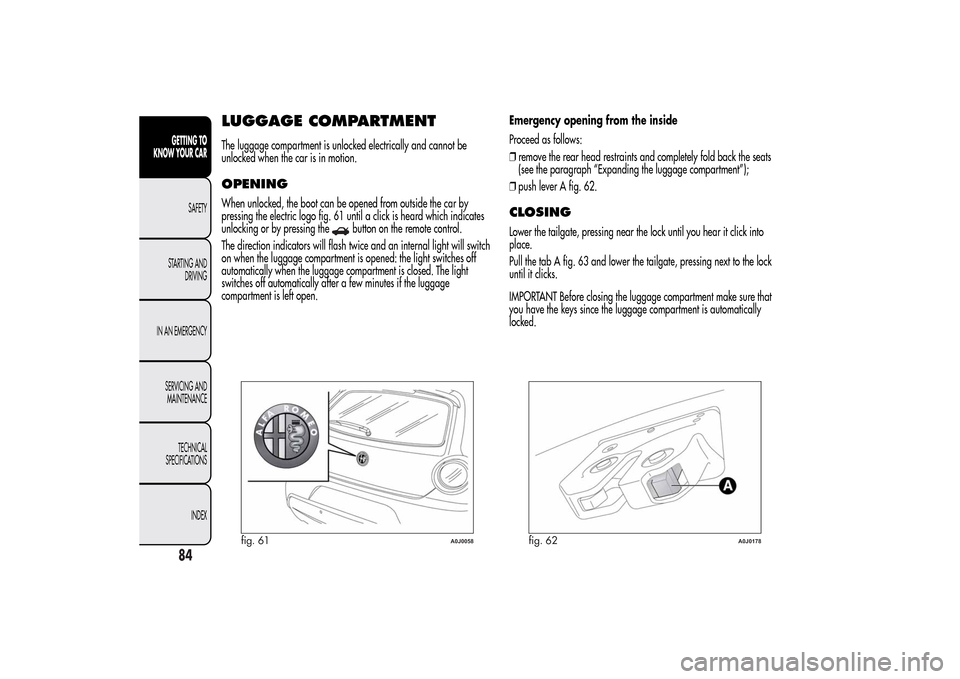
unlocked when the car is in motion.OPENINGWhen unlocked, the boot can be opened from outside the car by
pressing the electric logo fig. 61 until a click is heard which indicates
unlocking or by pressing the
button on the remote control.
The direction indicators will flash twice and an internal light will switch
on when the luggage compartment is opened: the light switches off
automatically when the luggage compartment is closed. The light
switches off automatically after a few minutes if the luggage
compartment is left open.Emergency opening from the inside
Proceed as follows:
❒remove the rear head restraints and completely fold back the seats
(see the paragraph “Expanding the luggage compartment”);
❒push lever A fig. 62.
CLOSINGLower the tailgate, pressing near the lock until you hear it click into
place.
Pull the tab A fig. 63 and lower the tailgate, pressing next to the lock
until it clicks.
IMPORTANT Before closing the luggage compartment make sure that
you have the keys since the luggage compartment is automatically
locked.
fig. 61
A0J0058
fig. 62
A0J0178
84GETTING TO
KNOW YOUR CAR
SAFETY
STARTING AND
DRIVING
IN AN EMERGENCY
SERVICING AND
MAINTENANCE
TECHNICAL
SPECIFICATIONS
INDEX
Page 90 of 280
Folding the seatsProceed as follows:
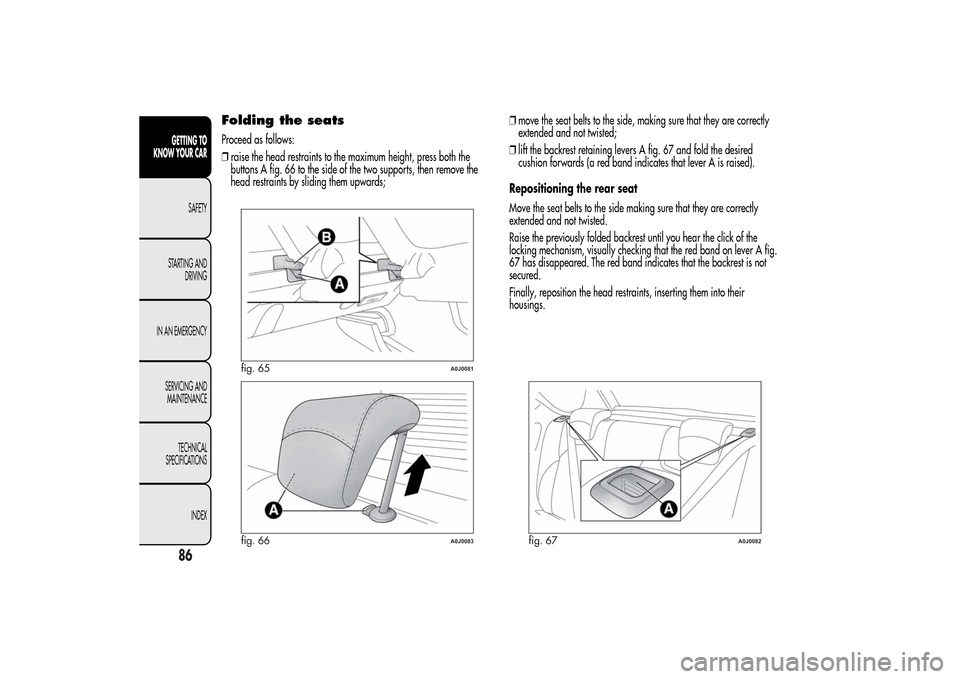
❒raise the head restraints to the maximum height, press both the
buttons A fig. 66 to the side of the two supports, then remove the
head restraints by sliding them upwards;❒move the seat belts to the side, making sure that they are correctly
extended and not twisted;
❒lift the backrest retaining levers A fig. 67 and fold the desired
cushion forwards (a red band indicates that lever A is raised).
Repositioning the rear seat
Move the seat belts to the side making sure that they are correctly
extended and not twisted.
Raise the previously folded backrest until you hear the click of the
locking mechanism, visually checking that the red band on lever A fig.
67 has disappeared. The red band indicates that the backrest is not
secured.
Finally, reposition the head restraints, inserting them into their
housings.
fig. 65
A0J0081
fig. 66
A0J0083
fig. 67
A0J0082
86GETTING TO
KNOW YOUR CAR
SAFETY
STARTING AND
DRIVING
IN AN EMERGENCY
SERVICING AND
MAINTENANCE
TECHNICAL
SPECIFICATIONS
INDEX
Page 91 of 280
BONNETOPENINGProceed as follows:
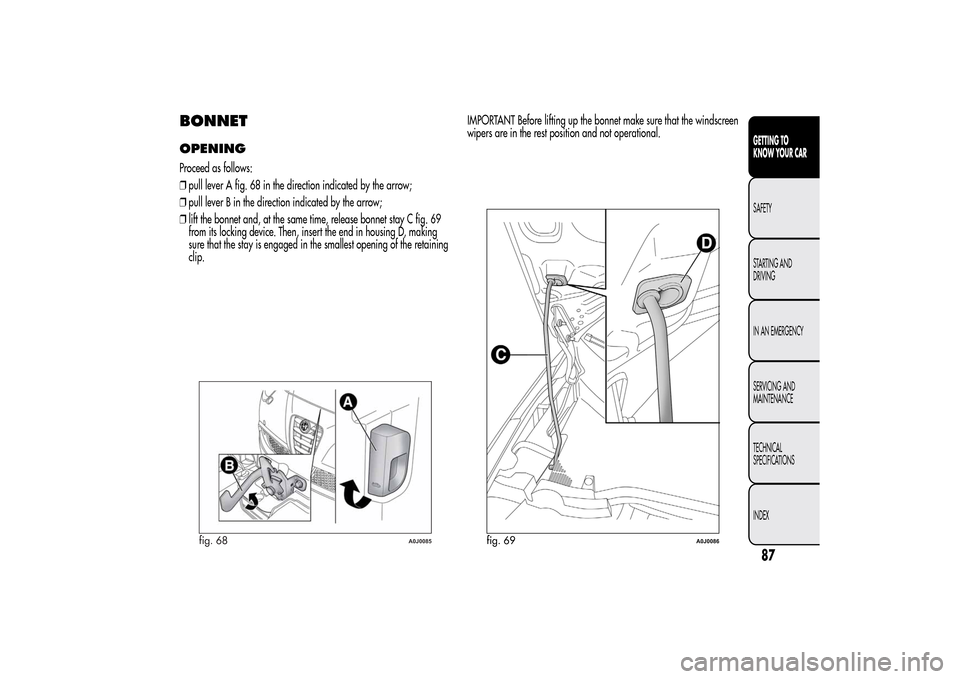
❒pull lever A fig. 68 in the direction indicated by the arrow;
❒pull lever B in the direction indicated by the arrow;
❒lift the bonnet and, at the same time, release bonnet stay C fig. 69
from its locking device. Then, insert the end in housing D, making
sure that the stay is engaged in the smallest opening of the retaining
clip.IMPORTANT Before lifting up the bonnet make sure that the windscreen
wipers are in the rest position and not operational.
fig. 68
A0J0085
fig. 69
A0J0086
87GETTING TO
KNOW YOUR CARSAFETY
STARTING AND
DRIVING
IN AN EMERGENCY
SERVICING AND
MAINTENANCE
TECHNICAL
SPECIFICATIONS
INDEX
Page 92 of 280
CLOSINGProceed as follows:
❒hold the bonnet up with one hand and with the other remove rod C
fig. 69 from housing D and fit it back into its locking device;
❒lower the bonnet to about 20 cm from the engine compartment, then
let it fall and check, by trying to raise it, that it is completely closed
and not only attached in safety position. If it is not perfectly closed,
open the bonnet and repeat the procedure. Do not simply press it.
IMPORTANT Always check that the bonnet is closed correctly to avoid
it opening while the car is travelling.
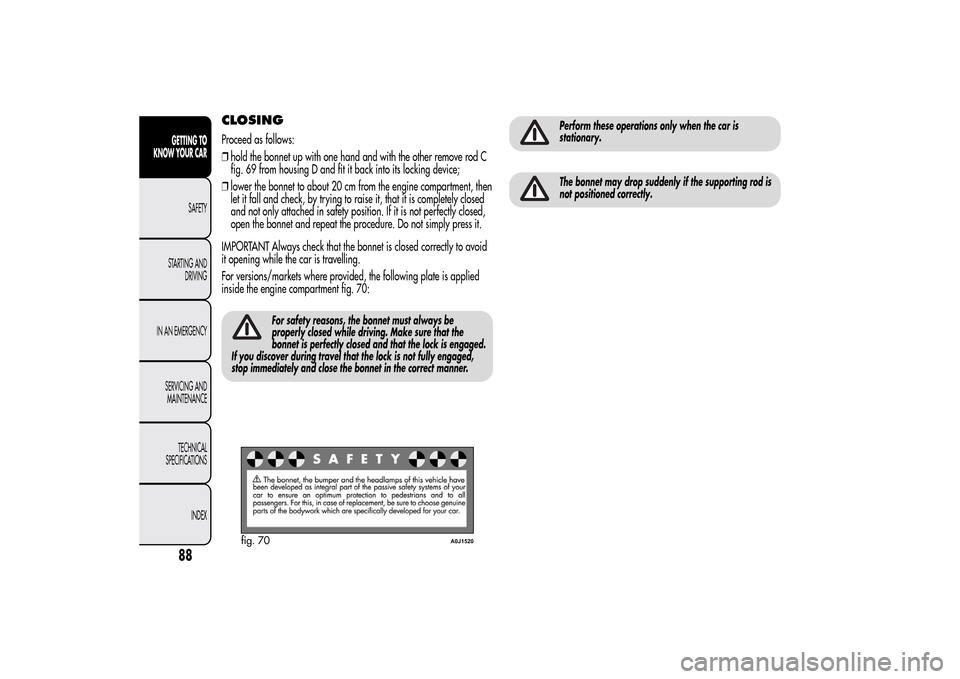
For versions/markets where provided, the following plate is applied
inside the engine compartment fig. 70:
For safety reasons, the bonnet must always be
properly closed while driving. Make sure that the
bonnet is perfectly closed and that the lock is engaged.
If you discover during travel that the lock is not fully engaged,
stop immediately and close the bonnet in the correct manner.
Perform these operations only when the car is
stationary.The bonnet may drop suddenly if the supporting rod is
not positioned correctly.
fig. 70
A0J1520
88GETTING TO
KNOW YOUR CAR
SAFETY
STARTING AND
DRIVING
IN AN EMERGENCY
SERVICING AND
MAINTENANCE
TECHNICAL
SPECIFICATIONS
INDEX
Page 95 of 280
ADJUSTING THE HEADLIGHTS ABROADThe dipped headlights are aligned to comply with the regulations of
the country of purchase. When travelling in countries with opposite
driving direction, to avoid dazzling the drivers on the other side of the
road, you need to cover areas of the headlight according to the
Highway code of the country you are travelling in.
ABS SYSTEMThe car is fitted with an ABS braking system, which prevents the wheels
from locking when braking, makes the most of road grip and gives
the best control when performing emergency braking under difficult
road conditions.
The EBD system (Electronic Braking Force Distribution) completes the
system allowing the brake force to be distributed between the front and
rear wheels.
IMPORTANT To obtain the maximum efficiency of the braking system,
a bedding-in period of about 500 km is needed: during this period
it is better to avoid sharp, repeated and prolonged braking.SYSTEM INTERVENTIONIt can be detected because the brake pedal pulsates slightly and the
system gets noisier: it means that the car speed should be altered
to suit the type of road surface.MECHANICAL BRAKE ASSIST
(emergency braking assistance)(for versions/markets, where provided)
This system, which cannot be deactivated, recognises emergency
braking conditions (according to the brake pedal operation speed) and
provides an additional hydraulic braking pressure to support that
provided by the driver. This allows faster and more powerful operation
of the braking system.
IMPORTANT When the Mechanical Brake Assist intervenes, noises may
be heard from the system. This is normal. In any case, while braking
keep the brake pedal firmly depressed.
91GETTING TO
KNOW YOUR CARSAFETY
STARTING AND
DRIVING
IN AN EMERGENCY
SERVICING AND
MAINTENANCE
TECHNICAL
SPECIFICATIONS
INDEX