lock Alfa Romeo MiTo 2016 User Guide
[x] Cancel search | Manufacturer: ALFA ROMEO, Model Year: 2016, Model line: MiTo, Model: Alfa Romeo MiTo 2016Pages: 280, PDF Size: 8.52 MB
Page 43 of 280
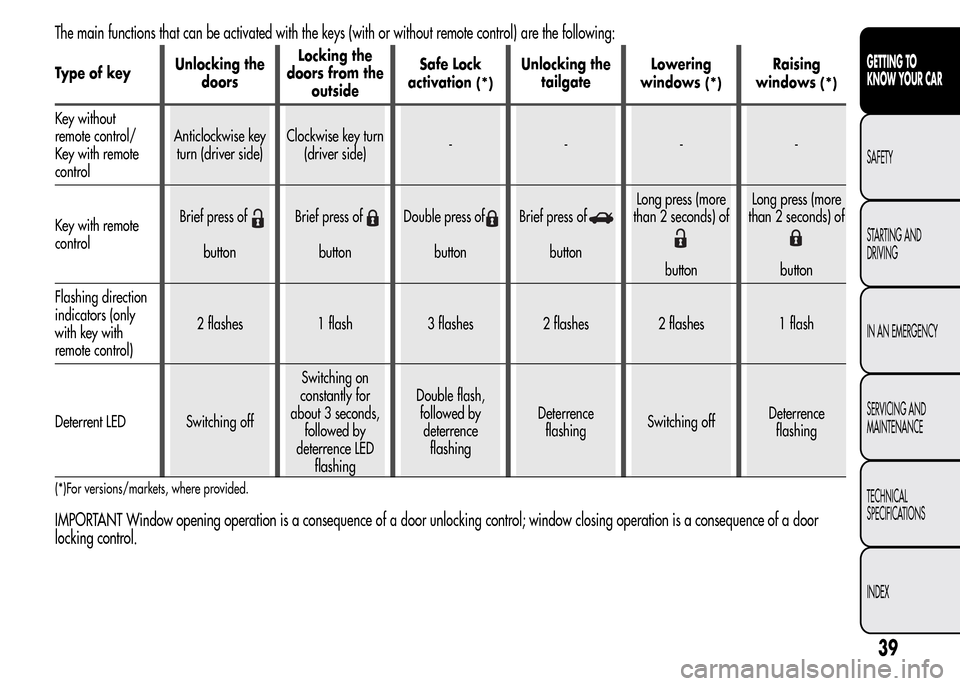
The main functions that can be activated with the keys (with or without remote control) are the following:
Type of keyUnlocking the
doorsLocking the
doors from the
outsideSafe Lock
activation(*)
Unlocking the
tailgateLowering
windows
(*)
Raising
windows
(*)
Key without
remote control/
Key with remote
controlAnticlockwise key
turn (driver side)Clockwise key turn
(driver side)----
Key with remote
controlBrief press of
buttonBrief press ofbuttonDouble press ofbuttonBrief press ofbuttonLong press (more
than 2 seconds) of
buttonLong press (more
than 2 seconds) ofbutton
Flashing direction
indicators (only
with key with
remote control)2 flashes 1 flash 3 flashes 2 flashes 2 flashes 1 flash
Deterrent LED Switching offSwitching on
constantly for
about 3 seconds,
followed by
deterrence LED
flashingDouble flash,
followed by
deterrence
flashingDeterrence
flashingSwitching offDeterrence
flashing
(*)For versions/markets, where provided.
IMPORTANT Window opening operation is a consequence of a door unlocking control; window closing operation is a consequence of a door
locking control.
39
GETTING TO
KNOW YOUR CAR
SAFETY
STARTING AND
DRIVING
IN AN EMERGENCY
SERVICING AND
MAINTENANCE
TECHNICAL
SPECIFICATIONS
INDEX
Page 44 of 280
ALARM
(for versions/markets, where provided)
ALARM ACTIVATION
The alarm activates in the following cases:
❒wrongful opening of a door/bonnet/luggage compartment
(perimeter protection);
❒wrongful operation of the ignition switch (key turned to MAR);
❒cutting of the battery cables;
❒movement inside the passenger compartment (volumetric protection);
❒anomalous lifting/tilting of the car (for versions/markets, where
provided).
Operation of the alarm is indicated by an acoustic and visual signal
(flashing of the direction indicators for several seconds). The alarm
activation modes may vary according to the market. There is a
maximum number of acoustic/visual cycles. When this is reached the
system returns to normal operation.
IMPORTANT The engine locking function is guaranteed by the Alfa
Romeo CODE, which is automatically activated when the ignition key
is extracted from the ignition switch.
IMPORTANT The alarm is adapted to meet requirements in various
countries.
SWITCHING ON THE ALARM
With the doors and bonnet closed and the ignition key either turned to
STOP or removed, direct the key with the remote control towards the
car, then press and release the
button. Except for specific markets,
the system emits a visual and acoustic signal and enables door locking.
A self-diagnosis stage precedes the switching on of the alarm: in the
event of faults, the system will generate a further acoustic and/or
visual signal through the LED on the dashboard.
If after the alarm is switched on, a second acoustic signal is emitted
and/or a visual signal via the LED on the dashboard, wait about
4 seconds and switch off the alarm by pressing the
button, check
that the doors, bonnet and luggage compartment are closed correctly
and then reactivate the system by pressing the
button.
If the alarm emits an acoustic signal even when the doors, bonnet and
boot are correctly closed, a fault has occurred in system operation:
in this case, contact Alfa Romeo Authorized Services.
ALARM SELF-ACTIVATION
(for versions/markets, where provided)
If the alarm has not been activated using the remote control, once
about 30 seconds have elapsed from when the ignition key was turned
to STOP and a door or the tailgate was last opened and then closed,
the alarm activates automatically.
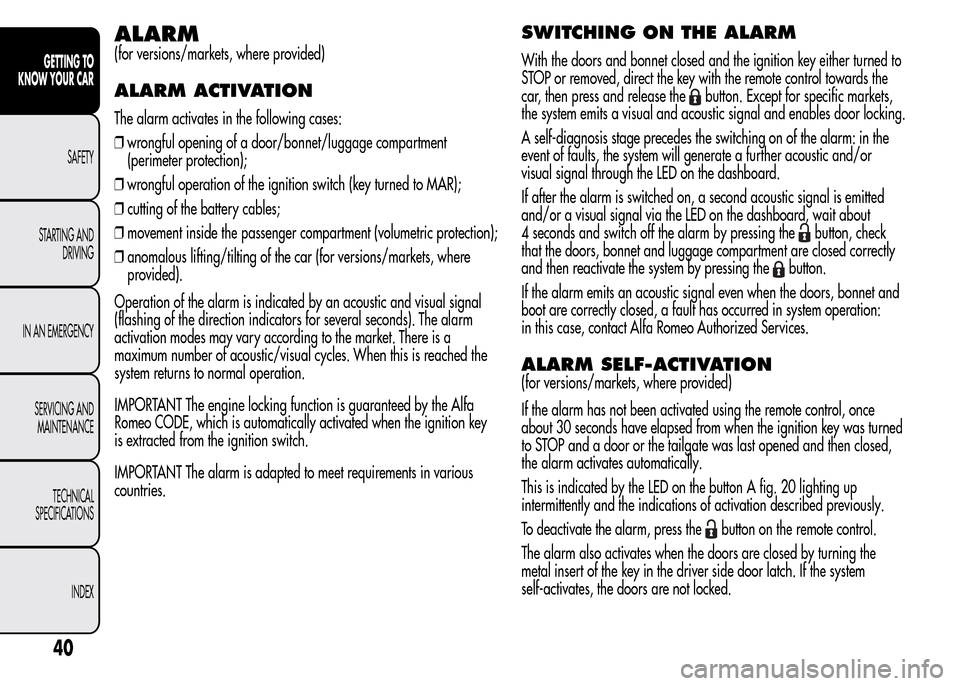
This is indicated by the LED on the button A fig. 20 lighting up
intermittently and the indications of activation described previously.
To deactivate the alarm, press the
button on the remote control.
The alarm also activates when the doors are closed by turning the
metal insert of the key in the driver side door latch. If the system
self-activates, the doors are not locked.
40
GETTING TO
KNOW YOUR CAR
SAFETY
STARTING AND
DRIVING
IN AN EMERGENCY
SERVICING AND
MAINTENANCE
TECHNICAL
SPECIFICATIONS
INDEX
Page 45 of 280
SWITCHING OFF THE ALARM
Press thebutton. The following operations are performed (excluding
specific markets):
❒the direction indicators flash briefly twice;
❒there are two brief acoustic signals;
❒unlocking of the doors.
IMPORTANT The alarm does not switch off when the central opening is
activated using the metal insert in the key.
VOLUMETRIC/ANTI-LIFT PROTECTION
To guarantee the correct operation of the protection, close the side
windows and any sun roof completely (for versions/markets, where
provided).
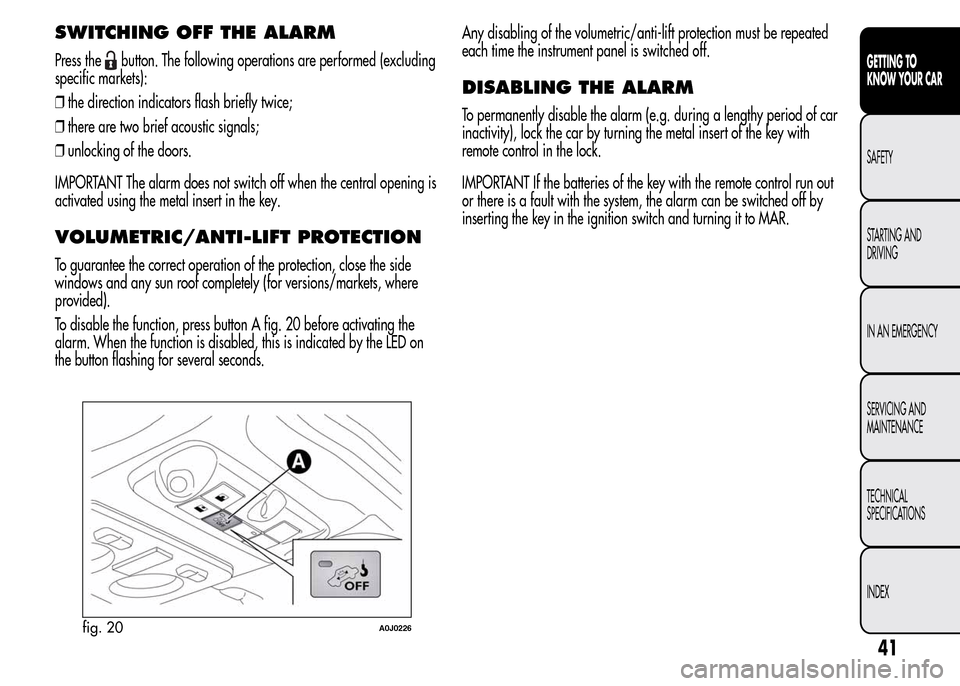
To disable the function, press button A fig. 20 before activating the
alarm. When the function is disabled, this is indicated by the LED on
the button flashing for several seconds.Any disabling of the volumetric/anti-lift protection must be repeated
each time the instrument panel is switched off.
DISABLING THE ALARM
To permanently disable the alarm (e.g. during a lengthy period of car
inactivity), lock the car by turning the metal insert of the key with
remote control in the lock.
IMPORTANT If the batteries of the key with the remote control run out
or there is a fault with the system, the alarm can be switched off by
inserting the key in the ignition switch and turning it to MAR.
fig. 20A0J0226
41
GETTING TO
KNOW YOUR CAR
SAFETY
STARTING AND
DRIVING
IN AN EMERGENCY
SERVICING AND
MAINTENANCE
TECHNICAL
SPECIFICATIONS
INDEX
Page 46 of 280
IGNITION DEVICE
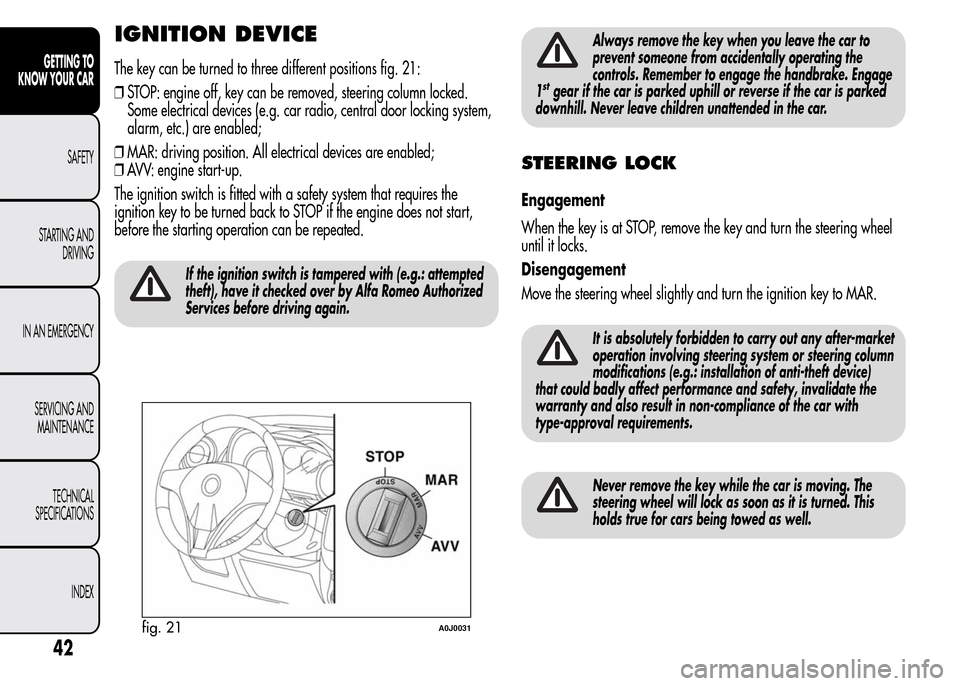
The key can be turned to three different positions fig. 21:
❒STOP: engine off, key can be removed, steering column locked.
Some electrical devices (e.g. car radio, central door locking system,
alarm, etc.) are enabled;
❒MAR: driving position. All electrical devices are enabled;
❒AVV: engine start-up.
The ignition switch is fitted with a safety system that requires the
ignition key to be turned back to STOP if the engine does not start,
before the starting operation can be repeated.
If the ignition switch is tampered with (e.g.: attempted
theft), have it checked over by Alfa Romeo Authorized
Services before driving again.
Always remove the key when you leave the car to
prevent someone from accidentally operating the
controls. Remember to engage the handbrake. Engage
1
stgear if the car is parked uphill or reverse if the car is parked
downhill. Never leave children unattended in the car.
STEERING LOCK
Engagement
When the key is at STOP, remove the key and turn the steering wheel
until it locks.
Disengagement
Move the steering wheel slightly and turn the ignition key to MAR.
It is absolutely forbidden to carry out any after-market
operation involving steering system or steering column
modifications (e.g.: installation of anti-theft device)
that could badly affect performance and safety, invalidate the
warranty and also result in non-compliance of the car with
type-approval requirements.
Never remove the key while the car is moving. The
steering wheel will lock as soon as it is turned. This
holds true for cars being towed as well.
fig. 21A0J0031
42
GETTING TO
KNOW YOUR CAR
SAFETY
STARTING AND
DRIVING
IN AN EMERGENCY
SERVICING AND
MAINTENANCE
TECHNICAL
SPECIFICATIONS
INDEX
Page 47 of 280
SEATS
FRONT SEATS
All adjustments must be made with the car stationary.
Lengthwise adjustment
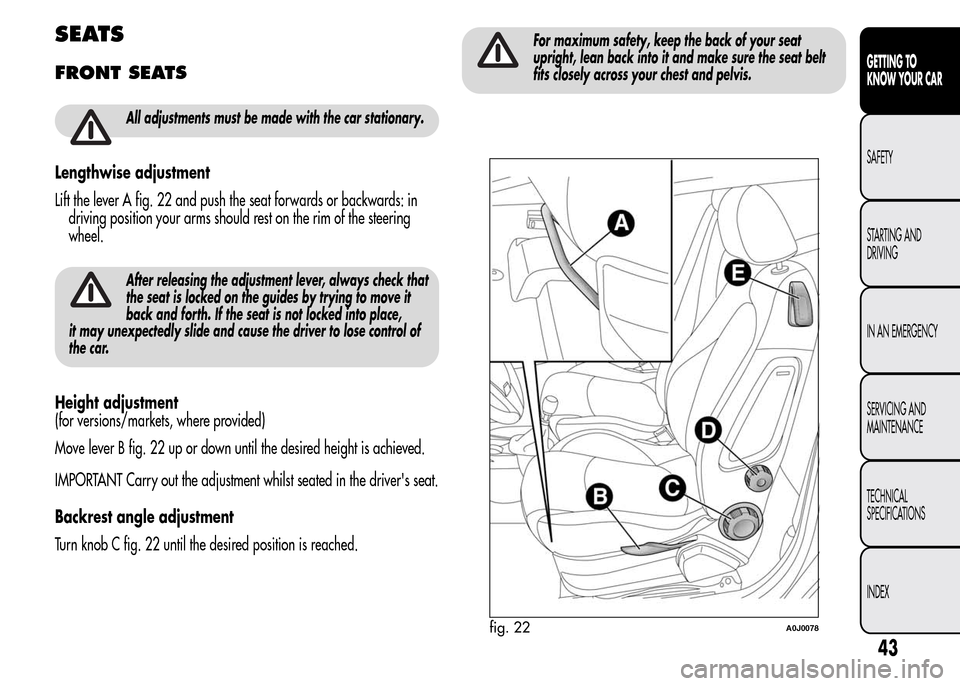
Lift the lever A fig. 22 and push the seat forwards or backwards: in
driving position your arms should rest on the rim of the steering
wheel.
After releasing the adjustment lever, always check that
the seat is locked on the guides by trying to move it
back and forth. If the seat is not locked into place,
it may unexpectedly slide and cause the driver to lose control of
the car.
Height adjustment
(for versions/markets, where provided)
Move lever B fig. 22 up or down until the desired height is achieved.
IMPORTANT Carry out the adjustment whilst seated in the driver's seat.
Backrest angle adjustment
Turn knob C fig. 22 until the desired position is reached.
For maximum safety, keep the back of your seat
upright, lean back into it and make sure the seat belt
fits closely across your chest and pelvis.
fig. 22A0J0078
43
GETTING TO
KNOW YOUR CAR
SAFETY
STARTING AND
DRIVING
IN AN EMERGENCY
SERVICING AND
MAINTENANCE
TECHNICAL
SPECIFICATIONS
INDEX
Page 48 of 280
Lumbar adjustment
(for versions/markets, where provided)
Turn knob D fig. 22 until the desired position is reached.
Backrest folding
To access the rear seats, pull handle E upwards fig. 22: the backrest
will fold and the seat will slide forwards when you push the backrest.
Moving the backrest backwards will return the seat to its initial
position.
Always check that the seat is firmly locked on the
guides, trying to push it forwards and backwards.
Seat heating
(for versions/markets, where provided)
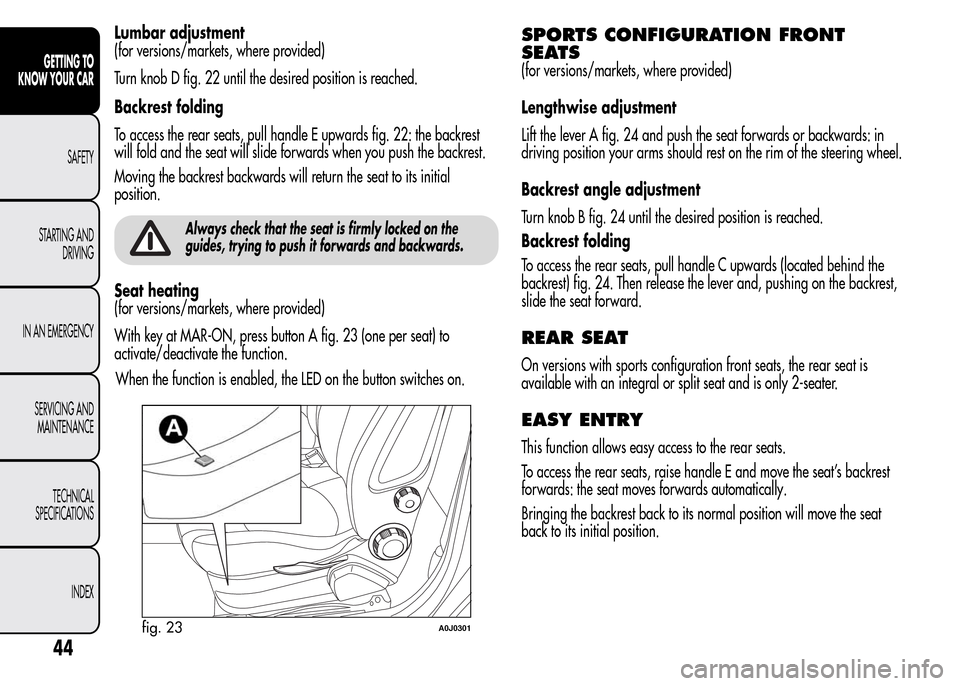
With key at MAR-ON, press button A fig. 23 (one per seat) to
activate/deactivate the function.
When the function is enabled, the LED on the button switches on.
SPORTS CONFIGURATION FRONT
SEATS
(for versions/markets, where provided)
Lengthwise adjustment
Lift the lever A fig. 24 and push the seat forwards or backwards: in
driving position your arms should rest on the rim of the steering wheel.
Backrest angle adjustment
Turn knob B fig. 24 until the desired position is reached.
Backrest folding
To access the rear seats, pull handle C upwards (located behind the
backrest) fig. 24. Then release the lever and, pushing on the backrest,
slide the seat forward.
REAR SEAT
On versions with sports configuration front seats, the rear seat is
available with an integral or split seat and is only 2-seater.
EASY ENTRY
This function allows easy access to the rear seats.
To access the rear seats, raise handle E and move the seat’s backrest
forwards: the seat moves forwards automatically.
Bringing the backrest back to its normal position will move the seat
back to its initial position.
fig. 23A0J0301
44
GETTING TO
KNOW YOUR CAR
SAFETY
STARTING AND
DRIVING
IN AN EMERGENCY
SERVICING AND
MAINTENANCE
TECHNICAL
SPECIFICATIONS
INDEX
Page 49 of 280
If the backrest encounters an obstacle when moving back (e.g. the
knees of the passenger in the back seat), the seat will stop, move
forwards by a few centimetres and then stop in this position.HEAD RESTRAINTS
FRONT
Head restraints are adjustable in height and they lock automatically
into the desired position:
❒upwards adjustment: raise the head restraint until it clicks into place;
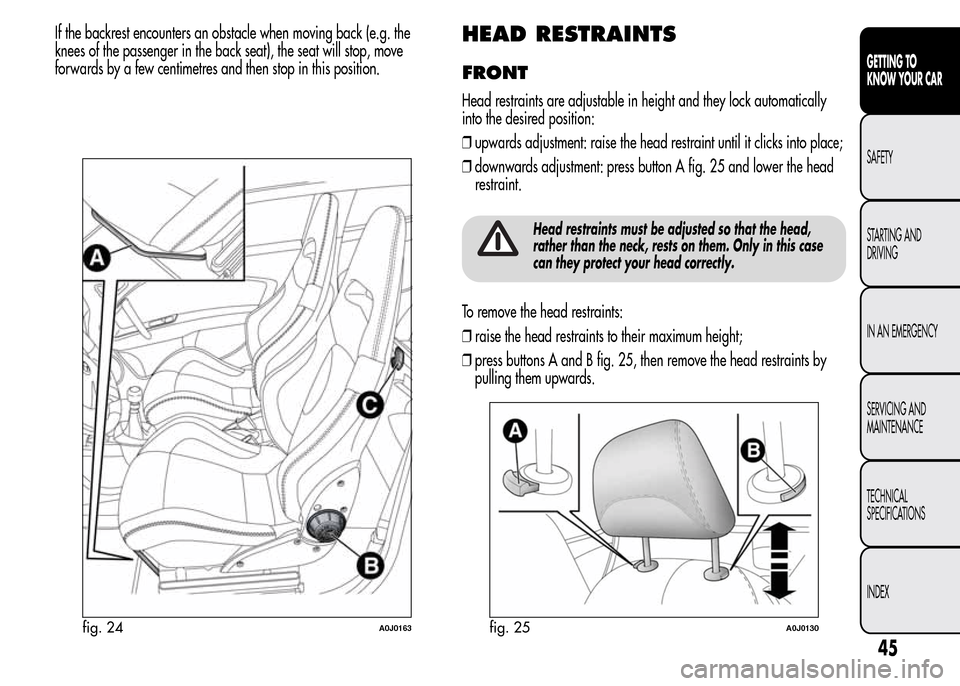
❒downwards adjustment: press button A fig. 25 and lower the head
restraint.
Head restraints must be adjusted so that the head,
rather than the neck, rests on them. Only in this case
can they protect your head correctly.
To remove the head restraints:
❒raise the head restraints to their maximum height;
❒press buttons A and B fig. 25, then remove the head restraints by
pulling them upwards.
fig. 24A0J0163fig. 25A0J0130
45
GETTING TO
KNOW YOUR CAR
SAFETY
STARTING AND
DRIVING
IN AN EMERGENCY
SERVICING AND
MAINTENANCE
TECHNICAL
SPECIFICATIONS
INDEX
Page 50 of 280
“Anti-Whiplash” device
The head restraints are equipped with an “Anti-Whiplash” device,
which reduces the distance between head and head restraint in the
event of a rear impact, thus mitigating the “whiplash” effect.
The head restraint may move when the backrest is pressed by the
occupant's torso or hand: this behaviour is caused by the system and
should not be considered a malfunction.
REAR
Two height-adjustable head restraints are provided for the back seats
(to adjust the height see the previous paragraph).
On some versions a head restraint is also provided for the central seat.
To remove the head restraints:
❒raise the head restraints to their maximum height;
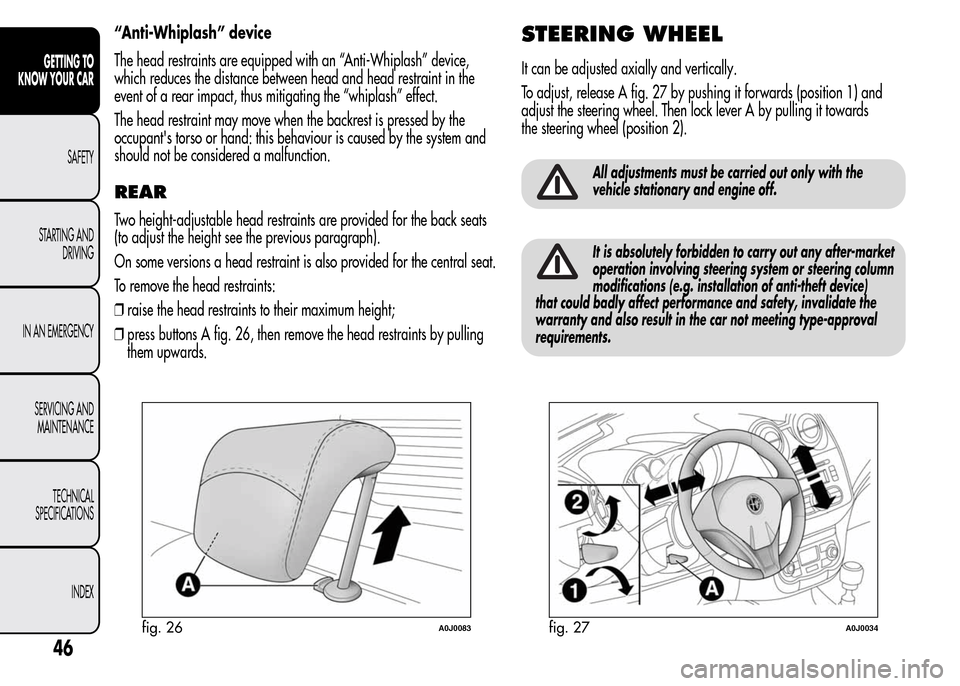
❒press buttons A fig. 26, then remove the head restraints by pulling
them upwards.
STEERING WHEEL
It can be adjusted axially and vertically.
To adjust, release A fig. 27 by pushing it forwards (position 1) and
adjust the steering wheel. Then lock lever A by pulling it towards
the steering wheel (position 2).
All adjustments must be carried out only with the
vehicle stationary and engine off.
It is absolutely forbidden to carry out any after-market
operation involving steering system or steering column
modifications (e.g. installation of anti-theft device)
that could badly affect performance and safety, invalidate the
warranty and also result in the car not meeting type-approval
requirements.
fig. 26A0J0083fig. 27A0J0034
46
GETTING TO
KNOW YOUR CAR
SAFETY
STARTING AND
DRIVING
IN AN EMERGENCY
SERVICING AND
MAINTENANCE
TECHNICAL
SPECIFICATIONS
INDEX
Page 66 of 280
EXTERNAL COURTESY LIGHTS
This function lights up the car and the space in front of it when the
doors are unlocked.
Activation
When the car is parked and the doors are unlocked by pressing the
button on the remote control (or the luggage compartment is
unlocked by pressing
), the dipped headlights, side lights and
number plate lights are activated.
The lights remain lit for approximately 25 seconds unless the doors
and boot are locked again with the remote control or the doors or boot
are opened and reclosed. In these cases they go out after 5 seconds.
The exterior courtesy lights can be enabled/disabled using the Setup
Menu (see the paragraph “Menu Items” in this chapter).
WINDOW CLEANING
WINDSCREEN WASHER/WIPER
The right stalk controls windscreen wiper/washer and rear window
wiper/washer operation.
This operates only with the ignition key turned to MAR.
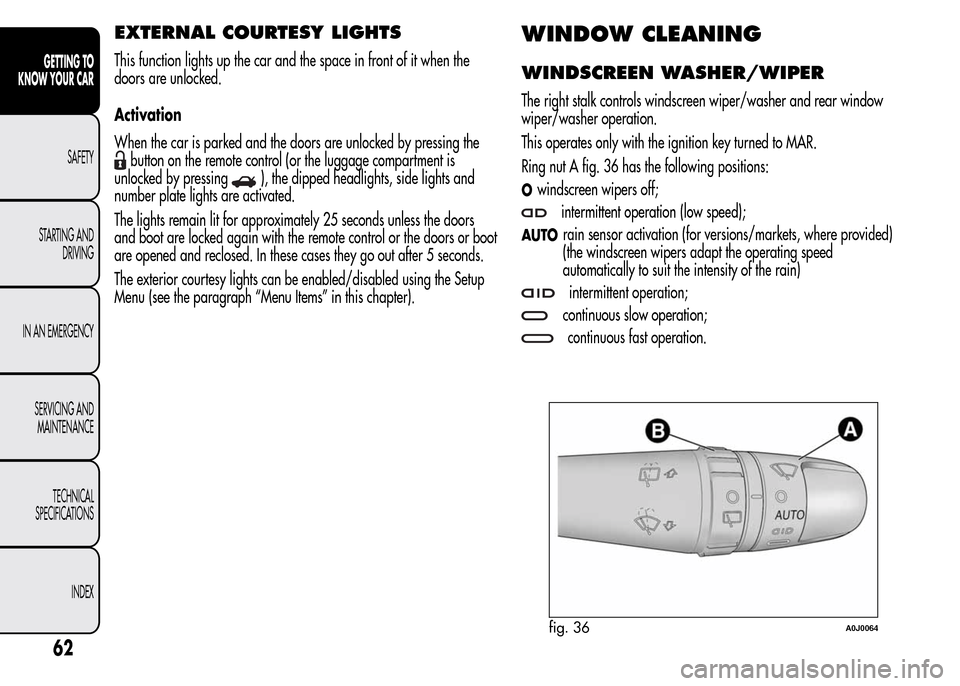
Ring nut A fig. 36 has the following positions:
Owindscreen wipers off;
intermittent operation (low speed);
AUTOrain sensor activation (for versions/markets, where provided)
(the windscreen wipers adapt the operating speed
automatically to suit the intensity of the rain)
intermittent operation;
continuous slow operation;
continuous fast operation.
fig. 36A0J0064
62
GETTING TO
KNOW YOUR CAR
SAFETY
STARTING AND
DRIVING
IN AN EMERGENCY
SERVICING AND
MAINTENANCE
TECHNICAL
SPECIFICATIONS
INDEX
Page 71 of 280
ROOF LIGHTS
FRONT ROOF LIGHT
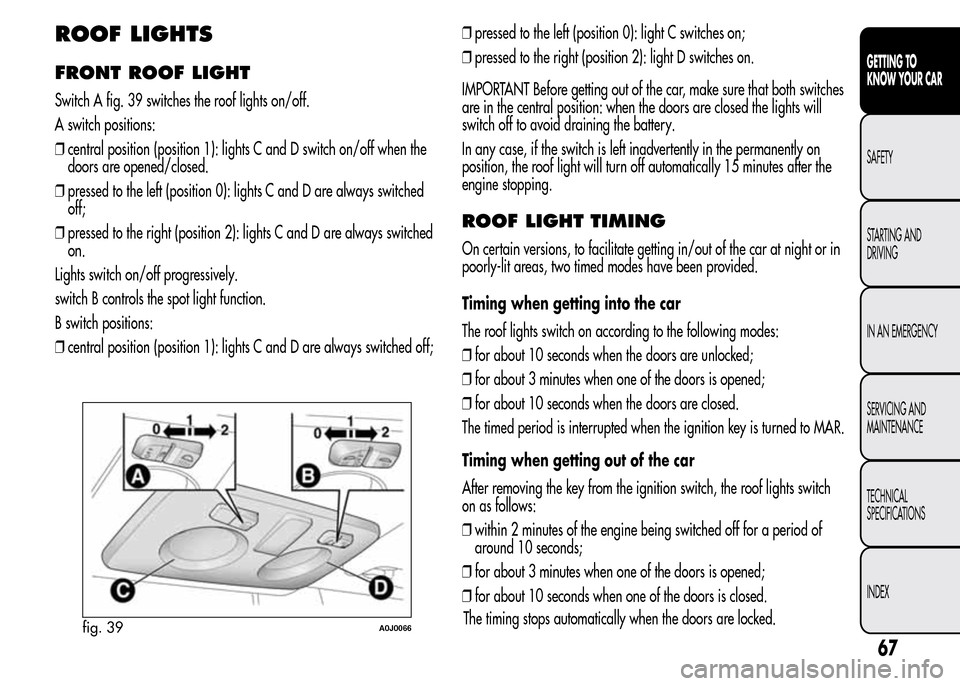
Switch A fig. 39 switches the roof lights on/off.
A switch positions:
❒central position (position 1): lights C and D switch on/off when the
doors are opened/closed.
❒pressed to the left (position 0): lights C and D are always switched
off;
❒pressed to the right (position 2): lights C and D are always switched
on.
Lights switch on/off progressively.
switch B controls the spot light function.
B switch positions:
❒central position (position 1): lights C and D are always switched off;❒pressed to the left (position 0): light C switches on;
❒pressed to the right (position 2): light D switches on.
IMPORTANT Before getting out of the car, make sure that both switches
are in the central position: when the doors are closed the lights will
switch off to avoid draining the battery.
In any case, if the switch is left inadvertently in the permanently on
position, the roof light will turn off automatically 15 minutes after the
engine stopping.
ROOF LIGHT TIMING
On certain versions, to facilitate getting in/out of the car at night or in
poorly-lit areas, two timed modes have been provided.
Timing when getting into the car
The roof lights switch on according to the following modes:
❒for about 10 seconds when the doors are unlocked;
❒for about 3 minutes when one of the doors is opened;
❒for about 10 seconds when the doors are closed.
The timed period is interrupted when the ignition key is turned to MAR.
Timing when getting out of the car
After removing the key from the ignition switch, the roof lights switch
on as follows:
❒within 2 minutes of the engine being switched off for a period of
around 10 seconds;
❒for about 3 minutes when one of the doors is opened;
❒for about 10 seconds when one of the doors is closed.
fig. 39A0J0066
67
GETTING TO
KNOW YOUR CAR
SAFETY
STARTING AND
DRIVING
IN AN EMERGENCY
SERVICING AND
MAINTENANCE
TECHNICAL
SPECIFICATIONS
INDEX
The timing stops automatically when the doors are locked.