lock Alfa Romeo MiTo 2016 Owner's Guide
[x] Cancel search | Manufacturer: ALFA ROMEO, Model Year: 2016, Model line: MiTo, Model: Alfa Romeo MiTo 2016Pages: 280, PDF Size: 8.52 MB
Page 74 of 280
FOG LIGHTS
(for versions/markets, where provided)
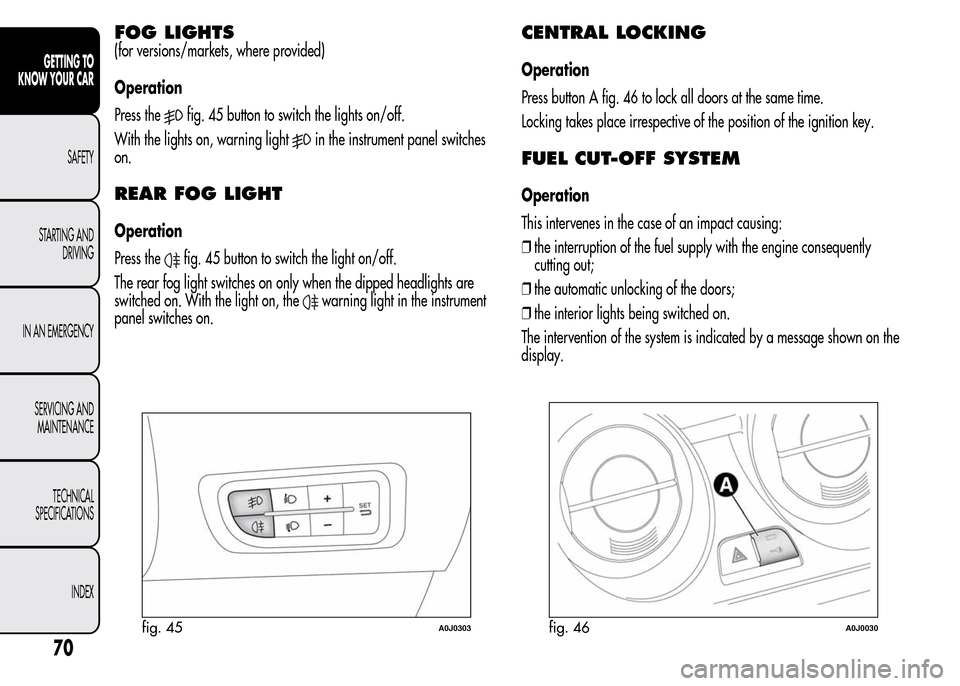
Operation
Press the
fig. 45 button to switch the lights on/off.
With the lights on, warning light
in the instrument panel switches
on.
REAR FOG LIGHT
Operation
Press the
fig. 45 button to switch the light on/off.
The rear fog light switches on only when the dipped headlights are
switched on. With the light on, the
warning light in the instrument
panel switches on.
CENTRAL LOCKING
Operation
Press button A fig. 46 to lock all doors at the same time.
Locking takes place irrespective of the position of the ignition key.
FUEL CUT-OFF SYSTEM
Operation
This intervenes in the case of an impact causing:
❒the interruption of the fuel supply with the engine consequently
cutting out;
❒the automatic unlocking of the doors;
❒the interior lights being switched on.
The intervention of the system is indicated by a message shown on the
display.
fig. 45A0J0303fig. 46A0J0030
70
GETTING TO
KNOW YOUR CAR
SAFETY
STARTING AND
DRIVING
IN AN EMERGENCY
SERVICING AND
MAINTENANCE
TECHNICAL
SPECIFICATIONS
INDEX
Page 81 of 280
MAINTENANCE/EMERGENCY
In the event of emergency or maintenance, the roof can be moved
manually when there is no power supply (opening/closing of the front
glass panel) by carrying out the following operations:
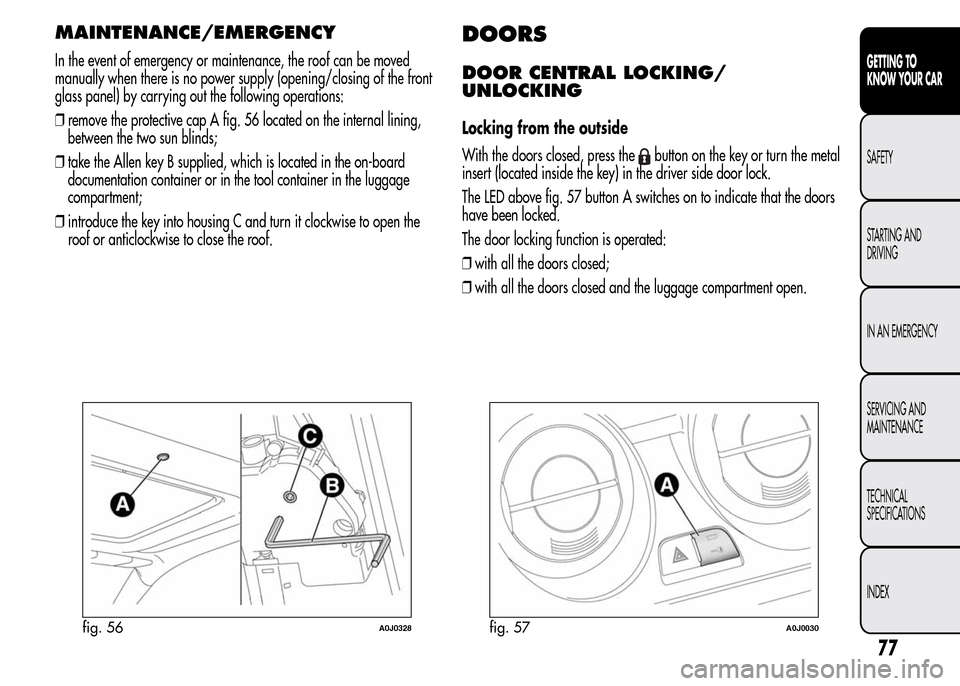
❒remove the protective cap A fig. 56 located on the internal lining,
between the two sun blinds;
❒take the Allen key B supplied, which is located in the on-board
documentation container or in the tool container in the luggage
compartment;
❒introduce the key into housing C and turn it clockwise to open the
roof or anticlockwise to close the roof.
DOORS
DOOR CENTRAL LOCKING/
UNLOCKING
Locking from the outside
With the doors closed, press the
button on the key or turn the metal
insert (located inside the key) in the driver side door lock.
The LED above fig. 57 button A switches on to indicate that the doors
have been locked.
The door locking function is operated:
❒with all the doors closed;
❒with all the doors closed and the luggage compartment open.
fig. 56A0J0328fig. 57A0J0030
77
GETTING TO
KNOW YOUR CAR
SAFETY
STARTING AND
DRIVING
IN AN EMERGENCY
SERVICING AND
MAINTENANCE
TECHNICAL
SPECIFICATIONS
INDEX
Page 82 of 280
Door unlocking from the outside
Press the
button on the key or turn the metal insert (located inside
the key) in the driver side door lock.
Door locking/unlocking from the inside
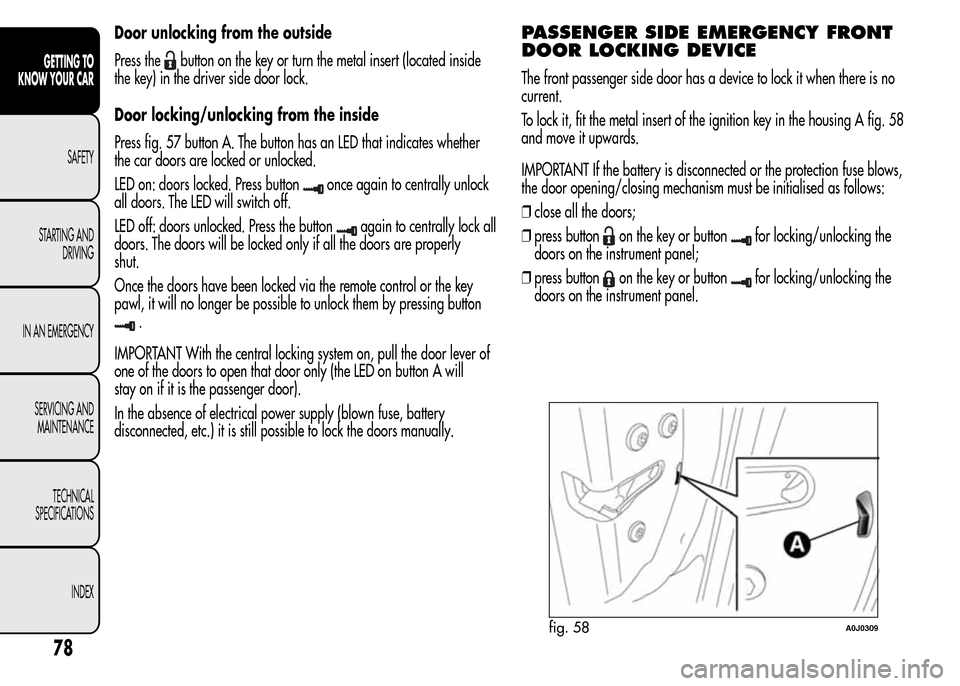
Press fig. 57 button A. The button has an LED that indicates whether
the car doors are locked or unlocked.
LED on: doors locked. Press button
once again to centrally unlock
all doors. The LED will switch off.
LED off: doors unlocked. Press the button
again to centrally lock all
doors. The doors will be locked only if all the doors are properly
shut.
Once the doors have been locked via the remote control or the key
pawl, it will no longer be possible to unlock them by pressing button
.
IMPORTANT With the central locking system on, pull the door lever of
one of the doors to open that door only (the LED on button A will
stay on if it is the passenger door).
In the absence of electrical power supply (blown fuse, battery
disconnected, etc.) it is still possible to lock the doors manually.
PASSENGER SIDE EMERGENCY FRONT
DOOR LOCKING DEVICE
The front passenger side door has a device to lock it when there is no
current.
To lock it, fit the metal insert of the ignition key in the housing A fig. 58
and move it upwards.
IMPORTANT If the battery is disconnected or the protection fuse blows,
the door opening/closing mechanism must be initialised as follows:
❒close all the doors;
❒press button
on the key or buttonfor locking/unlocking the
doors on the instrument panel;
❒press button
on the key or buttonfor locking/unlocking the
doors on the instrument panel.
fig. 58A0J0309
78
GETTING TO
KNOW YOUR CAR
SAFETY
STARTING AND
DRIVING
IN AN EMERGENCY
SERVICING AND
MAINTENANCE
TECHNICAL
SPECIFICATIONS
INDEX
Page 85 of 280
❒proceed in the same way as described in points 1 and 2 for the
passenger side door;
❒make sure that the initialisation is correct by checking that the
windows work automatically.
IMPORTANT With the central locking on, pulling the internal opening
lever for one of the doors switches the locking off for all the doors.
In the absence of electrical power supply (blown fuse, battery
disconnected, etc.) it is still possible to lock the doors manually. In this
case, the automatic lowering function of the windows is not available.
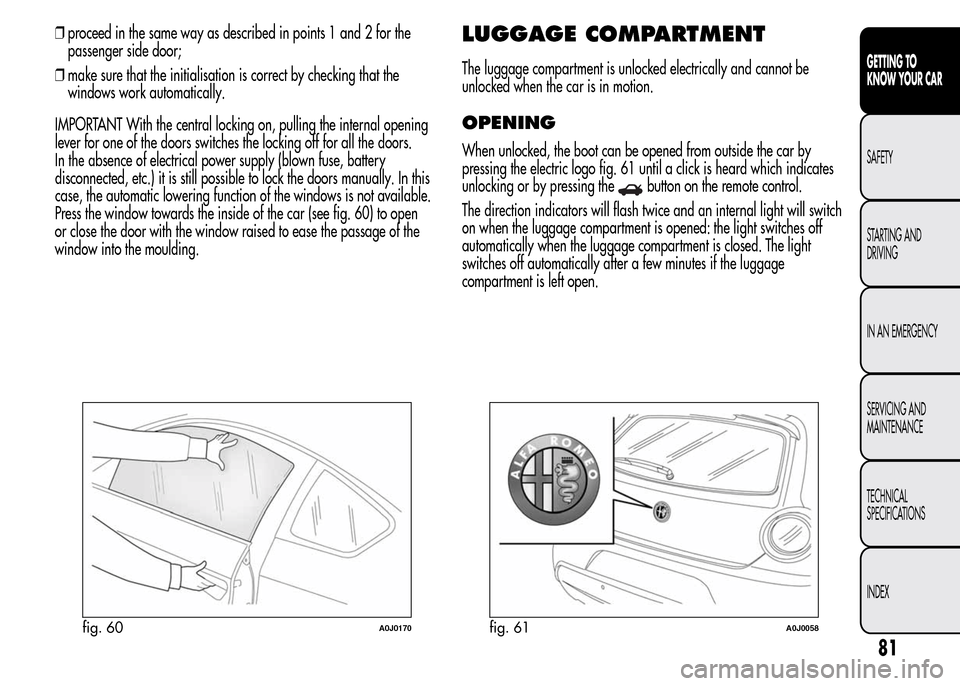
Press the window towards the inside of the car (see fig. 60) to open
or close the door with the window raised to ease the passage of the
window into the moulding.LUGGAGE COMPARTMENT
The luggage compartment is unlocked electrically and cannot be
unlocked when the car is in motion.
OPENING
When unlocked, the boot can be opened from outside the car by
pressing the electric logo fig. 61 until a click is heard which indicates
unlocking or by pressing the
button on the remote control.
The direction indicators will flash twice and an internal light will switch
on when the luggage compartment is opened: the light switches off
automatically when the luggage compartment is closed. The light
switches off automatically after a few minutes if the luggage
compartment is left open.
fig. 60A0J0170fig. 61A0J0058
81
GETTING TO
KNOW YOUR CAR
SAFETY
STARTING AND
DRIVING
IN AN EMERGENCY
SERVICING AND
MAINTENANCE
TECHNICAL
SPECIFICATIONS
INDEX
Page 86 of 280
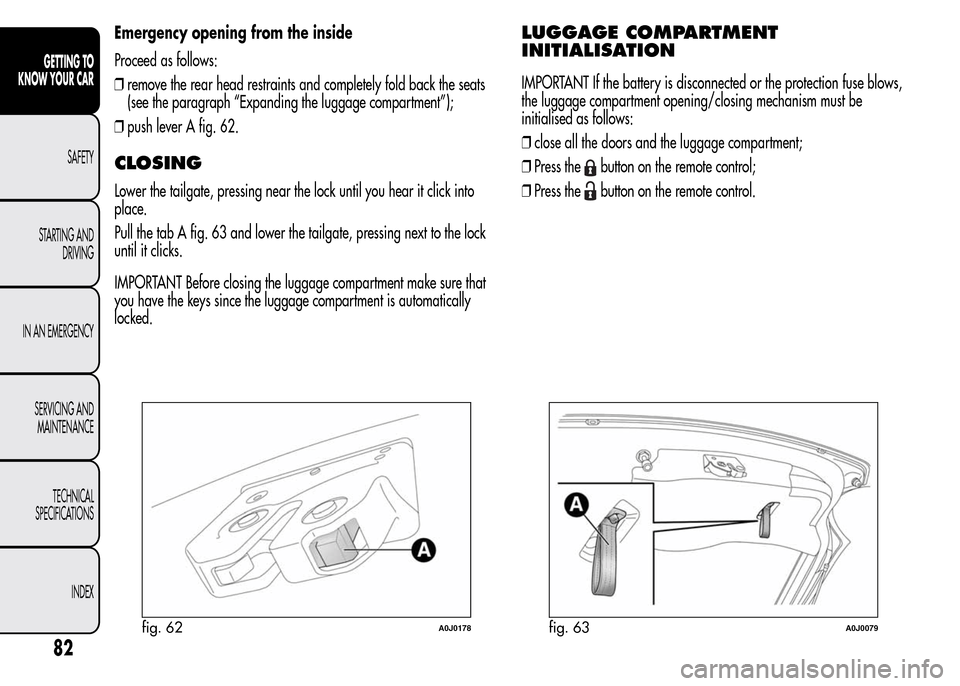
Emergency opening from the inside
Proceed as follows:
❒remove the rear head restraints and completely fold back the seats
(see the paragraph “Expanding the luggage compartment”);
❒push lever A fig. 62.
CLOSING
Lower the tailgate, pressing near the lock until you hear it click into
place.
Pull the tab A fig. 63 and lower the tailgate, pressing next to the lock
until it clicks.
IMPORTANT Before closing the luggage compartment make sure that
you have the keys since the luggage compartment is automatically
locked.
LUGGAGE COMPARTMENT
INITIALISATION
IMPORTANT If the battery is disconnected or the protection fuse blows,
the luggage compartment opening/closing mechanism must be
initialised as follows:
❒close all the doors and the luggage compartment;
❒Press the
button on the remote control;
❒Press the
button on the remote control.
fig. 62A0J0178fig. 63A0J0079
82
GETTING TO
KNOW YOUR CAR
SAFETY
STARTING AND
DRIVING
IN AN EMERGENCY
SERVICING AND
MAINTENANCE
TECHNICAL
SPECIFICATIONS
INDEX
Page 88 of 280
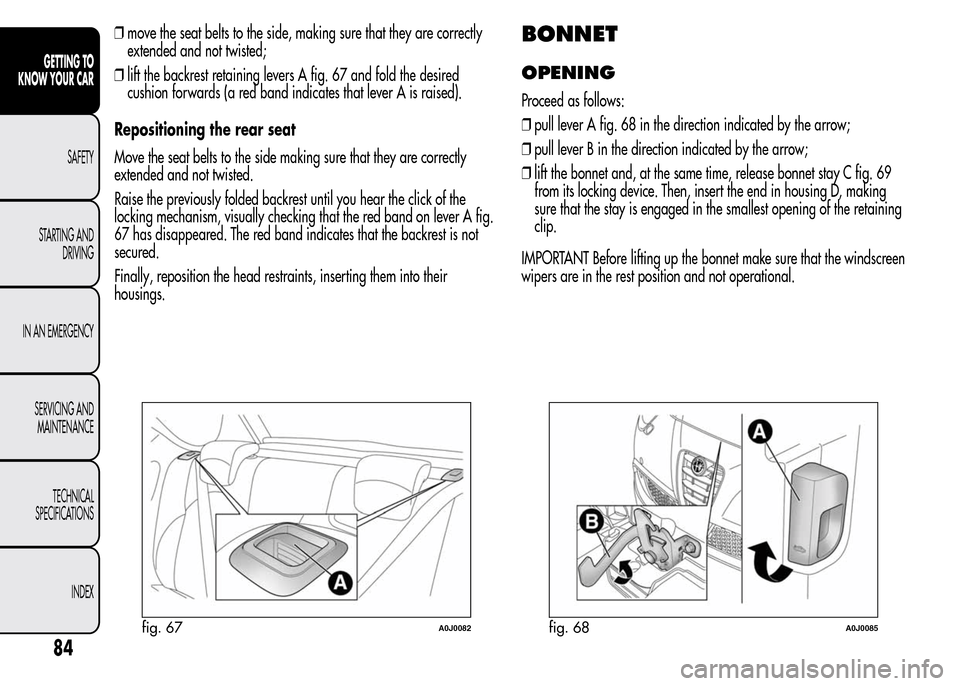
❒move the seat belts to the side, making sure that they are correctly
extended and not twisted;
❒lift the backrest retaining levers A fig. 67 and fold the desired
cushion forwards (a red band indicates that lever A is raised).
Repositioning the rear seat
Move the seat belts to the side making sure that they are correctly
extended and not twisted.
Raise the previously folded backrest until you hear the click of the
locking mechanism, visually checking that the red band on lever A fig.
67 has disappeared. The red band indicates that the backrest is not
secured.
Finally, reposition the head restraints, inserting them into their
housings.BONNET
OPENING
Proceed as follows:
❒pull lever A fig. 68 in the direction indicated by the arrow;
❒pull lever B in the direction indicated by the arrow;
❒lift the bonnet and, at the same time, release bonnet stay C fig. 69
from its locking device. Then, insert the end in housing D, making
sure that the stay is engaged in the smallest opening of the retaining
clip.
IMPORTANT Before lifting up the bonnet make sure that the windscreen
wipers are in the rest position and not operational.
fig. 67A0J0082fig. 68A0J0085
84
GETTING TO
KNOW YOUR CAR
SAFETY
STARTING AND
DRIVING
IN AN EMERGENCY
SERVICING AND
MAINTENANCE
TECHNICAL
SPECIFICATIONS
INDEX
Page 89 of 280
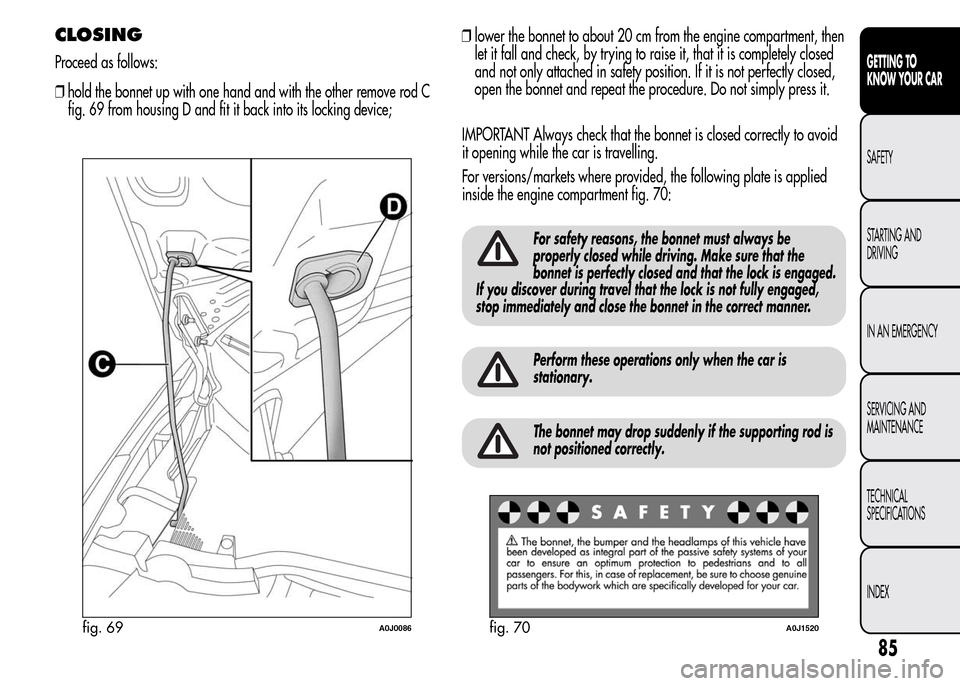
❒hold the bonnet up with one hand and with the other remove rod C
fig. 69 from housing D and fit it back into its locking device;❒lower the bonnet to about 20 cm from the engine compartment, then
let it fall and check, by trying to raise it, that it is completely closed
and not only attached in safety position. If it is not perfectly closed,
open the bonnet and repeat the procedure. Do not simply press it.
IMPORTANT Always check that the bonnet is closed correctly to avoid
it opening while the car is travelling.
For versions/markets where provided, the following plate is applied
inside the engine compartment fig. 70:
For safety reasons, the bonnet must always be
properly closed while driving. Make sure that the
bonnet is perfectly closed and that the lock is engaged.
If you discover during travel that the lock is not fully engaged,
stop immediately and close the bonnet in the correct manner.
Perform these operations only when the car is
stationary.
The bonnet may drop suddenly if the supporting rod is
not positioned correctly.
fig. 69A0J0086fig. 70A0J1520
85
GETTING TO
KNOW YOUR CAR
SAFETY
STARTING AND
DRIVING
IN AN EMERGENCY
SERVICING AND
MAINTENANCE
TECHNICAL
SPECIFICATIONS
INDEX
CLOSING
Proceed as follows:
Page 92 of 280
ABS SYSTEM
The car is fitted with an ABS braking system, which prevents the wheels
from locking when braking, makes the most of road grip and gives
the best control when performing emergency braking under difficult
road conditions.
The EBD system (Electronic Braking Force Distribution) completes the
system allowing the brake force to be distributed between the front and
rear wheels.
IMPORTANT To obtain the maximum efficiency of the braking system,
a bedding-in period of about 500 km is needed: during this period
it is better to avoid sharp, repeated and prolonged braking.
SYSTEM INTERVENTION
It can be detected because the brake pedal pulsates slightly and the
system gets noisier: it means that the car speed should be altered
to suit the type of road surface.
MECHANICAL BRAKE ASSIST
(emergency braking assistance)
(for versions/markets, where provided)
This system, which cannot be deactivated, recognises emergency
braking conditions (according to the brake pedal operation speed) and
provides an additional hydraulic braking pressure to support that
provided by the driver. This allows faster and more powerful operation
of the braking system.
IMPORTANT When the Mechanical Brake Assist intervenes, noises may
be heard from the system. This is normal. In any case, while braking
keep the brake pedal firmly depressed.
If the ABS system intervenes, this indicates that the
traction of the tyres on the road is nearing its limit.
Slow down to a speed compatible with the available
traction.
The ABS gets the most from the available grip, but it
cannot improve it; you should therefore take every
care when driving on slippery surfaces and not take
unnecessary risks.
When the ABS cuts in and you feel the brake pedal
pulsating, do not remove your foot, but keep the pedal
pushed down; in doing so you, will stop in the
shortest distance possible under the road conditions at the time.
88
GETTING TO
KNOW YOUR CAR
SAFETY
STARTING AND
DRIVING
IN AN EMERGENCY
SERVICING AND
MAINTENANCE
TECHNICAL
SPECIFICATIONS
INDEX
Page 104 of 280
ELECTRIC POWER STEERING
This only operates with the key turned to MAR-ON and the engine
started. Power steering allows the force required at the steering wheel
to be adapted to driving conditions.
The different power assistance modes can be selected via the "d,n,a"
positions of the “Alfa DNA System” lever (see “Alfa DNA System”
paragraph).
It is absolutely forbidden to carry out any after-market
operation involving steering system or steering column
modifications (e.g.: installation of anti-theft device)
that could badly affect performance and safety, invalidate the
warranty and also result in non-compliance of the car with
type-approval requirements.
Before performing any maintenance operations,
always turn off the engine and remove the key from
the ignition to lock the steering column, especially
when the car’s wheels are not touching the ground.
INSTALLING ELECTRICAL/
ELECTRONIC DEVICES
Electrical and electronic devices installed after buying the car in the
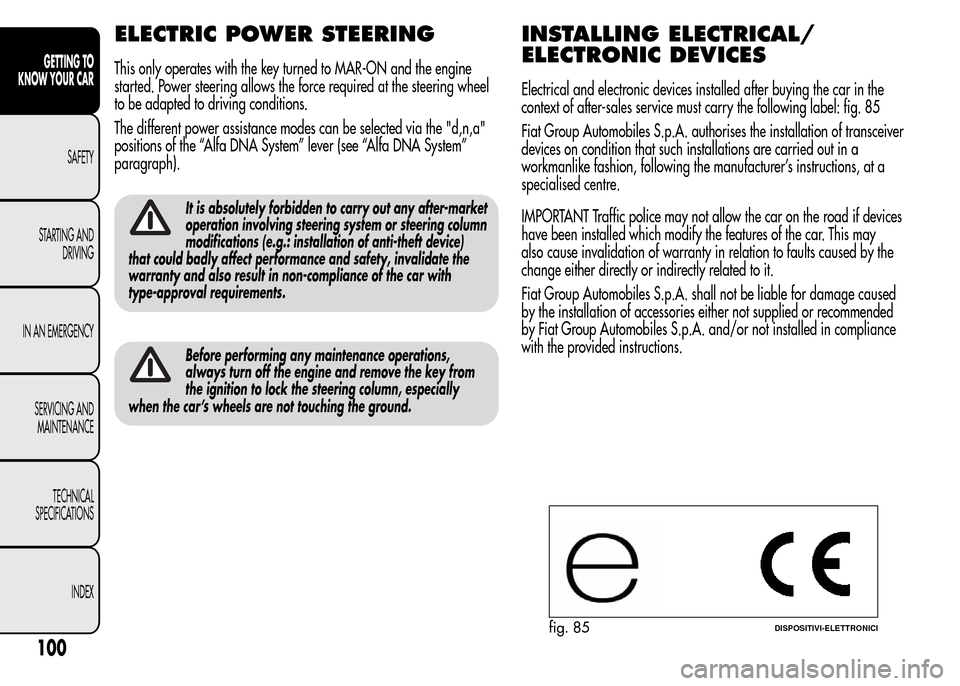
context of after-sales service must carry the following label: fig. 85
Fiat Group Automobiles S.p.A. authorises the installation of transceiver
devices on condition that such installations are carried out in a
workmanlike fashion, following the manufacturer’s instructions, at a
specialised centre.
IMPORTANT Traffic police may not allow the car on the road if devices
have been installed which modify the features of the car. This may
also cause invalidation of warranty in relation to faults caused by the
change either directly or indirectly related to it.
Fiat Group Automobiles S.p.A. shall not be liable for damage caused
by the installation of accessories either not supplied or recommended
by Fiat Group Automobiles S.p.A. and/or not installed in compliance
with the provided instructions.
fig. 85DISPOSITIVI-ELETTRONICI
100
GETTING TO
KNOW YOUR CAR
SAFETY
STARTING AND
DRIVING
IN AN EMERGENCY
SERVICING AND
MAINTENANCE
TECHNICAL
SPECIFICATIONS
INDEX
Page 111 of 280
REFUELLING THE CAR
Stop the engine before refuelling.
PETROL ENGINES
Only use unleaded petrol. The petrol octane rating (RON) must not be
lower than 95. In order to prevent damage to the catalytic converter
never introduce even the smallest amount of leaded petrol, even in the
event of an emergency.
DIESEL ENGINES
Use only diesel fuel compliant with European specification EN590. The
use of other products or mixtures may damage the engine beyond
repair and consequently invalidate the warranty, due to the damage
caused.
Operation at low temperatures
If the outside temperature is very low, the diesel thickens due to the
formation of paraffin clots with consequent defective operation of the
fuel supply system.
In order to avoid these problems, different types of diesel fuel are
distributed according to the season: summer type, winter type and
arctic type (cold/mountain areas). If refuelling with diesel fuel whose
features are not suitable for the temperature of use, it is advisable
to mix TUTELA DIESEL ART additive with the fuel, in the proportions
shown on the container. Pour the additive into the tank before the fuel.
When using or parking the vehicle for a long time in the mountains
or cold areas, it is advisable to refuel using locally available fuel.
In this case, it is also advisable to keep the tank over 50% full.
FUEL TANK CAP
Opening
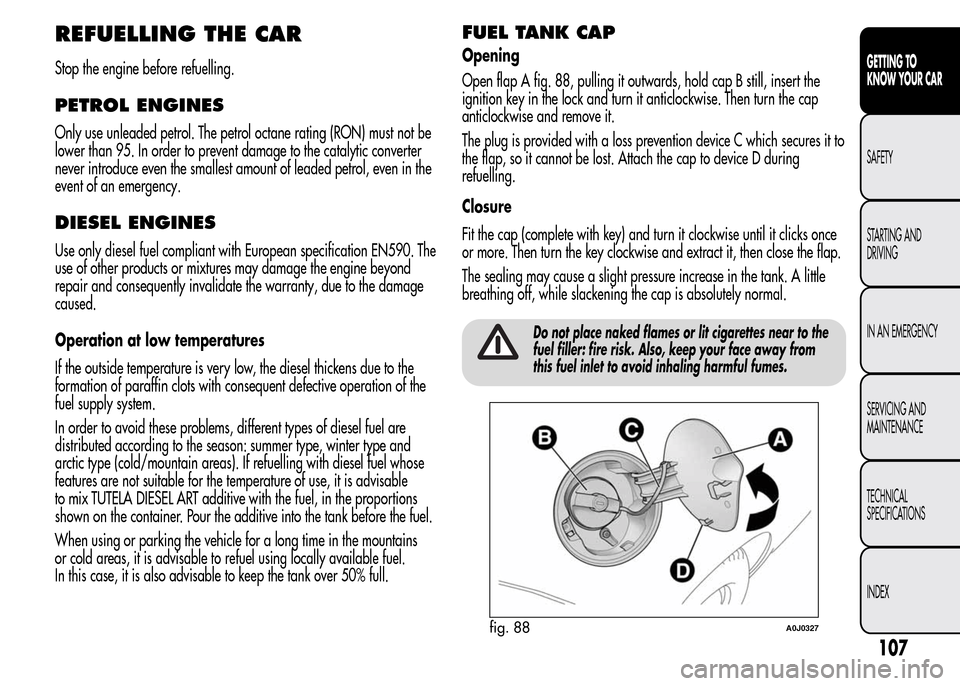
Open flap A fig. 88, pulling it outwards, hold cap B still, insert the
ignition key in the lock and turn it anticlockwise. Then turn the cap
anticlockwise and remove it.
The plug is provided with a loss prevention device C which secures it to
the flap, so it cannot be lost. Attach the cap to device D during
refuelling.
Closure
Fit the cap (complete with key) and turn it clockwise until it clicks once
or more. Then turn the key clockwise and extract it, then close the flap.
The sealing may cause a slight pressure increase in the tank. A little
breathing off, while slackening the cap is absolutely normal.
Do not place naked flames or lit cigarettes near to the
fuel filler: fire risk. Also, keep your face away from
this fuel inlet to avoid inhaling harmful fumes.
fig. 88A0J0327
107
GETTING TO
KNOW YOUR CAR
SAFETY
STARTING AND
DRIVING
IN AN EMERGENCY
SERVICING AND
MAINTENANCE
TECHNICAL
SPECIFICATIONS
INDEX