lock Alfa Romeo MiTo 2016 Service Manual
[x] Cancel search | Manufacturer: ALFA ROMEO, Model Year: 2016, Model line: MiTo, Model: Alfa Romeo MiTo 2016Pages: 280, PDF Size: 8.52 MB
Page 162 of 280
REPLACING INTERIOR BULBS
FRONT ROOF LIGHT
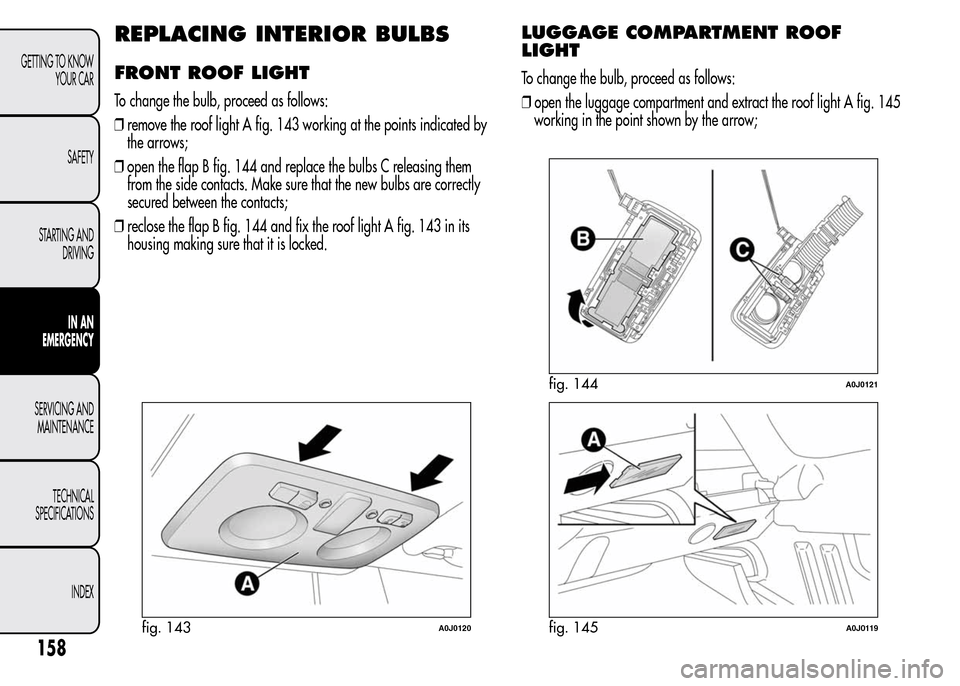
To change the bulb, proceed as follows:
❒remove the roof light A fig. 143 working at the points indicated by
the arrows;
❒open the flap B fig. 144 and replace the bulbs C releasing them
from the side contacts. Make sure that the new bulbs are correctly
secured between the contacts;
❒reclose the flap B fig. 144 and fix the roof light A fig. 143 in its
housing making sure that it is locked.
LUGGAGE COMPARTMENT ROOF
LIGHT
To change the bulb, proceed as follows:
❒open the luggage compartment and extract the roof light A fig. 145
working in the point shown by the arrow;
fig. 143A0J0120
fig. 144A0J0121
fig. 145A0J0119
158
GETTING TO KNOW
YOUR CAR
SAFETY
STARTING AND
DRIVING
IN AN
EMERGENCY
SERVICING AND
MAINTENANCE
TECHNICAL
SPECIFICATIONS
INDEX
Page 164 of 280
PUDDLE LIGHT
To change the bulb, proceed as follows:
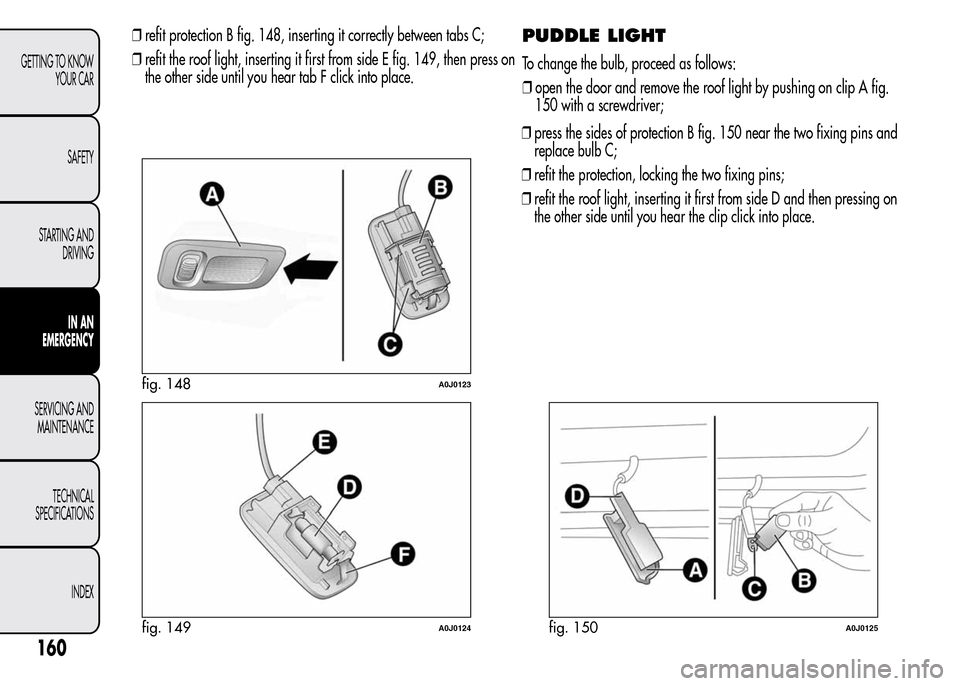
❒open the door and remove the roof light by pushing on clip A fig.
150 with a screwdriver;
❒press the sides of protection B fig. 150 near the two fixing pins and
replace bulb C;
❒refit the protection, locking the two fixing pins;
❒refit the roof light, inserting it first from side D and then pressing on
the other side until you hear the clip click into place.
fig. 148A0J0123
fig. 149A0J0124fig. 150A0J0125
160
GETTING TO KNOW
YOUR CAR
SAFETY
STARTING AND
DRIVING
IN AN
EMERGENCY
SERVICING AND
MAINTENANCE
TECHNICAL
SPECIFICATIONS
INDEX
❒refit protection B fig. 148, inserting it correctly between tabs C;
❒refit the roof light, inserting it first from side E fig. 149, then press on
the other side until you hear tab F click into place.
Page 170 of 280
INSTRUMENT PANEL FUSE BOX
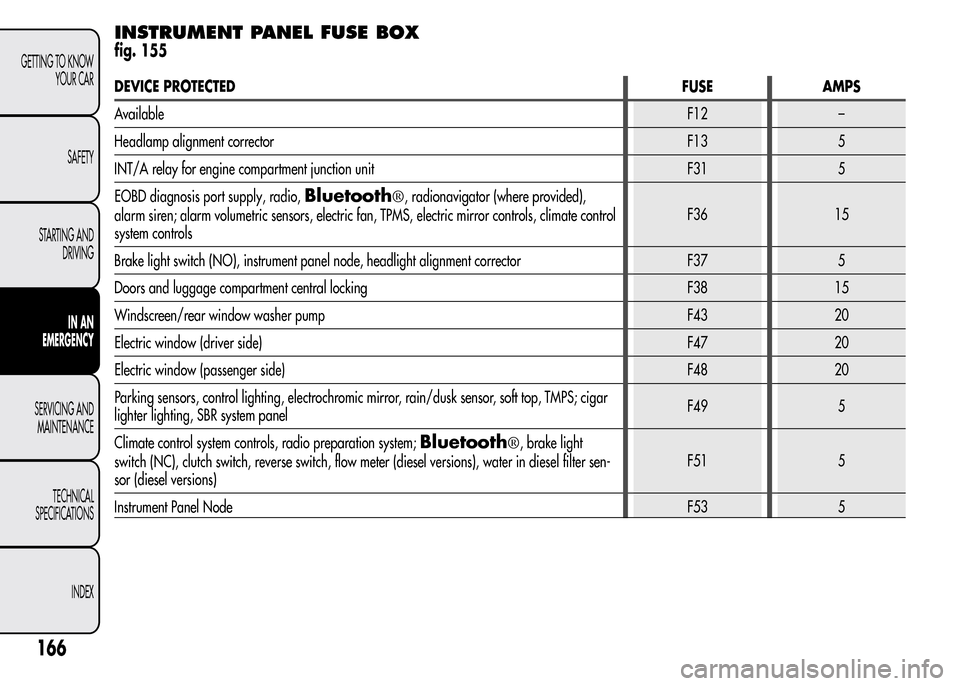
fig. 155
DEVICE PROTECTEDFUSE AMPS
AvailableF12 –
Headlamp alignment correctorF13 5
INT/A relay for engine compartment junction unit F31 5
EOBD diagnosis port supply, radio,
Bluetooth®, radionavigator (where provided),
alarm siren; alarm volumetric sensors, electric fan, TPMS, electric mirror controls, climate control
system controlsF36 15
Brake light switch (NO), instrument panel node, headlight alignment corrector F37 5
Doors and luggage compartment central locking F38 15
Windscreen/rear window washer pump F43 20
Electric window (driver side)F47 20
Electric window (passenger side)F48 20
Parking sensors, control lighting, electrochromic mirror, rain/dusk sensor, soft top, TMPS; cigar
lighter lighting, SBR system panelF49 5
Climate control system controls, radio preparation system;
Bluetooth®, brake light
switch (NC), clutch switch, reverse switch, flow meter (diesel versions), water in diesel filter sen-
sor (diesel versions)F51 5
Instrument Panel NodeF53 5
166
GETTING TO KNOW
YOUR CAR
SAFETY
STARTING AND
DRIVING
IN AN
EMERGENCY
SERVICING AND
MAINTENANCE
TECHNICAL
SPECIFICATIONS
INDEX
Page 174 of 280
Before beginning to tow, turn the ignition key to MAR
and then to STOP, without extracting it The steering
column will automatically lock when the key is
removed and the wheels cannot be steered.
Remember that whilst towing it is necessary to exert a
greater force when steering and braking because the
brake servo and electro-mechanical power steering
will be inoperative. Do not use wires for towing. Do not jerk. Be
careful not to damage parts in contact with the car while towing.
When towing the vehicle, you must comply with all specific traffic
regulations and adopt an appropriate driving behaviour. Do not
start the engine while towing the car. Clean the threaded seat
carefully before fastening the hook. Make sure that the hook is
fully fastened in the housing before towing the car.
The front and rear tow hooks should be used only for
emergencies on the road. You are allowed to tow the
vehicle for short distances using an appropriate device
in accordance with the highway code (a rigid bar), to move the
vehicle on the road in readiness for towing or transport via a
breakdown vehicle. Tow hooks MUST NOT be used to tow
vehicles off the road or where there are obstacles and/or for
towing operations using cables or other non-rigid devices.
Respecting the above conditions, towing must take place with the
two vehicles (one towing, the other towed) aligned as much as
possible along the same centre line.
170
GETTING TO KNOW
YOUR CAR
SAFETY
STARTING AND
DRIVING
IN AN
EMERGENCY
SERVICING AND
MAINTENANCE
TECHNICAL
SPECIFICATIONS
INDEX
Page 176 of 280
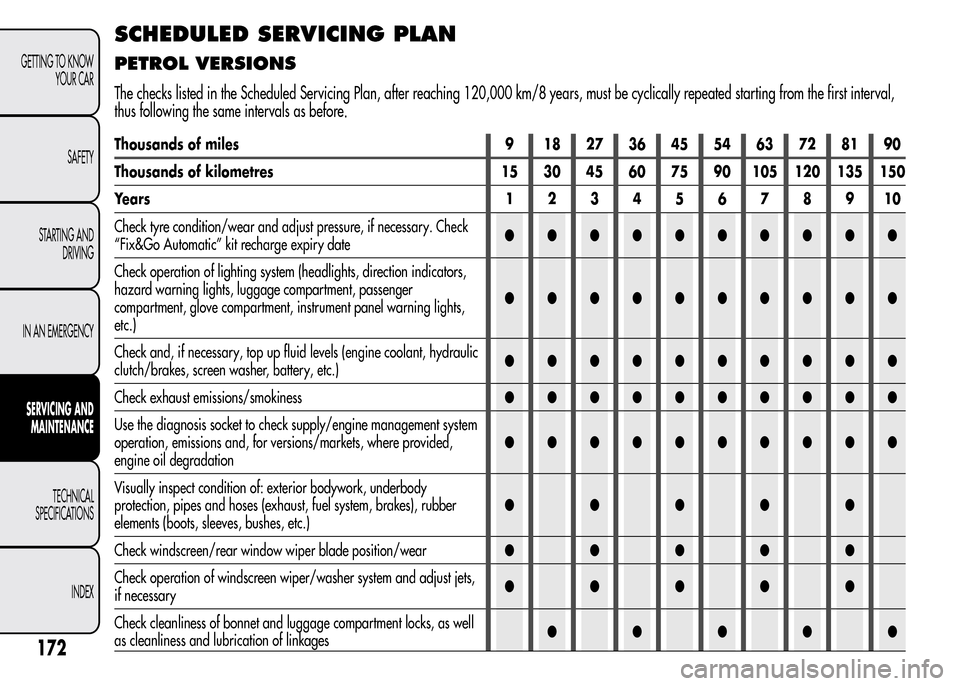
SCHEDULED SERVICING PLAN
PETROL VERSIONS
Thousands of miles 9 18 27 36 45 54 63 72 81 90
Thousands of kilometres 15 30 45 60 75 90 105 120 135 150
Years12345678910
Check tyre condition/wear and adjust pressure, if necessary. Check
“Fix&Go Automatic” kit recharge expiry date●●●●●●●●●●
Check operation of lighting system (headlights, direction indicators,
hazard warning lights, luggage compartment, passenger
compartment, glove compartment, instrument panel warning lights,
etc.)●●●●●●●●●●
Check and, if necessary, top up fluid levels (engine coolant, hydraulic
clutch/brakes, screen washer, battery, etc.)●●●●●●●●●●
Check exhaust emissions/smokiness●●●●●●●●●●
Use the diagnosis socket to check supply/engine management system
operation, emissions and, for versions/markets, where provided,
engine oil degradation●●●●●●●●●●
Visually inspect condition of: exterior bodywork, underbody
protection, pipes and hoses (exhaust, fuel system, brakes), rubber
elements (boots, sleeves, bushes, etc.)●●●●●
Check windscreen/rear window wiper blade position/wear●●●●●
Check operation of windscreen wiper/washer system and adjust jets,
if necessary●●●●●
Check cleanliness of bonnet and luggage compartment locks, as well
as cleanliness and lubrication of linkages●●●●●
172
GETTING TO KNOW
YOUR CAR
SAFETY
STARTING AND
DRIVING
IN AN EMERGENCY
SERVICING AND
MAINTENANCE
TECHNICAL
SPECIFICATIONS
INDEX
The checks listed in the Scheduled Servicing Plan, after reaching 120,000 km/8 years, must be cyclically repeated starting from the first interval,
thus following the same intervals as before.
Page 179 of 280
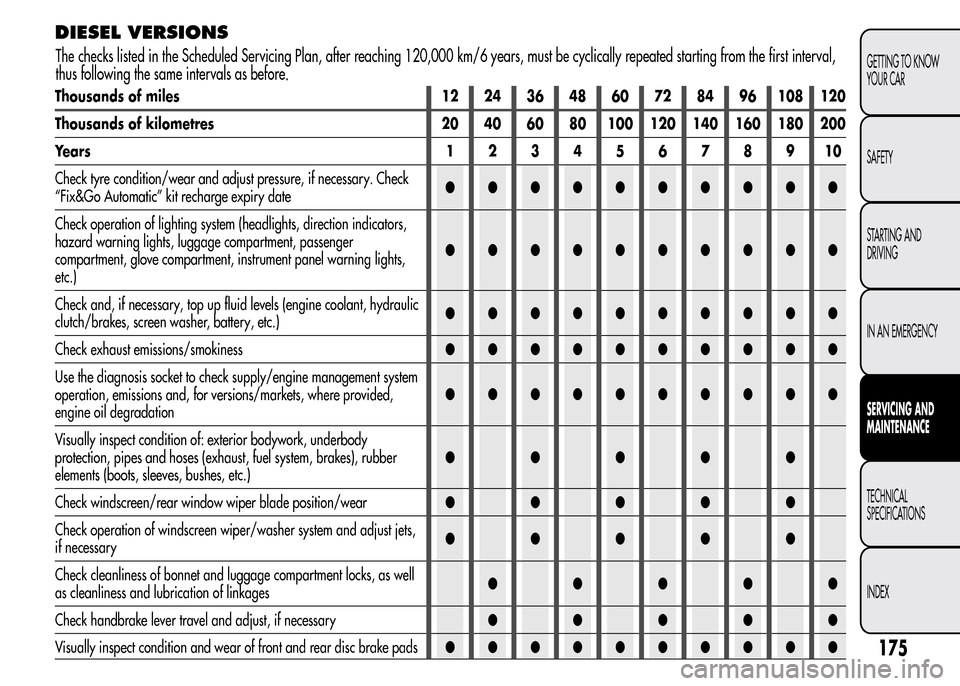
DIESEL VERSIONS
Thousands of miles 12 24 36 48 60 72 84 96 108 120
Thousands of kilometres 20 40 60 80 100 120 140 160 180 200
Years12345678910
Check tyre condition/wear and adjust pressure, if necessary. Check
“Fix&Go Automatic” kit recharge expiry date●●●●●●●●●●
Check operation of lighting system (headlights, direction indicators,
hazard warning lights, luggage compartment, passenger
compartment, glove compartment, instrument panel warning lights,
etc.)●●●●●●●●●●
Check and, if necessary, top up fluid levels (engine coolant, hydraulic
clutch/brakes, screen washer, battery, etc.)●●●●●●●●●●
Check exhaust emissions/smokiness●●●●●●●●●●
Use the diagnosis socket to check supply/engine management system
operation, emissions and, for versions/markets, where provided,
engine oil degradation●●●●●●●●●●
Visually inspect condition of: exterior bodywork, underbody
protection, pipes and hoses (exhaust, fuel system, brakes), rubber
elements (boots, sleeves, bushes, etc.)●●●●●
Check windscreen/rear window wiper blade position/wear●●●●●
Check operation of windscreen wiper/washer system and adjust jets,
if necessary●●●●●
Check cleanliness of bonnet and luggage compartment locks, as well
as cleanliness and lubrication of linkages●●●●●
Check handbrake lever travel and adjust, if necessary●●●●●
Visually inspect condition and wear of front and rear disc brake pads●●●●●●●●●●
175
GETTING TO KNOW
YOUR CAR
SAFETY
STARTING AND
DRIVING
IN AN EMERGENCY
SERVICING AND
MAINTENANCE
TECHNICAL
SPECIFICATIONS
INDEX
The checks listed in the Scheduled Servicing Plan, after reaching 120,000 km/6 years, must be cyclically repeated starting from the first interval,
thus following the same intervals as before.
Page 181 of 280
PERIODIC CHECKS
Every 1,000 km or before long journeys, check and restore the
following if necessary:
❒engine coolant, brake fluid and windscreen washer fluid level;
❒tyre inflation pressure and condition;
❒operation of lighting system (headlamps, direction indicators,
hazard warning lights, etc.);
❒operation of window washer/wiper system and positioning/wear of
windscreen/rear window wiper blades
Check and top up, if required, the engine oil level every 3,000 km.
HEAVY-DUTY USE OF THE CAR
If you use the car mainly under one of the following conditions:
❒towing a trailer or caravan;
❒dusty roads;
❒short, repeated journeys (less than 7-8 km) at sub-zero outside
temperatures;
❒engine often idling or driving long distances at low speeds or long
periods of idleness;
the following checks must be performed more frequently than indicated
in the Scheduled Servicing Plan:
❒check front disc brake pad conditions and wear;
❒check cleanliness of bonnet and boot locks, cleanliness and
lubrication of linkage;
❒visually inspect conditions of: engine, gearbox, transmission, pipes
and hoses (exhaust - fuel system - brakes) and rubber elements
(boots - sleeves - bushes - etc.);
❒check battery charge and battery fluid level (electrolyte);
❒visually inspect condition of the accessory drive belts;
❒check and, if necessary, change engine oil and replace oil filter;
❒check and, if necessary, replace pollen filter;
❒check and, if necessary, replace air cleaner.
177
GETTING TO KNOW
YOUR CAR
SAFETY
STARTING AND
DRIVING
IN AN EMERGENCY
SERVICING AND
MAINTENANCE
TECHNICAL
SPECIFICATIONS
INDEX
Page 194 of 280
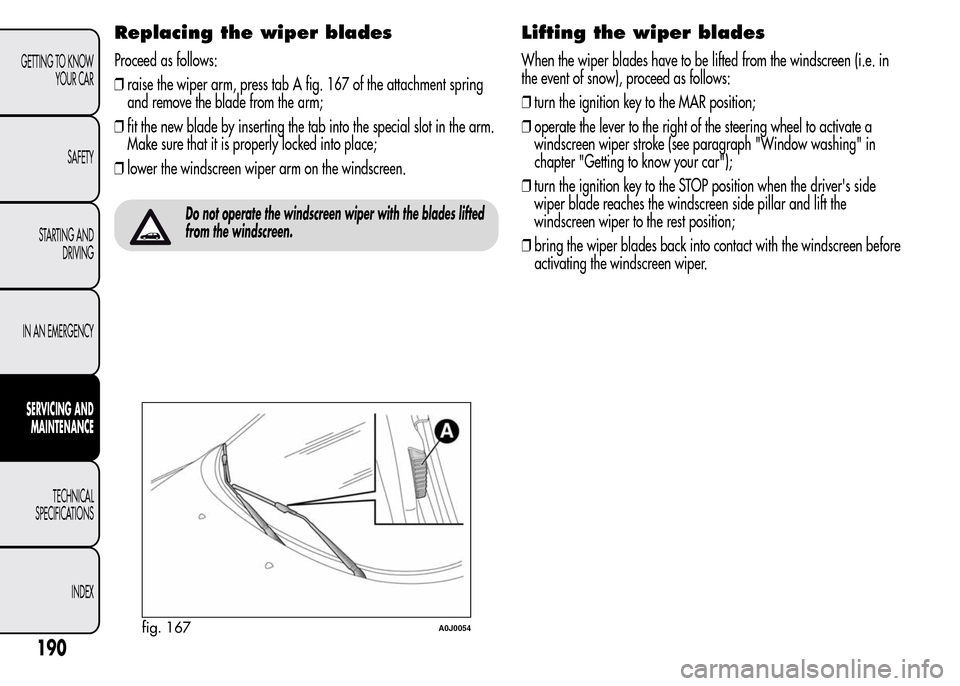
Replacing the wiper blades
Proceed as follows:
❒raise the wiper arm, press tab A fig. 167 of the attachment spring
and remove the blade from the arm;
❒fit the new blade by inserting the tab into the special slot in the arm.
Make sure that it is properly locked into place;
❒lower the windscreen wiper arm on the windscreen.
Do not operate the windscreen wiper with the blades lifted
from the windscreen.
Lifting the wiper blades
When the wiper blades have to be lifted from the windscreen (i.e. in
the event of snow), proceed as follows:
❒turn the ignition key to the MAR position;
❒operate the lever to the right of the steering wheel to activate a
windscreen wiper stroke (see paragraph "Window washing" in
chapter "Getting to know your car");
❒turn the ignition key to the STOP position when the driver's side
wiper blade reaches the windscreen side pillar and lift the
windscreen wiper to the rest position;
❒bring the wiper blades back into contact with the windscreen before
activating the windscreen wiper.
fig. 167A0J0054
190
GETTING TO KNOW
YOUR CAR
SAFETY
STARTING AND
DRIVING
IN AN EMERGENCY
SERVICING AND
MAINTENANCE
TECHNICAL
SPECIFICATIONS
INDEX
Page 201 of 280
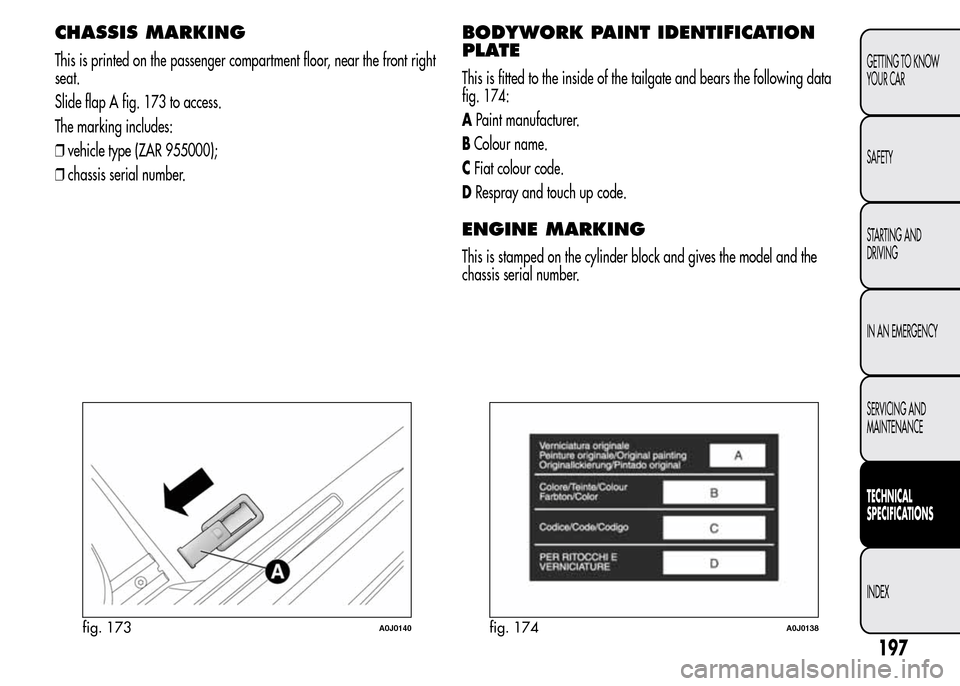
CHASSIS MARKING
This is printed on the passenger compartment floor, near the front right
seat.
Slide flap A fig. 173 to access.
The marking includes:
❒vehicle type (ZAR 955000);
❒chassis serial number.
BODYWORK PAINT IDENTIFICATION
PLATE
This is fitted to the inside of the tailgate and bears the following data
fig. 174:
APaint manufacturer.
BColour name.
CFiat colour code.
DRespray and touch up code.
ENGINE MARKING
This is stamped on the cylinder block and gives the model and the
chassis serial number.
fig. 173A0J0140fig. 174A0J0138
197
GETTING TO KNOW
YOUR CAR
SAFETY
STARTING AND
DRIVING
IN AN EMERGENCY
SERVICING AND
MAINTENANCE
TECHNICAL
SPECIFICATIONS
INDEX
Page 225 of 280
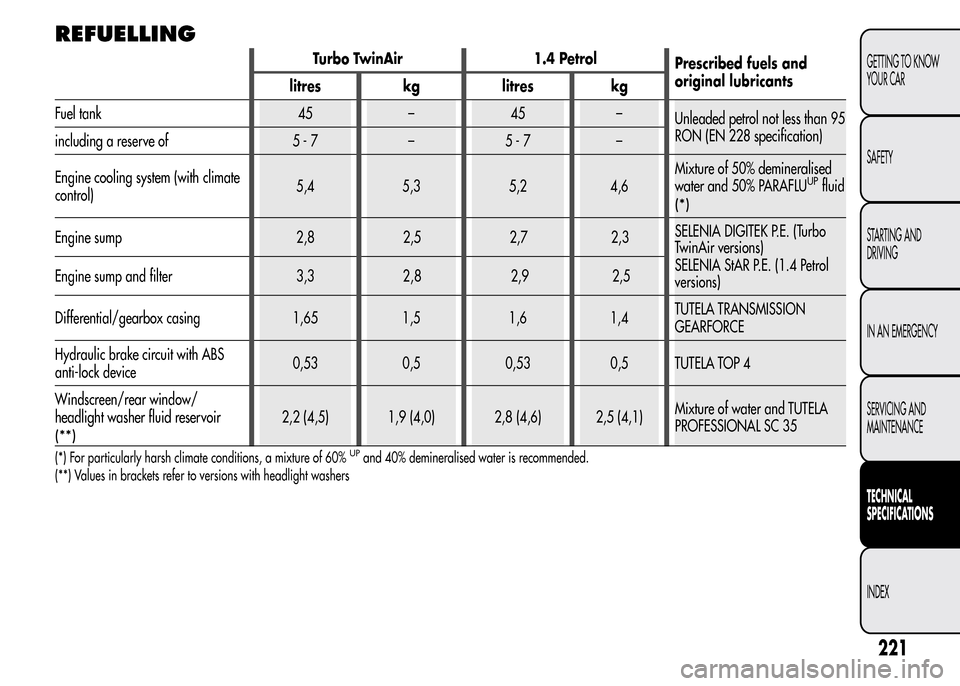
REFUELLING
Turbo TwinAir 1.4 Petrol
Prescribed fuels and
original lubricants
litres kg litres kg
Fuel tank 45 – 45 –
Unleaded petrol not less than 95
RON (EN 228 specification)
including a reserve of 5 - 7 – 5 - 7 –
Engine cooling system (with climate
control)5,4 5,3 5,2 4,6Mixture of 50% demineralised
water and 50% PARAFLU
UPfluid
(*)
Engine sump 2,8 2,5 2,7 2,3SELENIA DIGITEK P.E. (Turbo
TwinAir versions)
SELENIA StAR P.E. (1.4 Petrol
versions) Engine sump and filter 3,3 , 2,9 2,5
Differential/gearbox casing 1,65 1,5 1,6 1,4TUTELA TRANSMISSION
GEARFORCE
Hydraulic brake circuit with ABS
anti-lock device0,53 0,5 0,53 0,5 TUTELA TOP 4
Windscreen/rear window/
headlight washer fluid reservoir
(**)
2,2 (4,5) 1,9 (4,0) 2,8 (4,6) 2,5 (4,1)Mixture of water and TUTELA
PROFESSIONAL SC 35
(*) For particularly harsh climate conditions, a mixture of 60%UPand 40% demineralised water is recommended.
(**) Values in brackets refer to versions with headlight washers
221
GETTING TO KNOW
YOUR CAR
SAFETY
STARTING AND
DRIVING
IN AN EMERGENCY
SERVICING AND
MAINTENANCE
TECHNICAL
SPECIFICATIONS
INDEX
28