Rain Alfa Romeo MiTo 2016 Owner's Guide
[x] Cancel search | Manufacturer: ALFA ROMEO, Model Year: 2016, Model line: MiTo, Model: Alfa Romeo MiTo 2016Pages: 280, PDF Size: 8.52 MB
Page 125 of 280
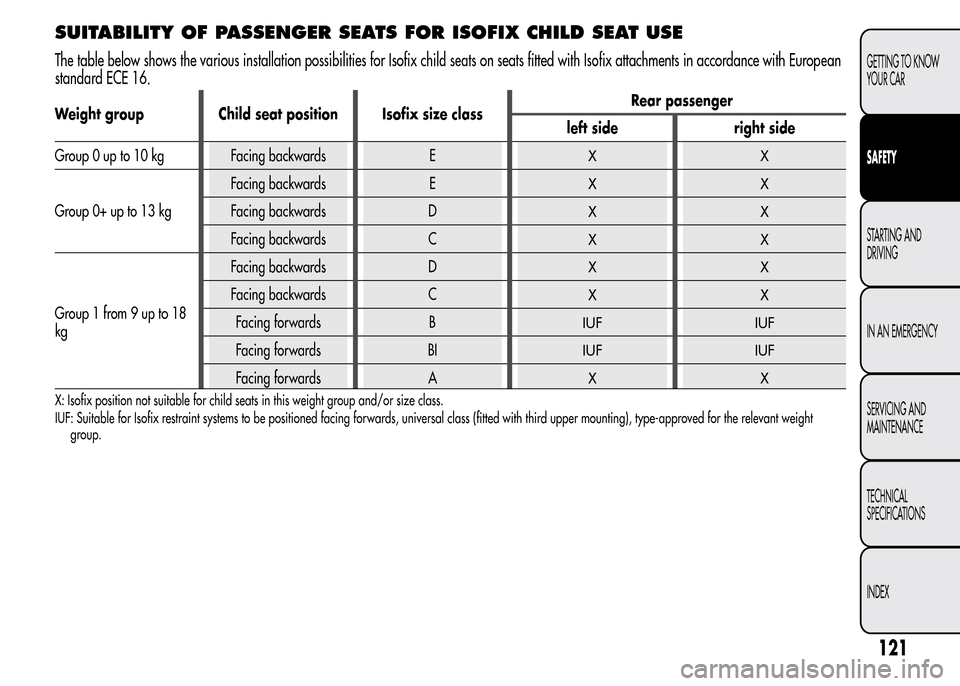
SUITABILITY OF PASSENGER SEATS FOR ISOFIX CHILD SEAT USE
The table below shows the various installation possibilities for Isofix child seats on seats fitted with Isofix attachments in accordance with European
standard ECE 16.
Weight group Child seat position Isofix size classRear passenger
left side right side
Group 0 up to 10 kg Facing backwards E
XX
Group 0+ up to 13 kgFacing backwards E
XX
Facing backwards DXX
Facing backwards CXX
Group 1 from 9 up to 18
kgFacing backwards D
XX
Facing backwards CXX
Facing forwards BIUF IUF
Facing forwards BIIUF IUF
Facing forwards AXX
X: Isofix position not suitable for child seats in this weight group and/or size class.
IUF: Suitable for Isofix restraint systems to be positioned facing forwards, universal class (fitted with third upper mounting), type-approved forthe relevant weight
group.
121
GETTING TO KNOW
YOUR CAR
SAFETY
STARTING AND
DRIVING
IN AN EMERGENCY
SERVICING AND
MAINTENANCE
TECHNICAL
SPECIFICATIONS
INDEX
Page 126 of 280
Fit the child seat according to the instructions, which
must be included.
Main recommendations to carry children safely
❒Install the child seats on the rear seat, which is the most protected
position in the event of an accident.
❒Keep children in rear facing seats for as long as possible, until 2
years old.
❒Should a rear facing child seat be installed on the rear seats, it is
advisable to position it as far forward as the position of the front
seat allows.
❒If the passenger's front airbag is deactivated always check the
permanent switching on of the dedicated warning light on the
instrument panel to make sure that it has actually been deactivated.
❒Carefully follow the instructions supplied with the child seat itself.
Keep the instructions in the car along with the other documents
and this handbook. Do not use second-hand child seats without
instructions.
❒Only one child is to be strapped into each restraint system; never
carry two children simultaneously.
❒Always check that the seat belts do not interfere with the child's
throat.❒Always check that the seat belt is well fastened by pulling on it.
❒While travelling, do not let the child sit incorrectly or unfasten the
belts.
❒Never allow a child to put the belt's diagonal section under an arm
or behind their back.
❒Never carry children on your lap, even newborns. No-one can
restrain a child in the event of an accident.
❒In the event of an accident, replace the child seat with a new one.
122
GETTING TO KNOW
YOUR CAR
SAFETY
STARTING AND
DRIVING
IN AN EMERGENCY
SERVICING AND
MAINTENANCE
TECHNICAL
SPECIFICATIONS
INDEX
Page 128 of 280
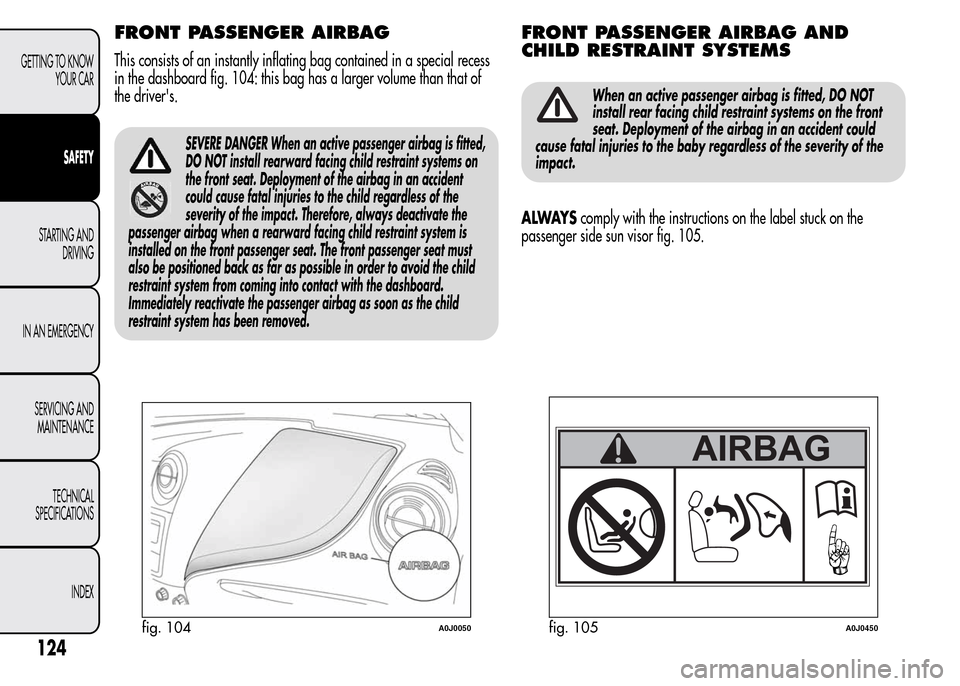
FRONT PASSENGER AIRBAG
This consists of an instantly inflating bag contained in a special recess
in the dashboard fig. 104: this bag has a larger volume than that of
the driver's.
SEVERE DANGER When an active passenger airbag is fitted,
DO NOT install rearward facing child restraint systems on
the front seat. Deployment of the airbag in an accident
could cause fatal injuries to the child regardless of the
severity of the impact. Therefore, always deactivate the
passenger airbag when a rearward facing child restraint system is
installed on the front passenger seat. The front passenger seat must
also be positioned back as far as possible in order to avoid the child
restraint system from coming into contact with the dashboard.
Immediately reactivate the passenger airbag as soon as the child
restraint system has been removed.
FRONT PASSENGER AIRBAG AND
CHILD RESTRAINT SYSTEMS
When an active passenger airbag is fitted, DO NOT
install rear facing child restraint systems on the front
seat. Deployment of the airbag in an accident could
cause fatal injuries to the baby regardless of the severity of the
impact.
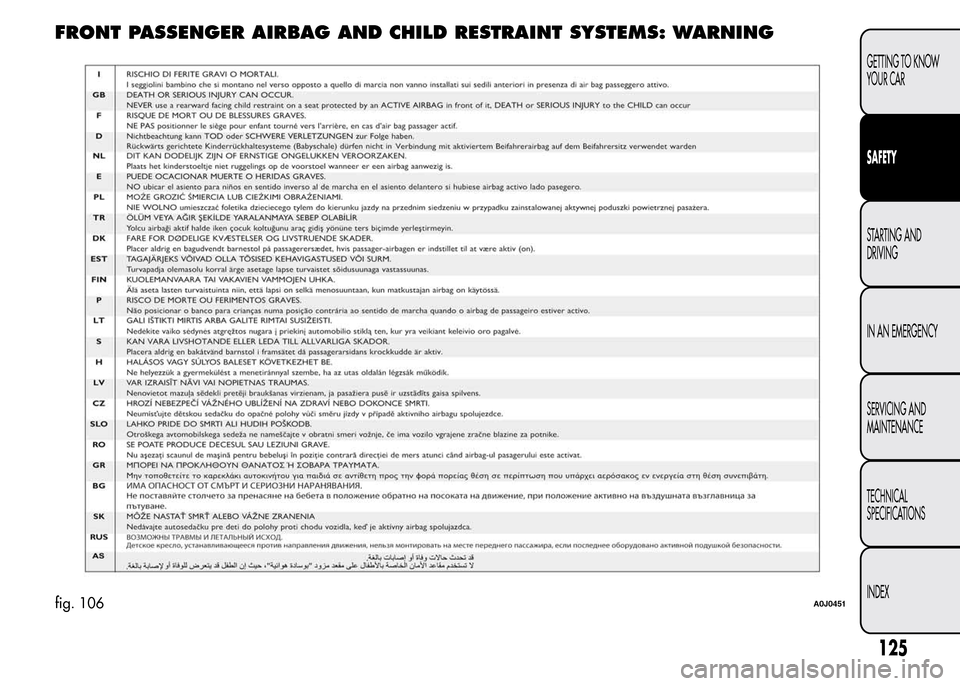
ALWAYScomply with the instructions on the label stuck on the
passenger side sun visor fig. 105.
fig. 104A0J0050fig. 105A0J0450
124
GETTING TO KNOW
YOUR CAR
SAFETY
STARTING AND
DRIVING
IN AN EMERGENCY
SERVICING AND
MAINTENANCE
TECHNICAL
SPECIFICATIONS
INDEX
Page 129 of 280
FRONT PASSENGER AIRBAG AND CHILD RESTRAINT SYSTEMS: WARNING
fig. 106A0J0451
125
GETTING TO KNOW
YOUR CAR
SAFETY
STARTING AND
DRIVING
IN AN EMERGENCY
SERVICING AND
MAINTENANCE
TECHNICAL
SPECIFICATIONS
INDEX
Page 130 of 280
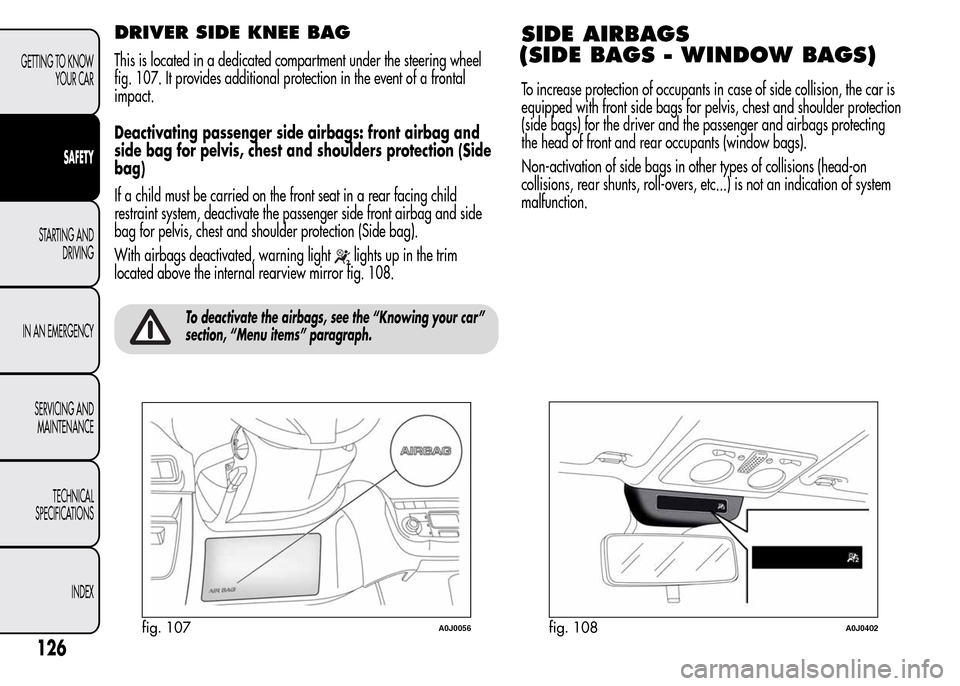
DRIVER SIDE KNEE BAG
This is located in a dedicated compartment under the steering wheel
fig. 107. It provides additional protection in the event of a frontal
impact.
Deactivating passenger side airbags: front airbag and
side bag for pelvis, chest and shoulders protection (Side
bag)
If a child must be carried on the front seat in a rear facing child
restraint system, deactivate the passenger side front airbag and side
bag for pelvis, chest and shoulder protection (Side bag).
With airbags deactivated, warning light
lights up in the trim
located above the internal rearview mirror fig. 108.
To deactivate the airbags, see the “Knowing your car”
section, “Menu items” paragraph.
SIDE AIRBAGS
(SIDE BAGS - WINDOW BAGS)
To increase protection of occupants in case of side collision, the car is
equipped with front side bags for pelvis, chest and shoulder protection
(side bags) for the driver and the passenger and airbags protecting
the head of front and rear occupants (window bags).
Non-activation of side bags in other types of collisions (head-on
collisions, rear shunts, roll-overs, etc...) is not an indication of system
malfunction.
fig. 107A0J0056fig. 108A0J0402
126
GETTING TO KNOW
YOUR CAR
SAFETY
STARTING AND
DRIVING
IN AN EMERGENCY
SERVICING AND
MAINTENANCE
TECHNICAL
SPECIFICATIONS
INDEX
Page 132 of 280
IMPORTANT
Do not wash the seats with water or pressurised steam (by hand or at
automatic seat washing stations).
The front and/or side bags may activate in the event of sharp knocks
to the underbody of the car (e.g. impact with steps, pavements,
potholes or road bumps etc.).
When the airbag deploys it emits a small amount of dust: the dust is
harmless and does not indicate the beginning of a fire. The dust may
irritate the skin and eyes however: in this case, wash with neutral soap
and water.
All operations on airbags (inspection, repair and replacement) must be
carried out by Alfa Romeo Authorized Services.
If the car is to be scrapped, contact Alfa Romeo Authorised Services to
have the airbags deactivated.
Pretensioners and airbags are deployed in different ways, according to
the type of impact. Failure to deploy of one of the devices does not
necessarily indicate a system malfunction.
If thewarning light does not switch on when the
key is turned to MAR-ON, or stays on while driving (on
some versions together with a message on the
display) there may be a fault in the restraint systems. In this
case, airbags or pretensioners may not be activated in the case
of an accident or (in a lesser number of cases) they may be
activated incorrectly. Before proceeding, contact Alfa Romeo
Authorised Services to have the system checked immediately.
Do not travel carrying objects in your lap, in front of
your chest or between your lips (pipe, pencils, etc.):
they could cause severe injury if the airbag is
deployed.
If the car has been subject to theft, attempted theft,
vandalism, or flooding, have the airbag system
inspected at Alfa Romeo Authorised Services.
When the ignition key is in and turned in the MAR-ON
position and the engine is off, the airbags may deploy
if the car is crashed by another moving vehicle.
Therefore, even if the car is stationary, when an active passenger
airbag is fitted, DO NOT install rear facing child restraint systems
on the front passenger seat. Deployment of the airbag following
an impact could cause fatal injuries to the child. Therefore,
always deactivate the passenger airbag when a rear facing child
restraint system is installed on the front passenger seat. The front
passenger seat must also be positioned back as far as possible
in order to avoid the child restraint system from coming into
contact with the dashboard. Immediately reactivate the
passenger airbag as soon as the child restraint system has been
removed. Also remember that, if the key is turned to STOP, none
of the safety devices (airbags or pretensioners) will be deployed
in the event of collision. Non-deployment in such cases does not
indicate a system malfunction.
128
GETTING TO KNOW
YOUR CAR
SAFETY
STARTING AND
DRIVING
IN AN EMERGENCY
SERVICING AND
MAINTENANCE
TECHNICAL
SPECIFICATIONS
INDEX
Page 135 of 280
PROCEDURE FOR DIESEL VERSIONS
Proceed as follows:
❒engage the handbrake and place the gearbox lever in neutral;
❒turn the ignition key to MAR-ON: the warning lights
and
(or the symbol on the display) on the instrument panel will
switch on;
❒wait for the warning lights (or the symbol on the display) to switch
off;
❒fully depress the clutch pedal, without touching the accelerator;
❒turn the ignition key to AVV;
warning light switches off.
Waiting too long will waste the heating work carried out by the
glow plugs. Release the key as soon as the engine starts.
If thewarning light flashes for about 1 minute after
starting or during prolonged cranking, this indicates a fault
in the glow plug preheating system. Use the car normally
if the engine starts and go to Alfa Romeo Authorized Services as soon
as possible.
It is dangerous to run the engine in enclosed areas. The
engine takes in oxygen and releases carbon dioxide,
carbon monoxide and other toxic gases.
It is advisable not to demand maximum performance from
your car (e.g. excessive acceleration, long distances at
maximum rpm, excessively intense braking, etc.) when it is
first used.
When the engine is off, do not leave the ignition key turned
to MAR to prevent unnecessary electrical consumption from
draining the battery.
Remember that the brake servo and electromechanical
power steering are not operational until the engine
has been started, therefore much more effort than
usual is required on the brake pedal and steering wheel.
Never start the engine by pushing, towing or driving
downhill. These manoeuvres may damage the catalytic
converter.
131
GETTING TO KNOW
YOUR CAR
SAFETY
STARTING AND
DRIVING
IN AN EMERGENCY
SERVICING AND
MAINTENANCE
TECHNICAL
SPECIFICATIONS
INDEX
Page 142 of 280
SNOW CHAINS
The use of snow chains should be in compliance with local regulations.
The snow chains may be applied only onto the front wheel tyres (drive
wheels).
Check the tension of the snow chains after the first few metres have
been driven.
Use reduced size snow chains: on all versions, for 195/55 R16" and
205/55 R16" size tyres use low-clearance snow chains with a
maximum projection beyond the tyre profile of 9 mm.
IMPORTANT The space-saver wheel cannot be fitted with snow chains.
If a front (drive) wheel is punctured and snow chains must be used,
you must remove a normal wheel from the rear and replace this one
with the space-saver wheel. In this way, with two normal drive wheels,
it is possible to use snow chains.
Keep your speed down when snow chains are fitted; do not
exceed 50 km/h. Avoid potholes, steps and pavements
and avoid driving long distances on roads not covered with
snow to avoid damaging the car and the roadbed.
STORING THE CAR
If the car is to be left inactive for longer than a month, the following
precautions should be noted:
❒park the vehicle in a dry, covered and, if possible, ventilated area;
engage a gear and check that the handbrake is not engaged;
❒disconnect the negative battery terminal and check the battery
charge. Repeat this check once every three months during storage;
❒if you have not disconnected the battery, check the battery charge
every thirty days;
❒clean and protect the painted parts using protective wax;
❒clean and protect the shiny metal parts using special compounds
available commercially;
❒sprinkle talcum powder on the windscreen and rear window wiper
rubber blades and lift them off the glass;
❒slightly open the windows;
❒cover the car with a cloth or perforated plastic sheet. Do not use
compact plastic sheets which do not allow humidity to evaporate
from the surface of the car.
❒inflate tyres to +0.5 bar above the standard specified pressure and
check it at intervals;
❒do not drain the engine cooling system.
IMPORTANT After turning the ignition key to STOP, wait at least 1
minute before disconnecting the battery power supply.
138
GETTING TO KNOW
YOUR CAR
SAFETY
STARTING AND
DRIVING
IN AN EMERGENCY
SERVICING AND
MAINTENANCE
TECHNICAL
SPECIFICATIONS
INDEX
Page 155 of 280
CHANGING A BULB
GENERAL INSTRUCTIONS
❒Before changing a bulb check the contacts for oxidation;
❒blown bulbs must be replaced with others of the same type and
power;
❒after replacing a headlight bulb, always check its alignment;
❒when a light is not working, check that the corresponding fuse is
intact before changing a bulb. For the location of fuses, refer to
the paragraph “Replacing fuses” in this section.
Halogen bulbs must be handled holding the metal part
only. Touching the transparent part of the bulb with your
fingers may reduce the intensity of the emitted light and
even reduce the lifespan of the bulb. In case of accidental contact, wipe
the bulb with a cloth moistened with alcohol and let the bulb dry.
Modifications or repairs to the electric system that are
not carried out properly or do not take the system
technical specifications into account can cause
malfunctions leading to the risk of fire.
Halogen bulbs contain pressurised gas which may
cause small fragments of glass to be projected
outwards if the bulb is broken.
IMPORTANT When the weather is cold or damp or after heavy rain or
washing, the surface of headlights or rear lights, may steam up and/or
form drops of condensation on the inside. This is a natural
phenomenon due to the difference in temperature and humidity
between the inside and the outside of the glass which does not indicate
a fault and does not compromise the normal operation of lighting
devices. The mist disappears quickly when the lights are turned on,
starting from the centre of the diffuser, extending progressively towards
the edges.
151
GETTING TO KNOW
YOUR CAR
SAFETY
STARTING AND
DRIVING
IN AN
EMERGENCY
SERVICING AND
MAINTENANCE
TECHNICAL
SPECIFICATIONS
INDEX
Page 170 of 280
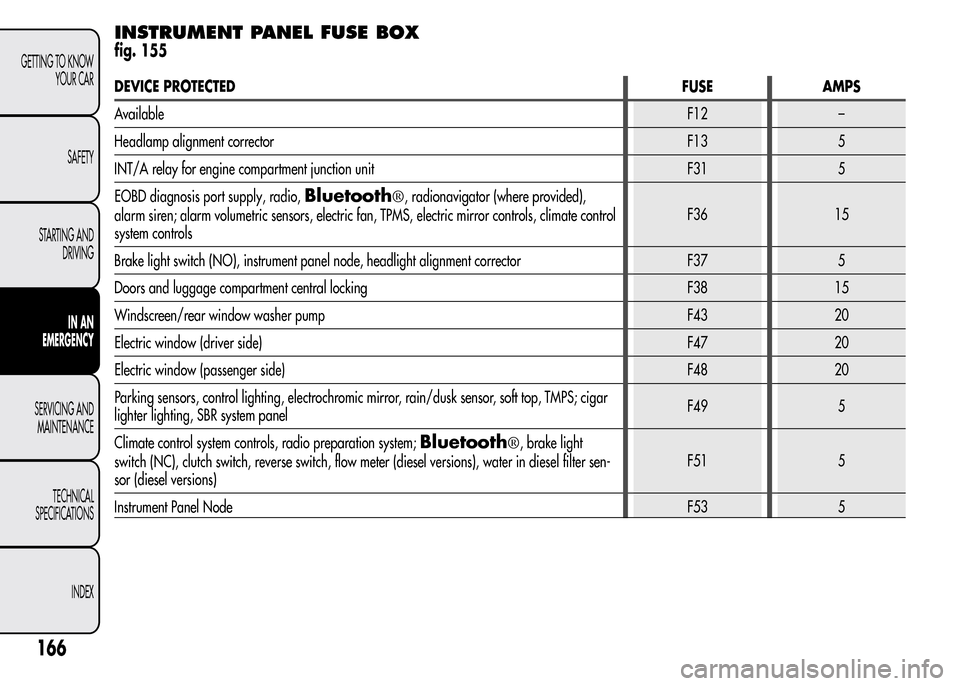
INSTRUMENT PANEL FUSE BOX
fig. 155
DEVICE PROTECTEDFUSE AMPS
AvailableF12 –
Headlamp alignment correctorF13 5
INT/A relay for engine compartment junction unit F31 5
EOBD diagnosis port supply, radio,
Bluetooth®, radionavigator (where provided),
alarm siren; alarm volumetric sensors, electric fan, TPMS, electric mirror controls, climate control
system controlsF36 15
Brake light switch (NO), instrument panel node, headlight alignment corrector F37 5
Doors and luggage compartment central locking F38 15
Windscreen/rear window washer pump F43 20
Electric window (driver side)F47 20
Electric window (passenger side)F48 20
Parking sensors, control lighting, electrochromic mirror, rain/dusk sensor, soft top, TMPS; cigar
lighter lighting, SBR system panelF49 5
Climate control system controls, radio preparation system;
Bluetooth®, brake light
switch (NC), clutch switch, reverse switch, flow meter (diesel versions), water in diesel filter sen-
sor (diesel versions)F51 5
Instrument Panel NodeF53 5
166
GETTING TO KNOW
YOUR CAR
SAFETY
STARTING AND
DRIVING
IN AN
EMERGENCY
SERVICING AND
MAINTENANCE
TECHNICAL
SPECIFICATIONS
INDEX