warning Alfa Romeo MiTo 2016 Owner's Guide
[x] Cancel search | Manufacturer: ALFA ROMEO, Model Year: 2016, Model line: MiTo, Model: Alfa Romeo MiTo 2016Pages: 280, PDF Size: 8.52 MB
Page 106 of 280
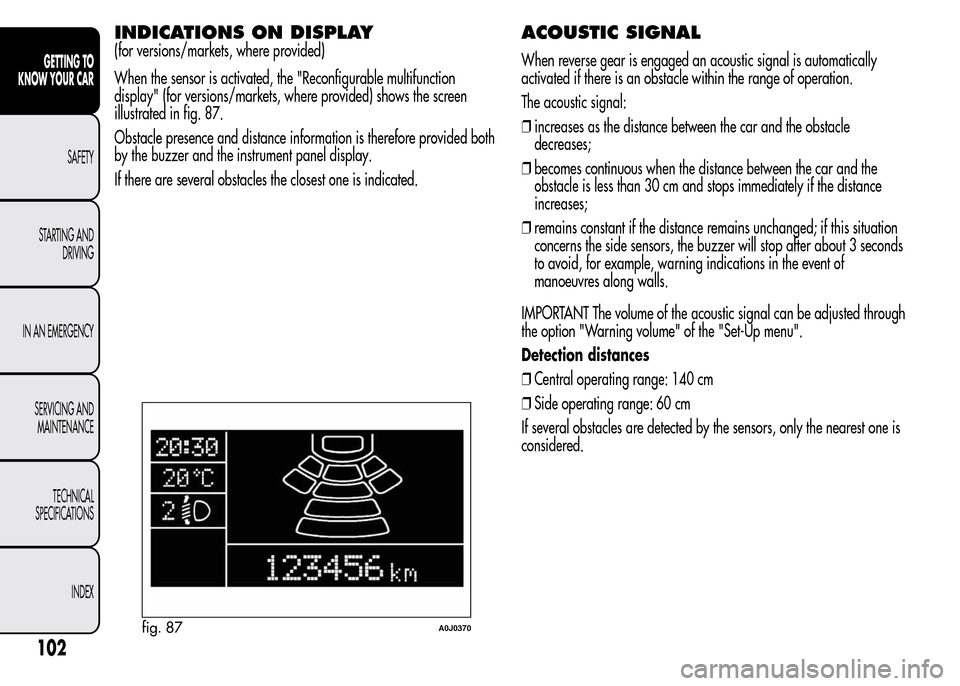
INDICATIONS ON DISPLAY
(for versions/markets, where provided)
When the sensor is activated, the "Reconfigurable multifunction
display" (for versions/markets, where provided) shows the screen
illustrated in fig. 87.
Obstacle presence and distance information is therefore provided both
by the buzzer and the instrument panel display.
If there are several obstacles the closest one is indicated.
ACOUSTIC SIGNAL
When reverse gear is engaged an acoustic signal is automatically
activated if there is an obstacle within the range of operation.
The acoustic signal:
❒increases as the distance between the car and the obstacle
decreases;
❒becomes continuous when the distance between the car and the
obstacle is less than 30 cm and stops immediately if the distance
increases;
❒remains constant if the distance remains unchanged; if this situation
concerns the side sensors, the buzzer will stop after about 3 seconds
to avoid, for example, warning indications in the event of
manoeuvres along walls.
IMPORTANT The volume of the acoustic signal can be adjusted through
the option "Warning volume" of the "Set-Up menu".
Detection distances
❒Central operating range: 140 cm
❒Side operating range: 60 cm
If several obstacles are detected by the sensors, only the nearest one is
considered.
fig. 87A0J0370
102
GETTING TO
KNOW YOUR CAR
SAFETY
STARTING AND
DRIVING
IN AN EMERGENCY
SERVICING AND
MAINTENANCE
TECHNICAL
SPECIFICATIONS
INDEX
Page 107 of 280
OPERATION WITH TRAILER
Parking sensor operation is deactivated automatically when the trailer
electric cable plug is fitted into the car tow hook socket. The sensors
are automatically enabled again when the trailer's cable plug is
removed.
The sensor must be free of mud, dirt, snow or ice in order
for the system to work. Be careful not to scratch or damage
the sensors while cleaning them. Avoid using dry, rough
or hard cloths. The sensors should be washed using clean water with
the addition of car shampoo if necessary. When using special washing
equipment such as high pressure jets or steam cleaning, clean the
sensors very quickly keeping the jet more than 10 cm away.
When repainting the bumpers or touching up paint in
the sensor area, contact Alfa Romeo Authorized
Services only. Incorrect paint application could affect
the operation of the parking sensors.
Parking manoeuvres however are always the driver’s
responsibility. When carrying out such manoeuvres,
always ensure that the manoeuvring area is free of
people (particularly children) and animals. The parking sensor is
designed to assist drivers, who must still never allow their
attention to lapse during potentially dangerous manoeuvres even
if performed at low speed.
GENERAL WARNINGS
During parking manoeuvres, pay the utmost attention to any obstacles
that could be located above or below the sensors.
Objects located near the rear of the car are not detected under certain
circumstances and could therefore cause damage to the car or be
damaged.
The following conditions may influence the performance of the parking
sensor system:
❒reduced sensor sensitivity and a reduction in the parking assistance
system performance could be due to the presence on the surface of
the sensor of: ice, snow, mud, thick paint
❒the sensors may detect a non-existent obstacle (echo interference)
due to mechanical interference, for example when washing the
car, in rain (strong wind), hail;
❒The signals sent by the sensors can also be altered by the presence
of ultrasonic systems (e.g. pneumatic brake systems or pneumatic
drills) near the vehicle.
❒sensor performance can also be influenced by the position of the
sensors. For example by a change in the ride setting (caused by
the wear of the shock absorbers, suspension), overloading the
vehicle and carrying out specific tuning operations that require the
vehicle to be lowered;
❒The detection of obstacles at the top part of the car may not be
guaranteed because the system detects obstacles that could cause an
impact with the car in the bottom part.
103
GETTING TO
KNOW YOUR CAR
SAFETY
STARTING AND
DRIVING
IN AN EMERGENCY
SERVICING AND
MAINTENANCE
TECHNICAL
SPECIFICATIONS
INDEX
Page 108 of 280
TPMS (Tyre Pressure
Monitoring System)
(for versions/markets, where provided)
The car may be fitted with a tyre pressure monitoring system (TPMS),
which informs the driver of the tyre inflation status via the "Check
tyre pressure" and "Low tyre pressure" messages on the display.
This system comprises a radio frequency transmitter fitted to each
wheel (on the wheel rim inside the tyre), which is able to send
information on the tyre inflation pressure of each wheel to the control
unit.
IMPORTANT INFORMATION ABOUT
THE TPMS
The fault indications are not stored and will therefore not be displayed
after the engine has been switched off and then on again.
If the fault conditions persist, the control unit will send the relative
indications to the instrument panel only after the car has been in
motion for a short time.
The presence of the TPMS does not permit the driver to
neglect regular checks of the tyre pressure, including
for the spare wheel.
Tyre pressure must be checked with tyres rested and
cold. Should it become necessary for whatever reason
to check pressure with warm tyres, do not reduce
pressure even though it is higher than the prescribed value, but
repeat the check when tyres are cold.
Should one or more wheels be fitted without sensors,
the system will no longer be available and a warning
message will be shown on the display, until 4 wheels
with sensors are fitted again.
The TPMS cannot warn of sudden decreases in tyre
pressure (for example when a tyre bursts). In this case,
stop the car, braking with caution and avoiding
abrupt steering.
Replacing standard tyres with winter tyres and vice
versa requires TPMS system adjustment that must only
be performed by Alfa Romeo Authorised Services.
Variations in outside temperature may cause tyre
pressures to vary. The TPMS may temporarily indicate
insufficient pressure. In this case, check the tyre
pressure when cold and, if necessary, restore the inflation values.
When a tyre is removed, it is advisable to replace the
rubber valve seal as well: contact Alfa Romeo
Authorised Services. Tyre and rim fitting/removal
operations require specific precautions; to avoid damaging or
fitting the sensors incorrectly, tyre and wheel fitting/removal
operations should only be carried out by specialised staff.
Contact Alfa Romeo Authorised Services.
104
GETTING TO
KNOW YOUR CAR
SAFETY
STARTING AND
DRIVING
IN AN EMERGENCY
SERVICING AND
MAINTENANCE
TECHNICAL
SPECIFICATIONS
INDEX
Page 112 of 280
PROTECTING THE ENVIRONMENT
The following devices are used for reducing petrol fuel engine
emissions: catalytic converter, oxygen sensors and evaporation control
system
The following devices are used for reducing diesel fuel engine
emissions: oxidising catalytic converter, exhaust gas recirculation
system (EGR) and particulate filter (DPF).
DIESEL PARTICULATE FILTER (DPF)
(Diesel Particulate Filter)
(for versions/markets, where provided)
The Diesel Particulate Filter is a mechanical filter, integral to the
exhaust system, that physically traps carbon particles present in the
exhaust gases of diesel engines.
The diesel particulate filter is needed to eliminate almost all carbon
particle emissions in compliance with current/future regulations and
standards.
During standard use of the vehicle, the engine control unit records a set
of data (e.g.: travel time, type of route, temperatures, etc.) and it will
then calculate how much particulate has been trapped by the filter.Since this filter physically traps particulate, it should be periodically
regenerated (cleaned) at regular intervals by burning carbon particles.
The regeneration procedure is controlled automatically by the engine
management control unit according to the filter conditions and vehicle
use conditions.
During the regeneration there may be a limited increase in the engine
idle speed, fan activation, a limited increase in fumes and high
temperatures at the exhaust.
These are not faults; they do not impair normal car performance or
damage the environment. If the dedicated message is displayed, see
contents of "Warning lights and messages" paragraph.
The catalytic converter and particulate filter (DPF) reach
very high temperatures during operation. Therefore
do not park the car on flammable materials (grass, dry
leaves, pine needles, etc.): fire hazard.
108
GETTING TO
KNOW YOUR CAR
SAFETY
STARTING AND
DRIVING
IN AN EMERGENCY
SERVICING AND
MAINTENANCE
TECHNICAL
SPECIFICATIONS
INDEX
Page 114 of 280
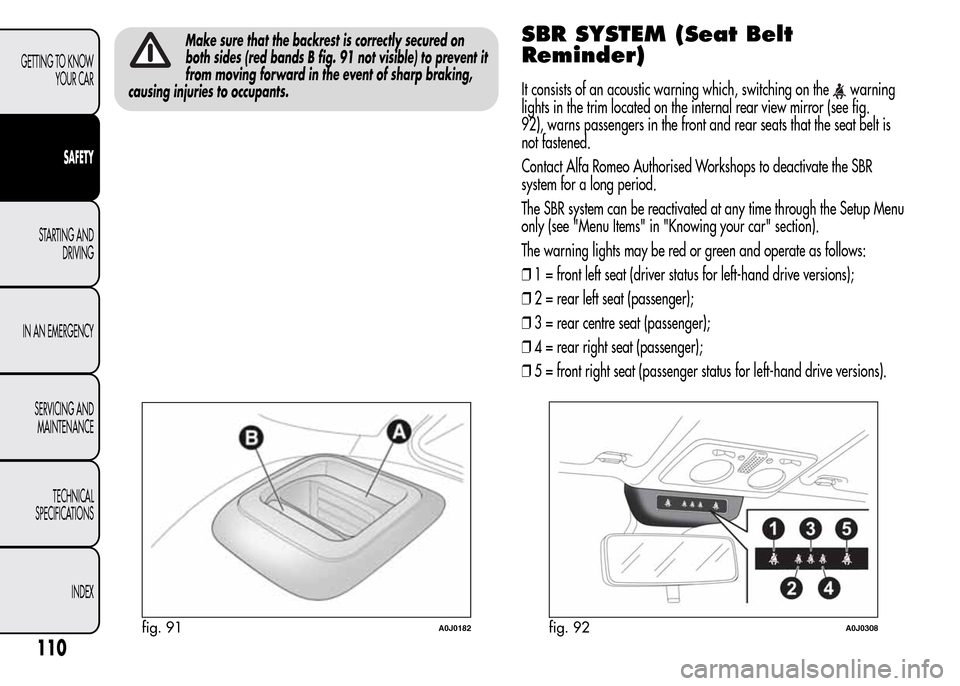
Make sure that the backrest is correctly secured on
both sides (red bands B fig. 91 not visible) to prevent it
from moving forward in the event of sharp braking,
causing injuries to occupants.SBR SYSTEM (Seat Belt
Reminder)
It consists of an acoustic warning which, switching on thewarning
lights in the trim located on the internal rear view mirror (see fig.
92), warns passengers in the front and rear seats that the seat belt is
not fastened.
Contact Alfa Romeo Authorised Workshops to deactivate the SBR
system for a long period.
The SBR system can be reactivated at any time through the Setup Menu
only (see "Menu Items" in "Knowing your car" section).
The warning lights may be red or green and operate as follows:
❒1 = front left seat (driver status for left-hand drive versions);
❒2 = rear left seat (passenger);
❒3 = rear centre seat (passenger);
❒4 = rear right seat (passenger);
❒5 = front right seat (passenger status for left-hand drive versions).
fig. 91A0J0182fig. 92A0J0308
110
GETTING TO KNOW
YOUR CAR
SAFETY
STARTING AND
DRIVING
IN AN EMERGENCY
SERVICING AND
MAINTENANCE
TECHNICAL
SPECIFICATIONS
INDEX
Page 115 of 280
NOTE On versions equipped with sports front seats, the passenger side
seat belt fastened indication (warning light 1 for RHD versions or
warning light 5 for LHD versions) will never be displayed.
FRONT SEATS (warning light no. 1 =
driver and no. 5 = passenger)
Driver
If the driver is the only occupant and their seat belt is not fastened,
when 20 km/h is exceeded or when travelling at a speed between 10
and 20 km/h for longer than 5 seconds, an acoustic signal cycle
will be started for the front seats (continuous acoustic signal for
6 seconds followed by a 90 second beep). The warning light will flash.
The warning lights will stay on constantly at the end of the cycle until
the engine is stopped. The acoustic signal will be interrupted
immediately when the driver’s seat belt is fastened and the warning
light will turn green.
The reminder cycle (acoustic and visual) will be repeated as described
above and the red warning light will flash if the seat belt is unfastened
again while travelling.
Passenger
A similar situation applies to the front passenger, with the difference
that the warning light turns green and the indication is also interrupted
when the passenger leaves the car.
If both front seat belts are unfastened a few seconds apart while the
car is travelling, the acoustic signal will refer to the most recent event
and the two warning lights will proceed with the visual indication
independently.
REAR SEATS (warning light no. 2, no.
3 and no. 4)
For the rear seats, the reminder cycle is only activated when any seat
belt is unfastened (flashing red).
In this condition, the warning light for the seat belt which has been
unfastened will flash (red) for approximately 30 seconds. An acoustic
signal is also emitted.
The visual indication (flashing red) will start and stop independently for
each warning light if several seat belts are unfastened. The warning
light will become green when the relevant seat belt is fastened again.
The rear seat warning lights will switch off, regardless of the state
of the belt (red or green) approximately 30 seconds after the last
signal.
IMPORTANT
The warning lights are all off if all seat belts (front and rear) are
already fastened when the ignition key is turned to MAR.
All warning lights switch on when at least one belt changes from
fastened to unfastened or vice versa.
111
GETTING TO KNOW
YOUR CAR
SAFETY
STARTING AND
DRIVING
IN AN EMERGENCY
SERVICING AND
MAINTENANCE
TECHNICAL
SPECIFICATIONS
INDEX
Page 126 of 280
Fit the child seat according to the instructions, which
must be included.
Main recommendations to carry children safely
❒Install the child seats on the rear seat, which is the most protected
position in the event of an accident.
❒Keep children in rear facing seats for as long as possible, until 2
years old.
❒Should a rear facing child seat be installed on the rear seats, it is
advisable to position it as far forward as the position of the front
seat allows.
❒If the passenger's front airbag is deactivated always check the
permanent switching on of the dedicated warning light on the
instrument panel to make sure that it has actually been deactivated.
❒Carefully follow the instructions supplied with the child seat itself.
Keep the instructions in the car along with the other documents
and this handbook. Do not use second-hand child seats without
instructions.
❒Only one child is to be strapped into each restraint system; never
carry two children simultaneously.
❒Always check that the seat belts do not interfere with the child's
throat.❒Always check that the seat belt is well fastened by pulling on it.
❒While travelling, do not let the child sit incorrectly or unfasten the
belts.
❒Never allow a child to put the belt's diagonal section under an arm
or behind their back.
❒Never carry children on your lap, even newborns. No-one can
restrain a child in the event of an accident.
❒In the event of an accident, replace the child seat with a new one.
122
GETTING TO KNOW
YOUR CAR
SAFETY
STARTING AND
DRIVING
IN AN EMERGENCY
SERVICING AND
MAINTENANCE
TECHNICAL
SPECIFICATIONS
INDEX
Page 129 of 280
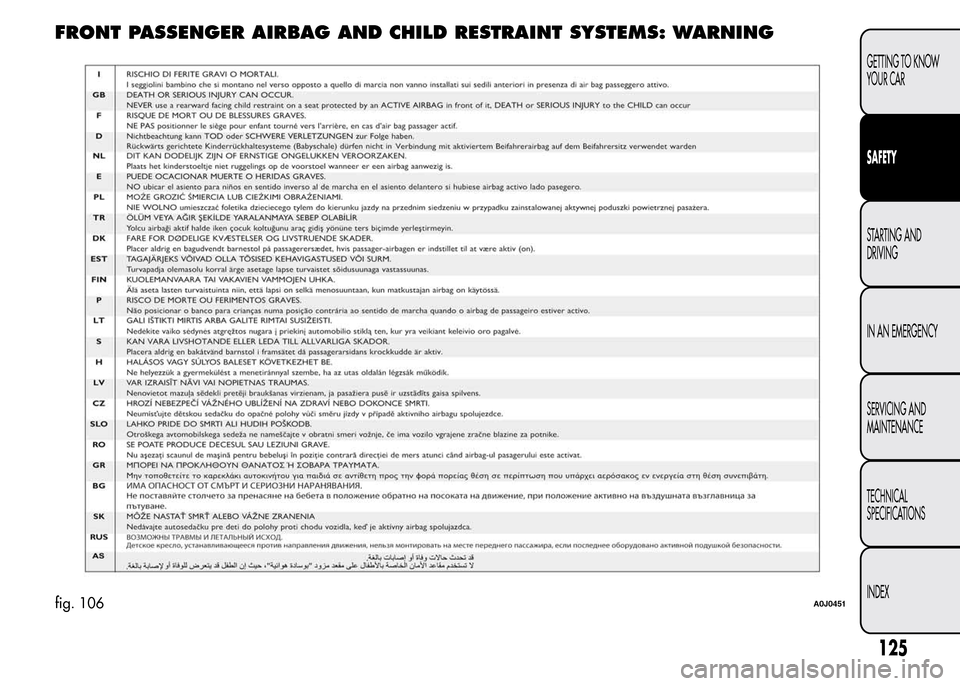
FRONT PASSENGER AIRBAG AND CHILD RESTRAINT SYSTEMS: WARNING
fig. 106A0J0451
125
GETTING TO KNOW
YOUR CAR
SAFETY
STARTING AND
DRIVING
IN AN EMERGENCY
SERVICING AND
MAINTENANCE
TECHNICAL
SPECIFICATIONS
INDEX
Page 130 of 280
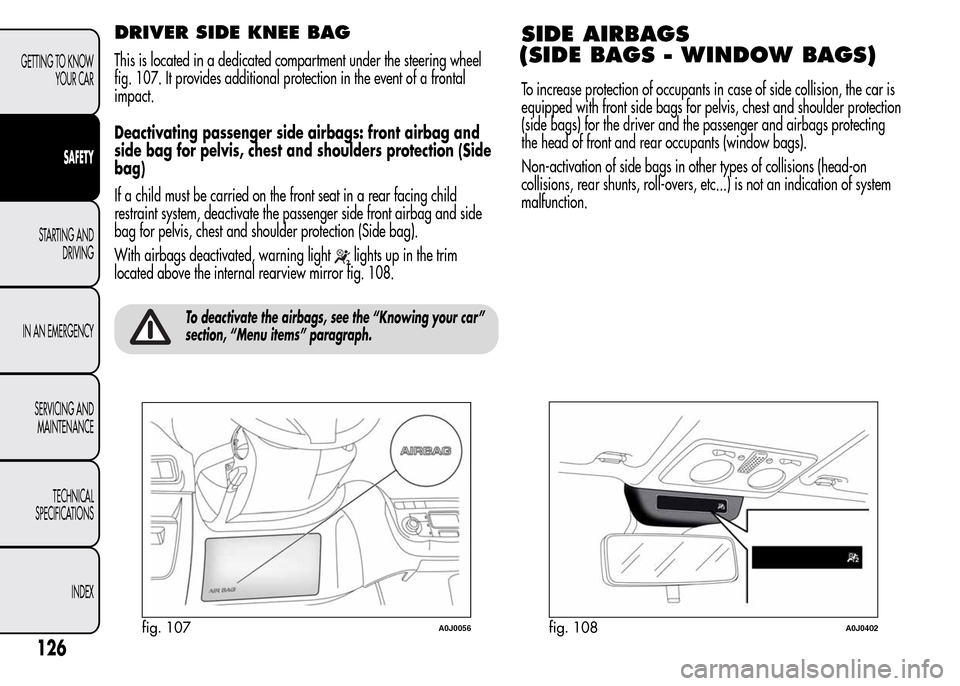
DRIVER SIDE KNEE BAG
This is located in a dedicated compartment under the steering wheel
fig. 107. It provides additional protection in the event of a frontal
impact.
Deactivating passenger side airbags: front airbag and
side bag for pelvis, chest and shoulders protection (Side
bag)
If a child must be carried on the front seat in a rear facing child
restraint system, deactivate the passenger side front airbag and side
bag for pelvis, chest and shoulder protection (Side bag).
With airbags deactivated, warning light
lights up in the trim
located above the internal rearview mirror fig. 108.
To deactivate the airbags, see the “Knowing your car”
section, “Menu items” paragraph.
SIDE AIRBAGS
(SIDE BAGS - WINDOW BAGS)
To increase protection of occupants in case of side collision, the car is
equipped with front side bags for pelvis, chest and shoulder protection
(side bags) for the driver and the passenger and airbags protecting
the head of front and rear occupants (window bags).
Non-activation of side bags in other types of collisions (head-on
collisions, rear shunts, roll-overs, etc...) is not an indication of system
malfunction.
fig. 107A0J0056fig. 108A0J0402
126
GETTING TO KNOW
YOUR CAR
SAFETY
STARTING AND
DRIVING
IN AN EMERGENCY
SERVICING AND
MAINTENANCE
TECHNICAL
SPECIFICATIONS
INDEX
Page 132 of 280
IMPORTANT
Do not wash the seats with water or pressurised steam (by hand or at
automatic seat washing stations).
The front and/or side bags may activate in the event of sharp knocks
to the underbody of the car (e.g. impact with steps, pavements,
potholes or road bumps etc.).
When the airbag deploys it emits a small amount of dust: the dust is
harmless and does not indicate the beginning of a fire. The dust may
irritate the skin and eyes however: in this case, wash with neutral soap
and water.
All operations on airbags (inspection, repair and replacement) must be
carried out by Alfa Romeo Authorized Services.
If the car is to be scrapped, contact Alfa Romeo Authorised Services to
have the airbags deactivated.
Pretensioners and airbags are deployed in different ways, according to
the type of impact. Failure to deploy of one of the devices does not
necessarily indicate a system malfunction.
If thewarning light does not switch on when the
key is turned to MAR-ON, or stays on while driving (on
some versions together with a message on the
display) there may be a fault in the restraint systems. In this
case, airbags or pretensioners may not be activated in the case
of an accident or (in a lesser number of cases) they may be
activated incorrectly. Before proceeding, contact Alfa Romeo
Authorised Services to have the system checked immediately.
Do not travel carrying objects in your lap, in front of
your chest or between your lips (pipe, pencils, etc.):
they could cause severe injury if the airbag is
deployed.
If the car has been subject to theft, attempted theft,
vandalism, or flooding, have the airbag system
inspected at Alfa Romeo Authorised Services.
When the ignition key is in and turned in the MAR-ON
position and the engine is off, the airbags may deploy
if the car is crashed by another moving vehicle.
Therefore, even if the car is stationary, when an active passenger
airbag is fitted, DO NOT install rear facing child restraint systems
on the front passenger seat. Deployment of the airbag following
an impact could cause fatal injuries to the child. Therefore,
always deactivate the passenger airbag when a rear facing child
restraint system is installed on the front passenger seat. The front
passenger seat must also be positioned back as far as possible
in order to avoid the child restraint system from coming into
contact with the dashboard. Immediately reactivate the
passenger airbag as soon as the child restraint system has been
removed. Also remember that, if the key is turned to STOP, none
of the safety devices (airbags or pretensioners) will be deployed
in the event of collision. Non-deployment in such cases does not
indicate a system malfunction.
128
GETTING TO KNOW
YOUR CAR
SAFETY
STARTING AND
DRIVING
IN AN EMERGENCY
SERVICING AND
MAINTENANCE
TECHNICAL
SPECIFICATIONS
INDEX