brake Alfa Romeo MiTo 2017 Owner's Guide
[x] Cancel search | Manufacturer: ALFA ROMEO, Model Year: 2017, Model line: MiTo, Model: Alfa Romeo MiTo 2017Pages: 212, PDF Size: 4.36 MB
Page 112 of 212
Direction indicators
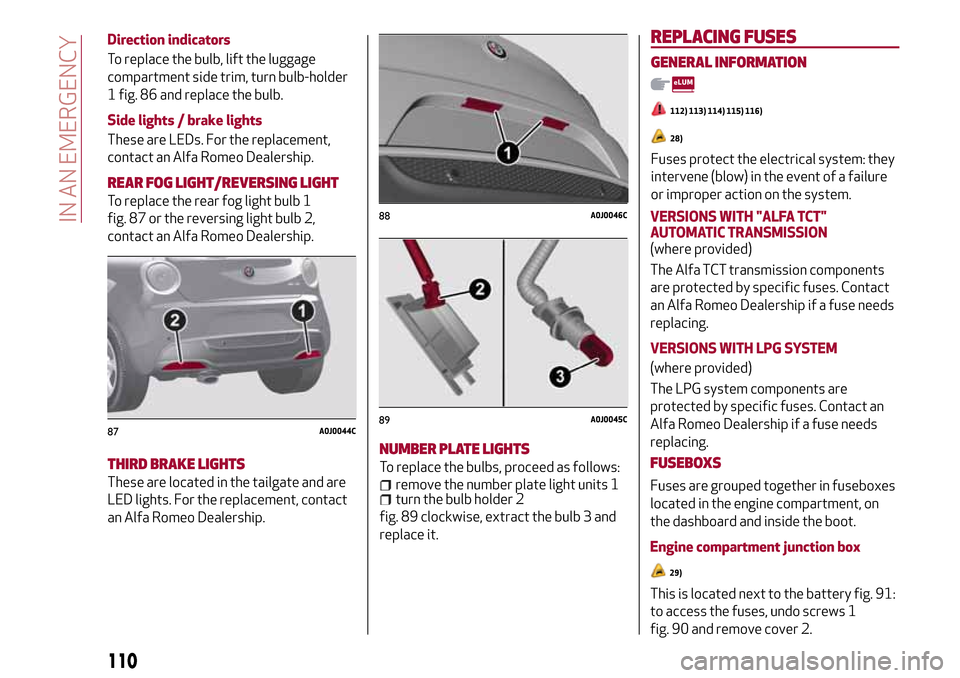
To replace the bulb, lift the luggage
compartment side trim, turn bulb-holder
1 fig. 86 and replace the bulb.
Side lights / brake lights
These are LEDs. For the replacement,
contact an Alfa Romeo Dealership.
REAR FOG LIGHT/REVERSING LIGHT
To replace the rear fog light bulb 1
fig. 87 or the reversing light bulb 2,
contact an Alfa Romeo Dealership.
THIRD BRAKE LIGHTS
These are located in the tailgate and are
LED lights. For the replacement, contact
an Alfa Romeo Dealership.
NUMBER PLATE LIGHTS
To replace the bulbs, proceed as follows:
remove the number plate light units 1turn the bulb holder 2
fig. 89 clockwise, extract the bulb 3 and
replace it.
REPLACING FUSES
GENERAL INFORMATION
112) 113) 114) 115) 116)
28)
Fuses protect the electrical system: they
intervene (blow) in the event of a failure
or improper action on the system.
VERSIONS WITH "ALFA TCT"
AUTOMATIC TRANSMISSION
(where provided)
The Alfa TCT transmission components
are protected by specific fuses. Contact
an Alfa Romeo Dealership if a fuse needs
replacing.
VERSIONS WITH LPGSYSTEM
(where provided)
The LPG system components are
protected by specific fuses. Contact an
Alfa Romeo Dealership if a fuse needs
replacing.
FUSEBOXS
Fuses are grouped together in fuseboxes
located in the engine compartment, on
the dashboard and inside the boot.
Engine compartment junction box
29)
This is located next to the battery fig. 91:
to access the fuses, undo screws 1
fig. 90 and remove cover 2.
87A0J0044C
88A0J0046C
89A0J0045C
110
IN AN EMERGENCY
Page 116 of 212
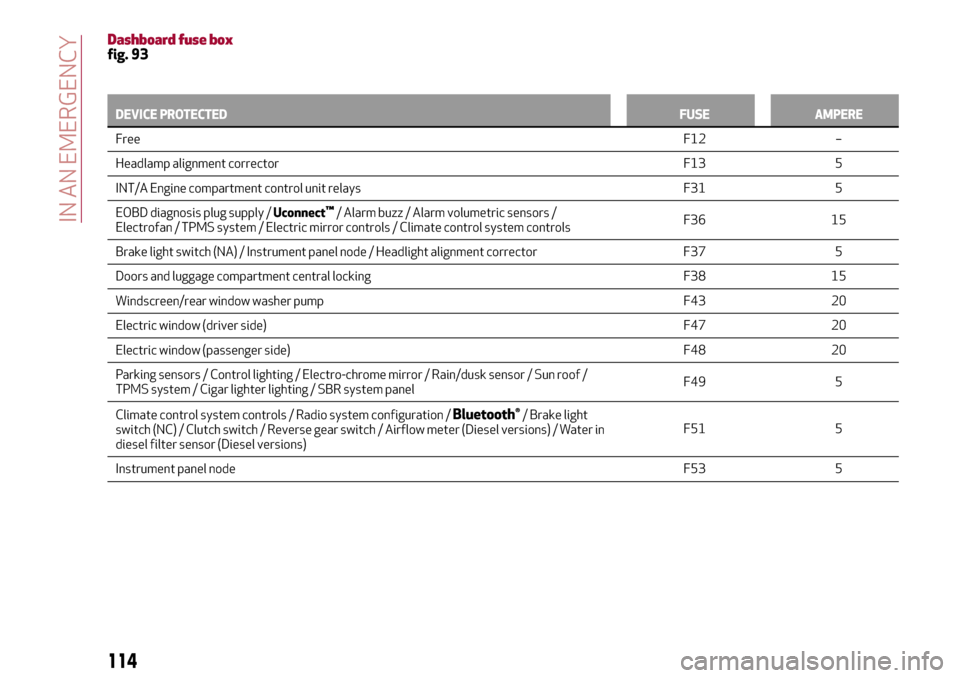
Dashboard fuse boxfig. 93
DEVICE PROTECTEDFUSE AMPERE
FreeF12 –
Headlamp alignment corrector F13 5
INT/A Engine compartment control unit relays F31 5
EOBD diagnosis plug supply /Uconnect
™/ Alarm buzz / Alarm volumetric sensors /
Electrofan / TPMS system / Electric mirror controls / Climate control system controlsF36 15
Brake light switch (NA) / Instrument panel node / Headlight alignment corrector F37 5
Doors and luggage compartment central locking F38 15
Windscreen/rear window washer pump F43 20
Electric window (driver side)F47 20
Electric window (passenger side) F48 20
Parking sensors / Control lighting / Electro-chrome mirror / Rain/dusk sensor / Sun roof /
TPMS system / Cigar lighter lighting / SBR system panelF49 5
Climate control system controls / Radio system configuration /
Bluetooth®/ Brake light
switch (NC) / Clutch switch / Reverse gear switch / Airflow meter (Diesel versions) / Water in
diesel filter sensor (Diesel versions)F51 5
Instrument panel nodeF53 5
114
IN AN EMERGENCY
Page 117 of 212
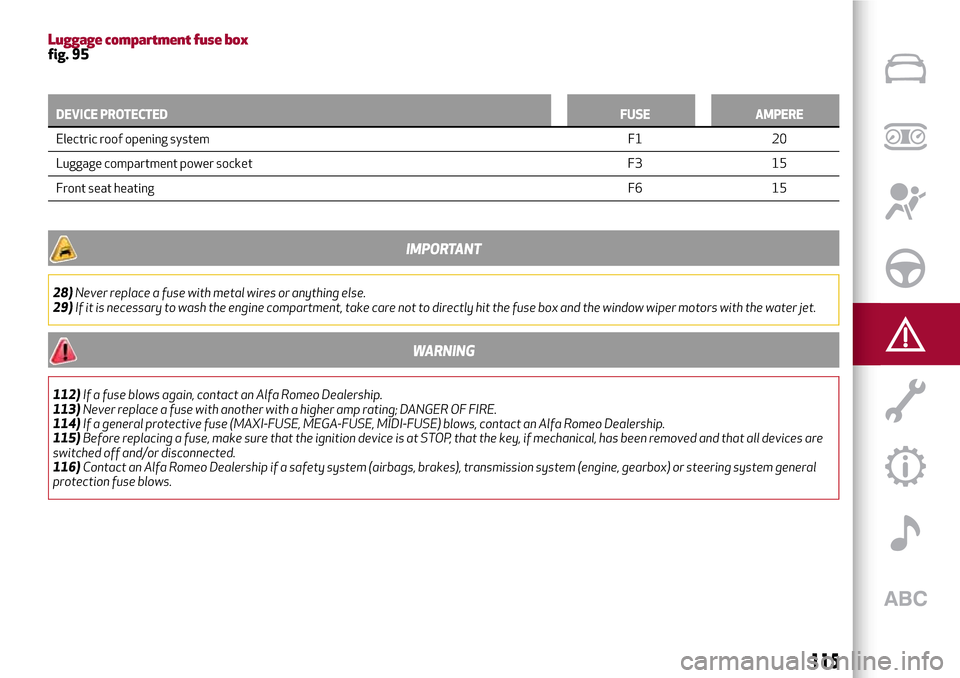
Luggage compartment fuse boxfig. 95
DEVICE PROTECTEDFUSE AMPERE
Electric roof opening systemF1 20
Luggage compartment power socket F3 15
Front seat heatingF6 15
IMPORTANT
28)Never replace a fuse with metal wires or anything else.
29)If it is necessary to wash the engine compartment, take care not to directly hit the fuse box and the window wiper motors with the water jet.
WARNING
112)If a fuse blows again, contact an Alfa Romeo Dealership.
113)Never replace a fuse with another with a higher amp rating; DANGER OF FIRE.
114)If a general protective fuse (MAXI-FUSE, MEGA-FUSE, MIDI-FUSE) blows, contact an Alfa Romeo Dealership.
115)Before replacing a fuse, make sure that the ignition device is at STOP, that the key, if mechanical, has been removed and that all devices are
switched off and/or disconnected.
116)Contact an Alfa Romeo Dealership if a safety system (airbags, brakes), transmission system (engine, gearbox) or steering system general
protection fuse blows.
115
Page 118 of 212
CHANGING A WHEEL
JACK
117) 118) 119) 120) 121) 122)
30) 31)
Please note that:
the jack weight is 1.76 kg;
the jack requires no adjustment;
the jack cannot be repaired and in the
event of a fault it must be replaced by
another genuine one;
no tool other than its cranking device
may be fitted on the jack.
Jack maintenance
prevent any dirt from depositing on
the "worm screw";
keep the "worm screw" lubricated;
never modify the jack.
Conditions in which not to use the jack
temperature below -40°C
o sandy or muddy ground
on uneven ground
on steep roads
in extreme weather conditions:
thunderstorms, typhoons, hurricanes,
blizzards, storms, etc.
in direct contact with the engine or for
repairs under the vehicle
on boats.Wheel replacement procedure
To change a wheel, proceed as follows:
stop the car in a position that is not
dangerous for oncoming traffic where
you can change the wheel safely. The
ground must be flat and sufficiently
compact;
switch off the engine, pull up the
handbrake and engage the 1stgear or
reverse. Wear the reflective safety jacket
(compulsory by law) before getting out of
the vehicle;
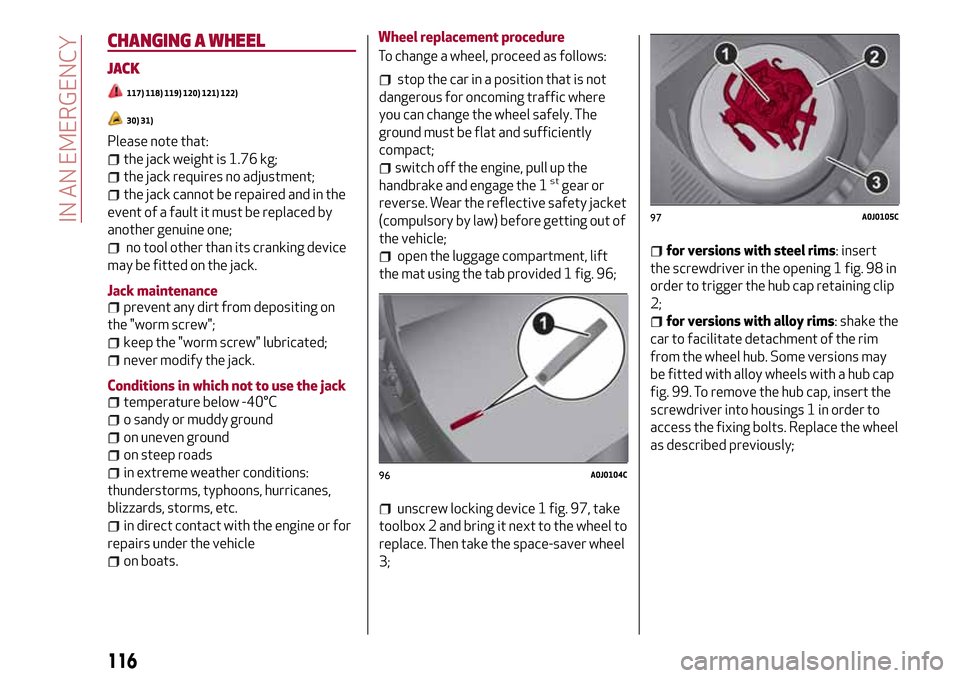
open the luggage compartment, lift
the mat using the tab provided 1 fig. 96;
unscrew locking device 1 fig. 97, take
toolbox 2 and bring it next to the wheel to
replace. Then take the space-saver wheel
3;
for versions with steel rims: insert
the screwdriver in the opening 1 fig. 98 in
order to trigger the hub cap retaining clip
2;
for versions with alloy rims: shake the
car to facilitate detachment of the rim
from the wheel hub. Some versions may
be fitted with alloy wheels with a hub cap
fig. 99. To remove the hub cap, insert the
screwdriver into housings 1 in order to
access the fixing bolts. Replace the wheel
as described previously;
96A0J0104C
97A0J0105C
116
IN AN EMERGENCY
Page 122 of 212
IMPORTANT
30)When turning the jack handle make sure
that it can turn freely without scraping your
hand against the ground. The moving
components of the jack ("worm screw" and
joints) can also cause injuries: avoid touching
them. If you come into contact with
lubricating grease, clean yourself
thoroughly.
31)Contact an Alfa Romeo Dealership as
soon as possible to have the correct
tightening of the wheel bolts checked.
"Fix&Go Automatic" KIT
123)
32) 33)
This is located in the boot. The kit also
contains a screwdriver and a tow hook.
The kit also contains:
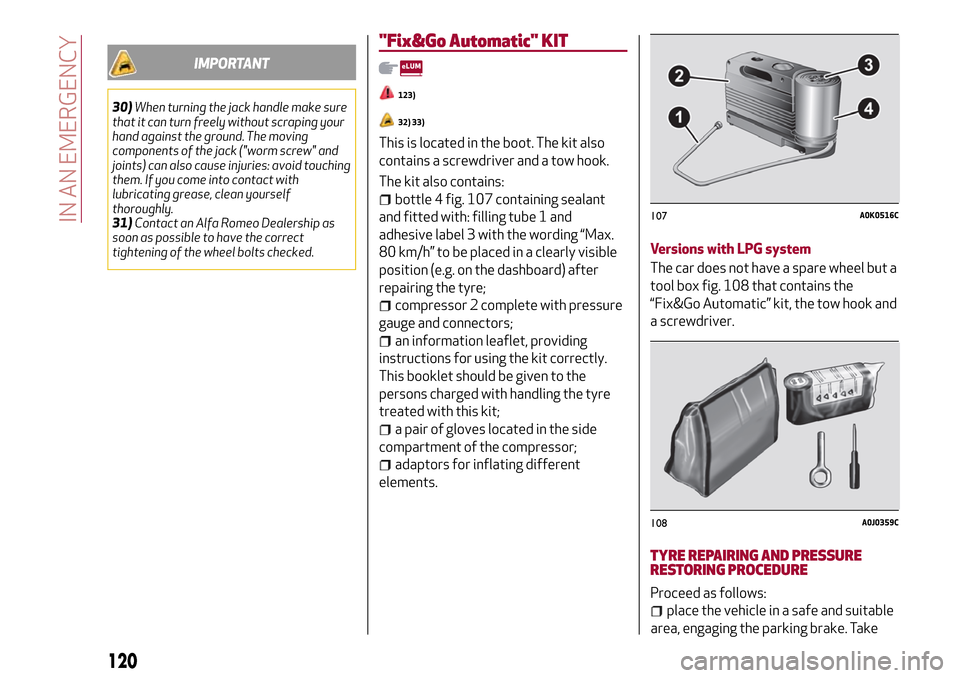
bottle 4 fig. 107 containing sealant
and fitted with: filling tube 1 and
adhesive label 3 with the wording “Max.
80 km/h” to be placed in a clearly visible
position (e.g. on the dashboard) after
repairing the tyre;
compressor 2 complete with pressure
gauge and connectors;
an information leaflet, providing
instructions for using the kit correctly.
This booklet should be given to the
persons charged with handling the tyre
treated with this kit;
a pair of gloves located in the side
compartment of the compressor;
adaptors for inflating different
elements.Versions with LPG system
The car does not have a spare wheel but a
tool box fig. 108 that contains the
“Fix&Go Automatic” kit, the tow hook and
a screwdriver.
TYRE REPAIRING AND PRESSURE
RESTORING PROCEDURE
Proceed as follows:
107A0K0516C
108A0J0359C
120
IN AN EMERGENCY
place the vehicle in a safe and suitable
area, engaging the parking brake. Take
Page 123 of 212
the kit from the specific compartment;
remove the adhesive label of speed 3
(see previous paragraph) and apply it in a
visible position. Wear the protective
gloves provided;
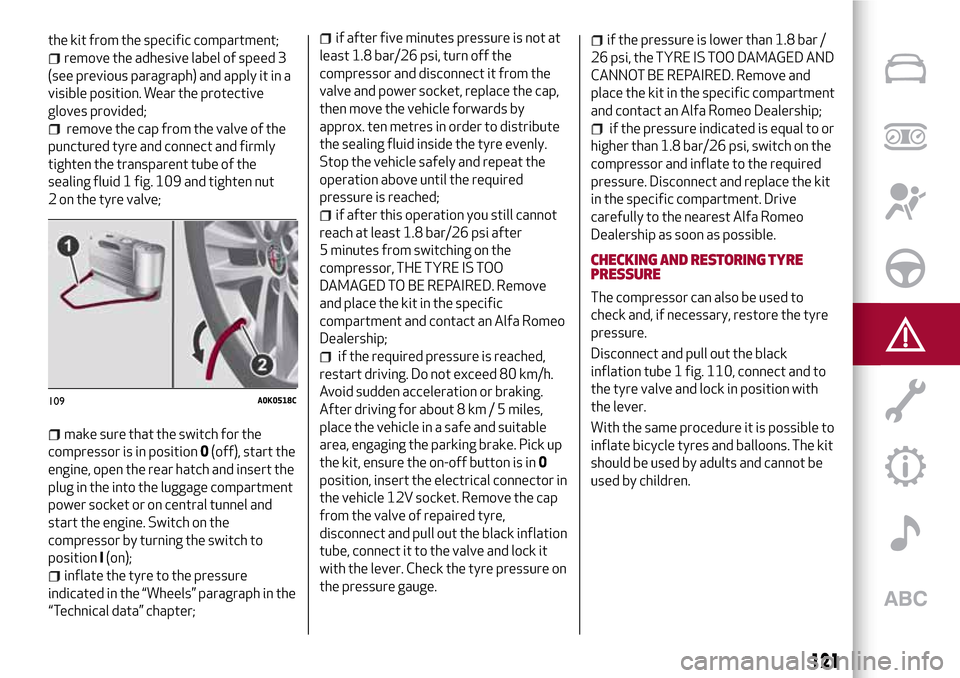
remove the cap from the valve of the
punctured tyre and connect and firmly
tighten the transparent tube of the
sealing fluid 1 fig. 109 and tighten nut
2 on the tyre valve;
make sure that the switch for the
compressor is in position0(off), start the
engine, open the rear hatch and insert the
plug in the into the luggage compartment
power socket or on central tunnel and
start the engine. Switch on the
compressor by turning the switch to
positionI(on);
inflate the tyre to the pressure
indicated in the “Wheels” paragraph in the
“Technical data” chapter;
if after five minutes pressure is not at
least 1.8 bar/26 psi, turn off the
compressor and disconnect it from the
valve and power socket, replace the cap,
then move the vehicle forwards by
approx. ten metres in order to distribute
the sealing fluid inside the tyre evenly.
Stop the vehicle safely and repeat the
operation above until the required
pressure is reached;
if after this operation you still cannot
reach at least 1.8 bar/26 psi after
5 minutes from switching on the
compressor, THE TYRE IS TOO
DAMAGED TO BE REPAIRED. Remove
and place the kit in the specific
compartment and contact an Alfa Romeo
Dealership;
if the required pressure is reached,
restart driving. Do not exceed 80 km/h.
Avoid sudden acceleration or braking.
After driving for about 8 km / 5 miles,
place the vehicle in a safe and suitable
area, engaging the parking brake. Pick up
the kit, ensure the on-off button is in0
position, insert the electrical connector in
the vehicle 12V socket. Remove the cap
from the valve of repaired tyre,
disconnect and pull out the black inflation
tube, connect it to the valve and lock it
with the lever. Check the tyre pressure on
the pressure gauge.
if the pressure is lower than 1.8 bar /
26 psi, the TYRE IS TOO DAMAGED AND
CANNOT BE REPAIRED. Remove and
place the kit in the specific compartment
and contact an Alfa Romeo Dealership;
if the pressure indicated is equal to or
higher than 1.8 bar/26 psi, switch on the
compressor and inflate to the required
pressure. Disconnect and replace the kit
in the specific compartment. Drive
carefully to the nearest Alfa Romeo
Dealership as soon as possible.
CHECKING AND RESTORING TYRE
PRESSURE
The compressor can also be used to
check and, if necessary, restore the tyre
pressure.
Disconnect and pull out the black
inflation tube 1 fig. 110, connect and to
the tyre valve and lock in position with
the lever.
With the same procedure it is possible to
inflate bicycle tyres and balloons. The kit
should be used by adults and cannot be
used by children.
109A0K0518C
121
Page 126 of 212
ignition key turned to the OFF
position;
turn the ignition key to the MAR-ON
position.
Versions with LPG system
In case of impact, petrol supply is
immediately cut-off, the LPG safety
valves are closed and the injection is
interrupted, switching off the engine.
WARNING
126)If, after an impact, you smell fuel or
notice leaks from the fuel system, do not
reactivate the system to avoid the risk of
fire.
ALFA TCT TRANSMISSION - KEY
REMOVAL
36)
The ignition key can be removed only if
the gear lever is in position P (Park).
If the battery is flat and the ignition key is
engaged, the latter is locked in position.
To remove the key manually, proceed as
follows:
apply the handbrake;
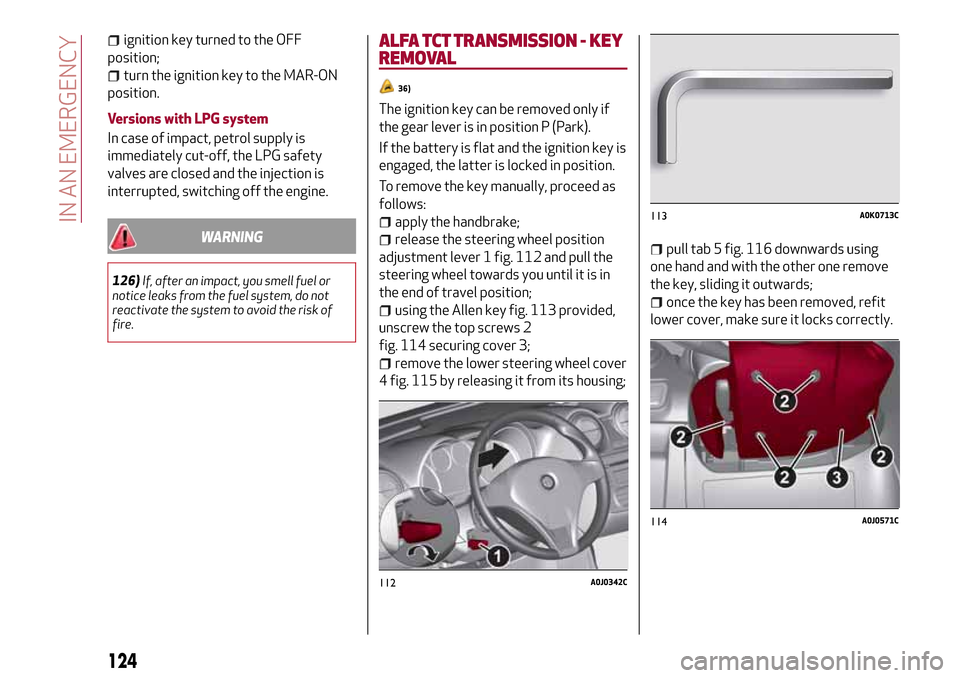
release the steering wheel position
adjustment lever 1 fig. 112 and pull the
steering wheel towards you until it is in
the end of travel position;
using the Allen key fig. 113 provided,
unscrew the top screws 2
fig. 114 securing cover 3;
remove the lower steering wheel cover
4 fig. 115 by releasing it from its housing;
pull tab 5 fig. 116 downwards using
one hand and with the other one remove
the key, sliding it outwards;
once the key has been removed, refit
lower cover, make sure it locks correctly.
112A0J0342C
113A0K0713C
114A0J0571C
124
IN AN EMERGENCY
Page 128 of 212
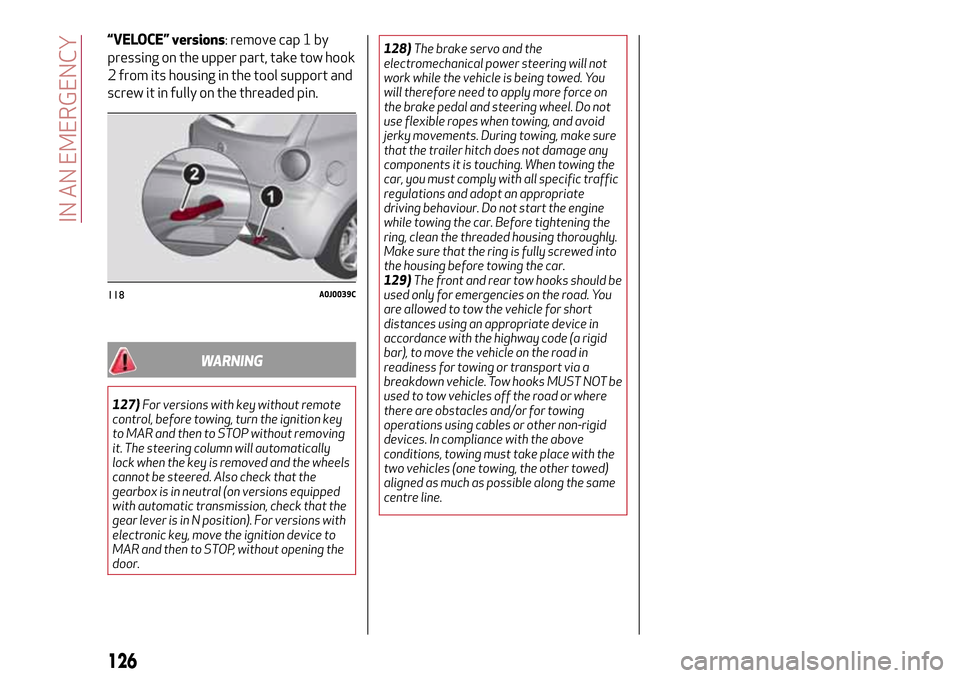
“VELOCE” versions: remove cap 1 by
pressing on the upper part, take tow hook
2 from its housing in the tool support and
screw it in fully on the threaded pin.
WARNING
127)For versions with key without remote
control, before towing, turn the ignition key
to MAR and then to STOP without removing
it. The steering column will automatically
lock when the key is removed and the wheels
cannot be steered. Also check that the
gearbox is in neutral (on versions equipped
with automatic transmission, check that the
gear lever is in N position). For versions with
electronic key, move the ignition device to
MAR and then to STOP, without opening the
door.128)The brake servo and the
electromechanical power steering will not
work while the vehicle is being towed. You
will therefore need to apply more force on
the brake pedal and steering wheel. Do not
use flexible ropes when towing, and avoid
jerky movements. During towing, make sure
that the trailer hitch does not damage any
components it is touching. When towing the
car, you must comply with all specific traffic
regulations and adopt an appropriate
driving behaviour. Do not start the engine
while towing the car. Before tightening the
ring, clean the threaded housing thoroughly.
Make sure that the ring is fully screwed into
the housing before towing the car.
129)The front and rear tow hooks should be
used only for emergencies on the road. You
are allowed to tow the vehicle for short
distances using an appropriate device in
accordance with the highway code (a rigid
bar), to move the vehicle on the road in
readiness for towing or transport via a
breakdown vehicle. Tow hooks MUST NOT be
used to tow vehicles off the road or where
there are obstacles and/or for towing
operations using cables or other non-rigid
devices. In compliance with the above
conditions, towing must take place with the
two vehicles (one towing, the other towed)
aligned as much as possible along the same
centre line.
118A0J0039C
126
IN AN EMERGENCY
Page 132 of 212
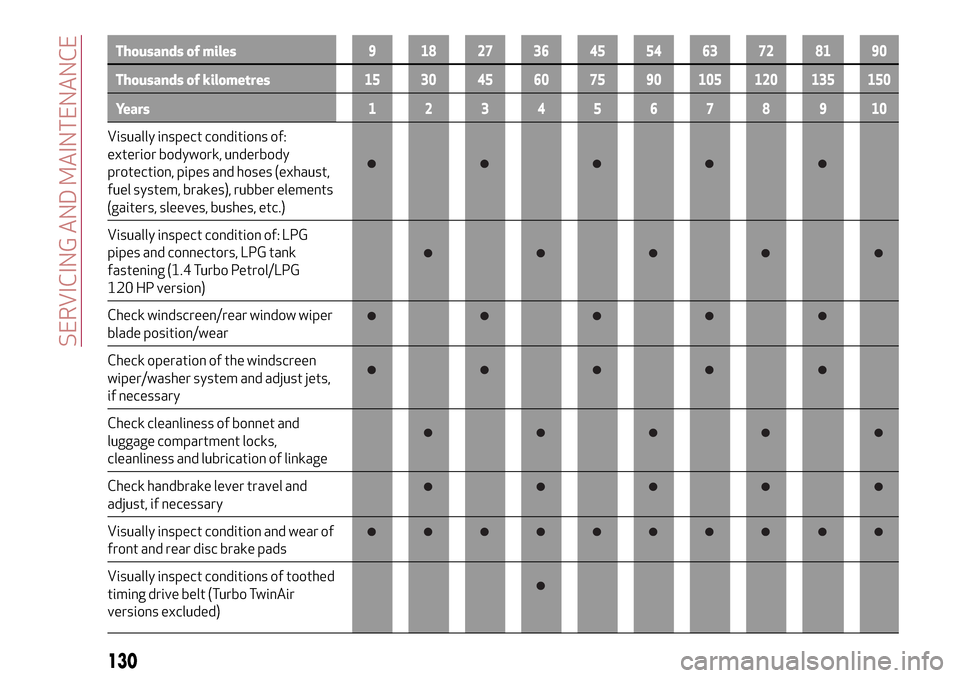
Thousands of miles9 182736455463728190
Thousands of kilometres15 30 45 60 75 90 105 120 135 150
Years12345678910
Visually inspect conditions of:
exterior bodywork, underbody
protection, pipes and hoses (exhaust,
fuel system, brakes), rubber elements
(gaiters, sleeves, bushes, etc.)
Visually inspect condition of: LPG
pipes and connectors, LPG tank
fastening (1.4 Turbo Petrol/LPG
120 HP version)
Check windscreen/rear window wiper
blade position/wear
Check operation of the windscreen
wiper/washer system and adjust jets,
if necessary
Check cleanliness of bonnet and
luggage compartment locks,
cleanliness and lubrication of linkage
Check handbrake lever travel and
adjust, if necessary
Visually inspect condition and wear of
front and rear disc brake pads
Visually inspect conditions of toothed
timing drive belt (Turbo TwinAir
versions excluded)
130
SERVICING AND MAINTENANCE
Page 134 of 212
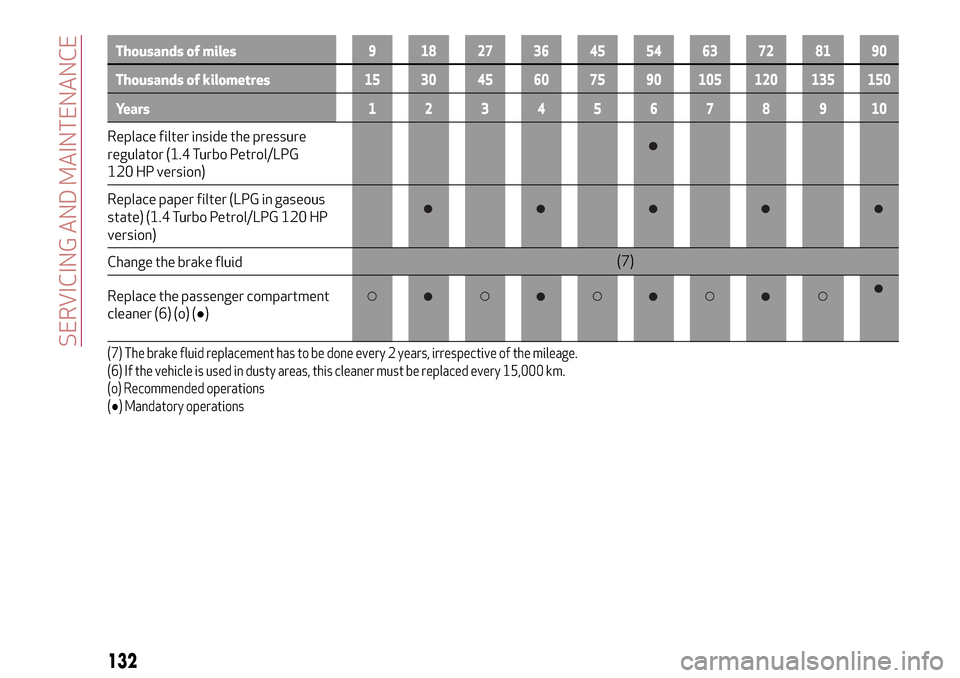
Thousands of miles9 182736455463728190
Thousands of kilometres15 30 45 60 75 90 105 120 135 150
Years12345678910
Replace filter inside the pressure
regulator (1.4 Turbo Petrol/LPG
120 HP version)
Replace paper filter (LPG in gaseous
state) (1.4 Turbo Petrol/LPG 120 HP
version)
Change the brake fluid(7)
Replace the passenger compartment
cleaner (6) (o) (●)
(7) The brake fluid replacement has to be done every 2 years, irrespective of the mileage.
(6) If the vehicle is used in dusty areas, this cleaner must be replaced every 15,000 km.
(o) Recommended operations
(●) Mandatory operations
132
SERVICING AND MAINTENANCE