Drive Alfa Romeo Stelvio 2019 Owner's Guide
[x] Cancel search | Manufacturer: ALFA ROMEO, Model Year: 2019, Model line: Stelvio, Model: Alfa Romeo Stelvio 2019Pages: 244, PDF Size: 4.95 MB
Page 55 of 244
Warning
lightWhat it means
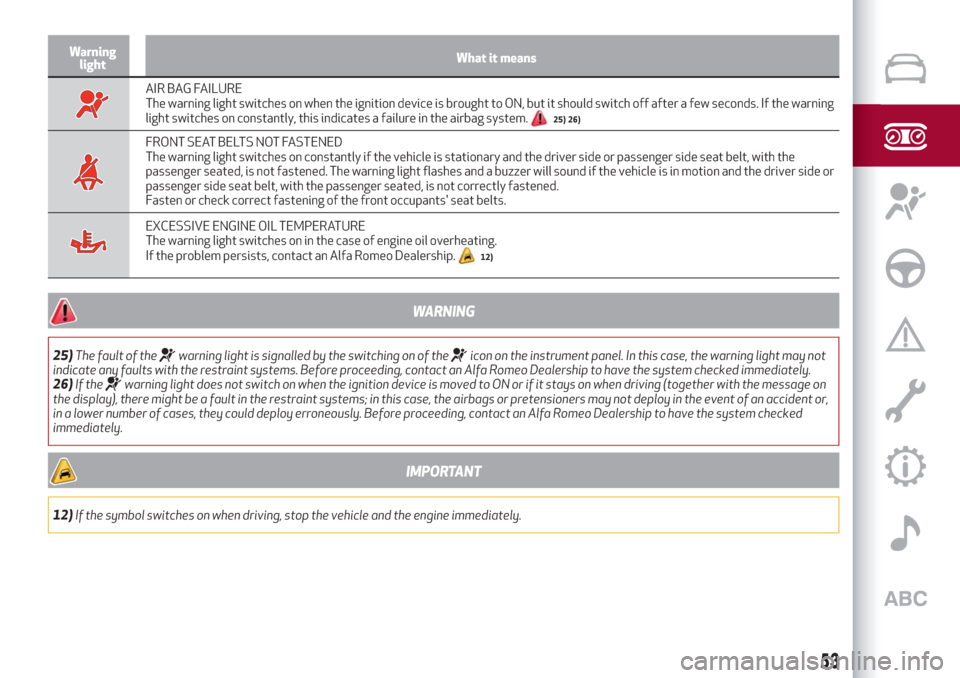
AIR BAG FAILURE
The warning light switches on when the ignition device is brought to ON, but it should switch off after a few seconds. If the warning
light switches on constantly, this indicates a failure in the airbag system.
25) 26)
FRONT SEAT BELTS NOT FASTENED
The warning light switches on constantly if the vehicle is stationary and the driver side or passenger side seat belt, with the
passenger seated, is not fastened. The warning light flashes and a buzzer will sound if the vehicle is in motion and the driver side or
passenger side seat belt, with the passenger seated, is not correctly fastened.
Fasten or check correct fastening of the front occupants' seat belts.
EXCESSIVE ENGINE OIL TEMPERATURE
The warning light switches on in the case of engine oil overheating.
If the problem persists, contact an Alfa Romeo Dealership.
12)
WARNING
25)The fault of thewarning light is signalled by the switching on of theicon on the instrument panel. In this case, the warning light may not
indicate any faults with the restraint systems. Before proceeding, contact an Alfa Romeo Dealership to have the system checked immediately.
26)If the
warning light does not switch on when the ignition device is moved to ON or if it stays on when driving (together with the message on
the display), there might be a fault in the restraint systems; in this case, the airbags or pretensioners may not deploy in the event of an accident or,
in a lower number of cases, they could deploy erroneously. Before proceeding, contact an Alfa Romeo Dealership to have the system checked
immediately.
IMPORTANT
12)If the symbol switches on when driving, stop the vehicle and the engine immediately.
53
Page 56 of 244
Amber warning lights
Warning
lightWhat it means
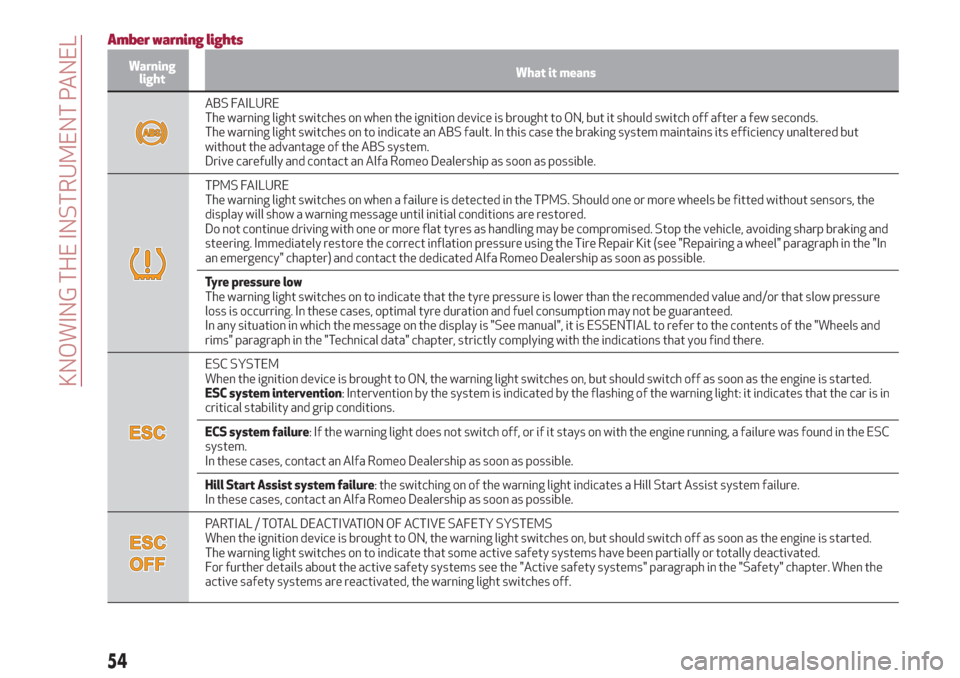
ABS FAILURE
The warning light switches on when the ignition device is brought to ON, but it should switch off after a few seconds.
The warning light switches on to indicate an ABS fault. In this case the braking system maintains its efficiency unaltered but
without the advantage of the ABS system.
Drive carefully and contact an Alfa Romeo Dealership as soon as possible.
TPMS FAILURE
The warning light switches on when a failure is detected in the TPMS. Should one or more wheels be fitted without sensors, the
display will show a warning message until initial conditions are restored.
Do not continue driving with one or more flat tyres as handling may be compromised. Stop the vehicle, avoiding sharp braking and
steering. Immediately restore the correct inflation pressure using the Tire Repair Kit (see "Repairing a wheel" paragraph in the "In
an emergency" chapter) and contact the dedicated Alfa Romeo Dealership as soon as possible.
Tyre pressure low
The warning light switches on to indicate that the tyre pressure is lower than the recommended value and/or that slow pressure
loss is occurring. In these cases, optimal tyre duration and fuel consumption may not be guaranteed.
In any situation in which the message on the display is "See manual", it is ESSENTIAL to refer to the contents of the "Wheels and
rims" paragraph in the "Technical data" chapter, strictly complying with the indications that you find there.
ESC SYSTEM
When the ignition device is brought to ON, the warning light switches on, but should switch off as soon as the engine is started.
ESC system intervention: Intervention by the system is indicated by the flashing of the warning light: it indicates that the car is in
critical stability and grip conditions.
ECS system failure: If the warning light does not switch off, or if it stays on with the engine running, a failure was found in the ESC
system.
In these cases, contact an Alfa Romeo Dealership as soon as possible.
Hill Start Assist system failure: the switching on of the warning light indicates a Hill Start Assist system failure.
In these cases, contact an Alfa Romeo Dealership as soon as possible.
PARTIAL / TOTAL DEACTIVATION OF ACTIVE SAFETY SYSTEMS
When the ignition device is brought to ON, the warning light switches on, but should switch off as soon as the engine is started.
The warning light switches on to indicate that some active safety systems have been partially or totally deactivated.
For further details about the active safety systems see the "Active safety systems" paragraph in the "Safety" chapter. When the
active safety systems are reactivated, the warning light switches off.
54
KNOWING THE INSTRUMENT PANEL
Page 57 of 244
Warning
lightWhat it means
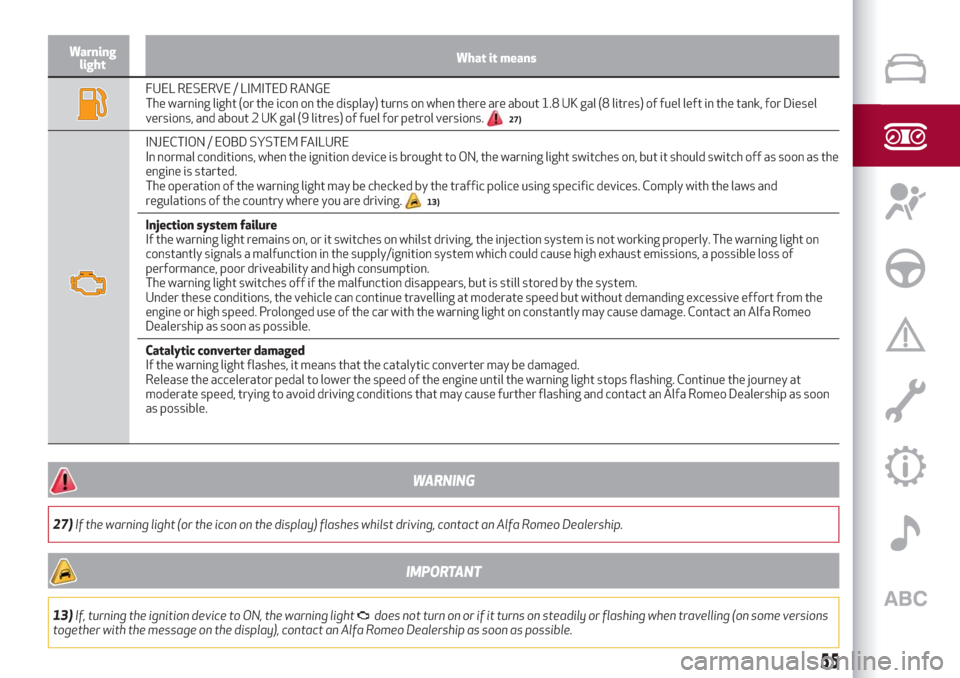
FUEL RESERVE / LIMITED RANGE
The warning light (or the icon on the display) turns on when there are about 1.8 UK gal (8 litres) of fuel left in the tank, for Diesel
versions, and about 2 UK gal (9 litres) of fuel for petrol versions.
27)
INJECTION / EOBD SYSTEM FAILURE
In normal conditions, when the ignition device is brought to ON, the warning light switches on, but it should switch off as soon as the
engine is started.
The operation of the warning light may be checked by the traffic police using specific devices. Comply with the laws and
regulations of the country where you are driving.
13)
Injection system failure
If the warning light remains on, or it switches on whilst driving, the injection system is not working properly. The warning light on
constantly signals a malfunction in the supply/ignition system which could cause high exhaust emissions, a possible loss of
performance, poor driveability and high consumption.
The warning light switches off if the malfunction disappears, but is still stored by the system.
Under these conditions, the vehicle can continue travelling at moderate speed but without demanding excessive effort from the
engine or high speed. Prolonged use of the car with the warning light on constantly may cause damage. Contact an Alfa Romeo
Dealership as soon as possible.
Catalytic converter damaged
If the warning light flashes, it means that the catalytic converter may be damaged.
Release the accelerator pedal to lower the speed of the engine until the warning light stops flashing. Continue the journey at
moderate speed, trying to avoid driving conditions that may cause further flashing and contact an Alfa Romeo Dealership as soon
as possible.
WARNING
27)If the warning light (or the icon on the display) flashes whilst driving, contact an Alfa Romeo Dealership.
IMPORTANT
13)If, turning the ignition device to ON, the warning lightdoes not turn on or if it turns on steadily or flashing when travelling (on some versions
together with the message on the display), contact an Alfa Romeo Dealership as soon as possible.
55
Page 58 of 244
Warning
lightWhat it means
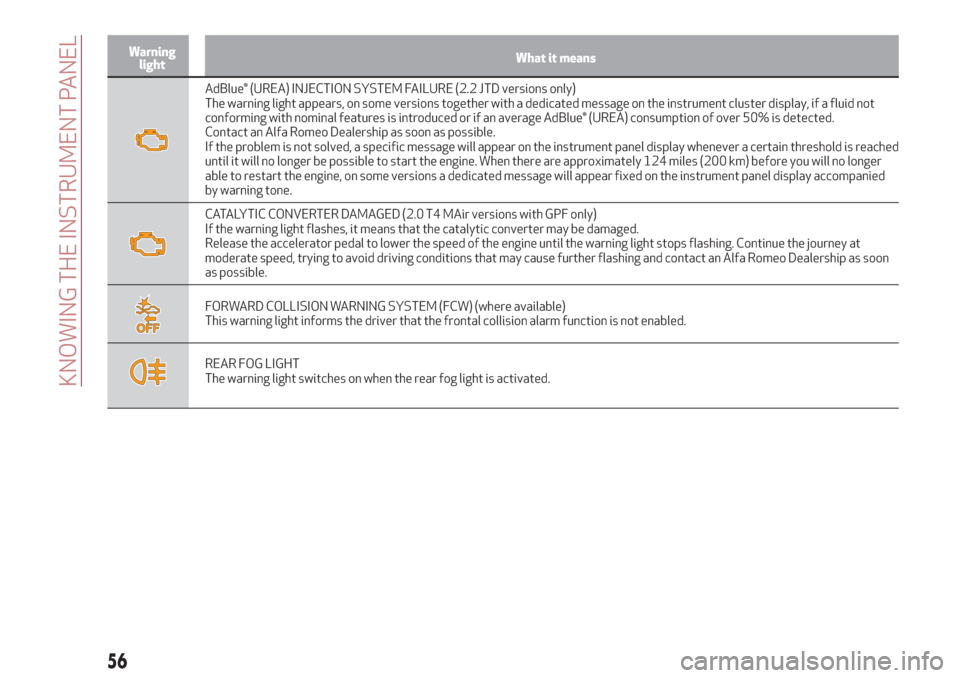
AdBlue® (UREA) INJECTION SYSTEM FAILURE (2.2 JTD versions only)
The warning light appears, on some versions together with a dedicated message on the instrument cluster display, if a fluid not
conforming with nominal features is introduced or if an average AdBlue® (UREA) consumption of over 50% is detected.
Contact an Alfa Romeo Dealership as soon as possible.
If the problem is not solved, a specific message will appear on the instrument panel display whenever a certain threshold is reached
until it will no longer be possible to start the engine. When there are approximately 124 miles (200 km) before you will no longer
able to restart the engine, on some versions a dedicated message will appear fixed on the instrument panel display accompanied
by warning tone.
CATALYTIC CONVERTER DAMAGED (2.0 T4 MAir versions with GPF only)
If the warning light flashes, it means that the catalytic converter may be damaged.
Release the accelerator pedal to lower the speed of the engine until the warning light stops flashing. Continue the journey at
moderate speed, trying to avoid driving conditions that may cause further flashing and contact an Alfa Romeo Dealership as soon
as possible.
FORWARD COLLISION WARNING SYSTEM (FCW) (where available)
This warning light informs the driver that the frontal collision alarm function is not enabled.
REAR FOG LIGHT
The warning light switches on when the rear fog light is activated.
56
KNOWING THE INSTRUMENT PANEL
Page 63 of 244
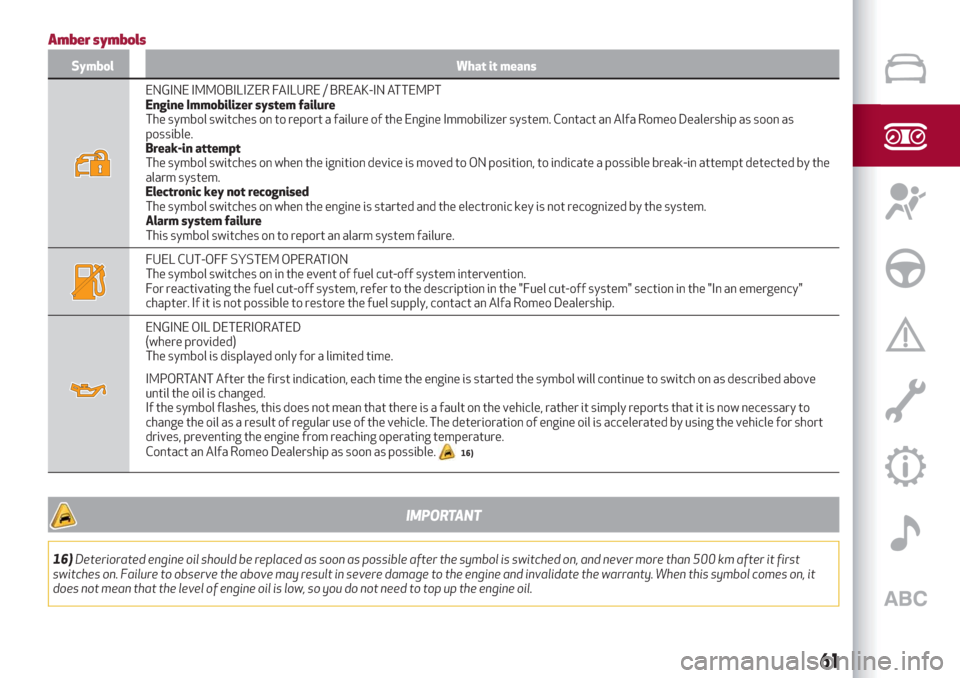
Amber symbols
Symbol What it means
ENGINE IMMOBILIZER FAILURE / BREAK-IN ATTEMPT
Engine Immobilizer system failure
The symbol switches on to report a failure of the Engine Immobilizer system. Contact an Alfa Romeo Dealership as soon as
possible.
Break-in attempt
The symbol switches on when the ignition device is moved to ON position, to indicate a possible break-in attempt detected by the
alarm system.
Electronic key not recognised
The symbol switches on when the engine is started and the electronic key is not recognized by the system.
Alarm system failure
This symbol switches on to report an alarm system failure.
FUEL CUT-OFF SYSTEM OPERATION
The symbol switches on in the event of fuel cut-off system intervention.
For reactivating the fuel cut-off system, refer to the description in the "Fuel cut-off system" section in the "In an emergency"
chapter. If it is not possible to restore the fuel supply, contact an Alfa Romeo Dealership.
ENGINE OIL DETERIORATED
(where provided)
The symbol is displayed only for a limited time.
IMPORTANT After the first indication, each time the engine is started the symbol will continue to switch on as described above
until the oil is changed.
If the symbol flashes, this does not mean that there is a fault on the vehicle, rather it simply reports that it is now necessary to
change the oil as a result of regular use of the vehicle. The deterioration of engine oil is accelerated by using the vehicle for short
drives, preventing the engine from reaching operating temperature.
Contact an Alfa Romeo Dealership as soon as possible.
16)
IMPORTANT
16)Deteriorated engine oil should be replaced as soon as possible after the symbol is switched on, and never more than 500 km after it first
switches on. Failure to observe the above may result in severe damage to the engine and invalidate the warranty. When this symbol comes on, it
does not mean that the level of engine oil is low, so you do not need to top up the engine oil.
61
Page 66 of 244
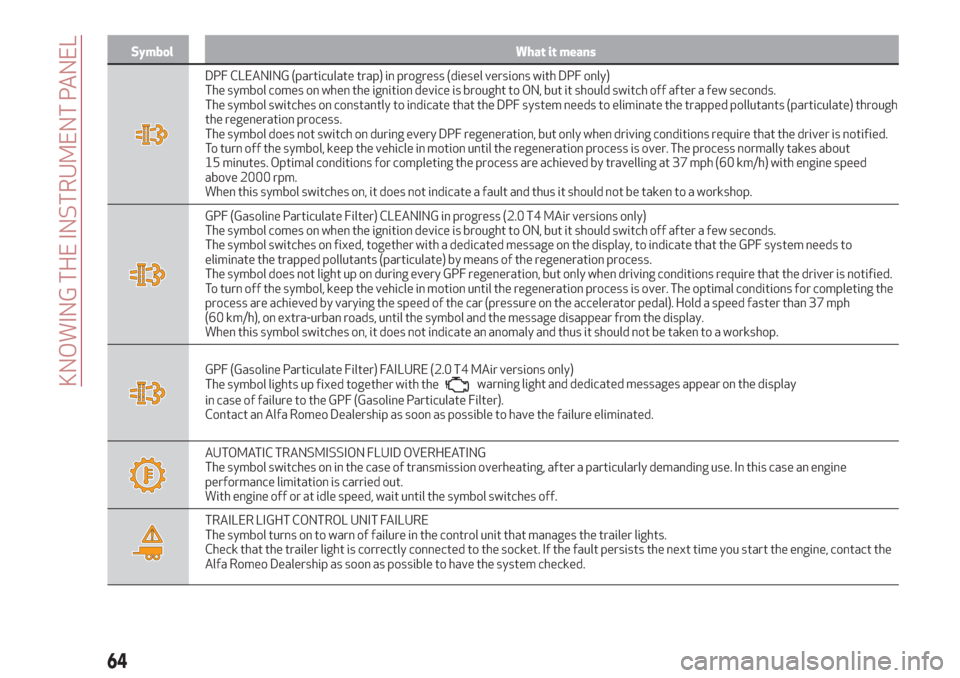
Symbol What it means
DPF CLEANING (particulate trap) in progress (diesel versions with DPF only)
The symbol comes on when the ignition device is brought to ON, but it should switch off after a few seconds.
The symbol switches on constantly to indicate that the DPF system needs to eliminate the trapped pollutants (particulate) through
the regeneration process.
The symbol does not switch on during every DPF regeneration, but only when driving conditions require that the driver is notified.
To turn off the symbol, keep the vehicle in motion until the regeneration process is over. The process normally takes about
15 minutes. Optimal conditions for completing the process are achieved by travelling at 37 mph (60 km/h) with engine speed
above 2000 rpm.
When this symbol switches on, it does not indicate a fault and thus it should not be taken to a workshop.
GPF (Gasoline Particulate Filter) CLEANING in progress (2.0 T4 MAir versions only)
The symbol comes on when the ignition device is brought to ON, but it should switch off after a few seconds.
The symbol switches on fixed, together with a dedicated message on the display, to indicate that the GPF system needs to
eliminate the trapped pollutants (particulate) by means of the regeneration process.
The symbol does not light up on during every GPF regeneration, but only when driving conditions require that the driver is notified.
To turn off the symbol, keep the vehicle in motion until the regeneration process is over. The optimal conditions for completing the
process are achieved by varying the speed of the car (pressure on the accelerator pedal). Hold a speed faster than 37 mph
(60 km/h), on extra-urban roads, until the symbol and the message disappear from the display.
When this symbol switches on, it does not indicate an anomaly and thus it should not be taken to a workshop.
GPF (Gasoline Particulate Filter) FAILURE (2.0 T4 MAir versions only)
The symbol lights up fixed together with the
in case of failure to the GPF (Gasoline Particulate Filter).
Contact an Alfa Romeo Dealership as soon as possible to have the failure eliminated.
AUTOMATIC TRANSMISSION FLUID OVERHEATING
The symbol switches on in the case of transmission overheating, after a particularly demanding use. In this case an engine
performance limitation is carried out.
With engine off or at idle speed, wait until the symbol switches off.
TRAILER LIGHT CONTROL UNIT FAILURE
The symbol turns on to warn of failure in the control unit that manages the trailer lights.
Check that the trailer light is correctly connected to the socket. If the fault persists the next time you start the engine, contact the
Alfa Romeo Dealership as soon as possible to have the system checked.
64
KNOWING THE INSTRUMENT PANELwarning light and dedicated messages appear on the display
Page 67 of 244
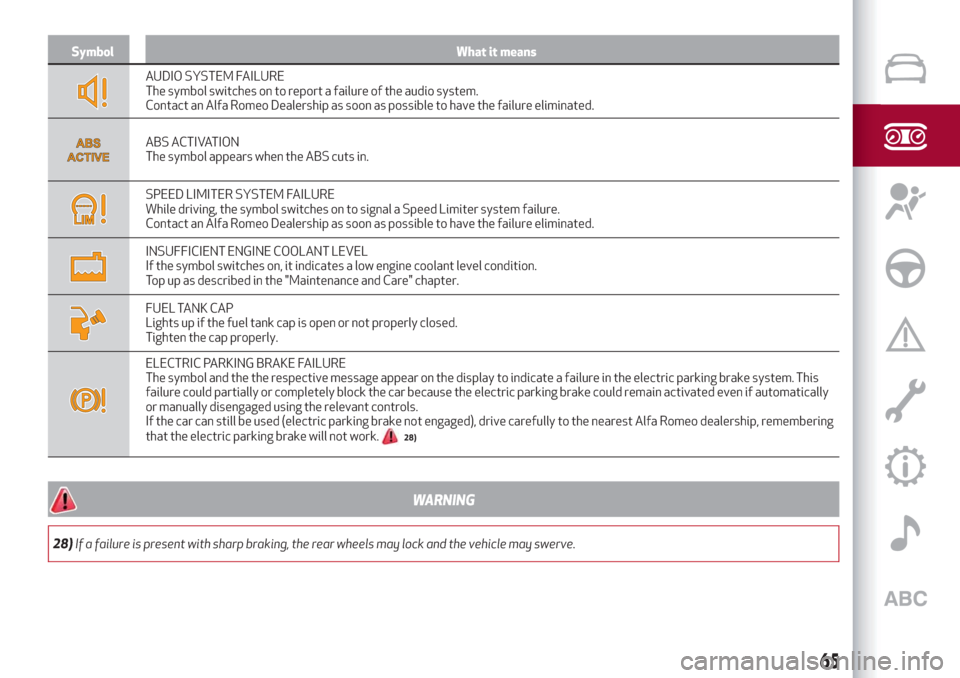
Symbol What it means
AUDIO SYSTEM FAILURE
The symbol switches on to report a failure of the audio system.
Contact an Alfa Romeo Dealership as soon as possible to have the failure eliminated.
ABS ACTIVATION
The symbol appears when the ABS cuts in.
SPEED LIMITER SYSTEM FAILURE
While driving, the symbol switches on to signal a Speed Limiter system failure.
Contact an Alfa Romeo Dealership as soon as possible to have the failure eliminated.
INSUFFICIENT ENGINE COOLANT LEVEL
If the symbol switches on, it indicates a low engine coolant level condition.
Top up as described in the "Maintenance and Care" chapter.
FUEL TANK CAP
Lights up if the fuel tank cap is open or not properly closed.
Tighten the cap properly.
ELECTRIC PARKING BRAKE FAILURE
The symbol and the the respective message appear on the display to indicate a failure in the electric parking brake system. This
failure could partially or completely block the car because the electric parking brake could remain activated even if automatically
or manually disengaged using the relevant controls.
If the car can still be used (electric parking brake not engaged), drive carefully to the nearest Alfa Romeo dealership, remembering
that the electric parking brake will not work.
28)
WARNING
28)If a failure is present with sharp braking, the rear wheels may lock and the vehicle may swerve.
65
Page 68 of 244
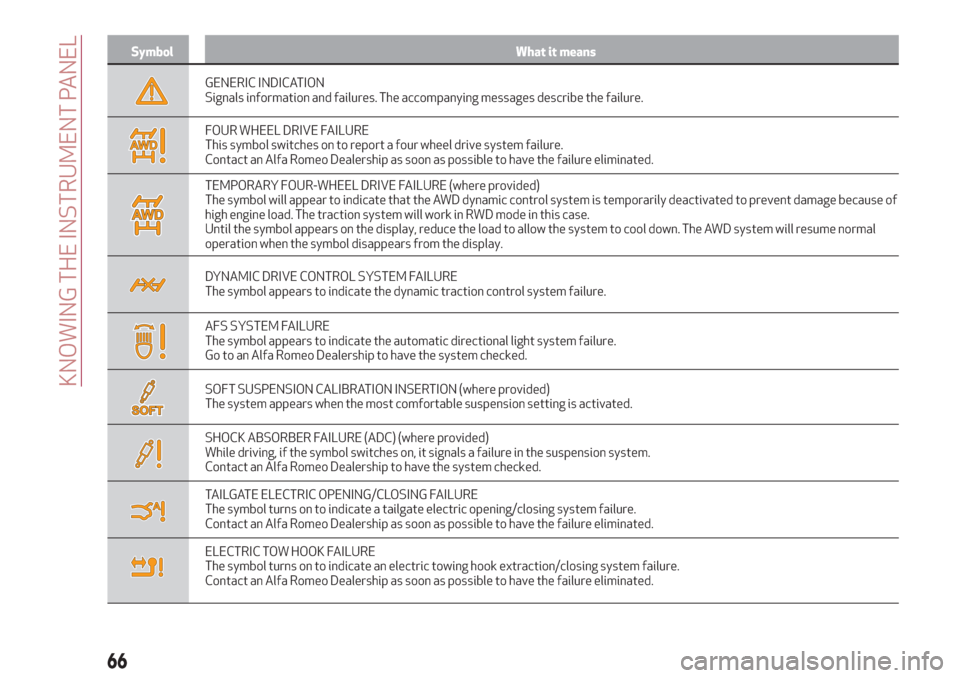
Symbol What it means
GENERIC INDICATION
Signals information and failures. The accompanying messages describe the failure.
FOUR WHEEL DRIVE FAILURE
This symbol switches on to report a four wheel drive system failure.
Contact an Alfa Romeo Dealership as soon as possible to have the failure eliminated.
TEMPORARY FOUR-WHEEL DRIVE FAILURE (where provided)
The symbol will appear to indicate that the AWD dynamic control system is temporarily deactivated to prevent damage because of
high engine load. The traction system will work in RWD mode in this case.
Until the symbol appears on the display, reduce the load to allow the system to cool down. The AWD system will resume normal
operation when the symbol disappears from the display.
DYNAMIC DRIVE CONTROL SYSTEM FAILURE
The symbol appears to indicate the dynamic traction control system failure.
AFS SYSTEM FAILURE
The symbol appears to indicate the automatic directional light system failure.
Go to an Alfa Romeo Dealership to have the system checked.
SOFT SUSPENSION CALIBRATION INSERTION (where provided)
The system appears when the most comfortable suspension setting is activated.
SHOCK ABSORBER FAILURE (ADC) (where provided)
While driving, if the symbol switches on, it signals a failure in the suspension system.
Contact an Alfa Romeo Dealership to have the system checked.
TAILGATE ELECTRIC OPENING/CLOSING FAILURE
The symbol turns on to indicate a tailgate electric opening/closing system failure.
Contact an Alfa Romeo Dealership as soon as possible to have the failure eliminated.
ELECTRIC TOW HOOK FAILURE
The symbol turns on to indicate an electric towing hook extraction/closing system failure.
Contact an Alfa Romeo Dealership as soon as possible to have the failure eliminated.
66
KNOWING THE INSTRUMENT PANEL
Page 74 of 244
ACTIVE SAFETYSYSTEMS
The vehicle may be equipped with the
following active safety devices:
ABS (Anti-Lock Brakes);
DTC (Drive Train Control);
ESC (Electronic Stability Control);
TC (Traction Control);
PBA (Panic Brake Assist);
HSA (Hill Start Assist);
AST (Alfa™ Steering Torque);
HDC (Hill Discent Control)
For the operation of the systems, see the
following pages.
ABS (Anti-lock Braking System)
This system, which is an integral part of
the braking system, prevents one or more
wheels from locking and slipping in all
road surface conditions, irrespective of
the intensity of the braking action,
ensuring that the vehicle can be
controlled even during emergency
braking and optimising stopping
distances.
The system intervenes during braking
when the wheels are about to lock,
typically in emergency braking or
low-grip conditions, when locking may be
more frequent.
The system also improves control and
stability of the vehicle when braking on a
surface where the grip of the left and
right wheels varies, or on corners.The Electronic Braking Force Distribution
(EBD) system completes the system
allowing the brake force to be distributed
between the front and rear wheels.
System intervention
The ABS equipped on this vehicle is
provided with the "Brake by wire"
(Integrated Brake System - IBS) function.
With this system, the brake pedal
command given by pressing the brake
pedal is not transmitted hydraulically but
electronically, therefore, the light
pulsation that could be felt on the pedal
with the traditional system is no longer
perceptible.29) 30) 31) 32) 33) 34)
DTC (Drive Train Control)SYSTEM(where provided)
Some versions of this vehicle are
equipped with a four-wheel drive system
(AWD), activated on request, which offers
an optimal drive for countless driving
conditions and road surfaces. The system
reduces the slipping of the tyres to a
minimum, automatically redistributing
the torque to the front and rear wheels,
as needed.
To maximize fuel savings, the car with
AWD automatically passes to rear-wheel
drive (RWD) when the road and
environmental conditions are such that
they would not cause the tyres to slip.When the road and environmental
conditions require better traction, the
vehicle automatically goes to AWD mode.
35)
IMPORTANT If the system failure symbol
switches on, after starting the engine or
while driving, it means that the AWD
system is not working properly. If the
warning message activates frequently, it
is recommended to carry out the
maintenance operations.
36)
ESC (Electronic Stability Control)
SYSTEM
The ESC system improves the directional
control and stability of the car in various
driving conditions.
The ESC system corrects the car’s
understeer and oversteer, distributing
the brake force on the appropriate
wheels. The torque supplied by the
engine can also be reduced in order to
maintain control of the vehicle.
The ESC system uses sensors installed
on the car to determine the trajectory
that the driver intends to follow and
compares it with the car’s effective
trajectory. When the real trajectory
deviates from the desired trajectory, the
ESC system intervenes to counter the
vehicle’s understeer or oversteer.
Oversteer: occurs when the car is
72
SAFETY
Page 75 of 244
turning more than it should according to
the angle of the steering wheel.
Understeer: occurs when the vehicle is
turning less than it should according to
the angle of the steering wheel.
System intervention
The intervention of the system is
indicated by the flashing of the ESC
warning light on the instrument panel, to
inform the driver that the vehicle
stability and grip are critical.
37) 38) 39) 40) 41)
TC (Traction Control)SYSTEM
The system automatically operates in the
event of slipping, loss of grip on wet
roads (aquaplaning) and acceleration on
slippery, snowy or icy roads, etc. on one
or both drive wheels. Depending on the
slipping conditions, two different control
systems are activated:
if the slipping involves both drive
wheels, the system intervenes, reducing
the power transmitted by the engine;
if the slipping only involves one of the
drive wheels, the BLD (Brake Limited
Differential) function is activated,
automatically braking the wheel which is
slipping (the behaviour of a self-locking
differential is simulated). This will
increase the engine torque transferred to
the wheel which isn't slipping.System intervention
The intervention of the system is
indicated by the flashing of the ESC
warning light on the instrument panel, to
inform the driver that the vehicle
stability and grip are critical.
42) 43) 44) 45) 46)
PBA (Panic Brake Assist)SYSTEM
The PBA system is designed to improve
the vehicle’s braking capacity during
emergency braking.
The system detects emergency braking
by monitoring the speed and force with
which the brake pedal is pressed, and
consequently applies the optimal brake
pressure. This can reduce the braking
distance: the PBA system therefore
complements the ABS.
Maximum assistance from the PBA
system is obtained by pressing the brake
pedal very quickly. In addition, the brake
pedal should be pressed continuously
during braking, avoiding intermittent
presses, to get the most out of the
system. Do not reduce pressure on the
brake pedal until braking is no longer
necessary.
The PBA system is deactivated when the
brake pedal is released.
47) 48) 49)
HSA (Hill Start Assist)SYSTEM
This is an integral part of the ESC system
and facilitates starting on slopes,
activating automatically in the following
cases:
uphill: vehicle stationary on a road
with a gradient higher than 5%, engine
running, brake pressed and transmission
in neutral or gear other than reverse
engaged;
downhill: vehicle stationary on a road
with a gradient higher than 5%, engine
running, brake pressed and reverse gear
engaged.
When setting off, the ESC system control
unit maintains the braking pressure on
the wheels until the engine torque
necessary for starting is reached, or in
any case for a maximum of 2 seconds,
allowing your right foot to be moved
easily from the brake pedal to the
accelerator.
When two seconds have elapsed, without
starting, the system is automatically
deactivated, gradually releasing the
braking pressure. During this release
stage it is possible to hear a typical
mechanical brake release noise,
indicating the imminent movement of the
car.
50) 51)
73