Drive Alfa Romeo Stelvio 2019 Service Manual
[x] Cancel search | Manufacturer: ALFA ROMEO, Model Year: 2019, Model line: Stelvio, Model: Alfa Romeo Stelvio 2019Pages: 244, PDF Size: 4.95 MB
Page 86 of 244
warning will disappear automatically as
soon as the radio-frequency interference
ceases to affect the system;
aftermarket application of coloured
films on the windows that interfere with
the radio waves emitted by the TPMS;
accumulation of layers of snow or ice
on the wheels or the wheel arches;
using snow chains;
use of rim/tyre assemblies without
sensors for TPMS;
After the punctured tyre has been
repaired with the original tyre sealant
contained in the TireKit, the previous
condition must be restored, so that the
warning light is off during normal
driving.
Deactivating TPMS messages
(for markets where provided)
When replacing the standard wheels with
others that do not have TPMS sensors
(for example when substituting the
rim/tyre assembly for the winter season)
and depending on the country of sale, the
messages only can be disabled
automatically at the next start-up after
the fault.
The TPMS will emit an acoustic warning,
the
warning light will flash for about
75 seconds, then it will stay on
continuously and the instrument panel
will display the "TPMS check" messagewith dashes (– –) instead of the pressure
values on the Connect system display.
From the following ignition cycle, the
TPMS will not emit any acoustic warning
and the display will not show the
message "TPMS check", but the dashes
will be still displayed instead of the
pressure value.
The system will only resume normal
operation when all the pressure sensors
have been detected again.
IMPORTANT If wheels without pressure
sensors (e.g. wheels with winter tyres)
have been installed on the vehicle and the
standard wheels (with sensors) are
stored close the vehicle, the system
could detect the pressures of the latter
and consequently display the fault cycle
again once its has left the sensitive area.
WARNING
54)The system is an aid for vehicle driving,
it DOES NOT warn the driver about incoming
vehicles outside of the detection areas. The
driver must always maintain a sufficient
level of attention to the traffic and road
conditions and for controlling the trajectory
of the vehicle.55)The system is an aid for the driver, who
must always pay full attention while driving.
The responsibility always rests with the
driver, who must take into account the
traffic conditions in order to drive in
complete safety. The driver must always
maintain a safe distance from the vehicle in
front.
56)If the driver depresses the brake pedal
fully or carries out a fast steering during
system operation, the automatic braking
function may stop (e.g. to allow a possible
manoeuvre to avoid the obstacle).
57)The system intervenes on vehicles
travelling in the same lane. People, animals
and things (e.g. pushchairs) are not taken
into consideration.
58)If the car must be placed on a roller
bench for maintenance interventions or if it
is washed in an automatic roller washing
tunnel with an obstacle in the front part (e.g.
another car, a wall or another obstacle), the
system may detect its presence and
activate. In this case the system must be
deactivated through the settings of the
Connect system.
59)The presence of the TPMS does not
permit the driver to neglect regular checks
of the tyre pressure, including for the spare
tyre, and correct maintenance: the system is
not used to signalling a possible tyre fault.
60)Tyre pressure must be checked with
tyres rested and cold. Should it become
necessary for whatever reason to check
pressure with warm tyres, do not reduce
pressure even though it is higher than the
prescribed value. Repeat the check when the
tyres are cold.
84
SAFETY
Page 88 of 244
OCCUPANT PROTECTION
SYSTEMS
The following protection systems are
among the vehicle’s most important
safety equipment:
seat belts;
SBA (Seat Belt Alert) system;
head restraints;
child restraint systems;
Front airbags and side bags.
Read the information given the following
pages with the utmost care. It is of
fundamental importance that the
protection systems are used in the
correct way to guarantee the maximum
possible safety level for the driver and
the passengers.
For the description of the head restraint
adjustment see the "Head restraints"
paragraph in the "Knowing your vehicle"
chapter.
SEAT BELTS
All the seat belts have three anchor
points and a retractor.
The retractor mechanism operates
locking the belt in the event of sharp
braking or strong deceleration due to an
impact. This allows the belt strap to slide
freely and to adapt to the body of the
occupant. In the event of an accident, the
belt will lock reducing the risk of impact
inside the passenger compartment and
of being projected outside the vehicle.
The driver is responsible for respecting,
and ensuring that all the other occupants
of the vehicle also respect, the local laws
in force in relation to the use of the seat
belts.
Always fasten the seat belts before
setting off.
USING THE SEAT BELTS
The seat belt should be worn keeping the
chest straight and rested against the
backrest.
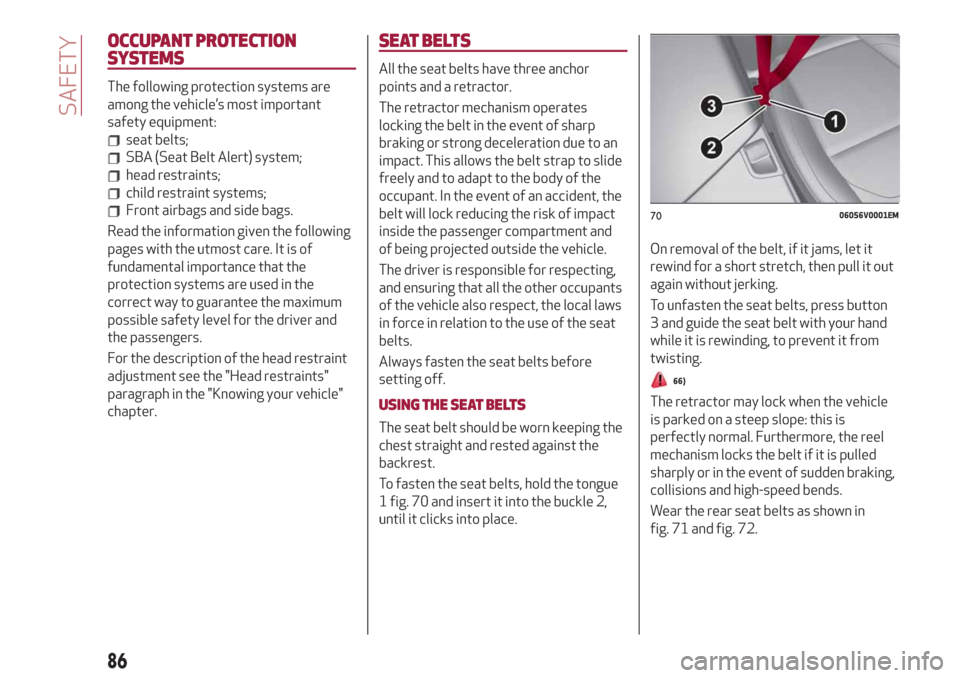
To fasten the seat belts, hold the tongue
1 fig. 70 and insert it into the buckle 2,
until it clicks into place.On removal of the belt, if it jams, let it
rewind for a short stretch, then pull it out
again without jerking.
To unfasten the seat belts, press button
3 and guide the seat belt with your hand
while it is rewinding, to prevent it from
twisting.
66)
The retractor may lock when the vehicle
is parked on a steep slope: this is
perfectly normal. Furthermore, the reel
mechanism locks the belt if it is pulled
sharply or in the event of sudden braking,
collisions and high-speed bends.
Wear the rear seat belts as shown in
fig. 71 and fig. 72.
7006056V0001EM
86
SAFETY
Page 90 of 244
SBA (Seat Belt Alert)SYSTEM
The SBR system warns the passengers of
the front and rear (where provided) seats
if their seat belt is not fastened.
The system warnings unfastened seat
belts with visual warnings (warning lights
on in the instrument panel and icons on
the display) and an acoustic warning (see
the following paragraphs).
FRONT SEAT BELT WARNING LIGHT
BEHAVIOUR
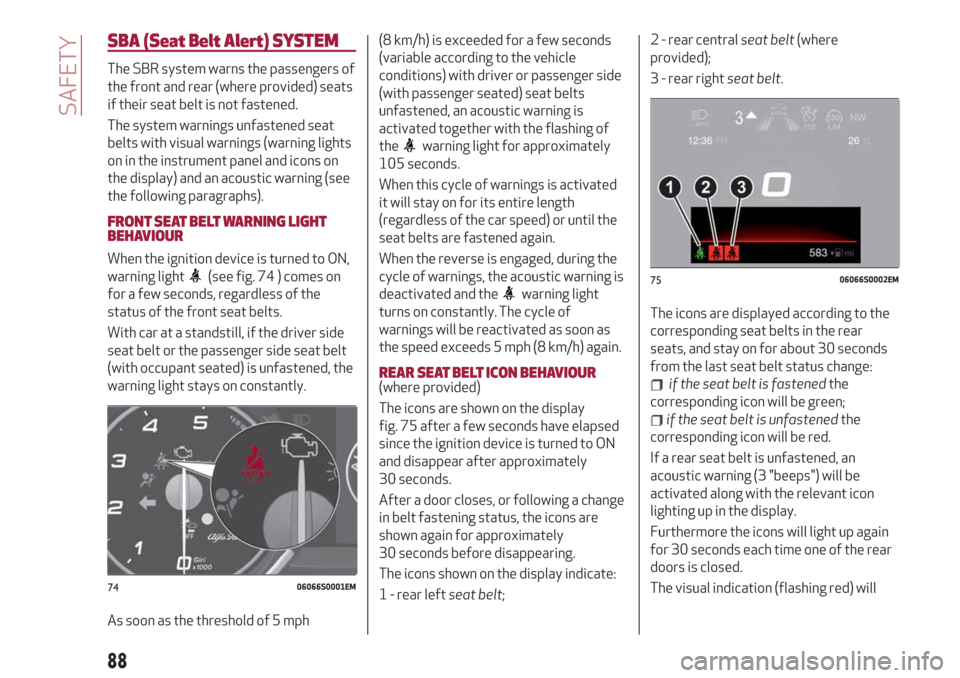
When the ignition device is turned to ON,
warning light
(see fig. 74 ) comes on
for a few seconds, regardless of the
status of the front seat belts.
With car at a standstill, if the driver side
seat belt or the passenger side seat belt
(with occupant seated) is unfastened, the
warning light stays on constantly.
As soon as the threshold of 5 mph(8 km/h) is exceeded for a few seconds
(variable according to the vehicle
conditions) with driver or passenger side
(with passenger seated) seat belts
unfastened, an acoustic warning is
activated together with the flashing of
the
warning light for approximately
105 seconds.
When this cycle of warnings is activated
it will stay on for its entire length
(regardless of the car speed) or until the
seat belts are fastened again.
When the reverse is engaged, during the
cycle of warnings, the acoustic warning is
deactivated and the
warning light
turns on constantly. The cycle of
warnings will be reactivated as soon as
the speed exceeds 5 mph (8 km/h) again.
REAR SEAT BELT ICON BEHAVIOUR(where provided)
The icons are shown on the display
fig. 75 after a few seconds have elapsed
since the ignition device is turned to ON
and disappear after approximately
30 seconds.
After a door closes, or following a change
in belt fastening status, the icons are
shown again for approximately
30 seconds before disappearing.
The icons shown on the display indicate:
1 - rear leftseat belt;2 - rear centralseat belt(where
provided);
3 - rear rightseat belt.
The icons are displayed according to the
corresponding seat belts in the rear
seats, and stay on for about 30 seconds
from the last seat belt status change:if the seat belt is fastenedthe
corresponding icon will be green;
if the seat belt is unfastenedthe
corresponding icon will be red.
If a rear seat belt is unfastened, an
acoustic warning (3 "beeps") will be
activated along with the relevant icon
lighting up in the display.
Furthermore the icons will light up again
for 30 seconds each time one of the rear
doors is closed.
The visual indication (flashing red) will
7406066S0001EM
7506066S0002EM
88
SAFETY
Page 91 of 244
start and stop independently for each
warning light if several seat belts are
unfastened.
The icon will turn green after the
corresponding seat belt has been
fastened.
The rear seat icons will go out, regardless
of the state of the belt (red icon or green
icon), approximately 30 seconds after
the last signal.
IMPORTANT NOTES
As far as the rear seats are concerned,
the SBR system will only indicate
whether the seat belts are unfastened
(red icon) or fastened (green icon), not
the presence of any passengers.
The warning lights/icons all stay off if all
seat belts (front and rear) are fastened
when the ignition device is set to ON.
For the rear seats, the icons will activate
a few seconds after the ignition device
has been turned to ON, regardless of the
status of the seat belts (even if the seat
belts are all fastened).
All the warning lights/icons will come on
when at least one belt changes from
fastened to unfastened status or vice
versa.PRE-TENSIONERS
The car is equipped with front and rear
lateral seat belt pretensioners, which
draw back the seat belts by several
centimetres in the event of a strong
frontal impact. This guarantees the
perfect adherence of the seat belts to
the occupant's bodies before the
retention action begins.
It is evident that the pretensioners have
been activated when the belt withdraws
toward the retractor.
This car is also equipped with a second
pretensioner on the front seat belts
(fitted in the kick plate area). Its
activation is signalled by the shortening
of the metal cable.
A slight discharge of smoke may be
produced during the activation of the
pretensioner which is not harmful and
does not involve any fire hazard.
The pretensioner does not require any
maintenance or lubrication: any changes
to its original conditions will invalidate its
efficiency.
If, due to unusual natural events (floods,
sea storms, etc.), the device has been
affected by water and/or mud, contact an
Alfa Romeo Dealership to have it
replaced.
IMPORTANT To obtain the highest
degree of protection from the action ofthe pretensioner, wear the seat belt tight
to the torso and pelvis.
LOAD LIMITERS
70)
29)
To increase safety in the event of an
accident, the front and rear lateral seat
belt retractors contain a load limiter
which controls the force acting on the
chest and shoulders during the belt
restraining action in the event of a
head-on collision.
GENERAL INSTRUCTIONS FOR USING
THE SEAT BELTS
71) 72) 73)
Respect and ensure that all the other
occupants of the vehicle comply with the
local laws in force regarding the use of
seat belts. Always fasten the seat belts
before setting off.
Seat belts must also be worn by pregnant
women: the risk of injury in the event of
an accident is reduced for them and the
unborn child if they are wearing a seat
belt.
Pregnant women must position the lower
part of the belt very low down so that it
passes over the pelvis and under the
abdomen fig. 76. While pregnancy
progresses, the driver must adjust both
seat and steering wheel to have full
control over the vehicle (pedals and
89
Page 105 of 244
81)Always make sure that the chest section
of the seat belt does not pass under the
arms or behind the back of the child. In the
event of an accident the seat belt will not be
able to secure the child, with the risk of
injury, including fatal injury. Therefore the
child must always wear the seat belt
correctly.
82)Do not use the same lower anchorage to
install more than one child restraint system.
83)If a Universal ISOFIX child seat is not
fixed to all three anchorages, the child seat
will not be able to protect the child correctly.
In a crash, the child could be seriously or
fatally injured.
84)Fit the child restraint system when the
car is stationary. The child restraint system
is correctly fixed to the brackets when you
hear the click. Follow the instructions for
assembly, disassembly and positioning that
the Manufacturer must supply with the child
restraint system.
85)If the vehicle was involved in an accident
of a certain severity, have the ISOFIX
anchorages and the child restraint system
replaced.
86)If the vehicle was involved in an accident
of a certain severity, have both the child
restraint system and the seat belt it was
attached to replaced.SUPPLEMENTARY RESTRAINT
SYSTEM (SRS) - AIRBAG
The vehicle is equipped with:
front driver airbag;
front passenger airbag;
driver and passenger front side bags
for pelvis, chest and shoulder protection
(Side bags);
side bags for head protection of front
seat passengers and rear side seat
passengers (window bag).
The location of the airbags on the vehicle
is marked by the word "AIRBAG" under
the Alfa Romeo emblem on the steering
wheel, on the dashboard, on the side trim
or on a label placed next to the airbag
deployment area.
FRONT AIRBAGS
The front (driver and passenger) airbags
protect the front seat occupants in the
event of head-on crashes of medium-high
severity, by placing the cushion between
the occupant and the steering wheel or
dashboard.
Therefore non-activation of airbags in
other types of collisions (side impacts,
rear shunts, roll-overs, etc.) does not
indicate a system malfunction.
Driver and passenger front airbags are
not a replacement of but complementary
to the seat belts, which should always be
worn, as specified by law in Europe and
most non-European countries.
In the event of impact, those not wearing
a seat belt are projected forwards and
may come into contact with the bag
which is still inflating. The protection
offered by the bag is compromised in
these circumstances.
Front airbags may not activate in the
following situations:
frontal impacts against highly
deformable objects not involving the
front surface of the vehicle (e.g. wing
collision against guard rail, etc.);
vehicle wedging under other vehicles
or protective barriers (e.g. trucks or
guard rails).
Failure to activate in the conditions
described above is due to the fact that
103
Page 106 of 244
they may not provide any additional
protection compared with seat belts, so
their activation would be inappropriate.
In these cases, non-deployment does not
indicate a system malfunction.
Front airbag driver's side
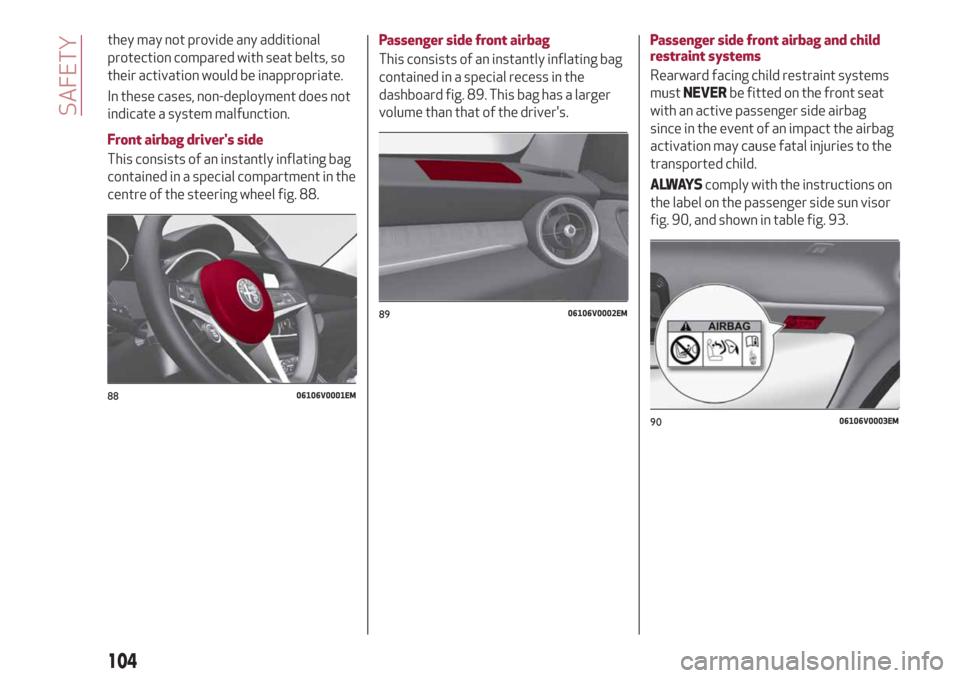
This consists of an instantly inflating bag
contained in a special compartment in the
centre of the steering wheel fig. 88.Passenger side front airbag
This consists of an instantly inflating bag
contained in a special recess in the
dashboard fig. 89. This bag has a larger
volume than that of the driver's.Passenger side front airbag and child
restraint systems
Rearward facing child restraint systems
mustNEVERbe fitted on the front seat
with an active passenger side airbag
since in the event of an impact the airbag
activation may cause fatal injuries to the
transported child.
ALWAYScomply with the instructions on
the label on the passenger side sun visor
fig. 90, and shown in table fig. 93.
8806106V0001EM
8906106V0002EM
9006106V0003EM
104
SAFETY
Page 109 of 244
SIDE AIRBAGS
To help increase occupants protection in
the event of side impact collisions, the
vehicle is equipped with front side bags
and window bags.
Side bag
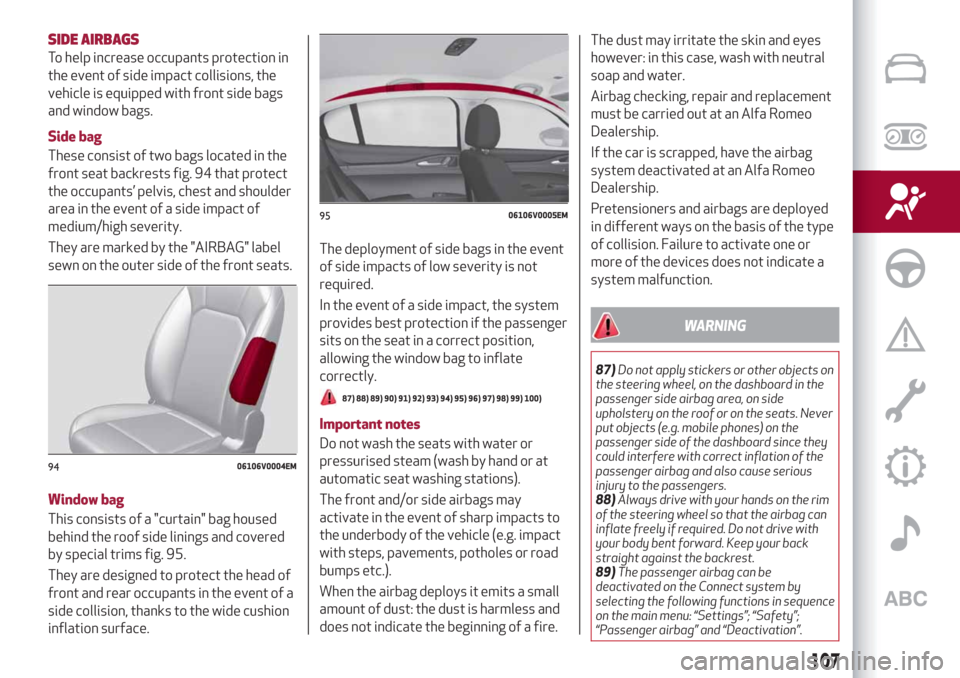
These consist of two bags located in the
front seat backrests fig. 94 that protect
the occupants’ pelvis, chest and shoulder
area in the event of a side impact of
medium/high severity.
They are marked by the "AIRBAG" label
sewn on the outer side of the front seats.
Window bag
This consists of a "curtain" bag housed
behind the roof side linings and covered
by special trims fig. 95.
They are designed to protect the head of
front and rear occupants in the event of a
side collision, thanks to the wide cushion
inflation surface.The deployment of side bags in the event
of side impacts of low severity is not
required.
In the event of a side impact, the system
provides best protection if the passenger
sits on the seat in a correct position,
allowing the window bag to inflate
correctly.
87) 88) 89) 90) 91) 92) 93) 94) 95) 96) 97) 98) 99) 100)
Important notes
Do not wash the seats with water or
pressurised steam (wash by hand or at
automatic seat washing stations).
The front and/or side airbags may
activate in the event of sharp impacts to
the underbody of the vehicle (e.g. impact
with steps, pavements, potholes or road
bumps etc.).
When the airbag deploys it emits a small
amount of dust: the dust is harmless and
does not indicate the beginning of a fire.The dust may irritate the skin and eyes
however: in this case, wash with neutral
soap and water.
Airbag checking, repair and replacement
must be carried out at an Alfa Romeo
Dealership.
If the car is scrapped, have the airbag
system deactivated at an Alfa Romeo
Dealership.
Pretensioners and airbags are deployed
in different ways on the basis of the type
of collision. Failure to activate one or
more of the devices does not indicate a
system malfunction.
WARNING
87)Do not apply stickers or other objects on
the steering wheel, on the dashboard in the
passenger side airbag area, on side
upholstery on the roof or on the seats. Never
put objects (e.g. mobile phones) on the
passenger side of the dashboard since they
could interfere with correct inflation of the
passenger airbag and also cause serious
injury to the passengers.
88)Always drive with your hands on the rim
of the steering wheel so that the airbag can
inflate freely if required. Do not drive with
your body bent forward. Keep your back
straight against the backrest.
89)The passenger airbag can be
deactivated on the Connect system by
selecting the following functions in sequence
on the main menu: “Settings”; “Safety”;
“Passenger airbag” and “Deactivation”.
9406106V0004EM
9506106V0005EM
107
Page 111 of 244
Let’s get to the core of the vehicle: seeing how you can exploit all
of its potential to the full. We’ll look at how to drive it safely in any
situation, so that it can be a welcome companion, with our comfort
and our wallets in mind.
STARTING AND DRIVING
STARTING THE ENGINE..........................110
PARKING THE VEHICLE..........................111
AUTOMATIC TRANSMISSION . .....................114
"ALFA DNA™" SYSTEM..........................116
START&STOPEVO............................117
SPEED LIMITER..............................118
CRUISE CONTROL.............................119
ACTIVE CRUISE CONTROL........................120
PARK SENSORS SYSTEM........................127
LANE DEPARTURE WARNING (LDW) SYSTEM............129
REAR BACK-UP CAMERA / DYNAMIC GRIDLINES . ........130
REFUELLING THE VEHICLE . . .....................131
AdBlue® (UREA) ADDITIVE FOR DIESEL EMISSIONS........136
SUGGESTIONS FOR DRIVING......................136
TOWING TRAILERS............................137
Page 113 of 244
IMPORTANT
30)We recommend that during the initial
period, or during the first 1600 km
(1000 miles), you do not drive to full car
performance (e.g. excessive acceleration,
long journeys at top speed, sharp braking,
etc.).
31)When the engine stopped never leave
the ignition device in the ON position to
prevent useless current draw from draining
the battery.
32)Warning light
will flash after starting
or during prolonged cranking to indicate a
fault with the glow plug heating system. If
the engine starts, the vehicle can be regularly
used, but an Alfa Romeo Dealership must be
contacted as soon as possible.
33)A quick burst on the accelerator before
turning off the engine serves absolutely no
practical purpose; it wastes fuel and is
damaging for the engine.
PARKING THE VEHICLE
104) 105) 106)
IMPORTANT In addition to parking the
vehicle with the parking brake always
engaged, the wheels turned, chocks or
stones positioned in front of the wheels
(when on a steep slope), you must always:
engage P (Park) mode;
always take the key with you when
leaving the vehicle.
IMPORTANT Always engage the electric
parking brake before leaving the vehicle.
ELECTRIC PARKING BRAKE
The car is equipped with electric parking
brake to guarantee better use and
optimal performance compared to a
manually operated parking brake.
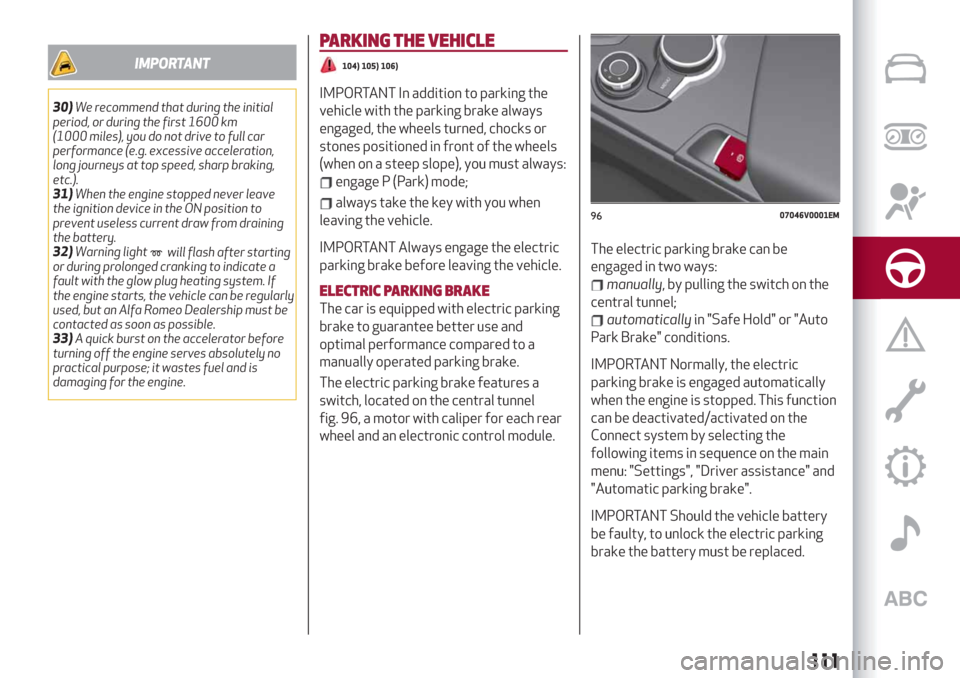
The electric parking brake features a
switch, located on the central tunnel
fig. 96, a motor with caliper for each rear
wheel and an electronic control module.The electric parking brake can be
engaged in two ways:
manually, by pulling the switch on the
central tunnel;
automaticallyin "Safe Hold" or "Auto
Park Brake" conditions.
IMPORTANT Normally, the electric
parking brake is engaged automatically
when the engine is stopped. This function
can be deactivated/activated on the
Connect system by selecting the
following items in sequence on the main
menu: "Settings", "Driver assistance" and
"Automatic parking brake".
IMPORTANT Should the vehicle battery
be faulty, to unlock the electric parking
brake the battery must be replaced.
9607046V0001EM
111
Page 114 of 244
Engaging the parking brake manually
Briefly pull the switch located on the
central tunnel to manually engage the
electric parking brake when the car is
stationary.
Noise may be heard from the rear part of
the car when engaging the electric
parking brake.
A slight movement of the brake pedal
may be detected when engaging the
electric parking brake with the brake
pedal pressed.
With the electric parking brake engaged,
the warning light
on the instrument
panel and the LED on the switch
fig. 96 turn on.
IMPORTANT With the Electronic Parking
Brake failure warning light on, some
functions of the electric parking brake
are deactivated. In this case the driver is
responsible for brake activation and
vehicle parking in complete safety
conditions.
If, under exceptional circumstances, the
use of the brake is required with the
vehicle in motion, keep the switch on the
central tunnel pulled as long as the brake
action is necessary.
The
warning light may switch on with
the hydraulic system temporarily
unavailable; in this case braking is
controlled by the motors.The brake lights (stop) will also
automatically switch on in the same way
as for normal braking with the use of the
brake pedal.
Release the switch on the central tunnel
to stop the braking action with the car in
motion.
If, through this procedure, the vehicle is
braked until a speed below 2 mph
(3 km/h) is reached and the switch is kept
pulled, the parking brake will definitively
engage.
IMPORTANT Driving the vehicle with the
electric parking brake engaged, or using
it several times to slow down the vehicle,
may cause severe damage to the braking
system.
Releasing the electric parking brake
manually
In order to manually release the parking
brake, the ignition device should be at ON
position. Moreover, you need to press the
brake pedal, then press the switch on the
central tunnel briefly.
Noise may be heard from the rear of the
vehicle and a slight movement of the
brake pedal may be detected during
disengagement.
After disengaging the electric parking
brake, the
warning light on the
instrument panel and the LED on the
fig. 96 switch turn off.If the
warning light on the instrument
panel remains on with the electric parking
brake disengaged, this indicates a fault:
in this case contact an Alfa Romeo
Dealership.
IMPORTANT Never use gear position P
(Park) instead of the electric parking
brake. Always engage the electric
parking brake when parking the vehicle to
prevent injury or damage caused by the
unexpected movement of the vehicle.
OPERATING THE ELECTRIC PARKING
BRAKE
The electric parking brake can operate in
the following ways:
"Dynamic driving way": this way is
activated by pulling the switch
continuously while driving;
"Static engagement and release
mode": with the car stationary, the
electric parking brake can be activated
by pulling the switch on the central tunnel
once. On the other hand, press the switch
and the brake pedal at the same time to
disengage the brake;
"Drive Away Release": (where
provided) the electric parking brake will
automatically disengage with the driver
side seat belt fastened and the detection
of an action performed by the driver to
move the car (forward gear or reverse
gear);
NOTE If the vehicle is equipped with
112
STARTING AND DRIVING