Drive Alfa Romeo Stelvio 2019 Repair Manual
[x] Cancel search | Manufacturer: ALFA ROMEO, Model Year: 2019, Model line: Stelvio, Model: Alfa Romeo Stelvio 2019Pages: 244, PDF Size: 4.95 MB
Page 129 of 244
PARK SENSORSSYSTEM
(where provided)
120)
44) 45) 46)
VERSIONS WITH 4/8 SENSORS
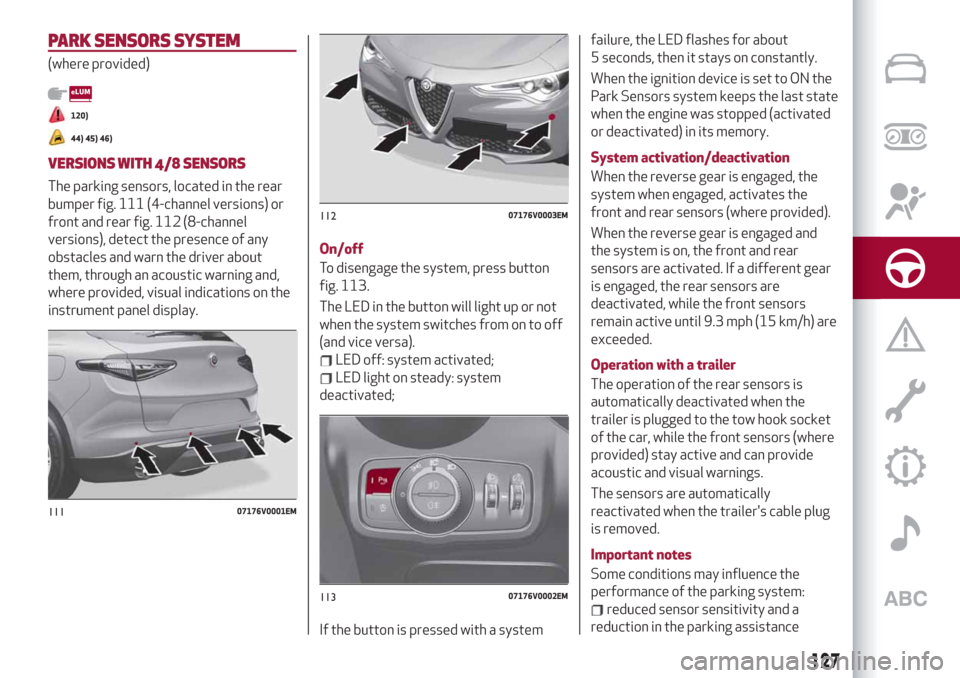
The parking sensors, located in the rear
bumper fig. 111 (4-channel versions) or
front and rear fig. 112 (8-channel
versions), detect the presence of any
obstacles and warn the driver about
them, through an acoustic warning and,
where provided, visual indications on the
instrument panel display.On/off
To disengage the system, press button
fig. 113.
The LED in the button will light up or not
when the system switches from on to off
(and vice versa).
LED off: system activated;
LED light on steady: system
deactivated;
If the button is pressed with a systemfailure, the LED flashes for about
5 seconds, then it stays on constantly.
When the ignition device is set to ON the
Park Sensors system keeps the last state
when the engine was stopped (activated
or deactivated) in its memory.
System activation/deactivation
When the reverse gear is engaged, the
system when engaged, activates the
front and rear sensors (where provided).
When the reverse gear is engaged and
the system is on, the front and rear
sensors are activated. If a different gear
is engaged, the rear sensors are
deactivated, while the front sensors
remain active until 9.3 mph (15 km/h) are
exceeded.
Operation with a trailer
The operation of the rear sensors is
automatically deactivated when the
trailer is plugged to the tow hook socket
of the car, while the front sensors (where
provided) stay active and can provide
acoustic and visual warnings.
The sensors are automatically
reactivated when the trailer's cable plug
is removed.
Important notes
Some conditions may influence the
performance of the parking system:
reduced sensor sensitivity and a
reduction in the parking assistance
11107176V0001EM
11207176V0003EM
11307176V0002EM
127
Page 130 of 244
system performance could be due to the
presence of: ice, snow, mud, thick paint,
on the surface of the sensor;
the sensor may detect a non-existent
obstacle ("echo interference") due to
mechanical interference, for example
when washing the vehicle, in rain (strong
wind), hail;
the signals sent by the sensor can also
be altered by the presence of ultrasonic
systems (e.g. pneumatic brake systems
of trucks or pneumatic drills) near the
vehicle;
parking assistance system
performance can also be influenced by
the position of the sensors, for example
due to a change in the ride setting
(caused by wear to the shock absorbers,
suspension), or by changing tyres,
overloading the vehicle or carrying out
specific tuning operations that require
the vehicle to be lowered;
the presence of a tow hook without
trailer, which may interfere with the
correct operation of the parking sensors.
Before using the Park Sensors system, it
is recommended to remove the tow hook
ball assembly when the vehicle is not
used for towing. Failure to comply with
this prescription may cause personal
injuries or damage to vehicles or
obstacles since, when the continuous
acoustic warning is emitted, the tow hook
ball is already in a position that is muchcloser to the obstacle than the rear
bumper. If you wish to leave the tow hook
fitted without towing a trailer, it is
advisable to contact an Alfa Romeo
Dealership for the Park Sensors system
update operations because the tow hook
could be detected as an obstacle by the
central sensors.
the presence of adhesives on the
sensors. Therefore, take care not to place
stickers on the sensors.
WARNING
120)Parking and other potentially
dangerous manoeuvres are, however,
always the driver’s responsibility. When
performing these operations, always make
sure that there are no other people
(especially children) or animals on the route
you want to take. The parking sensors are an
aid for the driver, but the driver must never
allow their attention to lapse during
potentially dangerous manoeuvres, even
those executed at low speeds.
IMPORTANT
44)The sensors must be clean of mud, dirt,
snow or ice in order for the system to
operate correctly. Be careful not to scratch
or damage the sensors while cleaning them.
Avoid using dry, rough or hard cloths. The
sensors should be washed using clean water
with the addition of car shampoo if
necessary. When using special washing
equipment such as high pressure jets or
steam cleaning, clean the sensors very
quickly keeping the jet more than 10 cm
away.
45)Have interventions on the bumper in the
area of the sensors carried out only by an
Alfa Romeo Dealership. Interventions on the
bumper that are not carried out properly
may compromise the operation of the
parking sensors.
46)Only have the bumpers repainted or any
retouches to the paintwork in the area of the
sensors carried out by an Alfa Romeo
Dealership. Incorrect paint application could
affect the operation of the parking sensors.
128
STARTING AND DRIVING
Page 131 of 244
LANE DEPARTURE WARNING
(LDW) SYSTEM
DESCRIPTION
47) 48) 49) 50) 51) 52)
The Lane Departure Warning system
makes use of a camera located on the
windscreen to detect the lane limits and
calculate the position of the vehicle
within such limits, in order to make sure
that it remains inside the lane.
When one or both lane limits are
detected and the vehicle passes over one
without the driver's say-so (direction
indicator not turned on), the system
emits an acoustic signal.
If the vehicle continues to go beyond the
line of the lane without any intervention
from the driver, the surpassed line will
light up on the display (left or right) to
urge the driver to bring the vehicle back
into the limits of the lane.
SYSTEM ON/OFF
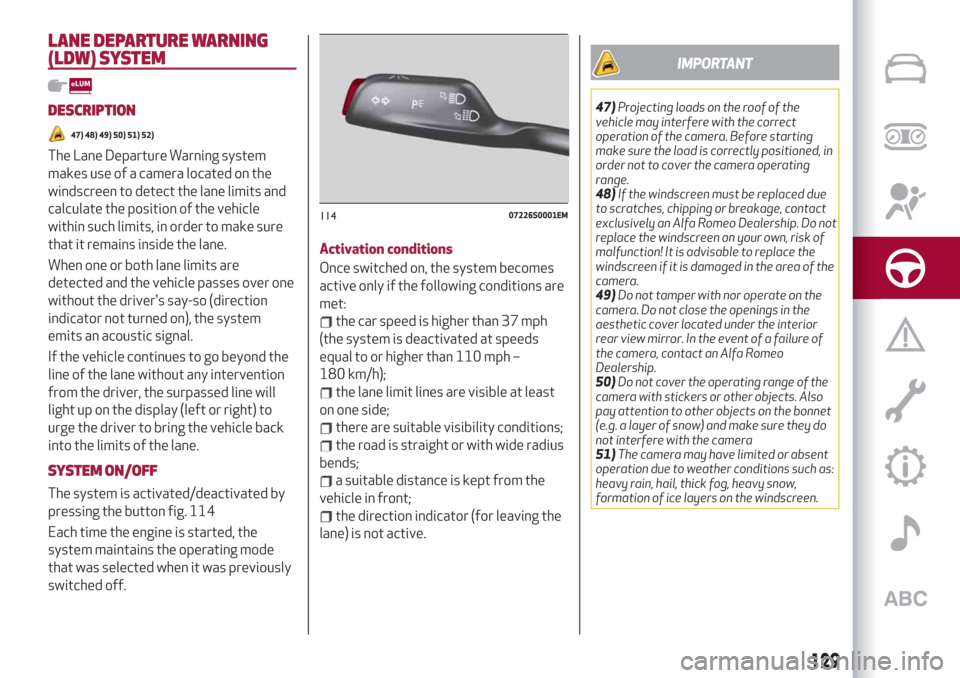
The system is activated/deactivated by
pressing the button fig. 114
Each time the engine is started, the
system maintains the operating mode
that was selected when it was previously
switched off.Activation conditions
Once switched on, the system becomes
active only if the following conditions are
met:
the car speed is higher than 37 mph
(the system is deactivated at speeds
equal to or higher than 110 mph –
180 km/h);
the lane limit lines are visible at least
on one side;
there are suitable visibility conditions;
the road is straight or with wide radius
bends;
a suitable distance is kept from the
vehicle in front;
the direction indicator (for leaving the
lane) is not active.
IMPORTANT
47)Projecting loads on the roof of the
vehicle may interfere with the correct
operation of the camera. Before starting
make sure the load is correctly positioned, in
order not to cover the camera operating
range.
48)If the windscreen must be replaced due
to scratches, chipping or breakage, contact
exclusively an Alfa Romeo Dealership. Do not
replace the windscreen on your own, risk of
malfunction! It is advisable to replace the
windscreen if it is damaged in the area of the
camera.
49)Do not tamper with nor operate on the
camera. Do not close the openings in the
aesthetic cover located under the interior
rear view mirror. In the event of a failure of
the camera, contact an Alfa Romeo
Dealership.
50)Do not cover the operating range of the
camera with stickers or other objects. Also
pay attention to other objects on the bonnet
(e.g. a layer of snow) and make sure they do
not interfere with the camera
51)The camera may have limited or absent
operation due to weather conditions such as:
heavy rain, hail, thick fog, heavy snow,
formation of ice layers on the windscreen.
11407226S0001EM
129
Page 132 of 244
52)Camera operation may also be
compromised by the presence of dust,
condensation, dirt or ice on the windscreen,
by traffic conditions (e.g. vehicles that are
driving not aligned with yours, vehicle driving
in a transverse or opposite way on the same
lane, bend with a small radius of curvature),
by road surface conditions and by driving
conditions (e.g. off-road driving). Make sure
the windscreen is always clean. Use specific
detergents and clean cloths to avoid
scratching the windscreen. The camera
operation may also be limited or absent in
some driving, traffic and road surface
conditions.REAR BACK-UP CAMERA /
DYNAMIC GRIDLINES
DESCRIPTION
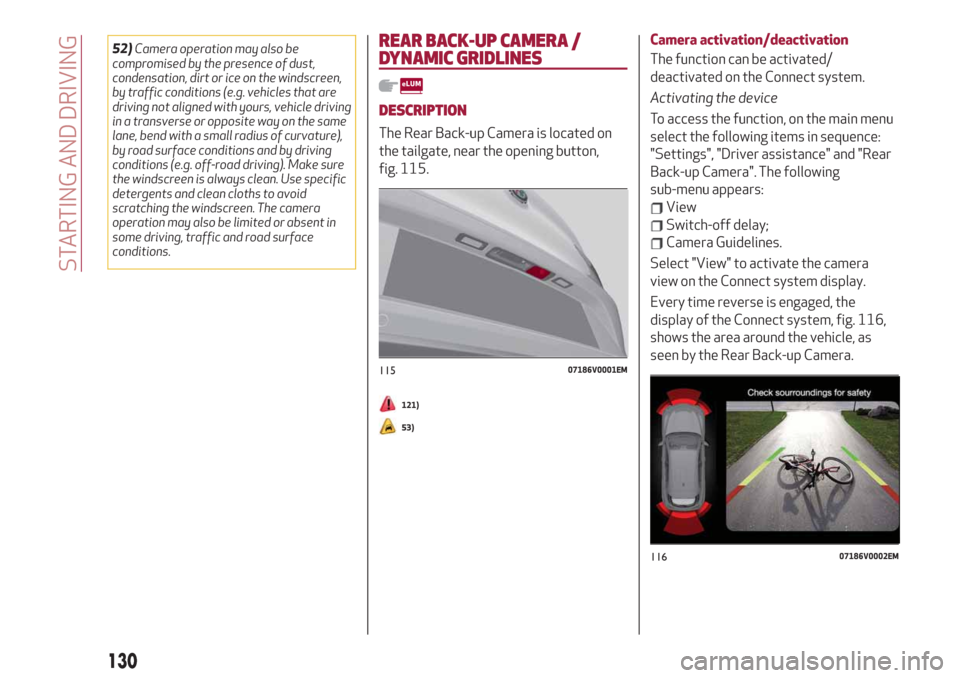
The Rear Back-up Camera is located on
the tailgate, near the opening button,
fig. 115.
121)
53)
Camera activation/deactivation
The function can be activated/
deactivated on the Connect system.
Activating the device
To access the function, on the main menu
select the following items in sequence:
"Settings", "Driver assistance" and "Rear
Back-up Camera". The following
sub-menu appears:
View
Switch-off delay;
Camera Guidelines.
Select "View" to activate the camera
view on the Connect system display.
Every time reverse is engaged, the
display of the Connect system, fig. 116,
shows the area around the vehicle, as
seen by the Rear Back-up Camera.
11507186V0001EM
11607186V0002EM
130
STARTING AND DRIVING
Page 133 of 244
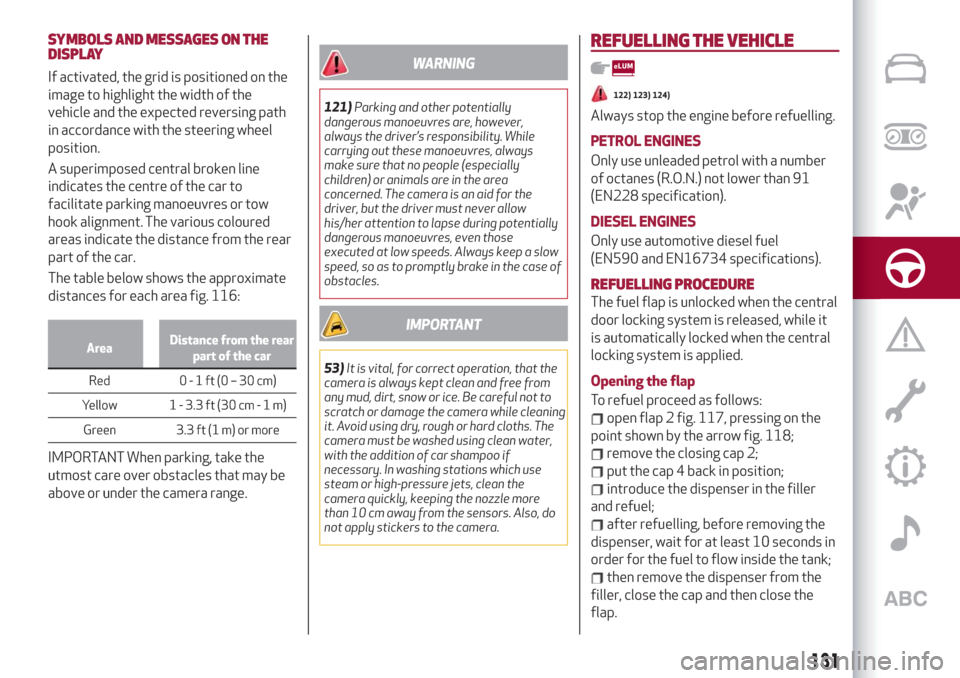
SYMBOLS AND MESSAGES ON THE
DISPLAY
If activated, the grid is positioned on the
image to highlight the width of the
vehicle and the expected reversing path
in accordance with the steering wheel
position.
A superimposed central broken line
indicates the centre of the car to
facilitate parking manoeuvres or tow
hook alignment. The various coloured
areas indicate the distance from the rear
part of the car.
The table below shows the approximate
distances for each area fig. 116:
AreaDistance from the rear
part of the car
Red 0-1ft(0–30cm)
Y
ellow 1 - 3.3 ft (30 cm-1m)
Green 3.3 ft (1 m) or more
IMPORTANT When parking, take the
utmost care over obstacles that may be
above or under the camera range.
WARNING
121)Parking and other potentially
dangerous manoeuvres are, however,
always the driver’s responsibility. While
carrying out these manoeuvres, always
make sure that no people (especially
children) or animals are in the area
concerned. The camera is an aid for the
driver, but the driver must never allow
his/her attention to lapse during potentially
dangerous manoeuvres, even those
executed at low speeds. Always keep a slow
speed, so as to promptly brake in the case of
obstacles.
IMPORTANT
53)It is vital, for correct operation, that the
camera is always kept clean and free from
any mud, dirt, snow or ice. Be careful not to
scratch or damage the camera while cleaning
it. Avoid using dry, rough or hard cloths. The
camera must be washed using clean water,
with the addition of car shampoo if
necessary. In washing stations which use
steam or high-pressure jets, clean the
camera quickly, keeping the nozzle more
than 10 cm away from the sensors. Also, do
not apply stickers to the camera.
REFUELLING THE VEHICLE
122) 123) 124)
Always stop the engine before refuelling.
PETROL ENGINES
Only use unleaded petrol with a number
of octanes (R.O.N.) not lower than 91
(EN228 specification).
DIESEL ENGINES
Only use automotive diesel fuel
(EN590 and EN16734 specifications).
REFUELLING PROCEDURE
The fuel flap is unlocked when the central
door locking system is released, while it
is automatically locked when the central
locking system is applied.
Opening the flap
To refuel proceed as follows:
open flap 2 fig. 117, pressing on the
point shown by the arrow fig. 118;
remove the closing cap 2;
put the cap 4 back in position;
introduce the dispenser in the filler
and refuel;
after refuelling, before removing the
dispenser, wait for at least 10 seconds in
order for the fuel to flow inside the tank;
then remove the dispenser from the
filler, close the cap and then close the
flap.
131
Page 142 of 244
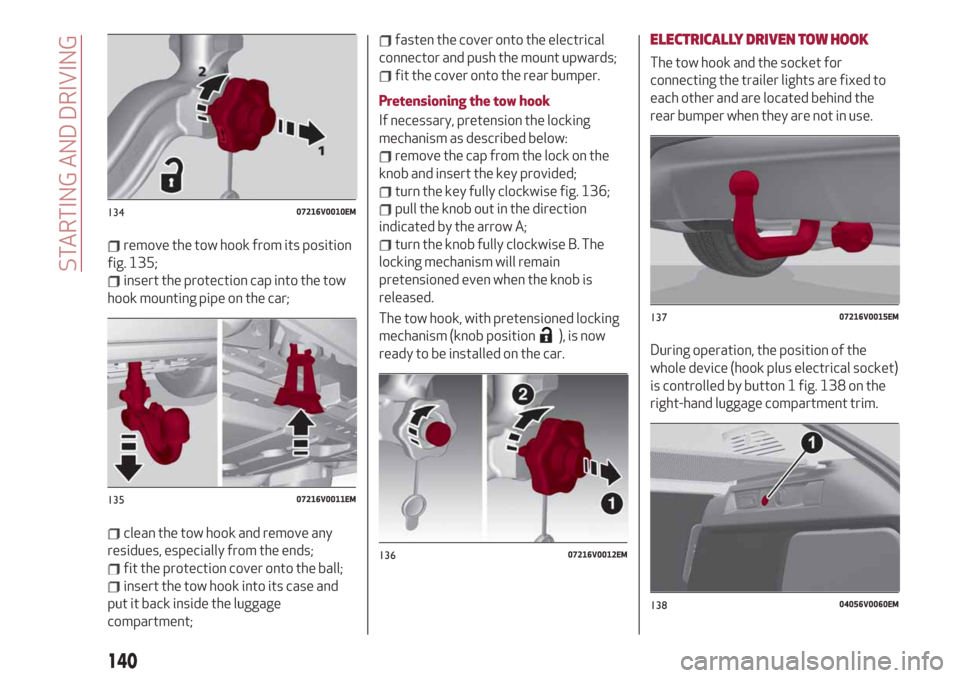
remove the tow hook from its position
fig. 135;
insert the protection cap into the tow
hook mounting pipe on the car;
clean the tow hook and remove any
residues, especially from the ends;
fit the protection cover onto the ball;
insert the tow hook into its case and
put it back inside the luggage
compartment;
fasten the cover onto the electrical
connector and push the mount upwards;
fit the cover onto the rear bumper.
Pretensioning the tow hook
If necessary, pretension the locking
mechanism as described below:
remove the cap from the lock on the
knob and insert the key provided;
turn the key fully clockwise fig. 136;
pull the knob out in the direction
indicated by the arrow A;
turn the knob fully clockwise B. The
locking mechanism will remain
pretensioned even when the knob is
released.
The tow hook, with pretensioned locking
mechanism (knob position
), is now
ready to be installed on the car.
ELECTRICALLY DRIVEN TOW HOOK
The tow hook and the socket for
connecting the trailer lights are fixed to
each other and are located behind the
rear bumper when they are not in use.
During operation, the position of the
whole device (hook plus electrical socket)
is controlled by button 1 fig. 138 on the
right-hand luggage compartment trim.
13407216V0010EM
13507216V0011EM
13607216V0012EM
13707216V0015EM
13804056V0060EM
140
STARTING AND DRIVING
Page 155 of 244
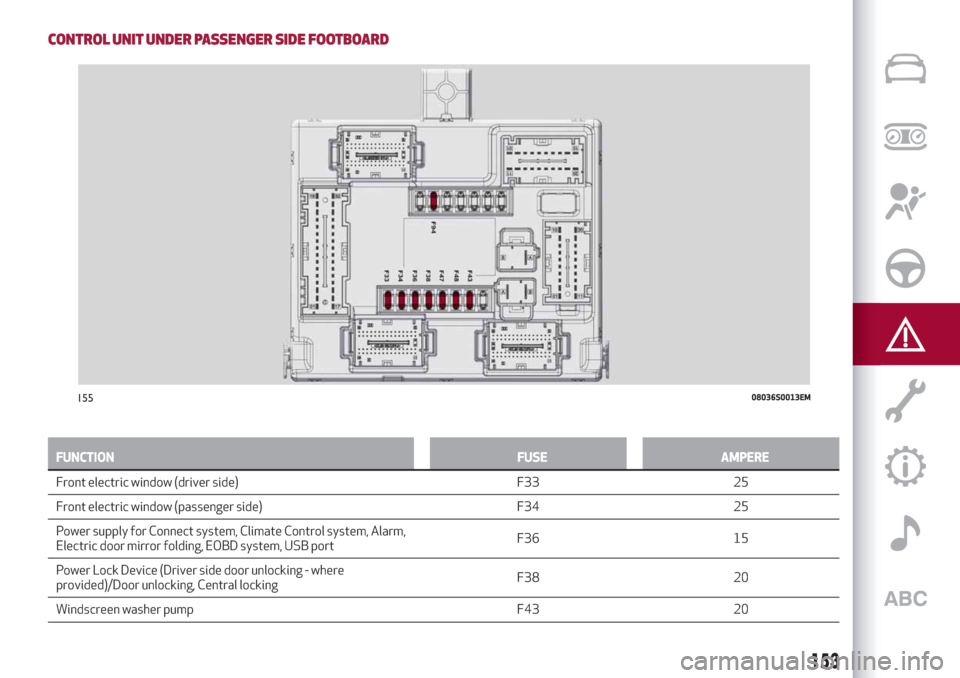
CONTROL UNIT UNDER PASSENGER SIDE FOOTBOARD
FUNCTION FUSE AMPERE
Front electric window (driver side) F33 25
Front
electric window (passenger side) F34 25
Power supply for Connect system, Climate Control system, Alarm,
Electric door mirror folding, EOBD system, USB portF36 15
Power Lock Device (Driver side door unlocking - where
provided)/Door unlocking, Central lockingF38 20
Windscreen washer pump F43 20
15508036S0013EM
153
Page 157 of 244
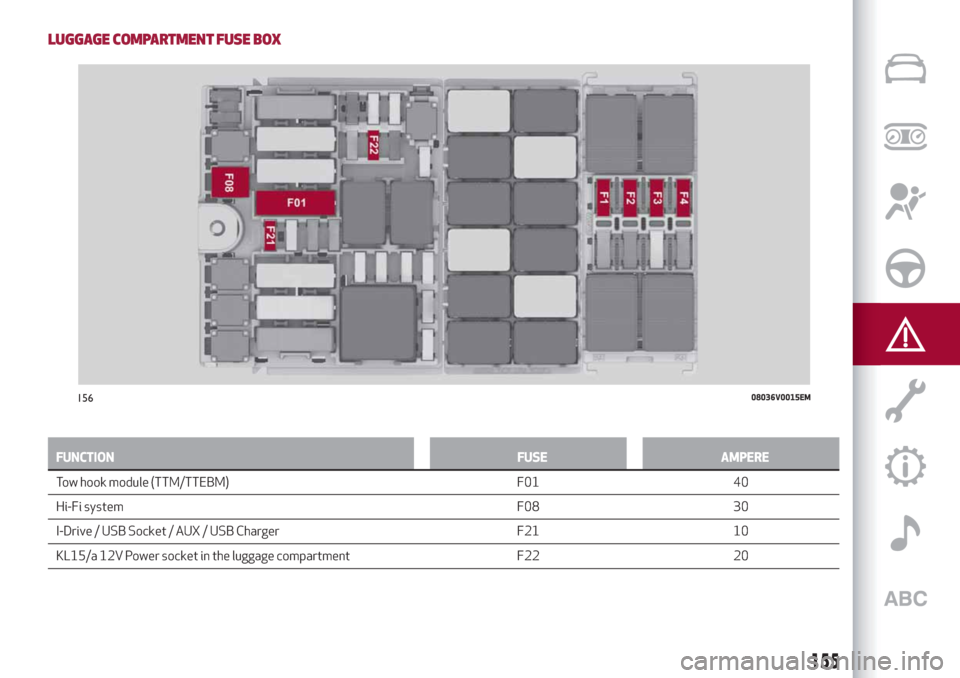
LUGGAGE COMPARTMENT FUSE BOX
FUNCTION FUSE AMPERE
Tow hook module (TTM/TTEBM) F01 40
Hi-Fi
system F08 30
I-Drive / USB Socket / AUX / USB Charger F21 10
KL15/a 12V Power socket in the luggage compartment F22 20
15608036V0015EM
155
Page 161 of 244
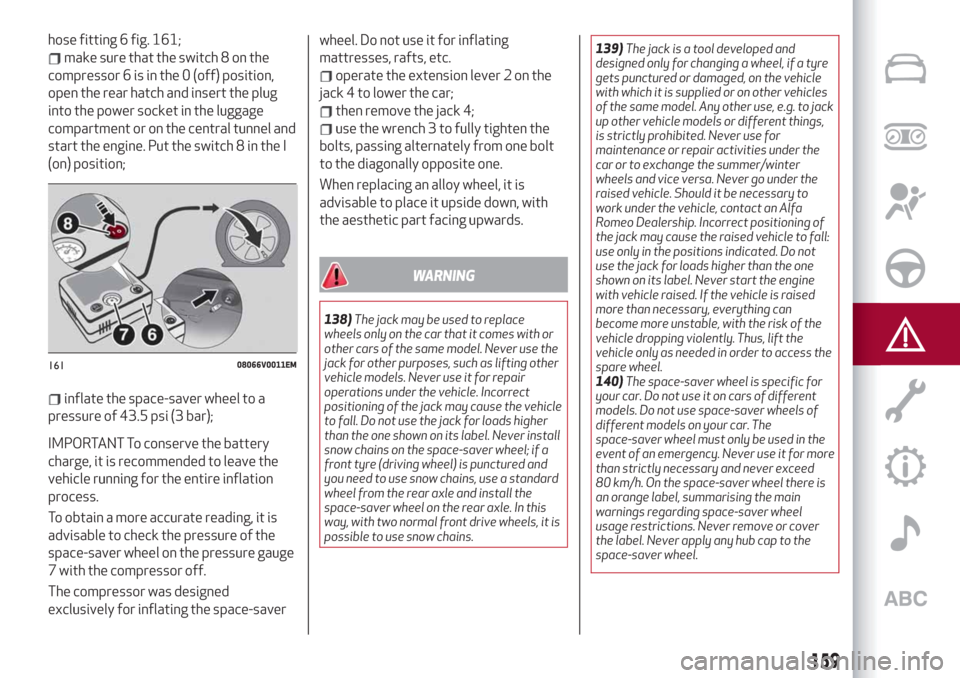
hose fitting 6 fig. 161;
make sure that the switch 8 on the
compressor 6 is in the 0 (off) position,
open the rear hatch and insert the plug
into the power socket in the luggage
compartment or on the central tunnel and
start the engine. Put the switch 8 in the I
(on) position;
inflate the space-saver wheel to a
pressure of 43.5 psi (3 bar);
IMPORTANT To conserve the battery
charge, it is recommended to leave the
vehicle running for the entire inflation
process.
To obtain a more accurate reading, it is
advisable to check the pressure of the
space-saver wheel on the pressure gauge
7 with the compressor off.
The compressor was designed
exclusively for inflating the space-saverwheel. Do not use it for inflating
mattresses, rafts, etc.
operate the extension lever 2 on the
jack 4 to lower the car;
then remove the jack 4;
use the wrench 3 to fully tighten the
bolts, passing alternately from one bolt
to the diagonally opposite one.
When replacing an alloy wheel, it is
advisable to place it upside down, with
the aesthetic part facing upwards.
WARNING
138)The jack may be used to replace
wheels only on the car that it comes with or
other cars of the same model. Never use the
jack for other purposes, such as lifting other
vehicle models. Never use it for repair
operations under the vehicle. Incorrect
positioning of the jack may cause the vehicle
to fall. Do not use the jack for loads higher
than the one shown on its label. Never install
snow chains on the space-saver wheel; if a
front tyre (driving wheel) is punctured and
you need to use snow chains, use a standard
wheel from the rear axle and install the
space-saver wheel on the rear axle. In this
way, with two normal front drive wheels, it is
possible to use snow chains.139)The jack is a tool developed and
designed only for changing a wheel, if a tyre
gets punctured or damaged, on the vehicle
with which it is supplied or on other vehicles
of the same model. Any other use, e.g. to jack
up other vehicle models or different things,
is strictly prohibited. Never use for
maintenance or repair activities under the
car or to exchange the summer/winter
wheels and vice versa. Never go under the
raised vehicle. Should it be necessary to
work under the vehicle, contact an Alfa
Romeo Dealership. Incorrect positioning of
the jack may cause the raised vehicle to fall:
use only in the positions indicated. Do not
use the jack for loads higher than the one
shown on its label. Never start the engine
with vehicle raised. If the vehicle is raised
more than necessary, everything can
become more unstable, with the risk of the
vehicle dropping violently. Thus, lift the
vehicle only as needed in order to access the
spare wheel.
140)The space-saver wheel is specific for
your car. Do not use it on cars of different
models. Do not use space-saver wheels of
different models on your car. The
space-saver wheel must only be used in the
event of an emergency. Never use it for more
than strictly necessary and never exceed
80 km/h. On the space-saver wheel there is
an orange label, summarising the main
warnings regarding space-saver wheel
usage restrictions. Never remove or cover
the label. Never apply any hub cap to the
space-saver wheel.
16108066V0011EM
159
Page 162 of 244
141)Alert other drivers that the car is
stationary in compliance with local
regulations: hazard warning lights, warning
triangle, etc. Any passengers on board
should leave the car, especially if it is heavily
laden. Passengers should stay away from
on-coming traffic while the wheel is being
changed. On hills or uneven roads, use
chocks or appropriate objects to block the
wheels of the vehicle.
142)If left in the passenger compartment,
the punctured wheel and jack constitute a
serious risk to the safety of occupants in the
event of accidents or sharp braking.
Therefore, always place both the jack and
punctured wheel in the dedicated housing in
the boot.
143)It is extremely dangerous to attempt
to change a wheel on the side of the vehicle
next to the driving lane: make sure that the
vehicle is at a sufficient distance from the
road, to avoid being run over.
144)Alert other drivers that the car is
stationary in compliance with local
regulations: hazard warning lights, warning
triangle, etc. Any passengers on board
should leave the car, especially if it is heavily
laden. Passengers should stay away from
on-coming traffic while the wheel is being
changed.
145)Never tamper with the inflation valve.
Never introduce tools of any kind between
the rim and the tyre. Check tyre and
space-saver wheel pressures regularly,
complying with the values given in the
"Technical specifications" chapter.146)The spare wheel must only be used in
an emergency. Never use it for more than
strictly necessary and never exceed
80 km/h. On the wheel there is an orange
sticker, summarising the main warnings
regarding wheel usage restrictions. Never
remove or cover the label. The label contains
the following indications in four languages:
"Warning! For temporary use only! 80 km/h
max! Replace with standard wheel as soon
as possible. Never cover this indication."
Never apply a wheel cap on the wheel. The
driving characteristics of the car will be
modified with the wheel fitted. Avoid violent
acceleration and braking, abrupt steering
and fast cornering. Have the wheel repaired
and refitted as soon as possible. Using two
or more spare wheels at the same time is
forbidden. Do not apply grease to the bolt
threads before fitting: they could come
unscrewed.
IMPORTANT
58)When turning the jack handle make sure
that it can turn freely without scraping your
hand against the ground. The moving
components of the jack ("worm screw" and
joints) can also cause injuries: avoid touching
them. If you come into contact with
lubricating grease, clean yourself
thoroughly.
59)Contact an Alfa Romeo Dealership as
soon as possible to have the correct
tightening of the wheel bolts checked.
TIRE REPAIR KIT
DESCRIPTION
147) 148) 149) 150) 151) 152) 153) 154) 155) 156)
60)
3)
The Tire Repair Kit is located in the
luggage compartment, inside a dedicated
container marked with the Alfa Romeo
logo.
To access the Tire Repair Kit, open the
boot, lift the load platform.
The Tire Repair Kit includes also:
a cannister 1 fig. 162 containing the
sealant, equipped with filling hose 2;
a compressor 4 complete with
pressure gauge, fittings and an adhesive
label 3 with the words Max. 80 km/h”, to
be attached in a position easily visible to
the driver (eg. on the dashboard) after
repairing the tyre;
some adaptors, for inflating different
elements.
160
IN AN EMERGENCY