engine Alfa Romeo Stelvio 2019 Workshop Manual
[x] Cancel search | Manufacturer: ALFA ROMEO, Model Year: 2019, Model line: Stelvio, Model: Alfa Romeo Stelvio 2019Pages: 244, PDF Size: 4.95 MB
Page 129 of 244
PARK SENSORSSYSTEM
(where provided)
120)
44) 45) 46)
VERSIONS WITH 4/8 SENSORS
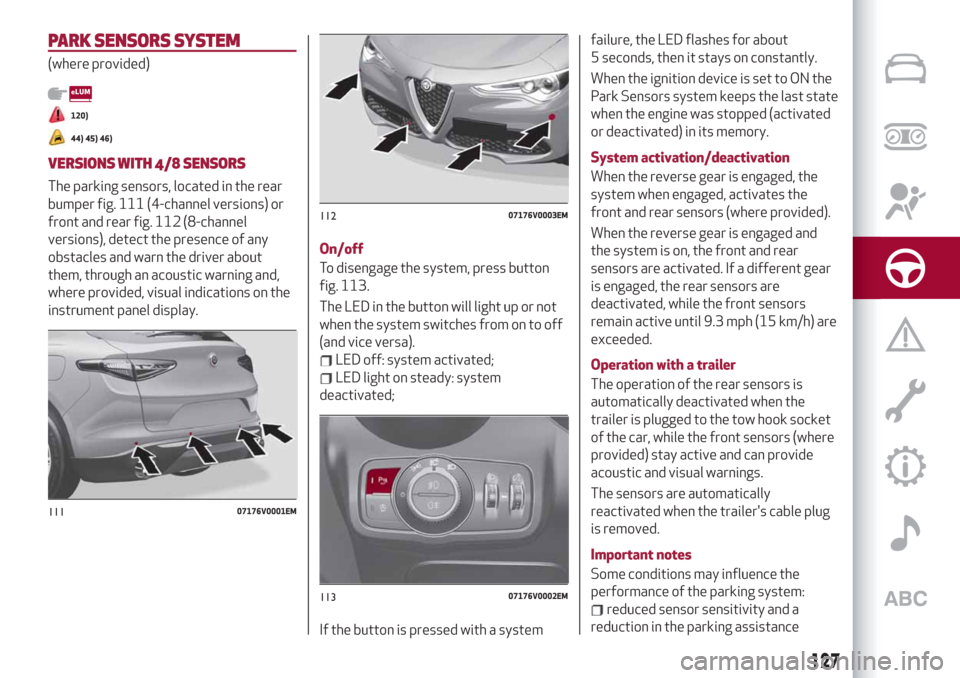
The parking sensors, located in the rear
bumper fig. 111 (4-channel versions) or
front and rear fig. 112 (8-channel
versions), detect the presence of any
obstacles and warn the driver about
them, through an acoustic warning and,
where provided, visual indications on the
instrument panel display.On/off
To disengage the system, press button
fig. 113.
The LED in the button will light up or not
when the system switches from on to off
(and vice versa).
LED off: system activated;
LED light on steady: system
deactivated;
If the button is pressed with a systemfailure, the LED flashes for about
5 seconds, then it stays on constantly.
When the ignition device is set to ON the
Park Sensors system keeps the last state
when the engine was stopped (activated
or deactivated) in its memory.
System activation/deactivation
When the reverse gear is engaged, the
system when engaged, activates the
front and rear sensors (where provided).
When the reverse gear is engaged and
the system is on, the front and rear
sensors are activated. If a different gear
is engaged, the rear sensors are
deactivated, while the front sensors
remain active until 9.3 mph (15 km/h) are
exceeded.
Operation with a trailer
The operation of the rear sensors is
automatically deactivated when the
trailer is plugged to the tow hook socket
of the car, while the front sensors (where
provided) stay active and can provide
acoustic and visual warnings.
The sensors are automatically
reactivated when the trailer's cable plug
is removed.
Important notes
Some conditions may influence the
performance of the parking system:
reduced sensor sensitivity and a
reduction in the parking assistance
11107176V0001EM
11207176V0003EM
11307176V0002EM
127
Page 131 of 244
LANE DEPARTURE WARNING
(LDW) SYSTEM
DESCRIPTION
47) 48) 49) 50) 51) 52)
The Lane Departure Warning system
makes use of a camera located on the
windscreen to detect the lane limits and
calculate the position of the vehicle
within such limits, in order to make sure
that it remains inside the lane.
When one or both lane limits are
detected and the vehicle passes over one
without the driver's say-so (direction
indicator not turned on), the system
emits an acoustic signal.
If the vehicle continues to go beyond the
line of the lane without any intervention
from the driver, the surpassed line will
light up on the display (left or right) to
urge the driver to bring the vehicle back
into the limits of the lane.
SYSTEM ON/OFF
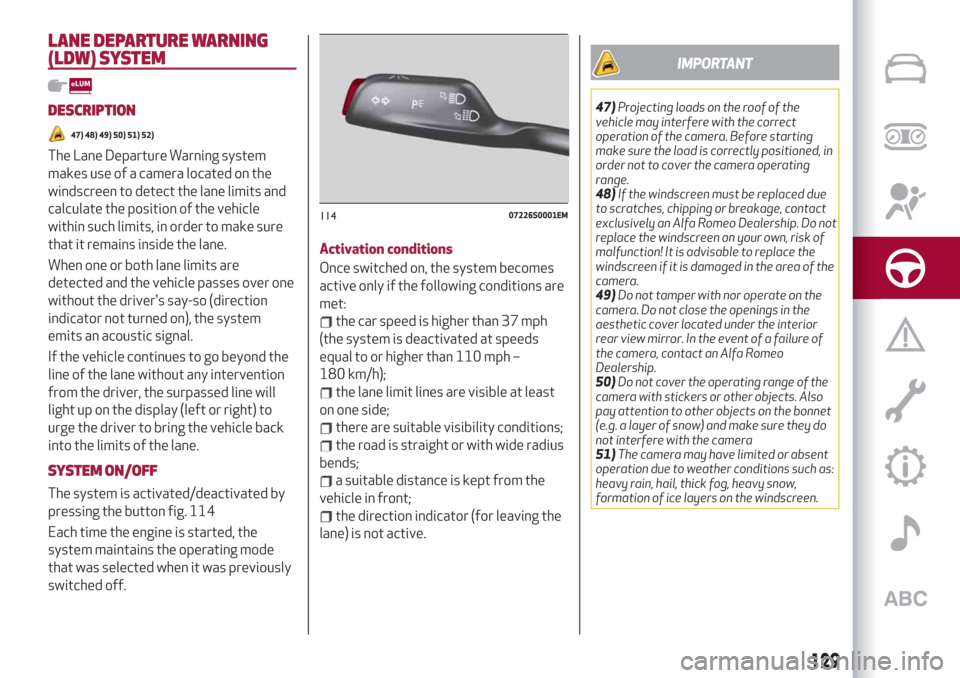
The system is activated/deactivated by
pressing the button fig. 114
Each time the engine is started, the
system maintains the operating mode
that was selected when it was previously
switched off.Activation conditions
Once switched on, the system becomes
active only if the following conditions are
met:
the car speed is higher than 37 mph
(the system is deactivated at speeds
equal to or higher than 110 mph –
180 km/h);
the lane limit lines are visible at least
on one side;
there are suitable visibility conditions;
the road is straight or with wide radius
bends;
a suitable distance is kept from the
vehicle in front;
the direction indicator (for leaving the
lane) is not active.
IMPORTANT
47)Projecting loads on the roof of the
vehicle may interfere with the correct
operation of the camera. Before starting
make sure the load is correctly positioned, in
order not to cover the camera operating
range.
48)If the windscreen must be replaced due
to scratches, chipping or breakage, contact
exclusively an Alfa Romeo Dealership. Do not
replace the windscreen on your own, risk of
malfunction! It is advisable to replace the
windscreen if it is damaged in the area of the
camera.
49)Do not tamper with nor operate on the
camera. Do not close the openings in the
aesthetic cover located under the interior
rear view mirror. In the event of a failure of
the camera, contact an Alfa Romeo
Dealership.
50)Do not cover the operating range of the
camera with stickers or other objects. Also
pay attention to other objects on the bonnet
(e.g. a layer of snow) and make sure they do
not interfere with the camera
51)The camera may have limited or absent
operation due to weather conditions such as:
heavy rain, hail, thick fog, heavy snow,
formation of ice layers on the windscreen.
11407226S0001EM
129
Page 133 of 244
SYMBOLS AND MESSAGES ON THE
DISPLAY
If activated, the grid is positioned on the
image to highlight the width of the
vehicle and the expected reversing path
in accordance with the steering wheel
position.
A superimposed central broken line
indicates the centre of the car to
facilitate parking manoeuvres or tow
hook alignment. The various coloured
areas indicate the distance from the rear
part of the car.
The table below shows the approximate
distances for each area fig. 116:
AreaDistance from the rear
part of the car
Red 0-1ft(0–30cm)
Y
ellow 1 - 3.3 ft (30 cm-1m)
Green 3.3 ft (1 m) or more
IMPORTANT When parking, take the
utmost care over obstacles that may be
above or under the camera range.
WARNING
121)Parking and other potentially
dangerous manoeuvres are, however,
always the driver’s responsibility. While
carrying out these manoeuvres, always
make sure that no people (especially
children) or animals are in the area
concerned. The camera is an aid for the
driver, but the driver must never allow
his/her attention to lapse during potentially
dangerous manoeuvres, even those
executed at low speeds. Always keep a slow
speed, so as to promptly brake in the case of
obstacles.
IMPORTANT
53)It is vital, for correct operation, that the
camera is always kept clean and free from
any mud, dirt, snow or ice. Be careful not to
scratch or damage the camera while cleaning
it. Avoid using dry, rough or hard cloths. The
camera must be washed using clean water,
with the addition of car shampoo if
necessary. In washing stations which use
steam or high-pressure jets, clean the
camera quickly, keeping the nozzle more
than 10 cm away from the sensors. Also, do
not apply stickers to the camera.
REFUELLING THE VEHICLE
122) 123) 124)
Always stop the engine before refuelling.
PETROL ENGINES
Only use unleaded petrol with a number
of octanes (R.O.N.) not lower than 91
(EN228 specification).
DIESEL ENGINES
Only use automotive diesel fuel
(EN590 and EN16734 specifications).
REFUELLING PROCEDURE
The fuel flap is unlocked when the central
door locking system is released, while it
is automatically locked when the central
locking system is applied.
Opening the flap
To refuel proceed as follows:
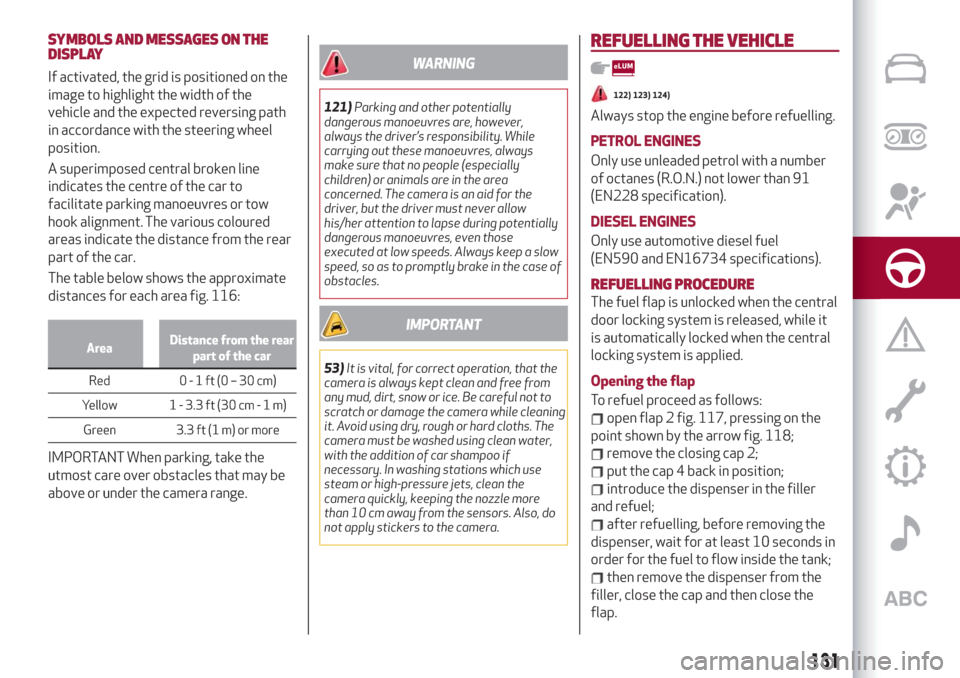
open flap 2 fig. 117, pressing on the
point shown by the arrow fig. 118;
remove the closing cap 2;
put the cap 4 back in position;
introduce the dispenser in the filler
and refuel;
after refuelling, before removing the
dispenser, wait for at least 10 seconds in
order for the fuel to flow inside the tank;
then remove the dispenser from the
filler, close the cap and then close the
flap.
131
Page 134 of 244
The refuelling procedure described
above is illustrated on the label (where
provided) located inside the fuel flap.TOPPING UP AdBlue® DIESEL
EMISSIONS ADDITIVE
(2.2 JTD versions only)
125)
Preliminary conditions
AdBlue® freezes at temperatures lower
than 12.2 °F (–11°C). If the car stands for
a long time at this temperature refilling
could be difficult. For this reason, it is
advised to park the car in a garage and/or
heated environment and wait for the
AdBlue® to return to liquid state before
topping up.
Proceed as follows:
park the car on level ground;
switch off the engine by turning the
ignition device to STOP;
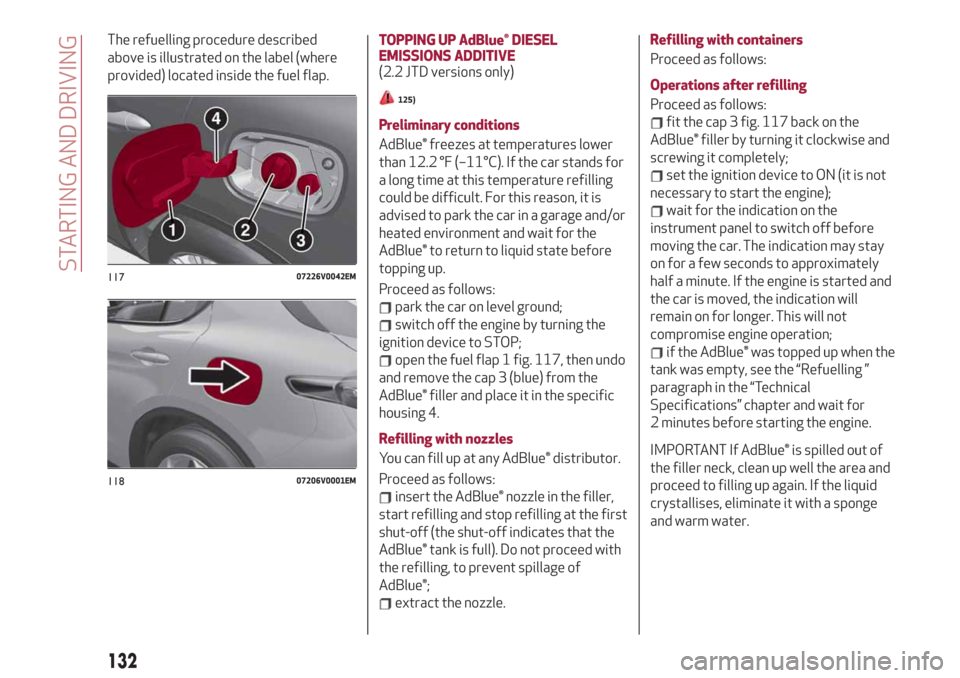
open the fuel flap 1 fig. 117, then undo
and remove the cap 3 (blue) from the
AdBlue® filler and place it in the specific
housing 4.
Refilling with nozzles
You can fill up at any AdBlue® distributor.
Proceed as follows:
insert the AdBlue® nozzle in the filler,
start refilling and stop refilling at the first
shut-off (the shut-off indicates that the
AdBlue® tank is full). Do not proceed with
the refilling, to prevent spillage of
AdBlue®;
extract the nozzle.Refilling with containers
Proceed as follows:
Operations after refilling
Proceed as follows:
fit the cap 3 fig. 117 back on the
AdBlue® filler by turning it clockwise and
screwing it completely;
set the ignition device to ON (it is not
necessary to start the engine);
wait for the indication on the
instrument panel to switch off before
moving the car. The indication may stay
on for a few seconds to approximately
half a minute. If the engine is started and
the car is moved, the indication will
remain on for longer. This will not
compromise engine operation;
if the AdBlue® was topped up when the
tank was empty, see the “Refuelling ”
paragraph in the “Technical
Specifications” chapter and wait for
2 minutes before starting the engine.
IMPORTANT If AdBlue® is spilled out of
the filler neck, clean up well the area and
proceed to filling up again. If the liquid
crystallises, eliminate it with a sponge
and warm water.
11707226V0042EM
11807206V0001EM
132
STARTING AND DRIVING
Page 135 of 244
IMPORTANT
DO NOT EXCEED THE MAXIMUM
LEVEL: this could cause damage to the
tank. AdBlue® freezes under 12.2°F
(–11°C). Although the system is
designed to operate below the freezing
point of AdBlue®, it is advisable not to
fill the tank beyond the maximum level
because if the AdBlue® freezes the
system can be damaged. Follow the
instructions in the “Topping up AdBlue®
diesel emissions additive” paragraph in
this chapter.
If AdBlue® is spilled on painted
surfaces or aluminium, immediately
clean the area with water and use
absorbent material to collect the fluid
that has been spilled on the ground.
Do not try to start the engine if
AdBlue® was accidentally added to the
Diesel fuel tank, this can result in
serious engine damage, contact an Alfa
Romeo Dealership.
Do not add additives or other fluids
to AdBlue®, doing so could damage the
system.
The use of non-conforming or
degraded AdBlue® may lead to
indications appearing on the
instrument panel display (see “Warning
lights and messages" paragraph in the
“Knowing the instrument panel”
chapter).
Never pour AdBlue® into another
container: it could be contaminated.
In case of damage to the sewage
system of exhaust gas resulting from
the use of additives / tap water, the
introduction of diesel fuel, or at least
by not fulfilling the requirements, the
warranty expires.
If the AdBlue® runs out, see “Warning
lights and messages" paragraph in the
“Knowing the instrument panel”
chapter to continue using the car
normally.
The AdBlue® level is not updated if
the car is parked on a sloping road.
Fuels - identification of vehicle
compatibility. Graphic symbol for
consumer information in accordance
with EN16942
The symbols, shown below, make it easier
to recognise the correct fuel type to use
with your car.
Before refuelling, check the symbols
(where provided) inside the fuel filler flap
and compare them with the symbols
shown on the fuel pump (where provided).PETROL ENGINES
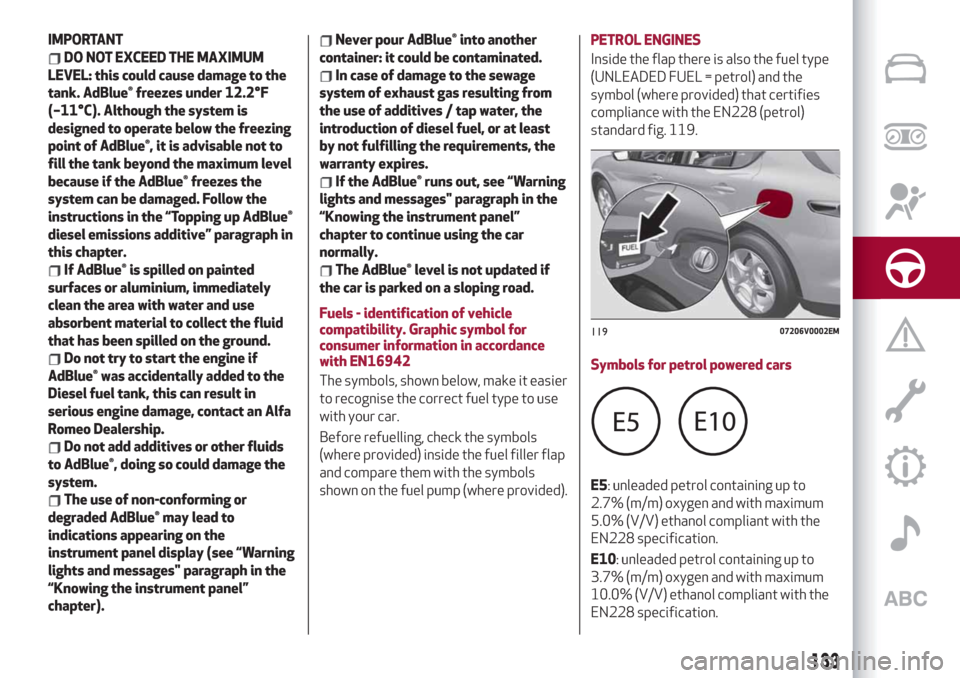
Inside the flap there is also the fuel type
(UNLEADED FUEL = petrol) and the
symbol (where provided) that certifies
compliance with the EN228 (petrol)
standard fig. 119.
Symbols for petrol powered cars
E5: unleaded petrol containing up to
2.7% (m/m) oxygen and with maximum
5.0% (V/V) ethanol compliant with the
EN228 specification.
E10: unleaded petrol containing up to
3.7% (m/m) oxygen and with maximum
10.0% (V/V) ethanol compliant with the
EN228 specification.
11907206V0002EM
133
Page 136 of 244
DIESEL ENGINES
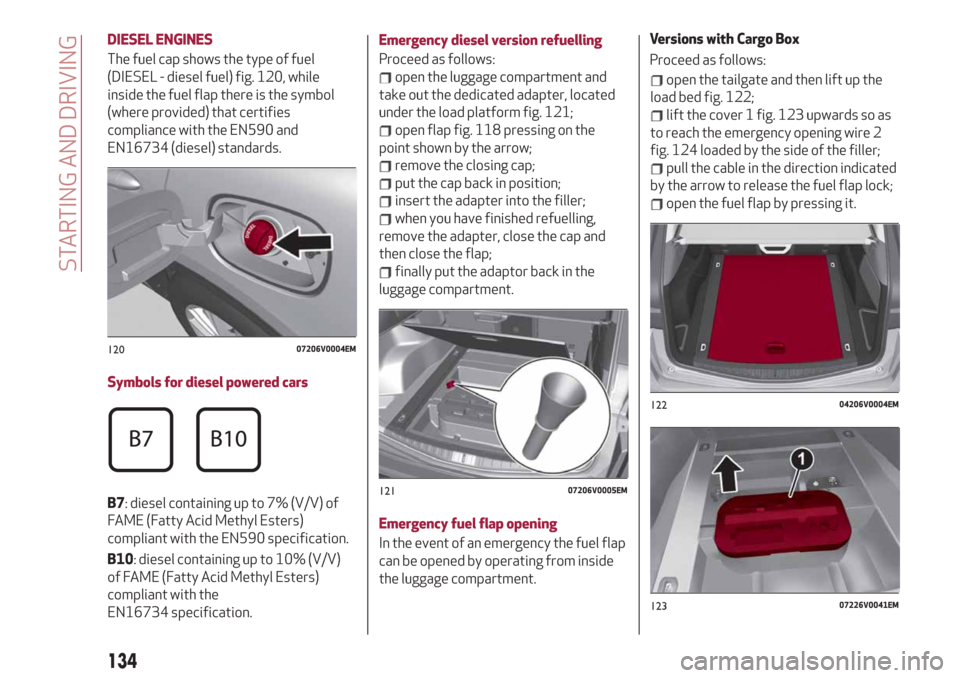
The fuel cap shows the type of fuel
(DIESEL - diesel fuel) fig. 120, while
inside the fuel flap there is the symbol
(where provided) that certifies
compliance with the EN590 and
EN16734 (diesel) standards.
Symbols for diesel powered cars
B7: diesel containing up to 7% (V/V) of
FAME (Fatty Acid Methyl Esters)
compliant with the EN590 specification.
B10: diesel containing up to 10% (V/V)
of FAME (Fatty Acid Methyl Esters)
compliant with the
EN16734 specification.Emergency diesel version refuelling
Proceed as follows:
open the luggage compartment and
take out the dedicated adapter, located
under the load platform fig. 121;
open flap fig. 118 pressing on the
point shown by the arrow;
remove the closing cap;
put the cap back in position;
insert the adapter into the filler;
when you have finished refuelling,
remove the adapter, close the cap and
then close the flap;
finally put the adaptor back in the
luggage compartment.
Emergency fuel flap opening
In the event of an emergency the fuel flap
can be opened by operating from inside
the luggage compartment.Versions with Cargo Box
Proceed as follows:
open the tailgate and then lift up the
load bed fig. 122;
lift the cover 1 fig. 123 upwards so as
to reach the emergency opening wire 2
fig. 124 loaded by the side of the filler;
pull the cable in the direction indicated
by the arrow to release the fuel flap lock;
open the fuel flap by pressing it.
12007206V0004EM
12107206V0005EM
12204206V0004EM
12307226V0041EM
134
STARTING AND DRIVING
Page 138 of 244
AdBlue® (UREA) ADDITIVE FOR
DIESEL EMISSIONS
(2.2 JTD versions only)
The car is equipped with an UREA
injection system and Selective Catalytic
Reduction to meet emission standards.
These two systems ensure compliance
with the diesel emissions requirements;
at the same time, they ensure
fuel-efficiency, handling, torque and
power. For messages and system
warnings, refer to the "Warning lights and
messages" paragraph in the "Knowing the
instrument panel" chapter.
AdBlue® (UREA) is considered a very
stable product with a long shelf life.
Stored at temperatures LOWER than
89.6° F (32 °C), it has a shelf life of at
least one year.
For more information on the AdBlue®
liquid type, see the “Fluids and lubricants”
paragraph in the “Technical
specifications” chapter.
The car is provided with an automatic
AdBlue® heating system when the engine
starts allowing the system to work
correctly at temperatures lower
than -11 °C.
IMPORTANT AdBlue® freezes at
temperatures lower than 12.2 °F (-11 °C).
SUGGESTIONS FOR DRIVING
SAVING FUEL
Below are some suggestions which may
help you save fuel and thus lower the
amount of harmful emissions released
into the atmosphere.
Vehicle maintenance
Checks and operations should be carried
out in accordance with the "Scheduled
Servicing Plan" (see chapter
"Maintenance and care").
Tyres
Check the tyre pressures at least once
every four weeks: if the pressure is too
low, consumption levels increase as
resistance to rolling is higher.
Unnecessary loads
Do not travel with an overloaded boot.
The weight of the vehicle and its
arrangement greatly affect fuel
consumption and stability.
Electric devices
Use electrical devices only for the
amount of time needed. The heated rear
window, additional headlights, screen
wipers and heater fan require a
considerable amount of energy;
increasing the current uptake increases
fuel consumption (by up to +25% in an
urban cycle).Climate control system
Using the climate control system will
increase consumption: use standard
ventilation when the temperature
outside permits.
Devices for aerodynamic control
The use of non-certified devices for
aerodynamic control may adversely
affect air drag and consumption levels.
DRIVING STYLE
Starting
Do not warm up the engine at low or high
revs when the vehicle is stationary; this
causes the engine to warm up more
slowly, thereby increasing fuel
consumption and emissions. It is
therefore advisable to move off
immediately, slowly, avoiding high
speeds: in this way the engine will warm
up more quickly.
Unnecessary actions
Avoid revving up when starting at traffic
lights or before stopping the engine. The
latter action, as well as double-
declutching, is unnecessary and causes
increased fuel consumption and
pollution.
Gear selection
Use a high gear when traffic and road
conditions allow it. Using a low gear for
faster acceleration will increase fuel
136
STARTING AND DRIVING
Page 139 of 244
consumption. In the same way, improper
use of a high gear increases consumption,
emissions and engine wear.
Max. speed
Fuel consumption considerably increases
as speed increases. Maintain a constant
speed, avoiding unnecessary braking and
acceleration, which cost in terms of both
fuel consumption and emissions.
Acceleration
Accelerating violently severely affects
consumption and emissions: acceleration
should be gradual and should not exceed
the maximum torque.CONDITIONS OF USE
Cold starting
Short journeys and frequent cold starts
do not allow the engine to reach optimum
operating temperature. This results in a
significant increase in consumption
levels (from +15 to +30% on the urban
cycle) and emissions.
Traffic and road conditions
High fuel consumption is caused by heavy
traffic, for instance when travelling in a
queue with frequent use of low gears or
in cities with many traffic lights. Winding
mountain roads and rough road surfaces
also adversely affect consumption.
Stops in traffic
During prolonged hold-ups (e.g. level
crossings) switch off the engine.
TOWING TRAILERS
126) 127)
TOW HOOK SETUP
Instructions for using the removable
ball head tow hook
IMPORTANT NOTE Before setting off,
checkthat the removable ball head tow
hook islockedcorrectly. To do this, check
the following conditions:
the green mark on the knob must
coincide with the green mark on the tow
hook fixing bracket;
the knob must be at the end of its
travel, resting on the tow hook fixing
bracket (no crack);
the lock on the knob must be locked
with the key removed. The knob cannot
be removed;
the tow hook fixing bracket must be
firmly attached to the mounting pipe on
the car. Check by shaking with a hand.
The installation procedure must be
repeated if any of these requirements is
NOT met.
If even only one of the requirements is
not met the tow hookmust notbe used,
since there is risk of causing accidents.
Contact an Alfa Romeo Dealership.
The ball head tow hook can be
fitted/removed manually without the
need for specific tools.
137
Page 143 of 244
Its status can be changed from unused to
operational only if:
the handbrake is engaged or the shift
lever is in the P position;
the engine is off;
the tailgate is open.
There is a LED on the button 1, which may
be in one of the following states:
LED off: indicates that at least one of
the above conditions is not met, or the
trailer light wiring is connected to the
socket.
LED flashing: indicates that the tow
hook is moving or that the system must
be initialised;
LED on fixed: indicates that the tow
hook can be moved.
Safe opening and closing of the tow hook
is guaranteed by a protection system
that can stop and reverse its movement
when it encounters an obstacle while
opening or closing.
The system must be initialised after the
battery has been disconnected, the
movement has been blocked by a
physical obstacle or if the safety system
has intervened three times
consecutively.
IMPORTANT When the tow hook is not in
use, put it in the closed position.
System initialisation
In the conditions of movement described
above, press the movement button 1 for
at least 10 seconds. The LED will turn on
to confirm the initialisation.
141
Page 151 of 244
REPLACING AN EXTERNAL BULB
Front light cluster with main
beam/dipped beam halogen headlights
Dipped beam headlights
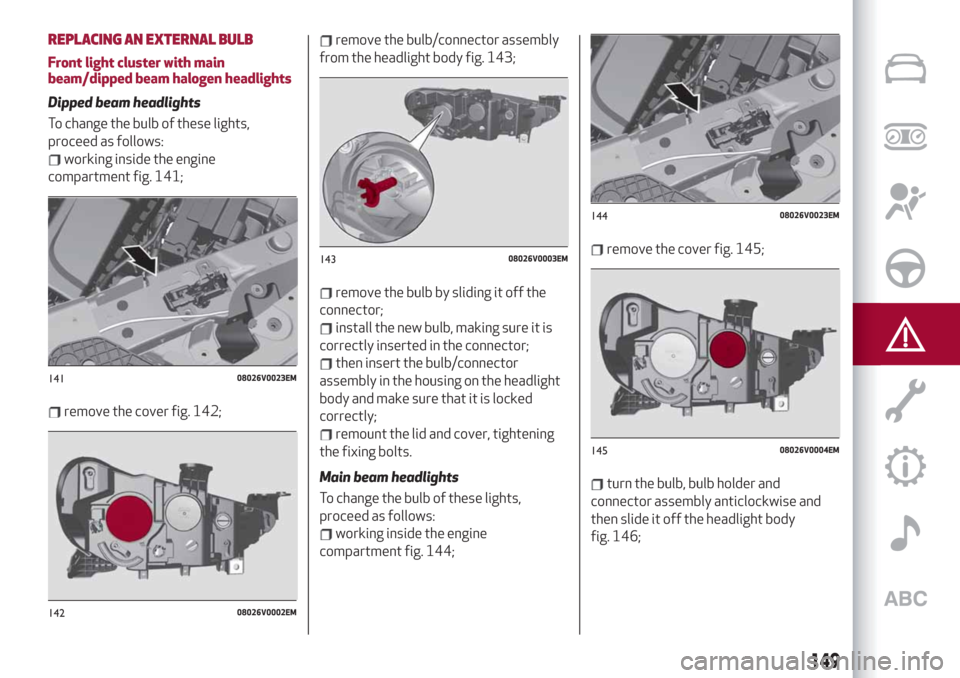
To change the bulb of these lights,
proceed as follows:
working inside the engine
compartment fig. 141;
remove the cover fig. 142;
remove the bulb/connector assembly
from the headlight body fig. 143;
remove the bulb by sliding it off the
connector;
install the new bulb, making sure it is
correctly inserted in the connector;
then insert the bulb/connector
assembly in the housing on the headlight
body and make sure that it is locked
correctly;
remount the lid and cover, tightening
the fixing bolts.
Main beam headlights
To change the bulb of these lights,
proceed as follows:
working inside the engine
compartment fig. 144;
remove the cover fig. 145;
turn the bulb, bulb holder and
connector assembly anticlockwise and
then slide it off the headlight body
fig. 146;
14108026V0023EM
14208026V0002EM
14308026V0003EM
14408026V0023EM
14508026V0004EM
149