stop start ALFA ROMEO STELVIO 2022 Service Manual
[x] Cancel search | Manufacturer: ALFA ROMEO, Model Year: 2022, Model line: STELVIO, Model: ALFA ROMEO STELVIO 2022Pages: 256, PDF Size: 10.17 MB
Page 183 of 256
181
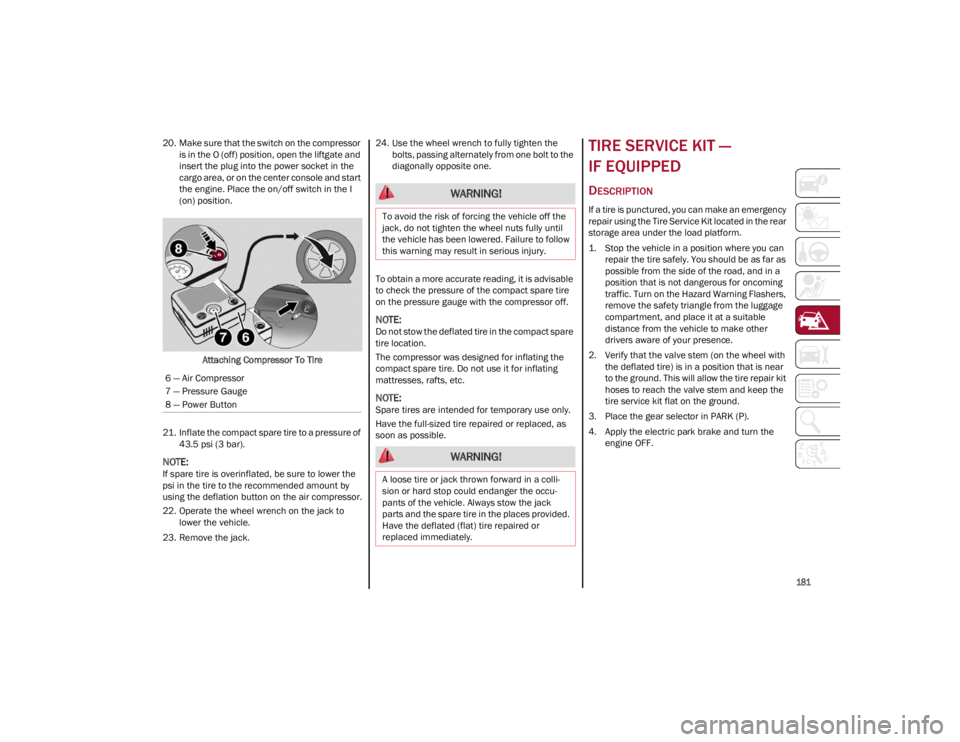
20. Make sure that the switch on the compressor is in the O (off) position, open the liftgate and
insert the plug into the power socket in the
cargo area, or on the center console and start
the engine. Place the on/off switch in the I
(on) position.
Attaching Compressor To Tire
21. Inflate the compact spare tire to a pressure of 43.5 psi (3 bar).
NOTE:
If spare tire is overinflated, be sure to lower the
psi in the tire to the recommended amount by
using the deflation button on the air compressor.
22. Operate the wheel wrench on the jack to lower the vehicle.
23. Remove the jack. 24. Use the wheel wrench to fully tighten the
bolts, passing alternately from one bolt to the
diagonally opposite one.
To obtain a more accurate reading, it is advisable
to check the pressure of the compact spare tire
on the pressure gauge with the compressor off.
NOTE:
Do not stow the deflated tire in the compact spare
tire location.
The compressor was designed for inflating the
compact spare tire. Do not use it for inflating
mattresses, rafts, etc.
NOTE:
Spare tires are intended for temporary use only.
Have the full-sized tire repaired or replaced, as
soon as possible.
TIRE SERVICE KIT —
IF EQUIPPED
DESCRIPTION
If a tire is punctured, you can make an emergency
repair using the Tire Service Kit located in the rear
storage area under the load platform.
1. Stop the vehicle in a position where you can repair the tire safely. You should be as far as
possible from the side of the road, and in a
position that is not dangerous for oncoming
traffic. Turn on the Hazard Warning Flashers,
remove the safety triangle from the luggage
compartment, and place it at a suitable
distance from the vehicle to make other
drivers aware of your presence.
2. Verify that the valve stem (on the wheel with the deflated tire) is in a position that is near
to the ground. This will allow the tire repair kit
hoses to reach the valve stem and keep the
tire service kit flat on the ground.
3. Place the gear selector in PARK (P).
4. Apply the electric park brake and turn the engine OFF.
6 — Air Compressor
7 — Pressure Gauge
8 — Power Button
WARNING!
To avoid the risk of forcing the vehicle off the
jack, do not tighten the wheel nuts fully until
the vehicle has been lowered. Failure to follow
this warning may result in serious injury.
WARNING!
A loose tire or jack thrown forward in a colli -
sion or hard stop could endanger the occu -
pants of the vehicle. Always stow the jack
parts and the spare tire in the places provided.
Have the deflated (flat) tire repaired or
replaced immediately.
22_GU_OM_EN_USC_t.book Page 181
Page 185 of 256
183
To use the Tire Service Kit, proceed as follows:
1. Apply the Electric Park Brake.
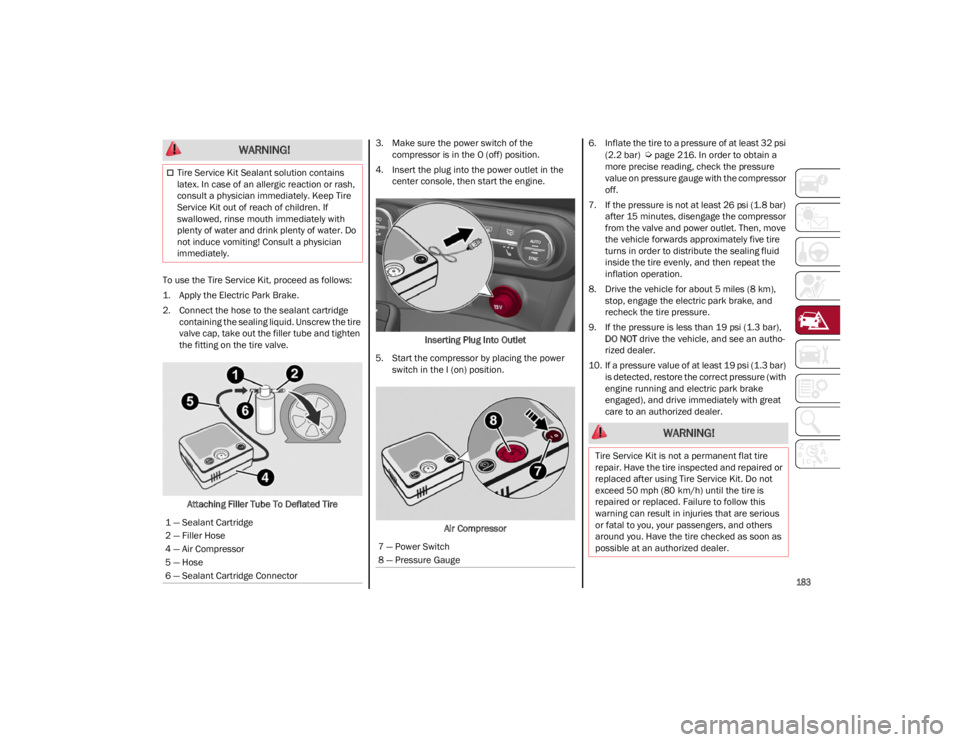
2. Connect the hose to the sealant cartridgecontaining the sealing liquid. Unscrew the tire
valve cap, take out the filler tube and tighten
the fitting on the tire valve.
Attaching Filler Tube To Deflated Tire 3. Make sure the power switch of the
compressor is in the O (off) position.
4. Insert the plug into the power outlet in the center console, then start the engine.
Inserting Plug Into Outlet
5. Start the compressor by placing the power switch in the I (on) position.
Air Compressor 6. Inflate the tire to a pressure of at least 32 psi
(2.2 bar)
Ú
page 216. In order to obtain a
more precise reading, check the pressure
value on pressure gauge with the compressor
off.
7. If the pressure is not at least 26 psi (1.8 bar) after 15 minutes, disengage the compressor
from the valve and power outlet. Then, move
the vehicle forwards approximately five tire
turns in order to distribute the sealing fluid
inside the tire evenly, and then repeat the
inflation operation.
8. Drive the vehicle for about 5 miles (8 km), stop, engage the electric park brake, and
recheck the tire pressure.
9. If the pressure is less than 19 psi (1.3 bar), DO NOT drive the vehicle, and see an autho -
rized dealer.
10. If a pressure value of at least 19 psi (1.3 bar) is detected, restore the correct pressure (with
engine running and electric park brake
engaged), and drive immediately with great
care to an authorized dealer.
Tire Service Kit Sealant solution contains
latex. In case of an allergic reaction or rash,
consult a physician immediately. Keep Tire
Service Kit out of reach of children. If
swallowed, rinse mouth immediately with
plenty of water and drink plenty of water. Do
not induce vomiting! Consult a physician
immediately.
1 — Sealant Cartridge
2 — Filler Hose
4 — Air Compressor
5 — Hose
6 — Sealant Cartridge Connector
WARNING!
7 — Power Switch
8 — Pressure Gauge
WARNING!
Tire Service Kit is not a permanent flat tire
repair. Have the tire inspected and repaired or
replaced after using Tire Service Kit. Do not
exceed 50 mph (80 km/h) until the tire is
repaired or replaced. Failure to follow this
warning can result in injuries that are serious
or fatal to you, your passengers, and others
around you. Have the tire checked as soon as
possible at an authorized dealer.
22_GU_OM_EN_USC_t.book Page 183
Page 189 of 256
187
Cable Connection
Proceed as follows to perform a jump starting
procedure:
1. Connect the positive (+) end of the jumper
cable to the remote positive (+) post of the
vehicle with the discharged battery.
2. Connect the opposite end of the positive (+)
jumper cable to the positive (+) post of the
booster battery.
3. Connect the negative (-) end of the jumper
cable to the negative (-) post of the booster
battery.
4. Connect the opposite end of the negative (-)
jumper cable to the remote negative (-) post
of the discharged vehicle.
5. Start the engine in the vehicle that has the booster battery, let the engine idle a few
minutes, and then start the engine in the
vehicle with the discharged battery. If using a
portable battery booster pack, before starting
the vehicle, wait a few seconds after
completing the connection.
6. Once the engine is started, follow the discon -
nection procedure. Cable Disconnection
1. Disconnect the negative
(-) end of the jumper
cable from the remote negative (-) post of the
vehicle with the discharged battery.
2. Disconnect the opposite end of the negative (-) jumper cable from the negative (-) post of
the booster battery.
3. Disconnect the positive (+) end of the jumper
cable from the positive (+) post of the booster
battery.
4. Disconnect the opposite end of the positive (+) jumper cable from the remote positive (+)
post of the vehicle with the discharged
battery, and reinstall the protective cap.
If frequent jump starting is required to start your
vehicle, you should have the battery and charging
system inspected at an authorized dealer.
BUMP STARTING
Never jump start the engine by pushing, towing or
coasting downhill.
NOTE:
You cannot start a vehicle with an automatic
transmission by pushing it.
ENGINE OVERHEATING
If your vehicle is overheating, it will need to be
serviced at an authorized dealer.
Engine overheating may occur in situations such
as (but not limited to) extreme environmental
temperatures or frequent engine stops/starts. If
the engine becomes overheated, the Engine
Temperature Warning Light in the instrument
cluster will illuminate along with a dedicated
message
Ú
page 75.
In any of the following situations, you can reduce
the potential for overheating by taking the
appropriate action.
On the highways — slow down.
In city traffic — while stopped, place the
transmission in NEUTRAL, but do not increase
engine idle speed.
NOTE:
There are steps that you can take to slow down an
impending overheat condition:
If your Air Conditioner (A/C) is on, turn it off.
The A/C system adds heat to the engine
cooling system and turning the A/C off can
help remove this heat.
You can also turn the temperature control to
maximum heat, the mode control to floor and
the blower control to high. This allows the
heater core to act as a supplement to the
radiator and aids in removing heat from the
engine cooling system.
WARNING!
Do not connect the jumper cable to the
negative (-) post of the discharged battery. The
resulting electrical spark could cause the
battery to explode and could result in serious
injury. Only use the specific ground point, do
not use any other exposed metal parts. CAUTION!
Accessories plugged into the vehicle power
outlets draw power from the vehicle’s battery,
even when not in use (i.e., cellular phones,
etc.). Eventually, if plugged in long enough
without engine operation, the vehicle’s battery
will discharge sufficiently to degrade battery
life and/or prevent the engine from starting.
22_GU_OM_EN_USC_t.book Page 187
Page 203 of 256
201
3. Disconnect the black cable terminal of the battery charger and then the red cable
terminal.
4. Refit the protective cover of the positive terminal of the battery and the access cover
to the battery compartment.
NOTE:
If a "quick-type" battery charger is used with the
battery fitted on the vehicle, before connecting it
disconnect both cables of the battery itself. Do
not use a "quick-type" battery charger to provide
the starting voltage.
VEHICLE MAINTENANCE
The following pages contain instructions on the
required maintenance from the technical
personnel who designed the vehicle.
In addition to these specific maintenance
instructions specified for routine scheduled
servicing, there are other components which may
require periodic maintenance or replacement
over the vehicle’s life cycle.
ENGINE OIL
Engine Oil Level Check
To ensure correct engine lubrication, the oil must
always be kept at the prescribed level
Ú
page 196.
Check the oil level at regular intervals, for
example every 1,864 miles (3,000 km).
It must be checked about five minutes after
stopping the engine.
Full operating temperature must be reached. The
vehicle must also be parked on as level a surface
as possible. The engine oil level can be checked using the
Information and Entertainment system. To
access the function, activate the main menu
(MENU button) and select the following options in
sequence:
1. “Vehicle Information”
2. “Engine Oil”
Ensure that the oil level is within the interval on
the dipstick between the minimum and maximum
limits (Quadrifoglio only).
Changing The Engine Oil
For the correct servicing intervals
Ú
page 192.
Choice Of Engine Oil Type
To ensure optimal performance and maximum
protection in all operating conditions, it is advised
to use certified engine oils
Ú
page 242.
Additives For Engine Oil
It is strongly recommended not to use additives
(other than leak detection dyes) with the engine
oil.
The engine oil is a product designed especially for
the vehicle, and its performance may be deteri -
orated through the use of further additives.
Disposal Of Used Engine Oil And Filters
For the disposal of the engine oil and filters,
contact the appropriate body to determine local
regulations.
NOTE:
Incorrectly disposed used engine oil may seri -
ously harm the environment.
ENGINE OIL FILTER
Replacing the Engine Oil Filter
The engine oil filter must be replaced each time
the engine oil is changed. It is advised to replace
it with a genuine spare part, specifically designed
for this vehicle.
ENGINE AIR CLEANER FILTER
Replacing the Engine Air Cleaner Filter
For the correct servicing intervals
Ú
page 192. It
is advised to replace the engine air cleaner filter
with a genuine spare part, specifically designed
for this vehicle.
AIR CONDITIONING SYSTEM
M
AINTENANCE
To ensure the best possible performance, the air
conditioning system must be checked and
undergo maintenance at an authorized dealer at
the beginning of the summer.
CAUTION!
Do not use chemicals to clean the air
conditioning system, since the internal
components may be damaged. This kind of
damage is not covered by warranty.
22_GU_OM_EN_USC_t.book Page 201
Page 206 of 256
SERVICING AND MAINTENANCE
204
(Continued)
EXHAUST SYSTEM
Adequate maintenance of the engine exhaust
system represents the best protection against
leaks of carbon monoxide into the passenger
compartment.
If an unusual noise from the exhaust or the
presence of smoke in the passenger
compartment is identified, or if the underbody or
rear section of the vehicle have been damaged,
have the entire exhaust system and adjoining
bodywork areas checked at an authorized dealer
to identify any components which are broken,
damaged, worn or have moved from their correct
fitting position.
Open welding or loose connections may permit
exhaust gas to enter the passenger
compartment.
Have the exhaust system checked every time the
vehicle is raised. Replace the components where
necessary (for these operations, contact an
authorized dealer).
In normal operating conditions, the catalytic
converter does not require maintenance. To
ensure that it operates correctly, and prevent it
from getting damaged, it is extremely important
that the engine operates perfectly.
To minimize the risk of damaging the catalytic
converter, proceed as follows:
Do not stop the engine or deactivate the
ignition with gear engaged and vehicle in
motion.
Do not attempt to start the engine by bump
starting.
Do not use the vehicle if irregular idling or
operating conditions are experienced.
COOLING SYSTEM
Coolant Check
Your vehicle has two cooling systems and both
need to be checked to ensure they are at proper
fill levels
Ú
page 196.
Check the engine coolant and intercooler coolant
level every oil change or before long trips.
If there are impurities in the engine coolant, the
system must be drained, flushed and refilled:
contact an authorized dealer.
Check the front part of the condenser for any
build-up of insects, leaves or other debris. Should
it be dirty, clean by spraying delicately with water.
Check the hoses of the engine/intercooler
cooling system to ensure that the rubber has not
deteriorated and that there are no cracks, tears,
cuts or obstructions in the expansion tank side
and radiator side connectors. Should there be
any doubt regarding leaks from the system (e.g. if
frequent top ups are required), have the seal
checked at an authorized dealer.
With the engine off and at normal operating
temperature, check that the cooling system
radiator cap is closed properly.
WARNING!
Exhaust gases can injure or kill. They contain
Carbon Monoxide (CO), which is colorless
and odorless. Breathing it can make you
unconscious and can eventually poison you.
A hot exhaust system can start a fire if you
park over materials that can burn. Such
materials might be grass or leaves coming
into contact with your exhaust system. Do not
park or operate your vehicle in areas where
your exhaust system can contact anything
that can burn.
WARNING!
You or others can be badly burned by hot
engine coolant (antifreeze) or steam from
your radiator. If you see or hear steam
coming from under the hood, do not open the
hood until the radiator has had time to cool.
Never open a cooling system pressure cap
when the radiator or coolant bottle is hot.
Keep hands, tools, clothing, and jewelry away
from the radiator cooling fan when the hood
is raised. The fan starts automatically and
may start at any time, whether the engine is
running or not.
When working near the radiator cooling fan,
disconnect the fan motor lead or turn the
ignition to the OFF position. The fan is
temperature controlled and can start at any
time the ignition is in the ON position.
WARNING!
Do not open hot engine cooling system.
Never add engine coolant (antifreeze) when
the engine is overheated. Do not loosen or
remove the cap to cool an overheated
engine. Heat causes pressure to build up in
the cooling system. To prevent scalding or
injury, do not remove the pressure cap while
the system is hot or under pressure.
22_GU_OM_EN_USC_t.book Page 204
Page 254 of 256

252
INDEX
Stop/Start System ....................................... 95
Storage Console ..................................................... 54
Suggestions For Driving .............................132
Sun Roof ................................................ 57, 59
Supplemental Restraint System –
Air Bag......................................................... 157
Suspension .................................................235
Symbol Glossary ........................................... 14
Symbols .......................................................... 6
System, Remote Starting ............................. 23
T
Telescoping Steering Column...................... 29
Tilt Steering Column..................................... 29
Tire And Loading Information Placard ......219
Tire Markings..............................................216
Tire Safety Information .............................. 216
Tire Service Kit ...........................................181
Tires .................................174, 222, 226, 229 Aging (Life Of Tires) ................................ 225Air Pressure ............................................ 222
Changing.................................................181
Compact Spare ...................................... 226
General Information......................222, 226
High Speed ............................................. 223
Inflation Pressure...................................222Life Of Tires ............................................ 225
Load Capacity................................219, 220Pressure Monitoring System (TPMS) ...... 73
Quality Grading....................................... 229
Radial......................................................224
Replacement ..........................................225
Safety .............................................216, 222
Sizes .......................................................217 Snow Tires ............................................. 228
Spare Tires.................................... 226, 227
Spinning ................................................. 225
Trailer Towing ........................................ 130
Tread Wear Indicators........................... 225
Tongue Weight/Trailer Weight .................. 129
Towing ............................................... 127, 128 Disabled Vehicle.................................... 188
Towing Eyes ............................................... 189
TPMS (Tire Pressure Monitoring
System) ...................................................... 149
Traction Control System (TCS) .................. 139
Traffic Jam Assist System ......................... 109
Traffic Sign Recognition System ............... 112
Trailer Towing............................................. 127 Hitches ................................................... 128
Minimum Requirements ....................... 129Tips ......................................................... 131
Trailer And Tongue Weight........... 128, 129
Wiring ..................................................... 130
Trailer Towing Guide.................................. 128
Trailer Weight............................................. 128
Transmission ............................................. 235
Transporting Pets ...................................... 173
Tread Wear Indicators ............................... 225
Turn Signals ........................................... 44, 74
U
Uconnect Settings Customer Programmable Features.........26
Passive Entry Programming.....................26
Uniform Tire Quality Grades...................... 229
Universal Garage Door Opener (HomeLink®)
S..........................................39
Universal Transmitter ...................................39 Untwisting Procedure, Seat Belt ............... 154
Use Of The Owner’s Manual........................... 5
V
Vehicle Changes/Alterations ......................... 4
Vehicle Identification Number .................. 233
Vehicle Loading ................................. 126, 220
W
Warning Lights (Instrument Cluster
Descriptions) ................................................ 72
Warnings, Roll Over ........................................ 3
Warranty Information ................................ 246
Washer Fluid For Windshield/
Headlights .................................................. 198
Washers, Windshield ................................... 46
Weights ....................................................... 238
Wheel And Wheel Tire Care....................... 227
Wheel And Wheel Tire Trim ....................... 227
Wheels And Tires ....................................... 216
Wind Buffeting ............................................. 57
Windows Power........................................................ 56
Windows (Cleaning) ................................... 231
Windshield Defroster ................................. 173
Windshield Washers .................................... 46
Windshield Wiper Replacing Blades ................................... 203
Windshield Wipers ....................................... 46
Wipers, Rain Sensitive................................. 46
Wireless Charging Pad ................................ 55
22_GU_OM_EN_USC_t.book Page 252