steering ALFA ROMEO STELVIO 2022 Repair Manual
[x] Cancel search | Manufacturer: ALFA ROMEO, Model Year: 2022, Model line: STELVIO, Model: ALFA ROMEO STELVIO 2022Pages: 256, PDF Size: 10.17 MB
Page 209 of 256
207
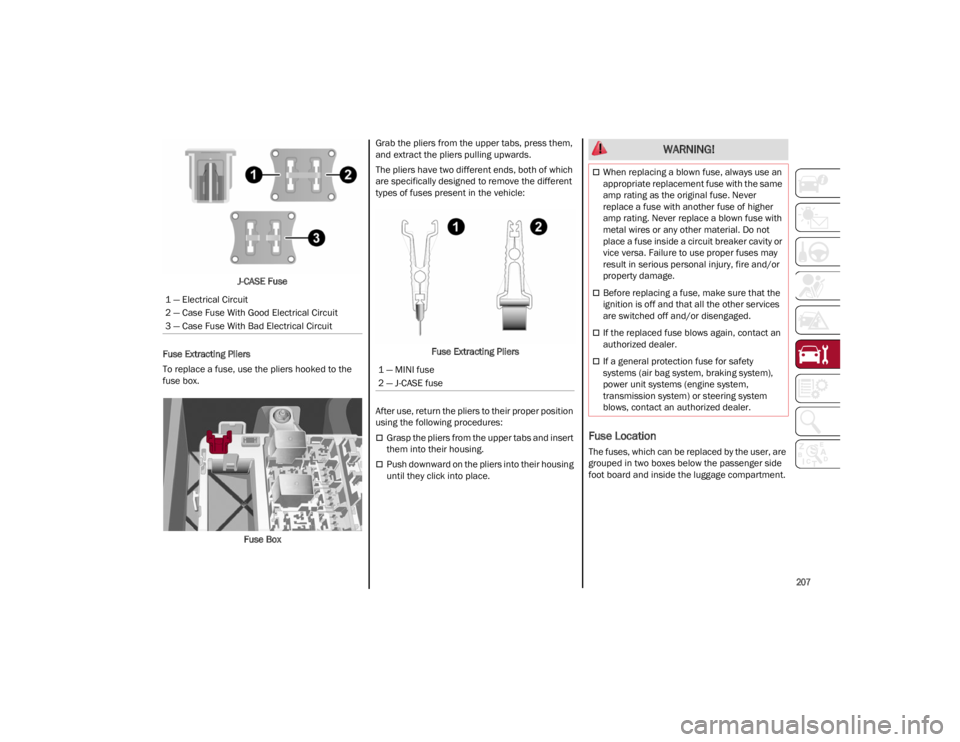
J-CASE Fuse
Fuse Extracting Pliers
To replace a fuse, use the pliers hooked to the
fuse box.
Fuse Box Grab the pliers from the upper tabs, press them,
and extract the pliers pulling upwards.
The pliers have two different ends, both of which
are specifically designed to remove the different
types of fuses present in the vehicle:
Fuse Extracting Pliers
After use, return the pliers to their proper position
using the following procedures:
Grasp the pliers from the upper tabs and insert
them into their housing.
Push downward on the pliers into their housing
until they click into place.
Fuse Location
The fuses, which can be replaced by the user, are
grouped in two boxes below the passenger side
foot board and inside the luggage compartment.
1 — Electrical Circuit
2 — Case Fuse With Good Electrical Circuit
3 — Case Fuse With Bad Electrical Circuit
1 — MINI fuse
2 — J-CASE fuse
WARNING!
When replacing a blown fuse, always use an
appropriate replacement fuse with the same
amp rating as the original fuse. Never
replace a fuse with another fuse of higher
amp rating. Never replace a blown fuse with
metal wires or any other material. Do not
place a fuse inside a circuit breaker cavity or
vice versa. Failure to use proper fuses may
result in serious personal injury, fire and/or
property damage.
Before replacing a fuse, make sure that the
ignition is off and that all the other services
are switched off and/or disengaged.
If the replaced fuse blows again, contact an
authorized dealer.
If a general protection fuse for safety
systems (air bag system, braking system),
power unit systems (engine system,
transmission system) or steering system
blows, contact an authorized dealer.
22_GU_OM_EN_USC_t.book Page 207
Page 224 of 256
SERVICING AND MAINTENANCE
222
TIRES — GENERAL INFORMATION
Tire Pressure
Proper tire inflation pressure is essential to the
safe and satisfactory operation of your vehicle.
Four primary areas are affected by improper tire
pressure:
Safety
Fuel Economy
Tread Wear
Ride Comfort and Vehicle Stability
Safety Both underinflation and overinflation affect the
stability of the vehicle and can produce a feeling
of sluggish response or over responsiveness in
the steering.
NOTE:
Unequal tire pressures from side to side may
cause erratic and unpredictable steering
response.
Unequal tire pressure from side to side may
cause the vehicle to drift left or right.
Fuel Economy
Underinflated tires will increase tire rolling
resistance resulting in higher fuel consumption.
Tread Wear
Improper cold tire inflation pressures can cause
abnormal wear patterns and reduced tread life,
resulting in the need for earlier tire replacement.
Ride Comfort And Vehicle Stability
Proper tire inflation contributes to a comfortable
ride. Overinflation produces a jarring and
uncomfortable ride.
Tire Inflation Pressures
The proper cold tire inflation pressure is listed on
the driver's side B-pillar or rear edge of the
driver's side door.
At least once a month:
Check and adjust tire pressure with a good
quality pocket-type pressure gauge. Do not
make a visual judgement when determining
proper inflation. Tires may look properly
inflated even when they are underinflated.
Inspect tires for signs of tire wear or visible
damage. Inflation pressures specified on the placard are
always “cold tire inflation pressure”. Cold tire
inflation pressure is defined as the tire pressure
after the vehicle has not been driven for at least
three hours, or driven less than 1 mile (1.6 km)
after sitting for a minimum of three hours. The
cold tire inflation pressure must not exceed the
maximum inflation pressure molded into the tire
sidewall.
Check tire pressures more often if subject to a
wide range of outdoor temperatures, as tire
pressures vary with temperature changes.
Tire pressures change by approximately 1 psi
(7 kPa) per 12°F (7°C) of air temperature
change. Keep this in mind when checking tire
pressure inside a garage, especially in the Winter.
Example: If garage temperature = 68°F (20°C)
and the outside temperature = 32°F (0°C) then
the cold tire inflation pressure should be
increased by 3 psi (21 kPa), which equals 1 psi
(7 kPa) for every 12°F (7°C) for this outside
temperature condition.
Tire pressure may increase from 2 to 6 psi (13 to
40 kPa) during operation. DO NOT reduce this
normal pressure build up or your tire pressure will
be too low.
WARNING!
Improperly inflated tires are dangerous and
can cause collisions.
Underinflation increases tire flexing and can
result in overheating and tire failure.
Overinflation reduces a tire's ability to
cushion shock. Objects on the road and
chuckholes can cause damage that result in
tire failure.
Overinflated or underinflated tires can affect
vehicle handling and can fail suddenly,
resulting in loss of vehicle control.
Unequal tire pressures can cause steering
problems. You could lose control of your
vehicle.
Unequal tire pressures from one side of the
vehicle to the other can cause the vehicle to
drift to the right or left.
Always drive with each tire inflated to the
recommended cold tire inflation pressure.
CAUTION!
After inspecting or adjusting the tire pressure,
always reinstall the valve stem cap. This will
prevent moisture and dirt from entering the
valve stem, which could damage the valve
stem.
22_GU_OM_EN_USC_t.book Page 222
Page 228 of 256
SERVICING AND MAINTENANCE
226
SPARE TIRES — IF EQUIPPED
NOTE:
For vehicles equipped with Tire Service Kit
instead of a spare tire
Ú
page 181.
Spare Tire Matching Original Equipped
Tire And Wheel — If Equipped
Your vehicle may be equipped with a spare tire
and wheel equivalent in look and function to the
original equipment tire and wheel found on the
front or rear axle of your vehicle. This spare tire
may be used in the tire rotation for your vehicle. If
your vehicle has this option, refer to an
authorized tire dealer for the recommended tire
rotation pattern.
Compact Spare Tire — If Equipped
The compact spare is for temporary emergency
use only. You can identify if your vehicle is
equipped with a compact spare by looking at the
spare tire description on the Tire and Loading
Information Placard located on the driver’s side
door opening or on the sidewall of the tire.
Compact spare tire descriptions begin with the
letter “T” or “S” preceding the size designation.
Example: T145/80D18 103M.
T, S = Temporary Spare TireSince this tire has limited tread life, the original
equipment tire should be repaired (or replaced)
and reinstalled on your vehicle at the first
opportunity.
Do not install a wheel cover or attempt to mount
a conventional tire on the compact spare wheel,
since the wheel is designed specifically for the
compact spare tire. Do not install more than one
compact spare tire and wheel on the vehicle at
any given time.
Full Size Spare — If Equipped
The full size spare is for temporary emergency
use only. This tire may look like the originally
equipped tire on the front or rear axle of your
vehicle, but it is not. This spare tire may have
limited tread life. When the tread is worn to the
tread wear indicators, the temporary use full size
spare tire needs to be replaced. Since it is not the
same as your original equipment tire, replace (or
repair) the original equipment tire and reinstall
on the vehicle at the first opportunity.
WARNING!
Do not use a tire, wheel size, load rating, or
speed rating other than that specified for
your vehicle. Some combinations of
unapproved tires and wheels may change
suspension dimensions and performance
characteristics, resulting in changes to
steering, handling, and braking of your
vehicle. This can cause unpredictable
handling and stress to steering and
suspension components. You could lose
control and have a collision resulting in
serious injury or death. Use only the tire and
wheel sizes with load ratings approved for
your vehicle.
Never use a tire with a smaller load index or
capacity, other than what was originally
equipped on your vehicle. Using a tire with a
smaller load index could result in tire
overloading and failure. You could lose
control and have a collision.
Failure to equip your vehicle with tires having
adequate speed capability can result in
sudden tire failure and loss of vehicle
control.
CAUTION!
Replacing original tires with tires of a different
size may result in false speedometer and
odometer readings.
CAUTION!
Because of the reduced ground clearance, do
not take your vehicle through an automatic car
wash with a compact or limited use temporary
spare installed. Damage to the vehicle may
result.
WARNING!
Compact and collapsible spares are for
temporary emergency use only. With these
spares, do not drive more than 50 mph
(80 km/h). Temporary use spares have limited
tread life. When the tread is worn to the tread
wear indicators, the temporary use spare tire
needs to be replaced. Be sure to follow the
warnings, which apply to your spare. Failure to
do so could result in spare tire failure and loss
of vehicle control.
22_GU_OM_EN_USC_t.book Page 226
Page 231 of 256
229
TIRE ROTATION RECOMMENDATIONS
Tires on the front and rear axles of vehicles
operate at different loads and perform different
steering, driving, and braking functions. For these
reasons, they wear at unequal rates. These
effects can be reduced by timely rotation of tires.
Rotation will increase tread life, maintain traction
levels and contribute to a smooth, quiet ride.
To resolve this problem, tires should be rotated at
each service interval (approximately every
10,000 miles [16,000 km]). More frequent
rotation is permissible if desired. The reasons for
any rapid or unusual wear should be corrected
prior to rotation being performed.
Tire Rotations Not Recommended — If Equipped
Due to different size tires and wheels on front and
rear axles, tire rotation is not possible for:
2.0L Engine equipped with a different front and
rear tire size.
Tire rotation contributes to the preservation of the
grip and traction performance on wet, muddy or
snowy roads, guaranteeing optimal drivability of
the vehicle.
In the case of irregular wear of the tires identify
the cause and correct it as soon as possible, by
contacting an authorized dealer.
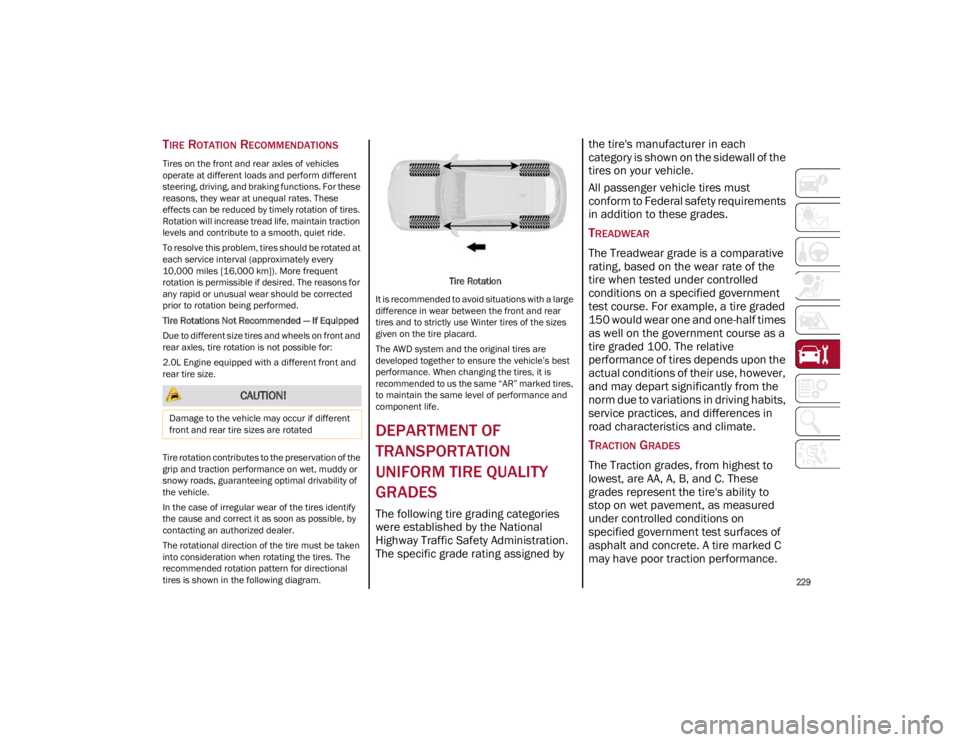
The rotational direction of the tire must be taken
into consideration when rotating the tires. The
recommended rotation pattern for directional
tires is shown in the following diagram.Tire Rotation
It is recommended to avoid situations with a large
difference in wear between the front and rear
tires and to strictly use Winter tires of the sizes
given on the tire placard.
The AWD system and the original tires are
developed together to ensure the vehicle’s best
performance. When changing the tires, it is
recommended to us the same “AR” marked tires,
to maintain the same level of performance and
component life.
DEPARTMENT OF
TRANSPORTATION
UNIFORM TIRE QUALITY
GRADES
The following tire grading categories
were established by the National
Highway Traffic Safety Administration.
The specific grade rating assigned by the tire's manufacturer in each
category is shown on the sidewall of the
tires on your vehicle.
All passenger vehicle tires must
conform to Federal safety requirements
in addition to these grades.
TREADWEAR
The Treadwear grade is a comparative
rating, based on the wear rate of the
tire when tested under controlled
conditions on a specified government
test course. For example, a tire graded
150 would wear one and one-half times
as well on the government course as a
tire graded 100. The relative
performance of tires depends upon the
actual conditions of their use, however,
and may depart significantly from the
norm due to variations in driving habits,
service practices, and differences in
road characteristics and climate.
TRACTION GRADES
The Traction grades, from highest to
lowest, are AA, A, B, and C. These
grades represent the tire's ability to
stop on wet pavement, as measured
under controlled conditions on
specified government test surfaces of
asphalt and concrete. A tire marked C
may have poor traction performance.
CAUTION!
Damage to the vehicle may occur if different
front and rear tire sizes are rotated
22_GU_OM_EN_USC_t.book Page 229
Page 237 of 256
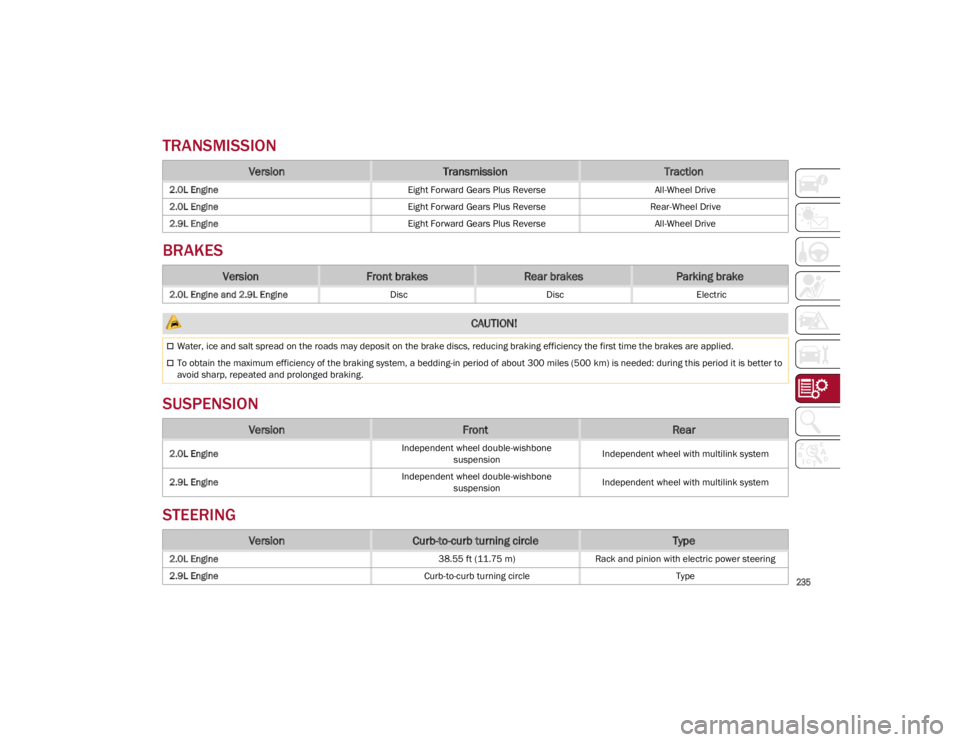
235
TRANSMISSION
BRAKES
SUSPENSION
STEERING
VersionTransmissionTraction
2.0L EngineEight Forward Gears Plus Reverse All-Wheel Drive
2.0L Engine Eight Forward Gears Plus Reverse Rear-Wheel Drive
2.9L Engine Eight Forward Gears Plus Reverse All-Wheel Drive
VersionFront brakesRear brakesParking brake
2.0L Engine and 2.9L EngineDiscDiscElectric
CAUTION!
Water, ice and salt spread on the roads may deposit on the brake discs, reducing braking efficiency the first time the brakes are applied.
To obtain the maximum efficiency of the braking system, a bedding-in period of about 300 miles (500 km) is needed: during this period it is better to
avoid sharp, repeated and prolonged braking.
VersionFrontRear
2.0L Engine Independent wheel double-wishbone
suspension Independent wheel with multilink system
2.9L Engine Independent wheel double-wishbone
suspension Independent wheel with multilink system
VersionCurb-to-curb turning circleType
2.0L Engine
38.55 ft (11.75 m)Rack and pinion with electric power steering
2.9L Engine Curb-to-curb turning circleType
22_GU_OM_EN_USC_t.book Page 235
Page 251 of 256

249
Door Locks .................................................... 28Automatic ................................................. 28
Door Opener, Garage ................................... 39
Doors............................................................. 25
Drive Train Control (DTC) System ..............136
Driving Modes .............................................. 92
Dynamic Steering Torque (DST) System ... 136
E
Electric Park Brake....................................... 84
Electric Remote Mirrors ............................... 38
Electronic Speed Control (Cruise Control) .. 98
Electronic Stability Control (ESC)
System ........................................................136
Electronic Throttle Control Warning Light... 75
Emergency In Case Of ......................................176, 181
SOS Emergency Call .............................. 176
Emergency, In Case Of Jump Starting .........................................184
Overheating ............................................ 187
Towing.....................................................189
Emission Control System Maintenance...... 80
Engine ......................................................... 233 Block Heater............................................. 83
Engine Coolant Level .............................198
Exhaust Gas Caution ....................174, 175
Fuel Requirements ................................ 239Jump Starting .........................................186
Oil ............................................................241
Oil Selection ...........................................241
Overheating ............................................ 187
Starting ................................................... 187
Engine Compartment .................................196
Engine Compartment (Washing) ...............231 Engine Oil
Level Check ........................................... 197
Enhanced Accident Response
Feature .............................................. 161, 190
Ethanol ....................................................... 239
Exhaust Gas Cautions ...................... 174, 175 Exhaust System ......................................... 174
Exterior Lighting ............................................42
Exterior Lights ...................................... 42, 174
F
Flashers Hazard Warning ..................................... 176
Turn Signals .............................. 44, 74, 174
Fluid Capacities ......................................... 241
Fluid Leaks ................................................. 174
Fluids And Lubricants................................ 242
Fog Lights, Rear ............................................44
Forward Collision Warning ........................ 145
Fuel Additives ................................................ 240
Clean Air................................................. 239
Ethanol ................................................... 239
Light ..........................................................77
Materials Added .................................... 240
Methanol................................................ 239
Tank Capacity ........................................ 241
G
Garage Door Opener (HomeLink) ................39
Gasoline, Clean Air .................................... 239
Gasoline, Reformulated ............................ 239
Gross Axle Weight Rating .......................... 127
Gross Vehicle Weight Rating..................... 127
GVWR ......................................................... 126 H
Hands-Free Liftgate ..................................... 61
Hazard Warning Flashers .......................... 176
Head Restraints ........................................... 35
Head Rests ................................................... 35
Headlights
Switch ....................................................... 42
Headlights (Cleaning) ................................ 231
Heated Mirrors ............................................. 38
Heated Seats ............................................... 34
Heated Steering Wheel ............................... 30
Heater, Engine Block ................................... 83
Highway Assist System .............................. 106
Hill Decent Control (HDC) System............. 137
Hill Start Assist (HSA) System ................... 138
Hitches Trailer Towing......................................... 128
HomeLink (Garage Door Opener) ............... 39
Hood Closing ...................................................... 59Opening .................................................... 59
I
Ignition .......................................................... 22 Switch ....................................................... 22
Immobilizer (Sentry Key) ............................. 21
In Case Of Emergency ............................... 176
Installing Electrical/Electronic Devices ......... 4
Instrument Cluster ....................................... 64 Descriptions ................................ 65, 66, 74
Display ...................................................... 66Reconfigurable Display ........................... 66
Instrument Panel Features ................................................... 64
22_GU_OM_EN_USC_t.book Page 249
Page 253 of 256

251
PowerMirrors ...................................................... 38
Outlet (Auxiliary Electrical Outlet) ........... 54
Seats......................................................... 33
Sunroof ..................................................... 57
Windows ................................................... 56
Power Seats Forward.............................................. 31, 33
Rearward ........................................... 31, 33
Recline ............................................... 31, 33
Power Supply ..............................................234
Pregnant Women And Seat Belts ..............155
Pretensioners Seat Belts ...............................................155
Prolonged Vehicle Inactivity ......................230
R
Radial Ply Tires ...........................................224
Radio Transmitters And Mobile Phones ....... 4
Rear Camera ..............................................122
Rear Cross Path .........................................139
Reformulated Gasoline .............................. 239
Refueling Procedure ..................................124
Refueling The Vehicle ................................ 124
Reminder, Seat Belt ...................................152
Remote Control Starting System........................................ 23
Remote Keyless Entry .................................. 19
Remote Starting Exit Remote Start Mode .......................... 23
Remote Starting System ....................... 23, 81
Replacement Tires ..................................... 225
Reporting Safety Defects ...........................246
Restraints, Child .........................................164
Restraints, Head .......................................... 35 Rims And Tires ........................................... 216
Roll Over Warning ........................................... 3
S
Safety Checks Inside Vehicle .................... 173
Safety Checks Outside Vehicle ................. 174
Safety Defects, Reporting ......................... 246
Safety Information, Tire............................. 216
Safety Tips ................................................. 173
Safety, Exhaust Gas .................................. 174
Saving Fuel ................................................ 132
Scheduled Servicing .................................. 191
Scheduled Servicing Program
(2.0L T4 MAir Engine Versions) ................ 192
Scheduled Servicing Program
(2.9L V6 Gasoline Engine Versions) ......... 194
Seat Belt Reminder ......................................71
Seat Belts.......................................... 152, 173
Adjustable Shoulder Belt ...................... 154Adjustable Upper Shoulder Anchorage.......................................... 154
Adjustable Upper Shoulder Belt Anchorage.......................................... 154
Child Restraints ..................................... 164
Energy Management Feature ............... 155
Front Seat .............................................. 152
Inspection .............................................. 173
Lap/Shoulder Belt Untwisting .............. 154
Lap/Shoulder Belts ............................... 152
Pregnant Women................................... 155
Pretensioners ........................................ 155
Rear Seat ............................................... 152
Reminder ............................................... 152
Seat Belt Pretensioner .......................... 155
Untwisting Procedure ............................ 154 Seats.......................................................31, 33
Adjustment .........................................31, 33
Head Restraints ....................................... 35
Heated...................................................... 34Height Adjustment ................................... 33
Power........................................................ 33
Tilting ........................................................ 33
Security Alarm .............................................. 24
Service Assistance ..................................... 245
Service Contract......................................... 245
Service Manuals ........................................ 247
Servicing Procedures ................................. 201
Shoulder Belts............................................ 152
Signals, Turn .................................44, 74, 174
Snow Chains .............................................. 228
Snow Tires .................................................. 228
Spare Tires ........................................ 226, 227
Speed Control Accel/Decel .............................................. 99
Accel/Decel (ACC Only) ......................... 102
Cancel..................................................... 100Distance Setting (ACC Only) .................. 103
Resume .................................................... 99
Set ............................................................ 99
Speed Control (Cruise Control) ................... 98
Starting ....................................................... 187 Button....................................................... 22Cold Weather ........................................... 82
Remote ..................................................... 23
Starting And Operating .............................. 187
Starting Procedures ................................... 187
Starting The Engine ..................................... 81
Steering ...................................................... 235 Wheel, Heated ......................................... 30
Wheel, Tilt ................................................ 29
22_GU_OM_EN_USC_t.book Page 251
Page 254 of 256

252
INDEX
Stop/Start System ....................................... 95
Storage Console ..................................................... 54
Suggestions For Driving .............................132
Sun Roof ................................................ 57, 59
Supplemental Restraint System –
Air Bag......................................................... 157
Suspension .................................................235
Symbol Glossary ........................................... 14
Symbols .......................................................... 6
System, Remote Starting ............................. 23
T
Telescoping Steering Column...................... 29
Tilt Steering Column..................................... 29
Tire And Loading Information Placard ......219
Tire Markings..............................................216
Tire Safety Information .............................. 216
Tire Service Kit ...........................................181
Tires .................................174, 222, 226, 229 Aging (Life Of Tires) ................................ 225Air Pressure ............................................ 222
Changing.................................................181
Compact Spare ...................................... 226
General Information......................222, 226
High Speed ............................................. 223
Inflation Pressure...................................222Life Of Tires ............................................ 225
Load Capacity................................219, 220Pressure Monitoring System (TPMS) ...... 73
Quality Grading....................................... 229
Radial......................................................224
Replacement ..........................................225
Safety .............................................216, 222
Sizes .......................................................217 Snow Tires ............................................. 228
Spare Tires.................................... 226, 227
Spinning ................................................. 225
Trailer Towing ........................................ 130
Tread Wear Indicators........................... 225
Tongue Weight/Trailer Weight .................. 129
Towing ............................................... 127, 128 Disabled Vehicle.................................... 188
Towing Eyes ............................................... 189
TPMS (Tire Pressure Monitoring
System) ...................................................... 149
Traction Control System (TCS) .................. 139
Traffic Jam Assist System ......................... 109
Traffic Sign Recognition System ............... 112
Trailer Towing............................................. 127 Hitches ................................................... 128
Minimum Requirements ....................... 129Tips ......................................................... 131
Trailer And Tongue Weight........... 128, 129
Wiring ..................................................... 130
Trailer Towing Guide.................................. 128
Trailer Weight............................................. 128
Transmission ............................................. 235
Transporting Pets ...................................... 173
Tread Wear Indicators ............................... 225
Turn Signals ........................................... 44, 74
U
Uconnect Settings Customer Programmable Features.........26
Passive Entry Programming.....................26
Uniform Tire Quality Grades...................... 229
Universal Garage Door Opener (HomeLink®)
S..........................................39
Universal Transmitter ...................................39 Untwisting Procedure, Seat Belt ............... 154
Use Of The Owner’s Manual........................... 5
V
Vehicle Changes/Alterations ......................... 4
Vehicle Identification Number .................. 233
Vehicle Loading ................................. 126, 220
W
Warning Lights (Instrument Cluster
Descriptions) ................................................ 72
Warnings, Roll Over ........................................ 3
Warranty Information ................................ 246
Washer Fluid For Windshield/
Headlights .................................................. 198
Washers, Windshield ................................... 46
Weights ....................................................... 238
Wheel And Wheel Tire Care....................... 227
Wheel And Wheel Tire Trim ....................... 227
Wheels And Tires ....................................... 216
Wind Buffeting ............................................. 57
Windows Power........................................................ 56
Windows (Cleaning) ................................... 231
Windshield Defroster ................................. 173
Windshield Washers .................................... 46
Windshield Wiper Replacing Blades ................................... 203
Windshield Wipers ....................................... 46
Wipers, Rain Sensitive................................. 46
Wireless Charging Pad ................................ 55
22_GU_OM_EN_USC_t.book Page 252