lock AUDI A3 2012 Owner´s Manual
[x] Cancel search | Manufacturer: AUDI, Model Year: 2012, Model line: A3, Model: AUDI A3 2012Pages: 280, PDF Size: 70.11 MB
Page 157 of 280

A WARNING
Using the wrong child restraint or an im
properly installed child restraint can cause
ser ious personal injury or death in a crash .
- Always make sure that the safety belt re-
tractor is locked when installing a child
safety seat. An unlocked safety belt re
tractor cannot hold the child safety seat
in place during normal driving or in a
crash .
- Always buck le the child safety seat firmly
in place even if a child is not s itting in it .
A loose ch ild safety seat can fly around
dur ing a sudden stop or in a crash.
- Always make sure the seat backrest to
wh ich the child restra int is installed is in
an upr ight position and secu rely latched
in to place and cannot fold forwa rd. Oth
erwise, the seatback w ith the ch ild s afety
seat attached to it could fly forward in
the event of an accident or other emer
gency situation.
- Always read and heed all WARN INGS
whenever using a child rest rained in ave
hicle is being used
,::!) page 143. Special
precautions apply when installing a ch ild
safety seat on the front passenger seat
¢ page 123, Child restraints on the front
seat -some important things to know.
Deactivating the convertible locking
retractor
The convertible locking retractor for child re
straints will be deactivated automatically when the belt is wound all the way ba ck into
the retractor.
~ Press the red button on the safety be lt
buc kle. The belt tongue will pop out of the
bu ck le.
~ G ui de the safety belt all the way back in to
it s stowed posit ion .
A lways le t the safety belt retract comp lete ly
in to its stowed posit ion. The sa fety belt can
now be used as an o rdinary sa fety belt with
out the convert ib le lock ing ret ractor for chi ld
restra ints.
-
Child Sa fet y 155
If the convertib le locking retractor should be
activated inadvertently, the safety be lt must
be unfastened and guided comp lete ly back in
to its stowed posit ion to deactivate this fea
ture. If the convert ible locking retractor is not
deact ivated, the safety belt w ill grad ua lly be
come tig hte r and uncomfortable to wear.
A WARNING
Im prop erly installed chi ld safety seats in
crease the r isk of serio us pe rsonal injury
a nd death in a c ollision.
- Never unfasten the safety belt to deacti
vate the conver tible locking retrac to r for
child res traints while the vehicle is mov
ing . You would not be restrained and
could be seriously injured in an accide nt.
- Always read and heed al l WAR NIN GS
wheneve r using a child restraine d in ave
hicle is being used
r::!) page 143 . Special
preca utions apply when insta lling a child
safety seat on the front passe nger seat
¢ page 123, Child restraints on the front
seat -some important things to know .
LATCH Lower
anchorages and tethers
for children
Child Restraint System anchors and how
are they related to child safety
T o p rov ide a simple r and more prac ticable way
to attach the c hild restraint on the vehi cle
seat, Federal regulat ions req uire spec ia l lower
anchorages in vehicles and devices on new
c hi ld restra ints to attach to the veh icle ancho
rages.
The combination of the tether anchorages and
the lower anchorages is now genera lly ca lled
the
LATCH system for " Lower Anchorages and
T ethers for Chil dren."
Fo rward-faci ng chi ld restraints manufactured
after September 1, 1999, are requ ired by U.S.
federa l regu lations to comply with new child
head movement performance requirements. .,.. •
•
Page 159 of 280
Attachment locator markers for lower
anchorages
Circular locator buttons on the rear seatback indicate the lower anchorage locations on the
rear seating positions ¢
fig. 144.
Lower anchorages
The lower anchorage attachment points are
l ocated between the rear seatback and rear
seat cushion ¢
fig. 145.
Lower anchorages secure the child restraint in
the seat witho ut using the vehicle 's safety
be lts . Anchorages provide a secure and easy
to-use attachment and minimize the possibili
ty of improper child restraint installation.
A ll child restraints manufactured after Sep
tember 1, 2002, must have lower anchorage
attachments for the
LATCH system.
Remember that the lower anchorage points
are only intended for installation and attach
ment of child restraints specifically certif ied
for use with
LATCH l ower anchorages . Child
restraints that are not equipped with the low
er anchorage attachments can still be instal led in compliance with the ch ild restra int
manufacturer's instruct ions on using vehicle
safety belts .
.&, WARNING
Improper use of LATCH lower anchorages
can cause serious persona l injury in an ac
cident .
- Always carefully fo llow the child re
straints manufacturer's instructions for
proper installation of the child restraint
and proper use of the lower anchorages
or safety belts in your vehicle.
- Never secure or attach any l uggage or
other items to the
LATCH lower ancho
rages.
-Always read and heed the important in
formation about child restraints in this
chapter and WARNINGS ¢
page 143,
Child Safety .
Child Safety 15 7
Installing a child restra int with LATCH
lower anchorages
Whenever you install a child restraint always
follow the child restraint manufacturer's in
structions.
Fig. 146 Rear bench seat: insta llin g the mount fo r
LATCH child seats
Fig. 147 Lower anchorages: proper mount ing
Mounting
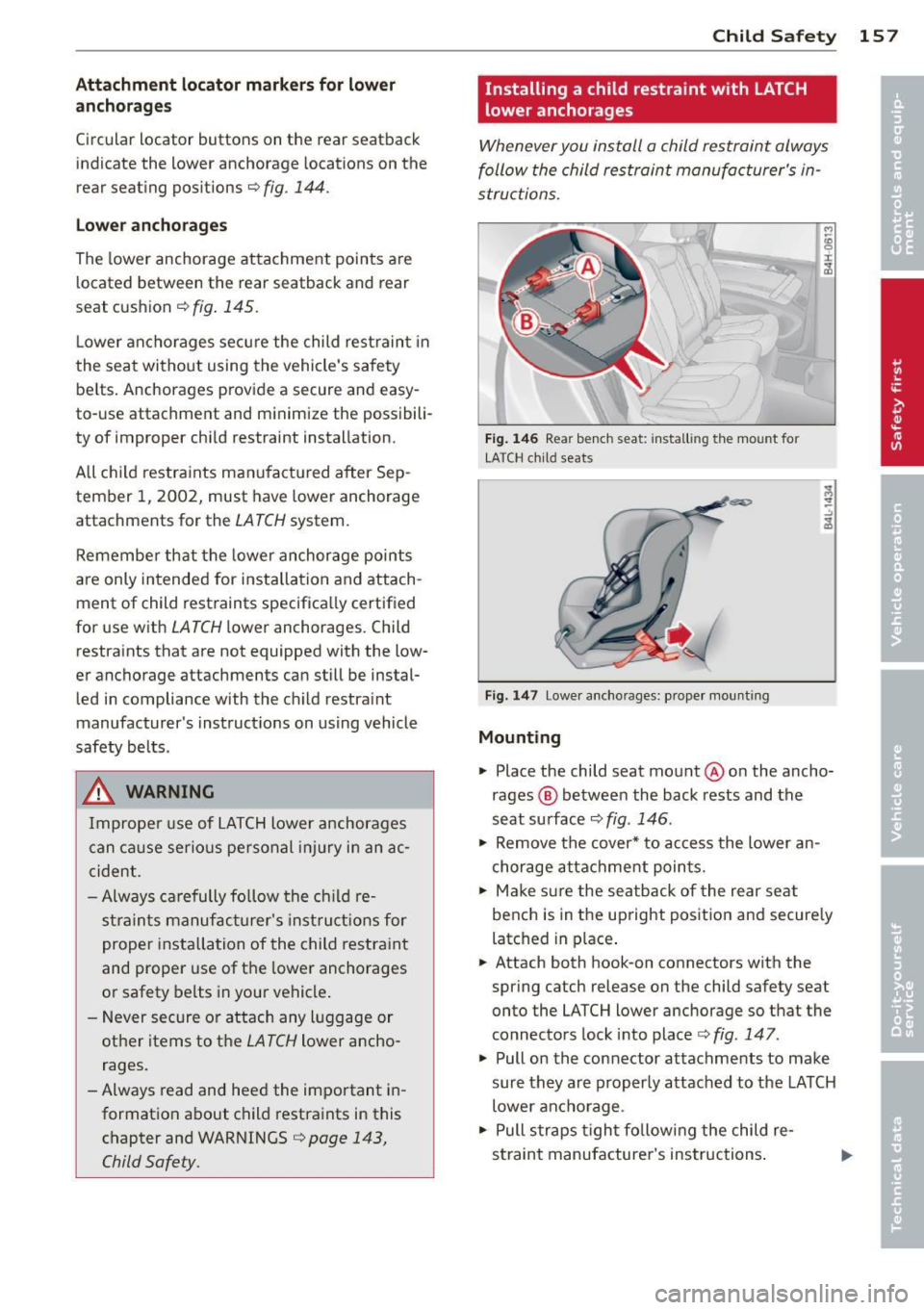
.,. Place the child seat mount@on the ancho
rages @ between the back rests and the
seat surface ¢
fig. 146 .
.,. Remove the cover* to access the lower an
chorage attachment points.
.,. Make sure the seatback of the rear seat
bench is in the upright position and secure ly
latched in place.
.,. Attach both hook-on connectors with the
spring catch release on the child safety seat
onto the LATCH lower anchorage so that the
connectors lock into place ¢
fig. 147.
.,. Pull on the connector attachments to make
sure they are properly attached to the LATCH
lower anchorage .
.,. Pull straps tight fo llowing the child re-
straint manufacturer's instructions . .,..
Page 164 of 280
162 Intelligent technology
ESP includes and/or works together with the
anti-lock brake system (ABS), brake assist sys
tem and anti-slip regulation (ASR). ESP is
switched on all the time. In certain situations
when you need less tract ion, you ca n sw itch
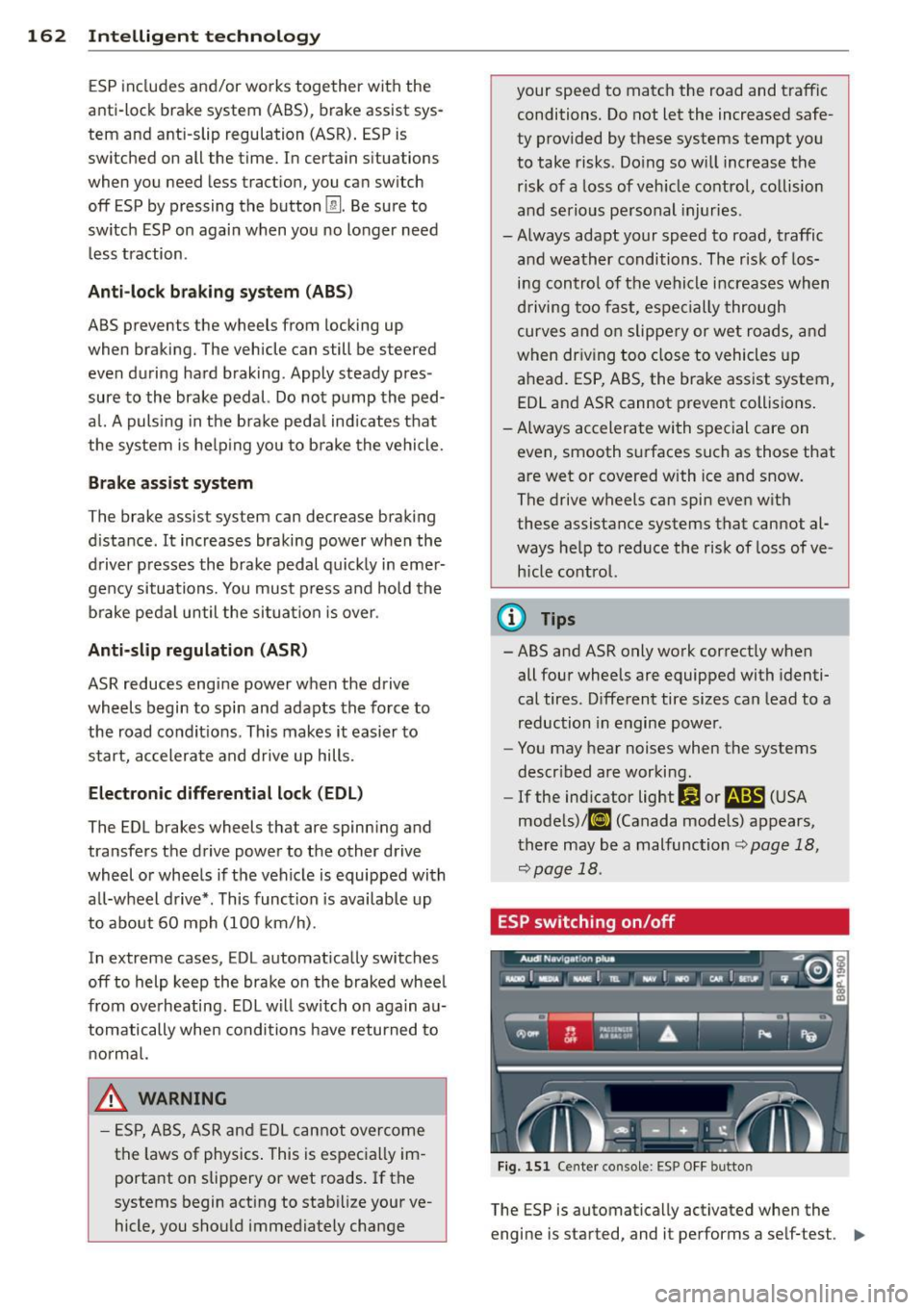
off ESP by pressing the button [g] _ Be sure to
switch ESP on again when you no longer need l ess traction .
Anti-lock b raking system (ABS)
ABS prevents the wheels from locking up
when braking. The vehicle can still be steered
even during hard braking. Apply steady pres
sure to the brake pedal. Do not pump the ped
al. A puls ing in the b rake pedal ind icates that
the system is he lp ing you to b ra ke the vehicle.
Br ake a ssist system
The brake assist system can decrease braking
d istance. It increases braking power when the
d river presses the brake pedal quick ly in eme r
gency situations. You must press and hold the
brake peda l until the si tuation is over .
Anti-slip regulation (ASR)
ASR reduces engine power when the drive
wheels begin to spin and adapts the fo rce to
the road co ndit io ns. This makes it easier to
start, ac celerate and drive up hills.
Electronic differential loc k (EDL )
The EDL brakes wheels that are spinn ing and
transfers the drive power to the other drive
wheel or whee ls if the vehicle is equipped with
a ll-wheel d rive*. This funct ion is available up
to abo ut 60 mph (100 km/h).
In extreme cases, EDL automat ically switches
off to help keep the brake on the braked whee l
from ove rheating . EDL w il l switch on aga in au
tomatically when conditions have returned to
n o rmal.
& WARNING
- ESP, A BS, ASR an d EDL cannot ove rcome
the laws of physics . This is espec ially im
portant on slippery or wet roads. If the
systems begin act ing to stab ilize your ve
hicle, you should immediately cha nge your speed to matc
h the road and t raffic
conditions. Do not let the increased safe
ty provided by these systems tempt you
to take risks. Do ing so w ill increase the
ris k of a loss of veh icle control , co llision
and serious pe rsonal inj uries .
- Always adapt your speed to road, traffic and weather conditions. The risk of los
ing control of the vehicle inc reases when
d riving too fast, espec ially through
curves and on slippe ry or wet roads, and
when dr iv ing too close to vehicles up
ahead. ESP, ABS, the brake assist system, EDL an d ASR cannot prevent collisions.
- Always accelera te with special care on
even, smooth s urfaces such as those that
are wet or covered with ice and snow.
The drive wheels can spin even w ith
these assistance systems that cannot al
ways he lp to red uce the risk of loss of ve
h icle control.
(D Tips
- ABS and ASR only work correct ly when
all four wheels are equipped with identi
cal tires. Diffe rent tire sizes can lead to a
reduction in engine powe r.
- You may hear noises when the systems
descr ibed are working .
- If the indicator light
D] or m (USA
mode ls)/ KC] (Canada models) appears,
t here may be a malfunction~
page 18,
~page 18.
ESP switching on/off
Fig. 151 Ce nter conso le: ESP O FF butto n
The ESP is automat ically activated whe n the
engine is started, and it performs a se lf-test .
II>
Page 166 of 280
164 Intelligent technolog y
Faults in the bra ke sys tem
If you should notice a sudden increase in
b rake peda l travel, then one of the two brake
circuits may have failed¢.& .
Low brake flu id le vel
Malfunct ions can occur in the brake system if
the brake fluid level is too low . T he brake fluid
l eve l is moni to red electronica lly .
Bra ke lining w ear st atu s
Brake l ining wear may be checked by visual in
spection of the condition of the brake pads
through the openings in the whee l. If neces
sa ry, the wheel may be removed for this in
spection
¢page 236, Wheel change.
A WARNING
-You should perform braking maneuvers
for the purpose of cleaning the brake
system on ly if road conditions permit.
Other road users must not be put at risk -
you may cause an acc ident!
- Before descending a steep grade, reduce
speed and shift transmiss ion into a lower
gear or lower driving range . Do not ride
the brakes or hold the pedal down too long or too often. This cou ld cause the
brakes to get hot and dimin ish braking
efficiency.
- Do not "r ide the brakes" by resting your
foot on the pedal when yo u do not intend
to bra ke . This may cause the brakes to
overheat, premature wear and increased
stopping distance .
- Under certain climat ic and operating
condit ions such as passing through wa
ter, driving in heavy rain or after washing
the vehicle, the effectiveness of the brakes can be reduced. In winter, ice can
accumulate on the brake pads, linings,
discs and drums . Carefully apply brakes
for a test . Brakes will dry and ice coat
ings will be cleaned off after a few care
ful brake applications.
- Driv ing for an extended period of time on
salt-covered roads w ithout us ing your
brakes can also affect braking efficiency . Clean off accumulated salt coating from
brake discs and pads with a few careful
brake applications.
- If you damage the front spoiler, or if you
install a different spoiler, be sure the a ir
flow to the front brakes is not obstruct ed. Otherwise the brake system could
overheat reducing the effectiveness of
the entire brake system.
- Failure of one brake circuit will impa ir
the braking capab ility result ing in an in
creased stopping distance. Avoid driving
the vehicle and have it towed to the near
est a utho rized Audi dea le r or q ualified
wo rkshop.
Brake booster '
The brake booster adds extra broking power.
The brake booster works with vacuum pres
sure which is created only when the eng ine is
run ning ¢.&_ .
_&. WARNING
-Never let the vehicle roll to a stop with
the engine shut off.
- I f the b rake booster is not working, for
examp le when towing yo ur vehicle, or
because the brake booster has somehow
been damaged, the brake pedal must be
pressed conside rably harder to make up
for the lack of booster assistance.
Functioning of Anti-Lock Brake System
(ABS)
ABS prevents the wheels from locking up un der broking.
.
The ABS contributes effectively to vehicle con
trol since it prevents the whee ls from
locking
when the brakes are applied. This means that
the vehicle remains steerable and is less likely
to sk id .
With ABS you do not need to pump th e
brake. Ju st hold the b ra ke pedal down.
Page 167 of 280

However, do not expect that the ABS shortens
braking distance under
all circumstances.
When driving on grave l or on newly fallen
snow on top of icy surfaces, braking distance may be even longer, therefore, under these
circumstances, it is especially important that
you dr ive slowly and with great care .
How th e ABS syste m work s
An automatic check is made when a speed of
about 4 mph (6 km/h) is reached. When this
happens, a pumping noise can be heard .
If an individua l wheel begins to rotate too
slowly in relation to vehicle speed and tends
to lock, the ABS automatically reduces brake
pressure to prevent that wheel from locking.
This automatic adjustment process will cause
a
s light vib ration of the brake pedal and some
noises to alert you that vehicle speed must be
adapted to existing road and traff ic condi
tions .
A WARNING
Although the ABS is very effective, always
remember that bra king capability is limit
ed by t ire traction. Always adjust your dr iv
ing speed according to the road and traffic
conditions . Do not let the extra sa fe ty af
forded bytheABStemptyou into taking
extra r isks. The ABS cannot overcome the
laws of physics.
(D Tips
- If ABS is not functioning properly, a
warning light will come on. See
¢ page 18.
- If a fault occurs in the ABS, the EDL is al
so not functioning . This is indicated by
the ABS warning light.
Brake assistant
The broke assistant is designed to achieve the
optimum broking effect .
The brake assistan t helps to increase the ef
fective
b raking power and thus to achieve a
shorter stopping distance . If the driver
Int ellig ent technolog y 165
presses the brake peda l very quick ly, the brake
assistant automatically boosts the braking
force to the max imum level, up to the po int
where the anti-lock brake function (ABS) inter
venes to stop the whee ls from locking. You
shou ld then keep the brake peda l pressed un
t il the vehicle has braked to the required
speed. The brake assistant switches itself off
as soon as you release the b ra ke peda l.
The brake ass istant wi ll not be operative if
there is a ma lfunction in the ABS.
A WARNING
P lease remember that the acc ident risk a l
ways increases if you drive too fast, espe
cially in corners or on a slippe ry road, o r if
you follow the vehicle ahead of yo u too
closely . An increased accident risk cannot
be compensated even by the brake assis
tant, so always mainta in a safe speed.
Electro-mechanical
power assist
The electro-mechanical power assist helps
the driver when steering .
The degree of power assist is electronically
matched to vehicle speed .
The power steering system assists the driver
so that he can steer the vehicle with reduced physical effort.
Power steering will not work if t he engine is
off . As a result, the steering wheel will be hard
to turn .
A WARNING
If the system deve lops a problem, you
must seek qualified professiona l assis
tance.
(D Note
If there is an e lectronic malfunction, ser
votronic
will still function like a conven-
tiona l power steering system, providing a
constant steering support force that is no
-
l onge r proportionate to the vehicle speed. ..,.
•
•
Page 169 of 280

Energy management
Starting ability is optimized
Energy management controls the distribution
of electrical energy and thus optimizes the
availability of electrical energy for starting the engine .
If a vehicle with a conventional energy system
is not driven for a long period of time , the bat
tery is discharged by idling current consumers
(e.g. immobilizer). In ce rtain c ircumstances it
can result in there being insuff icient ene rgy
avai lab le to start the engine .
Intell igent energy management in your vehi
cle hand les the d istribution of electrical ener
gy. Starting ab il ity is markedly improved and
the life of the battery is extended.
Basically, energy management consists of
batt ery di agno sis, idlin g current man ag e
m ent
and dyn ami c en ergy m anage ment .
Batter y diagnosis
Battery diagnosis continuously determines
the state of the battery . Sensors determ ine
battery vo ltage, battery current and battery
temperature. This dete rm ines the current
state of charge and the powe r of the battery.
Idling curr ent man agement
Idling current management reduces ene rgy
consumption while the vehicle is stand ing .
W ith the ignition switched off, it cont ro ls the
energy supply to the va rious electr ical compo
nents . Data from battery diagnosis is consid
ered.
Depending on the battery's state of charge,
i nd ividua l consumers are gradual ly t urned off
to prevent excess ive d ischarge of the bat tery
and thus maintain starting capability .
Dynamic en ergy management
While the vehicle is being driven, dynamic en
e rgy management dist ributes the energy gen
e rated according to the needs of the individu
a l components.
It reg ulates cons umption, so
that more electrical energy is not being used
Int ellig ent technolog y 167
than is being generated and ensures an opti
mal state of charge for the battery.
(0 Tips
- But even energy management canno t
negate the limits of physics . Consider
that the power and life of a battery are
limited .
- If starting ability is threatened, you are
informed by a warning
r:!) page 168,
Driver notification in the instrument
cluster display.
What you should know
The highest priority is given to maintaining
starting capability.
The battery is severe ly taxed in short -distance
driving, in city traffic and during the cold time
of year. Abundant electrical energy is re quired, but only a little is generated .
It is also
critical if the engine is not running and electri
cal components are turned on . In this in
stance energy is be ing consumed but none is
being generated.
It is in precisely these situations that you will
notice energy management actively regulat
ing the d istribution of energy .
Vehicle stands for an e xtended peri od
If you do not drive your vehicle over a period
of several days or weeks, e lectr ical compo
nents are gradually cut back or switched off.
This reduces energy consumption and ma in
ta ins start ing capability over a longer period .
Take into considerat ion that when you unlock
your vehicle, some convenience functions, such as the remote key or power seat adjust
ment, may not be available . The conven ience
funct ions w ill be available again when you
tu rn on the ignition and start the engine .
With the engine turned off
If you listen to the radio, for example, w ith
the engine turned off, the battery is being d is-
charged.
~
•
•
Page 178 of 280
176 Trailer towing
Always app ly bra kes early . When driving
downhill, shift into lower gear to use the en
g ine braking effect to slow down the vehicle.
Use of the brakes alone can cause them to
overheat and fail.
Coolant temperature
The coolant temperature gauge ¢ page 11
must be observed carefully. If the needle
moves close to the upper end of the scale, re
duce speed immed iate ly and/or switch
off the
a ir cond itioner.
If the coolant temperature warning light in
the instrument cluster starts flashing
J_, pull
off the road, stop and let the engine idle for
about two minutes to prevent heat build-up.
A WARNING
Anyone not properly restrained in a mov
ing veh icle is at a much greater risk in an
accident . Never let anyone r ide in your car
who is not prope rly wear ing the restra ints
provided by Aud i.
Trailer towing tips
Important to know
Your veh icle handles different ly when towing
-
a trailer because of the addit io nal weight and
weight distribution . Safety, performance and
economy w ill greatly depend on how carefu lly
you load your trai ler and ope rate your rig .
Before you actually tow your trailer, practice
turn ing, stopp ing and back ing up in an area
away from traffic. Keep practicing until you have comp letely become fam iliar w ith the way
your ve hicle-trai ler comb ination behaves and
responds .
Backing up is d iff icu lt and requires practice .
Backing up with a tra ile r genera lly requ ires
steer ing act ion opposite of tha t when backing
up your veh icle without a trailer .
Ma intain a g reater distance between your ve
h icle and the one in fro nt of you. You will need
mo re room to stop. To compensate for the trailer, yo
u will need a
larger than normal turning radius.
When passing, remember that you cannot ac
ce le rate as fas t as you no rma lly would be
cause of the added load. Make sure yo u have
enough room to pass . After passing, a llow
plenty of room for your trailer before chang
ing lanes again.
Avoid jerky starts , sharp turns or rapid lane
changes.
(D Tips
- Do not tow a trailer during the break -in
period of your vehicle.
- If you tow a trailer, yo ur Audi may re
quire more frequent maintenance due to
the extra load ¢
page 2 59.
Parking on a slope
Do not park with a trailer on a slope . If it can
not be avoided, do so only after doing the fol
lowing:
When parking:
.,. App ly the foot brake.
.. Have someone p lace cho cks under both the
veh icle and the trailer wheels.
.. With chocks in place, slowly release the
brakes unti l wheel b locks absorb th e load.
.. Turn the whee ls towards the cu rb.
.. App ly the parking brake.
.. Place an automat ic transm ission in
P, re
spectively a manual transmission in first or
reverse gear .
When restarting after p ark ing:
.. Start the engine.
.. Shift transm ission into gear .
.. Release the parking brake and slowly pull
out and away from the wheel blocks.
.,. Stop and have someone retr ieve the wheel
b locks .
Ill-
Page 179 of 280
@ Tips
If you move the selector lever of the auto
mat ic transm ission to
P before applying
the parking brake and before blocking the
wheels, you may have to use more force later to move the lever out of the
P pos i
tion .
Trailer towin g 177
•
•
Page 181 of 280

CD Note
You should remove debris (such as insects)
from the headlight lenses on a regular basis, for example when refueling your vehi
cle. Never clean the headlights with a dry
cloth or sponge . Use a wet cloth or
sponge.
It is best to use soapy water .
Automatic car wash
The vehicle can be washed in almos t any
modern automatic car wash .
The vehicle paint is so durable that the vehicle
can normally be washed without problems in
an automatic car wash . However, the effect on
the paint depends to a large extent on the de
sign of the facility, the filtering of the wash
water , the type of wash and care material , etc .
If the paint has a dull appearance after going
through the car wash or is scratched, bring
this to the attention of the operator immedi
ately. If necessary, use a different car wash.
Before going through a car wash, be sure to
take the usual precautions such as closing the
windows and panoramic sliding sunroof*. Re move antenna if applicable.
If you have installed additional accessories on
the vehicle -such as spoilers, roof rack, etc. -
it is best to ask the car wash operator if these
should be removed.
A WARNING
Always read and heed all WARNINGS and other information
¢ page 178.
Washing the vehicle by hand
A lot of water is needed when washing a vehi
cle by hand.
11-Before you start washing, make sure you
have read and understood the WARNINGS
¢ A in General information on page 178.
11-First soak all dried dirt until it is soft, then
rinse it off .
11-As you clean your vehicle, s tart with the
roof and work your way down to the bottom,
Cleaning and protection 179
using a sponge, a sponge glove or a clean
brush.
"" Rinse the sponge or the sponge glove often,
flushing it clean each time.
11-Use special car shampoo only for very per
sistent dirt .
11-Rinse the car thoroughly with water .
11-Use a chamois leather to gently wipe the ex-
terior dry.
Use a separate sponge for cleaning the
wheels, door sills and other regions exposed
to road dirt. In this way, you will not scratch
the paint with coarse particles imbedded in
the sponge the next time you wash the car.
A WARNING
= -
-Do not clean the underside of the chas-
sis, fenders, wheel covers , or other hard
to reach parts without protecting your hands and arms . You may cut yourself on
sharp-edged metal parts.
- Always read and heed all WARNINGS and
other information
¢ page 178.
CD Note
- Never try to remove dirt, mud or dust if
the surface of the vehicle is dry. Never
use a dry cloth or sponge, since this
could scratch your vehicle's paint or win
dows.
- Never wash your car in bright sunlight.
Drops of water act as magnifying lenses
and may damage your paint .
- When you wash your car in the winter: if
you rinse your vehicle with a hose, be
careful not to aim the stream of water
directly at locks, or at door or hatch
openings -they can freeze shut.
- Never use sponges designed to remove
insects, or any kitchen scouring sponges
or similar products. They can damage
your paint finish.
- Never use a dry cloth or sponge to clean
the headlights. Only use wet cloths or
sponges to prevent scratches. It is best
to use soapy water. •
•
Page 186 of 280
184 Cleaning and protection
Fabrics and fabric coverings
Fab rics and fabr ic coveri ngs (e.g. seats, door
tr im panels, etc.) should be cleaned at reg ular
inte rva ls with a vacuum cleaner. This removes
sur face dirt particles which could become em
bedded in the fabric through use. Steam
cleaners shou ld not be used, because the
steam tends to push the dirt deeper into the
fabric and lock it there.
Normal cleaning
Generally, we recommend using a soft sponge
or a lint-free microfiber cloth to the clean fab
ric. Brushes should on ly be used for carpets
and floor mats, s ince other fabric surfaces
could be harmed by brushes.
Normal surface stains can be cleaned using a
commercially available foam cleaner. Spread
the foam on the surface of the fabric with a
soft sponge and work it in gently. Do not satu
rate the fabric. Then pat the foam d ry using
absorbent, dry cloths (e.g . microfiber cloth)
and vacuum it afte r it has dried comp lete ly.
Cleaning stain s
Stains caused by beverages (e.g. coffee, fruit
ju ice, etc.) can be treated with a mild deter
gent solut ion. App ly the detergent so lution
with a sponge. In the case of stubbor n stains,
a detergent paste can be applied directly to
the sta in and wor ked into the fabric. Afte r
wards, use copio us amo unts o f cle an water to
remove t he remaining dete rgent. Apply the
water with a damp cloth or sponge and pat
the fabric d ry w ith an absorbent, dry cloth.
S tains from chocola te or make up s hou ld have
detergent paste (e .g. ox -gall soap) r ubbed in
to them. Afterwards, remove the soap with
water (damp sponge).
A lcohol can be used to t rea t stains from
g rease, oi l, lips tick or a ballpo in t pen . Me lted
grease or dye must be patted off using ab
sorbent materia l. It may be necessary to re
treat the areas with dete rgent paste and wa
ter. In the case of gene
ra l soiling o f the uphols
tery and cover material, we recommend hiring
a spec ia list that has the equipment to clean
the seat covers and other fabr ic surfaces by
shampooing and spray extraction.
A WARNING '"--
A lways read and heed all WARNINGS and
the information
~ page 178.
(D Tips
Open Ve lcro fasteners on yo ur clothing can
damage the seat cover. Please make sure
that Velcro fasteners are closed.
Plastic parts and instrument panel
~ Always use a clean cloth moistened in clear
wate r.
Always use a clean cloth moistened in clear
water to clean these areas. For pe rsisten t dirt
use an Aud i approved
solvent -free p lastic
cl eaner/p rotec tant.
A WARNING
S olven ts ca n ch ange the prope rties of
some p lastics and make it harde r fo r the
a ir ba g to de ploy .
-
- N ever cle an the in st rument p anel or the
sur face of Ai rbag modu les with cleaning
prod ucts t hat conta in solvents .
- P roduc ts containing solven ts will make
the surface of this part poro us.
- Ser ious inju ries c an resu lt if p lastic parts
come loose when t he ai rbag is deployed.
- Always re ad and heed a ll WAR NIN GS and
t he information¢
page 178 .
(J) Note
Cleaning agents conta ining so lvents w ill
a ttack t he mate rial and can ch ange the
w ay it behaves.