lock AUDI A3 2012 Owner´s Manual
[x] Cancel search | Manufacturer: AUDI, Model Year: 2012, Model line: A3, Model: AUDI A3 2012Pages: 280, PDF Size: 70.11 MB
Page 221 of 280

used today are underinflated just by looking
at them.
Therefore, be sure to check tire pressures at l eas t once a mon th and always before going
on a long trip. Make sure to take the number
of people and the amount of luggage into ac
count when adjusting tire pressure for a trip -
even one that you would not consider to be
"long." See ¢
page 220, Tires and vehicle
load limits
for more important information .
A lways use an accurate tire pressure gauge
when check ing and adjusting inflation pres
sures . Check all of the tires and be sure not to
forget the spare t ire . If the pressure in any tire
is too high when the tire is "cold," let air out
of the tire slowly with the edge of the t ire
gauge and keep checking the pressure until
you reach the p ress ure th at is cor rect for the
l oad (passengers and luggage) and kind of
driving you plan to do .
I f the p ressu re in any tire is too low , note the
d ifference between the pressure in the cold
tire and the pressure you need and add the air
that you need to reach the correct pressure for
the vehicle load (passengers and luggage) for
the tires on your vehicle as listed on the on
your veh icle and in this manual and the kind
of dr iving you p lan to do.
Never e xceed the m aximum inflation pre s
su re li sted on th e tir e side wall for any rea
son.
Remember that the vehicle manufacturer, not
the tire manufacturer, determines the co rrect
tire p ressure for the tires on your vehicle .
It is important to check the tire pressure when
the tires are cold .
- Read the requ ired ti re p ressu re from the tire
pressure label. On USA veh icles, the t ire
pressure label is located on driver's side 8-
pillar . On Canada vehicles, the tire pressure
label is located either on the driver's side 8-
pillar or inside the fuel fi ller flap.
- Turn the valve stem cap counter-clockwise
to remove it from the tire valve.
- Place the air pressure ga uge on the valve.
Tire s an d wheel s 219
- The tire pressures should only be checked
and adj usted when the tires are co ld . The
slightly raised pressures of warm tires must
not be reduced.
- Adjust the tire pressure to the load you are
carrying.
- Reinstall the valve stem cap on the va lve.
When should I check the tir e pressu re?
T he co rrect tire pressu re is especially impor
tant a t high speeds. The pressure should
therefore be checked at least once a month
and always before starting a jo urney . Do not
forget to check the tire pressure for the spare
whee l
¢page 234.
When should I adjust the tire pres sur es?
Adjus t the t ire press ure to the load you a re
carrying . After changing a whee l
or rep lacing
whee ls you have to adjust the tire pressu res
on all whee ls. In addition, yo u m ust then initi
ali ze the new t ire pressures in the tire pres
sure monitoring system*¢
page 230.
A WARNING
...---
Incorrect tire pressures and/or underinfla-
tion can lead sudden tire fa ilure, loss of
control, collision, serio us personal injury
or even death.
- When the warning symbol
ti] appears in
the instrument cluster, stop and inspect
the t ires.
- Inco rrect tire pressure and/or underinfla
tion can cause increased tire wea r and
can affect the hand ling of the vehicle and
s topping abi lity.
- I nco rrect tire pressures and/or unde rin
flation can a lso lead to sudden t ire fail
ure, including a blowou t and sudden de
flation, ca using loss of vehicle contro l.
- The driver is responsib le for the correc t
tire pressures for all tires on the veh icle.
The applicable pressure values are locat
ed on a sticker on the dr iver's side 8-pil
lar or on the ins ide of the fuel filler flap. •
•
Page 228 of 280

226 Tires and wheels
and drive with extra care. Refit the nor
mal road wheel as soon as safely possi
ble.
- Never drive faster than the maximum
speed for which the tires on your vehicle
are rated because tires that are driven
faster than their rated speed can fail
suddenly.
- Overloading tires cause heat build-up,
sudden tire failure, including a blowout
and sudden deflation and loss of control.
- Temperature grades apply to tires that are properly inflated and not over or un
derinflated .
- For technical reasons it is not always
possible to use wheels from other vehi
cles -in some cases not even wheels
from the same vehicle model.
- If you install wheel trim discs on the ve
hicle wheels , make sure that the air flow
to the brakes is not blocked. Reduced air
flow to the brakes can them to overheat,
increasing stopping distances and caus
ing
a collision.
- Run flat tires may only be used on vehi cles that were equipped with them at the
factory. The vehicle must have a chassis designed for run flat tires and a factory
installed tire pressure monitoring sys
tem* that indicates a loss of tire pres
sure . Incorrect use of run flat tires can
lead to vehicle damage or accidents .
Check with an authorized Audi dealer or
tire specialist to see if your vehicle can be
equipped with run flat tires . If run flat
tires are used, they must be installed on
all four wheels. Mixing tire types is not
permitted .
(D Note
-For technical reasons, it is not generally
possible to use the wheel rims from oth
er vehicles. This can hold true for wheels
of the same vehicle type.
- If the spare ti re is different from the
tires that you have mounted on your ve
hicle (for example winter tires or wide
profile tires), then use the spare tire for a short period of time only and
drive with
extra care. Replace the flat tire with the
tire matching the others on your vehicle
as soon as possible.
- If you put different wheels and tires on
your vehicle (e .g. winter wheels and
tires), you must be certain that the
wheels and tires are compatible with the
tire pressure monitoring system* . Other
wise the system will register a malfunc
tion and a fault message will be dis
played. For more information, contact
your authorized Audi dealer.
- Never drive without the valve stem cap .
The valves could get damaged .
@ For the sake of the environment
Dispose of old tires in accordance with the
local requirements.
Uniform tire quality grading
- Tread wear
- Traction AA A B C
- Temperature ABC
Quality grades can be found where applicable
on the tire side wall between tread shoulder
and maximum section width
¢ page 223,
fig. 171 .
For example: Tread wear 200, Traction AA,
Temperature A.
All passenger car tires must conform to Feder
al Safety Requirements in addition to these
grades .
Tread wear
The tread wear grade is a comparative rating
based on the wear rate of the tire when tested
under controlled conditions on a specified
government test course.
For example, a tire graded 150 would wear
one and one half (11/2) times as well on the
government course as a tire graded 100.
The relative performance of tires depends
upon the actual conditions of their use, how-
ever, and may depart significantly from the
ll-
Page 230 of 280
228 Tires and wheels
The speed rating letter code( ¢ page 224) is
on the side wall of the tire
¢ page 223.
A WARNING
Winter tires have maximum speed limits
that may be lower than your vehicle's max
imum speed . Always know the maximum
speed before driving off. Never drive faster
than the speed permitted for your specific
winter tires. This will cause damage to the
tires leading to an accident and serious
personal injury to you and your passen
gers.
A WARNING I>=
Driving faster than the maximum speed
for which the winter tires on your vehicle
were designed can cause tire failure in
cluding a blowout and sudden deflation,
loss of control, crashes and serious per
sonal injuries. Have worn or damaged tires
replaced immediately.
- Winter tires have maximum speed rating
that may be lower than your vehicle's
maximum speed .
- Never drive faster than the speed for
which the winter or other tires installed on your vehicle are rated.
A WARNING
Always adjust your driving to the road and
traffic conditions. Never let the good ac
celeration of the winter tires and all-wheel
drive tempt you into taking extra risks . Al
ways remember :
- When braking , an all-wheel drive vehicle
handles in the same way as a front drive
vehicle.
- Drive carefully and reduce your speed on
icy and slippery roads, even winter tires
cannot help under black ice conditions.
@) For the sake of the environment
Use summer tires when weather condi
tions permit. They are quieter, do not wear
as quickly and reduce fuel consumption.
Snow chains
Snow chains may be fitted only to the front
wheels, and only to certain tire sizes . Ask your
authorized Audi dealer on which tire sizes snow chains can be used.
If you are going to use snow chains, then you
must install them on the front wheels at
least.
The snow chains must have low-profile links
and must not be thicker than 0.53 inch
(13 .5 mm) , including the lock.
Remove wheel center covers and trim discs
before putting snow chains on your vehicle
¢ (!) . For safety reasons cover caps must then
be fitted over the wheel bolts. These are avail
able from authorized Audi dealers.
A WARNING
=
Using the wrong snow chains for your vehi-
cle or installing them incorrectly can in
crease the risk of loss of control leading to
serious personal injury.
- Snow chains are available in different
sizes . Always make sure to follow the in
structions provided by the snow chain manufacturer.
- When driving with snow chains never
drive faster than the speed permitted for
your specific snow chains.
- Always observe local regulations.
(D Note
- Remove snow chains before driving on
roads not covered with snow to avoid
damaging tires and wearing the snow
chains down unnecessarily .
- Snow chains, which come into direct con
tact with the wheel rim, can scratch or damage it. Therefore, make sure that the
snow chains are suitably covered. Check
the position of the snow chains after
driving a few yards and correct if neces
sary. Follow the instructions from the
snow chain manufacturer when doing so. ..,.
Page 236 of 280
234 What do I do now ?
What do I do now?
Jack, tools and spare
wheel
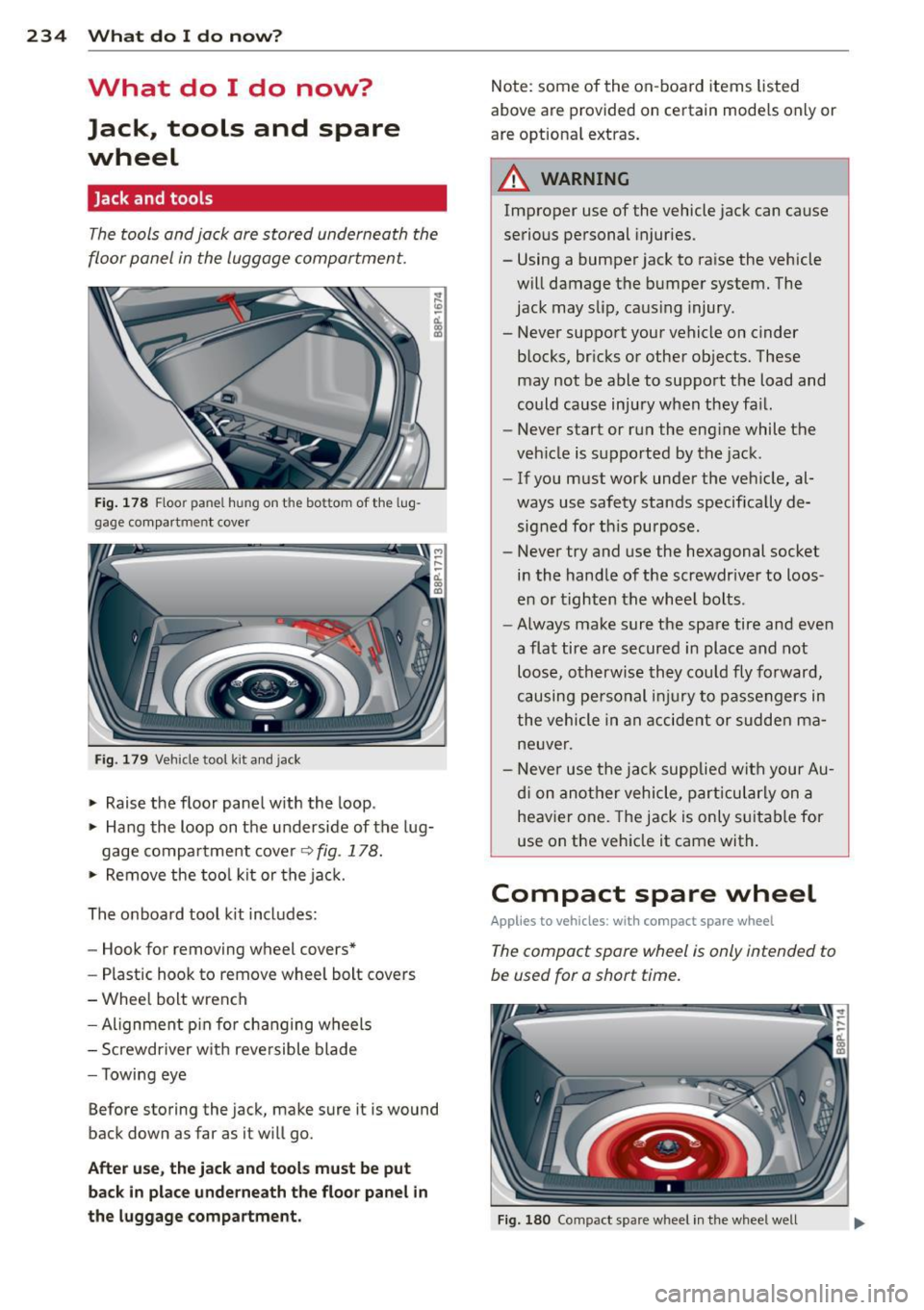
Jack and tools
The tools and jack are stored underneath the
floor panel in the luggage compartment.
Fig . 178 Floor panel hung on the bottom of the lug
gage compartment cover
Fig. 179 Vehicle tool kit and jack
~ Raise the floor panel w ith the loop.
~ Hang the loop on the underside of the lug-
gage compartment cover
Q fig. 178.
~ Remove the too l kit or the jac k.
The onboard tool kit incl udes:
- Hook for removing wheel covers*
- Plastic hook to remove wheel bolt covers
- Wheel bolt wrench
- Alignment p in for changing wheels
- Screwdriver w ith reve rsible blade
- T owing eye
Before storing the jack, make sure it is wound
back down as far as it will go.
After u se , th e jack and tool s mu st be put
b ac k in pl ace under nea th t he floo r pan el in
t he luggag e comp artmen t.
Note: some of the on -board items listed
above are provided on certain mode ls only or
are optiona l extras.
A WARNING
-Improper use of the vehicle jack can cause
serious personal injuries.
- Using a bumper jack to raise the vehicle
will damage the bumper system. The
jack may slip, caus ing injury.
- Never support your vehicle on c inder
b locks, br icks or other objects. These
may not be able to support the load and
could cause injury when they fail.
- Never start or run the eng ine while the
veh icle is supported by the jack.
- If you must work under the veh icle, al
ways use safety stands specifically de signed fo r th is purpose.
- Never try and use the hexagonal socket
in the handle of the screwdriver to loos
en or tighten the whee l bolts.
- Always make sure the spare tire and even
a flat tire are secured in place and not
loose, otherwise they cou ld fly forward,
causing pe rsonal i njury to passengers in
the vehicle in an accident or sudden ma
neuver.
- Neve r use the ja ck supplied with your Au
d i on another vehicle, particularly on a
heav ier one. The jack is only s uitable for
use on the vehicle it came with.
Compact spare wheel
Applies to veh icles: w ith compact spare whee l
The compact spare wheel is only intended to
be used for a short time.
Fig . 180 Compact spare wheel in the wheel well
Page 238 of 280
236 What do I do now?
-After installing the compact spare wheel,
the tire inflation pressure should be
checked and, if necessary, increased to
60 psi (4.2 bar).
- The load carrying capacity is marked on
the tire sidewalls and must not be ex
ceeded.
- After installing the compact spare wheel,
make sure that you remount the flat tire
in its storage area properly.
- The compact spare tire should be proper
ly remounted in its storage area as soon
as the standard road tire can be re placed .
- Because the compact spare tire was spe
cifically designed for your vehicle, it must not be used on any other vehicle .
Likewise, compact spare wheels from
other vehicles must not be used on your
vehicle.
- The compact spare tire must not be
mounted on any other wheels, nor must
standard tires, snow tires, wheel covers
or trim rings be used with the compact
spare wheel. If such use is attempted,
damage to these items or other vehicle
components may occur .
(D Tips
Check the inflation pressure of the com
pact spare tire (60 psi/4.2 bar) periodically
to keep the tire ready for use.
Wheel change
Before changing a wheel
Observe the following precautions for your
own and your passenger's safety when chang
ing a wheel .
.. After you experience a tire failure, pull the
car well away from moving traffic and try to
reach
level ground before you stop c:> ,&. .
.. All passengers should leave the car and
move to a safe location (for instance, behind
the guardrail)
c:> _&. .
.. Apply the parking brake firmly c:> _&. .
.. Move selector lever to position Pon an au
tomatic transmission ; put manual transmis
sion in
first gear c:> _&..
.. If you are towing a trailer : unhitch the trail
e r from your vehicle.
.. Take the
tool and the spare tire c:> page 234
out of the luggage compartment .
.&, WARNING
You or your passengers could be injured
while changing a wheel if you do not fol
low these safety precautions:
- If you have a flat tire, move a safe dis
tance off the road. Turn off the engine,
turn the emergency flasher on and use
other warning devices to alert other mo
torists.
- Make sure that passengers wait in a safe place away from the vehicle and well
away from the roadway and traffic .
- To help prevent the vehicle from moving suddenly and possibly slipping off the
jack, always fully set the parking brake
and block the wheel diagonally opposite
the wheel being changed. When one
front wheel is lifted off the ground, plac
ing the automatic transmission in "P"
(Park) , or engaging a gear in a manual
transmission will
not prevent the vehicle
from moving.
- Before you change a wheel, be sure the
ground is level and firm. If necessary,
use a sturdy board under the jack.
- After installing the spare wheel, make
sure that you remount the flat tire/wheel
in its storage area properly and tighten
the knurled retaining screw securely.
Changing a wheel
-
When you change a wheel, follow these
quence described below step-by-step and ex
actly in that order .
1. Remove the decorative wheel cover*. For
more details see also
c:> page 23 7, Deco
rative wheel covers
or c:> page 238,
Wheels with cap-covered wheel bolts.
Page 240 of 280
238 What do I do now?
Wheels with cap-covered wheel bolts
Applies to vehicles: wit h cap-cove red w hee l bo lts
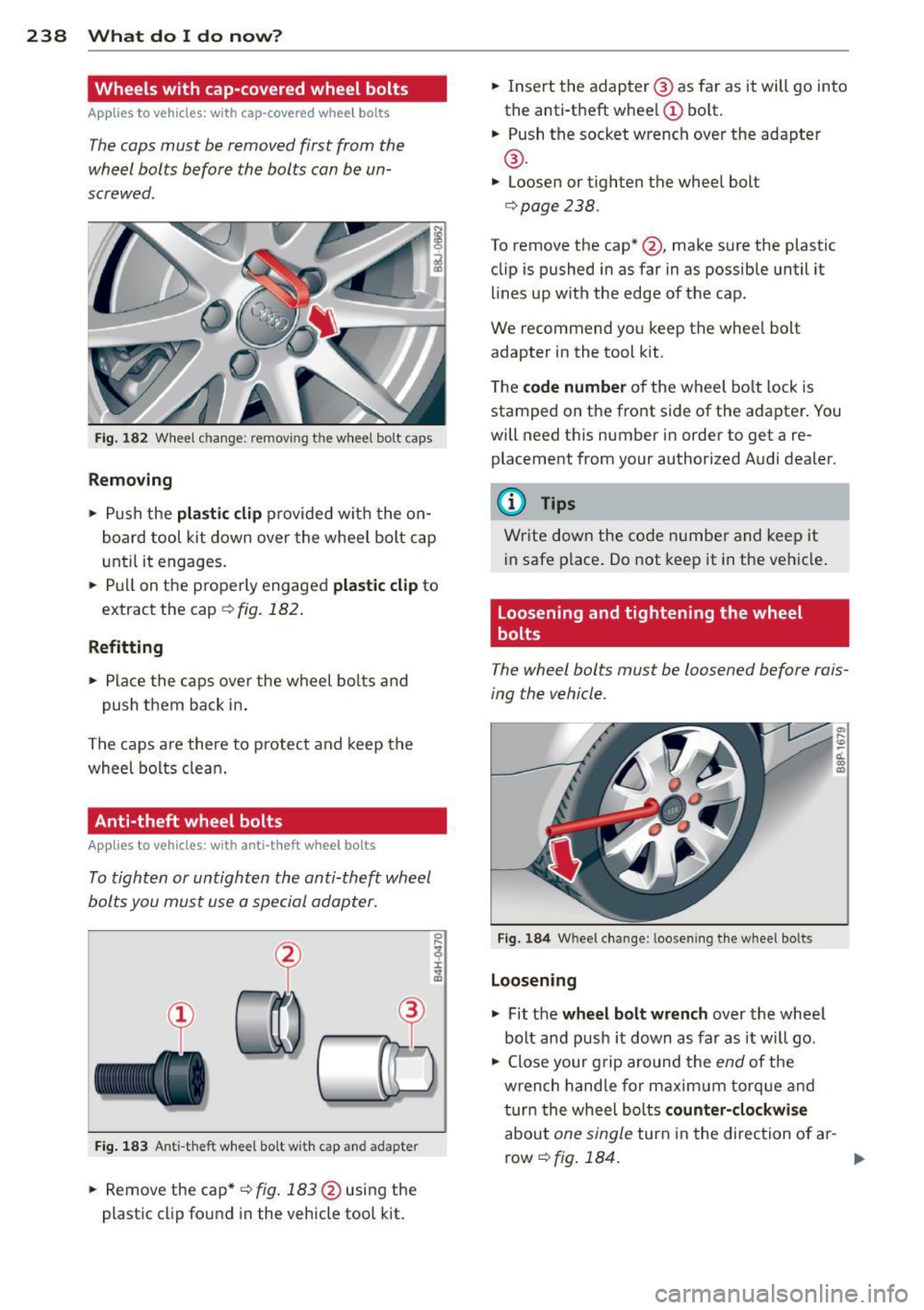
The caps must be removed first from the
wheel bolts before the bolts can be un
screwed.
Fig. 182 Whee l change : removing the wheel bo lt caps
Removing
.,. Push the plastic clip provided w ith the on
board tool kit down over the wheel bolt cap
u nt il it engages .
.. Pull on the properly engaged
plastic clip to
extract the cap
¢ fig. 182 .
Refitting
.. Place the caps over the wheel bolts and
push them back in .
The caps are there to p rotect and keep the
wheel bolts clean.
Anti-theft wheel bolts
Applies to vehicles : wit h ant i-t heft wheel bo lts
To tighten or untighten the anti-theft wheel
bolts you must use a special adapter.
(~
'
Fig. 183 Anti-theft w hee l bo lt w it h cap and adapter
.. Remove the cap* ¢fig. 183 @using the
plastic clip found in the vehicle tool kit. ..
Insert the adapter @ as far as it will go into
the anti -theft wheel
CD bolt.
.. Push the socket wrench over the adapter
@ .
.. Loosen or tighten the wheel bolt
¢page 238.
To remove the cap* @, make sure the plastic
clip is pushed in as far in as possible until it
lines up with the edge of the cap .
We recommend you keep the whee l bolt
adapter in the tool kit.
T he
code number of the wheel bolt lock is
stamped on the front side of the adapter . You
will need this number in order to get a re placement from your authorized A udi dealer.
Q) Tips
Write down the code number and keep it
in safe place. Do not keep it in the vehicle.
Loosening and tightening the wheel
bolts
The wheel bolts must be loosened before rais
ing the vehicle.
Fig. 184 W hee l change : loosen ing the wheel bolts
Loosening
.,. Fit the wheel bolt wrench over the wheel
bolt and push it down as far as it will go .
"' ...
.,. Close your g rip around the end of the
w rench handle for maximum torque and
turn the wheel bolts
counter-clockwise
about one single turn in the direction of ar-
row ¢
fig. 184. .,.
Page 241 of 280
Tightening
• Fit the wh eel b olt wren ch over t he wheel
bolt and push it down as far as it will go .
• Close your gr ip aro und the
end of the
wrench handle for maximum torque and
turn each whee l bolt
cl ock wise until it sits
tight.
A WARNING
- Us ing force without control to speed the
wheel change up can cause the veh icle to
slip off the jack and cause serious pe r
sonal inj uries.
- Do not loosen the wheel bolts more than
one turn
before you ra ise the veh icle with
the jack. -Risk of inj ury!
@ Tips
- Never t ry and use the hexagonal socket
i n the handle of the screwdriver to loos
en o r tighten the wheel bolts .
- If a wheel bolt sits very t ight, you may
find it easie r to loosen by carefully push
i ng down on the end of the whee l bolt
wre nch w ith
one foot only. As you do,
ho ld on to the ca r to keep yourse lf stable
and ta ke care not to slip .
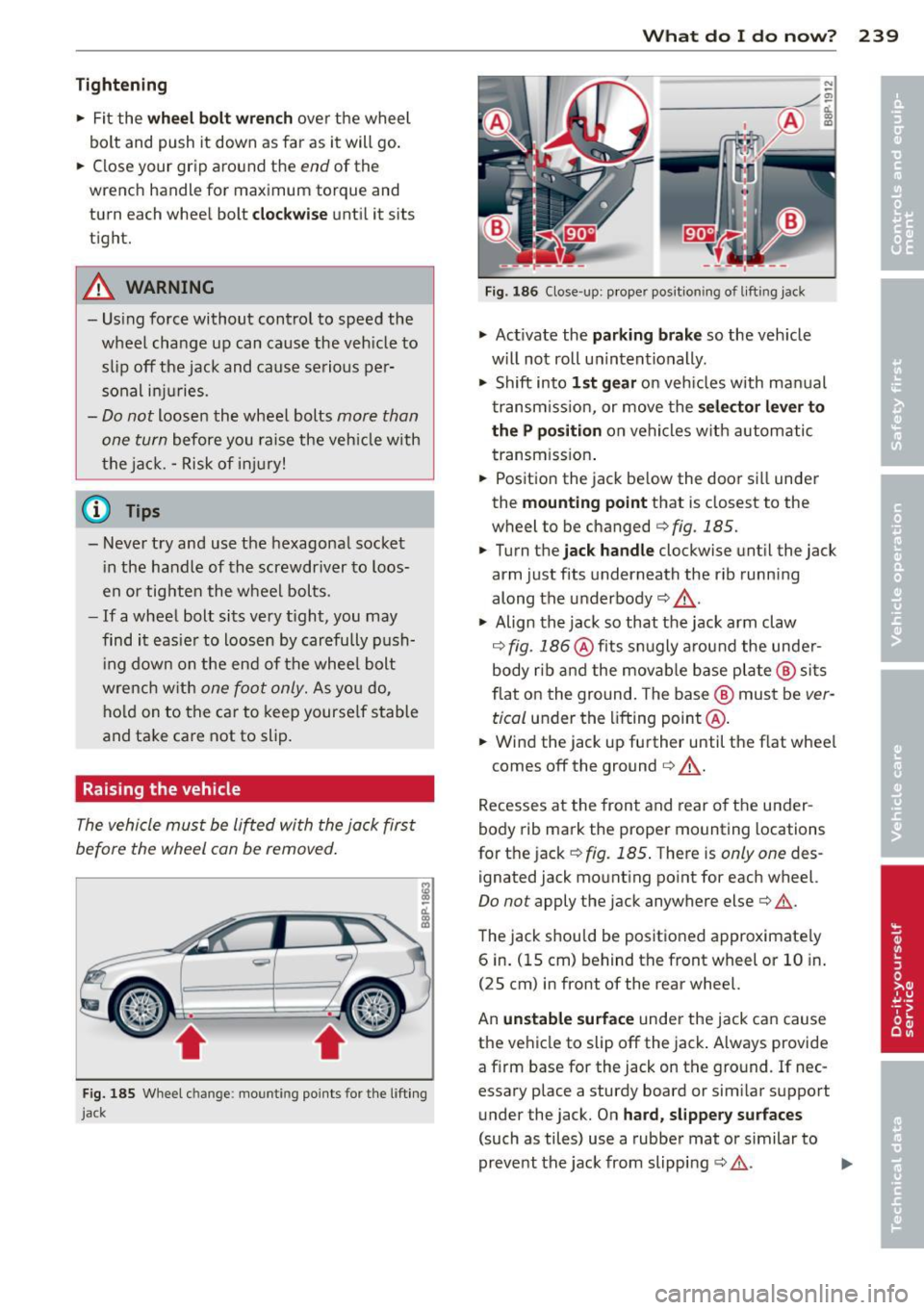
Raising the vehicle
The vehicle must be li~ed with the jack first
before the wheel can be removed .
Fig. 185 W heel c hange: mo untin g po ints for the lift ing
j ac k
What do I d o now ? 239
Fig. 1 86 Close -up: p roper pos ition ing o f lift in g jack
• Act ivate the parking brak e so the vehicle
w il l not roll u nintentionally .
• Shift into
1st gear on vehicles with manual
transm iss ion, or move the
se lecto r l ev e r to
the P p ositio n
on vehicles with automatic
transm ission .
• Pos it ion the jack be low the door sill under
the
mounting point that is closest to the
wheel to be changed
r=> fig. 185.
• Turn the jack handle clockwise unt il the jack
arm just fits underneath the rib running
along the underbody
c::> & ..
• Align the jack so that the jack arm claw
c:;, fig. 186 @fits snugly around the unde r
body rib and the movab le base plate ® sits
flat on the ground. The base @ must be
ver
tical
under the lifting point @.
• Wind the jack up further until the flat wheel
comes off the ground
c::> . & ..
Recesses at the front and rear of the under
body rib mark the proper mo unting locations
for the jack
c:;, fig. 185 . There is only one des
ignated jack mounting po int for each wheel.
Do not apply the jack anywhere else c::> .&. .
The jack shou ld be positioned approximate ly
6 in. (15 cm) behind the front wheel or 10 in.
(25 cm) in front of the rear wheel.
An
unstable surfa ce under the jack can cause
the vehicle to slip off the jack . Always provide
a firm base for the jack on the ground . If nec
essary place a sturdy board or sim ilar support
under the jack. On
hard , slipper y su rf a ces
(such as tiles) use a rubber mat or similar to
prevent the jack from slipp ing
c::> .&. . .,.
Page 242 of 280

240 What do I do now?
& WARNING
-You or your passengers could be injured
while changing a wheel if you do not fol
low safety precautions:
- Mounting the jack under the vehicle at
any other place than indicated above
may damage the vehicle or may result
in personal injuries .
- A soft or unstable surface under the
jack may cause the vehicle to slip off
the jack. Always provide a firm base for
the jack on the ground . If necessary,
use a sturdy board under the jack.
- On hard, slippery surface (such as tiles)
use a rubber mat or similar to prevent
the jack from slipping .
- To help prevent injury to yourself and
your passengers:
- Do not raise the vehicle until you a re
sure the jack is securely engaged.
- Passengers must not remain in the ve
hicle when it is jacked up.
- Make sure that passengers wait in a
safe place away from the vehicle and
well away from the roadway and traffic.
- Make sure jack position is correct , ad
just as necessary and then continue to
raise the jack.
Taking the wheel off/putting the spare
on
Follow these instructions step-by-step for
changing the wheel
Fig. 187 Wheel c han ge: using the sc rewdrive r handle
(w ith the blade removed) to turn the bolts
... ,._
"' i
"'
Fig. 188 W hee l change : alignmen t pin inside the top
hol e
M ,._
"' d. 00
"'
After you have loosened all wheel bolts and
jacked the vehicle off the ground, perform the
following steps to remove and replace the
wheel:
Removing the wheel
.,. Use the hexagonal socket in the screwdriv·
er handle
to completely turn out the top
most wheel bolt and set it aside on a
clean
surface c;, fig. 187 .
.,. Screw the threaded end of the alignment
pin from the tool kit hand-tight into the
now vacant bolt hole <=>
fig. 188 .
.,. Then completely unscrew the other wheel
bolts as described above.
.,. Take off the wheel leaving the alignment
pin in the bolt hole
c;, &,.
Putting on the spare
.,. Lift the spare wheel up and carefully slide it
over the alignment pin to guide it in place .
.,. Use the hexagonal socket in the screwdriver
handle to screw in and tighten all wheel
bolts
slightly .
.,. Unscrew the alignment pin and insert and
tighten the remaining wheel bolt slightly
like the rest.
.,. Turn the handle on the jack counter-clock
wise to lower the vehicle until the jack is
fully released .
.,. Use the wheel bolt wrench to tighten all
wheel bolts firmly
r:::;, page 238 . Tighten
them
crosswise , from one bolt to the (ap
proximately) opposite one, to keep the
wheel centered.
Page 246 of 280
244 Fuses and bulbs
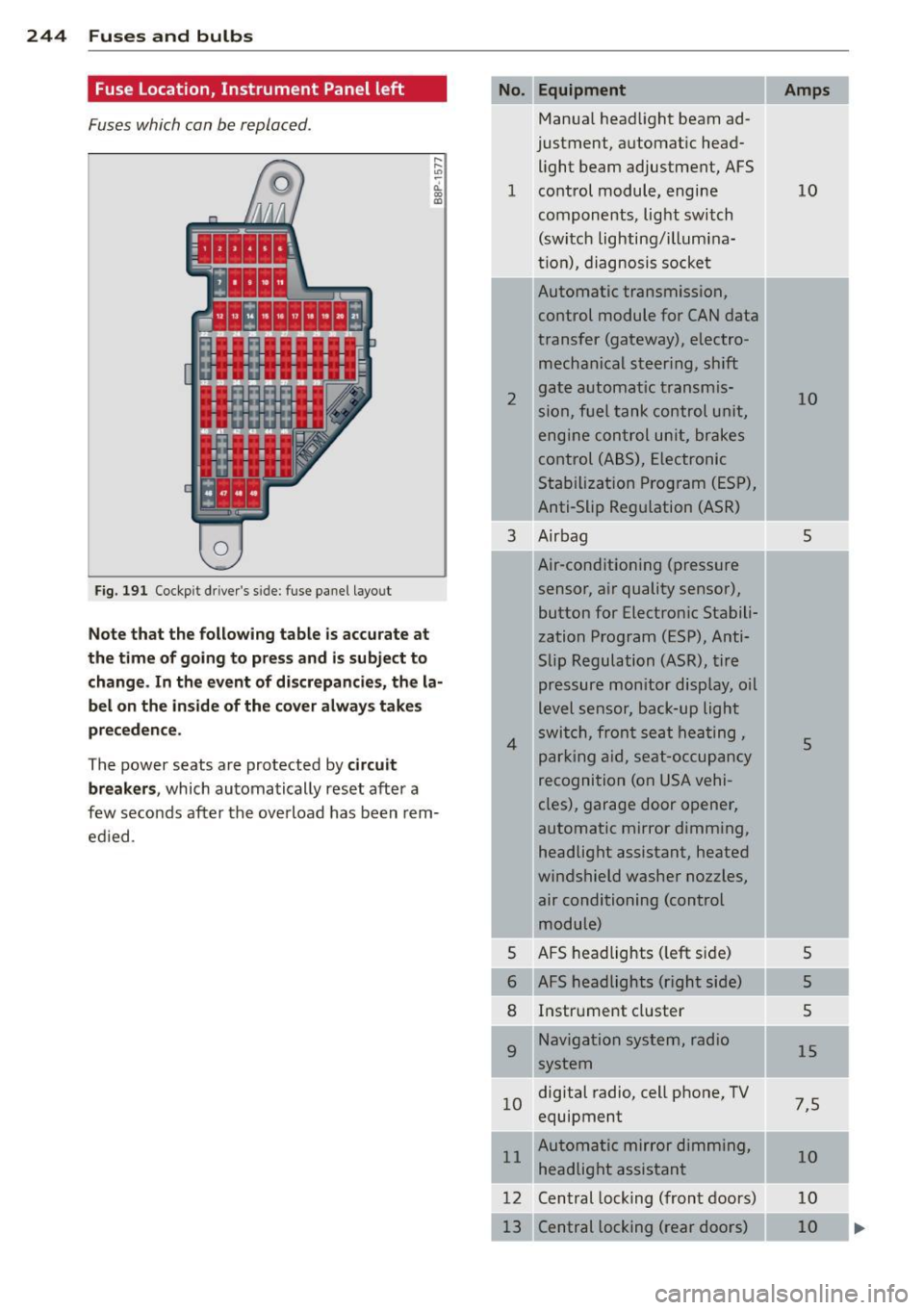
Fuse Location, Instrument Panel left
Fuses which can be replaced.
Fig. 191 Cockp it driver 's s ide: fuse pane l layout
Note that the following table is accurate at
the time of going to pr ess and i s subject to
change . In the event of d iscrepancies, the la
bel on the in side of the cover always take s
pr eceden ce .
The power seats are protected by circuit
break ers,
which automatically reset after a
few seconds after the ove rload has been rem
ed ied .
Equipment
Manua l head light beam ad
justment, a utomat ic head
light beam adjustment, AFS
1 co ntrol m odule, engine
components, light switch
(switch lighting/illumina
ti on), diagnosis socke t
2
3
4
5
6
8
9
Automatic transmission,
control module for CAN data
transfer (gateway), electro
mechanical steering, shift
gate automatic transmis
sion, fuel tank control unit,
engine control unit, brakes
control (A BS), Electronic
Stabili zation Program (ESP) ,
Anti-Slip Regulation (ASR)
Air bag
Air-conditioning (pressure
sensor, air quality sensor), button for Electronic Stabili
zation Program (ESP), Anti
Slip Regulat ion
(ASR), tire
pressure monitor display, oil
level senso r, back-up ligh t
s w itch, front se at he ati ng ,
p ark ing aid, sea t-occupancy
recognition (on USA vehi
cles), garage door opener,
automa tic mirror dimming,
headlight assistant, heated
windshield washer nozzles, air conditioning (control
module)
AFS headlights ( left si de)
AFS headlights (right side) Instr ument cluster
Navigation system, radio
system
1 0 digital
radio, cell phone, TV
equipment
11 Automatic mirror dimming,
headlight assistant
12 Central lock ing (front doors)
Central locking ( rear doors)
Amps
10
10
5
5
5
5
5
15
7 ,5
10
10
10
Page 247 of 280
No. Equ ipment
Electronic Stabilization Pro-
14
gram (ESP) (control mod-
u le), shift gate automatic
transmission
15 Interior lights, reading
lights
Diagnostic connector, rain
sensor, air conditioning
16 (control module), t
ire pres-
sure monitor d isplay (con-
trol module)
I 17
Anti-theft alarm warning
system
18 D iagnose Starter
19 All Wheel D rive
20 Audi magnetic ride
Blower fan
23
Driver's
side power window,
front
24 Power outlet front
2S Rear window defogger
26 Power outlet in luggage
compartment
27 Fuel tank control module,
fuel pump
28 Power window, rear
33 Slidi ng/pop-up roof
36 Lumbar support
37 Heated sea ts, front
1 38
Passenger side power win-
dow, front
39 Specia l func tion interface
40 Starter
41 Rear window wiper
43 Body control module
47
Ce ll phone package (V OA in-
terface)
Automatic circuit breakers:
10
10
10
5
5
10
40
30
20
30
20
15
30
20 10
20
30
5
40
15
20 5
The electri c power w in dows and the e lectr ic
seat adjusters are pro tected with circu it
breake rs which reset automatically after the
circuit overload has been corrected.
Fu se s and bulb s 245
@ Tips
-Whenever rep lacing a fuse, always con
sult the sticker on the inside of the f use
pane l cover. It contains the most up-to
date information regarding the fuse ar
rangement. If in doubt, ask your author
ized Aud i Service adviso r.
- Some of the equipment items listed are
opt ional or only available on certa in
mode l configurations.
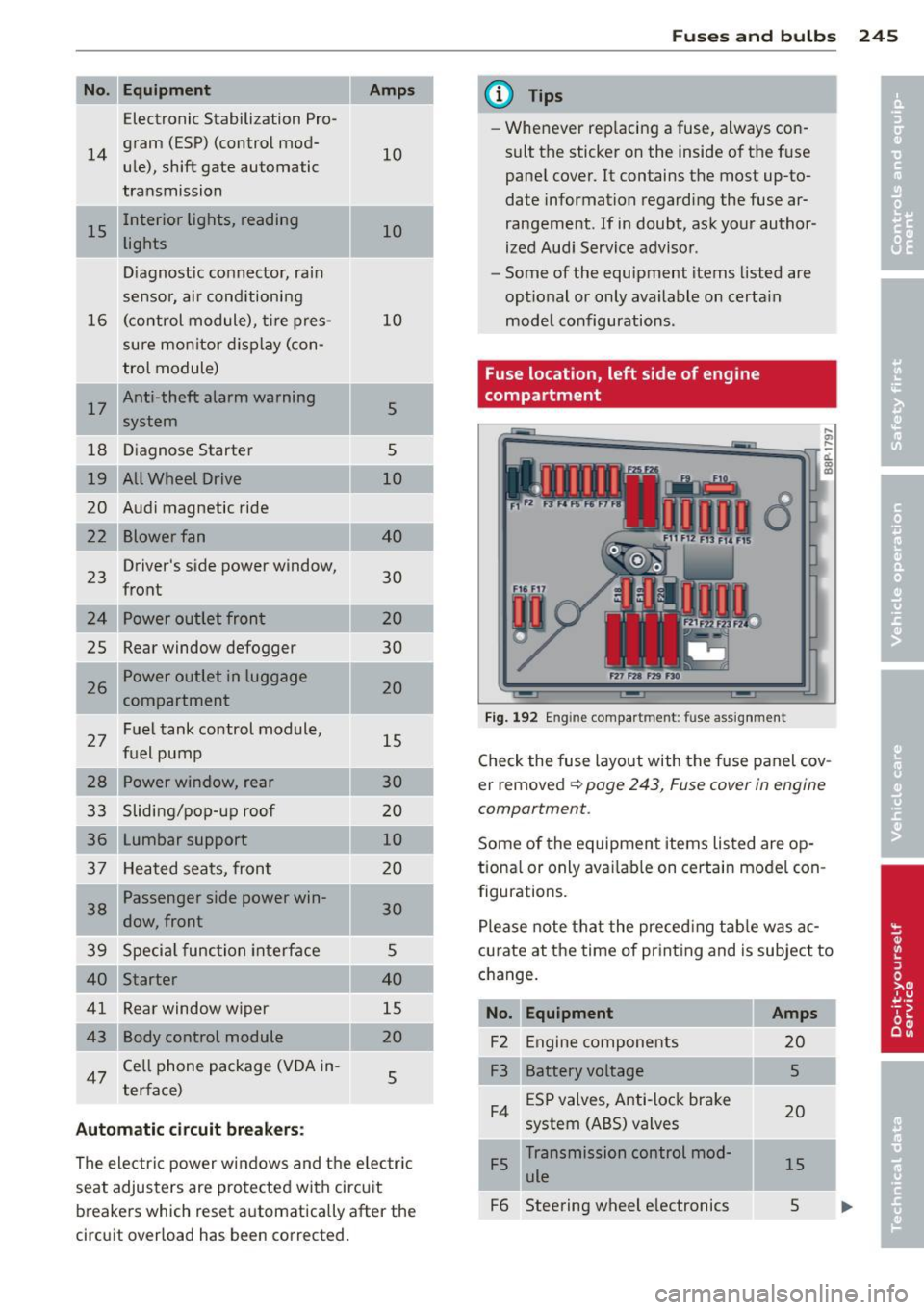
Fuse location, left side of engine
compartment
Fig . 192 En gine compar tment : fuse assig nment
,._
-d. a, a>
Check the fuse layout with the f use panel cov
er removed
¢ page 243, Fuse cover in engine
comportment.
Some of the equipmen t items listed are op
tiona l or only ava ilab le on certain model con
figurations.
Please note tha t the preced ing tab le was ac
c u rate at the time of pr int ing and is subject to
c h ange.
No. Equipment
F2 Engine compone nts
F3 Battery voltage ESP valves, Anti-lock brake
F4 system (ABS) valves
Transmission control mod
F5 ule
F6 Steering wheel e lectronics
Amps
20
5
20
15
s