lock AUDI A3 2012 Owner´s Manual
[x] Cancel search | Manufacturer: AUDI, Model Year: 2012, Model line: A3, Model: AUDI A3 2012Pages: 280, PDF Size: 70.11 MB
Page 187 of 280
Natural leather
Appl ies to vehicles: with nat ura l leather
Audi makes great efforts to maintain the
properties , natural look and feel of interior
leather .
General
We offer many different types of leather on
our veh icles. Most are different types of nappa
leather, which has a smooth surface and
comes in var ious colors .
The intensity of the color determines the v isu
al characteristics and appearance. If the sur
face of the leather has a typical natural look,
then the leather is a nappa leather that has been left in a relatively nat ural condition . This
l eather offers pa rticularly good comfo rt and
breathes well. Fine ve ins, closed g rains, i nsect
b ites, skin folds, and subtle variations in color
remain visib le. These characteristics demon
strate that the materia l is natural.
Natural nappa leather is not covered by a col
or finish .
It is therefore more sensitive to soil
ing and wear, which is something you need to
consider if chi ldren, animals or other factors
might prove to be particularly hard on the
leather.
By contrast, leather types that are covered by
a co lored finish layer are more durable. This
has a positive effect on the leather's resist
ance to wear and soiling in daily use. On the
other hand, the typical characterist ics of natu
ral leather a re barely or not apparent . Howev
er, this does not mean that the leather itself
i s of infer ior quality.
Care and handling
Because of the exclusive nature of the types of
leather that Audi uses and the ir unique prop
erties (such as sensitivity to o ils, grease, so il
in g, etc.), you will need to be somewhat care
fu l w ith these leathers, and a certain type of
care is required. For examp le, da rk cloth ing
materials can d iscolor leather seats (especial
l y i f such clothing is damp and was not dyed
correctly) . Dust and dirt particles in pores,
fo lds, and seams can have an abrasive effect
Cleaning and protec tion 185
and can damage the leather surface as we ll as
weaken seams.
T he lea ther should be cleaned regularly as
needed. After hav ing been used for a relat ive ly
long time, your leather seats will acq uir e a
rich aged finish . This is a characteristic of nat
ural leather and a sign of true quality.
In order to maintain the val ue of this natural
product over the li fe of your vehicle, you
sho uld follow the recommendations below:
(D Note
- T o keep your lea ther from b leach ing out,
do not allow it to be exposed to bright
sunlight for long periods of time . If you
have to leave the ve hicle parked outside
for long per iods, cover the leather to
protect it from direct exposure to sun
light.
- Sharp objects on clothing, such as zip
pers, rivets or sharp pieces on belts can
leave permanent scratches or scrape
marks on the surface of the leather.
(D Tips
-After each time you clean the leather and
at regular intervals, use a leather preser
vative creme that contains UV-blockers and that works into the leathe r. T his
c reme w ill nour is h and mo istu rize the
lea ther, helping it to breathe and stay
supple.
It also helps to build up a protec
tive coating on the surface.
- C lean the leather every 2 - 3 mon ths,
and clean any areas that get soi led .
- Remove fresh m arks made by ballpo int
pens, ink, lipstick, shoe polish, etc. as
soon as possible .
- Preserve the color o f the leather as need
ed by using a specia l co lored leathe r care
creme to touch up areas of uneven color . •
•
Page 189 of 280

(D Note
- Never use chemical solvents (e.g . lighter
flu id, turpentine), waxes, shoe polish or
s imilar products on Alcantara ® surfaces.
- To avoid damage, have stubborn stains
removed by a commercia l cleaning spe
cialist.
- Do not use brushes, stiff sponges or sim
ilarly abrasive cleaning aids.
Safety belts
Only well-maintained safety belts work relia
bly when needed.
.. Keep belts clean .
.. For cleaning, use a mi ld soap and water sol
ution . Let be lts dry thoroughly and away
from direct sunlight.
.,. Do not allow inertia reel safety belts to re
tract before they are completely dry.
.,. Check the condition of your safety belts
reg
ularly .
Heavily soiled safety belts may not retract
properly .
A WARNING
Damaged safety belts can break in a crash.
- Anything that might damage your safety
belts could mean that you and your pas
sengers wou ld not be adequately pro
tected in an acc ident.
- Safety belt performance depends on cor
rect installation. Never remove belts
from the vehicle to clean them.
- Do not use chemical cleaning agents,
bleach o r dyes. They have corros ive prop
erties whi ch weaken the webbing.
- When cleaning your safety belts, inspect
them for damage.
If you discover dam
age, see your a uthorized Audi dea ler.
- Always read and heed all WARN INGS and
other information
Q page 178.
l ) Use o nly the correct cleaning sol utions. Neve r use gas
oline or d iese l fuel.
Cleaning and protec tion
Engine compartment
Be especially careful when cleaning the en
gine compartment.
A lw ays switch o ff the ign it ion before cle an
i ng the eng ine
c> ,& .
Plenum pan el
Remove leaves from the plenum panel in front
of the windshield under the engine hood. This
prevents the water drain holes from becoming
blocked, and it prevents debris from enter ing
the vehicle interior through the heating and
vent ilat ion ducts.
Co rro sio n protect ion
The engine compartment and transmission
have been corrosion-protected at the factory.
Good anti -corrosion treatment is very impor
tant, partic ularly in the winter.
If the vehicle
is frequently driven on salt treated roads, the
entire engine compartment and p lenum panel
should be thoroughly cleaned at the end of
winter and retreated to prevent salt damage.
At the same time, the underside of the vehicle
shou ld be washed as well.
If the engine compartment is cleaned at any
time with grease remov ing solutions
1> , or if
you have the engine washed, the anti-corro
s ion treatment is almost always removed as
well.
It i s therefo re essentia l to have a long
lasti ng cor rosion pro tect ion reapplied to all
surfaces, seams, joints and components in the
engine compartment .
A WARNING
Be aware: The engine compartment of any
motor vehicle is a potentially hazardous
area.
- Before work ing in the engine compart
ment, be sure to read the information
c>page 194.
- Before reaching into the front plenum
panel, a lways remove the ignit ion key.
187
•
•
Page 193 of 280
Winter operation
At temperatures below 20° F (-7° C), Diesel
fuel No.
2 loses its fluidity due to wax separa
tion, which may clog the fuel filter or tank fil
ter and keep the engine from running .
To help the filter from being clogged by wax,
the fuel filter in your vehicle is automatically
preheated. Preheating the fuel filter makes
operation of your vehicle possible with Diesel
fuel No . 2 down to -10° F (-24° C).
If you expect temperatures below
5° F
(-15° C)
ask your fuel dealer whether their
Diese l fuel No.
2 is sufficiently winterized for
the prevailing and expected temperatures.
If not winterized or insufficiently winterized
d iesel fue l has already thickened to the extent
that the engine will not start, warm the vehi
cle up by leaving it in a heated garage.
It is normal that the engine noise leve l (die
seling) is louder during the warm-up period in
winter.
It is also norma l when whitish-blue
smoke comes out of the tailpipe after start ing
and during warm-up . The amount of smoke
depends on the outs ide temperature.
Do not let your diesel engine idle unnecessari
ly after a cold start. Driving off slowly will
shorten the warm-up period .
A WARNING
-Never use "starting assist fluids." They
may be potent ially explosive or cause a
"run-away" engine condition. This could
result in serious engine damage and per
sonal injury.
- Never use fuel line anti-freeze offered for
gasoline engines .
0 Note
- Your diesel engine has been specifically
designed to operate only on Ultra Low
Sulfur Diesel fuel. Therefore, never use
home heating oil or regular gasol ine. Th e
properties of these fuels may cause seri
ous damage to the fuel injection system
and to the engine. Using these fuels can
-
Fuel supply and filling your fuel tank 191
cause expensive engine repai rs and will
also adversely affect your New Vehicle
Limited Warranty.
- If diesel fuel should get on any rubber
hose, it must be wiped off immediately.
Then wash the contaminated hose por
tion with soap and warm water. Do not
allow diesel fuel to remain on connecting
hoses. They may develop leaks and cause
ser ious damage.
Fuel tank
Fuel filler neck
The fuel filler neck is located on the right rear
side panel behind the fuel filler flap.
If the power locking system should fail, you
can still open the flap manually -for detailed
instructions see
¢ page 193.
You can find the fuel tank capacity of your ve
hicle in
Technical Data ¢page 257 .
The labe l on the inside of the fuel fi ller flap
tells you the correct fuel for your vehicle. For
more information about fuel specifications,
see
¢ page 189.
Your vehicle fuel tank has an on-board refuel
ling vapor recovery system. This feature helps
to prevent fuel vapors from escaping from the
tank and polluting the environment while you refue l your vehicle. In order to fi ll the tank
properly while protecting the environment,
please follow this refueling procedure careful
ly.
A WARNING
Under normal operating conditions, never
carry addit ional fuel conta iners in your car .
Gas canisters and other containers used to
transport fuel can be dangerous. Such con
tainers, full or empty, may leak and could
cause a fire in a collision. If you must
transport fuel to use for your lawn mower,
snow b lower, etc., be very careful and al
ways observe loca l and state laws regard
ing the use, transportation and storage of
such fuel containers. Make certain the
~
•
•
Page 194 of 280

192 Fuel suppl y and filli ng your fuel t ank
container meets industry standards (ANSI/
ASTM F852 -86) .
(D Note
Never drive yo ur vehicle until the fuel tank
is completely dry . The irregular s upply of
fue l can cause misfiring. Gasoline cou ld
enter into the exhaust system and damage
the catalytic converter.
Refuelling
The fuel filler flap is unlocked from a button
in the driver 's door .
Fig. 152 Driver 's door: Un lock ing fuel filler flap
Fig. 153 F u el cap hooked on the opened fuel filler flap
When adding fuel, the ignition and any cellu
lar phones in the vehicle must be sw itched
off.
Tak ing th e fuel cap off
.. To open the fuel filler flap, pull the button
¢fig . 152 .
.. Unscrew fuel filler cap counter-clockwise
and hang it on the fuel filler flap¢
fig. 153 .
.. Check the label on the inside of the fuel fi ll
er flap to determine if the vehicle must be
fueled with gasoline or diesel fuel.
Refuell ing proc edur e
.. Insert the f uel nozzle from the gasoline
pump into the fuel fi ller neck as far as it wi ll
go .
.. Select a medium refuelling rate
so that the
nozzle switches off automatically when the
tank is full.
Putting th e fu el cap ba ck on
.. After fi lling your tank, twist the fuel filler
cap clockwise until you hear a definite click.
.. Close the fue l filler flap.
T o avoid fuel spilling or evaporating from the
fuel tank always close fuel filler cap properly
and completely. An improperly closed fuel fill
er cap may also cause a message in the driver
information system or cause the MIL lamp
¢page 24 to come on.
A WARNING
-Improper refue ling or handling of fuel can
cause fire, explosion and severe burns.
- Fue l is highly flammable and can cause
severe burns and other injur ies.
- Failure to shut the engine off while refu
eling and/or to insert the pump nozzle
ful ly into the fuel filler neck could cause
fue l to spray out of filler neck or to ove r
f low. Fue l spray and overflowing fue l can
cause a fire .
- Never use a ce ll ular telephone while re
fue ling. The electromagnet ic rad iation
can cause sparks that can ignite fuel va
pors and cause a fire.
- Never get back in to yo ur vehicle whi le re
fue ling. If in exceptional circ umstances
you must get back in your vehicle while
ref ueling, make certain that you close
the door and touch metal to discharge
static electricity before touching the fill
er nozzle again . Static e lectr icity can
cause sparks that can ignite fuel vapors
re leased du ring ref uel ing .
- Never smoke or have an open flame any
where in or near your veh icle when refu-
eling or fi lling a portab le fue l conta iner . ..,_
Page 195 of 280
-For your safety, we strongly recommend
that you do not travel with a portable
fuel container in your vehicle. The con
tainer, full or empty may leak and could
cause a fire, especially in a crash.
- If, under exceptional circumstances, you
must transport a portable fuel container
'
please observe the following:
- Never fill a portable fuel container
while it is anywhere in or on the vehicle (for example, in the luggage compart
ment, or on the trunk) . Static electrici
ty can build up while filling and can ig
nite fuel vapors causing a fire.
- Always place a portable fuel container
on the ground before filling .
-Always keep the filler nozzle complete ly inside the portable container before
and during filling.
- If filling a portable container made of metal, the filler nozzle must always be
in contact with the container. This will
help prevent static electricity from dis
charging and cause a fire.
- Never spill fuel inside the vehicle or
luggage compartment. Fuel vapors are
highly flammable.
- Always observe local and state/provin
cial laws regarding the use, storage
and transportation of fuel containers.
- Make certain the fuel container meets
industry standards (ANSI/ ASTM
F852-86).
(D Note
- If any fuel has spilled onto the car, it should be removed immediately to pre
vent damage to the paint.
- If the fuel tank runs completely empty in
a vehicle with a
diesel engine, the igni
tion must remain switched on for at least 30 seconds after refueling before
starting the engine.
It may take longer
than usual for the engine to start, even
up to a minute. This is because the air
must first bleed out of the fuel system
when starting the engine.
Fuel supply and filling your fuel tank 193
@) For the sake of the environment
As soon as the correctly operated nozzle
switches off automatically for the first
time, the tank is full. Do not try to add
more fuel because fuel may spill out. In
addition, the expansion space in the fuel
tank will be filled -causing the fuel to
overflow when it becomes warm and pol
lute the environment.
(0 Tips
-Running your engine while refuelling
may cause vapors to escape or even fuel
to spill out of the tank. This would then
shut off the fuel nozzle before the tank
is full.
- Do not refuel your vehicle with the igni
tion switched on. The fuel gauge may
otherwise not indicate the correct fuel
level after refuelling.
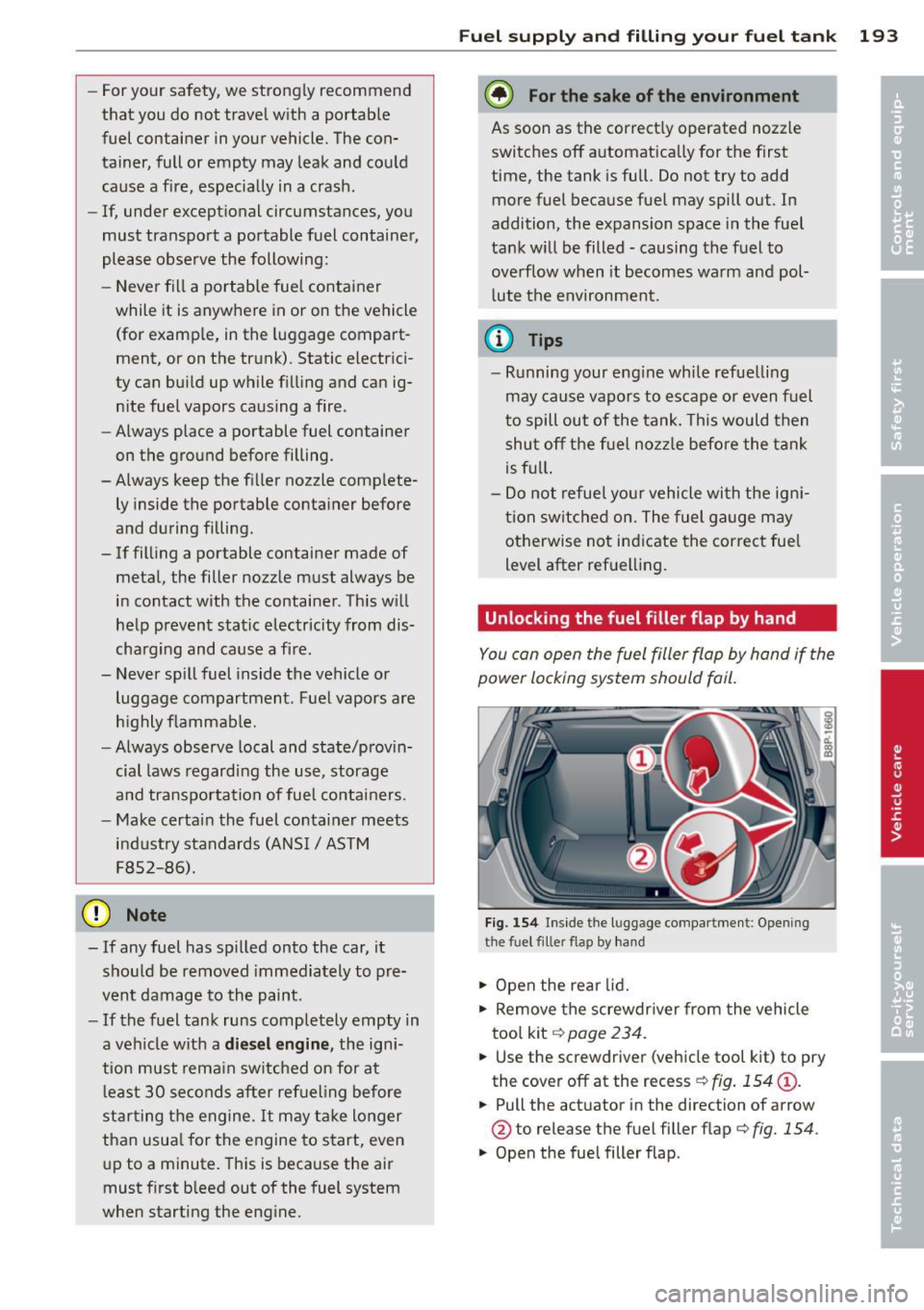
Unlocking the fuel filler flap by hand
You can open the fuel filler flap by hand if the
power locking system should fail.
Fig. 154 Inside the luggage compartment : Openi ng
the fuel fi lier flap
by hand
.,. Open the rear lid.
.,. Remove the screwdriver from the vehicle
tool kit
¢ page 234.
.,. Use the screwdriver (vehicle tool kit) to pry
the cover off at the recess
¢ fig. 154 (D .
.,. Pull the actuator in the direction of arrow
@ to release the fuel filler flap¢
fig. 154.
.,. Open the fuel filler flap .
Page 196 of 280
194 Checking and filling
Checking and filling
Engine hood
Releasing the engine hood
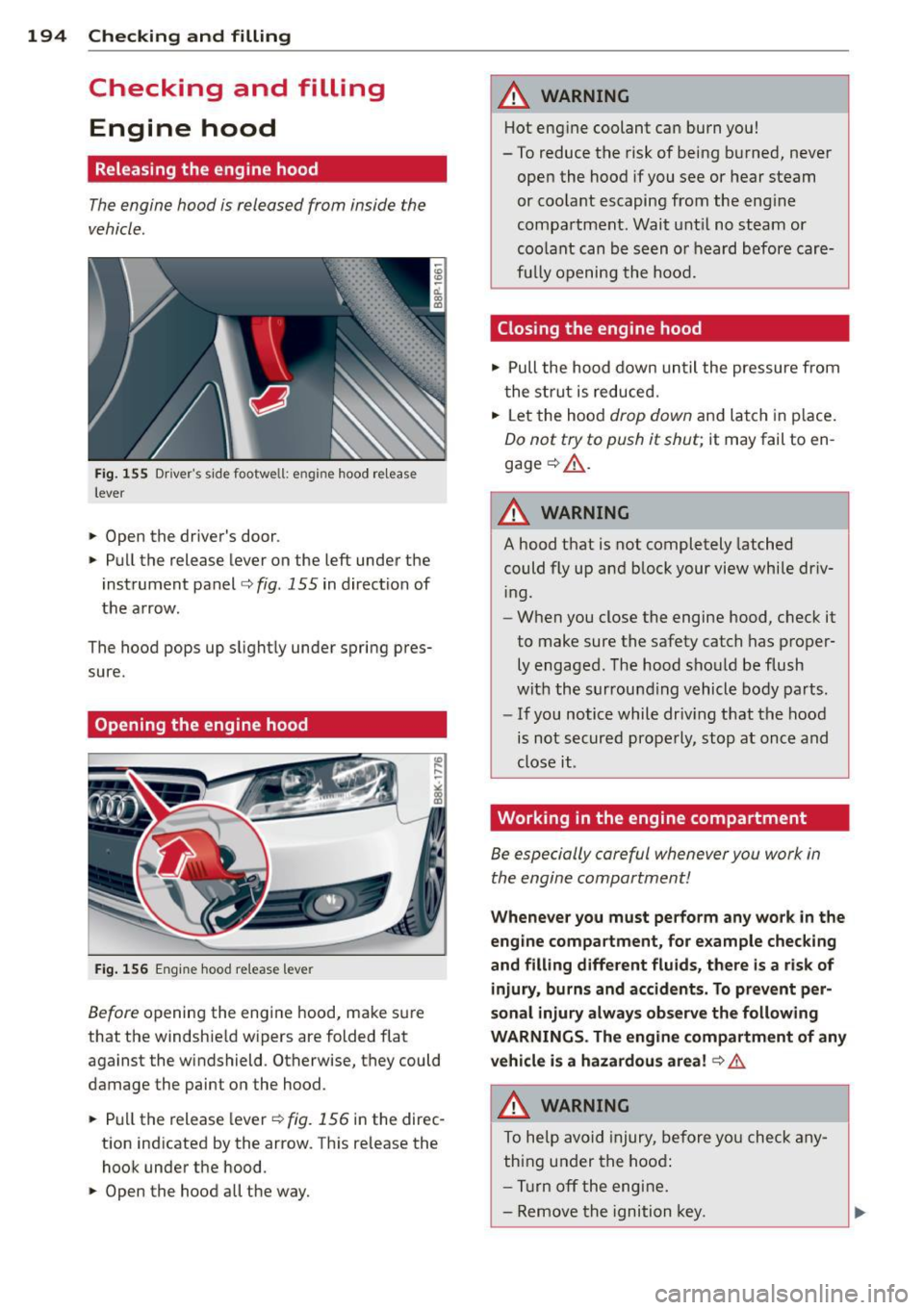
The engine hood is released from inside the
vehicle .
Fig. 155 Driver' s side footwe ll: e ngin e hood release
lever
.. Open the driver's door.
.. Pull the release lever on the left under the
instrument panel
c> fig . 155 in direction of
the a rrow .
The hood pops up slight ly under spring pres
sure.
Opening the engine hood
Fig . 156 Engine hood releas e le ve r
Before opening the eng ine hood, make sure
that the windshie ld wipers are folded flat
against the windshield . Otherwise, they could
damage the paint on the hood.
.. Pull the release lever
r=;,fig . 156 in the direc
tion indicated by the arrow . This release the
hook under the hood .
.. Open the hood all the way.
A WARNING
-Hot engine coolant can burn you!
- To reduce the risk of being burned, never
open the hood if you see or hear steam
or coo lant escaping from the eng ine
compartment . Wait unt il no steam or
coolant can be seen or heard before care
fu lly opening the hood.
Closing the engine hood
.. Pull the hood down until the pressure from
the strut is reduced .
.. Let the hood
drop down and latch in p lace.
Do not try to push it shut; it may fail to en
gage
c> .&, .
A WARNING
--
A hood that is not completely latched
could fly up and b lock your view while dr iv
i ng.
- When you close the engine hood, check it
to make sure the safety catch has properly engaged . The hood shou ld be flush
with the surrounding vehicle body parts.
- If you notice while dr iv ing that the hood
is not secured properly, stop at once and
close it .
Working in the engine compartment
Be especially careful whenever you work in
the engine compartment!
Whene ve r you must pe rform any wo rk in the
eng ine compartment, for e xample chec king
and filling differ ent fluid s, the re i s a risk of
injury , burns and accident s. T o pr event p er
s onal injury alwa ys observe the foll owing
WARNING S. Th e engin e c ompartm ent of an y
v e hicl e is a hazardou s area!
r=;, .&.
A WARNING
To help avoid injury, before yo u check any
thing under the hood:
- Turn off the engine .
- Remove the ignition key.
Page 206 of 280
204 Checking and filling
Checking the engine coolant level
The engine coolant level can be checked with
a quick glance .
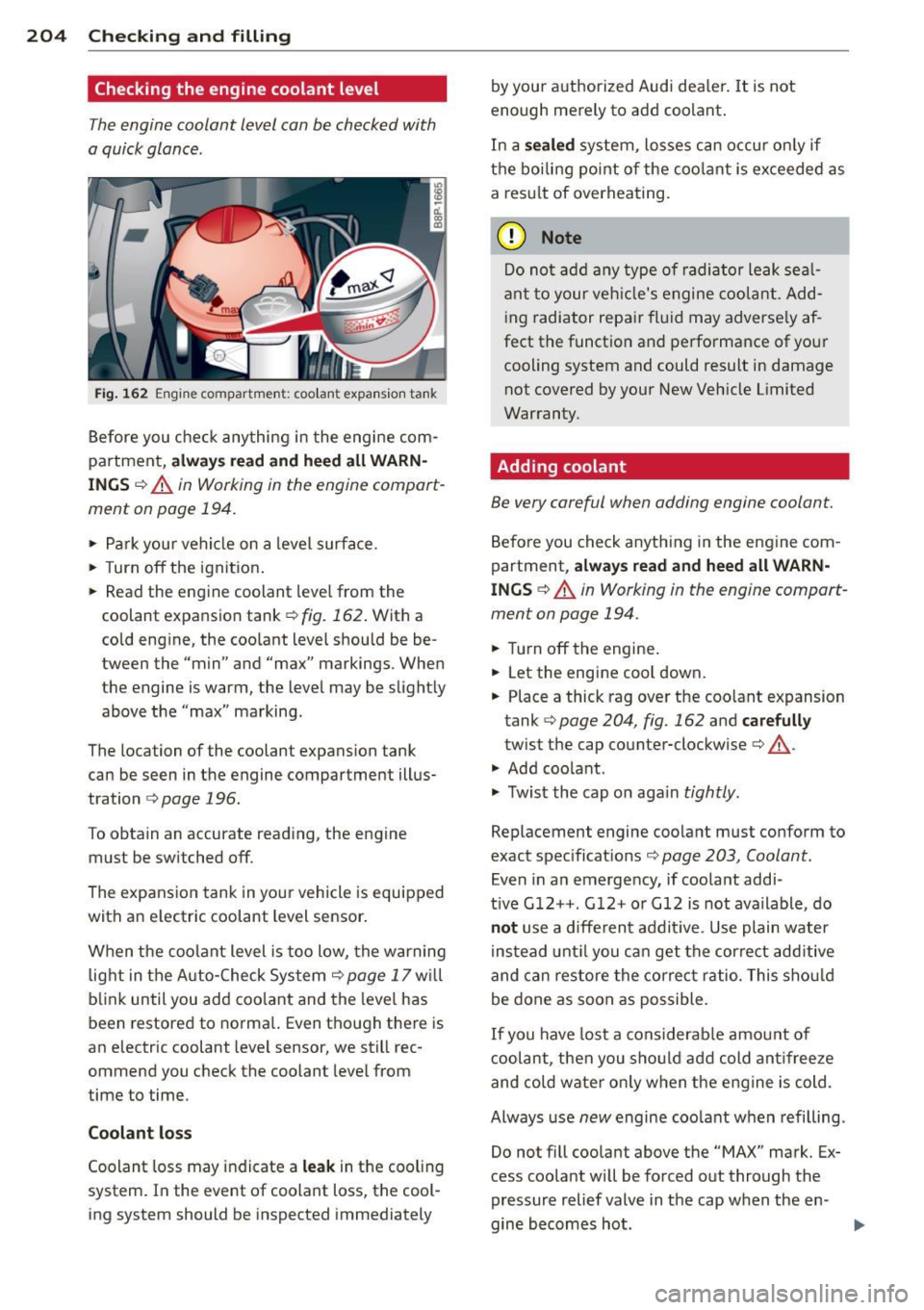
Fig. 162 Engine compartme nt: coo lant expansio n tank
Before you check anything i n the eng ine com
partment,
a lw ays rea d and h eed all WARN
ING S ¢&. in Working in the engine compart
ment on page 194.
.. Park your vehicle on a level surface.
.. Turn
off the ignit ion .
.. Read the eng ine coolant leve l from the
coolant expansion tank<=>
fig. 162 . With a
cold eng ine, the coo lant level should be be
tween the "min" and "max" markings . When
the engine is warm, the level may be slightly above the "max" marking.
The location of the coolant expansion tank
can be seen in the engine compartment illus
tration
i:> page 196.
To obtain an accurate read ing, the engine
must be switched
off.
The expansion tank in yo ur vehicle is equipped
with an e lectric coolant level sensor .
When the coolant level is too low, the warning light in the Auto -Check System
c> page 17 w ill
blink until you add coo lant and the level has
been restored to norma l. Even though there is
an electric coolant level sensor, we still rec
ommend you check the coolant level from
time to time.
Coolant lo ss
Coolant loss may indicate a le ak in the cooling
system . In the event of coolant loss, the cool
ing system should be inspected immediately by your authorized Audi dea
ler .
It is not
enough merely to add coolant .
In a
se aled system, losses can occur on ly if
the boiling point of the coo lant is exceeded as
a res ult of overheating.
(D Note
Do not ad d any type of radiator leak sea l
ant to your veh icle's engine coolant . Add
i ng radiator repair fl uid may adverse ly af
fect the funct ion and performance of your
cooling system and could result in damage not covered by your New Veh icle Limited
Warranty .
Adding coolant
Be very careful when adding engine coolant.
Before you check anything in the eng ine com
partment,
a lw ays re a d and heed all WARN
INGS c::> A in Working in the engine compart
ment on page 194 .
.. Turn off the engine .
.. Let the engine cool down.
.. Place a thick rag over the coolant expansion
tank
c::> page 204, fig . 162 and ca refull y
twist the cap counter-clockwise c::> A.
.. Add coo lant .
.. Twist the cap on aga in
tightly .
Replacement engine coolant must conform to
exact spec ificat ions
c::> page 203, Coolant.
Even in an emergency, if coolant addi-
t ive G12++ . G 12+ or G12 is not ava ilable, do
n ot use a d iffe rent addit ive. Use plain water
instead unt il you can get the correct add itive
and can restore the correct ratio. This shou ld
be done as soon as possible .
If you have lost a considerab le amou nt of
c oolant, then you sho uld add cold ant ifree ze
and co ld wate r on ly when the engine is cold.
Always use
new engine coo lant when refilling .
Do not f ill coolant above the
"MAX" mark. Ex
cess coolant will be forced out through the
pressure relief valve in the cap when the en -
gine becomes hot .
Iii>
Page 207 of 280
& WARNING
-The cooling system is under p ress ure and
can get very hot . Reduce the risk of
sca ld ing from hot coo lant by following
these steps.
- Tur n off the engine and a llow it to cool
down.
- Protect your face, hands and arms from
escap ing flu id and steam by cover ing
the cap wi th a large, thick rag.
- Tu rn the cap slowly and very ca refully
i n a cou nte r-clockw ise d irect ion w hile
ap ply ing ligh t, downw ard press ure on
the top of the cap.
- To avo id being burned, do no t sp ill an
tifreeze o r coolan t on the exhaust sys
tem or hot engine parts. Under certa in
conditions, the ethylene glyco l in en
gine coolant can catc h fir e.
- An tifreeze is poisonous . Always store an
tifreeze in its or iginal co ntainer and we ll
o ut o f the reach of children.
- If you drain the coolant, it must be
caught and safely stored in a p roper con
tainer clearly marked "poison".
(D Note
- Coolant po llutes the env ironment and
could cause an engine fire. Excess coo l
ant wi ll be forced out throug h the pres
su re re lief va lve in the cap when the en
gine becomes hot.
- If, in an emergency, only water can be
added, the cor rect ratio between water
and antifreeze
c:> page 203 must be re
stored as soon as possib le.
@) For the sake of the environment
Drained coolant shou ld n ot be re used. Al
ways dispose of used coolant while obse rv
ing all environmental regulations.
Checkin g and fillin g 205
Radiator fan
The radiator fan switches on automatically by
itself .
The electric radiator fan is controlled by ther
moswitches t hat sw itch on a nd off depending
o n coo lant and eng ine compartment tempera
tures .
An a uxiliary electric radiator fan* sw itches on
and off depending on coolant temperature
and othe r vehicle operat io n conditions.
After switching off the eng ine, the auxiliary
fan -even with the ignition off -can continue
runn ing for up to 10 minutes. It ca n even
switch on aga in later by itself
c:> A , if
- the temperature of the engine coo lant rises
due to the heat build-up from the engine in
the engi ne compartment , or
- the engine compa rtment heats up because
the vehicle is parked in intense sunlig ht.
& WARNING
- To reduce the risk of personal in ju ry nev
er touch the radiator fan .
- The auxiliary electric fan is temperature
contro lled a nd can switch on suddenly
even when the engine is not ru nning.
- The a uxiliary radiator fa n sw itches on a u
tomatically when the engine coo lant
reaches a certa in te mpera tu re and w ill
con tinue to ru n until t he coo lant temper
a ture drop s.
•
•
Page 208 of 280
206 Checking and filling
Brake fluid
Checking brake fluid level
The brake fluid level can be checked with a
quick glance .
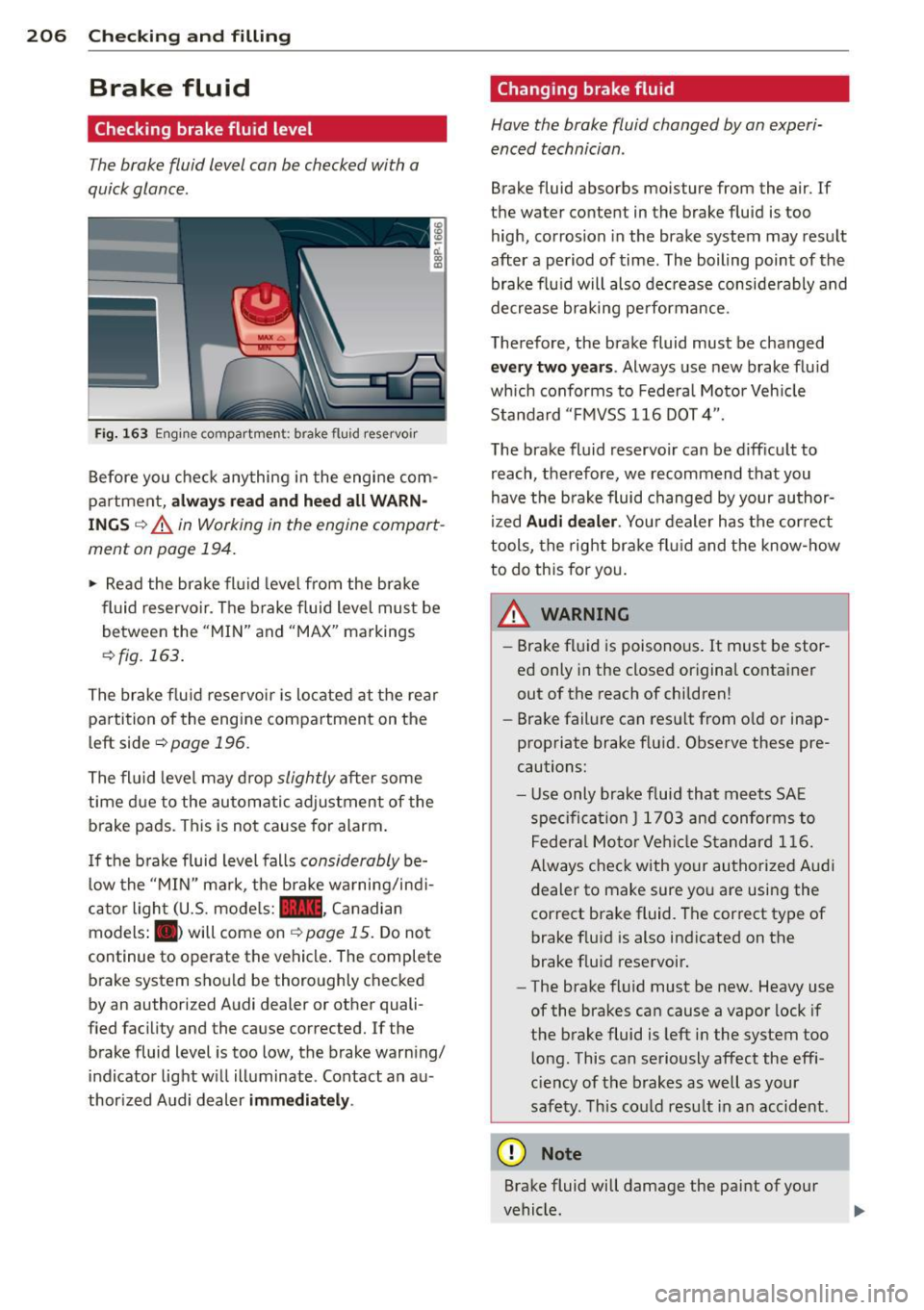
Fig. 163 Engine compartme nt: brake flu id reservo ir
Before you check anything i n the engine com
partment,
a lwa ys rea d and h eed a ll WA RN·
ING S c:> & in Working in the engine compart
ment on page
194.
~ Read the brake fluid level from the bra ke
fluid reservoir. The brake fluid Level must be
between the "MIN" and "MAX" markings
9fig. 163 .
The brake f lu id rese rvoir is located at the rear
partition of the engine compartment on the
L eft side
¢page 196.
The fluid level may drop slightly after some
time due to the automatic adjustment of the b rake pads . This is not cause for alarm .
I f the b rake fluid Level falls
considerably be
low the "MIN" mark, the brake wa rning/ind i
cator Light (U.S. models:
1111 , Canadian
models:
llllt will come on c:> page 15 . Do not
continue to operate the vehicle . The complete
brake system sho uld be thoroughly checked
by an authorized Audi dealer or other quali
fied facility and the cause corrected. If the
brake fluid level is too low, the brake warn ing/
indicator Light w ill illuminate . Contact an au
thor ized Audi dealer
imm ediatel y.
Changing brake fluid
Have the brake fluid changed by an experi
enced technician .
Brake fluid absorbs moisture from the air. If
the water content in the brake fluid is too high, corrosion in the brake system may result
after a period of time . The boiling point of the
brake flu id will also decrease conside rably and
decrease braking pe rformance.
Therefore, the brake fluid must be changed
eve ry two y ears. Always use new brake flu id
which conforms to Federal Motor Veh icle
Standard "F MVSS 116 DOT 4".
The brake fluid reservoir can be diff icult to
reach, therefore, we recommend that you
have the b rake fluid changed by your author
ized
Audi dealer . Your dealer has the correct
tools, the right brake fl uid and the know -how
to do this for you.
A WARNING
- Brake fluid is poisonous . It must be stor
ed only in the closed original container
out of the reach of children!
- Brake failure can resu lt from o ld or inap
propriate brake flu id. Observe these pre
cautions:
- Use only brake f luid that meets SA E
specifica tion
J 1 7 03 and conforms to
Federa l Moto r Ve hicl e Standard 1 16.
Always check with yo ur authorized Aud i
dealer to make sure yo u are using the
correct brake fluid. The correct type of brake f lu id is also ind icated on the
brake flu id reservoir.
- The brake fluid must be new. Heavy use
of the brakes can cause a vapor lock if
the brake fluid is left in the system too
l ong. This can seriously affect the effi
c iency of the brakes as well as your
safety. This cou ld resu lt in an accident.
(D Note
Brake fluid will damage the paint of your
vehicle .
Page 209 of 280

@ For the sake of the environment
Because of the problem of proper disposal
of brake fluid as we ll as the special tools
req uired and the necessary expert ise, we
recommend that you have the brake fluid
changed by your author ized Audi dealer.
Battery
General information
All work on the battery requires technical
knowledge!
F ig . 1 64 Eng ine co mpa rtment: Batte ry w it h cover*
The battery is located in the engine compart
ment
c::> fig. 164 and is near ly m ain te nance
fre e.
The condition of the battery is checked in the
framework of the inspection.
Disconnecting the battery
The batte ry should not be disconnected. Some
ve hicl e functions such as power windows are
unavailable if the battery termina ls are dis
connected. These funct ions have to be re
l earned after the battery term inals are con
nected aga in. To prevent this, the battery
should only be disconnected from the vehicle
electrical system if absolutely necessary .
Function
Power window
one-touch up/
down function
Master key with
remote control
Reprogramming
c::, page 45, Reactivating
the system after battery
disconnection
Synchronization
~page 38
Checkin g and fillin g 207
Reprogramming
Digita l clock c::, page 11
ESP indicator light The indicator ligh t goes
out after driving a few
meters
Vehicl es not driven for long periods and
sho rt -d is tance op eration
If you do no t drive your vehicle for several
days or weeks, electrical consumers are grad
u ally scaled back or switched off . This reduces
energy use and ensures the vehicle will be
able to start after long periods of time
c::, page 167. Some convenience functions
such as opening w it h the remote control key
may not be available. These conve nience func
tions wi ll be available again once you switch
the ignit io n on and sta rt the engine. Even
whe n consume rs a re switched off, the battery
will become deeply discharged by stand -by
power consumers if the vehicle is not driven
for several months . Deep discharging results
in a chemical reaction that destroys the inside
of the battery. The battery must be charged
every month to prevent th is
c::, page 209. Do
not disconnect the battery or the anti-t heft
alarm system* will not work .
Winter operation
Cold weather places higher demands on the
battery. This results in reduced starting abili
ty. Have the battery checked and recharged if
necessary befo re the cold weather begins.
Avoid unnecessary power consumpt ion, par
ticularly in city traffic or when traveling only
short distances . Let your authorized Audi
dealer check the capacity of the vehicle bat
tery before winter sets in
c::, page 209 . A well
c harged bat tery will not o nly prevent s tarti ng
problems when the weather is cold, but will
also last longer .
(D Note
-All wo rk on the batte ry requ ires techn i
cal know le d ge. P lease con ta ct an Audi
dealership or another authorized fa cility
lill>