warning light AUDI A3 2012 Owner´s Manual
[x] Cancel search | Manufacturer: AUDI, Model Year: 2012, Model line: A3, Model: AUDI A3 2012Pages: 280, PDF Size: 70.11 MB
Page 132 of 280

130 Airbag system
-Never carry sharp objects in your pockets
or place them on the seat. If the weight
sensing mat in the passenger seat is
punctured it cannot work properly .
- Never carry things on your lap or carry
objects on the passenger seat. Such items can increase the weight registered
by the weight-sensing mat and send the
wrong information to the airbag control
unit.
- Never store items under the front pas
senger seat. Parts of the Advanced Air
bag System under the passenger seat
could be damaged, preventing them and
the airbag system from working proper
ly.
- Never place seat covers or replacement
upholstery that have not been specifical
ly approved by Audi on the front seats.
- Seat covers can prevent the Advanced Airbag System from recognizing child re
straints or occupants on the front pas
senger seat and prevent the side airbag
in the seat backrest from deploying prop
erly .
- Never use cushions, pillows, blankets or
similar items on the front passenger
seat. The additional padding will prevent
the weight-sensing mat in the seat from
accurately registering the child restraint
or person on the seat and prevent the
Advanced Airbag System from function
ing properly.
- If you must use a child restraint on the
front passenger seat and the child re
straint manufacturer's instructions re
quire the use of a towel, foam cushion or
something else to properly position the
child restraint, make certain that the
PASSENGER AIR BAG OFF light comes
on and stays on whenever the child re
straint is installed on the front passen ger seat .
- If the
PASSENGER AIR BAG OFF light
does not come on and stay on, immedi
ately install child restraint in a rear seat
ing position and have the airbag system
inspected by your authorized Audi dealer.
How the Advanced Airbag System
components work together
The front Advanced Airbag System and the
side airbags supplement the protection of
fered by the front three-point safety belts
with pretensioners and load limiters and the
adjustable head restraints to help reduce the
risk of injury in a wide range of accident and
crash situations. Be sure to read the impor
tant information about safety and heed the
WARNINGS in this chapter.
Deployment of the Adva need Airbag System
and the activation of the safety belt preten
sioners depend on the deceleration measured
by the crash sensors and registered by the
electronic control unit. Crash severity depends
on speed and deceleration as well as the mass
and stiffness of the vehicle or object involved
in the crash.
When the electronic control unit registers a
low severity crash and the safety belt is being
used , the airbag will not deploy. If the safety
belt is not being used, the first stage deploys,
followed by the second stage after a much lat
er time in the crash sequence.
If the electronic control unit registers a crash
of medium severity, the first stage of the air
bag deploys followed by the second stage at a
much later time in the crash sequence - re
gardless of whether the safety belt is being
used or not . In higher severity crashes as reg
istered by the electronic control unit, both the
first and second stages deploy almost at the same time.
On the passenger side, regardless of safety
belt use, the airbag will be turned off if the
weight on the passenger seat is less than the
amount programmed in the electronic control
unit. The front airbag on the passenger side
will also be turned off if one of the child safe
ty seats that has been certified under Federal
Motor Vehicle Safety Standard 208 has been
recognized on the seat. The
PASSENGER AIR
BAG OFF
light comes on and stays on to tell
you when the front Advanced Airbag on the passenger side has been turned off ..,_
Page 133 of 280
¢ page 123, Child restraints on the front seat
- some important things to know .
A WARNING
To reduce the risk of injury when an airbag
inflates, always wear safety belts properly.
- If you are unrestrained, lean ing forward,
sitting sideways or out of position in any
way, your risk of injury is much higher.
- You w ill also receive serious injuries and
cou ld even be killed if you are up against
the a irbag or too close to it when it in
flates - even with an Advanced Airbag
~ page 122.
More important things to know about
front airbags
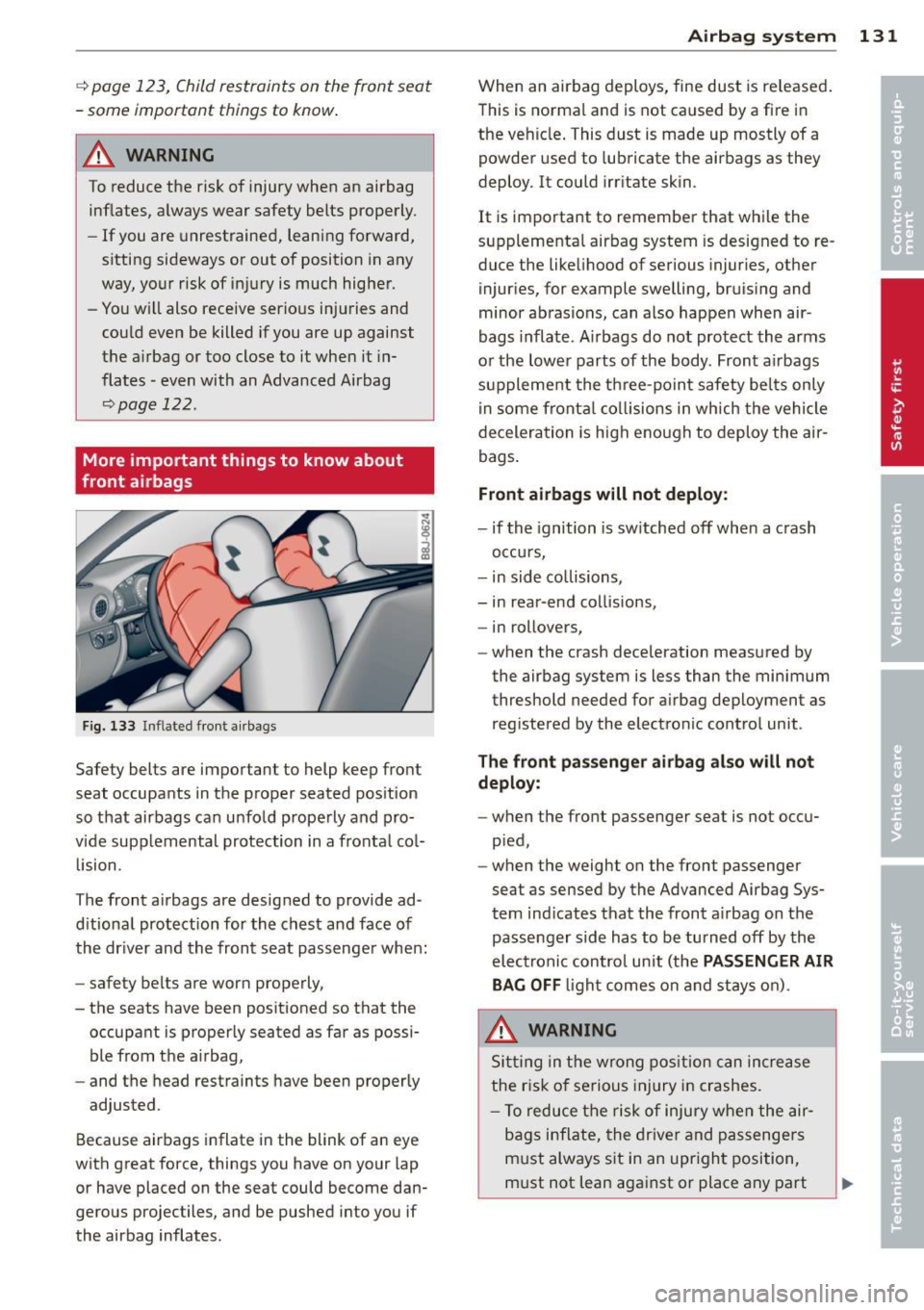
F ig. 133 Inflated front a irbags
Safety belts are important to help keep front
seat occupants in the proper seated pos ition
so that airbags can unfold properly and pro
vide supp lemental protection in a fronta l co l
lision .
The front a irbags are designed to provide ad
d itiona l protection for the chest and face of
the dr iver and the front seat passenger when :
- safety belts are worn properly,
- the seats have been positioned so that the occupant is properly seated as far as possi
ble from the a irbag,
- and the head restraints have been proper ly
adjusted .
Because airbags i nflate in the blink of an eye
with great force, things you have on your lap or have placed on the seat could become dan
gerous projectiles, and be pushed into you if
the airbag inflates.
A irba g sy stem 131
When an airbag deploys, fine dust is re leased.
This is norma l and is not caused by a fire in
the vehicle . This dust is made up mostly of a
powder used to lubricate the airbags as they
deploy. It could irritate skin .
It is important to remember that whi le the
supplementa l airbag system is designed to re
duce the like lihood of serious injuries, other
injur ies, for example swelling, bruising and
minor abras ions, can also happen when air
bags i nflate. A irbags do not protect the arms
or the lower parts of the body . Front a irbags
supplement the th ree -po in t safety belts only
in some fronta l co llisions in which the vehicle
deceleration is high enough to deploy the air
bags .
Front airbags will not deploy :
-if the ignition is sw itched off when a crash
o ccu rs,
- in side co llisions,
- in rear-end collisions,
- in rollovers,
- when the crash dece leration measured by
the airbag system is less than the minimum
threshold needed for a irbag deployment as
reg istered by the electron ic contro l unit .
The f ront pa ssen ger airbag als o will no t
deplo y:
- when the front passenger seat is not occu
pied,
- when the weight on the front passenger
seat as sensed by the Advanced Airbag Sys
tem ind icates that the front a irbag on the
passenger side has to be tu rned off by the
electronic contro l un it (the
PASSENGER AIR
BA G OFF
light comes on and stays o n).
.&, WARNING
Sitting in t he wrong pos ition can increase
the risk of serious injury in crashes.
- T o reduce the risk of injury when the air
bags inflate, the driver and passenge rs
m ust always s it in an upright position,
m ust not lean against or place any part
Page 134 of 280
132 Airbag system
of their body too close to the area where
the airbags are located.
- Occupants who are unbelted, out of posi
tion or too close to the airbag can be se riously injured by an airbag as it unfolds
with great force in the blink of an eye
r=> page 123 .
A WARNING
A child in a rearward-facing child safety
seat installed on the front passenger seat
will be seriously injured and can be killed if
the front airbag inflates -even with an Ad
vanced Airbag System.
- The inflating airbag will hit the child
safety seat or infant carrier with great
force and will smash the child safety seat
and child against the backrest, center armrest, door or roof.
- Always install rear-facing child safety
seats on the rear seat.
- If you must install a rearward facing
child safety seat on the front passenger
seat because of exceptional circumstan ·
ces and the
PASSENGER AIR BAG OFF
light does not come on and stay on, im
mediately install the rear-facing child
safety seat in a rear seating position and
have the airbag system inspected by your
authorized Audi dealer .
A WARNING
Objects between you and the airbag will
increase the risk of injury in a crash by in
terfering with the way the airbag unfolds
or by being pushed into you as the airbag
inflates.
- Never hold things in your hands or on
your lap when the vehicle is in use .
- Never transport items on or in the area
of the front passenger seat. Objects
could move into the area of the front air
bags during braking or other sudden ma
neuvers and become dangerous projec
tiles that can cause serious personal in
jury if the airbags inflate.
-
- Never place or attach accessories or oth
er objects (such as cup holders, tele
phone brackets, large, heavy or bulky ob
jects) on the doors, over or near the area
marked "AIRBAG" on the steering wheel,
instrument panel, seat backrests or be
tween those areas and yourself . These
objects could cause injury in a crash, es
pecially when the airbags inflate.
- Never recline the front passenger's seat
to transport objects. Items can also
move into the area of the side airbag or
the front airbag during brak ing or in a
sudden maneuver. Objects near the air
bags can become projectiles and cause
injury, particularly when the seat is re
clined.
A WARNING
-T he fine dust created when airbags deploy
can cause breathing problems for people
with a history of asthma or other breath
ing conditions.
= To reduce the risk of breathing problems ,
those with asthma or other respiratory
conditions should get fresh air right
away by getting out of the vehicle or
opening windows or doors.
- If you are in a collision in which airbags
deploy, wash your hands and face with
mild soap and water before eating.
- Be careful not to get the dust into your
eyes, or into any cuts or scratches.
- If the residue should get into your eyes ,
flush them with water.
Page 135 of 280

Monitoring the
Advanced Airbag
System
I Airbag monitoring indicator light
Two separate indicators monitor the function
of the Advanced Airbag System: the airbag
monitoring indicator light and the
PAS SEN
GER AIR BAG OFF
light.
The Advanced Airbag System (including the
e lectronic control unit, sensor circuits and sys
tem wiring) is monitored continuously to
make sure that it is functioning properly
whenever the ignit ion is on . Each t ime you
turn on the ignition, the airbag monitor ing in
d icator light
I will come on for a few seconds
(self diagnostics) .
t!i The syste m mus t be insp ected when the
indicato r light:
- does not come on when the ignit ion is
switched on,
- does not go out a few seconds after yo u
have switched on the ignition, o r
- comes on while d riving .
If an airbag system malfunction is detected,
the
I indicator light will first start flashing to
catch the driver's attention and then stay on
continuously to serve as a constant reminder
to have the system inspected immediately.
If a malfunction occurs that turns the front
a irbag on the passenger side off, the
PASSEN
GER AIR BA G OFF
light will come on and stay
on whenever the ignition is on.
_& WARNING
An airbag system that is not funct ioning
properly cannot provide supp lemen tal p ro
tection in a frontal crash.
- If the airbag indicator l igh t comes on, it
means that there may be something
wrong wit h the Advanced Airbag System.
It is possible that the airbag will inflate
when it is not s upposed to, or wi ll not in
flate when it should.
-
Airba g sy stem 133
-Have the airbag system inspected imme
diate ly by you r authorized Aud i dea ler.
PASSENGER AIR BAG OFF light
F ig . 1 34 Sect ion from th e ce nter console: PASSENGER
AIR BAG O FF light
The PAS SENGER AIR BAG OFF light is located
in the center console
c::> fig. 134.
The PA SSENGER AIR BAG OFF light will come
on and stay on to tell you when the front Ad
vanced Airbag on the passenger side has been
turned off by the electron ic control unit. Each
time you turn on the ignit ion, the
PAS SEN
GER A IR BAG OFF
light will flash for a few
seco nds and:
- will stay on if the front passenger seat is not
occupied,
- will stay on if there is a small ch ild or child
restraint on the front passenger seat,
- will go out if the front passenger seat is oc
cupied by an adult as registered by the
weight-sensi ng mat.
The
PA SSENGER AIR BAG OFF light must
come on and st ay on
if the ignition is on and
- a car bed has been installed on the front
seat, or
- a rearward -facing child restraint has been
installed on the front passenger seat, or
- a forward -facing chi ld restraint has been in
stalled on the front passenger seat, or
- t he weight reg iste red on the fron t passen-
ger seat is equal to or less than the com -
bined weight of a typical 1 year-old restrain
ed in one of the rear-facing or forward -fac-
ing infant restraints listed in Federal Motor
Vehicle Safety Standard 208 with which the ..,_
Page 137 of 280
PASSENGER AIR B AG ON will briefly appear
in the instrument cluster display. This is to in
form the driver of the current front passenger
airbag status .
Important safety instructions on
monitoring the Advanced Airbag System
A WARNING
An airbag system that is not functioning
properly cannot provide supplemental pro
tection in a frontal crash.
- If the airbag indicator light comes on, it
means that there may be someth ing
wrong with the Advanced Airbag System .
It is possible that the airbag will inflate
when it is not supposed to, or w ill not in
flate when it should .
- Have the airbag system inspected imme
diately by your author ized Audi dealer .
A WARNING
If the front airbag inflates, a ch ild without
a child restra int, or in a rearward-fac ing
child safety seat, or in a forward-facing
child restraint that has not been prope rly
installed will be serio usly injured and can
be killed.
- E ven though your veh icle is equipped
with an Advanced Airbag System , make
certain that a ll children, especially 12
years and younger, a lways ride on the
back seat properly restrained for their
age and si ze.
- Always install forward or rea r-facing
child safety seats on the rear seat -even
with an Advanced Airbag System.
- If you must install a rearward-facing
child safety seat on the front passenger
seat because of exceptional circumstan
ces and the
PAS SENG ER AIR BAG OFF
light does not appear and stay on, imme
diately install the rear-fac ing ch ild safety
sea t in a rear seating position and have
the a irbag sys tem inspected by you r au
tho rized Aud i dea ler.
-
A irbag system 135
-A t ight tether or other strap on a rea r
ward-facing child rest raint attached to
the front passenger seat can put too much pressure on the weight-sensing
mat in the seat and reg iste r more weight
than is actually on the seat . The heavie r
weight registered can make the system
wo rk as tho ugh an adult we re on the seat
and deploy the Advanced Airbag when it
m ust be suppressed causing serious or
even fata l injury to the chi ld .
- If , in exceptiona l c ircumstances , you
m ust install a forward-facing child re
straint on the front passenger seat, al
ways move the seat into its rearmost po sition in the seat's fore and aft adjust
ment range, as far away from the a irbag
as poss ible. The backrest must be adjust
ed to an upright pos ition. Make su re that
the
PASSENGER AIR BAG OFF light
comes on and stays on all the time when
eve r the ignit ion is switched on.
A WARNING
-
- If the PASSENGER AIR BAG OFF light
does not go o ut when an ad ult is sitting
on the front passenger seat after taking
the steps described above, make sure the
adu lt is properly seated and restra ined at
one of the rear seating pos itions.
- Have the airbag system inspected by
your author iz ed Audi dealer before trans
port ing anyone on the front passenger
seat .
(j) Tips
If the weight-sensing mat in the front pas
senger seat detects an empty seat, the
front airbag on the passenger side will be
turned off, and the
PASSENGER AIR BAG
OFF
light will stay on.
Repair , care and disposal of the airbags
Pa rts of the airbag system are installed at
many different places on your Aud i. Insta lling,
removing, servicing or repa iring a part in an
area of the vehicle can damage a part of an ..,.
•
•
Page 139 of 280

Other things that can affect Advanced
Airbag performance
Changing the vehicle's suspension system can
change the way that the Advanced Airbag Sys
tem performs in a crash. For example, us ing
tire-r im combinations not approved by Aud i,
lowering the vehicle, changing the stiffness of
the suspension, including the springs, suspen sion struts, shock absorbers etc. can change
the forces that are measured by the a irbag
se nsors and sent to the electron ic control
u ni t. Some suspens ion changes c an, for exam
p le, increase the force levels measured by the
sensors and make the airbag system deploy in
crashes in w hic h it would not dep loy if the
changes had not been made. Other k inds of
changes may reduce the force levels meas
ured by the sensors and prevent the airbag
from deploying when it shou ld .
The sensors in the safety belt buckle for the
driver and front passenger seat tell the elec
tronic control module if the safety belt is
l atched or not. If the safety belt is being used,
the front airbag will deploy at a slightly high
e r rate of vehicl e deceleration than if the safe
ty belt is not being used. Therefore, in a par
ticular co llision, it is poss ible th at an a irbag
will not deploy at a seating position where the
safety be lt is bei ng used but will inflate at the
position whe re the safety belt is not being
used. It is important that nothing interfere
with the safety belt buckles so t hat the sen
sors can send the correct information about
safety belt use to the electron ic cont rol unit.
A WARNING
Cha nging the vehicle's s uspension inclu d
ing use of u napproved t ire-rim comb ina
ti ons can change Advan ced A irb ag pe r
formance and incre ase the risk of ser io us
personal in jury in a crash.
- Never ins tall suspe nsion compone nts
t h at d o not h ave the same per forman ce
characteristics as the components origi
nally installed on you r vehicle .
- Never use t ire-r im combinat ions that
have not bee n approved by A udi.
A irba g sy stem 13 7
A WARNING
Items stored between the safety be lt
buckle and the center console can cause
the sensors in the b uckle to send the
wrong informa tion to the e lectronic con
trol module a nd prevent t he A dvan ced Air
bag System from wo rking properly.
- Always ma ke sure t ha t nothing can inter
fe re wi th the safety belt buckles and that
t hey are not obs truc te d .
Side airbags
Description of side airbags
The airbag system can provide supplemental
protection to properly restrained occupants.
Fi g. 135 Side a irbag location in t he drive r's seat
The side airbags are located in the sides of the
front seat backrests~
fig. 135 and the rear
back rest* facing the doors . Th ey are id entified
by the wo rd "AIRBAG".
The side airbag sy stem basically consi st s of :
-the electron ic control modu le and external
side impact sensors
- the two side airbags located in the s ides of
the front backrests
- two rear side airbags (as an ordered
option)
- t he airbag warn ing light in the ins trument
cl uste r.
T he airbag system is mo nitored e lec tronically
t o m ake ce rtain tha t it is fu nction ing p ro perl y
at all times . Each time you turn on the ig ni
tion, the airbag system indicator light will
come on for a few seconds (self diagnostics) . ..,.
Page 140 of 280

138 Airbag sys te m
The side airbag system supplements the safe
ty belts and can help to reduce the risk of in
jury to the driver's, front and rear* passeng
er's upper torso and head on the side of the
vehicle that is struck in a side collision. The
a irbag dep loys only in side impacts and only
when the vehicle acceleration registered by
the contro l unit is high enough. If th is rate is
below the refe rence value p rogrammed into
the contro l unit, the side airbags will not be
tr iggered, even though the car may be badly
damaged as a result of the collision.
It is not
possible to define an airbag triggering range
that will cover every possible angle of impact,
since the c ircumstances will vary considerab ly
between one collision and another. Important
factors include, fo r example, the nature (hard
or soft) of the impacting object, the angle of
impact, veh icle speed, etc.
q page 139, Im
portant safety instructions on the side airbag
system.
As ide from the ir normal safety function, safe
ty belts work to he lp keep the driver or front
passenger in position in the event of a side
coll is ion so that the side a irbags can provide
p rotection.
The airbag system is
not a substitute for your
safety belt. Rathe r, it is pa rt of the overall oc
cupant res traint system in your ve hicle. Al
ways remember that the side airbag system
can only help to protect you if you are wearing
your safety be lt and wearing it properly. This
is another reason why you sho uld always wear
your safety belts, not just because the law re
qu ires you to do so
<=')page 113, General
notes.
It is important to remember that while the
supp lemental s ide a irbag system is designed
to reduce the like lihood of serious injur ies,
other i njuries, for example, swell ing, bruising,
and minor abras ions can also be associated
with deployed side a irbags. Remember too,
side a irbags wi ll deploy on ly once and on ly in
cer tain k inds of ac cidents -yo ur sa fety belts
are a lways there to offer protection .
Vehicle damage, repa ir costs or even the lack
of vehicle damage a re not necessar ily an ind i- cation o
f over -sensitive or failed airbag activa
tion . In
some collisions, both front and side
airbags may inflate . Remember too, that air
bags will deploy only once and only in certain
k inds of collisions -your safety belts are al
ways there to offer protection in those acc i
dents in which a irbags are not supposed to
deploy or when they have a lready deployed .
The side airbag system will not deploy:
-when the ignit ion is turned off
- in side co llisions when the acceleration
measured by the sensor is too low
- in front -end collisions
- in rear -end co llisions
- in rollove rs.
In some types of accidents the front airbags,
s ide curtain airbags and s ide a irbags may be
t rigge red togethe r.
&, WARNING
- Safety belts and the air bag system will
only provide pro tection when occupants
are in the proper seating posi tion
¢page 139.
- If the airbag ind icator light comes on
when the vehicle is being used, have the
system inspected immediately by you r
author ized Audi dealer. The airbag may
not work properly when the vehicle ac
celeration in a side coll is ion is high
enough to activate the a irbag.
-
Page 143 of 280

in a side collision. The side curtain ai rbag in
f lates in side impacts and on ly when the vehi
cle acce lerat ion reg istered by the contro l unit
is high enough. If th is rate is be low the refer
ence value programmed into the control un it,
the side airbags will not be triggered, even
though the car may be badly damaged as a re sult of the collision . It is not possible to de
f ine an a irbag tr igger ing range that will cover
every possible angle of impac t, since the ci r
cumstances wi ll vary conside rably between
one co llision and another . Important factors
include, for examp le, the nat ure ( hard o r soft)
of the impacting object, the ang le of impact,
veh icle speed, etc.
c:> page 141.
Aside from the ir normal safety function , safe
ty belts work to he lp keep the driver or front
passenger in posit ion in the event of a co lli
sion so that the side curtain airbags can pro
vide protection.
The airbag system is not a s ubstitute for yo ur
safety belt. Rather, it is part of the overall oc
cupant restraint system in your vehicle. Al
ways remember that the airbag system can
only help to protect you if you are wearing
your safety belt and wear ing it prope rly. Thi s
i s another reason why you sho uld always wear
your safety bel ts, not just beca use the law re
q uir es you to do so
<=:>page 113, General
notes.
It
is important to rememb er that while the
side curta in a irbag sys tem is designed to he lp
r educe the like lihood of se rious injur ies, other
in ju ries, for example, swell ing, bruising, and
minor abrasions can a lso be associated with
these airbags upon deployment. Remember
too, these a irbags w ill dep loy on ly once and
only in certain kinds of accide nts - your safety
be lts are a lways there to offer protection .
The side curtain airbag sy stem ba sically
consi sts of:
- The electronic control mod ule and external
s ide impact sensors
- The side curtain airbags ab ove the front and
rear side w indows
A irba g sy stem 141
- The a irbag indicator light in the instrument
pane l
T he airbag system is mon itored e lec troni cally
to make ce rtain i t is func tioning prope rly at all
times . Each time you turn on the ignit ion, the
airbag system indicator light will come on for
a few seconds (self diagnostics).
The side curtain airbag is not activated :
-if the ignition is turned off ,
- in side co llisions whe n the accele ration
meas ured by the sensor is too low,
- in rea r-end collisions,
- in rollovers.
A WARNING
- Safety belts and the airbag system will
only provide protection w hen occupants
a re in the proper seating posi tion
c:> page 61, General re commendation s.
- If th e air bag ind icator lig ht comes on
when the vehicle is being used, h ave the
sys tem inspected immedi ately by your
author ized A udi dealer. The s ide cur tain
airbag may not wo rk proper ly even w hen
the vehicle acce lerat ion in a side collision
is high enoug h to activate the airbag.
How side curtain airbags work
Side curtain airbags ca n work together with
side airbags to help reduce the risk of head
and upper torso injuries for occupants who
are properly restrained.
Fi g. 13 8 Illust rat io n o f pri nc iple: I nflated s ide c urtai n
a irbags o n the le ft sid e
The side c urtai n airbags inflate betwee n the
occupant and the windows on the s ide of the ..,.
Page 144 of 280
142 Airbag sys te m
vehicle that is struck in a side co llision
~ fig . 138.
When the system is triggered , the side c urtain
a irbag is filled wi th propellant gas and b reaks
through a seam above the front and rear side
windows ide ntified by the AIRBAG label. In or
der to help provide this additional protection,
the side curtain airbag must inflate within the
blink of an eye at very high speed and w ith
great force. The side curtain airbag could in
jure you if your seat ing pos ition is not proper
or upright or if items are located in the area
where the suppleme nta l side cu rtain airbag
i nflates . This applies espe cial ly to childre n
~page 143.
Although they are not a soft pillow, side cur
tain airbags can "cushion" the impact and in
this way they ca n he lp to redu ce the r isk of in
ju ry to the head and the upper part of the
body .
A fine dust may develop when the airbag de p loys. This is q uite norma l and does not mean
there is a fire in the vehicle .
Important safety instructions on the
side curtain airbag system
Airbags are only supplemental restraints . Al
ways properly wear safety belts and ride in a
proper seating position.
There is a lot that you and your passengers
must know and do to help the safety belts and
a irbags do the ir job to provide s upplementa l
protection.
A WARNING
Improperly wearing safety belts and im
prope r seat ing positions increase the risk
of serious personal injury and death when
ever a veh icle is being used .
- Never let occupants p lace any parts of
their bodies in the a rea from wh ich the
side cu rtain airbags inflate.
- Always make sure that the side curta in
airbags can inflate w ithout interference .
Unsuitable accessor ies fitted inside the expansion range of a curtain airbag can
dangerously interfere with its funct
ion. A
deploying head airbag develops enough
force to catapult any p iece of add-on
component out of its path of infla tion
and into the passenger compa rtment. An
o ccu pant hit by such a projectile can suf
fe r serious injury or death~
page 262,
Technical Modifications.
- Do not swive l the sun visors to the side if
you have any objects clipped onto them
(for examp le pens). If the airbag should
deploy, you could be injured by these ob
jects .
- Use the bui lt -in coat hooks only for light
weight clothing . Never leave any heavy o r
sharp-edged objects in the pockets that
may interfere with a irbag dep loyment
and can cause personal injury in an acci
dent.
- Never use hangers to hang cloth ing from
the hooks.
- Only use factory-installed sun shades or,
in the case of shades installed after the
veh icle leaves the factory, on ly Audi roll
up sunscreens may be used
~ page 261,
Additional accessories and parts re
placement.
- Always sit in proper seat ing pos ition and
wear safety belts wh ile traveling so that
the side curtain airbag s can help p rov ide
p rotec tion.
- T he a irbag system can only be triggered
once .
If the airbag has been triggered,
t he system mus t be rep lace d by an au
thor ized A udi dealer or qualified work
shop .
- Always have work involving the side c ur
tain airbag system, removal and insta lla
tion of the airbag components, or ot her
repairs performed by a qua lified work
shop. Otherwise the airbag system may
not work correct ly.
- Never attempt to modify any compo
nents of the airbag system in any way .
Page 146 of 280

144 Child Safety
-Always install rear-facing child safety
seats on the rear seat.
- If you must install a rearward facing
child safety seat on the front passenger
seat in exceptional circumstances and
the
PASSENGER AIR BAG OFF light does
not come on and stay on, immediately
install the rear-facing child safety seat in
a rear seating position and have the air
bag system inspected immediately by
your authorized Audi dealer.
_& WARNING
If, in exceptional circumstances, you must
install a forward-facing child restraint on
the front passenger's seat:
- Always make sure the forward-facing
seat has been designed and certified by
its manufacturer for use on a front seat
with a passenger front and side airbag.
- Always follow the manufacturer's in
structions provided with the child safety
seat or carrier.
- Always move the passenger seat into its
rearmost position in the seat's fore and
aft adjustment range, as far away from
the airbag as possible before installing
the child restraint. The backrest must be adjusted to an upright position .
- Always make sure that the
PASSENGER
AIR BAG OFF
light comes on and stays
on all the time whenever the ignition is
switched on.
(D Tips
Always replace child restraints that were
installed in a vehicle during a crash. Dam
age to a child restraint that is not visible
could cause it to fail in another collision
situation.
Advanced front airbag system and children
Your vehicle is equipped with an "Advanced
Airbag System" in compliance with United
States Federal Motor Vehicle Safety Standard (FMVSS) 208 as applicable at the time your
vehicle was manufactured.
The Advanced Airbag system in your vehicle
has been certified to meet the "low-risk" re
quirements for 3- and 6-year old children on
the passenger side and small adults on the driver side. The low risk deployment criteria
are intended to reduce the risk of injury
through interaction with the airbag that can
occur, for example, by being too close to the
steering wheel and instrument panel when
the airbag inflates . In addition, the system
has been certified to comply with the "sup
pression" requirements of the Safety Stand
ard, to turn off the front airbag for infants up
to 12 months who are restrained on the front
passenger seat in child restraints that are list
ed in the Standard.
Even though your vehicle is equipped with an
Advanced Airbag system , all children, espe
cially those 12 years and younger, should al
ways ride in the back seat properly restrained
for their age and size. The airbag on the pas
senger side makes the front seat a potentially dangerous place for a child to ride . The front
seat is not the safest place for a child in a for
ward-facing child safety seat. It can be a very
dangerous place for an infant or a larger child
in a rearward-facing seat .
Advanced Airbags and the weight
sensing mat in the front seat
The Advanced Airbag System in your vehicle
detects the presence of an infant or child in a
child restraint on the front passenger seat us
ing the weight-sensing mat in the seat cush
ion and the sensor below the safety belt latch
on the front passenger seat that measures the
tension on the safety belt.
The weight -sensing mat measures total
weight of the child and the child safety seat
and a child blanket on the front passenger
seat. The weight on the front passenger seat
is related to the design of the child restraint
and its "footprint", the size and shape of the
bottom of the child restraint as it sits on the .,..