ABS AUDI A3 2015 User Guide
[x] Cancel search | Manufacturer: AUDI, Model Year: 2015, Model line: A3, Model: AUDI A3 2015Pages: 288, PDF Size: 71.46 MB
Page 149 of 288
of a typical 1 year-old, but less than the
weight of a small adult, the front airbag on
the passenger s ide may deploy (the
P A SSEN·
GER AIR BA G OFF
light does not come on).
For example, the a irbag may depl oy if:
- a small child that is heavier than a typical 1
year-o ld child is on the front passenger seat
(regardless of whether the child is in one of
the chi ld seats listed
page 168),
-a ch ild who has outgrown child rest raints is
on the front passenger seat.
I f the front passenger airbag is turned off, the
PA SSENGER AIR BAG OFF light in the center
of the inst rument panel w ill come on and stay
on.
If the front passenger airbag deploys, the
Federal Standard requires the a irbag to meet
the " low ris k" deployment criteria to help re
d uce the risk of injury through interaction
with the airbag . "Low risk" deployment occurs
in those crashes that take place at lower de
celerations as defined in the electronic control
un it
r:::> page 152.
Alw ays remember : Even though your vehicle
is equipped with Advanced Airbags, the safest
p lace for children is properly restrained on the
back seat. Please be sure to read the impor
tant information in the sect ions that follow
and be sure to heed all of the WARNINGS .
A WARNING
To reduce the risk of injury when an airbag
inflates, always wear safety belts prope rly.
- If you are unrestrained, lean ing forward,
sitting sideways or out of position in any
way, your risk of injury is much higher.
- You w ill also receive serious injuries and
cou ld even be killed if you are up against
the a irbag or too close to it when it in
fla tes - even with an Advanced Airbag
page 140 .
A WARNING ,~
A child in a rearward -facing child seat in -
stalled on the front passenger seat will be
-
A irbag system 147
seriously injured and can be killed if the
front airbag inflates - even w ith an Ad
vanced A irbag System.
- Altho ugh the Advanced Airbag System in
your veh icle is designed to turn off the
front airbag when a rearward-facing child restraint has been installed on the
front passenge r seat, nobody can abso
lutely guarantee that dep loyment is im
possible in all conceivable s ituations that
may happen dur ing the usefu l life of your
veh icle.
- The infla ting airbag will h it the ch ild seat
or infant carrier with g reat force and will
smash the child seat and child against
the backrest, center armrest, door, or
roof.
- Always install rearward-facing chi ld re
straints on the rear seat.
- If you must install a rearward fac ing
child seat on the front passenger seat because of exceptional circumstances
and the
PASSENGER AIR BAG OFF light
does not come on and stay on, immed i·
ately insta ll the rear-fac ing child seat in a
rea r seat ing pos ition and have the airbag
system inspected by you r Audi dealer .
A WARNING
If, in except iona l circumstances, you must
install a forward-facing child restraint on
the front passenge r's seat:
- Always ma ke sure the forward-facing
seat has been designed and cer tified by
its manufacture r for use on a front se at
with a passenger fron t and s ide a irbag .
- Never put the fo rward-facing child re
straint up against or ve ry near the instru
ment panel.
- Always move the passenge r seat into its
rea rmost pos ition in the seat's fore and
aft ad justment range, as fa r away from
the airbag as possible, before installing
the forward-fac ing chi ld restraint. The
backrest must be adjusted to an upright
position .
...
•
•
•
Page 159 of 288
www.dtsc.ca.gov/hazardouswaste/perchlorate. When the vehicle or parts of the
restraint system includ ing airbag modules
and safety belts with pretensioners are
scrapped, all applicable laws and regula
tions must be observed. Your authorized
Audi dealer is familiar with these require
ments and we recommend that you have
your dealer perform this serv ice for you.
Other things that can affect Advanced
Airbag performance
Changing the vehicle's suspension system can
change the way that the Advanced Airbag Sys
tem performs in a crash. For example, using
tire-r im combinations not approved by Audi,
lowering the vehicle, changing the stiffness of
the suspension, including the springs, suspen
sion struts, shock absorbers etc. can change
the forces that are measured by the airbag sensors and sent to the electron ic control
unit. Some suspension changes can, for exam
ple, increase the force levels measured by the
sensors and make the airbag system deploy in
crashes in which it would not deploy if the
changes had not been made. Other kinds of
changes may reduce the force levels meas
ured by the sensors and prevent the airbag
from deploying when it should .
The sensors in the safety belt buckle for the
driver and front passenger seat tell the elec
tronic control module if the safety belt is
latched or not.
It is important that nothing in
terfere with the safety belt buckles so that
the sensors can send the correct information
about safety belt use to the electronic control
unit.
_& WARNING
Changing the vehicle's suspension includ
ing use of unapproved tire-rim combina
tions can change Advanced Airbag per
formance and increase the risk of serious personal injury in a crash.
- Never install suspension components
that do not have the same performance
Airbag system 157
characteristics as the components origi
nally installed on your vehicle.
- Never use tire-rim combinations that
have not been approved by Audi.
Knee airbags
Description of knee airbags
App lies to vehicles: wi th knee airbags
The knee airbag system can provide supple
mental protection to properly restrained
front seat occupants.
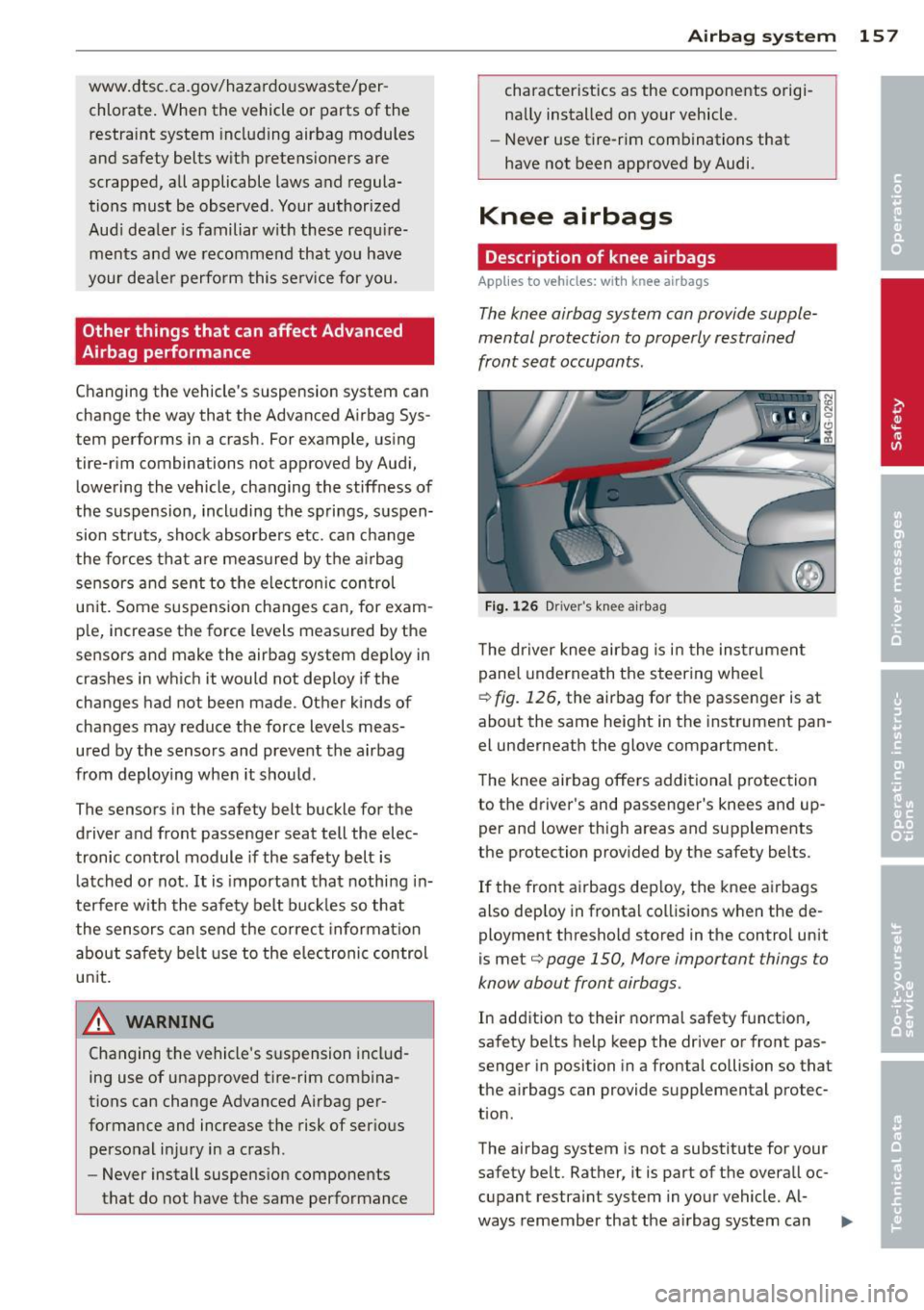
Fig. 126 Driver 's kn ee airbag
The dr iver knee airbag is in the instrument
panel underneath the steering wheel
~ fig. 126, the airbag for the passenger is at
about the same height in the instrument pan
el underneath the glove compartment.
The knee airbag offers additional protection
to the driver's and passenger's knees and up
per and lower thigh areas and supplements
the protection provided by the safety belts.
If the front airbags deploy, the knee airbags
also dep loy in frontal collisions when the de
ployment threshold stored in the control unit
is met
q page 150, More important things to
know about front airbags.
In addition to their normal safety function,
safety belts help keep the driver or front pas
senger in position in a frontal collision so that
the airbags can provide supplemental protec
tion.
The airbag system is not a substitute for your
safety belt. Rather, it is part of the overall oc
cupant restraint system in your vehicle. Al
ways remember that the airbag system can
Page 187 of 288
Smart Technology Notice about data
recorded by vehicle
control modules
Your veh icle is not equipped with an Event Da
ta Recorde r (EO R), installed by some manu
facture rs fo r the express purpose o f capturing
data for retr ieval after an accident or cras h
event . EDR's a re sometimes called "crash re
corders".
Some state laws res trict the retr ieval or down
l oadi ng of data stored by E DR's that were in
stalled in a veh icle for the exp ress purpose of
retrieving data after an accide nt or crash
event w ithout the owner's consent.
A lthough yo ur vehicle is no t equ ipped w it h an
EDR, it is equipped with a number of elect ron
ic control modules fo r various vehicle systems
such as, for examp le, eng ine f unction, em is
sion control, as well as for the airbags and
safety belt s.
These electronic contro l modules also record
veh icle -re lated data dur ing no rma l veh icle op
erat ion for d iagnostic and repa ir purposes .
T he recording capacity of the electronic con
trol modules is limited to data (no sound is re
corded) and only a small amount of data is ac
tually recorded ove r a ve ry limited pe riod of
time and stored when a sys tem faul t or o ther
condition is se nse d by a cont rol u nit. Some o f
the data then stored may re la te to vehicle
speed, dir ect io n, bra king as we ll as restra int
system use and perfo rmance in the event of a
crash or other condit ion. Stored data can only
be read and downloaded w ith special equip
ment.
Electronic stabilization
control (ESC)
Description
The ESC reinforces driver safety. It reduces
the r isk of slipp ing and improves driving sta
b ili ty . E SC detects cr itical s it u ations such as
the veh icle ove rsteer ing and understee ring or
Smart Technolog y 185
th e wheels a re sp inning . The vehicle is stabi
li zed by applying the brakes or red ucing en
gine torq ue. Once the ESC is act ive ly reg ulat
ing, the
G) i ndicato r light b links in the instru
ment cluster.
The anti-lock braking system (ABS), brake as s ist system, ant i-slip regu lation (ASR), e lec
tron ic different ia l loc k (EDU, electron ic differ
ential lock* (front wheel drive) and se lective
whee l to rque control* (a ll whee l drive) are in
teg rated in the ESC. The ESC suppo rts the sta
bilization of the vehicle th rough a change in
t h e s teer ing torq ue.
Anti-lock braking system (ABS)
ABS prevents the whee ls from locking when
braking . The vehicle ca n still be steered even
dur ing ha rd braking. App ly steady pressure to
the b rake peda l. Do not pump the p edal. A
puls ing in the bra ke peda l indicates t hat the
system is acting to st abil ize the ve hicle.
Brake assist system
The brake ass ist system can decrease braking
dis tance. It increases bra king power when the
drive r presses the bra ke peda l quickly in emer
gency s ituations. Yo u m ust pres s and hol d the
brake pedal unt il the dangerous s it u at ion is
ove r. In vehicles with adap tive c ruise control *,
the b rake assist system is more sensitive if the
distance detected to the vehicle ahead is too
small.
Anti-slip regulation (ASR )
ASR reduces eng ine power when the drive
whee ls beg in spi nning and adapts the fo rce to
the road conditions . This makes it easier to
start, accelerate and dr ive up inclines.
Electronic differential lock (EDL)
The EDL bra kes whee ls tha t a re sp inning and
trans fers the dr ive power to the othe r drive
whee l or w heels if the vehicle is equ ip ped with
a ll w heel d rive*) . This function is availab le up
to approximately 62 mph (100 km/h).
I n extreme cases, EDL au toma tically sw itches
off to keep t he b rake on the bra ked wheel
from overheat ing. The ve hicle is still working .,..
•
•
•
Page 188 of 288
186 Smart T echnol ogy
correctly. ED L will switch on again automati
cally when conditions have returned to nor
mal.
Electroni c inte raxle diff ere ntial lo ck */
s e le ct ive w heel t orqu e cont rol *
The electronic interaxle differential lock (front
wheel drive) or the selective wheel torque
contro l (all wheel drive) operates when driving
through curves. The front whee l on the inside
of the curve or both wheels o n the inside of
the curve are braked selectively as needed .
This minimizes s liding in the front wheels and
a llows for more precise driving through
curves. The app licab le system may not acti
vate when driving in wet or snowy conditions .
Post-collision bra ke ass ist
"Post-collision brake assist" can ass ist the
driver during a collision by reducing the dan
ge r of slipp ing and further co llision and by au
tomatic braking.
"Post-collision brake assist" functions during
front, side and rear collis ions when the a irbag
control module a detects a trigger level and
the co llision takes place at a dr iv ing speed
faster than 6 mph (10 km/h). The braking of
the vehicle happen automatically via the ESC
as long as the ESC, the hydraulic brake sys
tem, and the vehicle electrical system are not
damaged from the coll ision.
The fo llowing activ ities override the automat
ic braking during a collision:
- If the dr iver presses the accelerator peda l.
T here is no a utomatic braking.
- When the force on the press brake pedal is
stronger than the b raking force initiated by
the system . The vehicle is manually braked .
- When the ESC is damaged and the "post
collision brake assist" is not availab le.
A WARNING
- The ESC, ABS, ASR, EDL, electron ic inter
axle d ifferential lock or select ive wheel
torque control cannot overcome the laws
of physics. This is espec ially important
on sl ippery o r wet roads.
If the systems
begin acting to stabili ze your veh icle, you
should immediately alter your speed to
match the road and traffic conditions . Do
not let the increased safety prov ided
tempt you into tak ing risks. This could
increase your risk of a collision.
- Please note the risk of a collision increas
es when driving fast, especially through
curves and on slippery or wet roads, and
when dr iv ing too close to objects ahead .
ESC, ABS, the brake assist system, EDL,
electronic interaxle differentia l lock or
selective whee l to rque control cannot
p revent coll is ions.
- Press the acce lerator pedal carefully
when acce le rat ing o n even, slippe ry sur
f a ces such as ice and snow. The drive
wheels can spin even when these control
systems are installed and this can affect
driving stability and increase the risk of a
col lision.
(D Tips
- ABS and ASR only function correc tly
when all four wheels are eq uipped w ith
identical tires. Different t ire sizes can
lead to a reduction in engine power.
- Yo u may hear noises when the systems
described are working .
- If the
DJ or m] (USA models) !II] (Cana
da mode ls) indicator light appears, there
may be a malfunction
¢ page 22.
Page 200 of 288
198 Trailer towing
Trailer towing Driving with a trailer
General information
Your Audi was designed primarily for passen
ger transportation .
If you plan to tow a tra iler, p lease remember
that the addit ional load will affect durability,
economy and performance .
T railer towing not on ly places more stress on
the vehicle, it also calls for more concentra
tion from the driver.
F or this reason, always fo llow the operating
and drivi ng in str uctions provided and use
common sense.
@ Note
If you are going to tow a trai le r, you must
activate the trailer operation mode
c:::> page 198 , Operating instructions.
Technical requirements
Traile r hitch
Use a weight-carrying hitch conforming to the
gross trailer weight. The hitch must be suita
b le for your veh icle and trailer and must be
mo unted secure ly on the ve hicle's chassis at a
technically sound loca tion . Use only a trailer
hi tch with a removab le ball moun t. A lways
check with the tra ile r hitch manufac turer to
make sure that you are using t he cor rect
hitch.
Do not use a bumper hit ch .
The hitch must be installed in such a way that
i t does not interfe re with the impact-absorb
ing bumper system. No modifications should
be made to the vehicle exhaust and brake sys
tems . From time to time, check th at a ll hitch
mo unt ing bo lts remain securely fastened.
When you are not towing a trailer, remove the
tra iler hitch ball moun t. T his prevents the
h itch from causing damage sho uld your veh i
cle be str uck from be hind
c:::> A .
Trailer brake s
If your trailer is equipped wi th a b ra ki ng sys
tem, c heck to be sure t hat i t conforms to all
regulations .
T he trailer hyd rauli c brake system mus t not be
direc tly connec ted to the vehicle's hydraulic
brake system .
Safety chains
Always use safety chains between your veh icle
and the tra ile r.
Trailer lights
Trai ler lights must meet all regulations. Be
sure to check w ith your Audi dealer for correct
wiring, switches and relays .
Mirrors
If you are unable to see the traffic behind you
us ing the regular o utside mirrors, then you
must install extended mirrors. It is important
that you
always have clear v is ion to the rear.
A WARNING
--
Afte r removi ng the trailer hitch, do not
stor e it in your vehicle . In case of sudden
b raking, t he hitch co uld fly forwa rd and i n
j ur e you or your passengers.
Operating instructions
Maximum trailer weight
A tra ile r fo r your vehicle is limited to a typical
class 1 or class 2 tr ailer.
Trailer load distribution
Be sure the load in the tra ile r is held secure ly
i n place to p revent it from shift ing forward,
backward or sideways.
Ne ver allow a pa ssenger to ride in a trailer
c:::> A in Driving instructions on page 199 .
Engine cooling system
Towing a trailer makes the engine work hard
er . It is important that the cooling system's
performance is up to the additional load.
Page 202 of 288
200 Trailer towing
who is not properly wearing the restraints
provided by Aud i.
Trailer towing tips
Important to know
Your vehicle hand les different ly when tow ing
a trailer because of the additional weight and
different weight distribution. Safety, perform
ance and economy wi ll greatly depend on how
carefully you load your trailer and operate
your rig.
Before you actually tow your trailer, practice
turning, stopp ing and backing up in an area
away from traffic. Keep practicing until you have become completely familiar with the way
your vehicle-trailer combination behaves and responds.
Backing up is difficult and requires practice.
Backing up with a trai ler genera lly requires
steering action opposite to that when backing up your vehicle without a trailer.
Maintain a greater distance between your ve
hicle and the one in front of you. You will need
more room to stop. To compensate for the
trailer, you will need a larger than normal
turn ing radius .
When passing, remember that you cannot ac
celerate as fast as you normally would be
cause of the added load. Make sure you have
enough room to pass . After passing, allow
plenty of room for your tra iler before chang
ing lanes aga in.
Avoid jerky starts, sharp turns or rapid lane
changes .
(D Tips
-Do not tow a tra iler during the break-in
period of your vehicle.
- If you tow a trailer, your Audi may re
quire more frequent maintenance due to
the extra load
q page 268.
Parking on a slope
Do not park on a slope with a trailer . If it can
not be avoided, do so only after doing the fol lowing:
When parking:
.. App ly the foot brake.
.. Have someone place chocks under both the
vehicle and the trailer wheels .
.,. With chocks in place, slowly release the
brakes until the wheel chocks absorb the
load.
.. Turn the whee ls towards the curb.
.. App ly the parking brake.
.. Select the P selector lever position.
When restarting after parking:
.. Apply the foot brake .
.. Start the engine .
.. Select the D/S selector lever position.
.. Release the parking brake and s lowly pull
out and away from the wheel chocks .
.. Stop and have someone retrieve the wheel
chocks .
(D Tips
If you move the selector lever of the auto
matic transmission to P before applying
the parking brake and before blocking the
whee ls, you may have to use more force
later to move the lever out of the P posi
tion.
Page 206 of 288
204 Caring and cle aning
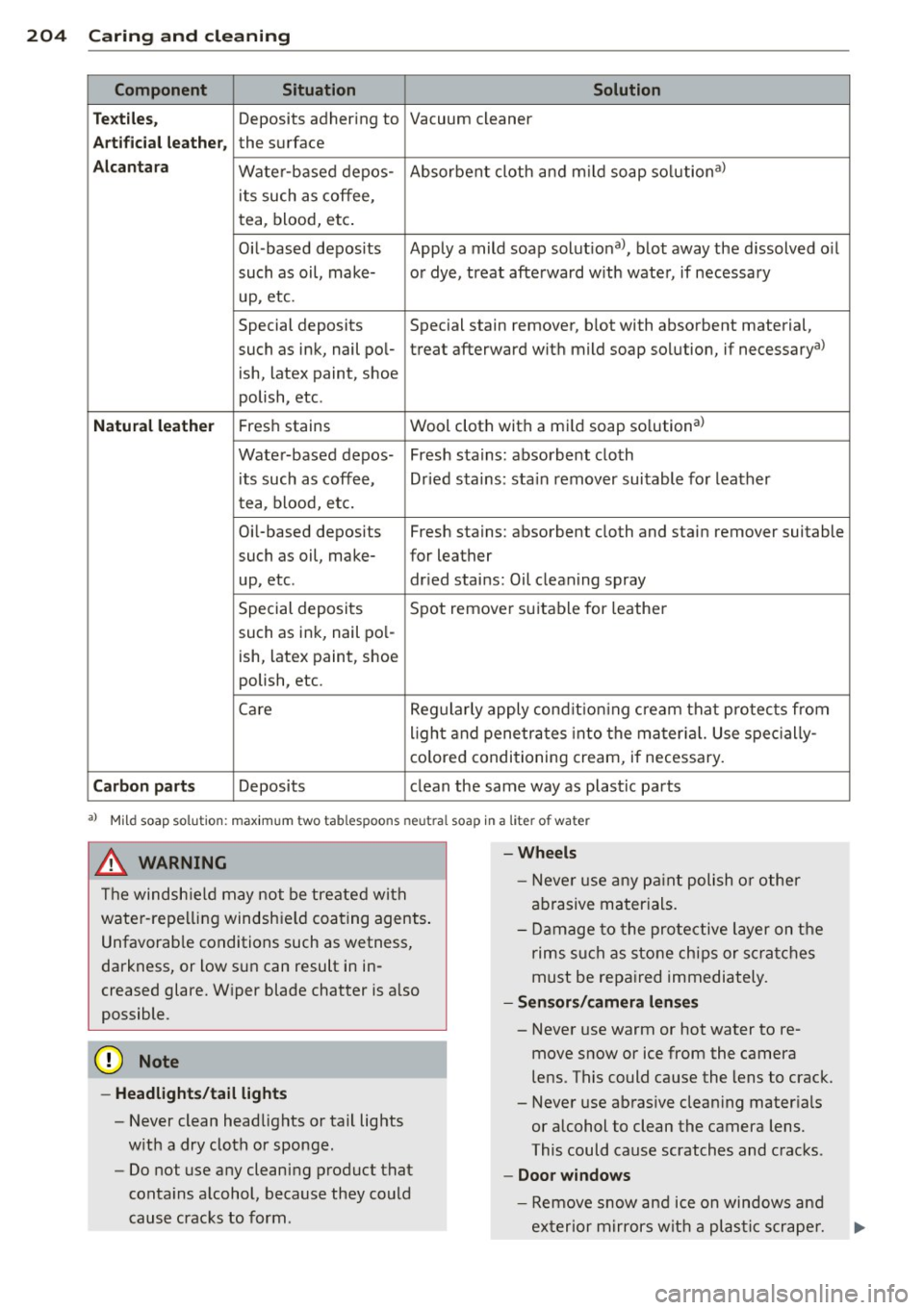
Component Situ ation Solution
Tex tile s,
Deposits adhering to Vacuum cleaner
Art ifi cial leat her, the surface
Alcan ta ra Water-based depos- Absorbent cloth and m
ild soap so lution a>
its such as coffee,
tea, blood, etc.
Oil-based deposits Apply
a mild soap solutiona >, blot away the dissolved o il
such as oil, make- o r dye, treat afterward w ith water, if necessary
up, etc.
Special deposits Special stain remover, blot with absorbent material,
such as ink, nail pol-treat afterward with mild soap so lution, if necessarya>
ish, latex paint, shoe
polish, etc.
Natura l leathe r Fresh stains Wool
cloth with a mild soap so lution a>
Water-based depos- Fresh stains: absorbent cloth its such as coffee, Dr ied stains: stain remover suitable for leather
tea, blood, etc.
Oi l-based deposits Fresh stains: absorbent cloth and stain remover suitable
such as oil, make- for leather
up, etc . dried stains: Oil clean ing spray
Special deposits Spot remover suitable for leathe r
such as ink, nail pol-
ish, latex paint, shoe
polish, etc.
Care Regularly apply condit ion ing cream that protects from
light and penetrates into the mater ial. Use spec ially-
co lored! conditioning cream, if necessary.
Carb on p art s Deposits clean th e same way as plastic parts
a) Mild soap solution: maximu m two tablespoons neutral soap in a liter of water
_& WARNING
The windsh ie ld may not be treated with
water-repelling windshield coating agents .
Unfavorab le conditions such as wetness,
darkness, or low sun can result in in
creased glare. Wiper blade chatter is also
possible.
([) Note
-Headlight s/tail li ght s
-Never clean headlights or tail lights
w ith a dry cloth or sponge.
- Do not use any cleaning product that
conta ins alcohol, because they could
cause cracks to form.
-
- Whee ls
- Never use any pa int polish or other
abrasive materials.
- Damage to the protective layer on the
rims s uch as stone chips or scratches
must be repaired immediately.
- Sen sors/ cam era len ses
-Never use warm or hot water to re-
move snow or ice from the camera
lens. This could cause the lens to crack.
- Never use abrasive cleaning mater ials
or alcohol to clean the camera lens.
This could cause scratches and cracks.
-Door windo ws
-Remove snow and ice on windows and
exter ior mirrors with a plastic scrape r.
Page 221 of 288
Brake fluid
Checking brake fluid level
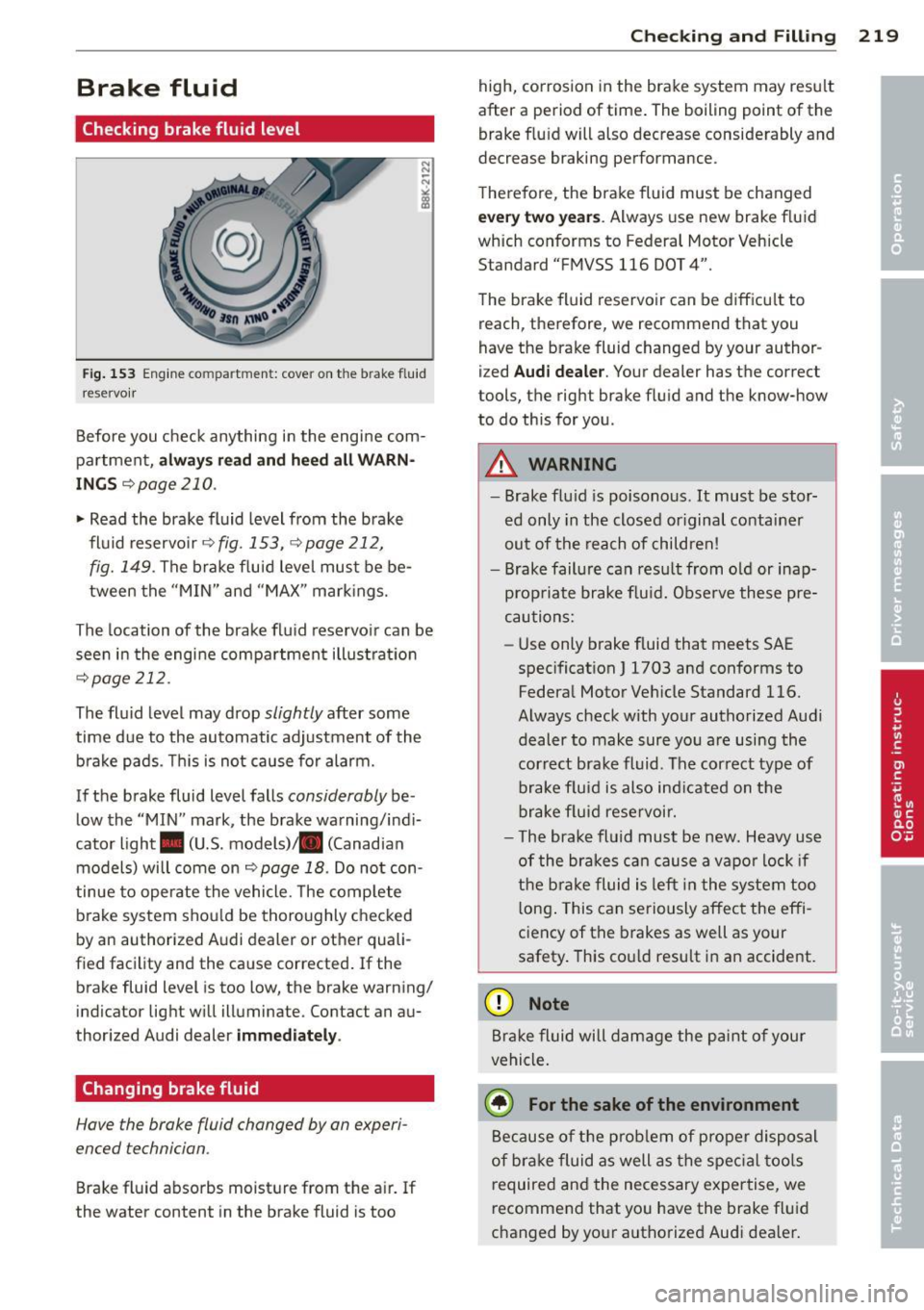
Fig . 153 Engine co mpa rtment: cove r on the b rake f lu id
reservo ir
B efore you check anything in the engi ne com
partment,
alwa ys read and heed all WARN ·
INGS r:=:,page 210 .
~ Read the brak e fluid level from the brake
fluid reservo ir
r:=;, fig . 153, r:=:, page 212,
fig. 149 .
The brake f luid leve l mus t be be
tween the "MIN" and "MAX " ma rkings.
The location of the brake flu id reservo ir can be
seen in the engi ne compa rtment illust ra ti on
¢ page 212 .
The fluid level may drop slightly after some
time due to the automatic adjustment of the b rake pads . Thi s is not cause for alarm.
If the brake fluid level falls
considerably be
low the "MIN" mark, the b rake wa rning/ind i
cato r light . (U .S . models)/ . (Canadian
models) will come on
r:=;, page 18 . Do not con
tinue to operate the vehicle. The comp lete
brake system should be thoroughly checked
by an authorized A udi dealer or other quali
f ied fac ility and the ca use corrected . If the
br ake fluid level is too low, the brake warning/
indica tor light w ill illuminate. Contact an au·
thor ized Audi dealer
immediately .
Changing brake fluid
Have the brake fluid changed by an experi
enced technician .
Brake fluid abso rbs moist ure from the air. If
the water content in the brake fluid is too
Che cking and Fillin g 219
high, co rrosion in the brake system may resu lt
after a period of time . The boiling point of the
brake f lu id will also decrease conside rably and
decrease braking performance.
T herefore, the brake fluid must be changed
eve ry two year s. Always use new brake f luid
which conforms to Federal Motor Veh icle
Standard "FMVSS 116 DOT 4".
The brake fluid reservoi r can be difficu lt to
reach, therefore, we recomm end that you
have the brake fluid changed by your author
i z ed
Audi dealer . Your dealer has the correct
tools, the right brake flu id and the know-how
to do this for you .
A WARNING
-
-Brake flu id is poisonous. It must be stor-
ed only in the closed or iginal containe r
out of the rea ch of children!
- Brake failure can resu lt from o ld or inap
p rop riate brake f lu id. Observe these pre
cautions:
- Use only brake f luid that meets SAE
spec ificat ion
J 1703 and conforms to
Federa l Motor Ve hicle Standard 116.
Always check with your authorized Audi
dealer to make sure yo u are using the
cor rect bra ke fluid. The cor rect type of
brake f luid is also i nd icated on t he
brake f lui d rese rvoir.
- The bra ke flu id must be new. Heavy us e
of the brake s can cause a vapo r lock if
the b ra ke fluid is left i n the system too
l ong . This can se riously affect the effi
ciency of the brakes as we ll as your
safety . This co uld resu lt i n an accident .
(D Note
Brak e fluid will dam age the pa int of your
vehicle .
@ For the sake of the environment
Because of the p rob lem of proper disposal
o f bra ke fluid as well as the spec ial too ls
r equired and the necessary exper tise, we
recommend that yo u have the brake flu id
changed by yo ur authorized Audi dea ler.
Page 222 of 288

220 Checking and Filling
Battery
General information
Under normal operating conditions, the bat
tery in your Audi does not need any mainte
nance. With
high outs ide temperatu res or
long daily drives we recommend that you have
the electro lyte level checked by a service fa
cility. The e lectrolyte level shou ld also be
checked each time the battery is charged
c:>page222.
Have the battery checked when you take your
vehicle in for service. You are well advised to replace a battery that is older than 5 years.
With certain types o f airbag deployment, the
battery is disconnected from the vehicle elec
trica l system for safety reasons
c;, .&. in Re
pair , care and disposal of the airbags on
page 156.
Disconnecting the battery terminals
Some vehicle functions such as power win
dows are unavai lable if the battery termina ls
are d isconnected. These functions have to be
relearned after the battery terminals are con
nected again. To prevent this, the battery
should only be disconnected from the vehicle
electrical system when absolutely necessary
for repairs .
To reprogram the functions, proceed as fol lows:
Function Reprogramming
Power window one-c;, page 40, Correcting
touch up/down power window mal-
function functions
Remote control key If the vehicle does not
or react to the key, it
convenience key must be synchroni zed
c:>page 33
Digital clock c:>page 10
ESC indicator light The indicator light
goes out after driving
a few meters
Vehicles not driven for long periods
If you do not drive your vehicle over a period
of severa l days or weeks, e lectrica l compo
nents are gradually sca led back or switched
off. This reduces energy consumption and
maintains starting capability over a longer pe
riod
c;, page 190. Some of the conven ience
functions may not operate, such as the interi
or lights or power seat adjustment. The con
venience functions will be availab le aga in
when you switch on the ignition and start the
engine.
Winter operation
During the winter months, battery capacity
tends to decrease as temperatures drop. This
is because more power is also consumed wh ile
sta rting, and the headlights, rear window de
fogger, etc. , are used more often.
Avoid unnecessary power consumpt ion, par
ticularly in city traffic or when traveling only
short distances. Let your authorized Aud i
dealer check the capacity of the vehicle bat
tery before winter sets in ~ page 222. A well
charged battery will not on ly prevent starting
problems when the weather is cold, but will
also last longer.
A WARNING -
-Work on the battery requ ires expert
know ledge. Contact your authorized Audi
dealer qualified repair facility for infor
mat ion regarding the vehicle battery.
There is a risk for chemical burns or ex
p losions.
- Never open the vehicle batte ry . Do not
try to change the battery electrolyte lev
el. Otherwise explosive gas will escape
from the battery and increase the risk of
an explosion .
(i) Tips
If your vehicle is left standing for several
weeks at extremely low temperatures, the
vehicle battery should be removed and
stored where it w ill not freeze. This will ..,.
Page 246 of 288
24 4 T ire s and wheel s
signal low tire pressure as intended. TPMS
malfunctions may occur for a variety of rea
sons, includ ing the installat ion of replace
ment or a lternate tires or whee ls on the veh i
cle that prevent the TPMS from funct ioning
properly . Always check the TPMS malfunct ion
telltale after replacing one or more t ires or
wheels on your veh icle to ensure that the re
p lacement or a lternate tires and wheels allow
the TPMS to continue to function properly.
If the Tire Pressure Monitoring System
indicator appears
Applies to vehicles: with tire pressure monitoring system
The tire pressure indicator in the instrument
cluster informs you if the tire pressure is too
low or if there is a system malfunction.
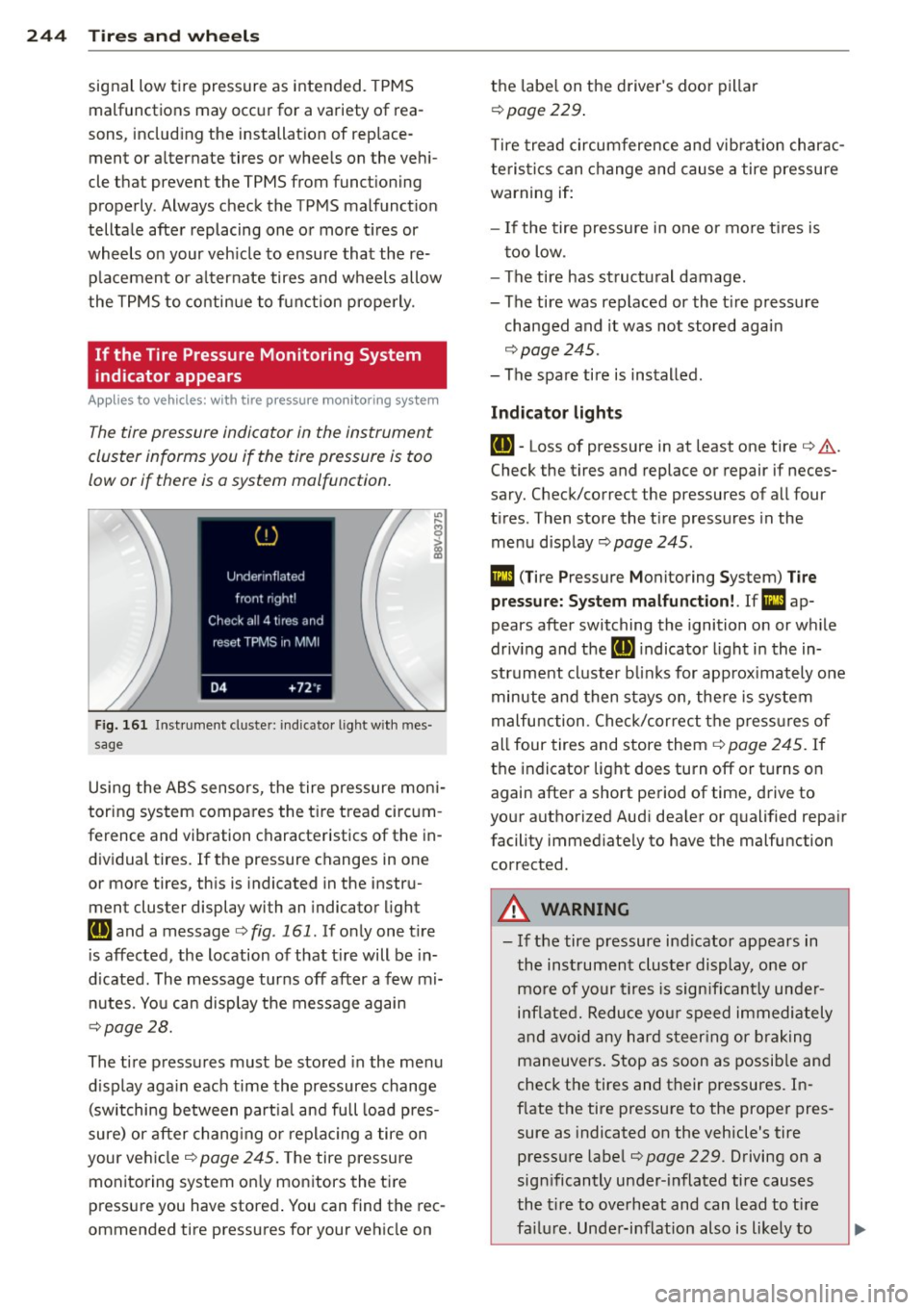
F ig. 161 Ins trumen t cluste r: ind icato r light w it h m es
s age
Using the ABS sensors, the tire pressure moni
toring system compa res the tire tread circum
ference and vibration characteristics of the in
dividual tires .
If the pressure changes in one
or more tires, th is is indicated in the instru
ment cluster display with an indicator light
IE and a message ¢ fig. 161 . If only one t ire
is affected, the location of that t ire will be in
d icated. The message turns off after a few mi
nutes. You can disp lay the message again
¢ page 28.
The tire pressures must be stored in the menu
d isplay aga in each time the pressures change
(switching between part ia l and full load pres
sure) or after chang ing or replac ing a tire on
your ve hicle ¢
page 245. The tire pressure
monitoring system on ly monitors the ti re
press ure you have stored . You can find the rec
ommended tire pressures for your vehicle on the
labe l on the driver's doo r pillar
¢ page 229 .
Tire tread circumference and vib ration charac
teristics can change and cause a tire pressure
warning if:
- I f the tire pressure in one or more ti res is
t oo low.
- The tire has structural damage.
- The tire was replaced or the t ire pressure
changed and it was not stored again
¢ page 245.
-The spare tire is installed .
Indicator lights
IE -Loss of pressure in at least one tire ¢ .&. .
Check the tires and replace or repair if neces
sary. Check/correct the pressures of all four
t ires . Then store the t ire pressures in the
menu display
¢ page 245.
Ill (T ire Pressure Monitoring System) T ire
pre ssure: S ystem mal function!. Ifm:!
ap
pears afte r switching the ignition on or w hile
driv ing and the [ti] indicato r light in the in
strument cluster b links for app rox imately one
minute and then stays on , the re is system
malfu nction . Check/cor rect the p ress ures of
all four tires and store them¢
page 245. If
t h e indicator lig ht does turn off or tu rns on
again after a short pe riod of time, drive to
your authori zed Aud i dea ler or qualified repair
facility immed iately to have the malfunction
corrected .
A WARNING
--- If the tire pressure ind icator appears in
the instrument cluster display , one or
mo re of your t ires is sign ifi cant ly unde r
i n flated. Reduce yo ur speed immedi ately
an d avoid any hard steer ing or b rak ing
maneuvers. Stop as soon as possib le and
check the tires and their pressures. In
f late the tire pressure to the proper pres
sure as indicated on the vehicle's tire
pressure labe l
¢page 229. Driving on a
significantly under-i nflated tire causes
the t ire to overheat and can lead to ti re
fa ilur e. Unde r-inflation also is li kely to