seats AUDI A3 2015 Owner's Manual
[x] Cancel search | Manufacturer: AUDI, Model Year: 2015, Model line: A3, Model: AUDI A3 2015Pages: 288, PDF Size: 71.46 MB
Page 127 of 288

-For adjustable head restraints: always
adjust the head restra int properly so that
it can give maximum protection.
Proper adjustment of head restraints
Applies to vehicles: with adjustable head restraints
Correctly adjusted head restraints are an im
portant part of your vehicle's occupant re
straint system and can help to reduce the risk of injuries in accident situations.
Fig. 110 Head restraint: v iewed from t he front
The head restraints must be correctly adjust
ed to achieve the best protection.
.,. Adjust the head restraint so the upper edge
is as even as poss ible with the top of your
head.
If that is not possible, try to adjust
the head restraint so that it is as close to
this position as possible
r:!.> fig . 110. Move
the head restraint so that it is as close to the
back of the head as possible.
.,. If there is a passenger on the rear center
seat ing position, slide the center head re
stra int upward at least to the next notch .
Adjusting head restraints ¢
page 55.
_& WARNING
All seats are equipped with head re
straints. Dr iving without head restraints or
w ith head restraints that are not properly
adjusted increases the risk of serious or fa
tal neck injury dramat ically . To help reduce
the risk of injury:
- Always drive with the head restraints in
place and properly adjusted.
- Every person in the veh icle must have a
properly ad justed head restra int.
Driving safety 125
-Always make sure each person in the ve
hicle properly ad justs their head re
straint. Adjust the head restraint so the
upper edge is as even as possible with
the top of your head.
If that is not possi
ble, try to adjust the head restraint so
that it is as close to this position as pos
sible. Move the head restraint so that it
is as close to the back of the head as pos
sible.
- Never attempt to adjust head restraint
while driving. If you have driven off and
must adjust the driver headrest for any
reason, first stop the vehicle safely be
fore attempting to adjust the head re
straint .
- Ch ildr en must a lways be properly re
strained in a child restraint that is appro
priate for their age and size¢
page 166.
Examples of improper seating positions
The occupant restraint system can only re
duce the risk of injury if vehicle occupants are
properly seated .
Improper seating positions can cause serious
injury or death. Safety belts can only work
when they are properly positioned on the body. Improper seating positions reduce the
effectiveness of safety belts and will even in
crease the r isk of injury and death by mov ing
the safety belt to crit ical areas of the body.
Improper seating positions a lso inc rease the
risk of serious injury and death when an air
bag deploys and strikes an occupant who is
not in the proper seating position . A driver is
responsible for the safety of all veh icle occu
pants and espec ially for children. Therefore :
.,. Never allow anyone to assume an incorrect
seating position when the vehicle is being
used
r:!.> _&. .
The following bulletins list only some sample
positions that will increase the risk of serio us
injury and death. Our hope is that these exam
ples will make yo u more aware of seating po-
sitions that are dangerous. ..,.
Page 128 of 288
126 Driving saf ety
Th ere fo re, wh enever th e vehicle i s
mo ving :
-never stand up in the vehicle
- never stand on the seats
- never knee l on the seats
- never ride with the seatback reclined
- never lie down on the rear seat
- never lean up aga inst the instrument panel
- never sit on the edge of the seat
- never sit sideways
- never lean out the w indow
- never put your feet out the window
- never put your feet on the instrument panel
- never rest your feet on the seat cushion o r
back of the seat
- never ride in the footwell
- never ride in the cargo area
A WARNING
Improper seat ing positions increase the
r isk of serious personal injury and death
whenever a veh icle is being used .
- Always make sure that all vehicle occu pants stay in a proper seating pos it ion
and are properly restra ined whenever the
vehicle is be ing used.
Driver and passenger
side footwell
Important safety instructions
App lies to vehicles: with knee a irbags
A WARNING
Always make s ure that the knee airbag can
inflate without interference. Objects be
tween yourse lf and the airbag can inc rease
the risk of in jury in an acc ident by interfer
ing w ith the way the a irbag deploys or by
being pushed into you as the airbag de
ploys.
- No persons (ch ildren) or animals should
ride in the footwell in front of the pas
senger seat. If the airbag deploys, this
can result in se rious or fata l injuries.
- No objects of any kind should be carried in the footwe ll area in front of the driv- er's or passenger's seat
. Bulky objects
(shopping bags, for example) can ham
per or prevent proper deployment of the
ai rbag. Small objects can be thrown
through the vehicle if the airbag deploys
and i njure you or your passenge rs .
Pedal area
Pedals
The pedals must always be free to move and
must never be interfered with by a floor mat
or any other object.
Make su re that a ll peda ls move free ly without
i nterference and that no thing preven ts them
from return ing to their or ig inal positions .
Only use f loor mats that leave the pedal a rea
free and can be secu red with floor mat fasten
ers.
If a brake c ircu it fa ils, inc reased brake pedal
t ravel is required to bring the vehicle to a full
stop.
A WARNING
P edals that cannot move free ly can ca use
l oss of vehicle contro l and increase the risk
of serious injury.
- Never p lace any objects in the driver's
footwell. An object co uld get into the
pedal area and interfere with pedal func
tion. In case of sudden braking or an ac
cident, you wou ld not be able to brake or
accelerate!
-Always make sure that nothing can fall
or move into the driver's footwell.
Floor mats on the driver side
Always use floor mats that can be securely attached to the floor mat fasteners and do
not interfere with the free movement of the
pedals.
.,. Make sure that the floor mats are properly
secured and cannot move and interfere with
the pedals
¢ A . ..,_
Page 133 of 288
Safety belts
General notes
Always wear safety belts!
Wearing safety belts correctly saves lives!
T his chapter explains why safety belts are nec
essary, how they work and how to adjust and
wear them correctly .
~ Read all the information that follows and
heed all of the instructions and WARNINGS.
A WARNING
Not wearing safety belts or wearing them
improperly increases the risk of serious
personal injury and death.
- Safety belts are the single most effective
means available to reduce the risk of se
rious injury and death in automobile acci
dents. For your protection and that of
your passengers, always correctly wear
safety belts when the vehicle is moving .
- Pregnant women, injured, or physically
impaired persons must also use safety
belts. Like all vehicle occupants, they are
more likely to be seriously injured if they
do not wear safety belts. The best way to
protect a fetus is to protect the mother -
throughout the entire pregnancy.
Number of seats
Your Audi has a total of five seating positions:
two in the front and three in the rear. Each
seating position has a safety belt .
A WARNING
Not wearing safety belts or wearing them
improperly increases the risk of serious
personal injury and death.
- Never strap more than one person, in
cluding small children, into any belt. It is
especially dangerous to place a safety
belt over a child sitting on your lap.
- Never let more people ride in the vehicle
than there are safety belts available.
Safety belts 131
-Be sure everyone riding in the vehicle is
properly restrained with a separate safe
ty belt or child restraint.
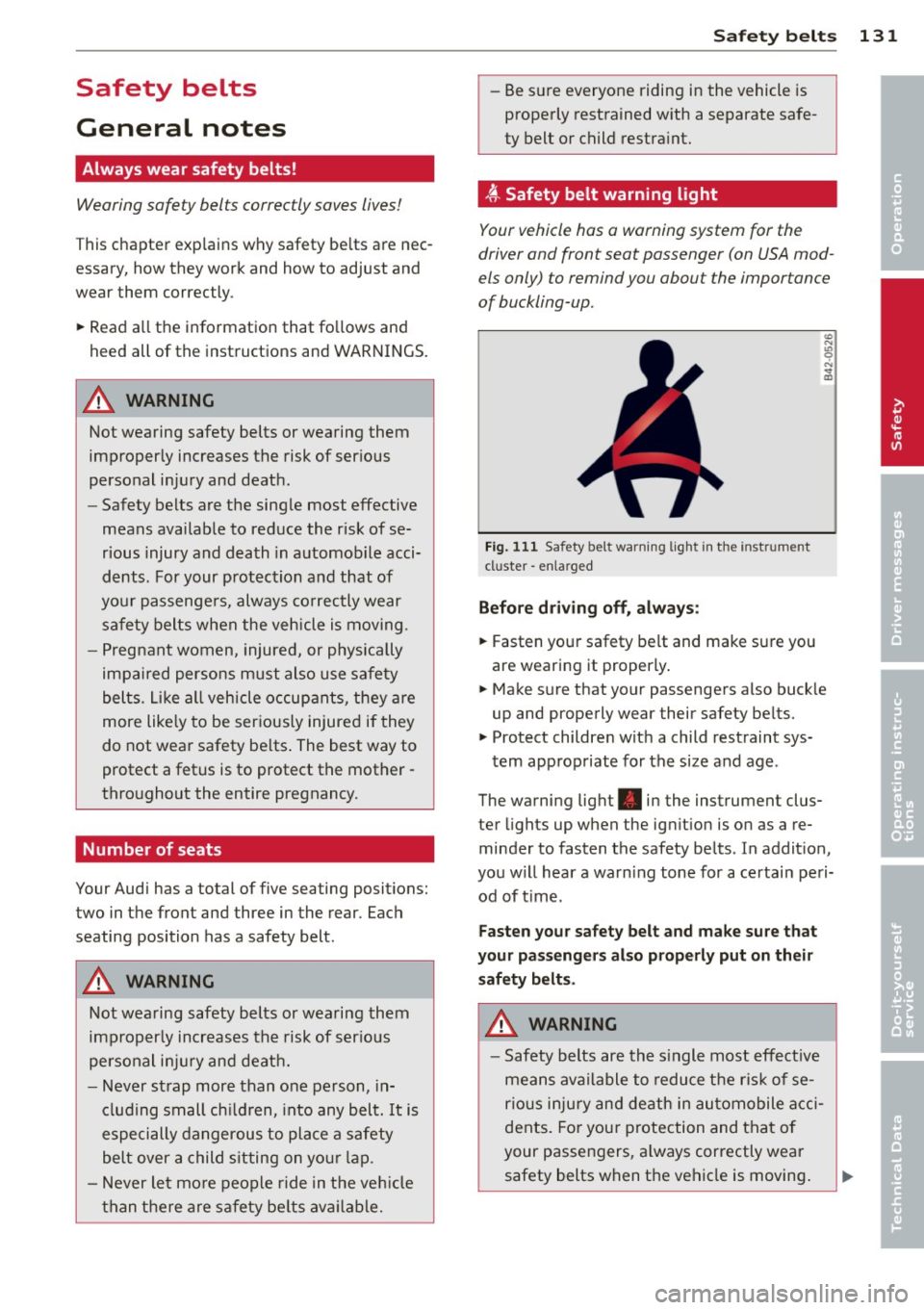
~ Safety belt warning light
Your vehicle has a warning system for the
driver and front seat passenger (on USA mod
els only) to remind you abou t the importance
of buckling-up.
Fig. 111 Safety bel t warn ing light in the instr ume nt
cl uster -enla rged
Before driving off, always:
~ Fasten your safety belt and make sure you
are wearing it properly.
~ Make sure that your passengers also buckle
up and properly wear their safety belts.
~ Protect children with a child restraint sys-
tem appropriate for the size and age .
The warning light . in the instrument clus
ter lights up when the ignition is on as a re
minder to fasten the safety belts . In addition,
you will hear a warning tone for a certain peri
od of time .
Fasten your safety belt and make sure that
your passengers also properly put on their
safety belts.
A WARNING
- Safety belts are the single most effective
means available to reduce the risk of se
rious injury and death in automobile acci
dents. For your protection and that of
your passengers, always correctly wear
safety belts when the vehicle is moving. •
•
•
Page 135 of 288
occupant will slam violently into the steering
wheel, instrument panel, windshield, or what
ever else is in the way
c::> fig. 114. This impact
with the vehicle interior has all the energy
they had just before the crash.
Never rely on airbags alone for protection.
Even when they deploy, airbags provide only
additional protection. Airbags are not sup
posed to deploy in all kinds of accidents. Al
though your Audi is equipped with airbags, all
veh icle occupants, including the driver, must
wear safety belts correctly in order to mini
mize the risk of severe injury or death in a
crash.
Remember too, that airbags will deploy only
once and that your safety belts are always
there to offer protection in those accidents in
which airbags are not supposed to deploy or
when they have already deployed. Unbelted
occupants can also be thrown out of the vehi
cle where even more severe or fatal injuries
can occur.
It is also important for the rear passengers to
wear safety belts correctly. Unbelted passen
gers in the rear seats endanger not only them
selves but also the driver and other passen
gers
c::> fig. 115. In a frontal collision they will
be thrown forward violently, where they can
hit and injure the driver and/or front seat pas
senger.
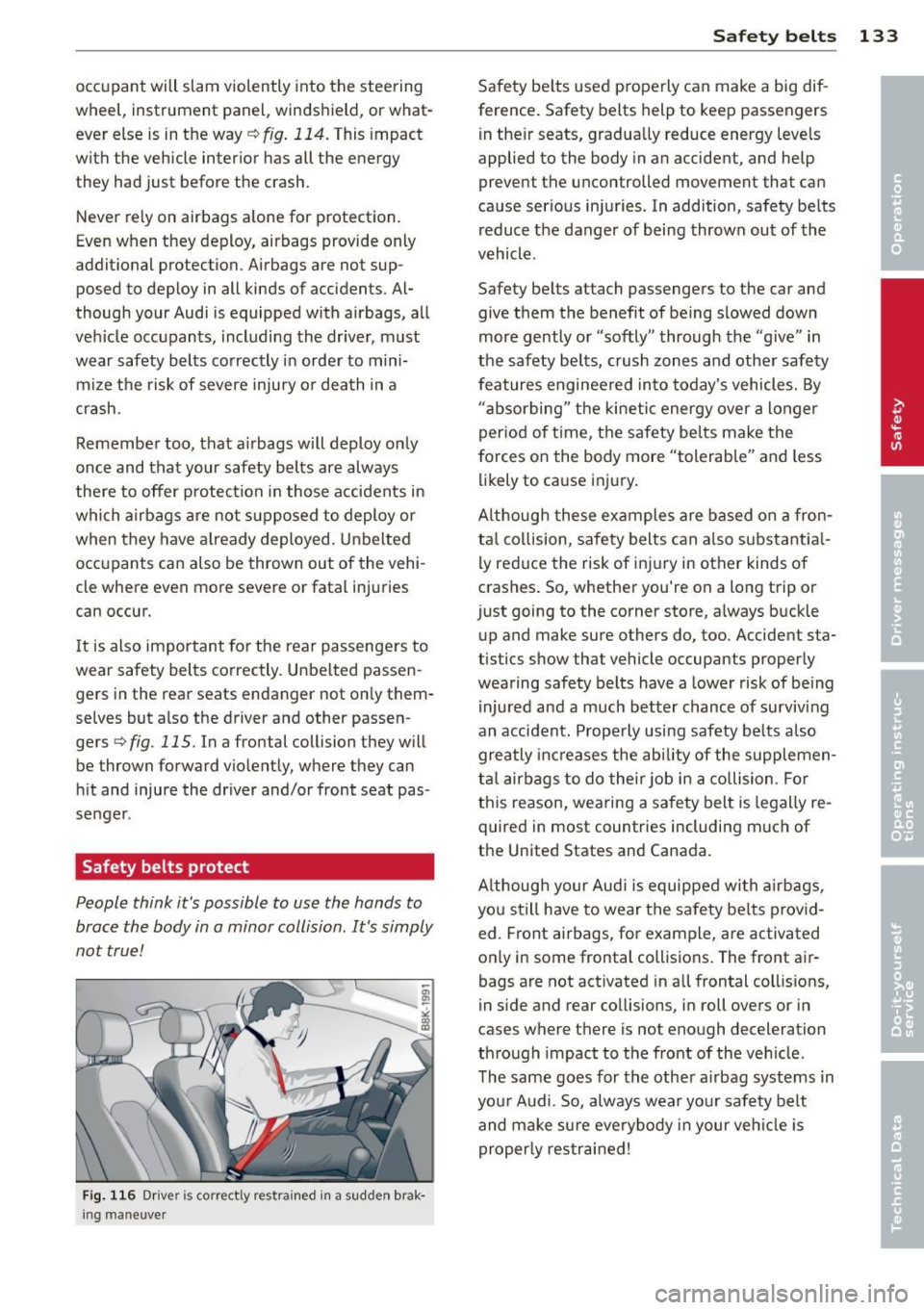
Safety belts protect
People think it's possible to use the hands to
brace the body in a minor collision. It's simply
not true!
Fig. 116 Driver is correctly restra ined in a sudden brak
ing maneuver
Safety belts 133
Safety belts used properly can make a big dif
ference. Safety belts help to keep passengers
in their seats, gradually reduce energy levels
applied to the body in an accident, and help
prevent the uncontrolled movement that can
cause serious injuries. In addition, safety belts
reduce the danger of being thrown out of the
vehicle.
Safety belts attach passengers to the car and
give them the benefit of being slowed down
more gently or "softly" through the "give" in
the safety belts, crush zones and other safety
features engineered into today's vehicles. By
"absorbing" the kinetic energy over a longer
period of time, the safety belts make the
forces on the body more "tolerable" and less
likely to cause injury .
Although these examples are based on a fron
tal collision, safety belts can also su bsta ntia l
ly reduce the risk of injury in other kinds of
crashes. So, whether you're on a long trip or
just going to the corner store, always buckle
up and make sure others do, too. Accident sta
tistics show that vehicle occupants properly
wearing safety belts have a lower risk of being
injured and a much better chance of surviving
an accident. Properly using safety belts also
greatly increases the ability of the supplemen
tal airbags to do their job in a collision . For
this reason, wearing a safety belt is legally re
quired in most countries including much of
the United States and Canada.
Although your Audi is equipped with airbags,
you still have to wear the safety belts provid
ed. Front airbags, for example, are activated
only in some frontal collisions. The front air
bags are not activated in all frontal collisions,
in side and rear collisions, in roll overs or in
cases where there is not enough deceleration
through impact to the front of the vehicle.
The same goes for the other airbag systems in
your Audi. So, always wear your safety belt
and make sure everybody in your vehicle is
properly restrained!
Page 137 of 288
To provide maximum protection, safety belts
must always be positioned correctly on the
wearer's body.
... Adjust the front seat and head restraint
properly
c::> page 53, Front seats.
• Make sure the seatback of the rear seat
bench is in an upright position and securely
latched in place before using the belt
c::> ,&..
... Hold the belt by the tongue and pull it even
ly across the chest and pelvis
c::> ,&. .
""Insert the tongue into the correct buckle of
your seat until you hear it latch securely
c::>fig. 117.
.., Pull on the belt to make sure that it is se-
curely latched in the buckle.
Automatic safety belt retractors
Every safety belt is equipped with an automat
ic belt retractor on the shoulder belt . This fea
ture locks the belt when the belt is pulled out
fast, during hard braking and in an accident.
The belt may also lock when you drive up or
down a steep hill or through a sharp curve. During normal driving the belt lets you move
freely.
Safety belt pretensioners
The safety belts are equipped with a belt pre
tensioner that helps to tighten the safety belt
and remove slack when the pretensioner is ac
tivated
c::> poge 137. The function of the pre
tensioner is monitored by a warning light
c::> page 21.
Switchable locking feature
Every safety belt except the one on the driver
seat is equipped with a switchable locking fea
ture that
must be used when the safety belt is
used to attach a child seat. Be sure to read the important information about this feature
c::> page 177 .
A WARNING
Improperly positioned safety belts can
cause serious injury in an accident
c::> page 135, Safety belt position.
-Safety belts offer optimum protection
only when the seatback is upright and
Safety belts 135
belts are properly positioned on the
body.
- Always make sure that the rear seat
backrest to which the center rear safety
belt* is attached is securely latched
whenever the rear center safety belt is
being used. If the backrest is not secure
ly latched, the passenger will move for
ward with the backrest during sudden
braking, in a sudden maneuver and espe
cially in a crash .
- Never attach the safety belt to the buck
le for another seat . Attaching the belt to
the wrong buckle will reduce safety belt
effectiveness and can cause serious per
sonal injury.
- A passenger who is not properly restrain
ed can be seriously injured by the safety
belt itself when it moves from the stron
ger parts of the body into critical areas
like the abdomen.
- Always lock the convertible locking re
tractor when you are securing a child seat in the vehicle
c::> page 179.
(D Tips
For information on safety belt pretension
ers, refer to
c::> page 13 7.
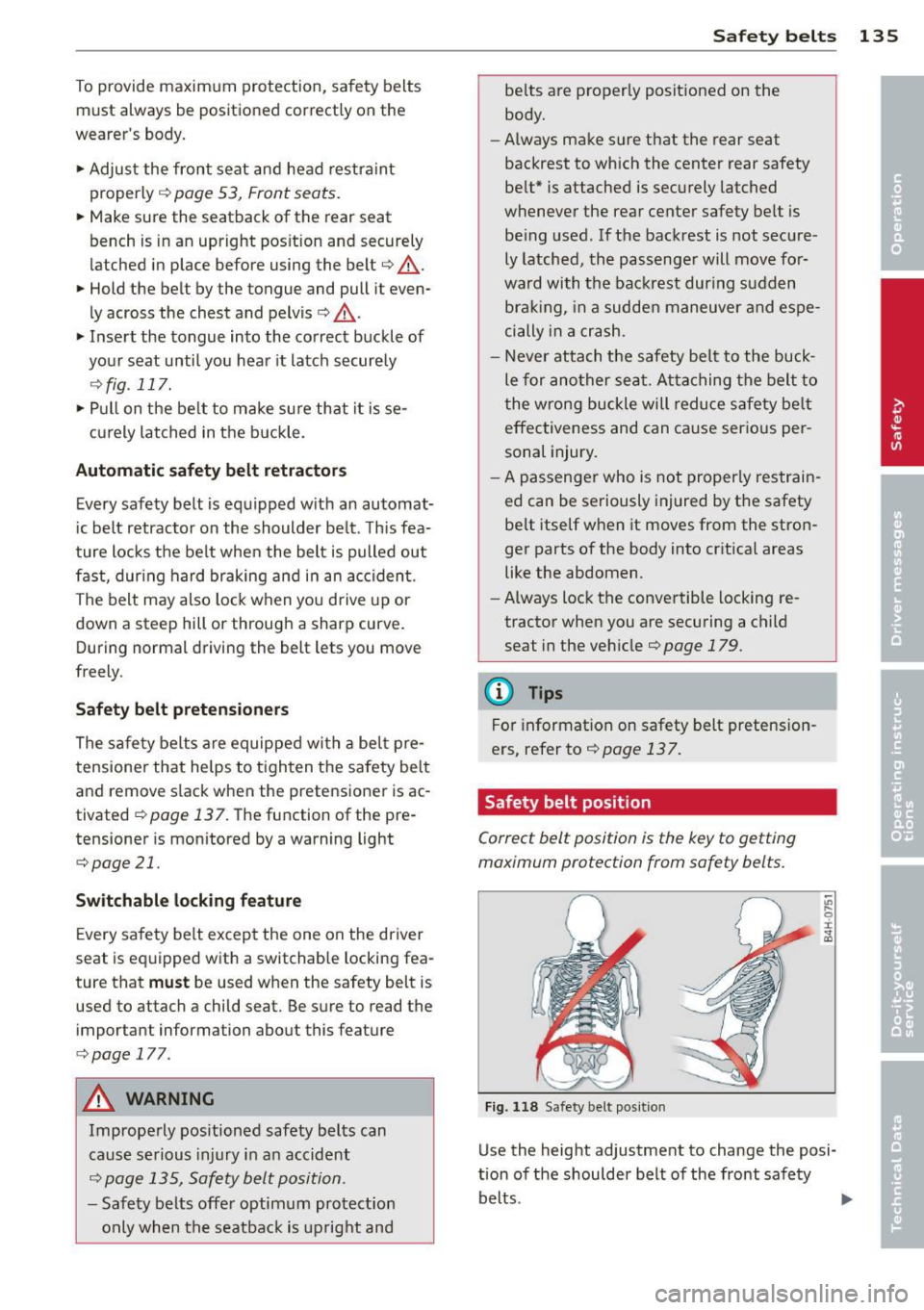
Safety belt position
Correct belt position is the key to getting
maximum protection from safety belts.
Fig. 118 Safety belt position
Use the height adjustment to change the posi
tion of the shoulder belt of the front safety
belts .
~
Page 138 of 288

136 Safet y belt s
A WARNING
Imprope rly positioned safety belts can
cause serious persona l injury in an acci
dent.
-
- The shoulder belt shou ld lie as close to
the center of the collar bone as poss ible
and should fit we ll on the body. Hold the
belt above the latch tongue and pull it
evenly across the chest so that it sits as
low as possible on the pelvis and there is
no p ressure on the abdomen. The be lt
sho uld a lways f it snugly
¢ fig . 118. Pull
on the be lt to tighten if necessary.
- A loose-fitt ing safety be lt can cause seri
o us in juries by s hifting its position on
yo ur body from the stro ng bones to more
vulnerab le, so ft tissue and cause serious
injury.
- Alw ays re ad and heed all WARN INGS and
other impor tant in format io n
¢ page 134.
Pregnant women must al so be correctly
restrained
The best way to protect the fetus is to moke
sure that expectant mothers always wear
safety belts correctly -throughout the preg
nancy.
Fi g. 1 19 Safety be lt pos ition du ring preg nancy
To provide maxim um protection, safety belts
must always be pos it io ned correctly on the
wearer 's body
¢ page 135.
.,. Adjust the front seat and adjustable head
restraint* correctly
c::> page 53, Front seats .
.,. Ho ld the belt by the tongue and pu ll it even
ly across the chest and pelvis¢
fig. 119,
¢ _&..
.,. Insert the tongue into the correct buck le of
your seat unt il you hear it latch securely
¢page 134, fig . 117.
.,. Pull on the belt to make sure that it is se·
curely latched in th e buckle .
_& WARNING
Imprope rly posit io ned safety be lts ca n
c a use ser ious perso nal in ju ry in an a cci
den t.
-
- Expe cta nt mo thers m ust alw ays wea r the
lap portion of the safety belt as low as
possible across the pelvis and below t he
round ing of the abdomen.
- Always read and heed all WA RNINGS and
other important information¢.&.
in Fas
tening safety belts on page 135.
Unfastening safety belts
Unbuckle the safety belt with the red release
button only after the vehicle has stopped .
Fig. 120 Releas ing the tong ue fro m the buck le
.,. Push the red release button on the buckle
¢ fig. 120 . The be lt tongue will spring out
of the buckle
¢ _& .
.,. Le t the belt wind up on the retractor as you
gu ide the be lt tongue to its stowe d posi tion .
_& WARNING
Neve r unfa sten sa fety belt whi le the vehi
cle is moving. Doing so will increase yo ur
risk of being in ju red o r killed.
Page 139 of 288

Adjusting safety belt height
With the aid of the safety belt height adjust
ment, the three point safety belt strap rout
ing can be fitted to the shoulder area, accord
ing to body size .
Fig. 121 Safety belt height ad justmen t for th e front
seats -loop -aro un d fit tings
The shoulder belt should lie as close to the
center of the collar bone as possible and
should fit well on the body ¢,&.
in Safety belt
position on page 136.
.,. Push
the loop -around fittings up c> fig . 121
@ , or
.,. squeeze together the@button, and push
the loop-around fittings down@.
.,. Pull the belt to make sure that the upper at
tachment is properly engaged.
A WARNING
Always read and heed all WARNINGS and
other important information
c> page 134.
@ Tips
With the front seats, the height adjust
ment of the seat can also be used to adjust
the position of the safety belts.
Improperly worn safety belts
Incorrectly positioned safety belts can cause severe injuries.
Wearing safety belts improperly can cause se
rious injury or death. Safety belts can only
work when they are correctly positioned on
the body. Improper seating positions reduce
the effectiveness of safety belts and will even increase the risk of injury and death by mov-
Safety belts 13 7
ing the safety belt to critical areas of the
body. Improper seating positions also in
crease the risk of serious injury and death
when an airbag deploys and strikes an occu
pant who is not in the correct seating posi
tion . A driver is responsible for the safety of
all vehicle occupants and especially for chil
dren . Therefore:
.,. Never permit anyone to assume an incorrect
sitting position in the vehicle while traveling
~ .&. -
A WARNING
Improperly worn safety belts increase the
risk of serious persona l injury and death
whenever a vehicle is being used.
- Always make sure that all vehicle occu
pants are correctly restrained and stay in
a correct seating position whenever the
vehicle is being used.
-Always read and heed all WARNINGS and
other important information
r:::>page 134 .
Safety belt preten
sioners
How safety belt pretensioners work
In front, side and rear-end collisions above a
particular severity and in a rollover, safety
belts are tensioned automatically .
Reversible safety belt tensioners
The safety belts on the front seats are equip
ped with power reversible tensioners . The fol
lowing functions are avai lable when the driv
er's/front passenger's safety belts are fas
tened:
-Automatic tensioners: at the start of a drive,
the safety belts automatically adjust to the
passenger after a certain time period or ve
hicle speed . To switch the automatic ten
sioners off, select the following in the MMI: .,..
Page 145 of 288
Fo r exa mple, the a irbag may depl oy if:
-a small child that is heavier than a typical 1
year-o ld child is on the front passe nger seat
(regardless of whether the child is in one of
the chi ld seats listed
page 168), or
- a ch ild who has outgrown child rest raints is
on the front passenger seat.
If the front passenger airbag is turned off, the
P ASS ENGER AIR B AG OFF light comes on in
the instrument cluster and stays on.
If the front passenger airbag deploys, the
Federal Standard requires the airbag to meet
the "low risk" deployment criter ia to reduce
the r isk of injury through interaction with the
airbag. "Low risk" deployment occurs in those
crashes that take place at lower decelerations
as defined in the electronic control unit
r::> page 153, PASSENGER AIR BAG OFF light.
Always remember, a chi ld seat or infant carri
er insta lled on the front seat may be struck
and knocked out of position by the rapidly in
flating passenger's airbag in a frontal colli
sion. The airbag could greatly reduce the ef
fectiveness of the child restraint and even se
riously injure the child during inflat ion.
For this reason, and because the back seat is
the safest place for children - when properly
restrained according to their age and size - we
strongly recommend that children always sit
in the back seat
r::> page 166, Child Safety .
A WARNING
A child in a rearward-facing child seat in
stalled on the front passenger seat will be
ser iously injured and can be killed if the
front airbag inflates -even with an Ad
vanced Airbag System .
- T he inflating airbag will hit the child seat
or infant carrier with great force and wi ll
smash the child seat and child against
the backrest, center armrest, door or roof.
- Always install rear-facing child seats on
the rear seat.
- If you must install a rearward facing
child seat on the front passenger seat
-
A irbag system 143
because of exceptional circumstances
and the
PAS SENGER AIR BAG OFF light
does not come on and stay on, immed i
ately install the rear-fac ing child seat in a
rear seat ing pos ition and have the airbag
system inspected by your A udi dealer.
- Forward-facing child seats installed on the front passenger's seat may interfere
with the dep loyment of the a irbag and
cause serious persona l injury to the
child.
A WARNING
If, in except iona l circumstances, you must
install a forward -facing child restraint on
the front passenger's seat:
- Always ma ke s ure the forward-facing
seat has been designed and certified by its manufacturer for use on a front seat
with a passenger front and s ide a irbag.
- Never put the forward-facing child re
straint up against or very near the instru
ment panel.
- Always move the passenge r seat into its
rea rmost pos ition in the seat's fore and
aft ad justment range, as far away from
the airbag as possible before installing
the forward-fac ing ch ild restra int. The
backrest must be adjusted to an upright
position.
- Make sure that the
PASSENGER AIR BAG
OFF
l ight comes on and stays on all the
time wheneve r the ig nit ion is switched
on.
A WARNING
To reduce the ri sk of ser ious injury, ma ke
sure that the
PASSENGER AIR BAG OFF
light w ill be displayed whenever a child re
straint is insta lled on the front passenger
seat and the ignition is switched on.
- If the PASSENGER AIR BAG OF F light
does not stay on, perform the checks de
scribed
¢ page 152, Monitoring the Ad-
vanced Airbag System.
~
•
•
•
Page 146 of 288
144 Airbag system
-Take the child restraint off the front pas
senger seat and install it properly at one
of the rear seat positions if the
PA SS EN
GE R AI R BAG OFF
light does not stay on .
- Have the airbag system inspected by
your Audi dealer immed iately.
- Always carefully follow instructions from
child restraint manufacturers when in
sta lling child restraints .
A WARNING ,.
If, in exceptional c ircumstances, you must
install a forward or rearward-fac ing child
restraint on the front passenge r's seat:
- Improper installation of child restraints
can reduce their effectiveness or even
prevent them from providing any protec
t ion.
- An improperly installed child restraint
can interfere with the airbag as it de
ploys and serio usly injure or even kill the
child -even wi th an Advanced Airbag
System.
- Always carefully follow the manufactur
er's instructions provided with the child
seat or car rier .
- Always m ake su re that there is nothing
on the front passenger seat that will
cause the capacitive passenger detection
system in the seat to s ignal to the Airbag
System that the seat is occupied by a person when it is not, or to signal that it
is occupied by someone who is heavier
than the pe rson actually s itting on the
seat. The presence of additiona l objects
cou ld cause the passenger front airbag
to be t urned on w hen it sho uld be off, or
cou ld cause the ai rbag to work in a way
that is different from the way it wou ld
have worked without the object on the
seat.
Front airbags
Description of front airbags
The airbag system can provide supplemental
protection to properly restrained front seat occupants .
Fig . 122 Loc atio n of drive r air b a g : i n stee ring wheel
Fig. 123 Loc ation of fro nt passe nge r's a irbag: in the in
str umen t pa nel
Your vehicle is equipped with an "Advanced
Airbag System " in compliance with Un ited
States Federa l Motor Veh icle Safety Standard
(FMVSS) 208 as applicable at the time you r
vehicle was manufactured . The safety belts
for the seats have "pretensioners" that help to take slack out of the belt system. The pre
ten sioners are also act ivated by the electronic
control unit for the airbag system.
T he front safety belts also have load lim iters
to help reduce the forces applied to the body
in a crash.
The airbag for the driver is in the steering
whee l hub
c:> fig. 122 and the airbag fo r the
front pas senger is in the instr ument panel
c::;, fig . 123. The gener al location of the a irbags
is marked "AIRBAG".
T here is a lot you need to know about the a ir
bags in your vehicle. We urge you to read the
II>
Page 148 of 288
146 Airbag sys te m
U.S. Federal Standard if a chi ld with elec
trical capac itance greater than the com
bined capacitance of a typical one-year
old infant restra ined in one of the for
ward fac ing or rearward-fac ing ch ild
seats with which your vehicle was certi
fied is on the front passenger seat and
the other conditions for airbag deploy ment are met.
- Acc ident statist ics have shown that chil
dren are generally safer in the rear seat
area than in the front seating posit ion .
- For their own safety, all chi ldren, espe
ci ally 12 years and younger, sho uld a l
ways ride in the back properly rest rained
for their age and size .
Advanced front airbag system
Your vehicle is equipped with a front Advanced
Airbag System in compliance with United
States Federal Motor Vehicle Safety Standard
208 as applicable at the time your vehicle was manufactured.
The front Advanced Airbag System supple ments the safety belts to provide addit ional
protection for the driver's and front passeng
er's heads and upper bodies in frontal crashes .
The airbags inflate only in frontal impacts
when the vehicle dece le rat io n is high enoug h.
The front Advanced Airbag System for the
fro nt seat occupants is not a substitute for
your safety belts . Rather, it is part of the over
a ll occupa nt restraint system in your veh icle.
A lways remember that the airbag system ca n
on ly help to pro tect you, if you are s itting up
right, wearing yo ur safety belt and wearing it
properly. This is why you and yo ur passengers
must always be properly restrained, not just
beca use the law requires you to be.
The Advanced Airbag System in your veh icle
has been certified to meet the " low risk" re
qu irements for 3 and 6 year-o ld children on
the passenger side and very small adu lts on
the dr iver side. The low risk deployment crite
ria are intended to he lp reduce the risk of in
jury through interaction with the front airbag that can occur, for example, by being too
close to the steering wheel and instr ument
panel when the airbag inflates .
In add ition, the system has been cer tified to
comply with the "s uppression" requirements
of the Safety Standard, to turn off the front
airbag for infants 12 months o ld and younger
who are restrained on the front passenger
seat in child restraints that are listed in the
Standard
Q page 168, Child restraints and
Advanced front airbag system .
"Suppression" requires the front a irbag on the
passenger side to be turned off if:
- a child up to abo ut one year of age is re
strained on the front passenger seat in one
of the rear-fac ing or forward-facing infant
restraints listed in Federal Motor Vehicle
Safety Standard 208 with which the Ad
vanced A irbag System in your veh icle was
cert ified . Fo r a listing of the chi ld restraints
t hat were used to certify your vehi cle's com
p lia nce w it h t he US Sa fety S tandard
Qpage 168,
-When a pe rson is detec ted o n the front pas
senger seat tha t has an elec trica l capa ci
tance that is more than the tota l electrical
capacitance of a child that is about 1 year
old restrained in one of the rear-facing or
forward-facing infant restraints (listed in
Federal Motor Vehicle Safety Standard 208
w ith which the Advanced A irbag System in
your veh icle was certified), the front airbag
on the passenger side may or may not de p loy .
The
PASS ENG ER AIR BAG OFF light comes on
when the elect ronic cont ro l unit detects a to
ta l elect rical capac itance on the front passen
ger seat that requ ires the front a irbag to be
tu rned off. If the
PASSENGER AIR BAG OFF
ligh t does not come on, the front airbag on
t h e passenger side has not been turned off by
the control unit and can deploy if the contro l
u nit senses an impact that meets the condi
t ions stored in its memory.
If the total e lectr ica l capacitance regis tered
on the front passenger seat is more than that
ll-