ESP AUDI A3 2015 Repair Manual
[x] Cancel search | Manufacturer: AUDI, Model Year: 2015, Model line: A3, Model: AUDI A3 2015Pages: 288, PDF Size: 71.46 MB
Page 205 of 288
Caring and cleaning 203
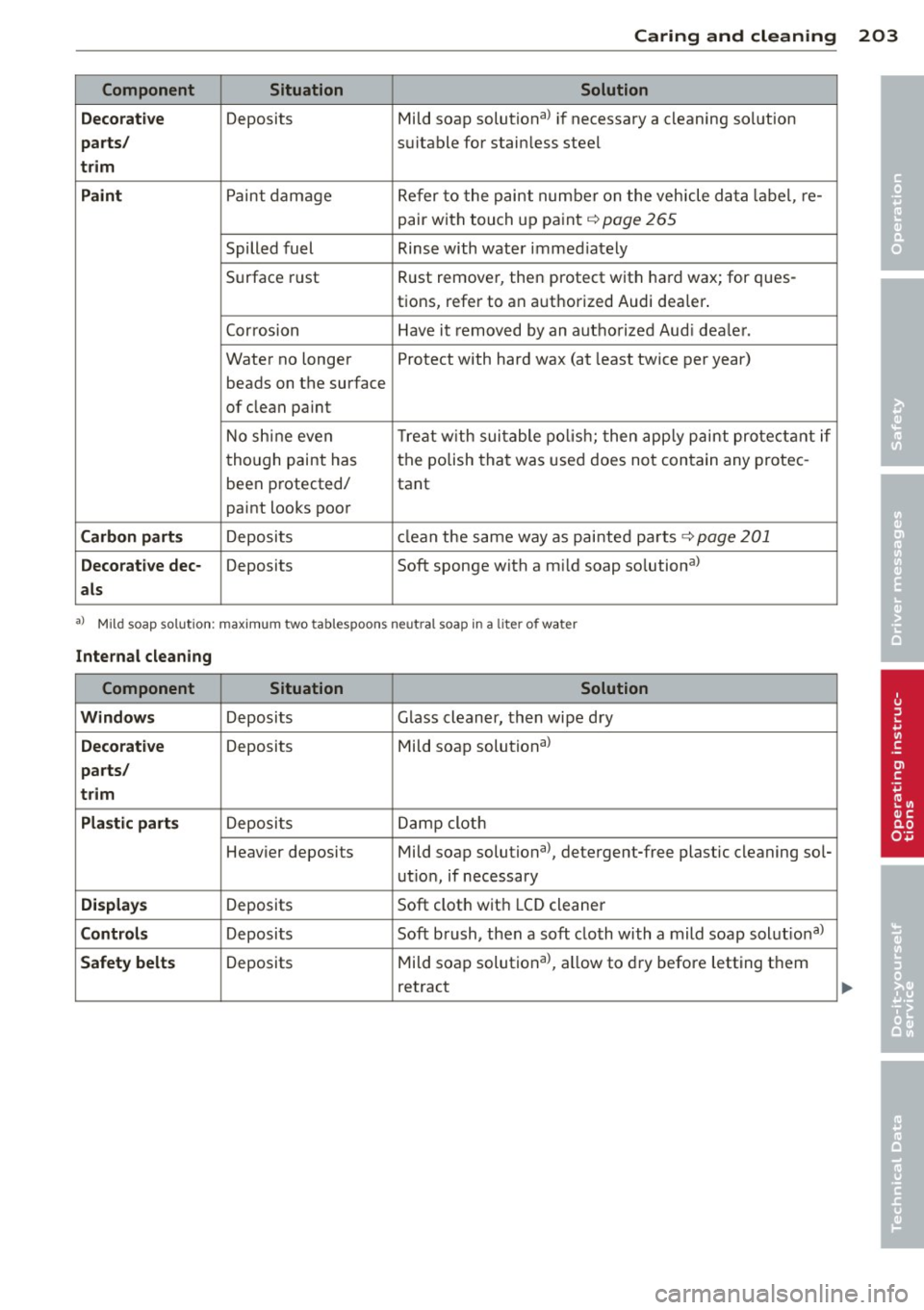
Component Situation Solution
Decorati ve
Deposits Mild soap solutional if necessary a cleaning solution
parts/ suitable for stainless steel
trim
Paint
Paint damage Refer to the paint number on the vehicle data label, re-
pair with touch up paint ~
page 265
Spilled fuel Rinse with water immediately
Surface rust Rust remover, then protect with hard wax; for ques- tions, refer to an authorized Audi dea ler .
Corrosion Have it removed by an authorized Aud i dealer.
Water no longer Protect with hard wax (at least twice per year)
beads on the surface
of clean paint
No shine even T
reat w ith suitable polish; then apply paint protectant if
though paint has the polish that was used does not contain any protec-
been protected/ tant
paint looks poor
Carbon parts Deposits clean the same way as painted parts~ page 201
Decorative dee-Deposits Soft sponge with a mild soap so lutional
als
al Mild s oap so lu tion: maxim um two tablesp oo ns ne utral s oap in a liter of wa ter
Internal cleaning
Component Situation Solution
Windows
Deposits Glass cleaner, then wipe dry
Decorative Deposits Mild soap solutional
parts/
trim
Plastic parts
Deposits Damp cloth
Heavier deposits Mild soap solutional, detergent-free plastic cleaning sol- ution, if necessary
Displays Deposits Soft cloth with LCD cleaner
Controls Deposits Soft brush, then a soft cloth with a mild soap solutiona l
Safety belts Deposits Mild soap solutional, allow to dry before letting them
retract •
•
•
Page 206 of 288
204 Caring and cle aning
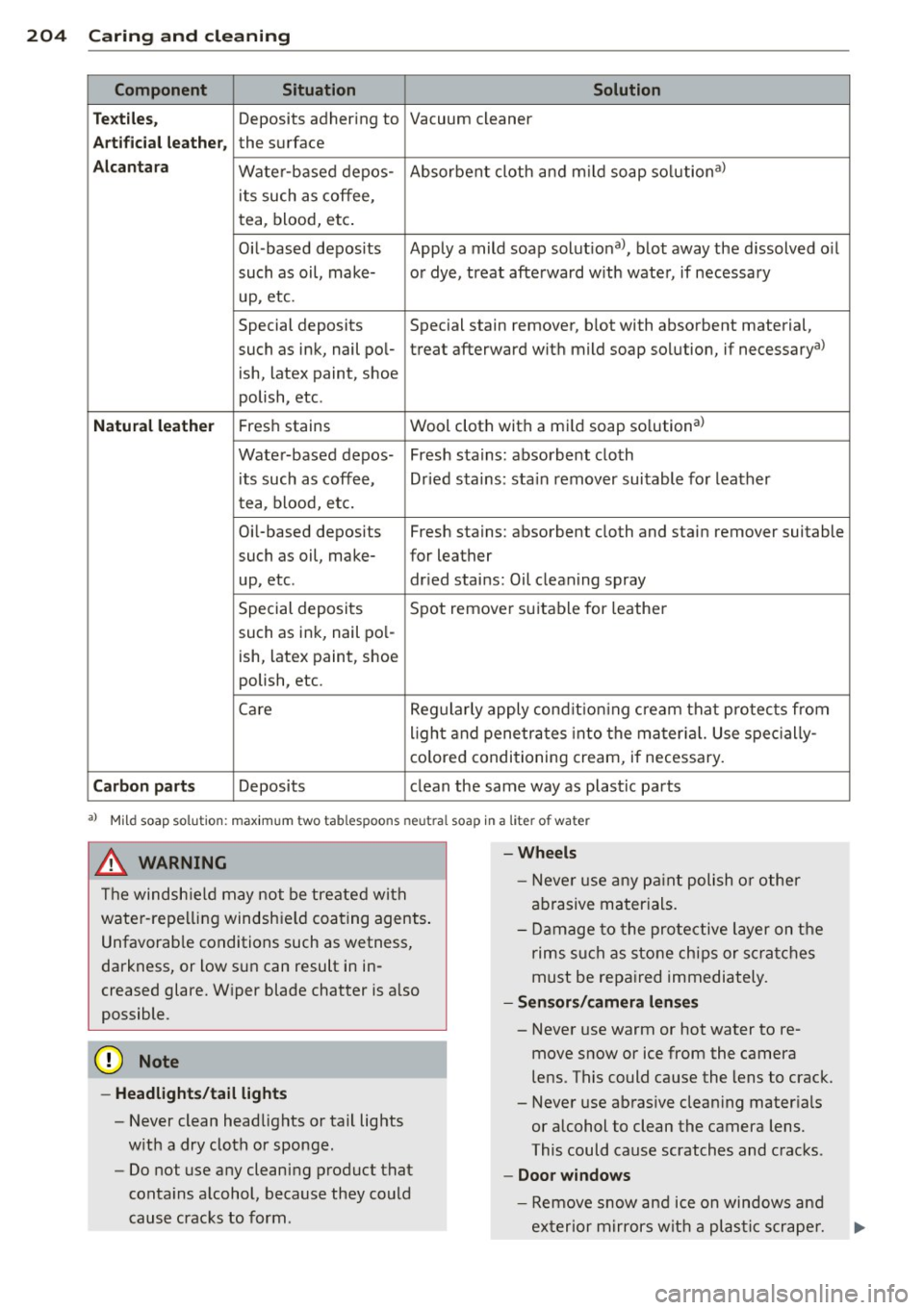
Component Situ ation Solution
Tex tile s,
Deposits adhering to Vacuum cleaner
Art ifi cial leat her, the surface
Alcan ta ra Water-based depos- Absorbent cloth and m
ild soap so lution a>
its such as coffee,
tea, blood, etc.
Oil-based deposits Apply
a mild soap solutiona >, blot away the dissolved o il
such as oil, make- o r dye, treat afterward w ith water, if necessary
up, etc.
Special deposits Special stain remover, blot with absorbent material,
such as ink, nail pol-treat afterward with mild soap so lution, if necessarya>
ish, latex paint, shoe
polish, etc.
Natura l leathe r Fresh stains Wool
cloth with a mild soap so lution a>
Water-based depos- Fresh stains: absorbent cloth its such as coffee, Dr ied stains: stain remover suitable for leather
tea, blood, etc.
Oi l-based deposits Fresh stains: absorbent cloth and stain remover suitable
such as oil, make- for leather
up, etc . dried stains: Oil clean ing spray
Special deposits Spot remover suitable for leathe r
such as ink, nail pol-
ish, latex paint, shoe
polish, etc.
Care Regularly apply condit ion ing cream that protects from
light and penetrates into the mater ial. Use spec ially-
co lored! conditioning cream, if necessary.
Carb on p art s Deposits clean th e same way as plastic parts
a) Mild soap solution: maximu m two tablespoons neutral soap in a liter of water
_& WARNING
The windsh ie ld may not be treated with
water-repelling windshield coating agents .
Unfavorab le conditions such as wetness,
darkness, or low sun can result in in
creased glare. Wiper blade chatter is also
possible.
([) Note
-Headlight s/tail li ght s
-Never clean headlights or tail lights
w ith a dry cloth or sponge.
- Do not use any cleaning product that
conta ins alcohol, because they could
cause cracks to form.
-
- Whee ls
- Never use any pa int polish or other
abrasive materials.
- Damage to the protective layer on the
rims s uch as stone chips or scratches
must be repaired immediately.
- Sen sors/ cam era len ses
-Never use warm or hot water to re-
move snow or ice from the camera
lens. This could cause the lens to crack.
- Never use abrasive cleaning mater ials
or alcohol to clean the camera lens.
This could cause scratches and cracks.
-Door windo ws
-Remove snow and ice on windows and
exter ior mirrors with a plastic scrape r.
Page 209 of 288
Many gasoline grades are blended to perform
especially well for winter or summer driving. During seasonal change-over , we suggest that
you fill up at busy gas stations where the sea sonal adjustment is more likely to be made in
time.
Q;) Note
- Methanol fuels which do not meet these requirements may cause corrosion and
damage to plastic and rubber compo
nents in the fuel system .
- Do not use fuels that fail to meet the
specified criteria in this chapter .
- If you are unable to determine whether
or not a particular fuel blend meets the
specificat ions, ask your service station or
i ts fuel supp lier .
- Do not use fuel for which the contents cannot be identified .
- Fuel system damage and performance
problems resulting from the use of fuels
different from those specified are not
the responsibility of Audi and are not
covered under the New Vehicle or the
Emission Control System Warranties.
- If you experience a loss of fuel economy
or driveability and performance prob
lems due to the use of one of these fuel
blends, we recommend that you switch
to unblended fuel.
Gasoline additives
A major concern among many auto manufac
turers is carbon deposit build-up caused by
the type of gasoline you use .
Although gasoline grades differ from one manufacturer to another, they have cer tain
things in common. All gasoline grades contain substances that can cause deposits to collect
on vital engine parts, such as fuel injectors
and intake valves. Although most gasoline
brands include additives to keep engine and
fuel systems clean, they are not equally effec
tive.
Checking and Filling 207
Audi recommends using TOP TIER Detergent
Gasoline . For more information on TOP TIER
Detergent Gasoline, please go to the official
website (www .toptiergas .com) .
After an extended period of using inadequate
fuels, carbon deposit build-ups can rob your engine of peak performance.
CJ) Note
Damage or malfunction due to poor fuel
quality is not covered by the Audi New Ve
hicle Limited Warranty.
Refueling
Fuel filler neck
The fuel filler neck is located on the right rear
side panel behind the fuel filler flap.
If the power locking system should fail, you
can still open the flap manually -for detailed
instructions see
c::> page 209.
You can find the fuel tank capacity of your ve
hicle in
c::> page 266.
The label on the inside of the fuel filler flap
tells you the correct fuel for your vehicle. For
more information about fuel specifications,
see
c::> page 206 .
Your vehicle fuel tank has an on board refuel
ling vapor recovery system. This feature helps
to prevent fuel vapors from escaping from the
tank and polluting the environment while you refuel your vehicle. In order to fill the tank
properly while protecting the environment,
please follow this refueling procedure careful
ly .
A WARNING ~
Under normal operating conditions, never
carry additional fuel containers in your car.
Gas canisters and other containers used to
transport fuel can be dangerous. Such con
tainers, full or empty, may leak and could
cause a fire in a collision . If you must
transport fuel to use for your lawn mower, ..,.
•
•
•
Page 211 of 288
-Never smoke or have an open flame any
where in or near your vehicle when refu
eling or filling a portable fuel container.
- For your safety, we strongly recommend
that you do not travel with a portable
fuel container in your vehicle. The con
tainer, full or empty may leak and could
cause a fire, especially in a crash.
- If, under exceptional circumstances, you
must transport a portable fuel container,
please observe the following:
- Never fill a portable fuel container while it is anywhere in or on the vehicle
(for example, in the luggage compart
ment, or on the trunk). Static electrici
ty can build up while filling and can ig
nite fuel vapors causing a fire .
- Always place a portable fuel container
on the ground before filling .
- Always keep the filler nozzle complete
ly inside the portable container before
and during filling.
- If filling a portable container made of
metal, the filler nozzle must always be
in contact with the container . This will
help prevent static electricity from dis
charging and cause a fire.
- Never spill fuel inside the vehicle or
luggage compartment. Fuel vapors are
highly flammable.
- Always observe local and state/provin
cial laws regarding the use, storage
and transportation of fuel containers.
- Make certain the fuel container meets
industry standards (ANSI/ ASTM
F852-86).
(D Note
If any fuel has spilled onto the car, it
should be removed immediately to prevent
damage to the paint.
@ For the sake of the environment
As soon as the correctly operated nozzle
switches off automatically for the first
time, the tank is full. Do not try to add
more fuel because fuel may spill out. In
Checking and Filling 209
addition, the expansion space in the fuel
tank will be filled -causing the fuel to
overflow when it becomes warm and pol
lute the environment.
@ Tips
-Running your engine while refuelling
may cause vapors to escape or even
cause fuel to spill out of the tank. This
would then shut off the fuel nozzle be
fore the tank is full.
- Do not refuel your vehicle with the igni
tion switched on. The fuel gauge may
otherwise not indicate the correct fuel
level after refuelling .
- The fuel filler flap of your vehicle is not
locked when you lock the vehicle from
the inside.
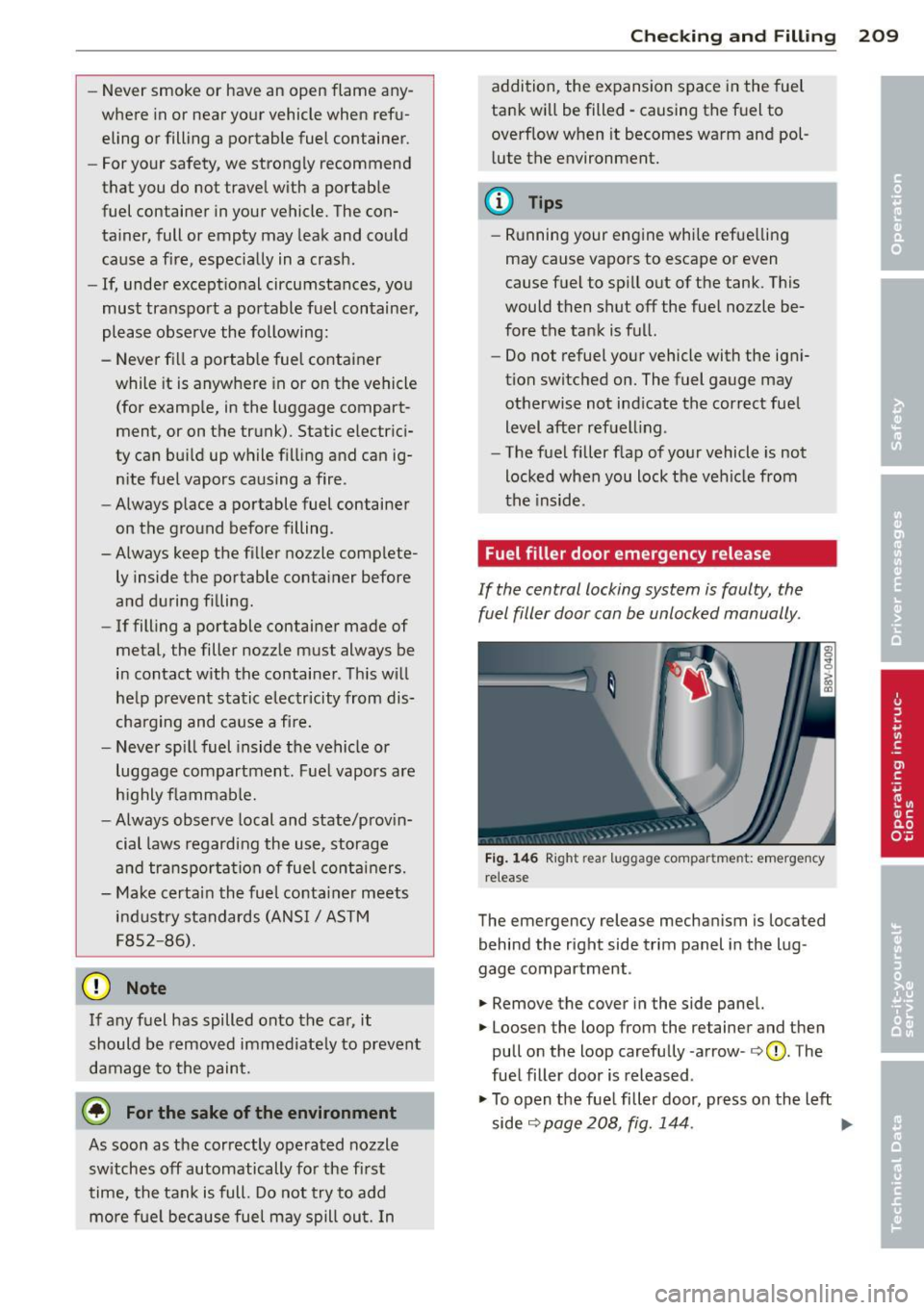
Fuel filler door emergency release
If the central locking system is faulty, the
fuel filler door can be unlocked manually .
Fig. 146 Rig ht rea r lu g g ag e compar tme nt: emergency
release
The emergency release mechanism is located
behind the right side trim panel in the lug
gage compartment .
.,. Remove the cover in the side panel.
.,. Loosen the loop from the retainer and then
pull on the loop carefully -arrow -
c:>(D . The
fuel filler door is released .
.,. To open the fuel filler door, press on the left
side
c:> page 208, fig. 144 . i,..
Page 212 of 288
210 Check ing and F illin g
Only pull on the loop until you fee l resist
ance. You will not hear it release . Other
w ise you could damage the emergency re
lease mechanism .
Hood
Working in the engine compartment
Special care is required if you are working in
the engine compartment
F o r w ork in th e engine co mpartm ent such as
c h ec king an d filling fluids, there i s a ri sk of
inj ury, sca lding, a ccid ent s, and b urn s. For
t hi s re ason , fo llow all th e followin g lis te d
warn in gs a nd ge neral safe ty pr eca utions.
Th e e ngine compartment is a d ange rous
area .¢ .& .
&_ WARNING
To reduce the risk of injury, before you
check anyth ing under the hood:
- Turn the engine off.
- Set the parking brake.
- Place the selector leve r in the P position.
- Remove the ignit io n key .
- Let the engine coo l down.
- To reduce the r isk of being burned, never
open the hood if you see or hear steam
or coolant escaping from the engine
compartment . Wait until no steam or
coolant can be seen or hea rd before ca re
fully opening the hood.
- Keep chi ldren away from the engine com
partment .
- Never spill flu ids on a hot engine. These
fluids (such as the freeze protection con
tained in the coolant) can catch fi re.
- Avoid short circuits in the electrical sys
tem, especially the battery.
- When working in the engine compart
ment, remembe r that the radiator fan
can switch on even if the ignition is
switched off, which increases the risk of
persona l injury . -
Never open the cap on the coolant ex
pans ion tank when the eng ine is warm.
The coolant system is under pressure.
- To protect your face, hands, and arms
from hot steam or coolant, cover the cap
with a large cloth when opening.
- Do not remove the engine cover under
any circumstances . This increases the
risk of burns .
- If tests need to be performed with the
engine runn ing , there is add itional dan
ger due to moving components (such as
the ribbed belt, generator and radiator
fan) and from the high voltage ignit ion
system.
- Never touch the rad iator fan . The auxili
ary electric fan is temperature controlled
and can switch on suddenly.
- Pay attention to the fo llow ing warnings
listed when wo rk on the fuel system or
on the e lectr ica l equipment is req uired.
-A lways disconnect the vehicle battery
from the vehicle electr ical system
- Do not smoke
- Never work near open flames
- Always have a wo rk ing fire exting uisher
nearby
- To avo id e lectr ica l sho ck and pe rsonal in
jury whi le the engine is running or being
started, never touch:
- Ign it ion cables
- Other components of the high voltage
electronic ignition system.
- If you must perform a check or repair
with the eng ine running:
- First, fully app ly the parking brake,
move selector lever to P (Park).
- Always use extreme caut io n to prevent
cl othing, jewelry, or long hair from get
ting caught in the radiator fan, V-be lts
o r other moving parts, o r from contact
ing hot parts. Tie back hair before
starting, and do not wear clothing that
will hang or droop into the engine.
- Minimize exposure to emission and
chemical hazards¢,& . ..,.
Page 219 of 288
The cooling system has been filled at the fac
tory with a permanent coolant which does not need to be changed. The coolant consists of a
mixture of spec ia lly conditioned water and the
manufacturer's glycol-based coolant addi-
tive Gl3 antifreeze with anticorros ion addi
tives (50% fo r USA models; 60% for Canadian
models) . This mixture both assures th e neces
sary frost protect ion a nd p rotects me tal com
ponents in the engine 's coo ling system from
corrosion and scaling.
It al so raises the boil
ing po int o f the coo lant .
D o no t reduce the concentration of t he coo l
an t in the summer by ad ding plain w ate r.
The
proportion of coolant additive must be at
lea st 50 % but not more than 60%
to main
tain ant ifreeze protection and cooling efficien
cy. If the coolant frost protect ion is too low ,
the coolant cou ld free ze and damage the veh i
cle heating and eng ine cooling system.
F or yea r-round driv ing, antifreeze is added at
the facto ry for temperatures down to:
- -3 1 °F ( -3 5°C) USA
- -4 0°F ( -4 0°C) Canada.
If you must add coolant, use a m ixture of wa
ter and coolant addit ive. M ixing the coolant
addi tive wi th dist illed wate r is recom mend ed.
_& WARNING
Bef ore yo u check any thing in the e ngine
comp artme nt, alw ays re ad and hee d all
WARN INGS
¢page 210.
(D Note
- B efo re winter sets in, have the coolant
c hec ked to see if the c oolan t ad dit ive i n
you r vehi cle is su fficient t o mee t the cl i
mate cond itions. This is especially impor
tant if yo u live in a region whe re the win
ter is extremely cold. If necessary, in
crease the proport ion of coolant additive
to 60%.
- W hen addi ng coolant additive to your
cooling system, remember:
- We recommend using only coolant ad
ditive Gl2 ++ o r Gl3 ( check t he label)
-
Che cking and Fillin g 21 7
for you r vehi cle. This coolan t additive is
avai lab le at authorize d Audi dea le rs .
Ot her types of antifreeze ca n sig nifi
cantly reduce corros io n protection. The
res ulting corrosion can cause a loss of
coolant and serio us e ngine da mage .
- Do not add any type of rad iator leak seal
ant to you r vehicle's engine coolant .
Add ing radiator repair flu id may adverse
ly affect t he function and performanc e of
yo ur cooling sys tem and co uld resu lt i n
damage not covered by yo ur New Ve hicle
L imi ted W arranty.
Adding coolant
Fi g. 152 En gine co mpa rtment: markin gs on t he coo l
an t e xpan sio n t ank
Befo re you check a nyt hing in the eng ine com
partment ,
alway s read and heed all WARN
INGS ¢ page 210.
Checking the engine coolant level
.,. Park yo ur vehicle o n a level su rf a ce .
.,. Switch t he ignition off.
.,. Read t he coolant leve l on the coo lant expan
sion tank ¢
fig. 152. The coolant leve l must
be between the markings when the engine
in cold. When the engine is warm it can be
slightly above the upper mark ing .
Adding coolant
Req uirement : There m ust be a res idual
amount of coo lant in the expansion tank
c::> Q) .
.,. Le t the engine cool down.
.,. Place a clot h over the coo lant expans ion
tank cap a nd u nscrew the cap co unterclock-
wise
c::> _& . ..,.
Page 223 of 288
prevent it from being damaged and having
to be replaced .
Working on the battery
Be especially careful when working on or near
the battery.
The battery is loca ted in the luggage compart
men t under the floor. Before yo u check any
thing in the l uggage compartment,
read and
hee d all WARNINGS
¢ _A .
Always heed the sa fe ty warning s, when work
i ng on the vehicle battery or the vehi cle elec
trica l system to prevent injury.
The following WARNINGS are very
impo rtant when working on the battery:
Alway s heed th e following WARNING SYM-
BOLS and saf ety precaution s when working
o n the b att ery.
®
Always wear e ye protection.
A
Batter y ac id contains sulfu ric acid .
Always w ear glo ves and e ye p rote c-
t ion .
@
No
- spark s
- flames
- smo king.
~
Wh en a battery i s charge d, it produ -
ce s hy d rogen ga s whi ch i s ex plo siv e
and could cau se perso na l injur y.
®
Alway s keep the b atter y w ell o ut of
r e ach of childr en.
A WARNING
Whenever working on the bat tery or on
the electrical system, there is the risk of
injury, accident and even fire. Read and
heed the following WARNINGS :
- Always wear eye p rotection. Do not let
battery acid or any lead particles get on
yo ur sk in or clothing. Sh ield your eyes.
Explosive gases can cause blindness or
other injury.
-
Checking and Fillin g 221
-Battery acid contains sulfuric acid . Sulfu
ric acid can cause blindness and severe
burns.
- Always wear g loves and eye protection.
Do no t tilt the ba ttery because acid
could leak out of the ventilat ion open
ings .
- If you ge t bat tery acid in your eyes or
on your skin, immediately rinse with
cold water for several minutes and get
med ical attention .
- If you should ingest any batte ry acid,
seek medical attention immediately.
- Do not expose the ba tte ry to an open
f lame, e lectric sparks or an open light .
- Do not smoke.
- Do not in terchange t he positive and neg-
ative cables.
- When working on t he battery, be su re
not to short-cir cuit the termina ls w ith
too ls or othe r metal objects. This would
cause the battery to heat up very quickly,
which could lead to damage or explosion
and pe rsonal injury.
- When a battery is charged, it produces
hydrogen gas which is explosive and
could cause personal inju ry.
- Always keep the battery well out of the
reach of children.
- Before work is done on the elect rical sys
tem, disconnect the negative ground ca
ble.
- Before performing any work on the e lec
trical system, switch off the engine and ignit ion as well as any electrical equip
ment. The negative cable on the battery
must be disconnected. If you are just go
ing to replace a light bulb, then it is
e nough to switc h off the lights.
- Before disconnecting the battery, switch off the anti-theft alarm system! Other
wise you will set off the alarm.
- When disconnecting the battery, first
disconnect the negat ive cab le and then
the posit ive cab le.
- Before reconnecting the battery, ma ke
sure all e lectr ica l consumers are sw itch
ed off. Reco nne ct the pos it ive cable first
•
•
•
Page 225 of 288
Battery charging (Ma ximum charging rate
o f 30 am ps/ 14.8 volt s)
When charging at
low voltages (e.g . with a
tri ckle ch arg er), the batte ry cables do not
have to be d isconnected first. The battery
caps should
not be opened when charging a
battery .
It is not necessary to remove the battery from
the luggage compartment, and it is also not
necessary to disconnect the cables.
F ast charging th e battery (charging rate
a bo ve 14 .8 volt s)
For technical reasons do not use a battery
charger that uses voltage greater than 14.8
volts to charge your ve hicle 's battery .
A WARNING
Charging a battery can be dangerous .
- Always follow the operating instructions
provided by the battery charge r manu
fact urer when charging your battery .
- Never charge a frozen battery . It may ex
plode because of gas t rapped in the ice .
Allow a frozen battery to thaw out first.
- Do not reuse batteries which we re fro
zen . The batte ry housing may have
cr acked and weakened whe n the battery
froze.
- Charge the battery in a we ll ventilated
area. Keep away from open flame o r ele c
trical spark. Do not smoke. Hydroge n gas
generated by the battery is exp losive.
- T o redu ce the danger o f explosion , never
conne ct or disconnect cha rger cables
wh ile the charger is operating .
- F ast charg ing a battery i s dangerous and
sho uld on ly be attempted by a compe
tent technician with the proper eq uip
me nt.
- Battery acid that may spill during charg
ing should be washed off with a so lution
of warm water and ba king soda to neu
tralize the acid.
Checking and Fillin g 223
@ Note
Neve r use a fast charger as a booster to
start the eng ine . This w ill seriously dam
age sens itive e lectronic components, such
as contro l units, relays, radio, etc., as well
as the batte ry charger .
Battery replacement
The new ba ttery mus t hove the some specifi
cations and dimensions as the original equip
ment battery .
Intelligent energy management in your vehi
cle is responsible for distributing the electri
ca l ene rgy throughout your vehicle
~ page 190 . The intelligent energy manage
ment system will keep the engine battery
c h arged better than vehicles without this sys
tem. To make sure the addition al ele ctri cal e n
ergy is ava ilab le once again after yo u have
changed the batte ry, we recommend that you
insta ll batteries of the same type an d manu
facture on ly (the same as those insta lled at
the time your veh icle was delivered) . Specif i
cations are listed on the battery housing. Your
authorized dea ler must code the battery in
the ene rgy management system to enab le you
to use the ene rgy management functions cor
re ct ly afte r repla cing the battery.
The new battery must have the same capacity,
vo ltage ( 12-volts) , amperage, construction
and plug sea ling .
When install ing the battery, make sure the ig
nition and a ll electrical consumers are switch
ed off .
~ Note
Make sure the ventilat ion hose on the side
of the battery is con nected, otherwise
fumes o r batte ry acid can lea k out.
@) For the sake of the environment
Because of the prob lem of proper disposal
of a battery, we recommend your author
i zed Audi dealer change the battery for
you. Batteries contain sulfur ic acid and ..,.
•
•
•
Page 227 of 288
Tires and wheels
Tires
General notes
Tires may be the least appreciated and most
abused parts of a motor vehicle .
Tires may be the least appreciated and most
abused parts of a motor vehicle . Tires are,
however, one of the most important parts of a
veh icle, particularly considering the compara
tively small patch of rubber on each tire that
assures that a ll- important contact between
you, your vehicle and the road.
Maintaining the correct tire pressure, mak ing
sure that your vehicle and its tires do not have
to carry mo re weight than they can safely han
d le, avoiding damage from road hazards and
r eg ularly inspect ing t ires for damage includ
ing cuts, slashes irregu la r wear and overall
condition are the most important things that
you can do to he lp avoid sudden tire failure in
cluding tread separation and blowouts.
Avoiding damage If you have to d rive over a curb or similar ob
stacle, drive very slow ly and as close as possi
b le at a right angle to the curb.
A lways keep chemicals includ ing grease, o il ,
gasoline and brake fluid off the t ires .
I nspect the t ires regularly for damage (cuts,
cracks or b listers, etc.). Remove any fo reign
bod ies embedde d in the treads.
Storing tires Mark t ires when you remove them to indicate
the direction of rotation . T his ensures you to
be ab le to mount them correctly when you re
i nstall them .
When removed, the whee ls or t ires should be
sto red in a cool, d ry and preferably dark place .
Store tires in a vertical pos ition if they are not
mounted on rims, in a horizontal pos ition if
they are mounted on rims .
Tires an d wheel s 225
New tires
New ti res h ave to be broken in¢& .
The tread depth of new t ires may vary, accord
ing to the type a nd make of t ire and the tread
pa tte rn.
H idden damage
Damage to tires and rims is ofte n not readily
visible . If you notice unusual v ib rat ion or the
vehicle pulls to one s ide, th is may ind icate
that one of the t ires has been damaged . T he
ti res m ust be chec ked immed iate ly by an au
thorized Audi dea le r or q ua lified wor kshop .
Unidirectional tires
A un idirectional tire can be identified by ar
rows on the sidewa ll, that po int in the direc
tion the t ire is designed to rotate. You mus t
f ol low the specified di rection o f rotation . T his
is necessary so that these tires can develop
their optimum characteristics regarding grip, road noise, wear and hydrop laning resistance.
For more information
¢page 253.
A WARNING
New tires or t ires that are old, worn or
damaged cannot provide maximum con
trol and braking ability .
-
-New tires tend to be slippery and must
also be b roken-in. To reduce the risk of
losing control , a collision and serious
pe rsonal injuries, drive w it h special care
for the first 350 miles (560 km).
- Driving with worn or damaged tires can
lead to loss of control, sudden tire fail
ure, including a blowout and sudden de
fl ation, cras hes and se riou s personal in
juries . Have wo rn or damaged t ires re
placed immediate ly.
- Ti res age even if they are not being used
and can fai l sudden ly, especially at hig h
spee ds. Tires that are more than 6 years
old can only be used in an emergency
and then w ith special care and at low
speed.
•
•
•
Page 228 of 288
226 Tire s and wheel s
-Never mount used tires on yo ur vehicle if
you are not sure of their "previous histo
ry." Old used tires may have been dam
aged even though the damage cannot be
seen that can lead to sudden t ire failure
and loss of vehicle control.
- If you notice unusual vibration or if the
vehicle pulls to one side when driving, al
ways stop as soon as it is safe to do so
and check the wheels and tires for dam
age.
(D Note
- Please note that summer and winter
tires are designed for the cond itions that
a re typ ica l in those seasons. Aud i recom
mends using w inter t ires d uring the win-
Glossary of tire and loading terminology
Accessory weight
means t he comb ined we ight (in excess of
those standard items which may be rep laced)
of automatic transmission, power steering,
power brakes, power windows, power seats,
radio, and heater, to the extent that these
items are availab le as factory-installed equip
ment (whether installed or not).
A spect ratio
means th e ratio of the height to the width of
the tire in percent. Numbers of 55 or lower in
d icate a low sidewall for improved steer ing re
sponse and better overall handling on dry
pavement .
Bead
means the part of the tire th at is made of
steel wires, wrapped or reinforced by ply cords
and that is shaped to fit the rim.
Bead s eparation
means a breakdown of the bond between
components in the bead.
Cord
means t he strands forming the plies in the
tire. ter months.
Low tempe ratu res signifi
cantly decrease the elasticity of summer
tires, which affects traction and braking ability. If summer tires are used in very
co ld temperatures, cracks can form on
the tread bars, resu lting in permanent
tire damage that can cause loud driving
noise and unbalanced tires. Aud i is not
responsib le for this type of damage.
- Burn ished, polished or chromed rims
must not be used in winter weather. The
surfa ce of the rims does not have suff i
c ien t cor rosion prote ct io n for this and
co uld be pe rmanen tly damaged by road
salt or simi lar substances. This damage
is not cove red by war ranty.
Cold tire inflat ion pre ssure
mea ns the t ire press ure recommended by the
vehicle manufacturer for a tire o f a des ignated
size that has not bee n driven for more than a
coup le of miles (ki lometers) at low speeds in
the three hour period before the tire press ure
is measured or adjusted.
Curb weight
means the weight of a motor vehicle w ith
standard equipment including the maximum
capacity of fuel, o il, and coolant, air condi
tion ing and additional weight of optional
equipment.
E x tra load tire
means a tire design to operate at higher loads
and at higher inflation pressures than the cor
responding standard tire. Extra load tires may
be identified as "XL", "xl", "EXTRA LOAD", or
"RF" on the sidewall.
Gross A xle Weight Rating ("GAWR")
means the load-carrying capacity of a single
axle system, measured at the tire-ground in-
terfaces.
IJ>,