seats AUDI A3 2015 Owners Manual
[x] Cancel search | Manufacturer: AUDI, Model Year: 2015, Model line: A3, Model: AUDI A3 2015Pages: 288, PDF Size: 71.46 MB
Page 4 of 288
2 Table of contents Vehicle literature . . . . . . . . . . . . . .
5
About this Owner's Manual . . . 6
Operation . . . . . . . . . . . . . . . . . . . . . . 8
Cockpit . . . . . . . . . . . . . . . . . . . . . . . . 8
Overview illustration . . . . . . . . . . . . . . 8
Instruments and indicator
lights . . . . . . . . . . . . . . . . . . . . . . . . . .
1 0
Instruments . . . . . . . . . . . . . . . . . . . . . 10
Indicator lights . . . . . . . . . . . . . . . . . . 14
Driver information system . . . 26
Overview . . . . . . . . . . . . . . . . . . . . . . . . 26
Operation . . . . . . . . . . . . . . . . . . . . . . . 27
Efficiency program . . . . . . . . . . . . . . . . 28
On-Board Diagnostic system (OBD) . . . 29
Opening and closing . . . . . . . . . . 31
Central locking . . . . . . . . . . . . . . . . . . . 31
Luggage compartment lid . . . . . . . . . . 37
Child safety lock . . . . . . . . . . . . . . . . . . 38
Power windows . . . . . . . . . . . . . . . . . . 38
Panorama sunroof . . . . . . . . . . . . . . . .
40
Lights and Vision . . . . . . . . . . . . . . 4 2
Exterior lighting . . . . . . . . . . . . . . . . . . 42
Inter ior light ing . . . . . . . . . . . . . . . . . . 45
V1s 1on . .. ............... .. .. .. . .
Windshie ld wipers .......... .. ... .
Mirrors ......... ......... ... ... .
Digital compass ............ .. ... .
Seats and storage ....... .... . .
General information ....... ... ... .
Front seats ............... ... ... .
Head restraints ............ .. ... .
Socket . ................. .. .. ... .
Storage .............. ........ .. .
Roof rack .. ................ ... . .
Luggage compartment
Warm and cold ............... .
C limate control system .... .. .. .. . .
46
46
48
so
5 2
52
53
55
56
57
59
60
64
64
Driving ....... .. .......... ... ... 70
Steering . . . . . . . . . . . . . . . . . . . . . . . . 70
Ig nition lock . . . . . . . . . . . . . . . . . . . . . 70
Starting and stopping the engine
(vehicles with an ignition lock) . . . . . . 70
Starting and stopping the engine
(vehicles w ith a convenience key) . . . . 73
Driver messages . . . . . . . . . . . . . . . . . . 75
El ectromechani cal parking brake . . . . 76
Hill hold . . . . . . . . . . . . . . . . . . . . . . . . 78
Speed warning system . . . . . . . . . . . . . 79
Cruise control system . . . . . . . . . . . . . 79
Audi adaptive cruise control .. 82
Introduction . . . . . . . . . . . . . . . . . . . . . 82
General Information . . . . . . . . . . . . . . 82
Adaptive cruise control . . . . . . . . . . . . 84
Driver messages . . . . . . . . . . . . . . . . . . 88
Audi pre sense . . . . . . . . . . . . . . . . 90
Introduction . . . . . . . . . . . . . . . . . . . . . 90
General information . . . . . . . . . . . . . . 90
Audi pre sense basic . . . . . . . . . . . . . . . 90
Audi pre sense front . . . . . . . . . . . . . . . 90
Driver messages . . . . . . . . . . . . . . . . . . 92
Audi active lane assist . . . . . . . . 94
Lane assist . . . . . . . . . . . . . . . . . . . . . . 94
Audi side assist . . . . . . . . . . . . . . . 98
S ide assist . . . . . . . . . . . . . . . . . . . . . . 98
Audi drive select . . . . . . . . . . . . . . 102
Driving settings . . . . . . . . . . . . . . . . . . 102
Automatic transmission . . . . . . 105
S tronic -transmission . . . . . . . . . . . . . . 105
Parking systems . . . . . . . . . . . . . . 114
General information . . . . . . . . . . . . . . 114
Rear parking system . . . . . . . . . . . . . . 115
Parking system plus . . . . . . . . . . . . . . . 115
Rearviewcamera .............. .. . 116
Adjusting the display and the warning
tones.... ..... .. .. ..............
120
Error messages . . . . . . . . . . . . . . . . . . 120
Page 5 of 288
Safety . . . . . . . . . . . . . . . . . . . . . . . . . 12 1
Driving safety . . . . . . . . . . . . . . . . . 121
General notes . . . . . . . . . . . . . . . . . . . . 121
Proper occupant seating posit ions . . . 122
Driver and passenger side footwell . . . 126
Pedal area . . . . . . . . . . . . . . . . . . . . . . . 126
Stowing luggage . . . . . . . . . . . . . . . . . 127
R eport ing Safety Defects . . . . . . . . . . . 129
Safety belts ... .. ...... .. .. .. . .
General notes ............... .. .. .
Why safety bel ts? ........ .... .. . .
Safety belts ............. .. .. .. . . 131
13
1
13 2
134
Safety belt p re tens ioners . . . . . . . . . . 13 7
Airbag system . . . . . . . . . . . . . . . . . 140
I mpor tan t th ings to know . . . . . . . . . . 1 40
Fr ont airbags . . . . . . . . . . . . . . . . . . . . 14 4
M onitoring the Advanced Airbag
System . . . . . . . . . . . . . . . . . . . . . . . . . 152
Knee airbags . . . . . . . . . . . . . . . . . . . . . 157
Side airbags . . . . . . . . . . . . . . . . . . . . . 160
Side curta in a irbags . . . . . . . . . . . . . . . 163
Ch ild Safety . . . . . . . . . . . . . . . . . . . 166
Important things to know . . . . . . . . . . 166
C hi ld safety seats ............ .... . 172
Install ing a chi ld safety seat . . . . . . . . 177
L A TC H L ower ancho rages and tethe rs
fo r ch ild ren . . . . . . . . . . . . . . . . . . . . . . 180
A ddit io nal Informa tion 184
Driver messages . . . . . . . . . . . . . . 185
Smart Technology . . . . . . . . . . . . 185
N ot ice about da ta recorded by vehi cle
control mod ules . . . . . . . . . . . . . . . . . . 185
Electron ic stabilization control (ESC) 185
Brakes . . . . . . . . . . . . . . . . . . . . . . . . . . 187
Electromechanical steering . . . . . . . . . 189
All whee l drive (quatt ro) . . . . . . . . . . . 190
Energy management . . . . . . . . . . . . . . 190
Driving and the environment 193
The first 1,000 miles (1,500 km) and
afterwards . . . . . . . . . . . . . . . . . . . . . . 193
D riving through water on roads . . . . . 194
Cata lytic conve rter . . . . . . . . . . . . . . . . 194
Table of contents 3
P lac ing you r vehicle out of service. . . . 195
Operate yo ur vehicle economically an d
min imize poll ution. .. .. ... .... ... . 195
Trailer towing . . . . . . . . . . . . . . . . . 198
Driving with a trailer . . . . . . . . . . . . . . 198
Trai ler tow ing tips . . . . . . . . . . . . . . . . 200
Operating instructions ..... .. .
Caring and cleaning .......... .
General information ........... .. .
Car was hes .. .. .. ............... .
Cleaning and care information 201
201
201
201
202
Checking and Filling
. . . . . . . . . . 206
Gasoline . . . . . . . . . . . . . . . . . . . . . . . . 206
Refueling . . . . . . . . . . . . . . . . . . . . . . . 207
Hood . . . . . . . . . . . . . . . . . . . . . . . . . . . 210
E ngine o il . . . . . . . . . . . . . . . . . . . . . . . 212
c oolant system . . . . . . . . . . . . . . . . . . . 216
Br ake fluid . ... .. .. .. .. .. .... ... . 219
Battery . . . . . . . . . . . . . . . . . . . . . . . . . 220
Windshie ld washer fluid container . . . 224
Tires and wheels . . . . . . . . . . . . . . 225
Tires . . . . . . . . . . . . . . . . . . . . . . . . . . . 225
Tire pressure monitoring system 243
Do-it-yourself service . . . . . . . . . 246
What do I do now? . . . . . . . . . . . . 246
Luggage compartment lid emergency
release . . . . . . . . . . . . . . . . . . . . . . . . . 246
General information . . . . . . . . . . . . . . 246
Equ ipment . . . . . . . . . . . . . . . . . . . . . . 247
Spare ti re .... ... .. ..... ......... 247
Chang ing a wheel . . . . . . . . . . . . . . . . . 248
Fuses and bulbs . . . . . . . . . . . . . . . 255
El ectr ica l fus es . . . . . . . . . . . . . . . . . . . 255
B ulbs. . . . . . . . . . . . . . . . . . . . . . . . . . . 258
Emergency situations . . . . . . . . . 259
Genera l . . . . . . . . . . . . . . . . . . . . . . . . . 259
Star ting by p ushing o r towing . . . . . . . 259
Star ting with jumpe r cables . . . . . . . . 259
U se o f jumpe r cables . . . . . . . . . . . . . . 260
•
•
•
Page 54 of 288
52 Seat s a nd s tor ag e
Seats and storage
General information
Important information
& WARNING
Refer to the chapter Driving Safely
r::!>poge 121, Driving safety for important
information, t ips, suggestions and warn
ings that you should read and follow for
your own safety and the safety of your pas sengers.
Why is your seat adjustment so important?
The safety belts and the airbag system con
only provide maximum protection if the front
seats ore correctly adjusted.
There are various ways of adjusting the front
seats to provide safe and comfortable support
for the driver and the front passenger. Adjust
your seat properly so that :
- you can easily and quickly reach all the
switches and controls in the instrument
panel
- your body is properly supported thus reduc
ing physical stress and fatigue
- the safety belts and airbag system can offer
maximum protection
r::!> page 140.
In the following sections, you will see exactly
how you can best adjust your seats .
There are special regulations and instructions
for insta lling a child seat on the front pas
senger's seat. Always follow the information regarding child safety provided in
r::!> page 166, Child Safety .
& WARNING
Incorrect seating position of the dr iver and
all other passengers can result in serious
personal in jury.
- Always keep your feet on the f loor when
the vehicle is in motion - never p ut your
feet on top of the instrumen t panel, out of the window or on top of the seat c
ush
ion. This applies espec ially to the passen
gers. If your seating position is incorrect,
you increase the risk of injury in the case
of sudden braking or an accident .
If the
airbag inflates and the seating position is incorrect, this could result in pe rsonal
inj ury or even death.
- It is important for both the drive r and
front passenger to keep a distance of at least 10 inches ( 25 cm) between them
selves and the steering wheel and/or in
strument panel. If you're sitting any
closer than this, the airbag system can not protect you properly. In addition, the
front seats and head restraints must be
adjusted to your body height so that they
can give you max imum protect ion.
- Always try to keep as much distance as
possible between yourself and the steer
ing wheel o r instrument panel.
- Do not adjust the driver's or front pas
senger's seat whi le the vehicle is moving.
Your seat may move unexpectedly, caus
ing sudden loss of veh icle cont ro l and
pe rsonal injury. If you adjust yo ur seat
while the veh icle is moving, yo u are ou t
of posit ion .
Driver's seat
The correct seat position is important for safe
and relaxed driving.
We recommend that you adjust the dr iver's
seat in the fo llow ing manne r:
.. Adjust the seat in fore and aft direction so
that you can easily push the peda ls to the
floor wh ile keeping your knees sl ightly bent
r::!> &. in Why is your seat adjustment so im
portant? on page 52.
.. Ad just the bac krest so tha t when you sit
w ith your back against the backrest, you can
still hold the top of the steering wheel.
.. For adjustab le head restraints: adjust the
head restra int so the upper edge is as even
as poss ible with the top of your head. If that
is not possible, try to adjust the head ..,.
Page 55 of 288
restraint so that it is as close to this position
as possible
q page 55 . Move the head re
stra int so that it is as close to the back of
the head as possible .
A WARNING
Never place any objects in the driver's foot
well. An object could get into the pedal
area and interfere with pedal function. I n
case of sudden braking or an accident, you
would not be ab le to brake or acce lerate.
Front passenger's seat
Always move the front passenger seat into
the rearmost position.
To avoid contact with the airbag while it is de
ploying, do not sit any closer to the instru
ment panel than necessary and always wear
the three -point safety belt provided adjusted
correctly . We recommend that you adjust the
passenger's seat in the following manner :
• Bring the backrest up to an (almost) upright
pos ition.
D o not ride w ith the seat reclined.
• For adjustable head restraints : adjust the
head restraint so the upper edge is as even
as possib le with the top of your head. If that
is not possible, try to adjust the head re
straint so that it is as close to this position
as possible
q page 55 . Move the head re
straint so that it is as close to the back of
the head as possible.
• Place your feet on the floor in front of the
passenger's seat .
Sea ts a nd s to rage 53
Front seats
Manual seat adjustment
App lies to vehicles: with manually adjustab le seats
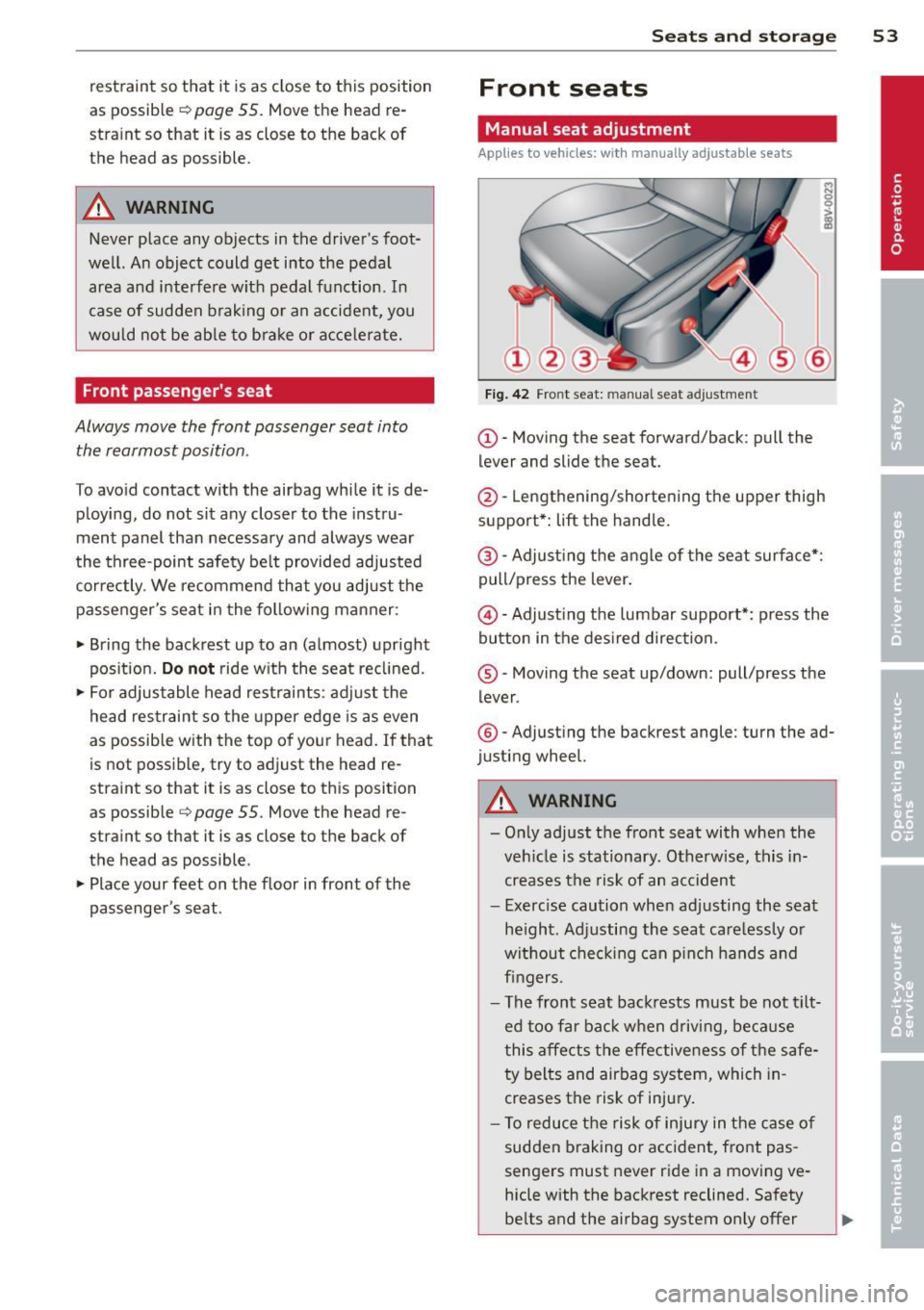
Fig . 42 Fro nt seat: man ual seat adjustment
(D-Moving the seat forward/back : pull the
lever and slide the seat.
@-Lengthening/shortening the upper thigh
support*:
lift the handle.
@ -Adjust ing the a ngle of the seat surface*:
pull/press the lever.
@ -Adjusting the lumbar support*: press the
button in the des ired direction.
® -Moving the seat up/down: pull/press the
lever .
®-Adjust ing the backrest angle : turn the ad
justing wheel.
A WARNING
-Only adjust the front seat with whe n the
veh icle is stationary. Otherwise, this in
creases the risk of an accident
- Exerc ise caution when adjusting the seat
he ight. Ad justing the seat care lessly or
without check ing can p inch hands and
fingers .
- The front seat backrests must be not tilt
ed too far bac k when driving, because
this affects the effective ness of the safe
ty belts and airbag system, which in
creases the risk of injury.
- To reduce the risk of injury in the case of
sudden braking o r accident, front pas
sengers must never ride in a moving ve
hicle with the backrest reclined. Safety
be lts and the airbag system only offer
Page 56 of 288
54 Seats and storage
maximum protection when the backrest
is upright and the safety belts are prop
erly positioned on the body. The more
the backrest is reclined, the greater the
risk of personal injury from an incorrect
seating position and improperly posi
tioned safety belts.
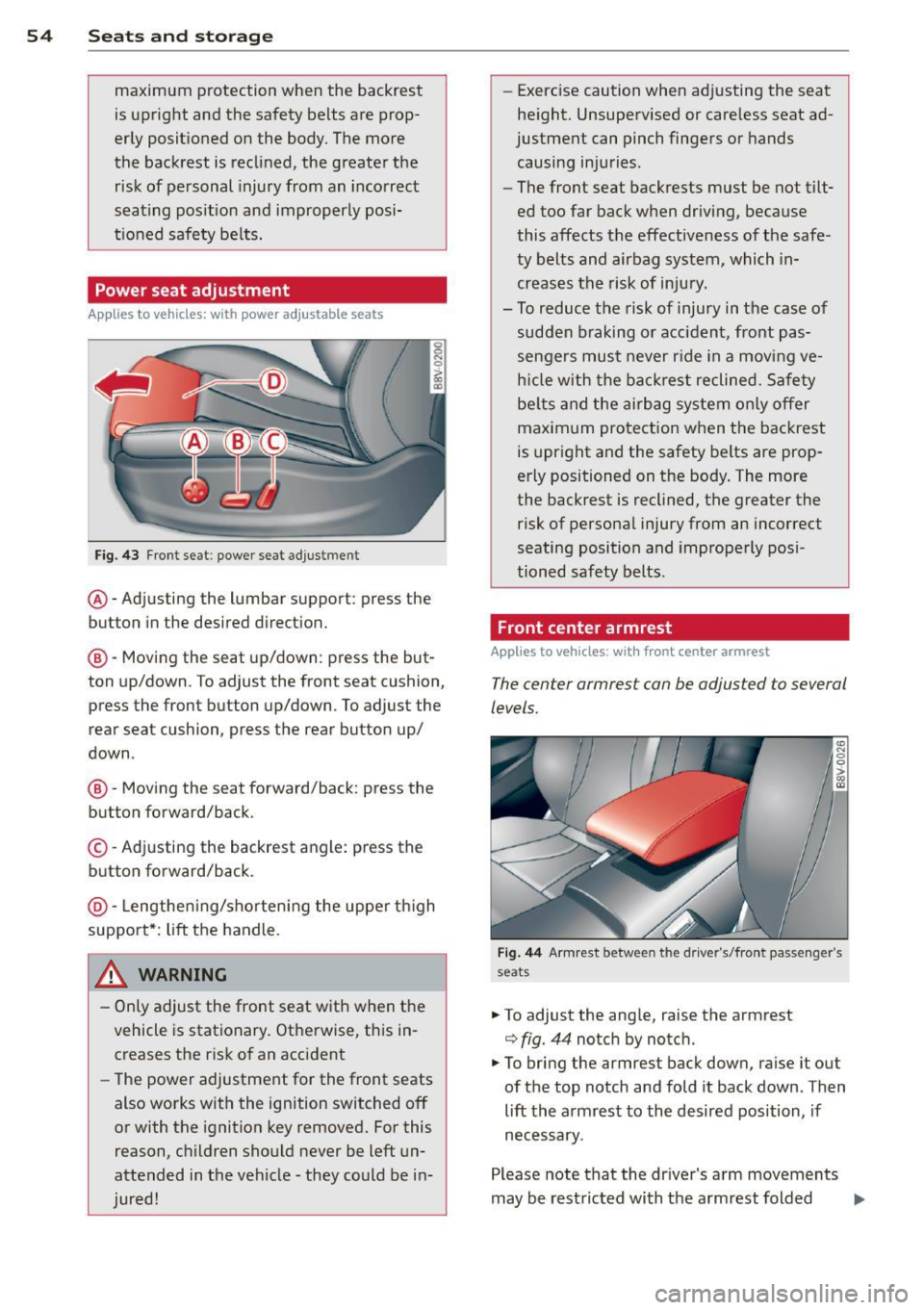
Power seat adjustment
Appl ies to vehicles: with power a djustable seats
Fig. 43 Front seat: power seat adjustment
@-Adjusting the lumbar support: press the
button in the desired direction.
@-Moving the seat up/down: press the but
ton up/down . To adjust the front seat cushion,
press the front button up/down. To adjust the
rear seat cushion, press the rear button up/
down .
@-Moving the seat forward/back: press the
button forward/back.
©-Adjusting the backrest angle: press the
button forward/back.
@-Lengthening/shortening the upper thigh
support*: lift the handle.
.&_ WARNING
- Only adjust the front seat with when the
vehicle is stationary. Otherwise, this in
creases the risk of an accident
- The power adjustment for the front seats
also works with the ignition switched off
or with the ignition key removed. For this
reason, children should never be left un
attended in the vehicle -they could be in
jured! -
Exerc ise caution when adjusting the seat
height. Unsupervised or careless seat ad
justment can pinch fingers or hands
causing injuries .
- The front seat backrests must be not tilt
ed too far back when driving, because
this affects the effectiveness of the safe
ty belts and airbag system, which in
creases the risk of injury.
- To reduce the risk of injury in the case of sudden braking or accident, front pas
sengers must never ride in a moving ve
hicle with the backrest reclined. Safety
belts and the airbag system only offer
maximum protection when the backrest
is upright and the safety belts are prop
erly positioned on the body. The more
the backrest is reclined, the greater the
risk of personal injury from an incorrect
seating position and improperly posi
tioned safety belts.
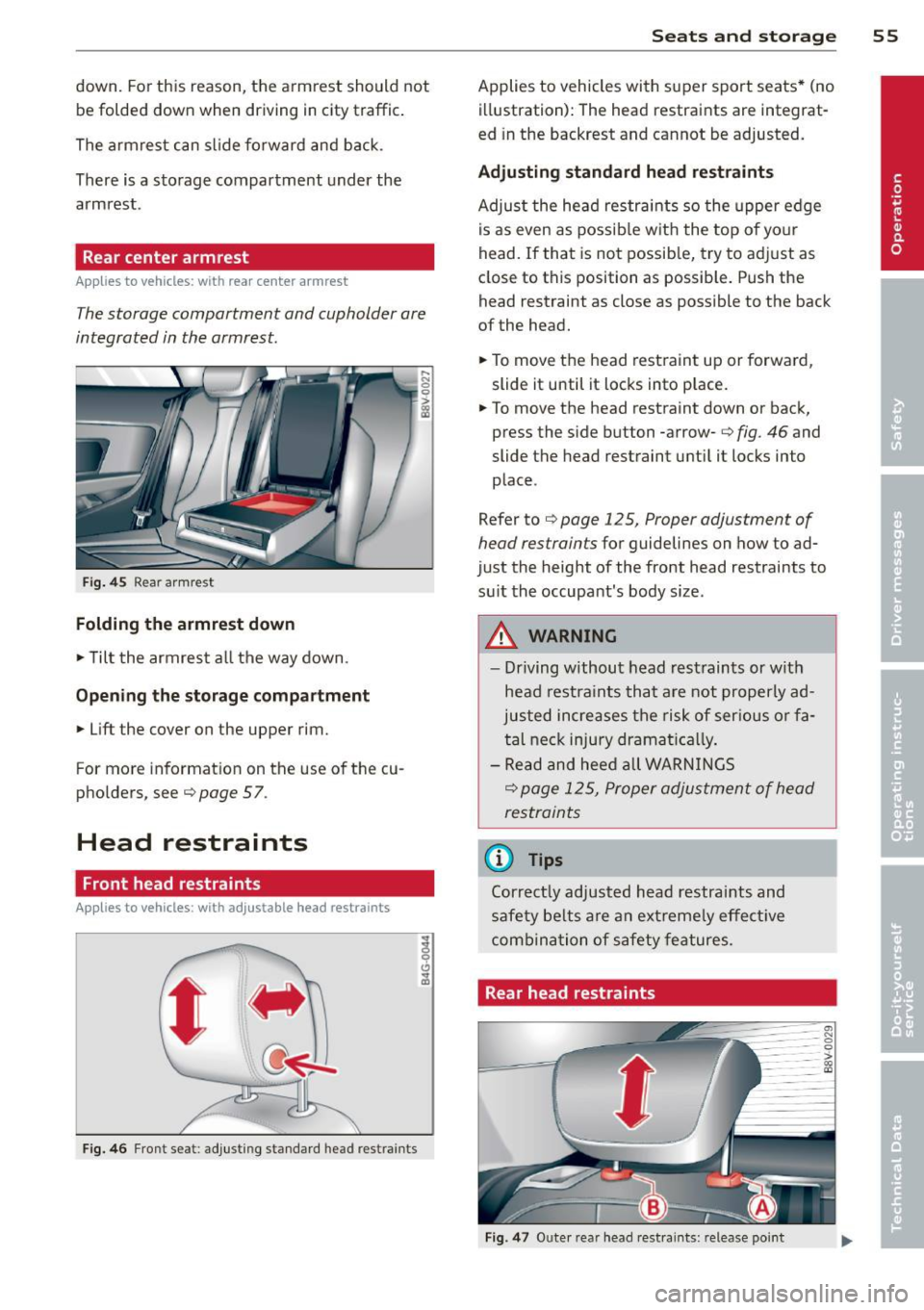
Front center armrest
App lies to vehicles: wit h front cente r armrest
The center armrest con be adjusted to several
levels.
Fig. 44 A rmr est between the driver's/fro nt passenger's
seats
.. To adjust the ang le, raise the armrest
¢ fig. 44 notch by notc h.
.. To bring the armrest back down, raise it out
of the top notch and fold it back down . Then
lift the armrest to the desired position, if
necessary .
Please note that the driver 's arm movements
may be restricted with the armrest folded
Ill>
Page 57 of 288
down. For this reason, the armrest should not
be folded down when driving in city traffic.
The arm rest can slide forward and back.
There is a storage compartment under the
armrest .
Rear center armrest
Applies to vehicles : wit h rear center armrest
The storage compartment and cupholder are
integrated in the armrest.
Fig. 45 Rear armrest
Folding the armrest down
~ Tilt the armrest all the way down .
Opening the storage compartment
~ Lift the cover on the upper rim.
For more information on the use of the cu
pholders, see¢
page 57 .
Head restraints
Front head restraints
Applies to vehicles : wit h adjustab le head restra ints
Fig. 46 Front seat : adjusting standard head restraints
Seats and storage 55
Applies to vehicles with super sport seats* (no
illustration): The head restraints are integrat
ed in the backrest and cannot be adjusted.
Adjusting standard head restraints
Adjust the head restraints so the upper edge
i s as even as possible with the top of your
head. If that is not possible, try to adjust as
close to this position as possib le. Push the
head restraint as close as possible to the back
of the head.
~ To move the head restraint up or forward,
slide it until it locks into place.
~ To move the head restraint down or back,
press the side button -arrow-¢
fig. 46 and
slide the head restraint until it locks into
place .
Refer to ¢
page 12 5, Proper adjustment of
head restraints
for guidelines on how to ad
just the height of the front head restraints to
su it the occupant's body size.
A WARNING
-Driving without head restraints or with
head restra ints that are not properly ad
justed increases the risk of ser ious or fa
tal neck injury dramatically.
- Read and heed all WARNINGS
¢ page 12 5, Proper adjustment of head
restraints
(D Tips
Correct ly adjusted head restraints and
safety belts are an extreme ly effective
combina tion of safety features.
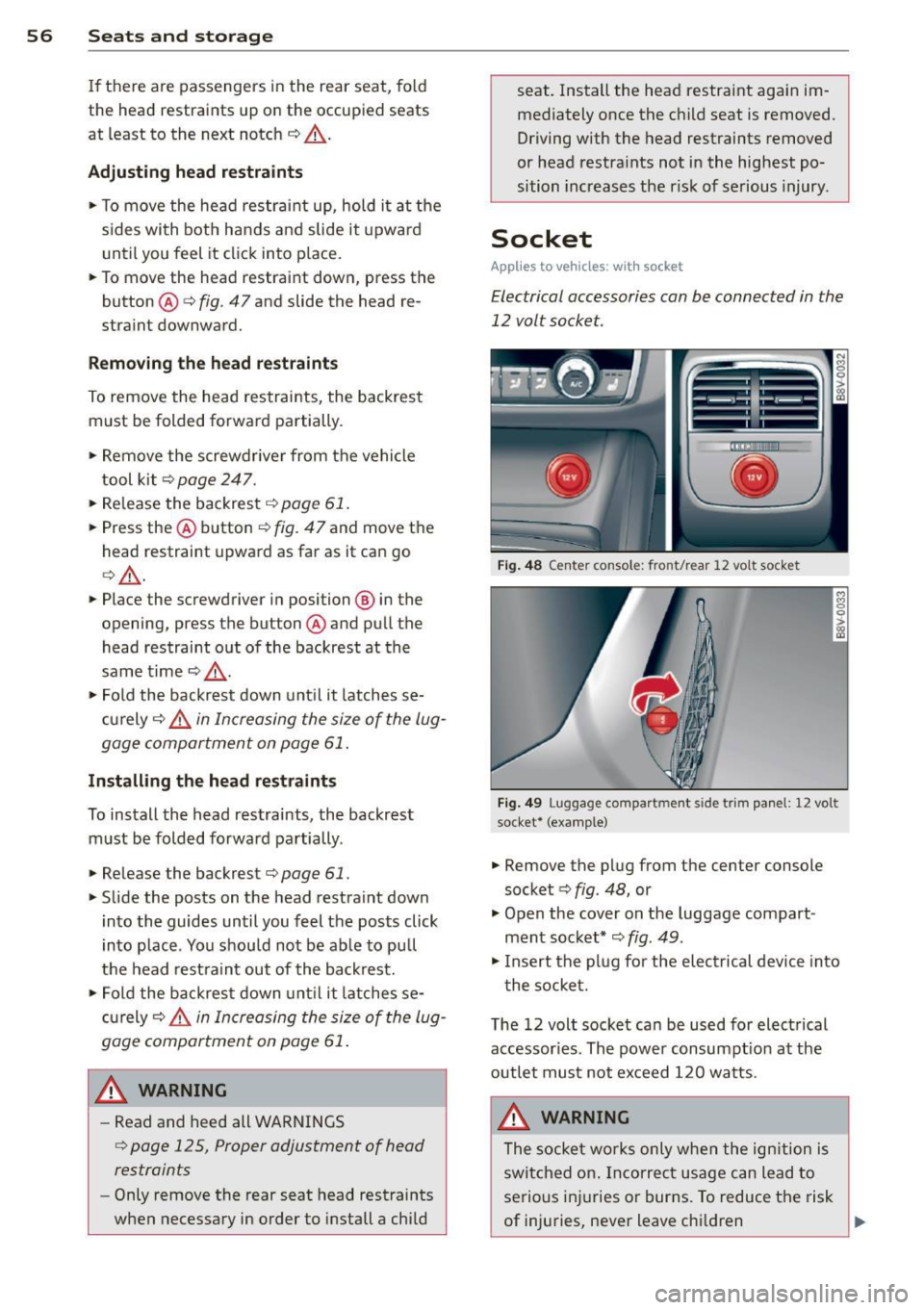
, Rear head restraints
Fig . 47 Outer rear head restraint s: release point
-
Page 58 of 288
56 Seats and storage
If there are passengers in the rear seat, fold
the head restraints up on the occupied seats
at least to the next notch ¢
A.
Adju sting head re stra ints
"' To move the head restraint up, hold it at the
s ides with both hands and slide it upward
until you feel it click i nto place.
,,. To move the head restraint down, press the
button ®<=>
fig. 4 7 and slide the head re
stra int downward.
R emoving the head r estraints
To remove the head restraints, the backrest must be folded forward partially.
,,. Remove the screwdrive r from the vehicle
tool kit¢
page 247.
,,. Re lease the backrest¢ page 61.
,,. Press the@ button ¢ fig. 47 and move the
head restraint upward as far as it can go
<=> A .
,,. Place the screwdriver in position ® in the
opening, press the button @ and pull the
head restraint out of the backrest at the
same time ¢_&. .
,,. Fold the backrest down until it latches se
c ur ely ¢
A in Increasing the size of the lug
gage compartment on page 61.
In sta lling th e he ad re st raints
To install the head restraints, the backrest must be folded forward partially .
,,. Release the backrest¢
page 61.
,,. Slide the posts on the head restraint down
i nto the guides until you feel the posts click
into place . You should not be ab le to pu ll
the head rest raint out of the backrest.
,,. Fold the backrest down unt il it latches se
c urely ¢
A in Increasing the size of the lug
gage compartment on page 61 .
&_ WARNING
- Read and heed all WARNINGS
<=> page 125, Proper adjustment of head
restraints
- Only remove the rear seat head restraints
when necessary in order to install a chi ld seat. Install the head restraint again im
mediately once the ch
ild seat is removed.
Driving with the head restraints removed
or head restra ints not i n the highest po
sition increases the risk of serious injury .
Socket
Applies to vehicles: wit h socket
Electrical accessories can be connected in the
12 volt socket.
-·- ,-,- ,~ ,- -
' ' -i--
•
Fi g. 4 8 Ce nte r co nsol e: fro nt/r ear 12 vo lt sock et
Fig . 49 Lu ggage compa rtm ent s ide t rim panel : 12 vol t
socket* (example)
,,. Remove the plug from the center console
socke t
c:> fig. 48, or
,,. Open the cover on the luggage compart
ment socket* ¢
fig. 49.
"'I nsert the plug fo r the electrical device into
t he socket.
T he 12 volt socket can be used for electrical
accessor ies. The power consumpt io n at the
outlet must not exceed 120 watts.
&_ WARNING
The socke t works only whe n the ign ition is
switched on . Incorrect usage can lead to
serious inj uries or burns. To reduce the risk
of injuries, never leave chi ldren
~
Page 59 of 288
unattended in the vehicle with the vehicle
key.
(D Note
To avoid damaging the socket, only use
plugs that fit properly.
- Never connect equipment that generates
electrical current, such as a solar panel
or battery charger, to the 12-volt socket.
This could damage the vehicle's e lectri
cal system .
- The 12-volt socket should only be used
for a short period of time as a power
source for electrical equipment . Please
use the electrical sockets in the vehicle
when connecting equipment for longer periods .
- To avoid damaging the socket, only use
plugs that fit properly .
{D) Tips
The vehicle battery drains when accesso
ries are turned on but the engine is off .
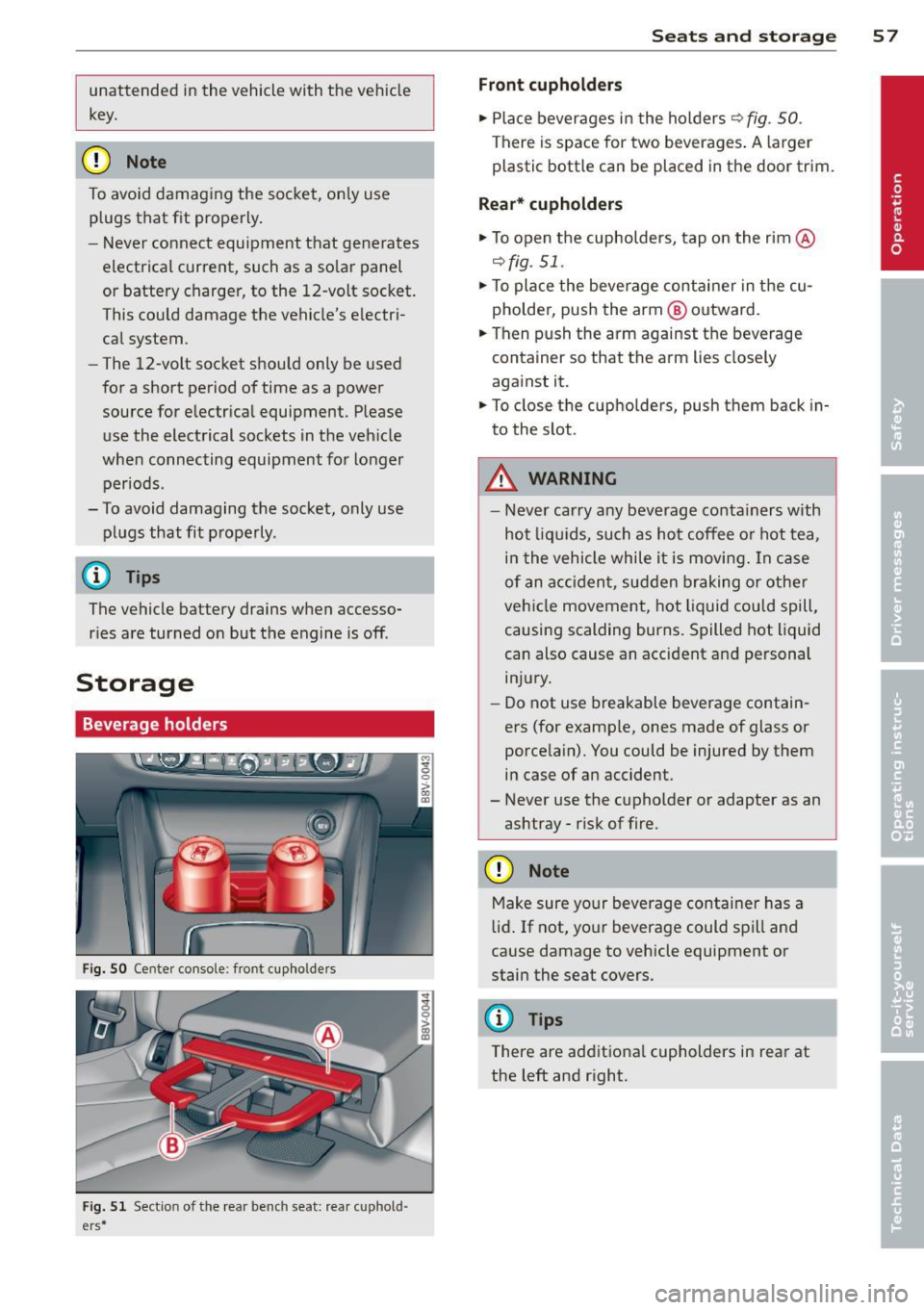
Storage
Beverage holders
Fig. 50 Center console: front cupho lde rs
Fig. 51 Sect ion of the rear benc h seat: rea r cuphold ·
e rs *
Seats and storage 57
Front cupholders
.,. Place beverages in the holders ¢ fig . SO.
There is space for two beverages. A larger
plastic bottle can be placed in the door trim.
Rear* cupholders
.,. To open the cupholders, tap on the rim @
¢fig. 51.
.,. To place the beverage container in the cu
pholder, push the arm @ outward.
.,. Then push the arm against the beverage
container so that the arm lies closely
against it.
.,. To close the cupholders, push them back in
to the slot .
A WARNING
-
- Never carry any beverage conta iners with
hot liqu ids, such as hot coffee or hot tea,
in the vehicle while it is moving. In case
of an acc ident, sudden braking or other
vehicle movement, hot liquid could spill,
causing scalding burns. Spilled hot liquid
can also cause an accident and personal injury.
- Do not use breakable beverage contain
ers (for example, ones made of glass or
porcelain). You could be injured by them
in case of an accident .
- Never use the cupholder or adapter as an
ashtray -risk of fire.
(D Note
Make sure your beverage container has a
lid. If not, your beverage could spill and
cause damage to vehicle equipment or
stain the seat covers.
(D Tips
There are additiona l cupholders in rear at
the left and right.
Page 60 of 288
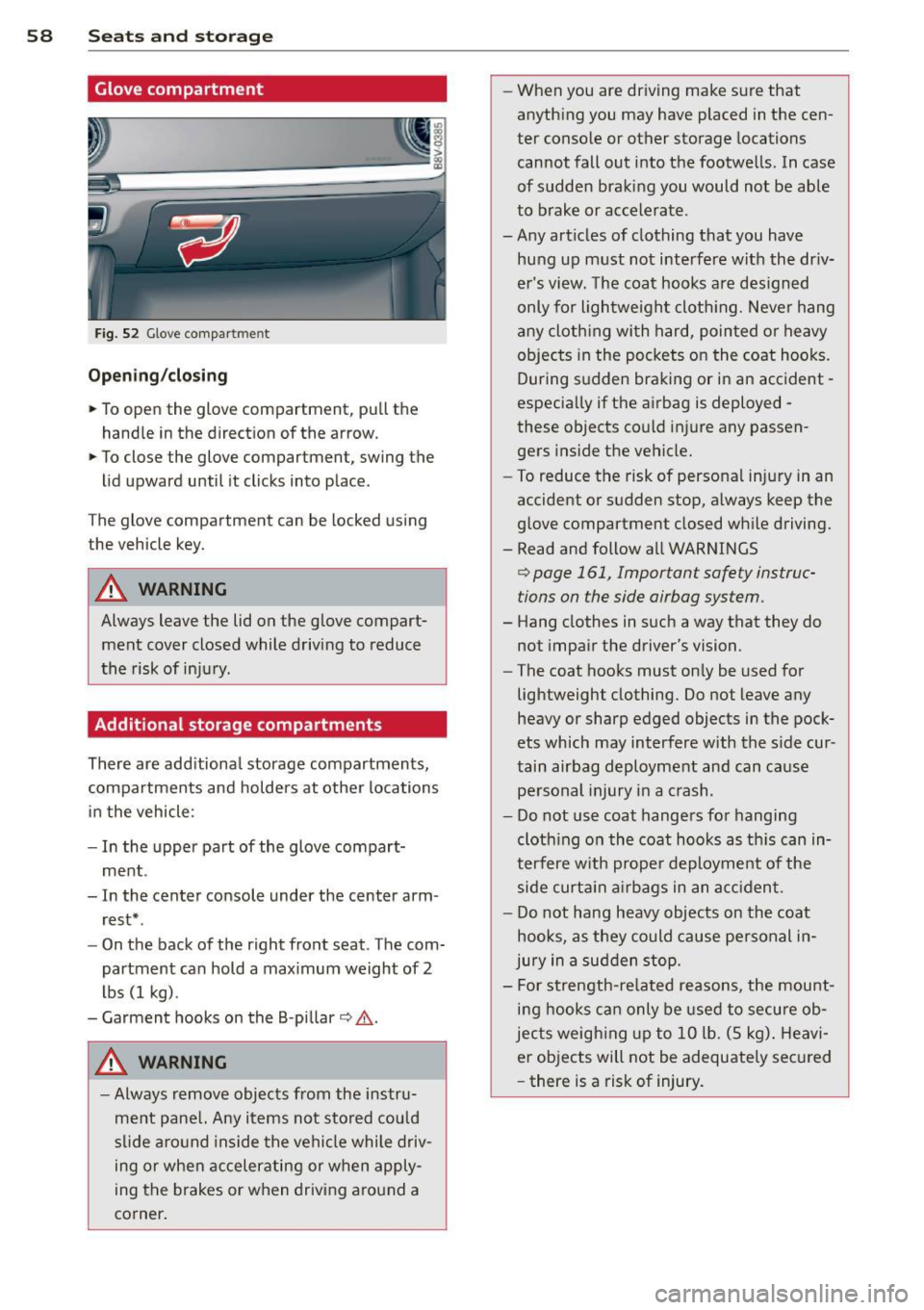
58 Seats and storage
Glove compartment
Fig. 52 Glove compa rt m en t
Open ing /closing
,,. To open the glove compartment, pull the
handle in the direct ion of the arrow.
,,. To close the glove compartment, swing the
lid upward until it clicks into place .
The glove compartment can be locked using
the vehicle key.
A WARNING
Always leave the lid on the glove compart ment cover closed while driving to reduce
the risk of in ju ry .
Additional storage compartments
There are add itiona l storage compartments,
compartments and holders at other locations
in the vehicle :
- In the upper part of the glove compart
ment .
- In the center console under the center arm rest* .
- On the back of the right front seat. The com
partment can hold a max i mum weight of 2
lbs (1 kg) .
- Garment hooks on the B -pillar
c:> A .
A WARNING
-Always remove objects from the instru
me nt pane l. Any items not stored could
s li de aro und inside the vehicle while driv
ing or when accelerating or when apply
ing the brakes or when driving a round a
corner .
-
-When you are dr iving make sure that
anyth ing you may have placed in the cen
ter conso le or other storage locations
cannot fall out into the footwells . In case
of sudden braking you would not be able
to b rake or accele rate .
- A ny articles of clothing that you have
hung up m ust not interfere with the dr iv
e r's vi ew. The coat hooks are des igned
only for lightweight cloth ing. Neve r hang
a ny cloth ing wi th hard, pointed o r heavy
objects in the pockets on the coat hooks.
During s udden braking or in an accident -
especia lly if the airbag is deployed -
these objects cou ld injure any passen
gers inside the vehicle.
- To reduce the risk of persona l in ju ry in an
accident or s udden stop, always keep the
g love compartment closed wh ile driving.
- Read and follow all WARNINGS
<=> page 161, Important safety instruc
tions on the side airbag system.
- Hang clothes in such a way that they do
not impair the driver's vision.
- The coat hooks must on ly be used for
lightweight clothing. Do not leave any heavy or sharp edged objects in the pock
ets which may interfere w ith the s ide cur
tain airbag deployment and can cause
pe rsonal injury in a crash .
- Do not use coat hange rs fo r hanging
cloth ing o n the coat hooks as th is can in
terfere w ith prope r deployment of the
side curt ain air bags in an a cciden t.
- Do not hang heavy objects on the coat
hooks, as they could cause pe rsonal in
jury in a sud den stop.
- For strength-re lated reasons, the mount
i n g hooks ca n only be used to secure ob
jects weigh ing up to 10 lb . (5 kg) . Heavi
er objects will not be adequate ly sec ured
- there is a risk of injury.
Page 62 of 288
60 Seats and st o rage
loading the roof rack
Always distribute loads evenly . Make sure
anything on the roof rack is securely tied
down.
,. Always distribute the loads on the roof rack
evenly .
,. Always attach items to the roof rack securely
before you d rive off.
The maximum perm iss ible roof we ight is
165 lb (75 kg ). The roof weight is the total of
the we ight of the roof rack, the attachments
and the cargo you are carry ing. You m ust also
not exceed the maximum load weight for the
roof rack you are using.
When us ing a roof rack system which has a
l owe r load carry ing capac ity, you must not use
up the total max imum pe rm issib le load carry
i ng capac ity specified above. Instead, you
should load the roof rack system only to the
maximum capacity specified by the manufac
turer of the roof rack system.
A WARNING
Weak, damaged or improper straps used
to secure items to the roof rack can fail
during hard braking or in a collision and
cause se rious personal injury .
- Make sure the roof rack is insta lled exact
ly as specified above¢
page 59.
-Always use suitable mounting straps for
securing items to the roof rack to help
prevent items from shift ing o r fly ing for
ward.
- Items on the roof rack must always be sec urely mounted.
- The use of a roof rack can negative ly af
fect the way a vehicle handles . Ca rgo
that is larg e, heavy, bulky, long o r flat
will have a g reater negative influence on
the vehicle's aerodynamics, center of
gravity and overal l handling. Always
dr ive slowly, avo id sudden braking and
maneuvers when transporting cargo on
the roof of your vehicle.
- Never exceed the maxim um permissible
load carrying capacity of the roof of your
veh icle, the permissible axle weights and
the permissible total weight of your vehi cle ¢
page 265, Weights.
@ For the sake of the env ironment
As a result of the increased wind resist
ance created by a roof rack, your vehicle is
us ing fuel unnecessarily . So
remove the
r oof rack after using it .
Luggage compartment
loading luggage compartment
Luggage items must be stowed securely.
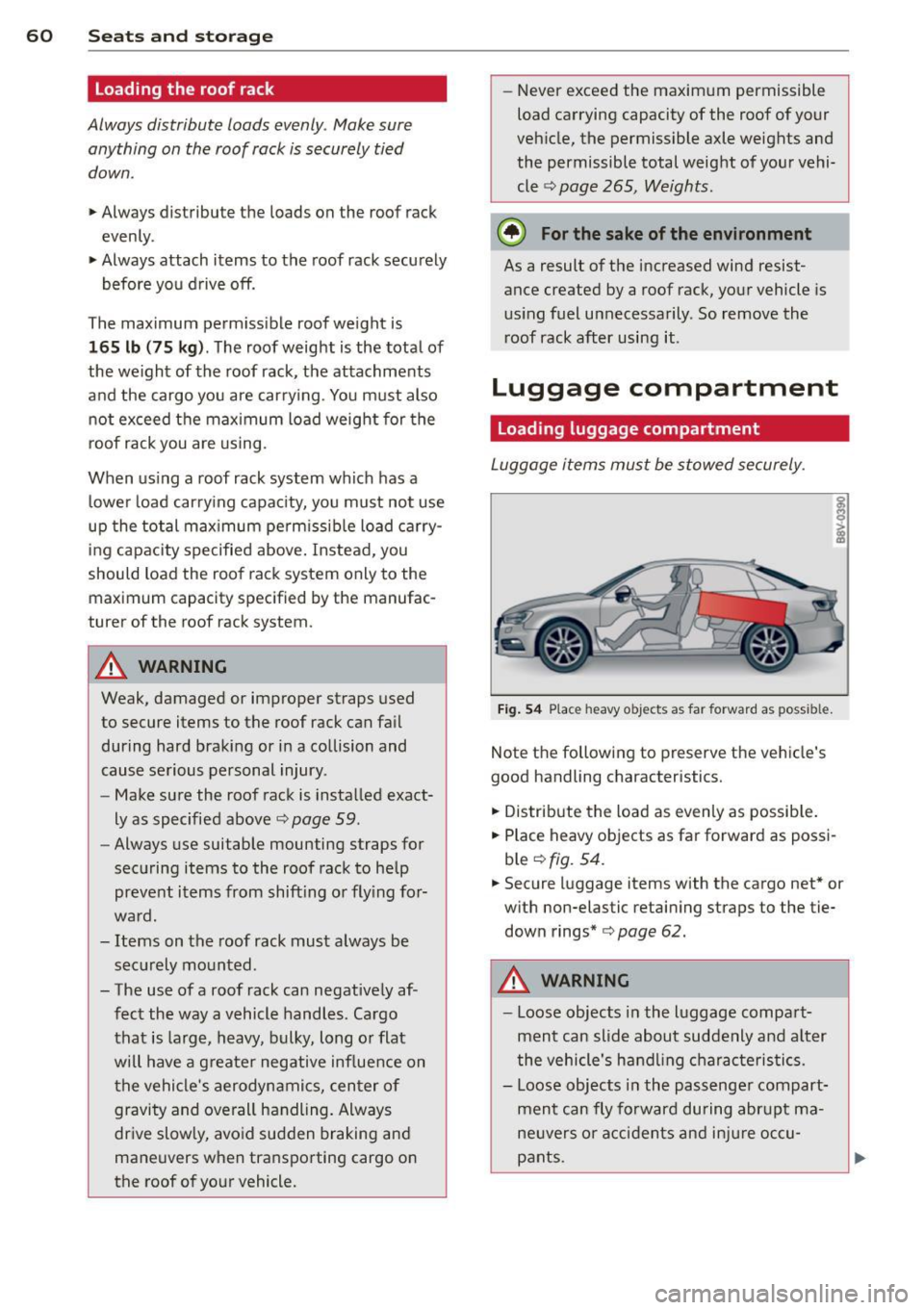
Fig . 5 4 Place heavy objects as far forward as possible.
Note the following to preserve the vehicle's
good handling characteristics.
,. Distribute the load as even ly as possib le.
,. Place heavy objects as far forward as possi
ble ¢
fig. 54.
,. Secure luggage items with the cargo net* or
w ith non-elastic retaining straps to the tie
down rings*
¢page 62.
A WARNING
-Loose objects in the l uggage compart
ment can slide about suddenly and a lter
the vehicle's hand ling cha racteristics.
- Loose objects in the passenge r compart
ment can fly forward during abr upt ma
ne uvers o r acci dents and inj ure occu
pants.
-