water AUDI A3 2016 Owner´s Manual
[x] Cancel search | Manufacturer: AUDI, Model Year: 2016, Model line: A3, Model: AUDI A3 2016Pages: 328, PDF Size: 81.78 MB
Page 112 of 328
e-tron
The gasoline engine is no longer available be
cause there is not enough fuel. Drive immediately
to a gas station.
Fuel filler door emergency release
A pp lies to ve hicles: w ith plug- in hy brid drive
You must use the emergency release to open the
fuel filler door when there is a malfunction
c::> page232 .
The tank is not vented. You can only fill a small
amount of fuel in the tank.
~ Fill only until the automatic fuel pump nozzle
turns off for the first time when it is operated
correctly.
Drive to an authorized Audi dealer or authorized
Audi Service Facility immediately to have the
malfunction corrected.
(D Tips
Pressure can escape if you open the tank cap
after using the emergency release. This can
create noises.
Charging
General information
A pp lies to veh icles: w ith plug -in hybrid drive
Two options are available for charging the vehi
cle:
- Charge at a public charging station with a spe
cial charging cable*
c::>page 112.
- Charge with household and industrial power
sockets using the Audi e-tron charging system
c::> page 112.
Environmental conditions when using the
charging system
-Operating temperature : -13 °F (-25 °C) to 95 °F
(+35 °C)
- Humidity:
5% to 95%, non-condensing
- 13,000 feet (4,000 meters) maximum above
sea level
110
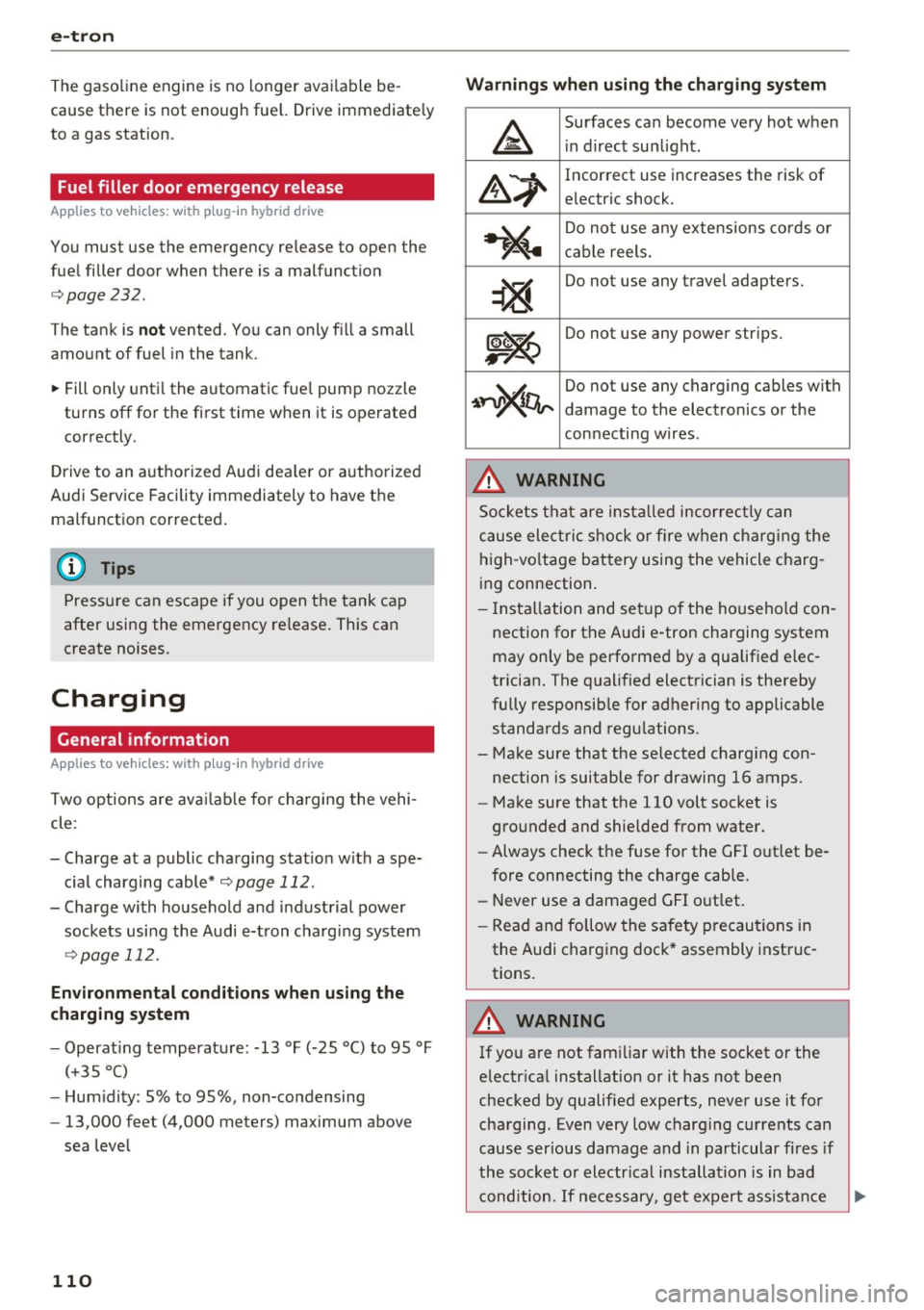
Warnings when using the charging system
£
Surfaces can become very hot when
in direct sunlight.
&~
Incorrect use increases the risk of
electric shock.
~"-
Do not use any extensions cords or
cable reels.
~
Do not use any travel adapters.
~~
Do not use any power strips.
~~~
Do not use any charging cables with
damage to the electronics or the
connecting wires.
.&_ WARNING
-
Sockets that are installed incorrectly can
cause electric shock or fire when charging the
high-voltage battery using the vehicle charg
ing connection.
- Installation and setup of the household con
nection for the Audi e-tron charging system
may only be performed by a qualified elec
trician. The qualified electrician is thereby
fully responsible for adhering to applicable
standards and regulations.
- Make sure that the selected charging con nection is suitable for drawing 16 amps .
- Make sure that the
110 volt socket is
grounded and shielded from water.
- Always check the fuse for the GFI outlet be
fore connecting the charge cable.
- Never use a damaged GFI outlet.
- Read and follow the safety precautions in
the Audi charging dock* assembly instruc
tions.
.&_ WARNING
If you are not familiar with the socket or the
e lectrical installation or it has not been
checked by qualified experts, never use it for
charging. Even very low charging currents can
cause ser ious damage and in particular fires if
the socket or electrical installation is in bad
condition. If necessary, get expert assistance
~
Page 113 of 328
,....,
N
0 > co ,....,
ist.
A WARNING
Incorrect handling of the connector contacts
can cause e lectric shock or fire.
- Do not touch the contacts on the vehicle charging port and on the Audi e-tron charg
ing system .
- Do not insert any objects in the vehicle charg ing port or in the Audi e-tron charging
system .
- Protect the sockets and connectors against
any moisture, water and other flu ids.
A WARNING
Using a damaged or incorrect charging cable
or a damaged or incorrect socket, using the
Audi e-tron charg ing system incorrectly or
disregarding the safety precaut ions could
cause sho rt circu iting, e lectric shoc k, exp lo
sions , fires or burns.
- Do not use the Audi e-t ron c ha rging system
if it is damaged and/or dirty . Check the ca
ble and connector for damage and dirt be
f ore using .
- T he Aud i e-tron charg ing system must only
be connected to sockets that a re insta lled
correctly and that are not damaged as we ll
as to electr ica l installations that have no
faults.
- Do not use any extension cords, cable reels,
power str ips or (travel) adapters.
- Disconnect the Audi e-tron charging system
from the power network during a thunder
storm .
- Do not modify or repair any electrical com
ponents.
- Never immerse the Audi e-tron charging system and connectors in water.
- The Aud i e-tron charging system must only
be cleaned when the control unit is com
pletely disconnected from the power supply
and from the veh icle. Use a dry towel to
clean.
- I f a 110 volt socket is used for charging, on
ly connect one veh icle at a time to the same
e-tron
circuit. Use a different circuit if an add ition
al vehicle needs to be charged at the same
time. Note the maximum permitted current
draw for the c ircuit. Contact a qualified elec
tr ical technician if there is any doubt.
A WARNING '"---
The components in the Audi e-tron charg ing
system can trigger sparks which can cause
flammable or explos ive f umes to ignite .
- To reduce the r isk of explosions, espec ially
in garages, make sure the contro l unit is at
least 19 in ches (SO cm) above the floo r
when charging.
- Do not use the Aud i e-tron charg ing system
in areas at risk for exp losions .
- The Audi e-tron charging system is only suit
ab le for use on Aud i vehicles and veh icles
within the Volkswagen Group. Using the de
vice on vehicles made by another manufac
turer is not authorized .
CI) Note
Make sure that you a lways use the s uitable
power plug prov ided with the A udi e-tron
charging system for the corresponding mar
ket. Contact an authorized Audi dealer o r au
thorized Audi Service Facility for more infor mation.
(D Tips
- For an uninterrupted charging process, we
recommend only charging using sockets
that are connected to a separately protect ed circuit.
- Us ing NEMA sockets w ith a current rat ing of
at least 30 A or industrial sockets in accord
ance with IEC 60309 when charging is rec
ommended .
- When charging the high-voltage battery us
ing household/ industrial sockets, the elec
trical installation can be used at full capaci
ty. Having a qualified electrician regularly inspect the electrical installations that are
used for charg ing is recommended.
111
Page 114 of 328
e-tron
-The vehicle radio and TV systems may have
limited reception when charging the vehi
cle.
Charging at public
charging stations
App lies to vehicles: w ith plug-in hybrid drive and special
charging cable
Use the charging cable supplied at the public
charging station for charging. Contact an author
ized Audi dealer or authorized Audi Service Facili
ty for more information.
• Read the operating instructions at the charging
station to charge the battery.
• Unl ock the vehicle if necessary¢
page 35.
• Make sure that the selector lever is in the P po
sition and drive ready mode is switched off .
• Turn the lock until it is vertical to open the
cov
er on the charging unit r:;> page 115, fig . 108.
• Slide the cover carefully to the side if necessa
ry .
• Remove the lock on the charging port
¢page 115, fig. 109 .
• Remove the cap from the charging cable if nec
essary .
• Connect the cable to the veh icle charging port .
• If a charg ing timer is not set, the charging
process will start automatically depending on
the charging station¢
page 116, Setting the
charging timer.
• The vehicle operating status is indicated by the
status LED@¢
table on page 119.
• Refer to the information under¢ page 117,
After charging
or ¢ page 121 , Vehicle charg
ing connector emergency release.
@ Tips
-It is not possible to charge using the charg
ing timer at some charging stations .
- You can use your Audi e-tron charging sys
tem if there is a household or industrial con
nection availab le at the charging station.
112
Charging the battery
with the Audi e-tron
charging system
Charging system overview
Applies to vehicles : with plug -in hybrid drive
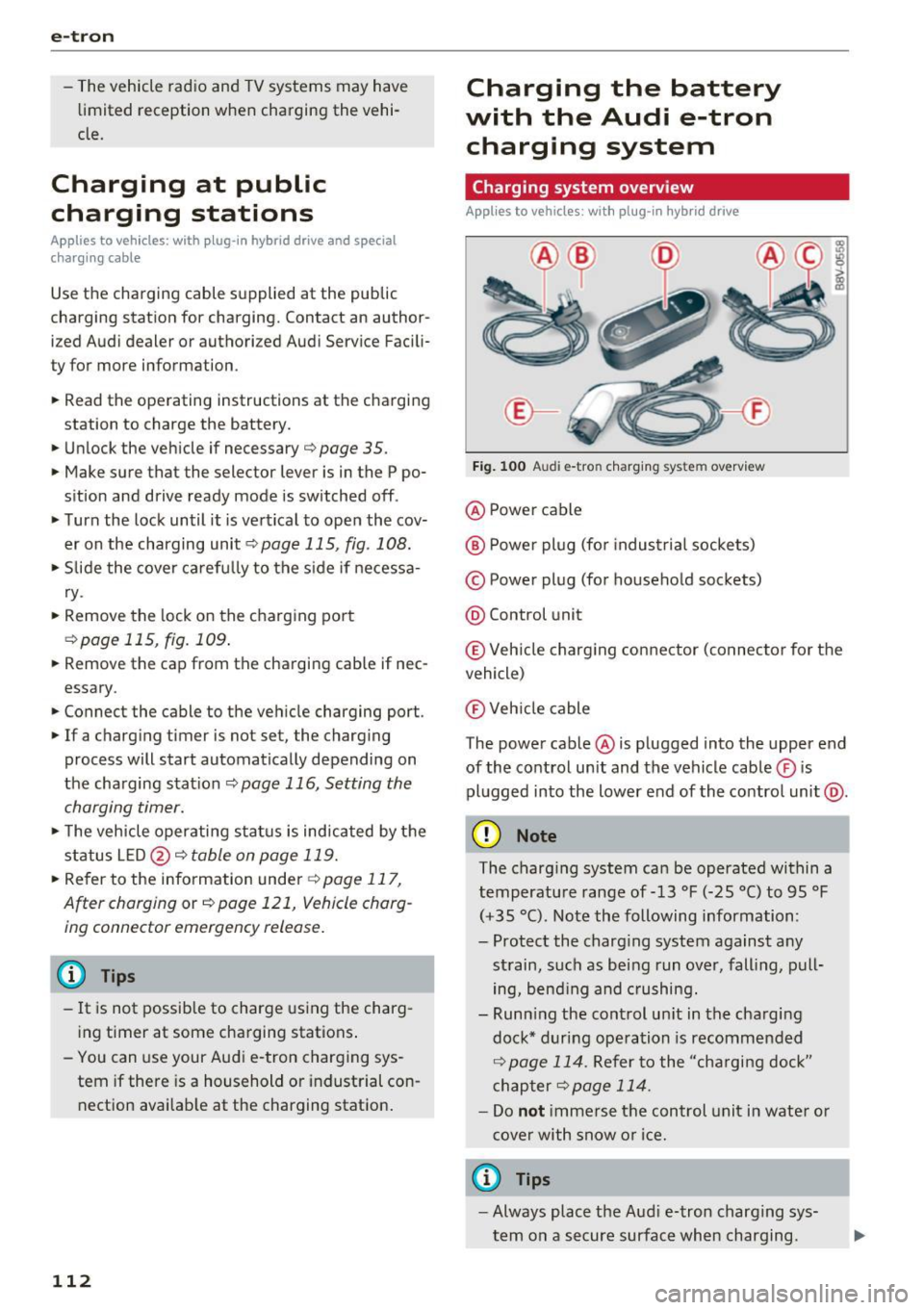
Fig. 100 Audi e-tron c harging system overview
@ Power cable
@ Power plug (for industrial sockets)
© Power plug (for household sockets)
@ Control unit
© Veh icle charging connector (connector for the
vehicle)
® Vehicle cable
The power cable @ is plugged into the upper end
of the control unit and the vehicle cable ® is
plugged into the lower end of the contro l unit @.
(D Note
The charging system can be operated within a
temperature range of-13 °F (-25 °C) to 95 °F
(+35 °C). Note the following information:
- Protect the charg ing system against any
strain, such as being run over, falling, pull
ing, bend ing and crushing.
- Runn ing the control un it in the charging
dock* during operation is recommended
¢ page 114. Refer to the "cha rging dock"
chapter
¢page 114.
-Do not immerse the control unit in water or
cover with snow or ice.
a) Tips
-Always place the Aud i e-tron charging sys
tem on a secure surface when charging.
Page 124 of 328
e-tron
You can release cover using the emergency re
lease.
.,. Turn the lock to the horizontal position .
.,. Unlock the veh icle.
.,. Open the hood
r:!;> page 23 7, Opening the hood .
.,. Carefully pull on the knob @until there is re-
s istance .
.,. Turn the lock to the vertical position
r:!;> page 115, fig . 108 .
.,. Slide the cover carefully to the side if necessa
ry .
Climate control
Description
Applies to vehicles: with plug- in hybrid drive
Your vehicle has either auxiliary heating or auxili
ary heat ing/ air conditioning*.
The auxiliary heating or the auxi liary heating/ air
conditioning* switches on depending on the out
side temperature and the temperature set on the
climate control unit .
Switching on/off immediately
.,. You can switch the climate control on and off
immediately in the MMI*
¢page 123. Or
.,. Switch off the blower with the~ button
¢ page 72, fig. 72.
Setting the timer
.,. You can set the time when your vehicle should
reach the desired temperature. Your set tem
perature and the outside temperature deter
mine when the climate control switches on.
@ Tips
- The temperature that the climate control
system adjusts to depends on the last tem
perature you set in the climate control unit
c;;,page 72.
-The climate control system does not auto
matically switch on or off earlier if the vehi
cle battery charge or the fuel level is too low.
122
· Auxiliary climate control
Applies to vehicles: with plug-in hybrid drive without auxiliary
hea ting
The aux iliary climate control controls the tem
perature in the vehicle inter ior ent irely with elec
tric power. It turns on only if the high-voltage
battery charge level is sufficient and there is
enough fuel in the tank.
Auxiliary heating / air conditioning
Applies to vehicles: with plug-in hybrid drive and auxiliary
heat ing
The aux iliary heating/ air conditioning controls
the temperature in the vehicle interior if the
high-voltage battery charge level is suff icient and
there is eno ugh fuel in the tank.
The
.ill. symbo l blinks in the climate contro l unit
whe n auxiliary heating is switched on.
When the auxiliary heating/ air conditioning t im
er is programmed, the Ill symbol stays turned on
until the departure t ime is reached.
& WARNING
- To reduce the risk of poisoning, the auxiliary
heating/ air conditioning must not run in
confined spaces .
- To redu ce the risk of fires, the auxiliary
heating/ air conditioning must not run
when refueling.
- Due to the high temperatures that result
from operating the auxiliary heating/ air
conditioning, the vehicle must be parked in
a way so that the hot exhaust can escape at
the bottom of the engine cover without ob
struction. The exhaust must not come into
direct contact with highly flammab le mate
r ials.
(D Tips
Water vapor can build up near the engine
compartment when outside temperatures are low. This is a natural phenomenon and is no
cause for concern.
Page 145 of 328
.... N
0 > CX)
.... I.Cl U"I
.... I.Cl ....
-For safety reasons, active lane assist must
not be used when there are poor road and/
or weather conditions such as slippery
roads, fog, gravel, heavy ra in, snow and the
potent ial for hydroplaning . Using active lane
assist under these conditions may increase
the risk of a c rash.
Switching on and off
Applies to vehicles: with Audi active lane assist
•
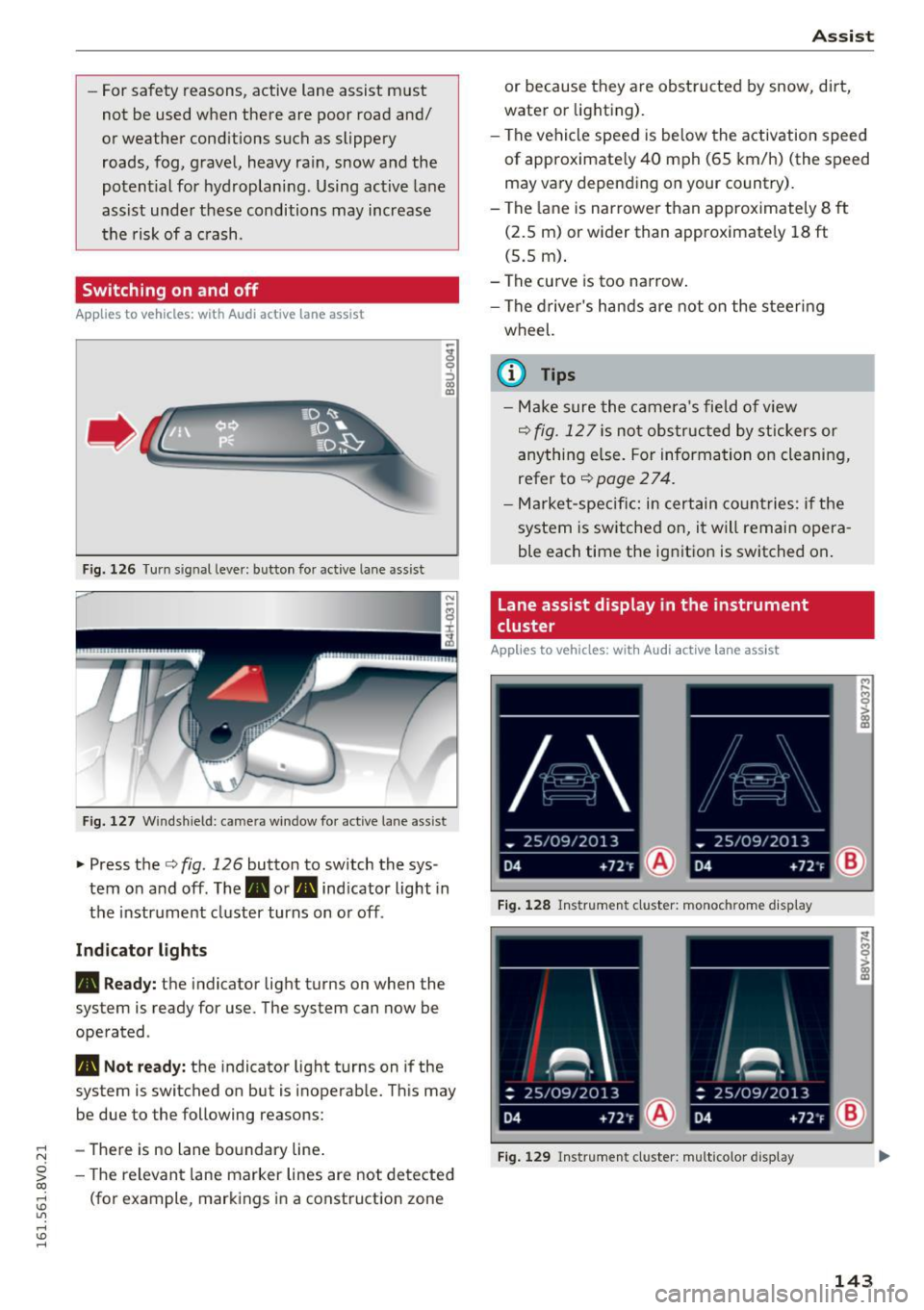
F ig. 1 26 Turn s ig n al leve r: button for active lane as sist
F ig. 127 W ind sh ield: c ame ra win dow fo r act ive lane ass is t
~ Press the c::> fig. 126 button to sw itch the sys
tem on and off . The . or. indicator light in
the instrument cluster turns on o r off .
Ind icator light s
• Read y :
the indicator light turns on when the
system is ready for use. The system can now be
operated .
• Not ready: the indicator light turns on if the
system is switched on but is inoperable. Th is may
be due to the following reasons:
- There is no lane bo undary line .
- The relevant lane marker lines are not de tected
(fo r example, markings in a const ruction zone
A ss ist
or because they are obstructed by snow, dirt,
water or lighting).
- The vehicle speed is be low the activation speed
of approximate ly 40 mph (65 km/h) (the speed
may va ry depend ing on your country).
- The lane is narrowe r th an approximately 8
ft
(2.5 m) or wider than approximate ly 18 ft
(5.5 m) .
- The curve is too narrow .
- The d river's hands are not on the steering
wheel.
(0 Tips
- Make sure the camera's field o f view
c::> fig . 12 7 is not obs tructed by st ickers or
anything e lse. For informa tion on clea nin g,
refer to
c::> page 2 7 4.
- Market-specifi c: in certain co untries: if the
system is switched on, it will remain opera
ble each time the ig nitio n is switched on .
Lane assist display in the instrument
cluster
Applies to vehicles: with Audi act ive lane assist
Fig. 1 28 Ins trumen t cl uster: monoc hrom e disp lay
F ig . 12 9 Instru men t cl uster: multicolor display
143
Page 163 of 328
,....,
N
0 > co ,....,
You should only switch sport mode on or switch ESC/ASR off if your driving abilities
and road conditions permi t.
- The stabilization function is limited when
sport mode is sw itched on . T he driving
w heels could spi n and the veh icle cou ld
swerve, espec ially on s lick o r sli ppery road
s u rf aces.
- T here is no veh icle stabilization when ESC/
ASR a re swi tched off.
(D Tips
- ESC/ASR cannot be switched off or sport
mode cannot be sw itched on if t he cru ise
contro l system* or the adaptive c ruise con
tro l* is sw itched on .
- Mal functions in the Audi magnet ic r ide may
make it imposs ible to sw itch the ESC/ASR
off or to switc h sport mode on .
Brakes
New brake pads
New brake pads do not ac hieve the ir full braking
effect during the first 250 mi (400 km) . They
must be "b roken in " fi rs t . However, you can com
pensate for the slightly reduced bra king fo rce by
p ressing firmly o n the brake pedal. Avoid heavy
b raking during the break -in period .
Wear
Brake pad
wear depends largely on the way th e
ve hicl e is driven a nd on operat ing cond itions.
This is especially true if you are d riving frequently
in the c ity and on c urves o r wi th a sporty driving
style.
Operating noise
Noises may occur when bra kin g depend ing on the
speed , braking force and ou ts ide cond it ions s uch
as tempe rature and humidity .
Effect of water and road salt
In certain situations, for example after dr iving
through water, in heavy ra in, after ove rnig ht con
densat ion or after washing your car, the b raking
Intellig ent Technology
effect ca n be reduced by moist ure o r ice on the
bra ke rotors and brake pads . The brakes must be
"d ried" first with a few caref ul brake applica
tions.
At h igher speeds and w ith the wi ndshield wipe rs
tu rned on, the brake pads press against the brake
roto rs fo r a short amount of time. This action
wh ich is not felt by the dr iver happens at reg ular
interva ls and facilit ates a be tter reaction t ime for
the brakes in wet weather .
The braking effect can a lso be reduced if yo u are
driv ing on salted roads and yo u do not app ly the
brakes for long per iods of time . The layer of salt
o n the brake rotors and pads must be wor n off
first whe n the bra kes are applied .
Corrosion
Leaving the vehicle pa rked for long periods of
time, low mileage and avoiding heavy braking
can contribute to corros ion on the brake rotors
and dirty brake pads .
If you usua lly avoid heavy brak ing or if there is
corrosion present, occasiona l heavy brak ing at
high speeds is recommended to clean the b rake
roto rs and pads<=>,& .
Brake system malfunction
if you notice that t he b rake pedal travel has sud
denly gotten larger, t hen a b rake c ircuit may have
failed. Drive to an author iz ed Audi dealer or au
thorized Audi Serv ice Facility immediately to have
t h e problem corrected. On the way there, drive
with red uced speed and keep in mind that a long
bra king d ista nce and increased pressu re on the
br ak e pedal w ill be necessary.
Low brake fluid level
When the brake fluid level is low, malfunctions in
the brake system may occur . The b rake fluid level
i s elec tronica lly monito red .
Brake booster
The brake booster amp lifies the press ure you ap
ply to the brake pedal. It on ly operates wh ile the
engine is run ning o r when the ignition is switched
on (p lug-i n hyb rid dr ive*) . .,.
161
Page 164 of 328

Intelligent Technology
A WARNING
-New brake pads do not achieve their full
braking effect during the first 250 mi
-
(400 km). They must be "broken in" first .
However, you can compensate for the
slightly reduced braking force by pressing
firmly on the brake pedal. Avoid heavy brak
ing during the break-in period.
- Only apply the brakes for the purpose of
cleaning the brake system when road and
traffic conditions permit. You must not en
danger other road users. This increases the
risk of an accident.
- On steep slopes, reduce the speed and se
lect a lower gear or lower selector lever po
sition. Drive as little as possible while press
ing the brake pedal and avoid putting your
left foot on the brake pedal while driving.
This could cause the brakes to overheat and
impair the efficiency of the brakes.
- Do not let the brakes "grind" by always
keeping your foot on the brake pedal. This
can cause the brakes to overheat, increase
wear and increase braking distance unneces
sarily.
- Certain weather and operating conditions
such as driving through water, driving in heavy rain or driving after washing your ve
hicle can impair the effectiveness of the
brakes . In the winter, ice may build up on
the brake pads, rotors and drums. Check
these components by braking carefully. Ap
plying the brakes carefully several times
dries the brakes and removes ice build-up .
- The efficiency of the brakes can also be im
paired by driving for long stretches on roads
covered with salt without using the brakes.
You can remove salt deposits from the brake rotors and pads by carefully applying
the brakes several times.
- If the front spoiler is damaged or you install
another spoiler, make sure the front wheel brakes are ventilated properly . Otherwise,
the brake system could overheat, which re
duces their effectiveness .
- Failure of a brake circuit impairs braking
performance, which increases braking dis -
162
tance. Avoid driving the vehicle and have it
towed it to the nearest authorized Audi
dealer or authorized Audi Service Facility.
- Never let the vehicle roll while the engine is
stopped because this increases the risk of an
accident .
- If the brake booster is not working, you will
have to press much harder on the brake
pedal to compensate for the lack of the
booster.
(D Note
- Never let the brakes "rub" by pressing the
pedal lightly when braking is not really nec
essary. This causes the brakes to overheat
and increases braking distance and causes
wear .
- Before driving on a long stretch with steep
slopes, reduce your speed and shift to the
next lower gear This makes use of the en
gine braking effect and relieves the brakes.
If you need to brake additionally, brake in
intervals and not continuously.
(D Tips
- If the brake booster is not working, you
must press the brake pedal with much more
force than normal.
- If you retrofit your vehicle with a front spoil
er, wheel covers or similar items, make su re
that the air flow to the front wheels is not
interrupted. Otherwise the brake system
can become too hot.
Electromechanical
steering
The electromechanical steering supports the
driver's steering movements.
Power steering adapts electronically based on
the vehicle speed .
The vehicle still has full steering functionality if
the power steering fails or when the engine is
stopped (towing) . To steer, you must apply much
more force than usual. .,.
Page 197 of 328

,....,
N
0 > co ,....,
backrest, center armrest, door or roof.
- Always install rear-facing child seats on the
rear seat.
- If you must install a rearward facing child
seat on the front passenger seat because of
exceptional circumstances and the
PASSEN
GER AIR BAG OFF
light does not come on
and stay on, immediately install the rear
facing child seat in a rear seating position
and have the airbag system inspected by
your Audi dealer.
A WARNING
Objects between you and the airbag will in
crease the risk of injury in a crash by interfer
ing with the way the airbag unfolds or by be
ing pushed into you as the airbag inflates.
- Never hold things in your hands or on your
lap when the vehicle is in use.
- Never transport items on or in the area of
the front passenger seat . Objects could
move into the area of the front airbags dur
ing braking or other sudden maneuvers and
become dangerous projectiles that can
cause serious personal injury if the airbags
inflate.
- Never place or attach accessories or other objects (such as cup holders, telephone
brackets, large, heavy or bulky objects) on
the doors, over or near the area marked "AIRBAG" on the steering wheel, instru
ment panel, seat backrests or between
those areas and yourself. These objects
could cause injury in a crash, especially
when the airbags inflate.
- Never recline the front passenger's seat to
transport objects. Items can also move into
the area of the side airbag or the front air bag during braking or in a sudden maneu
ver. Objects near the airbags can become
projectiles and cause injury, particularly
when the seat is reclined.
- Never place or transport objects on the front passenger seat. Objects on the front passenger seat could cause the capacitive
sensor in the seat to signal to airbag system
Airbag system
that the seat is occupied by a person when it
in fact is not, or that the person on the seat
is heavier than he or she actually is. The
change in electric capacitance because of
such objects can cause the passenger front
airbag to be turned on when it should be
off, or can cause the airbag to work in a way
that is different from the way it would have
worked without objects on the seat.
- Always make sure that there is nothing on
the front passenger seat that will cause the
capacitive passenger detection system in
the seat to signal to the Airbag System that
the seat is occupied by a person when it is not, or to signal that it is occupied by some
one who is heavier than the person actually
sitting on the seat. The presence of an ob
ject could cause the passenger front airbag to be turned on when it should be off, or
could cause the airbag to work in a way that is different from the way it would have
worked without the object on the seat.
_LD. WARNING
The fine dust created when airbags deploy can cause breathing problems for people with a
history of asthma or other breathing condi
tions.
- To reduce the risk of breathing problems,
those with asthma or other respiratory con
ditions should get fresh air right away by
getting out of the vehicle or opening win
dows or doors.
- If you are in a collision in which airbags de ploy, wash your hands and face with mild
soap and water before eating .
- Be careful not to get the dust into your eyes,
or into any cuts or scratches.
- If the residue should get into your eyes, flush them with water .
195
Page 199 of 328
,....,
N
0 > co ,....,
the front passenger seat . Always make sure that
the safety belt for the front passenger seat is
properly fastened.
Th e PASSENGER AIR BAG OFF light will show
the status of the front seat p assenger' s fr ontal
Ad vanced Airbag a few se cond s after the igni·
tion i s swit ched on and the ai rbag in d icator
light goes off . The PA SSEN GER AIR BA G OFF
light :
-will stay on if the front passenger seat is not
occupied;
- wi ll stay on if the electrical ca pacita nee meas
ured by the capacit ive passenger detection sys
tem for the front passenger seat equals the combined capacitance of an infant up to about
one year of age and one of the rearward-facing
o r fo rwa rd-facing ch ild restraints listed in Fed
era l Moto r Vehicle Safety Standard 208 w it h
wh ich the Advanced Airbag System in your veh i
cl e was certified; Fo r a listing of the child re
straints that were used to certify you r vehicle 's
compliance with the U.S. Safety Standard
¢ page 211 .
-will go out if the front passenger seat is occu
pied by an adult as registered by the capacitive
passenger detection system .
- The
PASSENGER AIR BAG OFF light must come
on and stay on if the ignition is on and ...
- a car bed has been insta lled on the front pas
senger seat, or
- a rearward-facing child restrai nt has been in
sta lled on the front passenger seat, or
- a forwa rd-facing child restra int has bee n instal
l ed on the front passenge r seat,
- and if the e lectr ic al capaci tance registered on
the front passenger seat is equal to or less than
the combined capacitance of a typical 1 year o ld infant and one of the rearward-facing or
forward -facing chi ld restraints listed in Federal
Motor Vehicle Safety Standard 208 w ith which
the Advanced Airbag System in your vehicle was
certified.
If the front passenger seat is not occupied, the
front airbag w ill not deploy, and the
PA SSENGER
AIR BAG OFF
light will stay on. Never install a
rearward -fac ing ch ild restraint on the front pas-
Airb ag sys tem
senger seat, the safest place for a chi ld in any
kind of child restraint is at one of the seating po
s itions on the rear seat¢
page 185, Child re
straints on the front seat -some important
things to know
and ¢ page 209, Child safety .
If the PASSENGER AIR BAG light comes
on ...
If the PA SSEN GER AIR BAG OFF light comes on
when one of the conditions listed above is met,
be sure to check the light regu larly to make cer
ta in that the
PASSENGER AIR BAG OFF l ight
stays on continuously whenever the ignition is
on. If the
PASSENGER AIR BAG OFF li ght does
not appear on and does no t stay on a ll the time,
stop as soon as it is safe to do so and
- react ivate the system by turning the ignit ion
off for more than 4 seconds a nd then turn ing it
on again;
- remove and re insta ll the chi ld restraint. Make
sure that the chi ld restraint is properly insta l
led and that the safety belt for the front pas
senger seat has been correct ly routed through
the child restraint as described in the c hild re
straint manufacturer's instructions;
- make sure that the convertible locking retrac
tor on the safety belt for the front passenge r
seat has been activated and that the safety belt has been pulled tight.
- make sure that no e lectr ica l device (such as a
laptop, CD player, e lectron ic games device,
power inverter or seat heater for ch ild seats) is
placed or used on the fro nt passenger seat if
the device is connected to the 12-volt socket or
the c igarette lighter socket;
- make sure that no seat heater has been retro
fitted or othe rw ise added to the front passen
ger seat;
- make sure that not hing can inte rfere with the
safety belt buckles and that they are not ob
structed;
- make sure that there are no wet objects (such
as a wet towe l) and no water or other liquids on
the front passenge r seat cushion. .,..
197
Page 201 of 328
,....,
N
0 > co ,....,
insta ll a forward-fac ing ch il d restraint on
the front passenger seat, always move the
seat into its rearmost pos ition in the seat's
fore and aft adjustment range, as far away
from the airbag as possib le . The backrest
must be ad justed to an up right posit ion.
Make sure that the
PASSENGER AIR BAG
OFF
light comes on and stays on all the time
whenever the ignition is switched on .
A WARNING
-If the PASSENGER AIR BAG OFF light does
not go out when an ad ult is sitting on the
front passenger seat after taking the steps
described above, make sure the adu lt is
properly seated and restrained at one of the
rear seat ing pos itions .
- Have the airbag system inspected by your
Audi dealer before transport ing anyone on
the front passenger seat .
If the capacitive passenger detection system
determines that the front passenger seat is
empty, the frontal airbag on the passenge r
side w ill be tu rned off, and the
PASSENGER
AIR BAG OFF
light will stay on .
Repair, care and disposal of the airbags
Pa rts of t he air bag system are i nstalled at many
d ifferen t places on your Aud i. Insta lling , remov
ing, servi cing or repa iring a part in an area of the
ve hicle can damage a part of an airbag system
and prevent that system from working properly
in a co llision .
There are some important things you have to
know to mak e sure that the effectiveness of the
system wi ll not be impaired and that discarded
components do not cause injury or poll ute the
env ironment.
A WARNING
Improper care, serv icing and repa ir proce
dures can increase the r isk of personal injury
and death by preventing an airbag from de-
-
Airb ag sys tem
ploying when needed or deploy ing an a irbag
unexpectedly:
- Never cover, obstruct, or change the steer
ing wheel ho rn pad or airbag cover or the in
strument panel or modify them in any way.
- Never attach any ob jects s uch as c up ho lders
or telephone mountings to the surfaces cov
ering the a irbag un its.
- For cleaning the horn pad or instr ument
panel, use only a soft, dry cloth or one mois
tened with p lain water. Solvents or cleaners
could damage the airbag cove r or change
the st iffness o r strength of the material so
that the ai rbag cannot deploy and p rotect
p rope rly.
- Never repair, adjust, or change any parts of
the airbag system.
- All work on the steering wheel, inst rument
panel, front seats or e lectr ica l system ( in
cludi ng the ins tall ation of a udio eq uipment,
cellular telephones and C B radios , etc.)
m ust be performed by a qualif ied techn ic ian
who has the t raining and spec ial equ ipment
necessary.
- For any wo rk on the airbag system, we
strong ly recommend that you see yo ur au
thor ized Audi dealer or qualif ied workshop .
- Never modify the front bumpe r or parts of
the vehicle body.
- Always make sure that the s ide a irbag can
inflate w ithout interference:
- Never install seat covers or replacement
upholste ry ove r the front seatbacks that
have not been specifica lly approved by
Audi .
- Never use additional seat c ushions that
cove r the areas where the sid e airbags in
flate.
- Damage to the orig inal seat cove rs or to
the seam in the area of the s ide airbag
module must always be repaired immedi
ate ly by an au thori ze d Aud i dealer .
- The airb ag system can deploy on ly once. Af
ter an airb ag h as been deployed, i t must be
replaced with new replacement parts de
signed and approve d espec ially for your
Audi mo del version . Replacement of com
p lete airbag systems or airbag components
199