battery AUDI A3 2016 Owner´s Manual
[x] Cancel search | Manufacturer: AUDI, Model Year: 2016, Model line: A3, Model: AUDI A3 2016Pages: 328, PDF Size: 81.78 MB
Page 166 of 328

Intelligent Technology
- The braking ability of your vehicle is limited
to the traction of the wheels. In this way, it
is not different from a two whee l dr ive vehi
cle . Do not be tempted to accelerate to a
high speed when the road is slippe ry th is in
c reases the risk of an acc ident .
- Note that on wet streets, the front wheels can "hyd roplane" if d riving at s peeds that
are too hig h. Unlike front whee l drive
vehicles , the eng ine does no t rev highe r su d
denly when the vehicle begins hyd ro planing.
For this reason, pay attention to the road
co ndit ions regar dless of your speed.
Energy management
The starting ability is optimized
The energy management system manages the
electrical energy distribution and optimizes the
availability of electrical energy for starting the
engine .
When a ve hicle w ith a conventional energy sys
tem is not driven for a long time, the battery is
d rained by equ ipment (for example the immobi l
i z e r) . In certain circumsta nces, there could may
not be eno ugh en ergy to start the engine.
Your ve hicle is equipped with a n intellige nt ener
gy management system for d istr ibut ing electric i
ty . This s ignifica ntly imp roves the starting ability
and increas es the battery life.
The energy management system Is made up of
battery diagnosis , idling current management
and dynamic energy management .
Battery diagnosis
The battery diagnosis determines the battery
charge level. The sensors dete rm ine the battery
voltage, the battery cur rent, and t he battery
temperature . The c urrent charge level and the
pe rformance of the bat tery are dete rm ined based
on this.
Idling current management
The idling current management decreases the
energy used w hile parked . With the eng ine
sw itched off, i t manages the energy dist ribution
164
to the different e lectr ica l components. Date from
batte ry diagnosis is taken into account for this.
De pend ing o n the bat tery charge leve l, elect ric al
equipmen t is switched o ff one item a fter the o th
er, to prevent the bat tery from drai ning and to
retain the start ing ability .
Dynamic energy management
While driv ing , dynam ic energy manageme nt dis
tribu tes the ap propr iate amo unt of energy to t he
electr ical eq uipment. It contro ls the battery
charge level so that more energy is no t used then
i s being generated in order to maintain an opti
mal batte ry charge level.
(D Tips
- Ener gy management cannot overcome the
laws of p hysics . Note that the charge leve l
and length of the battery life are limited.
- When the sta rting ability is en dangered, the
(•) indicator light t urns on ¢
page 20 .
What you should know
Maintaining the s tarting ability is the highest
priority.
A lo t of st ress is placed on the b attery when dr iv
i ng sho rt d istances, in t raff ic, and a t cold times
of the year . A lot of energy is used but litt le is
generated. It is also critical whe n the engine is
not running but e lectr ica l equipment is sw itched
on. In th is case, energy is used but none is gener
ated.
In sit uat ions like th is, ene rgy management w ill
active ly regulated the distrib ution of energy.
Long periods without use
I f you do no t drive yo ur vehicle fo r sever al days o r
weeks, e le ctrica l equ ipment is g radua lly sca le d
back or switched off. This reduces energy use and
ensures th e vehicle will be ab le to start a fter long
per iods of time . Some conven ience f unctions
such as opening w ith the remote control key may
not be available . These convenience functions
will be ava ilable again o nce you swi tch the ig ni-
tion on and sta rt the eng ine. .,..
Page 167 of 328
,....,
N
0 > co ,....,
The battery will d rain if you use fu nctions such as
listening to the radio while the engine is switch
ed off.
The vehicle 's ability to start may be impaired by
the energy use, a message will appear in the In
fotainment system disp lay .
The message ind icates that the system will
switch off au tomati cally soon. If you wou ld like
to continue using the funct ions, you must s tart
the engine.
With the engine running
Although electrical energy is gene rated whi le
d riving, the batte ry can d rain. This can happen
when little energy is generated, and m uch is used
and the charge leve l of the battery is not optima l.
To restore the balance of energy, components that requ ire large amou nts of energy are tempo
rari ly sca led bac k or switched off . He ating sys
t ems in part icu lar require a g rea t d eal of ene rgy.
If yo u no tice, for example, that the seat heating*
or rear w indow defroster is not wo rking, then it
has been temporar ily reduced or switched off.
These systems are available again as soon as the
energy supp ly has been restored.
In addition , you may notice that the idle speed
has slightly increased . That is norma l and no
cause for concern. Due to the increased idling
speed, the add itiona l required energy w ill be
generated and the battery will be c harged.
Intellig ent Technology
165
Page 202 of 328
Airbag syste m
must be performed by qualified workshops
only. Make sure that any airbag service ac
tion is entered in your Aud i Warranty
&
Maintena nce booklet under AIRBAG RE
PLACEMENT RECORD.
- For safety reasons in severe accidents, the
alternator and starter are separated from
the vehicle battery with a pyrotechn ic circuit
in terrupter.
- Work on the pyrotechnic circuit interrupt
er must only be performed by a qualified
technicians who have the experience, in
formation and special tools necessary to
perform the work safely.
- If the vehicle or the circuit interrupter is
scrapped, all applicab le safety precautions
must be followed .
@ For the sake of the environment
Undeployed airbag modu les and pretension
ers might be classified as Perch lorate Materi
al -special handling may apply, see
www.dtsc.ca.gov/hazardouswaste/perchlo rate . When the veh icle o r parts of the re
stra int system including airbag modules and
safety belts w it h pretensioners are scrapped,
all applicable laws and regu lations must be
observed. Your authorized Audi dealer is fa
m iliar with these requirements and we recom
mend that you have your dealer perform this
serv ice for you.
Other things that can affect Advanced
Airbag performance
Changing the vehicle's suspension system can
change the way that the Advanced A irbag System
pe rforms in a crash. For e xamp le, using t ire -r im
comb inations no t approved by Audi, lowering t he
veh icle, chang ing the stiffness o f the suspe nsio n,
i n cluding the springs, suspension struts, shock
absorbers etc . can change the forces that are
measured by the airbag sensors and sent to the
electronic contro l unit . Some suspens ion changes
can, for example, increase the force levels meas
ured by the sensors and make the airbag system
deploy in c rashes in w hich it would not deploy if
the changes had not been made. Other ki nds of
200
changes may reduce the force levels measured by
the sensors and prevent the airbag from deploy
i ng when it should .
_& WARNING
Changing the vehicle's suspension including
use of unapproved tire-rim comb inations can
change Advanced Airbag performance and in
crease the r isk of serious personal injury in a
crash .
- Never install suspension components that do not have the same performance charac
ter istics as the components origina lly instal
led on your vehicle.
- Never use tire-r im combinations that have
not been approved by Aud i.
Knee airbags
Description of knee airbags
Applies to vehicles: with knee airbags
The knee airbag system can provide supplemen
tal protection to properly restrained front seat
occupants .
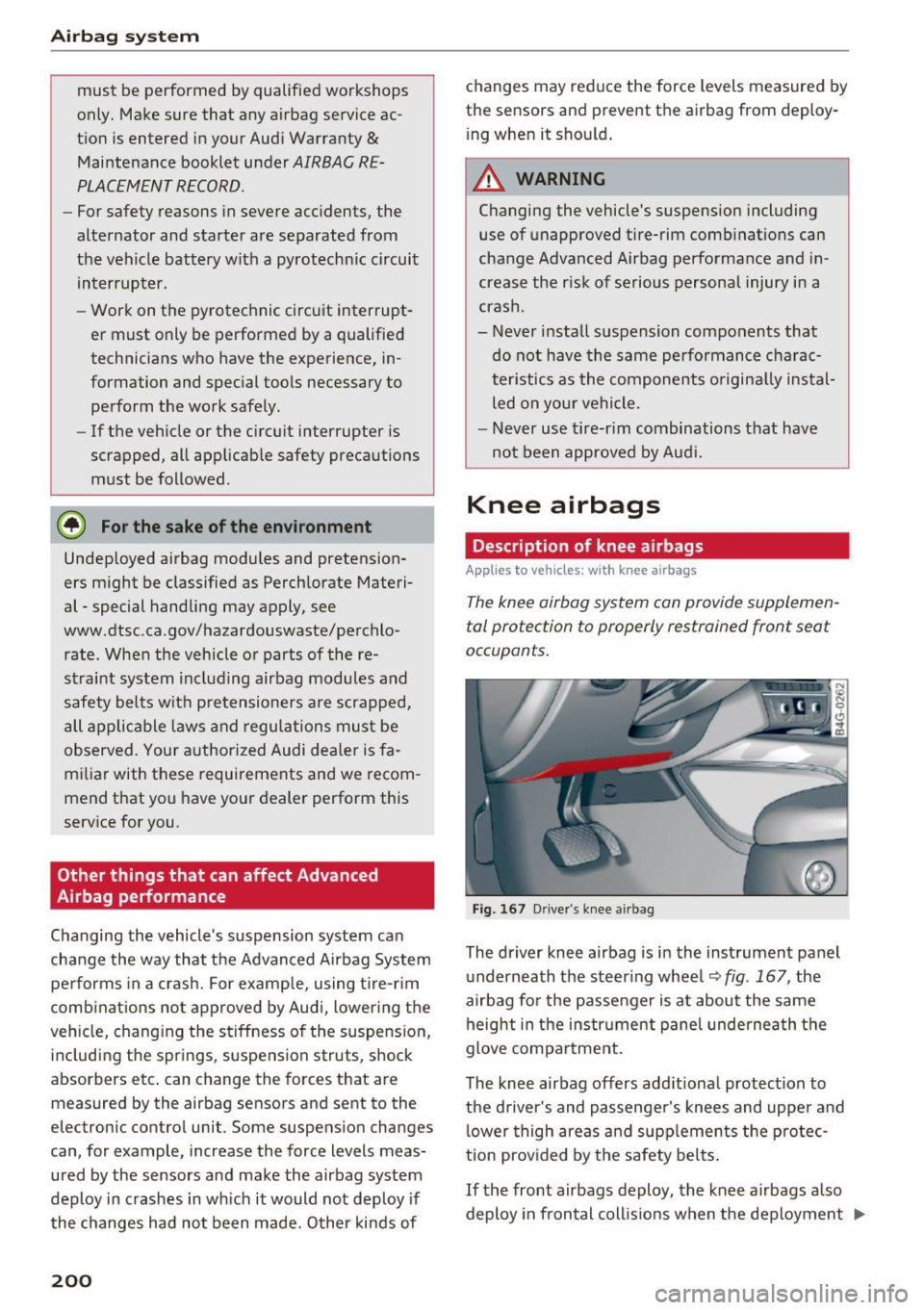
Fig . 16 7 D river 's knee a irbag
The driver knee airbag is in the instrument panel
u nderneath the s teer ing whee l¢
fig. 167, the
airbag fo r the passenger is at about the same
height in the i nstr ument panel underneath the
glove compa rtment.
The knee airbag offers add itiona l protect ion to
the d river's and passenge r's knees and uppe r and
l ower thigh areas a nd sup plements the p rotec
t ion prov ided by the safety belts .
If the front airbags deploy, the knee a irbags also
deploy in fron tal coll is ions when t he deployment ..,_
Page 238 of 328
Checking and Filling
CJ) Note
-Only use Ad Blue that conforms to the
standard ISO 22241-1. Do not mix any addi
tives with the AdBlue and do not dilute it
with water.
- Only use refill bottles that are approved for your vehicle. Using other systems can cause Ad Blue to leak.
- Do not add Ad Blue to the diesel tank or add diesel fuel to the Ad Blue tank. Do not start
the engine under any circumstances if the
wrong fuel is filled in the tank . There is a
risk of damaging the fuel tank system and
the engine . See an authorized Audi dealer or
authorized Audi Service Facility for assis
tance.
- AdBlue attacks surfaces such as painted ve
hicle components, plastic and carpet. Re
move the fluid as quickly as possible with a
damp cloth and plenty of cold water. If the
Ad Blue has already crystallized, use warm
water and a sponge. AdBlue residue that is
not removed will crystallize and can damage
the affected surface .
- Do not store the refill bottle in the vehicle.
If it leaks, the escaping Ad Blue could dam
age the vehicle interior .
- Do not allow Ad Blue to come into contact
with clothing. If there is contact with the
fluid, flush immediately with plenty of wa
ter .
(D Tips
-You can obtain refill bottles from an author
ized Audi dealer or authorized Audi Service
Facility .
- Follow the Ad Blue manufacturer's instruc
tions for use and storage .
- A permitted refill bottle contains approxi
mately 1.9 liters of AdBlue .
- Ad Blue can freeze at very low temperatures.
If this happens, the system will not detect
that the Ad Blue was refilled and it will con
tinue to inform you of the low AdBlue level.
The message turns off as soon as the tank
thaws out again.
236
Engine compartment
Working in the engine compartment
Special care is required if you are working in the
engine compartment
For work in the engine compartment such as
checking and filling fluids, there is a risk of in
jury, scalding, accidents, and burns. For this
reason, follow all the following listed warnings
and general safety precautions. The engine
compartment is a dangerous area.
¢ .&. .
.8, WARNING
To reduce the risk of injuries, complete the
following steps before opening the hood:
- Turn the engine off.
- Switch the ignition off.
- Set the parking brake.
- Place the selector lever in the P position.
- Let the engine cool down.
- Never open the hood when you see that
steam or coolant drips from the engine
compartment- there is a danger of burns!
Wait until no steam or coolant flows out.
- Keep children away from the engine com
partment.
- Never spill fluids on a hot engine. These flu
ids (such as the freeze protection contained in the coolant) can catch fire.
- Avoid short circuits in the electrical system,
especially the battery.
- When working in the engine compartment,
remember that the radiator fan can switch
on even if the ignition is switched off, which
increases the risk of personal injury.
- Never open the cap on the coolant expan
sion tank when the engine is warm . The
cooling system is under pressure.
- To protect your face, hands, and arms from
hot steam or coolant, cover the cap with a
large cloth when opening.
- Do not remove the engine cover under any
circumstances . This increases the risk of
burns.
- If tests need to be performed with the en-
-
gine running, there is additional danger due ~
Page 239 of 328
.... N
0 > CX)
.... I.Cl U"I
.... I.Cl ....
to moving components (such as the ribbed belt, alternator and radiator fan) and from
the high-voltage ignition system.
- Never reach into the radiator fan. The elec
tric auxiliary fan is controlled by tempera
ture and can switch on suddenly.
- Pay attention to the following warnings list ed when work on the fuel system or on the
electrical equipment is required.
- Always d isconnect the vehicle battery
from the vehicle electrical system
- Do not smoke
- Never work near open flames
- Always have a working fire extinguisher nearby
- To reduce the risk of electric shock and in
jury, never touch the following components when the eng ine is running or is being start
ed:
- Ignition cable
- Other components in the electronic h igh -
voltage ignition system
- If you must check or perform work on the engine while it is running:
- Set the parking brake and place the selec
tor lever in the P (park) position first .
- Always proceed with extreme caution so
that clothing, jewelry or long ha ir do not
become caught in the radiator fan, fan
be lt or other moving components or do
not come into contact with hot compo
nents. Tie back long hair before beginning
work and do not wear cloth ing that can
hang down into the engine.
- L imit your exposure to exhaust and chemi
cals to as short a time as possible~&.
_& WARNING
California Proposition 65 Warning:
- Engine exhaust, some of its constituents,
and certain vehicle components contain or
em it chem icals known to the State of Cali
fornia to cause cancer and birth defects and reproductive harm. In addition, certain flu
ids contained in vehicles and certain prod
ucts of component wear contain or emit
chemicals known to the State of California
C hecki ng an d Fill in g
to cause cancer and birth defects or other
reproductive harm.
- Battery posts, terminals and related acces
sories contain lead and lead compounds,
chemicals known to the State of California
to cause cancer and reproductive harms.
Wash hands after handling.
(D Note
When filling fluids, be sure not to mix the f lu
i ds up. Otherwise severe malfunctions and en
gine damage will occur.
@ For the sa ke of the environment
You should regularly check the ground under
your vehicle in order to detect leaks quickly. If there are visible spots from oil or other fluids, bring your veh icle to an authorized Audi deal
er or authorized Aud i Serv ice Facility to be
checked.
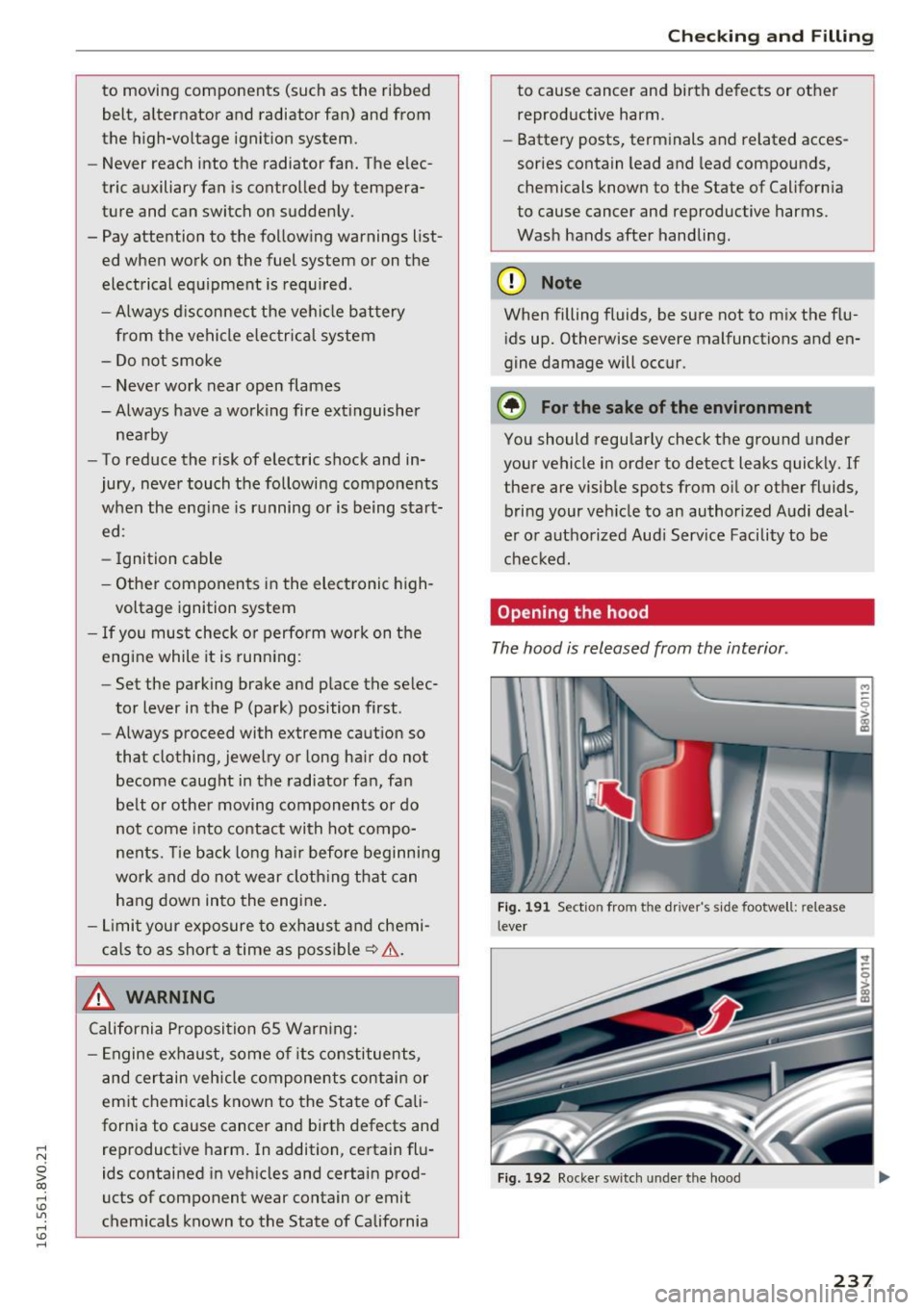
Opening the hood
The hood is released from the interior .
Fig. 191 Sectio n from t he driver 's side footwell: release
lever
Fig. 192 Rocker switch under the hood
237
Page 241 of 328
.... N
0 > CX)
.... I.Cl U"I
.... I.Cl ....
Checking and Filling
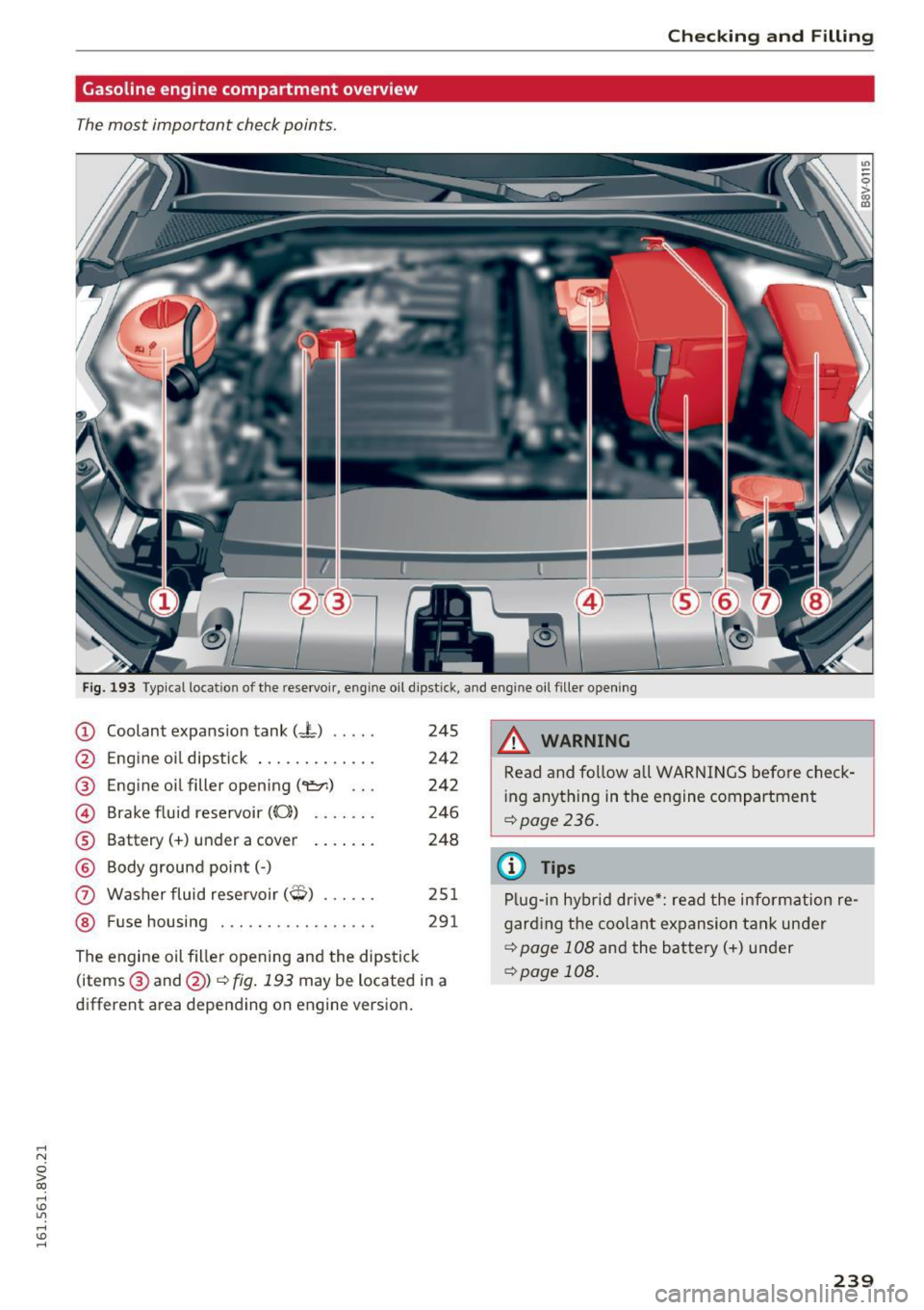
Gasoline engine compartment overview
The most important check points .
Fig. 193 Typical location of the rese rvoir , engine oil dipst ick, and engine oil filler opening
CD
@
®
©
®
©
(J)
®
Coolant expansion tank (-L) .... .
Engine oil dipstick ............ .
Engine oil filler opening(~) .. .
Brake fluid reservoir (0))
Battery(+) under a cover ..... . .
Body ground point(-)
Washer fluid reservoir
(O) ..... .
Fuse housing . .... .... ....... .
245
242
242
246
248
251 291
The engine oil filler opening and the dipstick
(items ® and @)
q fig. 193 may be located in a
different area depending on engine version .
_& WARNING
=
Read and follow all WARNINGS before check-
i ng anything in the engine compartment
¢page 236.
(D Tips
Plug-in hybrid drive*: read the information re
garding the coolant expansion tank under
¢page 108 and the battery(+) under
¢ page 108 .
239
Page 242 of 328
Checking and Filling
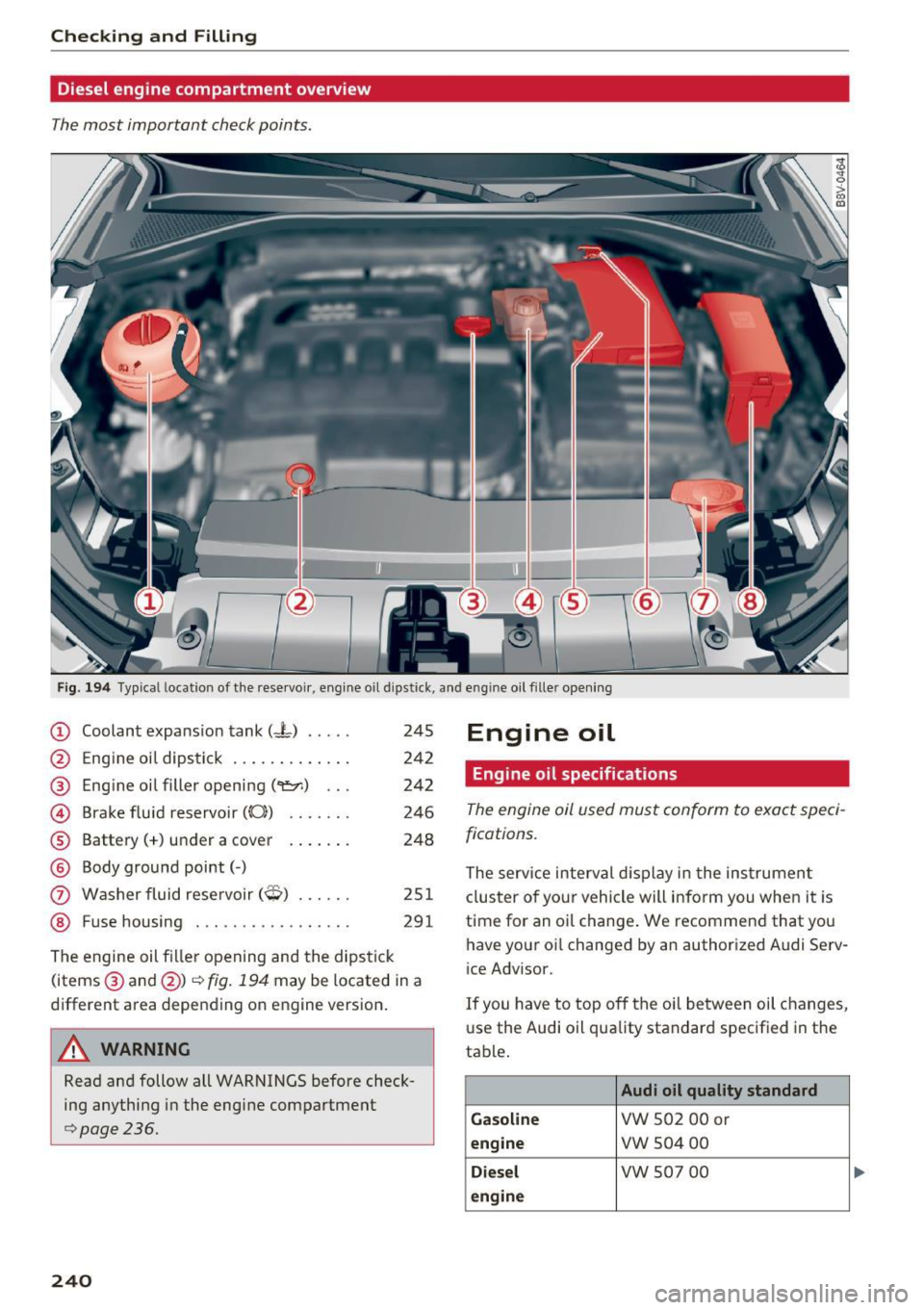
Diesel engine compartment overview
The most important check points.
Fig. 194 Typical location of the rese rvoir, engine o il dipstick, and engine oil fille r opening
(D Coolant expansion tank (- L) .. ...
@
®
©
®
®
0
®
Engine oil dipstick ............ .
Engine oil filler opening
(9=:r.) .. .
Brake fluid reservoir ((0))
Battery(+) under a cover
Body ground point( -)
Washer fluid reservoir
(q) ..... .
Fuse housing .. .............. .
245
242
242
246
248
251 291
The engine oil fi ller opening and the dipstick
(items @ and @)¢
fig. 194 may be located in a
different area depending on engine version.
,& WARNING
Read and follow all WARNINGS before check
ing anything in the engine compartment
¢page 236.
240
Engine oil
Engine oil specifications
The engine oil used must conform to exact speci
fications.
The service interval display in the instrumen t
cluster of your vehicle will inform you when it is
time for an oi l change. We recommend that you
have your oi l changed by an authorized Audi Serv
ice Advisor.
If you have to top off the oil between oil changes,
use the Audi oil quality standard specified in the
table .
Audi oil quality standard
Gasoline
VW 502 00 or
engine vw 504 00
Diesel vw 507 00
engine
Page 249 of 328
,....,
N
0 > co ,....,
you.
A WARNING
- Brake fluid is poisonous. It must be stored
only in the closed original container out of
the reach of chi ldren!
- Brake failure can resu lt from old or inappro
priate brake fluid. Observe these precau
t ions:
- Use only brake flu id that meets SA E speci
fication
J 1703 and conforms to Federal
Motor Vehicle Standard 116. Always check
with your authorized Audi dealer to make
sure you are using the correct brake fluid.
The correct type of brake fluid is also indi
cated on the brake flu id reservoir.
- The brake fluid must be new. Heavy use of
the brakes can cause a vapor lock if the
brake fluid is left in the system too long.
This can ser iously affect the efficiency of
the brakes as well as your safety. This
could result in an acc ident.
(D Note
Brake fluid w ill damage the pa int of your vehi
cle.
For the sake of the environment
Because of the prob lem of proper disposal of
brake flu id as well as the special tools re
quired and the necessary expertise, we rec
ommend that you have the brake fluid
changed by your author ized Audi dealer.
Battery
General information
All work on the battery requires expert knowl
edge.
Read and foll ow t he WARNING S before check
ing anything in the engine compartment
¢ page 236, Working in the engine comport
ment.
Ch eck ing and Filling
Plug -in hybrid drive* : you can find important in
formation about the high -vo ltage battery under
¢ page 98.
The battery in yo ur Audi does not need any ma in
tenance under
normal operating conditions . Audi
recommends having the electrolyte level check
by an authorized Audi dealer or author ized Audi
Service Facility when there are
high outside tem
peratures or when dr iving all day. The e lectrolyte
level should also be checked each time the bat
tery is charged¢
page 249.
Have the battery checked when you bring your ve
hicle in for an inspection. It is a good idea to re
place the battery if it is more than 5 years old.
D uring certa in types of a irbag deployments, the
battery is d isconnected from the veh icle electri
cal system for safety reasons¢
& in Repair, core
and disposal of the airbags on page 199.
Di sco nnecting the battery te rminal s
The battery should not be disconnected. Several
vehicle functions (power windows, for example)
will be lost when the battery is disconnected. The
funct ions must be reprogrammed after connect
ing the battery. To avoid this, the battery should
only be disconnected from the vehicle electrical
system when it is absolutely necessary.
To reprogram the functions, proceed as follows:
Function Reprogramming
Power window one-¢ page 44, Correcting
touch up/down func-power window molfunc-
tion tions
Remote control key or
If the vehicle does not
Convenience key react to the key, it must
be synchronized
¢page 37
Dig ita l clock ¢page 10
ESC indicator light The indicator light goes
out after driving a few
meters
247
Page 250 of 328
Check ing and F illing
Not running th e vehicle for long p eriod s of
t im e
If you do not drive your vehicle for several days or
weeks, electrical components are gradually re duced or sw itched off. Th is reduces energy con
sumpt io n and maintains the vehicle's ability to
start over a long period of time
c:::, page 164 .
Some convenience functions, such as interior
lighting or power seats* may not work . These
convenience functions will be available again
once yo u sw itch the ignition on and start the en
gine.
Winter operation
During the winter months, it is common for the
battery capacity to decrease as the temperatures
become lowe r. This is because mo re power is
needed to sta rt the veh icle and components s uch
as the headlights and the rear window defogger
are used more frequently .
Avoid using power unnecessar ily, especially in
ci ty driving or on sho rt trips. Have yo ur author
ized Audi dealer or authorized Audi Service Facili
ty check the battery capacity before the start of
winter c:::, page 249. A well-charged battery will
not on ly reduce starting problems in cold weath
er, but it will also last longer .
A WARNING
-Work on the battery requires expert knowl
edge. Contact an authorized Audi dealer or
autho rized Aud i Service Facility for informa
t ion regarding the vehicle battery. There is a
risk for chemical burns or explosions.
- Never open the vehicle battery. Do not t ry to
c hange the batte ry electro lyte level. Othe r
wise explosive gas wi ll escape from the bat
te ry and increase the risk of an explos ion .
(D Tips
If your vehicle is not driven for several weeks
in very cold temperatu res, remove the batte ry
and sto re it in a pla ce where it wi ll not freeze.
This prevents the battery from being dam
aged and needing to be replaced.
248
· Working on the battery
Be especially careful when working on or near
the battery.
Plug- in hybrid drive*: For important informat ion
about the high-voltage battery, refer to
c:::, page 98 .
The battery is located in the engine compart
ment . Before you check anything in the engine
compartment,
r e ad and heed all WARNING S
¢,&. .
Always heed the safe ty wa rnings , when working
on the vehicle battery or the veh icle electrical
system to prevent injury .
The following WARNINGS are very important
w hen wor king on the batter y:
Alwa ys heed the following WARNING S YM-
BOLS and safet y precaut ions when wo rking on
the batte ry.
®
Alwa ys wear e ye protection .
&
Batt ery ad d co ntains sulfu ric acid . Al-
way s w ear glove s and ey e prot ect ion .
@
No
-spark s
- flame s
- smoking .
~
When a battery is cha rged , it p roduce s
h yd rog en gas which is e xplo siv e and
could cause personal in jur y.
®
Alway s kee p the ba tter y w ell out of
r each of children.
A WARNING
Whenever working on the battery or on the
e lectr ical system, there is the r isk of injury,
accident and even fire. Read and heed the fol low ing WARNINGS:
- Always wear eye protection. Do not let bat
tery acid or any lead particles get on your
skin or clothing . Shield your eyes. Explosive
gases can cause blindness or other in ju ry .
- Battery acid contains sulfuric acid . Sulfuric
acid can cause blindness and severe burns .
Page 251 of 328
.... N
0 > CX)
.... I.Cl U"I
.... I.Cl ....
-Always wear gloves and eye protection. Do
not tilt the battery because acid could leak
out of the ventilation openings.
- If you get battery acid in your eyes or on
your skin, immediately rinse with cold wa
ter for several minutes and get medical at
tention .
- If you should ingest any battery acid, seek
medical attention immediately.
- Do not expose the battery to an open flame,
electric sparks or an open light.
- Do not smoke.
- Do not interchange the positive and nega-
tive cab les.
- When working on the battery, be sure not to
short-circuit the terminals with tools or oth
er metal objects. This wou ld cause the bat
tery to heat up very quickly, which could
lead to damage or explosion and personal
injury.
- When a battery is charged, it produces hy
drogen gas which is explosive and could
cause personal injury.
- Always keep the battery well out of the
reach of children.
- Before work is done on the electrical sys
tem, disconnect the negative ground cable.
- Before performing any work on the electri
cal system, switch off the engine and igni
tion as well as any electrical equipment . The
negative cable on the battery must be dis
connected. If you are just going to replace a
light bulb, then it is enough to switch off
the lights.
- Before disconnecting the battery, switch off
the anti-theft alarm system! Otherwise you
will set off the a larm.
- When disconnecting the battery, first dis
connect the negative cable and then the
posit ive cab le.
- Before reconnecting the battery, make sure
all electrical consumers are switched off.
Reconnect the positive cab le first and then
the negative cable . Never interchange the
cables - th is could start a fire!
- Never charge a frozen o r a thawed-out bat
tery. It could explode! If a battery has fro-
Checking and Filling
zen, then it must be replaced. A discharged
battery can freeze over at 32 °F (0 °C).
- Make sure the vent hose is always attached
to the opening on the side of the battery.
- Never use batteries which are damaged.
There is the danger of an exp losion! Always
replace a damaged battery.
_8 WARNING ~
California Proposition 65 Warning:
- Battery posts, term inals and related acces
sories contain lead and lead compounds,
chemicals known to the State of California
to cause cancer and reproductive problems.
Wash hands after handling.
(D Note
-Do not disconnect the vehicle battery when
the ignition is on or when the engine is run
ning, otherwise, you will damage electronic
components in the electrical system.
- If your vehicle is going to stand for a long
period of time without being driven, protect
the battery from "freezing", otherwise it
w ill be damaged and will then have to be re
placed .
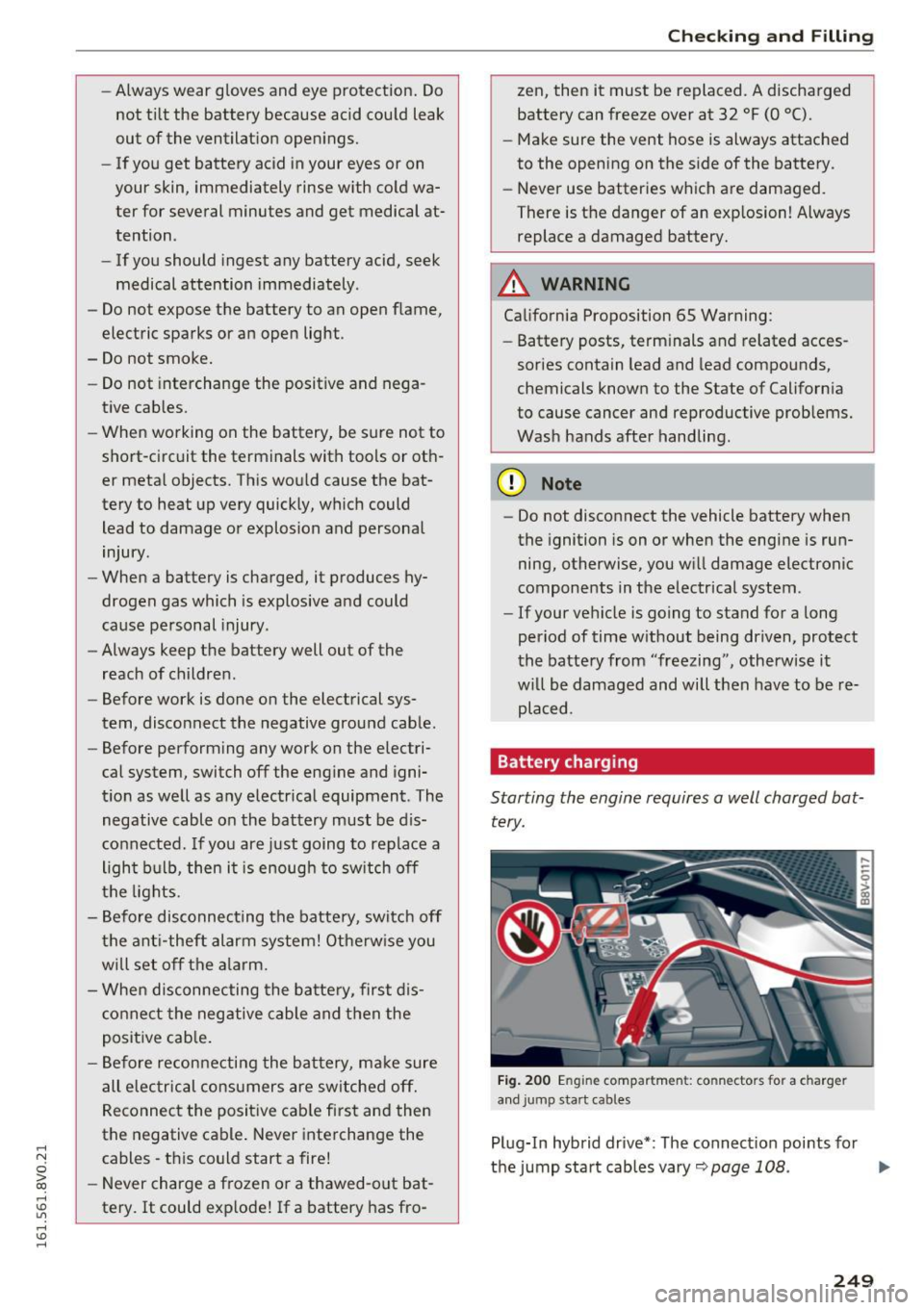
Battery charging
Starting the engine requires a well charged bat
tery.
Fig. 200 Eng ine compartmen t: co nnectors fo r a charger
a n d jump start cab les
Plug-In hybrid drive* : The connect ion points for
the jump start cables vary~
page 108. .,.
249