battery AUDI A3 2016 Owner´s Manual
[x] Cancel search | Manufacturer: AUDI, Model Year: 2016, Model line: A3, Model: AUDI A3 2016Pages: 328, PDF Size: 81.78 MB
Page 252 of 328

Check ing and F illing
Al ways read and heed all WARNING S below
¢
A and ¢ A in Working on the battery on
page 248.
... Swi tch off the ignition and all electrical con
sumers .
... Make sure the area is well ventilated when you
charge the battery.
... Open the engine hood ¢
page 23 7.
... Open the red cover on the positive pole
¢fig . 200.
... Clamp the cha rge r terminal clamps as instruct
ed on the
batt ery terminal (+ ) and only on the
bo dy ground poin t(·).
... Only now pl ug the mains lead for the charging
equipment into the wall outlet and turn it on
¢£ .
... Make su re the ch arg ing rate is not o ver
3 0 a mp s/ 1 4.8 Volt.
... When the battery is fully charged: Turn the
charg ing equipment off and remove the mains
lead from the wall outlet.
... Now remove the clamps fo r the charging equ ip-
ment .
... Close the red cover on the positive pole.
... Close the hood ¢
page 238.
A discharged battery can freeze at temperatures
of only 32 F
0 (0 °C). A llow a frozen battery to
thaw comp letely before attempt ing to c harge it
¢
.&. . However, we recommend not us ing a
thawed batte ry again because the battery casing
can be cracked due to ice formation and can leak
battery acid.
Battery charging (Ma ximum charging rate of
30 amp s/ 14.8 Volt )
When charging at low voltages (e.g. with a trick
le charger ),
the battery cables do not have to be
d isconnected first. The battery caps should
not
be opened when charging a battery.
It is not necessary to remove the battery from
the lu ggage compartment, and it is also not nec
essary to disconnect the cables.
250
Fast charging the battery (charg ing rat e
abov e 14.8 Volts )
For technical reasons do not use a battery charg
er that uses voltage greater than 14.8 Volts to
charge your veh icle's battery.
A WARNING
Charg ing a battery can be dangerous .
-Always follow the operating instructions
provided by the battery charger manufactur
er when charging your battery .
- Never charge a frozen battery.
It may ex
plode because of gas trapped in the ice. Al
low a frozen battery to thaw out first.
- Do not reuse batteries which were frozen.
The battery hous ing may have cracked and
weakened when the battery froze.
- Charge the battery in a well ventilated area .
Keep away from open flame or electrical
spark. Do not smoke . Hydrogen gas generat
ed by the batte ry is explosive .
- To reduce the danger of explosion, never
connect or d isconnect charger cables while
the charger is ope rating .
- Fast charg ing a battery is dangerous and
should only be attempted by a competent
technician w ith the prope r equipment.
- Batte ry acid that may spill during charging
should be washed off w ith a so lution of
warm water and baking soda to neutra lize
the ac id.
{[) Note
Never use a fast cha rge r as a booster to start
the eng ine. This will se riously damage sensi
tive elec tronic components, such as control
u nits, re lays, ra dio, e tc., as well as the ba ttery
charger.
Battery replacement
The new battery must hove the some specifica
tions and dimensions as the original equipment
battery .
Intelligent energy man agement in yo ur vehicle is
r esponsib le for d istr ib uting the elec trica l energy ..,.
Page 253 of 328
,....,
N
0 > co ,....,
gent energy management system wi ll keep the
engine battery charged better than veh icles w ith
out this system . To make sure the additional
e lectrical energy is avai lab le once again after you
have changed the battery, we recommend that
you install batteries of the same type and manu
facture on ly (the same as those installed at the
time your veh icle was de livered). Specifications
are listed on the battery housing. Your author
ized dealer must code the battery in the energy
management system to enable you to use the en
ergy management functions correctly after re p lacing the battery.
The new battery must have the same capacity,
voltage (12 -volts), amperage, construction and
p lug sealing .
When insta lling the battery, ma ke sure the igni
tion and all e lectrical consumers are switched
off .
(D Note
Ma ke sure the ventilation hose on the side of
the battery is connected, otherw ise fumes o r
battery acid can leak out .
@ For the sake of the environment
Because of the prob lem of proper disposal of
a ba ttery, we recommend your author ized
Audi dea ler change the battery for you . Bat
teries contain su lf u ric acid and lead and must
always be disposed of properly in compliance
w ith all environmental regulations. D isposing
of vehicle batteries improperly is very danger
ous to the env ironment.
Ch eck ing and Filling
Windshield washer
system
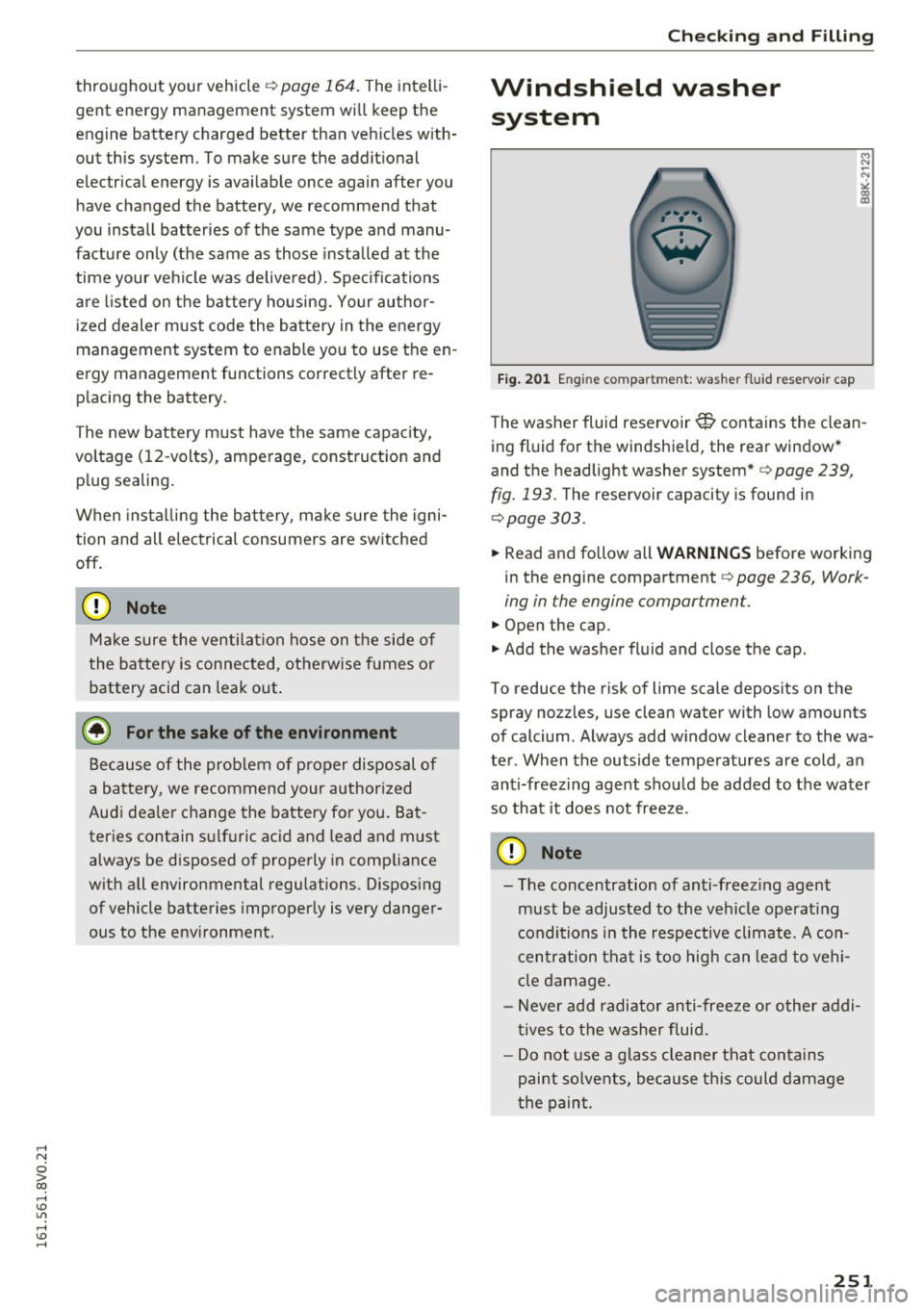
F ig . 201 E ngin e compar tmen t: was her flui d reservo ir cap
M N
-N ~
"' m
The washer fluid reservoir W contains the clean
ing fluid for the windshield, the rear window *
and the headlight washer system*¢
page 239,
fig. 193 .
The reservoir capacity is found in
¢ page 303.
.,. Read and follow all WARNING S before working
in the engine compartment <=>
page 236, Work
ing in the engine compartment .
.,. Open the cap.
.,. Add the washer fluid and close the cap .
To reduce the risk of lime scale deposits on the
spray nozzles, use clean water with low amounts
of calcium. Always add w indow cleaner to the wa
ter . When the outside temperatures are cold, an
anti-freez ing agent should be added to the water
so that it does not free ze.
(D Note
- The concentration of ant i-freez ing agent
must be adjusted to the vehicle operat ing
conditions in the respective cl imate. A con
c entration that is too high can lead to vehi
cle damage.
- Never add radiator an ti-free ze or other addi
tives to the washer fluid.
- Do not use a glass cleane r that contains
pai nt solvents, because t his could damage
t he paint.
251
Page 254 of 328
Checking and Filling
Service interval display
The service interval display detects when your ve
hicle is due for service.
The service interval display works in two stages:
-Inspection or oil change reminder: after a cer-
tain distance driven, a message appears in the
instrument cluster display each time the igni
tion is switched on or off . The remaining dis
tance or time is displayed briefly.
- Inspection or oil change due: if yo ur vehicle
has reached an inspection or oi l change interval
or both intervals at the same time, the mes
sage
Inspection due! or Oil change due! or Oil
change and inspection due!
appears briefly af
ter switching the ignition on/off .
Checking service intervals
You can check the remaining distance or time un
til the next oil change or next inspection in the
MMI. Select the
I MENU I button> Car> Systems *
control button > Service & control > Service in
tervals .
Resetting the indicator
Your authorized Audi dealer or authorized Audi
Serv ice Facility will reset the serv ice interval dis
p lay after performing service.
If you perform an oil change yourself to the Audi
specifications, you must reset the service interval
d isp lay.
To reset the display, select the
I MENU ! button >
Car > Systems * control button > Service & con
trol
> Service intervals > Reset oil change inter
val.
([) Note
-Only reset the oil change indicator if the oil
was changed.
- Following the service intervals is critical to
maintain ing the service life and va lue of
your vehicle, especially the engine. Even if
the m ileage on the vehicle is low, do not ex
ceed the time for the next service.
- Calculating the time to the next oil change
i s interrupted when the ve hicle battery is
disconnected. If the vehicle is not driven for
252
a long period of time, check the mainte
nance schedule so that you can fo llow the
maintenance intervals.
Page 259 of 328
(a) Curb weight
(b) Accessory weight
(c) Vehicle capacity weight, and
(d) Production options weight
Maximum (permissible )
inflation p ressure
means the maximum cold infla
tion pressure to which a t ire may
be inflated. Also called "maxi
mum inflation pressure."
Normal occupant weight
means 150 lbs. (68 kilograms)
times the number of occupants
seated in the vehicle up to the to
tal seating capacity of your vehi
c le.
Occupant distribution
means distribution of occupants
in a vehicle.
Outer diameter
means the overall diameter of an
inflated new tire.
Overall width
means the linear distance be
tween the exteriors of the side
walls of an inflated tire, including elevations due to labeling, deco
rations, or protective bands or
ribs .
Tires and wheels
Ply
means a layer of rubber-coated
parallel cords .
Production options weight
means the combined weight of
those installed regular production
options weighing over 5 lbs. (2.3 kg) in excess of those standard
items which they replace, not pre
viously considered in curb weight
or accessory weight, including heavy duty brakes, ride levelers,
roof rack, heavy duty battery, and
specia l trim .
Radial ply tire
means a pneumatic tire in which
the ply cords that extend to the beads are laid at substantially 90
degrees to the centerline of the
tread.
Recommended inflation
pressure
see ~ page 256, Cold tire infla
tion pressure .
Reinforced tire
means a tire designed to operate
at higher loads and at higher in
flat ion pressures than the corre
sponding standard tire. Rein
forced tires may be identified as .,.
257
Page 294 of 328
Fuses and bulbs
-Some of the equipment listed in the follow
ing tables applies only to certain mode l ver
sions or certain optional equ ipment.
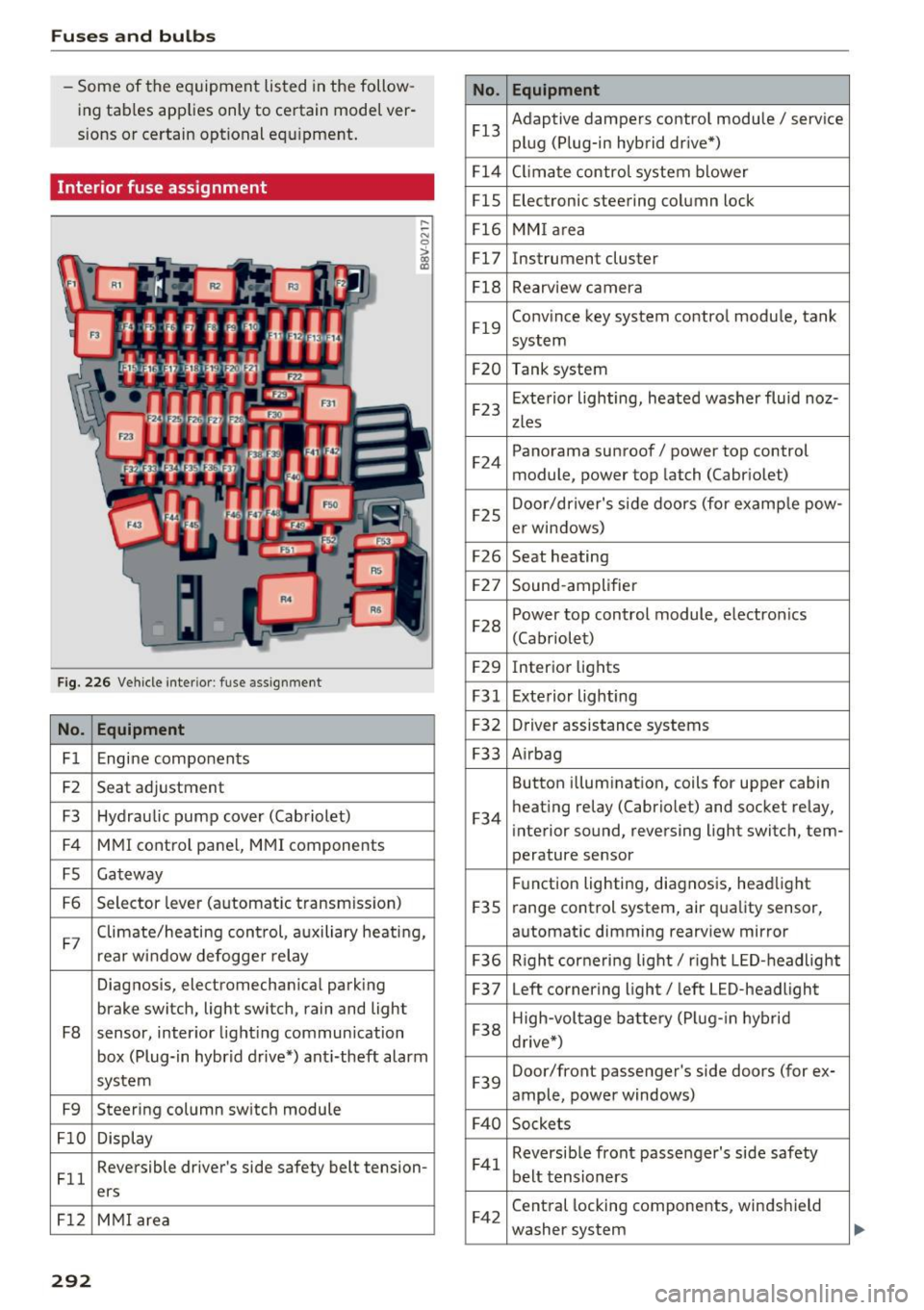
Interior fuse assignment
F ig. 226 Vehicle interior: fuse assignment
No. Equipment
Fl Engine components
F2 Seat adjustment
F3 Hydraulic pump
cover (Cabriolet)
F4 MMI control panel, MMI components
FS Gateway
F6 Selector lever (automatic transmiss
ion)
.... ~ N 0
> a) cc
F7 Climate/heating cont
rol, auxiliary heating,
rear window defogger relay
Diagnosis, electromechanical parking
brake switch, light switch , rain and light
F8 sensor, interior lighting commun ication
box (Plug-in hybrid drive*) ant i-theft alarm
system
F9 Steering column switch module
FlO Display
Fll Reversible driver's side safety belt tension-
ers
Fl2 MMI area
292
No.
Fl3
Fl4
FlS
Fl6
Fl7
Fl8
Fl9
F20
F23
F24
F25
F26
F27
F28
F29 F31
F32
F33
F34
F35
F36
F37
F38
F39
F40
F41
F42
Equipment
Adaptive dampers control module/ service plug (Plug-in hybrid dr ive")
Climate control system blower Electronic steering column lock
MMI area
Instrument cluster
Rearview camera
Convince key system control module, tank
system
Tank system Exterior lighting, heated washer fluid noz-
zles
Panorama sunroof/ power top control
module, power top latch (Cabriolet)
Door/dr iver's side doors (for example pow-
er windows)
Seat heating
Sound-amplifier
Power top control module, electro nics
(Cabriolet)
Interior lights
Exterior lighting
Driver assistance systems
A irbag
Button illumination, coils for upper cabin
heating relay (Cabriolet) and socket relay,
interior sound, reversing light switch, tern-
perature sensor
Function lighting, diagnosis, headlight
range control system, air quality sensor,
automat ic dimming rearv iew mirror
Right corneri ng light/ r ight LED-headlight
Left cornering light/ left LED-headlight
High-voltage battery (Plug- in hybrid
drive*)
Door/front passenger's side doors (for ex-
ample, power windows)
Sockets
Reversib le front passenger's side safety
belt tensioners
Central locking components, windshield
washer system
Page 295 of 328
.... N
0 > CX)
rl I.Cl U"I
rl I.Cl ....
No. Equipment
F43 Headlights, lighting
F44 all whee l drive
F47 Rear window wiper
F48 Outer noise amplifier
(Plug-in hybrid
drive*)
Starter, clutch sensor, headlight relay coil,
F49 high-voltage battery (Plug-in hybr id
drive*)
F53 Rear window
defogger
The power seats* are protected via
circuit break
ers
that automatically switch on after a few sec
onds after the overload has been reduced.
(D Tips
Note that the following table was accurate at
the time of printing and is subject to change.
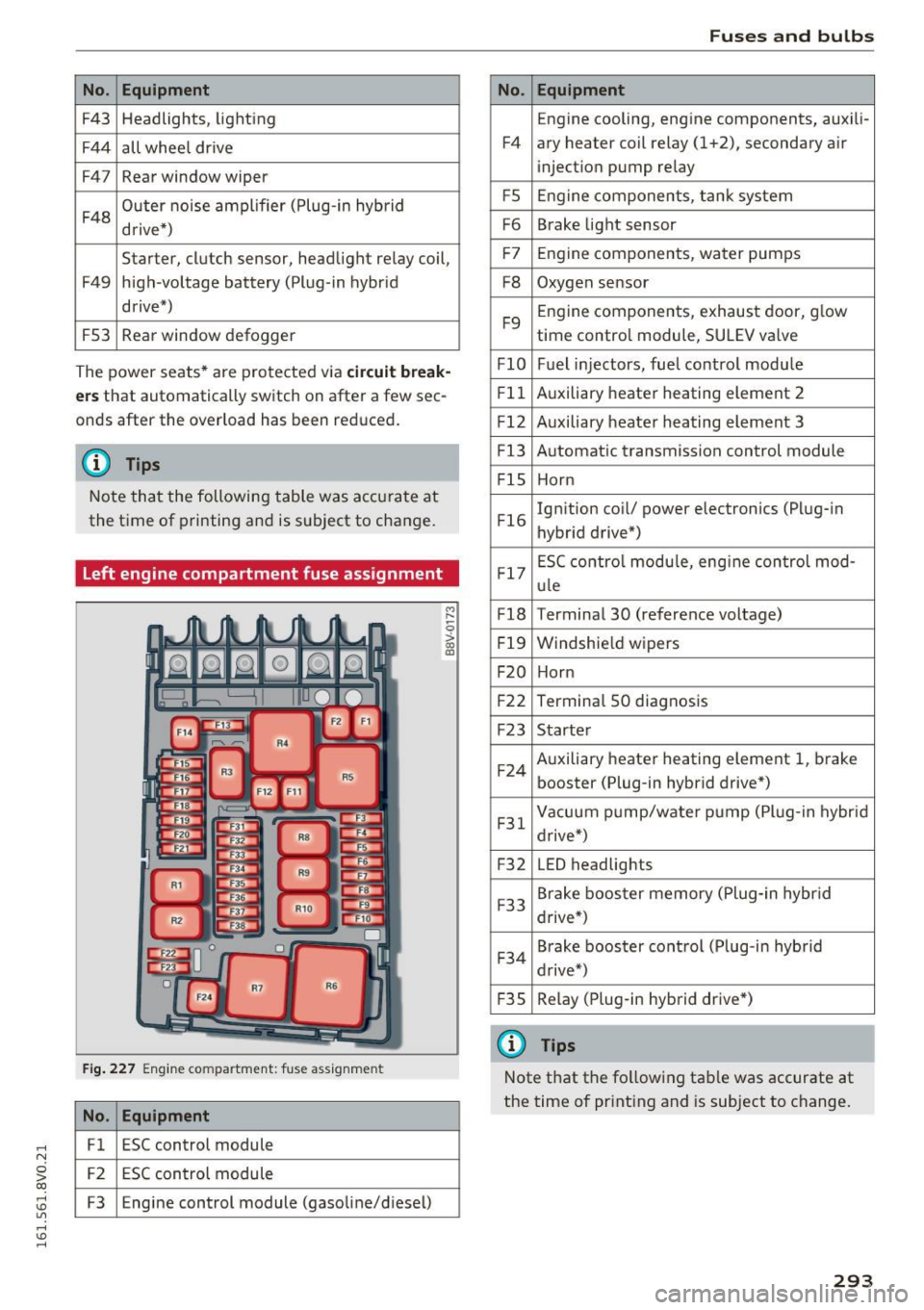
Left engine compartment fuse assignment
Fig. 227 Engine compartment: fuse assignment
No. Equipment
Fl ESC control module
F2 ESC control module
F3 Engine control module (gasoline/d iesel)
M ,-..
0
> co ID
Fuses and bulbs
No. Equipment
Engine cooling, engine components, auxili-
F4 ary heater coil relay (1+2), secondary a ir
injection pump relay
FS Engine components, tank system
F6 Brake light sensor
F7 Engine components,
water pumps
F8 Oxygen sensor
F9 Engine
components, exhaust door, glow
time control module, SULEV va lve
FlO Fuel injectors, fuel control modu le
Fll Auxiliary heater heating element 2
F l2 Auxiliary heater heating element 3
Fl3 Automatic transmission control module
FlS Horn
Fl6 Ignition coil/
power electronics (Plug-in
hybrid drive*)
Fl7 ESC control
module, eng ine control mod -
ule
Fl8 Terminal 30 (reference voltage)
F l9 Windshield wipers
F20 Horn
F22 Termina l 50 diagnosis
F23 Starter
F 24 Auxiliary heater heating element 1,
brake
booster (Plug-in hybrid drive*)
F31 Vacuum
pump/water pump (Plug-in hybrid
drive*)
F32 LED
headlights
F33 Brake booster
memory (Plug-in hybrid
drive*)
F 34 Brake
booster control (Plug -in hybrid
drive*)
F 35 Relay (Plug-in hybrid drive*)
@ Tips
Note
that the fo llowing tab le was accurate at
the time of printing and is subject to change.
293
Page 297 of 328
,....,
N
0 > co ,....,
General
This chapter is intended for trained emergency
crews and working personnel who have the nec
essary tools and equipment to perform these
ope rations.
Starting by pushing or
towing
(D Note
Veh icles with an automatic transmission can
not be started by pushing or towing.
Starting with jumper
cables
If necessary, the engine can be started by con
necting it to the battery of another vehicle.
Plug-in hybrid drive*: the connection points for
the jump start cables vary ¢
page 108.
If the engine should fail to start because of a dis
charged or weak battery, the battery can be con
nected to the battery of
another vehicle, using a
pair of jumper cables to start the engine.
Jumper cables
Use only jumper cables of suffic iently large cross
section
to carry the starter current safely. Refer
to the manufact urer 's specifications.
Use only jumper cables with
insulated term inal
clamps which are distinct ly ma rked:
plus (+) cable in most cases colored red
minus (-) cable
in most cases colored black .
.,&. WARNING -
Plug-in hybrid drive*: you must not give a
jump start with your vehicle. This could cause significant damage to the electrical system in
your vehicle ¢
page 108.
Emergency situations
.,&. WARNING
-
Batteries contain electricity, acid, and gas.
Any of these can cause very serious or fatal in
jury . Follow the instruct ions below for safe
handling of your vehicle's battery.
- Always shield your eyes and avoid leaning over the battery whenever possible.
- A discharged battery can freeze at tempera
tures just below 32 °F (0 °C) . Before con
necting a jumper cable, you must thaw the
frozen battery completely, otherwise it
could explode.
- Do not allow battery acid to contact eyes or
skin. Flush any contacted area with water
immed iate ly.
- Improper use of a booster batte ry to sta rt a
veh icle may cause an exp losion .
- Veh icle batteries generate exp losive gases .
Keep sparks, flames and lit cigarettes away
from batteries.
- Do not try to jump start any vehicle with a
low acid level in the battery .
- The voltage of the booster battery must also
have a 12 volt rat ing. The capacity (Ah) of
the booster battery should not be lower
than that of the discharged battery. Use of
batteries of different voltage or substantial ly different "Ah" rating may cause an explo
sion and personal injury.
- Never charge a frozen battery . Gas trapped
in the ice may cause an explosion.
- Never charge or use a battery that has been
frozen. The battery case may have been
weakened.
- Use of batteries with different voltage or
substantially different Ah rating may cause
an explosion and injury. The capacity (Ah) of
the booster battery should not be lower
than that of the discharged battery .
- Before you check anyth ing in the eng ine
compartment, always read and heed all
WARNINGS
¢page 236.
(D Note
-App lying a higher voltage booster battery
will cause expensive damage to sensitive
295
Page 298 of 328
Emergency situations
electronic components, such as control
units, re lays, radio, etc.
- There must be no electrical contact between
the vehicles otherwise current could already
start to flow as soon as the positive(+) ter minals are connected.
@ Tips
The discharged battery must be properly con
nected to the vehicle's electrical system .
When jump starting or charging the battery,
never connect the negative ground cable to
the battery negative post because the battery
manager system must be able to detect the
battery's state of charge. Always connect the
negat ive g ro und cable to the negative g round
post on the battery manager control unit.
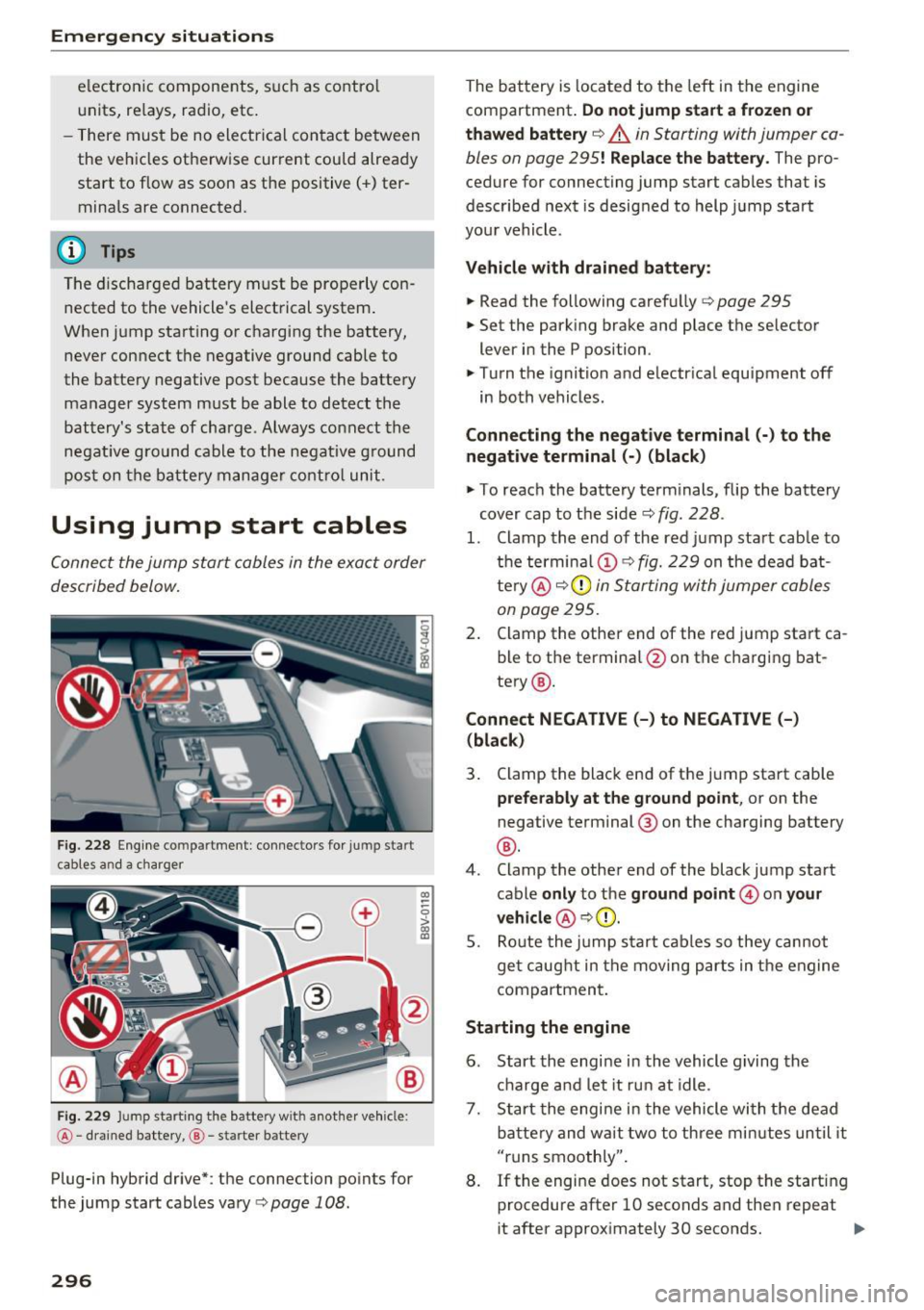
Using jump start cables
Connect the jump start cables in the exact order
described below.
Fig. 228 Engine co mpartment : connectors for ju mp start
cables and a charger
Fig. 229 Jump starting the battery wit h another vehicle:
@ -drained battery, @- starter battery
Plug-in hybrid drive* : the connection points for
the jump start cables vary<=>
page 108.
296
00 ~
5 > 00 ID
The battery is located to the left in the engine
compartment.
Do not jump start a frozen or
thawed battery
¢ A in Starting with jumper ca
bles on page 295 !
Replace the battery. The pro
cedure for connecting jump start cables that is
described next is designed to help jump start
your vehicle.
Vehicle with drained battery :
.,. Read the following carefu lly <=> page 295
.,. Set the parking brake and place the selector
lever in the P position.
.,. Turn the ignition and electr ical equipment off
in both vehicles .
Connecting the negative terminal(-) to the
negative terminal(·) (black)
.,. To reach the battery terminals, flip the battery
cover cap to the side¢
fig. 228 .
1. Clamp the end of the red jump start cab le to
the terminal @¢
fig. 229 on the dead bat
te ry @ ¢
0 in Starting with jumper cables
on page 295.
2. Clamp the other end of the red jump start ca
ble to the terminal @on the charging bat
tery @.
Connect NEGATIVE(-) to NEGATIVE(-)
(black)
3. Clamp the black end of the jump start cable
preferably at the ground point, or on the
negative terminal @ on the charging battery
®·
4. Clamp the other end of the black jump start
cable
only to the ground point © on your
vehicle @
¢0.
5. Route the jump start cables so they cannot
get caught in the moving parts in the engine
compartment.
Starting the engine
6 . Start the engine in the vehicle giving the
charge and let it run at idle.
7. Start the engi ne in the vehicle with the dead
batte ry and wait two to three minutes until it
"runs smoothly".
8. If the engine does not start, stop the starting
procedure after 10 seconds and then repeat
it after approximately 30 seconds. ..,_
Page 299 of 328
,....,
N
0 > co ,....,
switch the heater fan and rear window de
froster on to reduce any voltage peaks that
may occur when disconnecting the jumper
cab les. The he adlights must be switched off.
10 . With the engines running, remove the cables
i n
reverse order of the way they were instal
l ed . Make sure the cables do not get caught
in mov ing engine components.
11. Sw itch the heater fan and rear w indow de-
froster off.
12. Close the battery cover .
The battery is vented to the o utside so that not
gases enter the passenger compartment. Make
sure that the connected positive terminal clamps
on the jump start cab le have sufficient contact
with m etal.
.&_ WARNING
Follow the warnings and instructions from
the jump start cable manufacturer to reduce
the risk of serious injuries and vehicle dam
age. If you are unsure about anything, call
roads ide assistance.
- The jump start cables must be long enough
so that the veh icles do not touch .
-
-Route the jump start cables so they cannot
get caught in the moving parts in the engine
compartment .
- Always read and follow the warnings before
check ing anything in the engine compart
me nt ¢
page 236.
Connecting jump start cables incorrectly can
destroy the alternator .
- Always connect the positive terminal(+) to
the positive term inal( +) and the negative
term inal(-) to the negat ive termi nal( -) on
the body ground po int, but not the negative
te rminal on t he battery.
- Make sure the screw plugs on the battery
ce lls are installed securely .
If not, tighten
the p lugs before connecting the clamps to
the negat ive termina l on the battery.
- Please note that the connecting p rocess de
scribed below for the j ump start cables is in-
Emergency s ituatio ns
tended for when your vehicle is be ing j ump
started.
If you are jump starting another ve
hicle, do not connect the negat ive cab le to
the negative term inal( -) on the dra ined
battery, but rather connect it to a large
metal component that is bolted secure ly to
the engine block, or to the engi ne b lock it
self . If the batte ry in the veh icle being jump
s tarted is not ven ted to the outside, there is
a risk of explos ion due to hyd rogen gas .
- Make sure that the connected pos itive ter
m inal clamps have suff ic ien t conta ct with
metal.
- Do not use the battery negative terminal for
jump starting or a m alfunction co ul d o ccur
in the vehicle e lectrica l system.
Towing with a tow truck
General hints
Your Audi requires special handling for towing.
T he following information is to be used by com
mercial tow truck operators who know how to op
e rate th eir equipment safely.
- Ne ver tow your Audi. Towing will caus e dam
age to the engine and tr ansmi ssion.
- Neve r wrap th e safety ch ains or win ch c able s
a round the brake lin es.
- To pr event unn ecess ary damag e, your Audi
must be tran sport ed with a flat bed tru ck.
- To load th e ve hicl e on to the flat bed, use the
towin g loop found in the v ehicle tools and at
t ac h t o the front o r rea r anchorage
¢ page 298 and ¢ page 298 .
.&_ WARNING ~
A vehicle being towed is not safe for passen-
gers. Never allow anyone to ride in a vehicle
being towed, for any reason.
297
Page 306 of 328
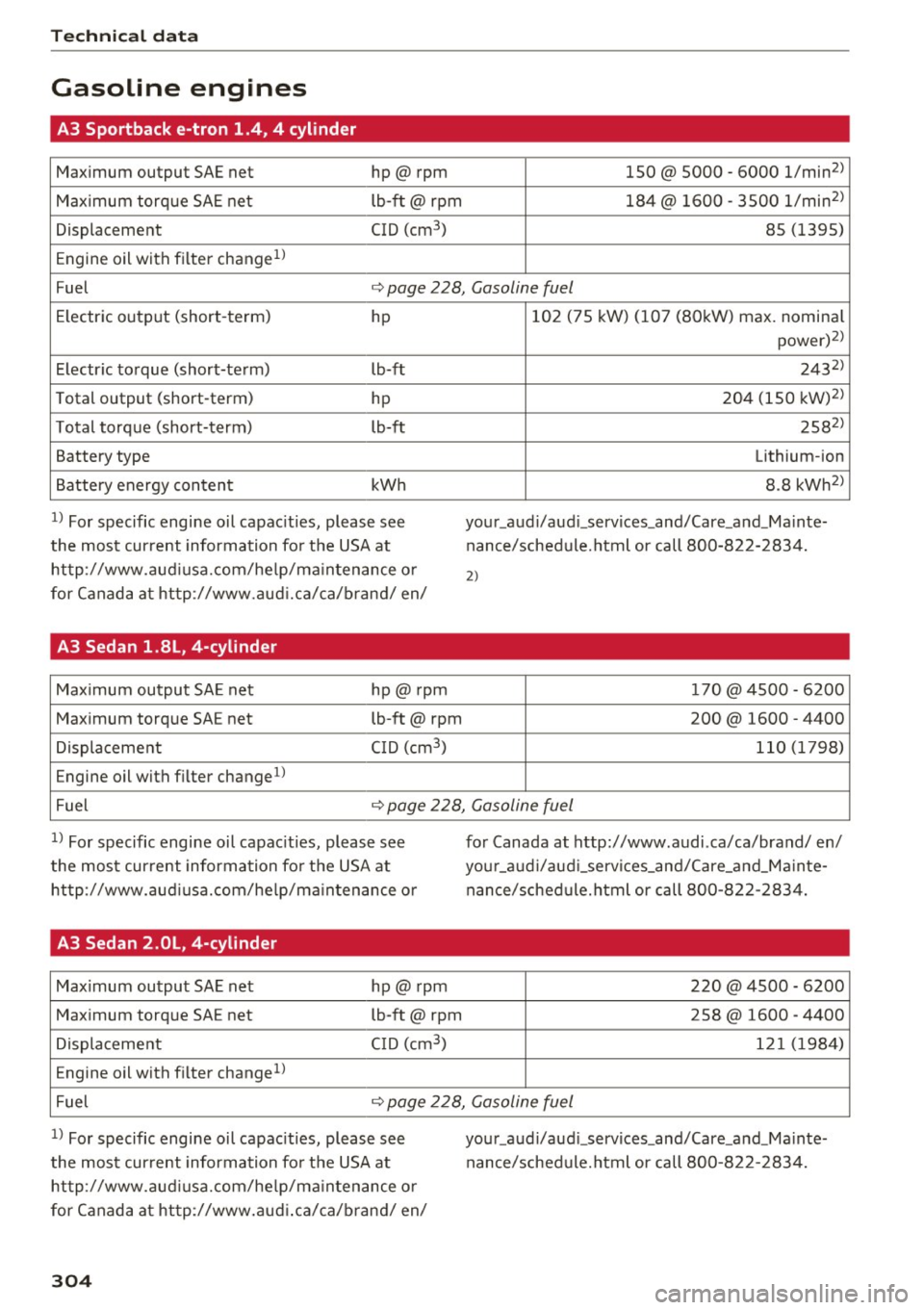
Tech nical data
Gasoline engines
A3 Sportback e-tron 1.4, 4 cylinder
Maximum output SAE net hp@ rpm 150@ 5000 -6000 l/min2>
Max
imum torq ue SAE net lb-ft@ rpm 184@ 1600 - 3500 l/min2>
Displacement
CID (cm3
) 85 (1395)
Engine oil with filter change
1>
Fuel ¢ page 228, Gasoline fuel
Electric output (short-term)
hp
E lectr ic torque (short-te rm) lb-ft
Total output (short-term) hp
T otal torque (short-term) lb-ft
Battery type
Battery energy content kWh
1> For specific engine oil capacities, please see
the most cur rent informa tion fo r th e USA at
http :/ /www.aud iusa.com/he lp/ma intenance o r
for Canad a at http ://www. aud i.c a/ca/ brand/ en/
A3 Sedan l.8L, 4-cylinder
Maximum output SA E net hp@rpm
Maximum torq ue SAE net lb-ft@ rpm
Displa cement C
ID (cm
3
)
Engine oil with filter change1>
102 (75 kW) (107 (80kW) max. nomina l
power) 2
l
243 2
)
204 (150 kW)2l
2582
)
Lithium-ion 8.8 kWh 2
l
you r _ aud i/aud i_ services_ and/Care _a nd_Ma i nte
nance/schedule. html or call 800-822-2834.
2)
1 70 @ 4500 - 6200
200@ 1600 - 4400 110 (1798)
Fuel
¢ page 228, Gasoline fuel
l ) For specific engine oil capac it ies , please see
the mos t cur rent informa tion fo r the USA at
http :/ /www. audi usa.com/he lp/ma inten ance o r
A3 Sedan 2.0L, 4-cylinder
Maximum output SA E net hp@ rpm
Maximum torque SAE net lb-ft@ rpm
Displa cement C
ID (cm
3
)
Engine oil with f ilter changell fo
r Canada at http://www.audi.ca/ca/brand/ en/
yo ur _a ud i/aud i_services_and/Care_a nd_Ma i nte
nance/sched ule. h tml or c all 8 00-822- 2834.
220 @ 4500 - 6200
258@ 1600 -4400
12 1 (1984)
Fuel
¢ page 228 , Gasoline fuel
l) For specific engine oil capac ities, please see
the most cur rent informa tion fo r th e USA at
http://www.au diusa.com/he lp/ma inten ance o r
for C anada at h ttp://www.au di.ca /ca/br and/ en/
304
you r _ a ud i/aud i_ services_ and/Care _and _Ma i nte
nance/schedule. html or call 800-822-283 4.