weight AUDI A3 2020 Owner´s Manual
[x] Cancel search | Manufacturer: AUDI, Model Year: 2020, Model line: A3, Model: AUDI A3 2020Pages: 400, PDF Size: 107.47 MB
Page 62 of 400
Stowing and using
Other storage
| BBV-0434
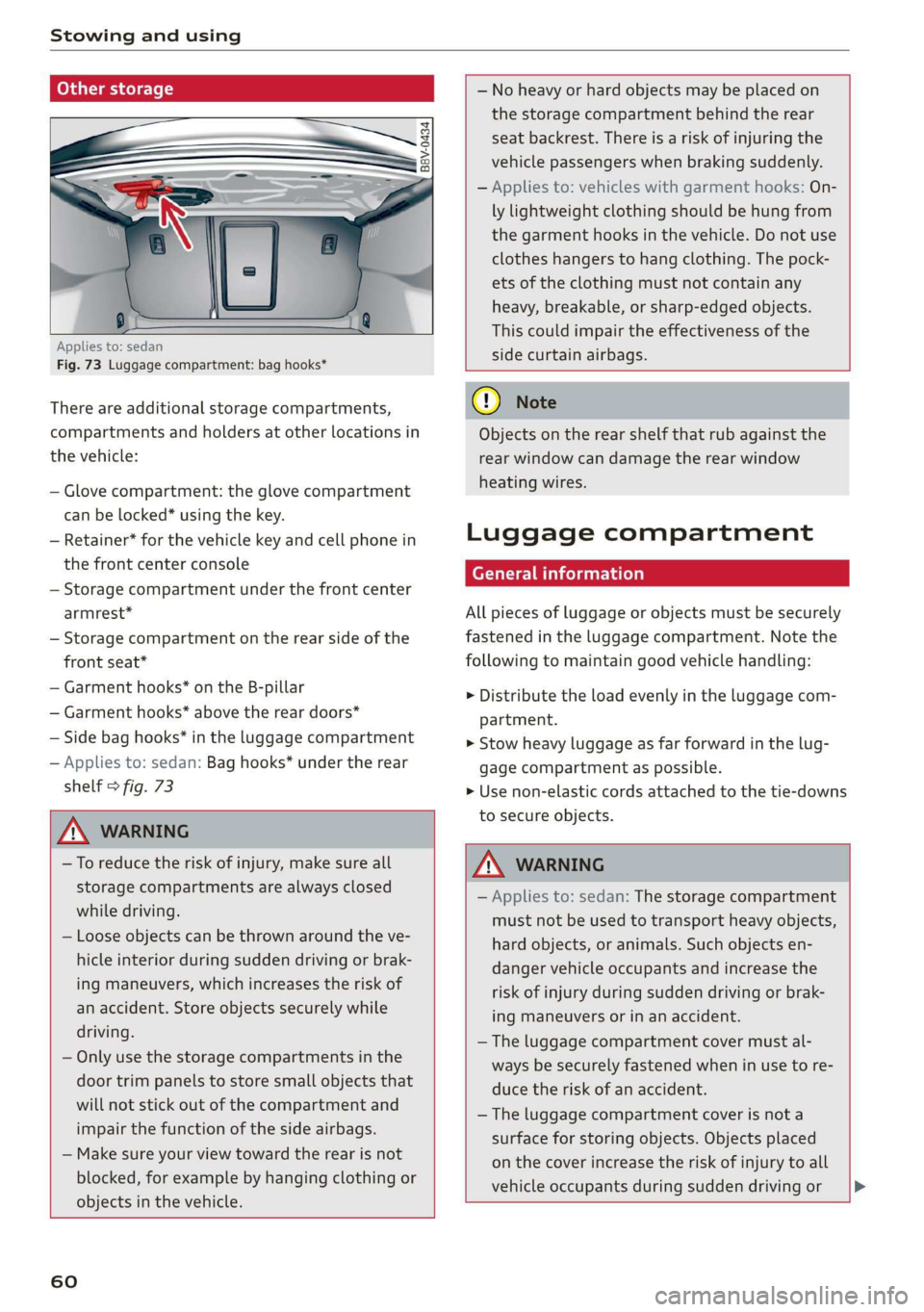
Applies to: sedan
Fig. 73 Luggage compartment: bag hooks*
There are additional storage compartments,
compartments and holders at other locations in
the vehicle:
— Glove compartment: the glove compartment
can be locked* using the key.
— Retainer* for the vehicle key and cell phone in
the front center console
— Storage compartment under the front center
armrest*
— Storage compartment on the rear side of the
front seat*
— Garment hooks* on the B-pillar
— Garment hooks* above the rear doors*
— Side bag hooks* in the luggage compartment
— Applies to: sedan: Bag hooks* under the rear
shelf > fig. 73
ZX WARNING
—To reduce the risk of injury, make sure all
storage compartments are always closed
while driving.
— Loose objects can be thrown around the ve-
hicle interior during sudden driving or brak-
ing maneuvers, which increases the risk of
an accident. Store objects securely while
driving.
— Only use the storage compartments in the
door trim panels to store small objects that
will not stick out of the compartment and
impair the function of the side airbags.
— Make sure your view toward the rear is not
blocked, for example by hanging clothing or
objects in the vehicle.
60
— No heavy or hard objects may be placed on
the storage compartment behind the rear
seat backrest. There is a risk of injuring the
vehicle passengers when braking suddenly.
— Applies to: vehicles with garment hooks: On-
ly lightweight clothing should be hung from
the garment hooks in the vehicle. Do not use
clothes hangers to hang clothing. The pock-
ets of the clothing must not contain any
heavy, breakable, or sharp-edged objects.
This could impair the effectiveness of the
side curtain airbags.
() Note
Objects on the rear shelf that rub against the
rear window can damage the rear window
heating wires.
Luggage compartment
General information
All pieces of luggage or objects must be securely
fastened in the luggage compartment. Note the
following to maintain good vehicle handling:
> Distribute the load evenly in the luggage com-
partment.
> Stow heavy luggage as far forward in the lug-
gage compartment as possible.
» Use non-elastic cords attached to the tie-downs
to secure objects.
ZA WARNING
— Applies to: sedan: The storage compartment
must not be used to transport heavy objects,
hard objects, or animals. Such objects en-
danger vehicle occupants and increase the
risk of injury during sudden driving or brak-
ing maneuvers or in an accident.
— The luggage compartment cover must al-
ways be securely fastened when in use to re-
duce the risk of an accident.
— The luggage compartment cover is not a
surface for storing objects. Objects placed
on the cover increase the risk of injury to all
vehicle occupants during sudden driving or
Page 63 of 400

8V2012721BK
Stowing and using
braking maneuvers or in the event of an ac-
cident.
Loose objects can be thrown around the ve-
hicle interior during sudden driving or brak-
ing maneuvers, which increases the risk of
an accident. Always stow objects securely in
the luggage compartment and secure them
at the tie-downs. Use straps suitable for
heavy objects.
If pieces of luggage or objects are secured
to the tie-downs with unsuitable or dam-
aged straps, this can increase the risk of in-
jury during braking maneuvers or accidents.
When transporting heavy objects, the vehi-
cle characteristics will change due to the
shift in the center of gravity, which increases
the risk of an accident. You may need to
adapt your driving style and speed to the
current conditions.
The cargo net is only strong enough to se-
cure light objects. Heavy objects are not ade-
quately secured. Attempting to secure heavy
objects increases the risk of injury.
Never exceed the permitted axle and load
and vehicle weight > page 380.
Never secure a child safety seat to the tie-
downs.
Never leave your vehicle unattended, espe-
cially if the luggage compartment lid is
open. Children could enter the luggage com-
partment and close the luggage compart-
ment lid from the inside. This creates the
risk of fatal injury, since the children would
be locked in and may not be able to escape
by themselves.
Do not allow children to play in or on the ve-
hicle. Close and lock the luggage compart-
ment lid as well as all other doors when you
leave the vehicle.
Never transport passengers in the luggage
compartment. Every passenger must be cor-
rectly secured with the safety belts in the
vehicle > page 245.
Be careful when releasing the backrest and
folding
it forward. To reduce the risk of be-
ing pinched, pay attention and check when
folding backrests forward.
— The backrest must be securely latched so
objects cannot slide forward out of the lug-
gage compartment during sudden braking.
— The backrest must be latched securely to en-
sure that the safety belt is protecting the
center seating position.
— Always pull forward on the backrest to make
sure it is check if it is correctly locked in
place.
@) Note
—To reduce the risk of damage, move the rear
head restraints down > page 57 before fold-
ing the rear backrests forward.
— When folding the backrest forward, make
sure the outer safety belts are in the belt
guide recess so that they do not get pinched
in the backrest lock and damaged. Other ob-
jects should be removed from the rear
bench seat to protect the backrest from
damage.
— If you move the front seat back when the
rear seat backrest is folded forward, you
could damage the head restraints on the
rear seat.
— Make sure that the heating grid strips for
the rear window defogger are not damaged
by abrasive objects.
@ Tips
— The tire pressure must be adapted to the
load > page 330.
— You can purchase straps at specialty stores.
Luggage compartment cover
Applies to: vehicles with luggage compartment cover
5 = S$
= = &
oO
Fig. 74 Luggage compartment: luggage compartment cov-
er >
61
Page 65 of 400
8V2012721BK
Stowing and using
> Pull the release lever (@) in the direction of the
arrow and fold the backrest forward.
> Fold the backrest down until it latches securely.
When you can no longer see the red mark on
the pin Q,, the seat is latched.
Pee dalceltela)
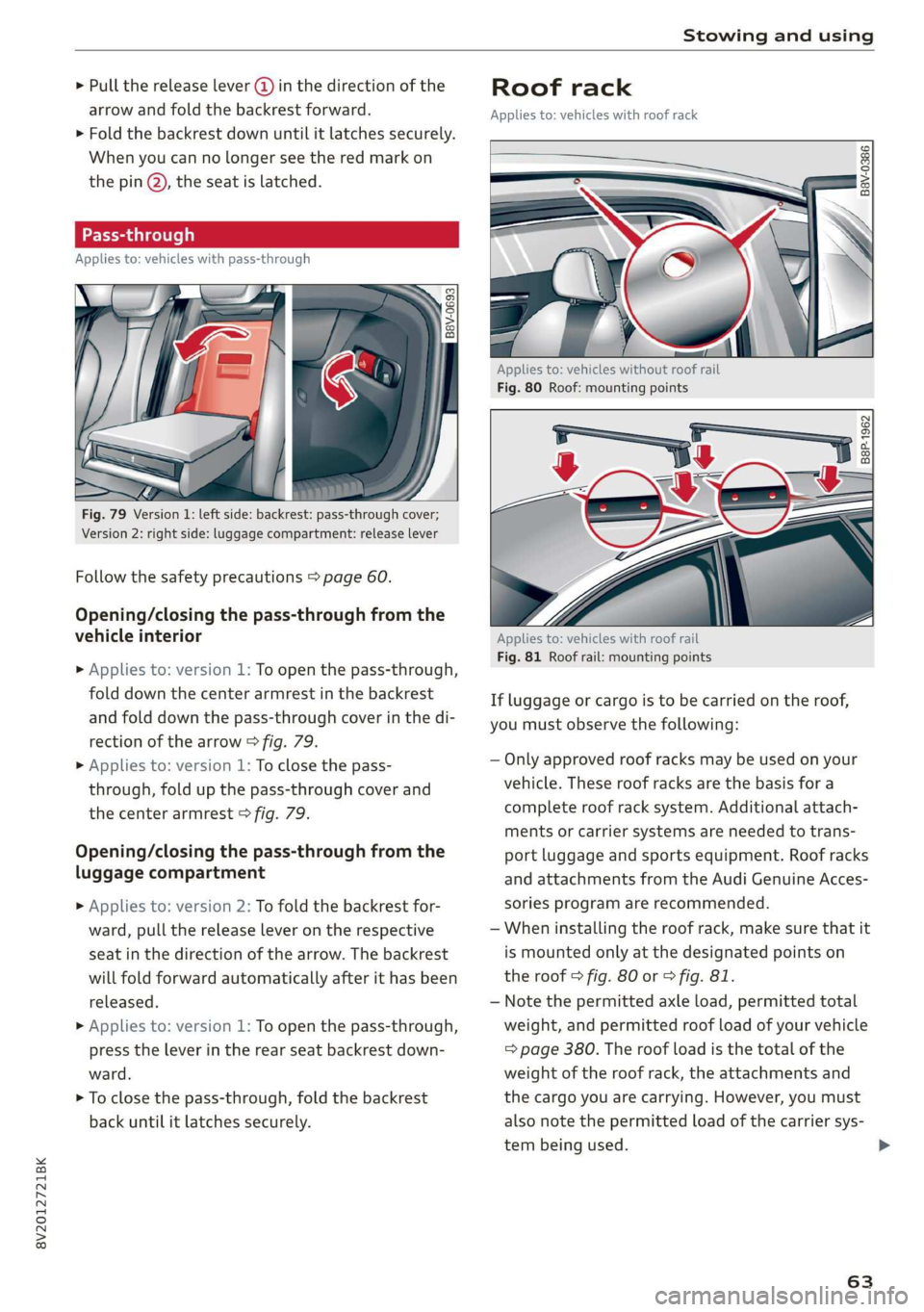
Applies to: vehicles with pass-through
2 2 S
<. = & oO
Fig. 79 Version 1: left side: backrest: pass-through cover;
Version 2: right side: luggage compartment: release lever
Follow the safety precautions > page 60.
Opening/closing the pass-through from the
vehicle interior
> Applies to: version 1: To open the pass-through,
fold down the center armrest in the backrest
and fold down the pass-through cover in the di-
rection of the arrow > fig. 79.
> Applies to: version 1: To close the pass-
through, fold up the pass-through cover and
the center armrest > fig. 79.
Opening/closing the pass-through from the
luggage compartment
» Applies to: version 2: To fold the backrest for-
ward, pull the release lever on the respective
seat in the direction of the arrow. The backrest
will fold forward automatically after it has been
released.
> Applies to: version 1: To open the pass-through,
press the lever in the rear seat backrest down-
ward.
> To close the pass-through, fold the backrest
back until it latches securely.
Roof rack
Applies to: vehicles with roof rack
B8V-0386
||
_B8P-1962
Applies to: vehicles with roof rail
Fig. 81 Roof rail: mounting points
If luggage or cargo is to be carried on the roof,
you must observe the following:
— Only approved roof racks may be used on your
vehicle. These roof racks are the basis for a
complete roof rack system. Additional attach-
ments or carrier systems are needed to trans-
port luggage and sports equipment. Roof racks
and attachments from the Audi Genuine Acces-
sories program are recommended.
— When installing the roof rack, make sure that it
is mounted only at the designated points on
the roof > fig. 80 or > fig. 81.
— Note the permitted axle load, permitted total
weight, and permitted roof load of your vehicle
=> page 380. The roof load is the total of the
weight of the roof rack, the attachments and
the cargo you are carrying. However, you must
also note the permitted load of the carrier sys-
tem being used.
63
>
Page 84 of 400
Driving
— Turn off electrical equipment that is not need-
ed, for example seat heating*.
— Anticipate upcoming traffic situations while
driving to avoid unnecessary acceleration and
braking.
— Avoid driving at high speeds.
— Avoid adding extra weight to the vehicle if pos-
sible, for example by not leaving roof racks or
bike racks installed when they are not needed.
— Make sure the tire pressure is correct.
— Have maintenance performed regularly on the
vehicle.
— Do not drive with winter tires during the summ-
er.
— Do not let the engine run while the vehicle
parked.
— Use the Start/Stop system.
— Utilize the engine braking effect.
— Avoid driving short distances when possible.
— Plug-in hybrid drive: brake early and evenly to
use the recuperation function.
@) Tips
The amount of noise produced by the vehicle
can increase significantly when driving with a
sporty style. Show respect to others around
you and the environment with the way you op-
erate your vehicle, especially at night.
Energy management
Your vehicle is equipped with an intelligent ener-
gy management system for distributing electrici-
ty. This significantly improves the starting ability
and increases the vehicle battery life.
G) Tips
— If you drive short distances frequently, the
vehicle battery may not charge enough
while driving. As a result, convenience func-
tions for electrical equipment may be tem-
porarily unavailable.
— The vehicle battery will gradually drain if
the vehicle is not driven for long periods of
time, or if electrical equipment is used
when the engine is not running. To ensure
that the vehicle can still be started, the
82
electrical equipment will be limited or
switched off.
S Engine stopped: power steering and brake
booster not possible
There is a malfunction in the engine or the fuel
supply. More force is needed to steer and brake
the moving vehicle when the engine is stopped.
If the vehicle is rolling, try to bring it to a stop off
to the side from moving traffic. See an author-
ized Audi dealer or authorized Audi Service Facili-
ty for assistance.
EB EB Drive system: malfunction! Safely stop
vehicle
There is a malfunction in the plug-in hybrid sys-
tem. The brake booster and the power steering
may stop working. Stop the vehicle immediately
at a suitable location or as soon as possible. Park
the vehicle in a safe place outdoors that is not
near buildings, roof overhangs, carports or simi-
lar structures. Switch the ignition off. Have the
problem corrected by an authorized Audi dealer
or authorized Audi Service Facility.
B i B Electric drive: overheated! Safely stop
vehicle and check coolant
The coolant level is too Low or the coolant tem-
perature is too high. Stop the vehicle in the out-
doors as soon as it is safely possible. Switch the
ignition off.
Read the important safety precautions > A in
Coolant on page 312 and check the coolant level
= page 312. If the coolant level is OK, the mal-
function may be caused by the system overheat-
ing. Let the vehicle's electric drive system cool
down for some time.
— If the message turns off after cooling down and
switching the ignition back on, you can contin-
ue driving. Contact an authorized Audi dealer or
authorized Audi Service Facility immediately to
have the malfunction corrected.
— If the indicator light stays on, contact an au-
thorized Audi dealer or authorized Audi Service
Facility.
Page 115 of 400
8V2012721BK
Trailer towing
Trailer towing
Driving with a trailer
General information
Your vehicle is primarily intended for transport-
ing people and luggage. However, if you drive
with a trailer, follow the technical requirements,
the operation and driving tips, and the legal reg-
ulations.
Driving with a trailer affects the vehicle's energy
usage, performance, and wear. It also requires
higher concentration from the driver.
Z\ WARNING
Do not transport any people in a trailer due to
the risk of fatal injury.
Technical requirements
Trailer hitch
Only use a trailer hitch with a removable ball
hitch mount and ball hitch. The trailer hitch must
be permitted for the vehicle, the trailer and the
permitted total weight of the trailer being
pulled. Above all, it must be securely and safely
attached to the vehicle trailer.
Never mount a trailer hitch on the bumper. The
trailer hitch must be mounted in a way that does
not impair the function of the bumper. Do not
make any changes to the exhaust system and the
brake system.
Check regularly if the trailer hitch is securely
mounted. Always follow the instructions given by
the trailer hitch manufacturer.
Trailer brakes
If the trailer has its own brake system, then fol-
low the manufacturer specifications. However,
the brake system on the trailer must never be
connected to the vehicle brake system.
Engine cooling system
Driving with a trailer means a higher load on the
engine and the cooling system. The cooling sys-
tem must be designed for additional load and
contain enough coolant > @.
CG) Note
Longer inclines cannot be driven without a
suitable cooling system, especially if the out-
side temperatures are high. Otherwise, this
increases the risk of engine damage.
Operating instructions
Towing capacity
Your vehicle can only be operated with class 1 or
class 2 trailers.
Load distribution
Poor cargo load and distribution can negatively
impact vehicle handling. To have the lowest im-
pact as possible, load the trailer according to
these criteria:
— Store objects in the vehicle luggage compart-
ment, if possible. The vehicle should always
carry the heaviest possible load and the trailer
should have the lightest possible load.
— Distribute the load in the trailer so that the
heavy objects are as close to the axle as possi-
ble.
— Secure objects so that they do not slide.
— Utilize the maximum permitted tongue weight
if possible.
Tires
Set the tire pressure on your vehicle for a “full
load”; see the tire pressure sticker > page 330. If
necessary, also adjust the tire pressure on the
trailer according to the manufacturer's specifica-
tions.
The trailer and the vehicle should be equipped
with winter tires when driving in winter tempera-
tures.
Outside mirrors
If you cannot see the traffic behind the trailer
with the standard exterior mirrors, then you
must attach additional exterior mirrors. Adjust
them so you have a sufficient visibility behind
you.
113
Page 248 of 400
Safety belts
For your protection and that of your passen-
gers, always correctly wear safety belts
when the vehicle is moving.
— Failure to pay attention to the warning light
that come on, could lead to personal injury.
Why use safety belts?
ee meee Lem ee mele iN ley
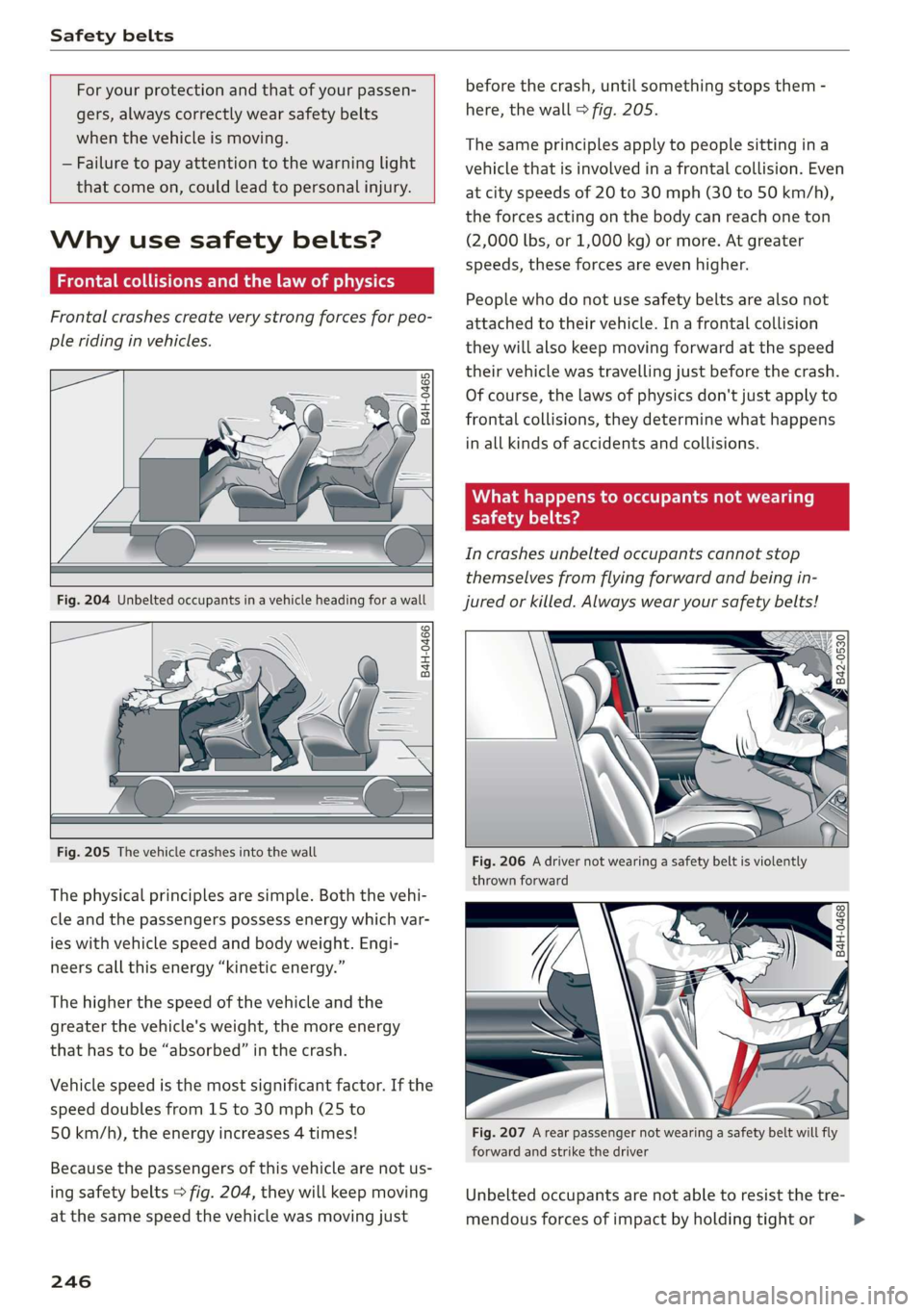
Frontal crashes create very strong forces for peo-
ple riding in vehicles.
B4H-0465 4 §
B4H-0466
Fig. 205 The vehicle crashes into the wall
The physical principles are simple. Both the vehi-
cle and the passengers possess energy which var-
ies with vehicle speed and body weight. Engi-
neers call this energy “kinetic energy.”
The higher the speed of the vehicle and the
greater the vehicle's weight, the more energy
that has to be “absorbed” in the crash.
Vehicle speed is the most significant factor. If the
speed doubles from 15 to 30 mph (25 to
50 km/h), the energy increases 4 times!
Because the passengers of this vehicle are not us-
ing
safety belts > fig. 204, they will keep moving
at the same speed the vehicle was moving just
246
before the crash, until something stops them -
here, the wall > fig. 205.
The same principles apply to people sitting ina
vehicle that is involved in a frontal collision. Even
at city speeds of 20 to 30 mph (30 to 50 km/h),
the forces acting on the body can reach one ton
(2,000 lbs, or 1,000 kg) or more. At greater
speeds, these forces are even higher.
People who do not use safety belts are also not
attached to their vehicle. In a frontal collision
they will also keep moving forward at the speed
their vehicle was travelling just before the crash.
Of course, the laws of physics don't just apply to
frontal collisions, they determine what happens
in all kinds of accidents and collisions.
What happens to occupants not wearing
ical lieya
In crashes unbelted occupants cannot stop
themselves from flying forward and being in-
jured or killed. Always wear your safety belts!
Fig. 207 A rear passenger not wearing a safety belt will fly
forward and strike the driver
Unbelted occupants are not able to resist the tre-
mendous forces of impact by holding tight or >
Page 257 of 400
8V2012721BK
Airbag system
about children and Advanced Airbags
=> page 278.
Even though your vehicle is equipped with an Ad-
vanced Airbag System, make certain that all chil-
dren, especially those 12 years and younger, al-
ways ride in the back seat properly restrained for
their age and size. The airbag on the passenger
side makes the front seat a potentially dangerous
place for a child to ride. The front seat is not the
safest place for a child in a forward-facing child
seat.
It can be a very dangerous place for an in-
fant or a child in a rearward-facing seat.
The Advanced Airbag System in your vehicle has
been certified to comply with the requirements
of United States Federal Motor Vehicle Safety
Standard (FMVSS) 208, as well as Canada Motor
Vehicle Safety Standard (CMVSS) 208 as applica-
ble at the time your vehicle was manufactured.
According to requirements, the front Advanced
Airbag System on the passenger side has been
certified for “suppression” for infants of about
12 month old and younger and for “low risk de-
ployment” for children aged 3 to 6 years old (as
defined in the standard).
The PASSENGER AIR BAG OFF light in the instru-
ment panel tells you when the front Advanced
Airbag on the passenger side has been turned off
by the electronic control unit.
Each time you switch on the ignition, the PAS-
SENGER AIR BAG OFF light will come on for a
few seconds and:
— will stay on if the front passenger seat is not
occupied,
—will stay on if the electrical capacitance meas-
ured by the capacitive passenger detection sys-
tem for the front passenger seat equals the
combined capacitance of an infant up to about
one year of age and one of the rearward-facing
or forward-facing child restraints listed in Fed-
eral Motor Vehicle Safety Standard 208 with
which the Advanced Airbag System in your vehi-
cle was certified. For a listing of the child re-
straints that were used to certify your vehicle's
compliance with the U.S. Safety Standard
=> page 280.
— will stay on if there is a small child or child re-
straint on the front passenger seat,
— will go off if the front passenger seat is occu-
pied by an adult as registered by the capacitive
passenger detection system > page 265, Moni-
toring the Advanced Airbag System.
The PASSENGER AIR BAG OFF light comes on
when electrical capacitance registered on the
front passenger seat is equal to or less than the
combined capacitance of a typical 1 year-old in-
fant and one of the rearward-facing or forward-
facing child restraints listed in Federal Motor Ve-
hicle Safety Standard 208 with which the Ad-
vanced Airbag System in your vehicle was certi-
fied.
If the total electrical capacitance registered on
the front passenger seat is more than that of a
typical 1 year-old child but less than the weight
of a small adult, the front airbag on the passen-
ger side can deploy (the PASSENGER AIR BAG
OFF light does not come on).
If the PASSENGER AIR BAG OFF light does not
come on, the front airbag on the passenger side
has not been turned off by the electronic control
unit and can deploy if the control unit senses an
impact that meets the conditions stored in its
memory.
For example, the airbag may deploy if:
—asmall child that is heavier than a typical 1
year-old child is on the front passenger seat (re-
gardless of whether the child is in one of the
child seats listed > page 280), or
—a child who has outgrown child restraints is on
the front passenger seat.
If the front passenger airbag is turned off, the
PASSENGER AIR BAG OFF light comes on in the
instrument cluster and stays on.
If the front passenger airbag deploys, the Federal
Standard requires the airbag to meet the “low
risk” deployment criteria to reduce the risk of in-
jury through interaction with the airbag. “Low
risk” deployment occurs in those crashes that
take place at lower decelerations as defined in
the electronic control unit > page 265, PASSEN-
GER AIR BAG OFF light.
255
>
Page 261 of 400
8V2012721BK
Airbag system
The front Advanced Airbag System for the front
seat occupants is not a substitute for your safety
belts. Rather, it is part of the overall occupant re-
straint system in your vehicle. Always remember
that the airbag system can only help to protect
you, if you are sitting upright, wearing your safe-
ty belt and wearing it properly. This is why you
and
your passengers must always be properly re-
strained, not just because the law requires you to
be.
The Advanced Airbag System in your vehicle has
been certified to meet the “low risk” require-
ments for 3 and 6 year-old children on the pas-
senger side and very small adults on the driver
side. The low risk deployment criteria are intend-
ed to help reduce the risk of injury through inter-
action with the front airbag that can occur, for
example, by being too close to the steering wheel
and instrument panel when the airbag inflates.
In addition, the system has been certified to
comply with the “suppression” requirements of
the Safety Standard, to turn off the front airbag
for infants 12 months old and younger who are
restrained on the front passenger seat in child re-
straints that are listed in the Standard
=> page 280, Child restraints and Advanced front
airbag system.
“Suppression” requires the front airbag on the
passenger side to be turned off if:
—achild up to about one year of age is restrained
on the front passenger seat in one of the rear-
facing or forward-facing infant restraints listed
in Federal Motor Vehicle Safety Standard 208
with which the Advanced Airbag System in your
vehicle was certified. For a listing of the child
restraints that were used to certify your vehi-
cle's compliance with the US Safety Standard
=> page 280,
—a person is detected on the front passenger
seat that has an electrical capacitance that is
more than the total electrical capacitance of a
child that is about 1 year old restrained in one
of the rear-facing or forward-facing infant re-
straints (listed in Federal Motor Vehicle Safety
Standard 208 with which the Advanced Airbag
System in your vehicle was certified), the front
airbag on the passenger side may or may not
deploy.
The PASSENGER AIR BAG OFF light comes on
when the electronic control unit detects a total
electrical capacitance on the front passenger seat
that requires the front airbag to be turned off. If
the PASSENGER AIR BAG OFF light does not
come on, the front airbag on the passenger side
has not been turned off by the control unit and
can deploy if the control unit senses an impact
that meets the conditions stored in its memory.
If the total electrical capacitance registered on
the front passenger seat is more than that of a
typical 1 year-old, but less than the weight of a
small adult, the front airbag on the passenger
side may deploy (the PASSENGER AIR BAG OFF
light does not come on).
For example, the airbag may deploy if:
—asmall child that is heavier than a typical 1
year-old child is on the front passenger seat (re-
gardless of whether the child is in one of the
child seats listed S page 280),
—a child who has outgrown child restraints is on
the front passenger seat.
If the front passenger airbag is turned off, the
PASSENGER AIR BAG OFF light in the center of
the instrument panel will come on and stay on.
If the front passenger airbag deploys, the Federal
Standard requires the airbag to meet the “low
risk” deployment criteria to help reduce the risk
of injury through interaction with the airbag.
“Low risk” deployment occurs in those crashes
that take place at lower decelerations as defined
in the electronic control unit > page 265.
Always remember: Even though your vehicle is
equipped with Advanced Airbags, the safest place
for children is properly restrained on the back
seat. Please be sure to read the important infor-
mation in the sections that follow and be sure to
heed all of the WARNINGS.
ZA\ WARNING
To reduce the risk of injury when an airbag in-
flates, always wear safety belts properly. >
259
Page 269 of 400
8V2012721BK
Airbag system
— take the child restraint off the front passenger
seat and install it properly at one of the rear
seat positions. Have the airbag system inspect-
ed by your Audi dealer immediately.
— move the child to a rear seat position and make
sure that the child is properly restrained ina
child restraint that is appropriate for its size
and age.
The PASSENGER AIR BAG light should NOT
come on...
The PASSENGER AIR BAG OFF light should NOT
come on when the ignition is on and an adult is
sitting in a proper seating position on the front
passenger seat. If the PASSENGER AIR BAG OFF
light comes on and stays on or flashes for about
5 seconds while driving, under these circumstan-
ces, make sure that:
— the adult on the front passenger seat is proper-
ly seated on the center of the seat cushion with
his or her back up against the backrest and the
backrest is not reclined,
— the adult is not taking weight off the seat by
holding on to the passenger assist handle
above the front passenger door or supporting
their weight on the armrest,
— the safety belt is being properly worn and that
there is not a lot of slack in the safety belt web-
bing,
— there are no aftermarket seat covers or cush-
ions or other things (such as blankets) on the
front passenger seat that might cause the ca-
pacitive passenger detection system to miscal-
culate electrical capacitance.
Mu elas see)
monitoring the Advanced Airbag System
— If the PASSENGER AIR BAG OFF light does
not go off when an adult who is not very
small is sitting on the front passenger seat
after taking the steps described above,
make sure the adult is properly seated and
restrained at one of the rear seating posi-
tions. Have the airbag system inspected by
your authorized Audi dealer before trans-
porting anyone on the front passenger seat.
ZA WARNING
An airbag system that is not functioning prop-
erly cannot provide supplemental protection
in a frontal crash.
—If the airbag indicator light > page 238
comes when the vehicle is being used, have
the system inspected immediately by your
authorized Audi dealer. It is possible that
the airbag will inflate when it is not sup-
posed to, or will not inflate when it should.
Z\ WARNING
— If the status of the Advanced Airbag System
has changed while the vehicle is moving, the
PASSENGER AIR BAG OFF light blinks for
about 5 seconds to catch the driver's atten-
tion. If this happens, always stop as soon as
it is safe to do so and check the steps descri-
bed above.
Z\ WARNING
If the front airbag inflates, a child without a
child restraint, or in a rearward-facing child
safety seat, or in a forward-facing child re-
straint that has not been properly installed
will be seriously injured and can be killed.
— Even though your vehicle is equipped with
an Advanced Airbag System, make certain
that all children, especially 12 years and
younger, always ride on the back seat prop-
erly restrained for their age and size.
— Always install forward or rear-facing child
seats on the rear seat — even with an Ad-
vanced Airbag System.
— If you must install a rearward-facing child
seat on the front passenger seat because of
exceptional circumstances and the PASSEN-
GER AIR BAG OFF light does not appear and
stay on, immediately install the rear-facing
child seat in a rear seating position and have
the airbag system inspected by your Audi
dealer.
— If, in exceptional circumstances, you must
install a forward-facing child restraint on
the front passenger seat, always move the
seat into its rearmost position in the seat's
267
Page 276 of 400
Airbag system
— Damage to the original seat covers or to
the seam in the area of the side airbag
module must always be repaired immedi-
ately by an authorized Audi dealer.
— Objects between you and the airbag can in-
crease the risk of injury in an accident by in-
terfering with the way the airbag unfolds or
by being pushed into you as the airbag in-
flates.
— Never place or attach accessories or other
objects (such as cup holders, telephone
brackets, or even large, bulky objects) on
the doors, over or near the area marked
“AIRBAG” on the seat backrests.
— Such objects and accessories can become
dangerous projectiles and cause injury
when the supplemental side airbag de-
ploys.
— Never carry any objects or pets in the de-
ployment space between them and the air-
bags or allow children or other passengers
to travel in this position.
— Always use the built-in coat hooks only for
lightweight clothing. Never leave any heavy
or sharp-edged objects in the pockets that
may interfere with side airbag deployment
and can cause personal injury in an accident.
— Always prevent the side airbags from being
damaged by heavy objects knocking against
or hitting the sides of the seatbacks.
— The airbag system can only be triggered
once. If the airbag has been triggered, the
system must be replaced by an authorized
Audi dealership.
— Damage (cracks, deep scratches etc.) to the
original seat covers or to the seam in the
area of the side airbag module must always
be repaired immediately by an authorized
Audi dealer.
— If children are seated improperly, their risk
of injury increases in the case of an accident
= page 278, Child safety.
— Never attempt to modify any components of
the airbag system in any way.
— Ina side collision, side airbags will not func-
tion properly if sensors cannot correctly
measure increasing air pressure inside the
274
doors when air escapes through larger, un-
closed openings in the door panel.
— Never drive with interior door trim panels
removed.
— Never drive when parts have been removed
from the inside door panel and the open-
ings they leave have not been properly
closed.
— Never drive when loudspeakers in the
doors have been removed unless the
speaker holes have been properly closed.
— Always make certain that openings are
covered or filled if additional speakers or
other equipment is installed in the inside
door panels.
— Always have work on the doors done by an
authorized Audi dealer or qualified work-
shop.
Side curtain airbags
Description of side curtain airbags
Applies to: vehicles with side curtain airbags
The side curtain airbag system can provide sup-
plemental protection to properly restrained oc-
cupants.
10 rn
2 3
ro a
Fig. 224 A curtain airbags, driver's side: side curtain air-
bag location (example)
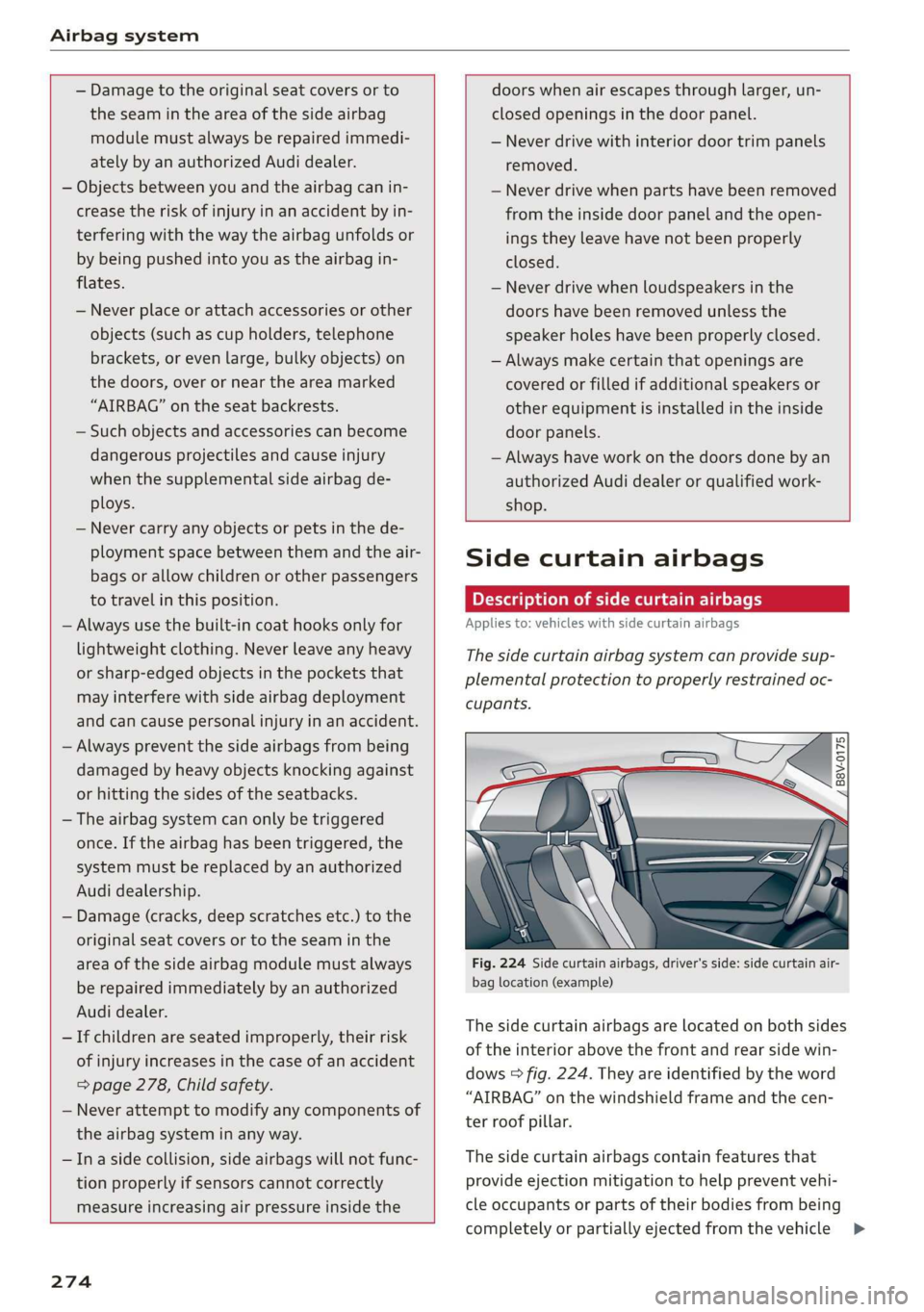
The side curtain airbags are located on both sides
of the interior above the front and rear side win-
dows > fig. 224. They are identified by the word
“AIRBAG” on the windshield frame and the cen-
ter roof pillar.
The side curtain airbags contain features that
provide ejection mitigation to help prevent vehi-
cle occupants or parts of their bodies from being
completely or partially ejected from the vehicle >