door lock AUDI A3 2020 Owner´s Manual
[x] Cancel search | Manufacturer: AUDI, Model Year: 2020, Model line: A3, Model: AUDI A3 2020Pages: 400, PDF Size: 107.47 MB
Page 104 of 400
High-voltage system
Loosening the cable
> If necessary, loosen the screw () 9 fig. 97 us-
ing
the screwdriver provided.
> Lift the lever @ all the way up.
> Pull the connector (2) out just until you feel re-
sistance.
> Close the lever @ until it is resting on the con-
nector (2).
> Remove the connector (2) completely.
Attaching the cable
> Lift the lever @ up slightly.
> Insert the connector 2) into the control unit
just
until you feel resistance.
> Lift the lever @ all the way up.
> Insert the connector @) all the way into the
control unit.
> Close the lever @).
> Tighten the screw @) using the screwdriver pro-
vided.
ZA WARNING
— Always remove the power cable from the
socket before changing the power cable or
vehicle cable.
— Always follow the instructions given when
charging the high-voltage battery.
— Only change cables in a dry environment.
— The Audi charging system may only be used
as a complete unit consisting of the power
cables, the control unit, and the vehicle ca-
ble. Depending on the country, the total
length of the power cable, control panel and
vehicle cable may be restricted, for example
to 24.6 ft (7.5 m) in the USA. We recom-
mend using only cables approved by Audi.
102
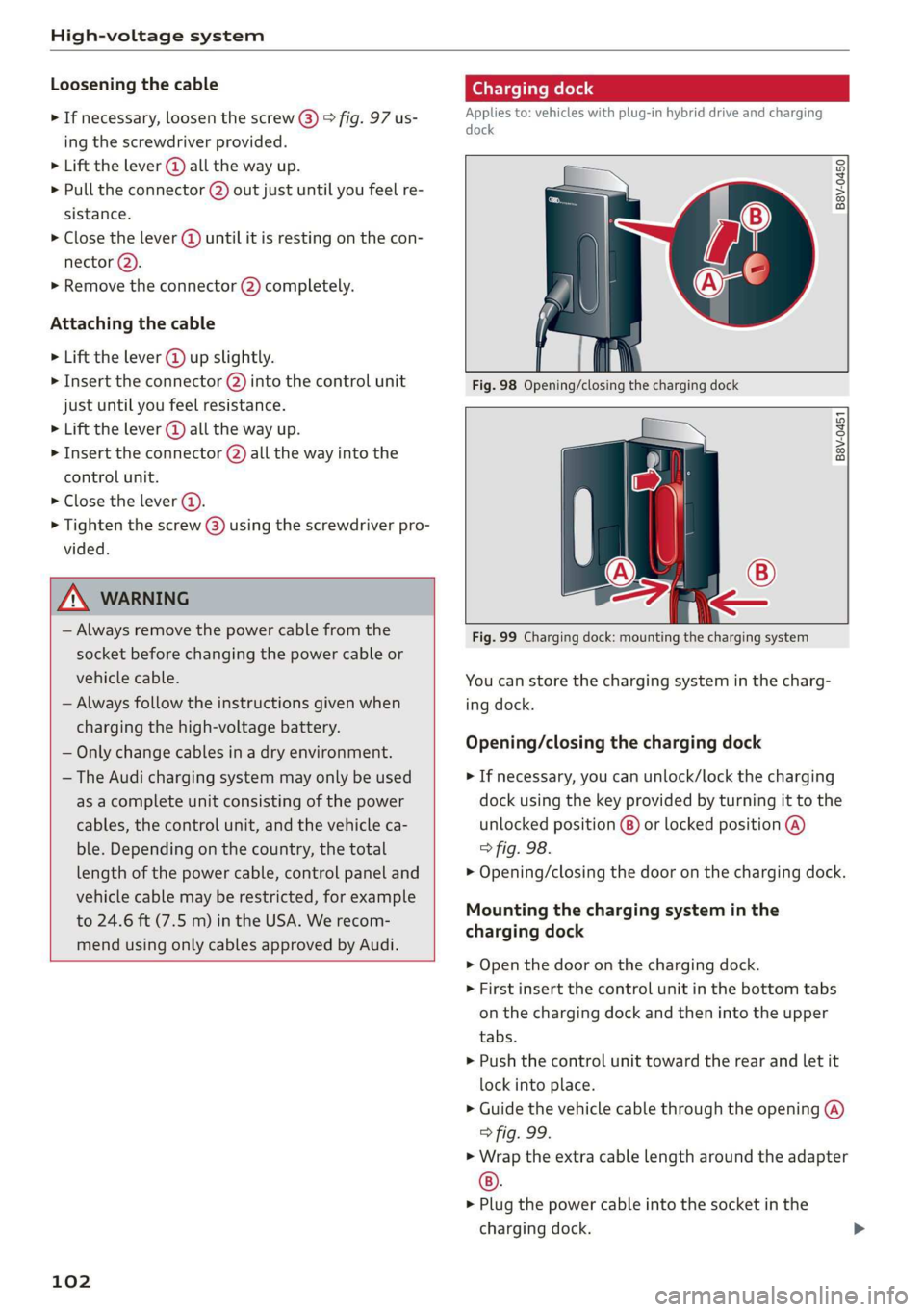
Charging dock
Applies to: vehicles with plug-in hybrid drive and charging
dock
B8V-0450
B8V-0451
Fig. 99 Charging dock: mounting the charging system
You can store the charging system in the charg-
ing dock.
Opening/closing the charging dock
> If necessary, you can unlock/lock the charging
dock using the key provided by turning it to the
unlocked position @) or locked position @)
> fig. 98.
> Opening/closing the door on the charging dock.
Mounting the charging system in the
charging dock
> Open the door on the charging dock.
> First insert the control unit in the bottom tabs
on the charging dock and then into the upper
tabs.
> Push the control unit toward the rear and let it
lock into place.
> Guide the vehicle cable through the opening @)
> fig. 99.
> Wrap the extra cable length around the adapter
®).
> Plug the power cable into the socket in the
charging dock.
Page 105 of 400
8V2012721BK
High-voltage system
> Close the door.
> After charging, you can place the vehicle charg-
ing connector (6) > page 101, fig. 96 in the
holder on the charging dock door > fig. 98.
Removing the charging system from the
charging dock
> Open the door on the charging dock.
> Remove the power cable connector from the
socket in the charging dock.
> Unwrap the cable from the adapter ().
> To loosen the control unit from the holder,
press the release tabs above the control unit in
the direction of the arrow > fig. 99.
G) Tips
— Always keep the door on the charging dock
closed.
— Do not place any objects on the door or the
charging dock.
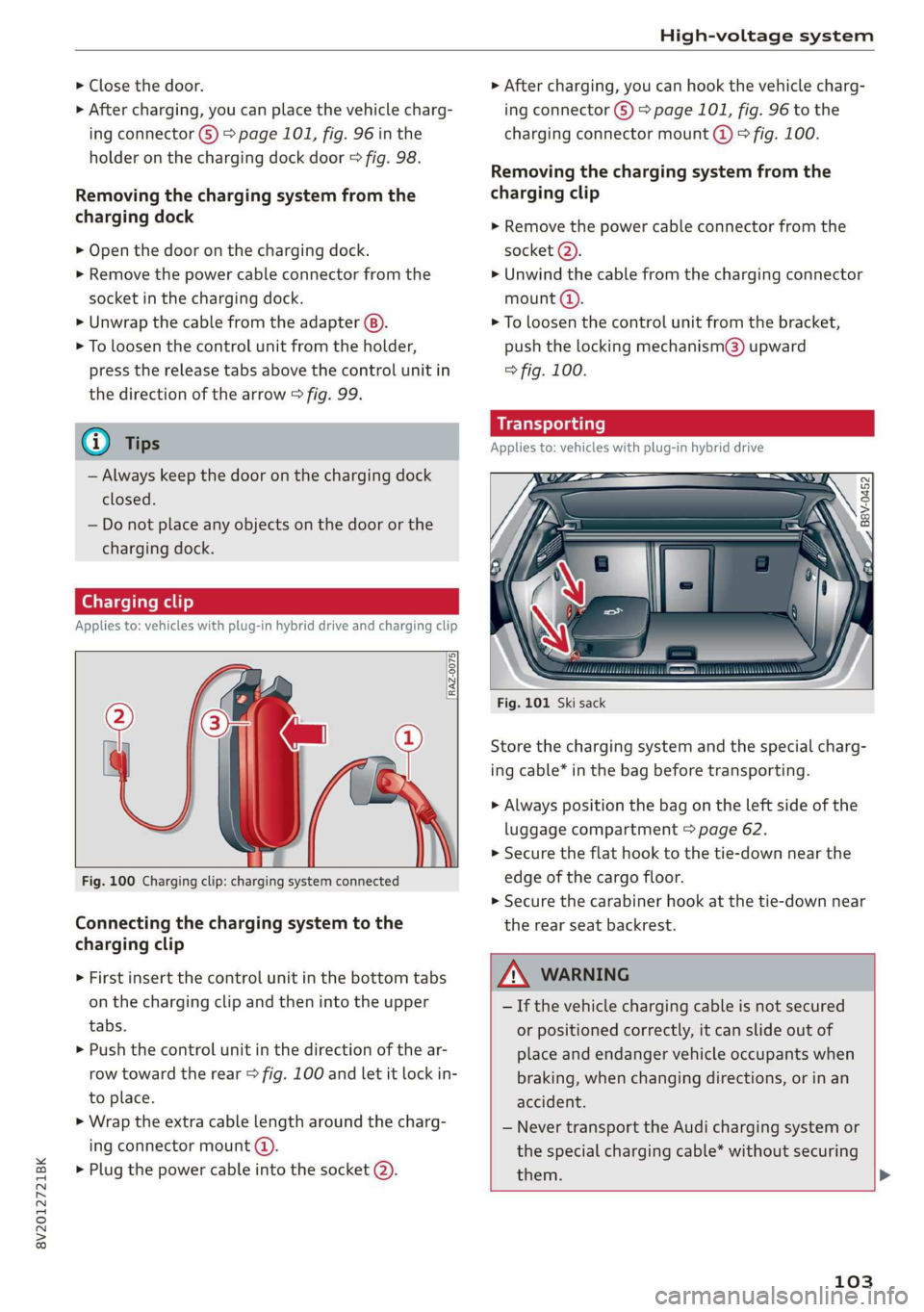
Charging clip
Applies to: vehicles with plug-in hybrid drive and charging clip
[RAZ-0075|
=O)
.
t
4—_(+)
Fig. 100 Charging clip: charging system connected
Connecting the charging system to the
charging clip
> First insert the control unit in the bottom tabs
on the charging clip and then into the upper
tabs.
> Push the control unit in the direction of the ar-
row toward the rear > fig. 100 and let it lock in-
to place.
> Wrap the extra cable length around the charg-
ing connector mount ().
> Plug the power cable into the socket @).
> After charging, you can hook the vehicle charg-
ing connector G) > page 101, fig. 96 to the
charging connector mount @) © fig. 100.
Removing the charging system from the
charging clip
> Remove the power cable connector from the
socket (2).
> Unwind the cable from the charging connector
mount (2).
> To loosen the control unit from the bracket,
push the locking mechanism@) upward
=> fig. 100.
Applies to: vehicles with plug-in hybrid drive
rT re} t g
> e 3
Fig. 101 Ski sack
Store the charging system and the special charg-
ing cable* in the bag before transporting.
> Always position the bag on the left side of the
luggage compartment > page 62.
> Secure the flat hook to the tie-down near the
edge of the cargo floor.
> Secure the carabiner hook at the tie-down near
the rear seat backrest.
Z\ WARNING
— If the vehicle charging cable is not secured
or positioned correctly, it can slide out of
place and endanger vehicle occupants when
braking, when changing directions, or in an
accident.
— Never transport the Audi charging system or
the special charging cable* without securing
them. >
103
Page 109 of 400
8V2012721BK
High-voltage system
Deactivating sleep mode
> Unlock the vehicle > page 25. Or
> Open the driver's door. Or
> Press the button © > page 105, fig. 105.
Unlocking the vehicle charging connector
when the vehicle is unlocked
> If necessary, deactivate sleep mode.
> Press the button with the illuminated LED @) or
© > page 105, fig. 105. Or
> Press the {@ button in the driver's door
= page 29, fig. 22 or the & button on the re-
mote control key.
> The connector will unlock for 30 seconds.
> Remove the connector.
> If the connector is not removed within 30 sec-
onds, it will lock again automatically.
Closing the charging unit
> Put the cap back on the charging port
=> page 104, fig. 103.
> Carefully slide the cover back in its original po-
sition.
> Turn the lock to the horizontal position
=> page 104, fig. 102.
@) Note
If you drive with an open charging unit, both
the cover and the electronics installed behind
it could be damaged.
G) Tips
The instrument cluster will indicate if the
charging unit is open while driving. Check be-
fore every drive after charging if the cover is
locked.
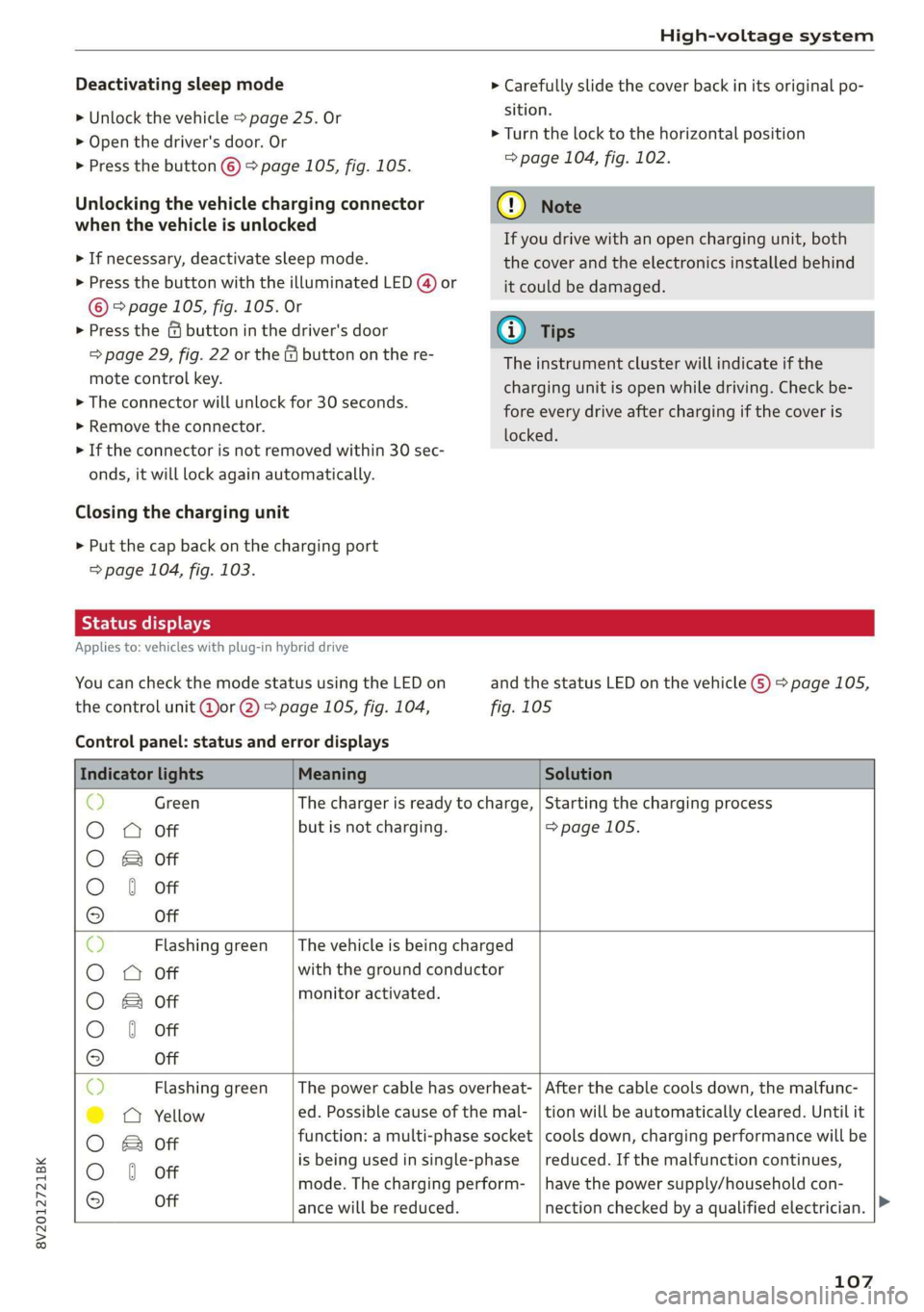
Semele
Applies to: vehicles with plug-in hybrid drive
You can check the mode status using the LED on
the control unit @or @) > page 105, fig. 104,
Control panel: status and error displays
and the status LED on the vehicle G) > page 105,
fig. 105
Indicator lights Meaning Solution
© Green The charger is ready to charge, | Starting the charging process
O 0 Off but is not charging. => page 105.
O B&B off
O 0 of
9 Off
c) Flashing green __| The vehicle is being charged
O O off with the ground conductor
O Bor monitor activated.
O 0 Off
9 Off
Sy Flashing green _| The power cable has overheat- | After the cable cools down, the malfunc-
©) a Yellow ed. Possible cause of the mal- | tion will be automatically cleared. Until it
O B otf function: a multi-phase socket | cools down, charging performance will be
O 6 off is being used in single:phase reduced. If the malfunction continues,
mode. The charging perform- | have the power supply/household con-
© Off ance will be reduced. nection checked by a qualified electrician.
107
Page 260 of 400
Airbag system
— Never hold the steering wheel at the 12
o'clock position or with your hands any-
where inside the steering wheel or on the
steering wheel hub. Holding the steering
wheel the wrong way increases the risk of
severe injury to the arms, hands, and head if
the driver airbag deploys.
ZA\ WARNING
Objects between you and the airbag will in-
crease the risk of injury in a crash by interfer-
ing with the way the airbag unfolds and/or by
being pushed into you as the airbag inflates.
— Always make sure nothing is in the front air-
bag deployment zone that could be struck
by the airbag when it inflates.
— Objects in the zone of a deploying airbag can
become projectiles when the airbag deploys
and cause serious personal injury.
— Never hold things in your hands or on your
lap when the vehicle is in use.
— Never place accessories or other objects
(such as cup holders, telephone brackets,
note pads, navigation systems, or things
that are large, heavy, or bulky) on the doors;
never attach them to the doors or the wind-
shield; never place them over or near or at-
tach them to the area marked ,, AIRBAG“ on
the steering wheel, instrument panel or the
seat backrests; never place them between
these areas and you or any other person in
the vehicle.
— Never attach objects to the windshield
above the passenger front airbag, such as
accessory GPS navigation units or music
players. Such objects could cause serious in-
jury in a collision, especially when the air-
bags inflate.
— Never recline the front passenger seat to
transport objects. Items can also move into
the deployment area of the side airbags or
the front airbag during breaking or in a sud-
den maneuver. Objects near the airbags can
fly dangerously through the passenger com-
partment and cause injury, particularly
when the seat is reclined and the airbags in-
flate.
258
Z\ WARNING
A person on the front passenger seat, espe-
cially infants and small children, will receive
serious injuries and can even be killed by be-
ing too close to the airbag when it inflates.
— Although the Advanced Airbag System in
your vehicle is designed to turn off the front
passenger airbag if an infant or a small child
is on the front passenger seat, nobody can
absolutely guarantee that deployment un-
der these special conditions is impossible in
all conceivable situations that may happen
during the useful life of your vehicle.
— The Advanced Airbag System can deploy in
accordance with the ,,low risk“ option for 3-
and 6-year-old children under the U.S. Fed-
eral Standard if a child with electrical capac-
itance greater than the combined capaci-
tance of a typical one-year old infant re-
strained in one of the forward facing or rear-
ward-facing child seats with which your ve-
hicle was certified is on the front passenger
seat and the other conditions for airbag de-
ployment are met.
— Accident statistics have shown that children
are generally safer in the rear seat area than
in the front seating position.
— For their own safety, all children, especially
12 years and younger, should always ride in
the back properly restrained for their age
and
size.
Advanced front airbag system
Your vehicle is equipped with a front Advanced
Airbag System in compliance with United States
Federal Motor Vehicle Safety Standard 208, as
well as Canada Motor Vehicle Safety Standard
(CMVSS) 208 as applicable at the time your vehi-
cle was manufactured.
The front Advanced Airbag System supplements
the safety belts to provide additional protection
for the driver's and front passenger's heads and
upper bodies in frontal crashes. The airbags in-
flate only in frontal impacts when the vehicle de-
celeration is high enough.
Page 288 of 400
Child safety
convertible locking retractor on the safety belt
to prevent the child safety seat from moving
=> page 289 or install the seat using the LATCH
attachments.
> Push the child safety seat down with your full
weight to get the safety belt really tight so that
the seat cannot move forward or sideways more
than one inch (2.5 cm) > page 289.
> If the child safety seat is equipped with a tether
strap, attach it to the tether anchors
=> page 294.
> Secure unused safety belts on the rear seat
=> page 284.
A toddler or child is usually too large for an in-
fant restraint if it is more than one year old and
weighs more than 20 lbs. (9 kg).
Toddlers and children who are older than one
year up to about 4 years old and weigh more than
20 lbs (9 kg) up to 40 lbs. (18 kg) must always be
properly restrained in a child safety seat certified
for their size and weight > fig. 228 and
> fig. 229.
The airbag on the passenger side makes the front
seat a potentially dangerous place for a child to
ride. The front seat is not the safest place for a
child in a forward-facing child safety seat. Itisa
very dangerous place for an infant or a larger
child in a rearward-facing seat.
against the backrest, center arm rest, door
or roof.
— Always install rear-facing child safety seats
on the rear seat.
— If you must install a rearward facing child
safety seat on the front passenger seat be-
cause of exceptional circumstances and the
PASSENGER AIR BAG OFF light does not
come on and stay on, immediately install
the rear-facing child safety seat in a rear
seating position and have the airbag system
inspected by your Audi dealer.
—The rear side of the child safety seat should
be positioned as close as possible to the
backrest on the vehicle seat.
— For adjustable head restraints: adjust or re-
move the rear seat head restraint if it is dif-
ficult to install the child seat with the head
restraint in place > page 57. Install the
head restraint again immediately once the
child seat is removed. Driving without head
restraints or with head restraints that are
not properly adjusted increases the risk of
serious or fatal neck injury dramatically.
— Always read and heed all WARNINGS when-
ever using a child restrained in a vehicle is
being used > page 245, Safety belts,
= page 253, Airbag system and > page 278,
Important information.
ZA WARNING
Not using a child safety seat, using the wrong
child safety seat or improperly installing a
child restraint increases the risk of serious
personal injury and death in a collision or oth-
er emergency situation.
— Children on the front seat of any car, even
with Advanced Airbags, can be seriously in-
jured or even killed when an airbag inflates.
A child in a rearward-facing child safety seat
installed on the front passenger seat will be
seriously injured and can be killed if the
front airbag inflates —- even with an Ad-
vanced Airbag System.
— The inflating airbag will hit the child safety
seat or infant carrier with great force and
will smash the child safety seat and child
286
ZA, WARNING
If exceptional circumstances require the use
of a forward-facing child restraint on the front
passenger's seat, the child's safety and well-
being require that the following special pre-
cautions be taken:
— Make sure the forward-facing seat has been
designed and certified by its manufacturer
for use on a front seat with a passenger
front and side airbag.
— Always follow the manufacturer's instruc-
tions provided with the child safety seat or
infant carrier.
— Always move the front passenger seat to the
highest position in the up and down adjust-
ment range and move it back to the rear-
most position in the seat's fore and aft ad-
justment range, as far away from the airbag
Page 291 of 400
8V2012721BK
Child safety
OFF light must come on and stay on, when-
ever the ignition is switched on.
— If the PASSENGER AIR BAG OFF light does
not come on and stay on, perform the
checks described > page 265, Monitoring
the Advanced Airbag System.
— Take the child restraint off the front passen-
ger seat and install it properly at one of the
rear seat positions if the PASSENGER AIR
BAG OFF light does not stay on whenever
the ignition is switched on.
— Always read and heed all WARNINGS when-
ever using a child restrained in a vehicle is
being used > page 245, Safety belts,
=> page 253, Airbag system and > page 278,
Important information.
Securing child safety
seats
Securing a child safety seat using a safety
ert
Safety belts for the rear seats and the front pas-
senger can be locked with the convertible locking
retractor to properly secure child safety seats.
The safety belts emergency locking retractors for
the rear seats safety belts and for the front pas-
senger’s seat safety belt have a convertible lock-
ing retractor for child restraints. The safety belt
must be locked so that belt webbing cannot un-
reel. The retractor can be activated to lock the
safety belt and prevent the safety belt webbing
from loosening up during normal driving. A child
safety seat can only be properly installed when
the safety belt is locked so that the child and
child safety seat will stay in place.
Always remember: Even though your vehicle is
equipped with an Advanced Airbag system, all
children, especially those 12 years and younger,
should always ride in the back seat properly re-
strained for their age and size.
ZA\ WARNING
Improperly installed child safety seats in-
crease the risk of serious personal injury and
death in a collision.
— Always make sure that the safety belt retrac-
tor is locked when installing a child safety
seat. An unlocked safety belt retractor can-
not hold the child safety seat in place during
normal driving or in a crash.
— Always buckle the child safety seat firmly in
place even if a child is not sitting init. A
loose child safety seat can fly around during
a sudden stop or in a collision.
— Always make sure that the rear seat backrest
to which the center rear safety belt* is at-
tached is securely latched whenever the rear
center safety belt is being used to secure a
child restraint.
—If the backrest is not securely latched, the
child and the child restraint will be thrown
forward together with the backrest and will
strike parts of the vehicle interior. The child
can be seriously injured or killed.
— Never install rear-facing child safety seats or
infant carriers on the front passenger seat.
A child will be seriously injured and can be
killed when the passenger airbag inflates.
— The inflating airbag will hit the child safety
seat or infant carrier with great force and
will smash the child safety seat and child
against the backrest, center armrest, door
or roof.
— Always install rear-facing child safety seats
or infant carriers on the rear seat.
— Forward-facing child safety seats or infant
carriers installed on the front passenger's
seat may interfere with the deployment of
the airbag and cause serious injury to the
child.
—It is safer to install a forward-facing child
safety seat on the rear seat.
— Always read and heed all WARNINGS when-
ever using a child restrained in a vehicle is
being used > page 278. Special precautions
apply when installing a child safety seat on
the front passenger seat > page 254, Child
restraints on the front seat - some impor-
tant things to know.
289
Page 292 of 400
Child safety
ZA WARNING
Always take special precautions if you must
install a forward or rearward-facing child re-
straint on the front passenger's seat in excep-
tional situations:
— Whenever a forward or rearward-facing
child restraint is installed on the front pas-
senger seat, the PASSENGER AIR BAG OFF
light must come on and stay on whenever
the ignition is switched on.
— If the PASSENGER AIR BAG OFF light does
not come on and stay on, perform the
checks described > page 265, Monitoring
the Advanced Airbag System.
— Take the child restraint off the front passen-
ger seat and install it properly at one of the
rear seat positions if the PASSENGER AIR
BAG OFF light does not stay on whenever
the ignition is switched on.
— Improper installation of child restraints can
reduce their effectiveness or even prevent
them from providing any protection.
— An improperly installed child restraint can
interfere with the airbag as it deploys and
seriously
injure or even kill the child.
— Always carefully follow the manufacturer's
instructions provided with the child safety
seat or carrier.
— After checking to make sure that the child
restraint is properly installed, make certain
that the child restraint is correctly recog-
nized by the capacitive passenger detection
system in the front passenger seat and that
the PASSENGER AIR BAG OFF light signals
the correct front passenger frontal airbag
status.
ZA\ WARNING
Forward-facing child restraints:
— Always make sure the forward-facing seat
has been designed and certified by its manu-
facturer for use on a front seat with a pas-
senger front and side airbag.
— Never put the forward-facing child restraint
up, against or very near the instrument pan-
el
290
— Always move the front passenger seat to the
highest position in the up and down adjust-
ment range and move it back to the rear-
most position in the seat's fore and aft ad-
justment range, as far away from the airbag
as possible, before installing the forward-
facing child restraint.
— Always make sure that the safety belt upper
anchorage is behind the child restraint and
not next to or in front of the child restraint
so that the safety belt will be properly posi-
tioned.
— Make sure that the PASSENGER AIR BAG
OFF light comes on and stays on all the time
whenever the ignition is switched on.
ZA WARNING
Rearward-facing child restraints:
-Achild in a rearward-facing child safety seat
installed on the front passenger seat will be
seriously injured and can be killed if the
front airbag inflates - even with an Ad-
vanced Airbag System.
— The inflating airbag will hit the child safety
seat or infant carrier with great force and
will smash the child safety seat and child
against the backrest, center armrest, door
or roof.
— Always be especially careful if you must in-
stall a rearward facing child safety seat on
the front passenger seat in exceptional cir-
cumstances.
— Make sure that the PASSENGER AIR BAG
OFF light comes on and stays on all the time
whenever the ignition is switched on.
— If the PASSENGER AIR BAG OFF light does
not come on and stay on, immediately in-
stall the rear-facing child safety seat ina
rear seating position and have the airbag
system inspected by your Audi dealer.
Activating the convertible locking retractor
Use the convertible locking retractor to secure a
child restraint.
Always heed the child safety seat manufacturer's
instructions when installing a child restraint in
Page 298 of 400
Child safety
» Applies to: Sportback: Unlock the backrest and
fold it slightly forward > page 62, Increasing
the cargo area and locate the tether anchor be-
hind the rear seat backrest.
» Applies to: Cabriolet: Unlock the backrest and
fold it slightly forward > page 63, Pass-
through and locate the tether anchor behind
the rear seat backrest.
> Guide the upper tether strap under the rear
head restraint (raise the head restraint if neces-
sary) > fig. 238. For child restraints with V-
tether straps, always make sure that the head
restraint guide rods do not interfere with any
part of the top tether strap.
> Attach the tether strap anchorage hook into the
opening of the tether anchorage.
> Pull on the tether strap hook so that the spring
catch of the hook is engaged.
> Straighten the backrest back up into its upright
position and press it firmly into the locking
mechanism.
>» Tighten the tether strap firmly following the
child restraint manufacturer's instructions.
Releasing the tether strap
> Loosen the tension on the straps following the
child restraint manufacturer's instructions.
> Depress the spring catch on the hook and re-
lease it from the anchorage.
Remember: Use tether straps to help keep the
child restraint firmly in place.
ZA WARNING
Improper use of the LATCH system can in-
crease the risk of serious personal injury and
death in an accident.
— These anchors were developed only for child
safety seats using the “LATCH” system.
— Never attach other child safety seats, belts
or other objects to these anchors.
— Always make sure that you hear a click when
latching the seat in place. If you do not hear
a click the seat is not secure and could fly
forward and hit the interior of the vehicle, or
be ejected from the vehicle.
Z\ WARNING
Improper installation of child restraints will
increase the risk of injury in an accident.
— Always follow the child restraint system
manufacturer's instructions for proper in-
stallation of the child restraint system and
proper use of tether straps as well as the
lower anchorages or safety belts in your ve-
hicle.
— Always read and heed the important infor-
mation and WARNINGS about child safety
and the installation of child restraint sys-
tems > page 278, Child safety.
Using tether straps on rearward-facing
child restraints
Currently, few rear-facing child restraint systems
come with a tether. Please read and heed the
child restraint system manufacturer's instruc-
tions carefully to determine how to properly in-
stall the tether.
Z\ WARNING
A child in a rearward-facing child safety seat
installed on the front passenger seat will be
seriously injured and can be killed if the front
airbag inflates - even with an Advanced Airbag
System.
— The inflating airbag will hit the child safety
seat or infant carrier with great force and
will smash the child safety seat and child
against the backrest, center armrest, or
door.
— If you must install a rearward facing child
safety seat on the front passenger seat be-
cause of exceptional circumstances and the
PASSENGER AIR BAG OFF light does not
come on and stay on, immediately install
the rear-facing child safety seat in a rear
seating position and have the airbag system
inspected by your Audi dealer.
296
Page 301 of 400

8V2012721BK
Checking and Filling
— Do not use any gasoline mixture whose
composition cannot be identified.
— Audi does not assume any responsibility for
damage to the fuel system or for perform-
ance problems caused by using gasoline
mixtures different from those specified.
This type of damage also does not fall under
the New Vehicle Limited Warranty or under
the emissions control system warranty.
— If you notice a higher fuel consumption or
poor handling or performance problems due
to such gasoline mixtures, we recommend
fueling with unblended gasoline.
Gasoline additives
An important issue for many automobile manu-
facturers is combustion residue in the engine
that results from the use of certain fuels.
Although types of gasoline differ depending on
the manufacturer, there are similarities. Certain
substances in the gasoline may cause deposits in
the engine. Additives in the gasoline that should
keep the engine and fuel system clean do not all
function equally.
Audi recommends using TOP TIER Detergent Gas-
oline. For additional information on TOP TIER De-
tergent Gasoline, visit www.toptiergas.com.
If you use incorrect fuels over a long period of
time, the maximum engine performance may be
impaired by combustion residue.
@) Note
— Damage or malfunctions caused by the use
of incorrect types of gasoline are not cov-
ered by the New Vehicle Limited Warranty.
— Only gasoline additives that have been ap-
proved by Audi may be used.
Refueling
Fueling procedure
B8V-0111
Applies to: vehicles with conventional drive system
Fig. 239 Right rear side of vehicle: opening the fuel filler
door
B8V-0110
Applies to: vehicles with conventional drive system
Fig. 240 Fuel filler door with tank cap on
Plug-in hybrid drive*: refer to the information un-
der > page 302, Refueling.
The fuel filler door is unlocked or locked by the
central locking system.
> Plug-in hybrid drive: read and follow the in-
structions under > page 302, Opening the fuel
filler door.
>» Unlock the vehicle if necessary.
> Conventional drive system: press on the left
side of the fuel filler door to open it > fig. 239.
> Unscrew the tank cap counterclockwise.
» Place the cap from above on the open fuel filler
door > fig. 240.
> Insert the fuel pump nozzle all the way into the
fuel filler neck.
> Begin fueling. Once the fuel pump nozzle turns
off the first time, the fuel tank is full. Do not
continue fueling, or else the expansion space in
the tank will be filled with fuel. >
299
Page 302 of 400

Checking and Filling
> After the fuel pump has switched off, wait five
seconds before removing the nozzle to allow
the rest of the fuel to finish dripping into the
fuel tank.
> Turn the fuel cap clockwise until it clicks into
place.
> Close the fuel filler door and then press on the
left side until it latches.
The correct fuel type for your vehicle can be
found ona label located on the inside of the fuel
filler door. For additional information on fuel, see
=> page 298.
For the tank capacity in your vehicle, refer to the
Technical Data > page 380.
To reduce the risk of fuel leaking out or vapors
escaping, make sure that the fuel tank is closed
correctly. Otherwise the Ey indicator light will
turn on.
If the central locking system malfunctions, there
is a fuel filler door emergency release
= page 301.
Messages
Plug-in hybrid drive: for additional information
on refueling, see > page 302.
| Tank system: malfunction! Please contact
Service
There is a malfunction in the fuel tank system.
Drive to an authorized Audi dealer or authorized
Audi Service Facility immediately to have the
malfunction corrected.
— If you do not insert the fuel pump nozzle all
the way into the filler tube, then fuel can
leak out. Spilled fuel can ignite and start a
fire.
— Never get into the vehicle when refueling. If
there is an exceptional situation where you
must enter the vehicle, close the door and
touch a metal surface before touching the
fuel pump nozzle again. This will reduce the
risk of electrostatic discharge that can cause
flying sparks. Sparks can start a fire when
refueling.
ZA\ WARNING
Improper fueling procedures and improper
handling of fuel can lead to explosions, fires,
severe burns, and other injuries.
— Do not smoke. Keep away from open flames.
— The ignition must be switched off when re-
fueling.
— Mobile devices, radio devices, and other ra-
dio equipment should always be switched
off when refueling. Electromagnetic rays
ZA WARNING
Transporting fuel containers inside the vehicle
is not recommended. Fuel could leak out of
the container and ignite, especially during an
accident. This can cause explosions, fires, and
injuries.
— If you must transport fuel in a fuel contain-
er, note the following:
— Always place the fuel container on the
ground before filling. Never fill the fuel
container with fuel while it is inside or on
the vehicle. Electrostatic discharge can oc-
cur while refueling and the fuel vapors
could ignite.
— When using fuel containers made of met-
al, the fuel pump nozzle must always re-
main in contact with the container to re-
duce the risk of static charge.
— Insert the fuel pump nozzle as far as pos-
sible into the filler opening while refuel-
ing.
— Follow the applicable legal regulations in
the country where you are driving when
using, storing and transporting fuel con-
tainers.
— Make sure that the fuel container meets
the industry standards, for example ANSI
or ASTM F852-86.
could cause sparks and start a fire.
1) Depending on the engine and country
300