towing AUDI A3 CABRIOLET 2015 User Guide
[x] Cancel search | Manufacturer: AUDI, Model Year: 2015, Model line: A3 CABRIOLET, Model: AUDI A3 CABRIOLET 2015Pages: 302, PDF Size: 73.83 MB
Page 204 of 302
202 Trailer towing
"Full load" on the label located on the driver's
side B-pillar (visible when the door is open).
Inflate trailer tires to trai ler and t ire manufac
turers' specif ications.
Lights
Check to make sure both vehicle and trailer
lights are working properly.
Safety chains
Be sure trailer safety chains are properly con
nected from the trailer to the hitch on the ve
hicle. Leave enough slack in the chains to per
mit turning corners. When you install safety
chains, make sure they wi ll not drag on the
road when you are driving.
The chains should cross under the trailer
tongue to prevent it from dropping in case of
separation from the hitch.
Driving instructions
Driving with a trailer always requires extra
care and consideration.
To obtain the best possible handling of vehicle
and trailer, please note the following:
.. Do not tow a loaded tra iler when your car it
self is not loaded.
.,. Be espec ially car efu l when passing other
vehicles.
.. Observe speed limits.
.. Do not drive at the maximum permissible
speed.
.. Always apply brakes early .
.. Monitor the temperature gauge.
Weight distribution
Towing a loa ded trai ler with an empty ca r re
sults in a high ly unstable distribution of
weight . If this cannot be avoided, drive at very
low speeds only to avoid the risk of losing
steering control.
A "balanced" rig is easier to operate and con
trol. This means that the tow vehicle should be loaded to the extent poss ible and permissi
ble, while keeping the trailer as light as possi
ble under the circumstances . Whenever possi- ble,
transfer some cargo to the luggage com
partment of the tow vehicle while observing
tong ue load requirements and vehicle loading
considerations.
Speed
T he higher the speed, the more difficult it be
comes for the driver to control the rig. Do not
drive at the maximum permissible speed . Re
duce your speed even more if load, weather or
wind conditions are unfavorable -particularly
when going downhill.
Reduce vehicle speed
immediately if the trail
er shows the slightest sign of sway ing.
Do not
try to stop the swaying by accelerating.
Observe speed limits . In some areas, speeds
for vehicles towing trai lers are lower than for
regular vehicles .
Always apply brakes early. When driving
downhi ll, shift into a lower gear to use the en
gine braking effect to s low the vehicle. Use of
the brakes alone can cause them to overheat
and fail.
Coolant temperature
The coolant temperature gauge~ page 12
must be observed carefu lly. The coolant tem
perature can increase if you drive on long in
clines in a low gear at high engine speeds. Re
duce your speed immediately if the LEDs in
the top part of the d isplay turn on .
For more information about indicator lights,
refer to. ~
page 19 .
A WARNING
Anyone not properly restrained in a mov
ing vehicle is at a much greater risk in an
accident. Never let anyone ride in your car
who is not properly wearing the restraints
provided by Audi.
Trailer towing tips
Important to know
Your vehicle handles differently when towing
a trai ler because of the additional weight and ..,.
Page 205 of 302
M N
" > co ,...., \!) 1.1"1 ,...., 1.1"1 ,....,
different weight distribution. Safety, perform
ance and economy wi ll greatly depend on how
carefu lly you load your trailer and operate
your rig.
Before you actually tow your trailer, practice
turning, stopping and backing up in an area
away from traffic. Keep practicing until you
have become comp letely familiar with the way
your vehicle- trailer combination behaves and
responds .
Backing up is d ifficult and requires practice.
Backing up with a trai ler generally requires
stee ring action opposite to that when backing
up your vehicle without a trailer .
Maintain a greater distance between your ve
hicle and the one in front of you. You will need
more room to stop. To compensate for the
trailer, you will need a larger than normal
turn ing radius.
When passing, remember that you cannot ac
celerate as fast as you normally would be
cause of the added load. Make sure you have
enough room to pass . After passing, allow
p lenty of room for your tra iler before chang
ing lanes again.
Avoid jerky starts, sharp turns or rapid lane
changes.
(D Tips
- Do not tow a tra iler during the break-in
period of your vehicle.
- If you tow a trailer, your Audi may re
quire more frequent maintenance due to
the extra load
¢ page 282 .
Parking on a slope
Do not park on a slope with a trailer. If i t can
not be avoided, do so only after doing the fol
lowing:
When parking:
.. Apply the foot brake.
.. Have someone place chocks under both the
vehicle and the trailer wheels.
Trailer towing 203
.. With chocks in place, slowly release the
brakes until the wheel chocks absorb the
load .
.. Turn the wheels towards the curb.
.. Apply the parking brake.
.. Select the P selector lever posit ion.
When re starting after parking:
.. App ly the foot brake.
.. Start the engine.
.. Select the
0/5 selector lever position.
.. Release the parking brake and slowly pull
out and away from the wheel chocks .
.. Stop and have someone retr ieve the wheel
chocks.
(D Tips
If you move the selector lever of the auto
matic transmission to
P before applying
the parking brake and before blocking the
whee ls, you may have to use more force
lat er to move the lever out of the
P posi
tion.
•
•
•
Page 248 of 302

246 Tires and wheels
being loaded on the vehicle.
That weight may not safely
exceed the available cargo
and luggage load capacity
calculated in Step 4.
6. If your vehicle will be towing
a trailer, load from your trail
er will be transferred to your
vehicle. Consult this manual
to determine how this re duces the available cargo
and luggage load capacity of
your vehicle.
.,.Check the tire sidewall
(¢ page 248, fig. 176) to de
termine the designated load
rating for a specific tire.
Tire service life
The service life of tires depends
on a lot of different things in
cluding proper installation and
balancing, correct tire pressure
and driving style.
Fig. 174 Tire tread: tread wear indi
cators (TWI)
Fig. 175 Rotating tires for more even
wear
Tread Wear Indicator (TWI)
The original tires on your vehi
cle have
1/16 inch (1.6 mm)
high "wear indicators"
¢ fig. 174 running across the
tread. Depending on the make,
there will be six to eight of
them evenly placed around the
tire. Marks on the tire sidewall (for example "TWI" or other
symbols) indicate the positions
of the tread wear indicators.
Worn tires must be replaced. Different figures may apply in
other countries
¢ .&. .
Tire pressure
Incorrect tire pressure causes
premature wear and can cause
sudden tire blow-out. For this
reason, tire press ure must be
checked at least once a month
¢page 240.
Page 265 of 302
the tire chain before mounting the wheel
and tire is recommended.
- Loose items in the passenger compart
ment can cause serious personal injury
during hard braking or in an accident.
Never store the inf latab le spare tire or
jack and tools in the passenger compart
ment.
- Normal summer or winter tires must not
be mounted on the compact spare wheel
rim.
Removing the subwoofer
A pp lies to vehicles: with s ubwoofer
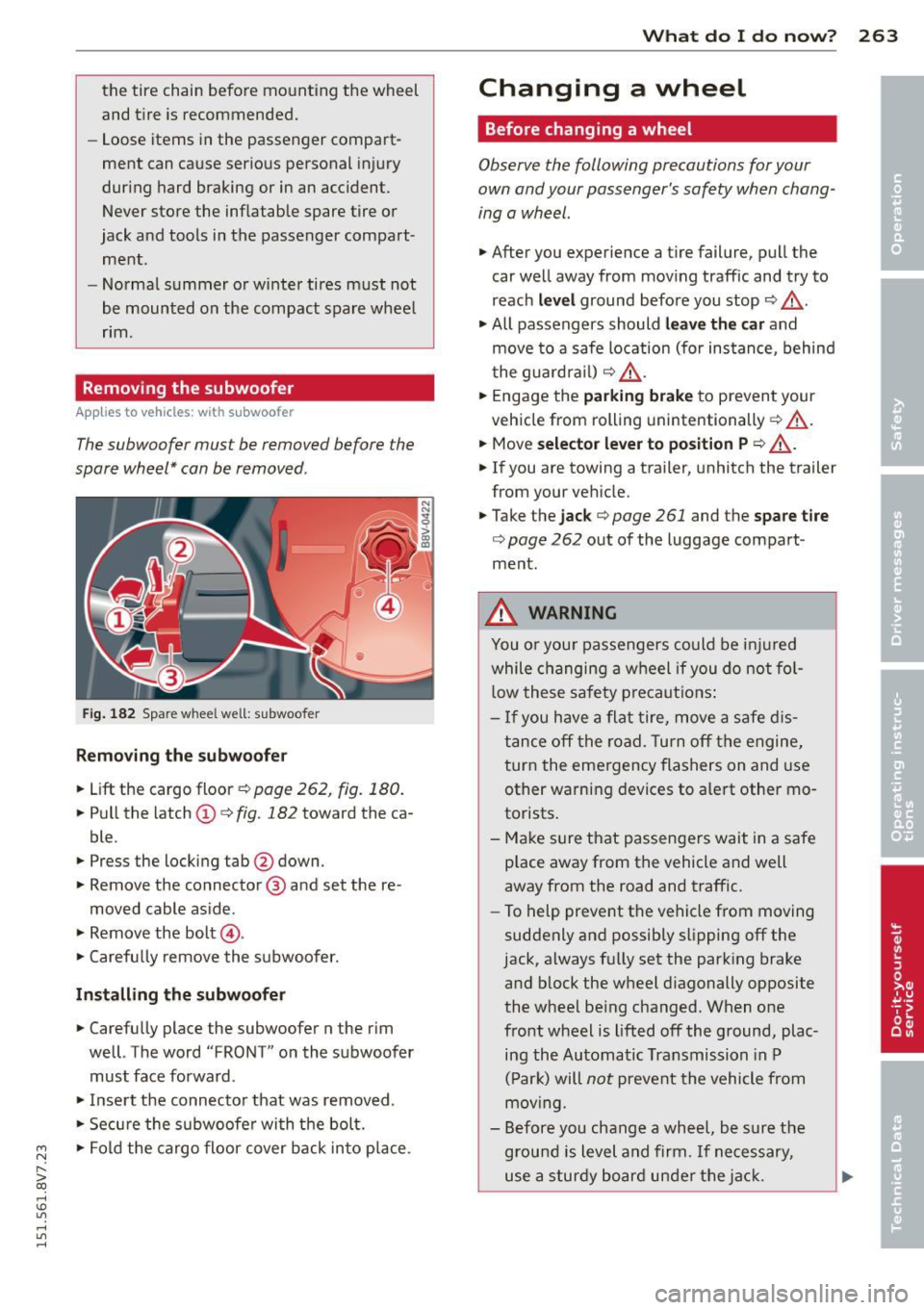
The subwoofer must be removed before the
spare wheel* can be removed.
Fig. 182 Spare wheel well: subwoofer
Removing the subwoofer
• Lift the cargo floor c:, page 262, fig. 180.
• Pull the latch (D c:> fig. 182 toward the ca
ble.
• Press the locking tab @down .
• Remove the connector @ and set the re-
moved cable aside.
• Remove the bolt@.
• Carefully remove the subwoofer.
Installing the subwoofer
• Carefully place the subwoofer n the rim
well. The word "FRONT" on the subwoofer
must face forward .
• Insert the connector that was removed .
• Secure the subwoofer with the bolt.
~ • Fold the cargo floor cover back into place.
r--. > co
rl I.O
"' rl
"' rl
What do I do now? 263
Changing a wheel
Before changing a wheel
Observe the following precautions for your
own and your passenger's safety when chang
ing a wheel.
• After you experience a tire failure, pull the
car well away from moving traffic and try to
reach
level ground before you stop c:> _&..
• All passengers should leave the car and
move to a safe location (for instance, behind
the guardrail)
c:> _&..
• Engage the parking brake to prevent your
vehicle from rolling unintentionally
c:> _&. .
• Move selector lever to position P c:> ,&..
• If you are towing a trailer, unhitch the trailer
from your vehicle.
• Take the
jack c:, page 261 and the spare tire
r:> page 262 out of the luggage compart
ment .
A WARNING
You or your passengers could be injured
while changing a wheel if you do not fol
low these safety precautions:
-If you have a flat tire, move a safe dis
tance off the road. Turn off the engine,
turn the eme rgency flashers on and use
other warning devices to alert other mo
torists.
- Make sure that passengers wait in a safe
place away from the vehicle and well
away from the road and traffic.
- To help prevent the vehicle from moving
suddenly and possibly slipping off the
jack, always fully set the parking brake
and block the wheel diagonally opposite
the wheel being changed. When one
front wheel is lifted off the ground, plac ing the Automatic Transmission in P
(Park) will
not prevent the vehicle from
mov ing .
- Before you change a wheel, be sure the
ground is level and firm. If necessary,
use a sturdy board under the jack.
-
Page 275 of 302
M N
" > co ,...., \!) ..,.,
,...., ..,., ,....,
Emergency situations
General
This chapter is intended for trained emer
gency crews and working personnel who have the necessary tools and equipment to
perform these operations.
Starting by pushing or
towing
(D Note
Vehicles with an automatic transmission
cannot be started by pushing or towing.
Starting with jumper
cables
If necessary, the engine can be started by
connecting it to the battery of another vehi
cle.
If the engine should fail to start because of a
discharged or weak battery, the battery can be
connected to the battery of
another vehicle,
using a
pair of jumper cables to start the en
gine.
Jumper cables
Use only jumper cables of sufficiently large
cross section to carry the starter current safe
ly. Refer to the manufacturer's specifications.
Use only jumper cables with
insulated termi
nal clamps which are distinctly marked :
plus(+) cable in most cases colored red
minus(-) cable
in most cases colored black.
A WARNING
Batteries contain electricity, acid, and gas.
Any of these can cause very serious or fatal
injury. Follow the instructions below for
safe handling of your vehicle's battery.
- Always shield your eyes and avoid lean
ing over the battery whenever possible.
- A discharged battery can freeze at tem
peratures just below 32 °F (0 °C). Before
Emergency situations 273
connecting a jumper cable, you must
thaw the frozen battery completely, oth
erwise it could explode.
- Do not allow battery acid to contact eyes
or skin. Flush any contacted area with
water immediately .
- Improper use of a booster battery to start a vehicle may cause an explosion.
- Vehicle batteries generate explosive gas
es. Keep sparks, flame and lighted ciga
rettes away from batteries.
- Do not try to jump start any vehicle with a low acid level in the battery.
- The voltage of the booster battery must
also have a 12-volt rating. The capacity
(Ah) of the booster battery should not be
lower than that of the discharged bat
tery . Use of batteries of different voltage
or substantially different "Ah" rating
may cause an explosion and personal in
JU ry.
- Never charge a frozen battery. Gas trap
ped in the ice may cause an explosion.
-Never charge or use a battery that has
been frozen. The battery case may have
be weakened.
- Use of batteries of different voltage or
substantially different capacity (Ah) rat
ing may cause an explosion and injury.
The capacity (Ah) of the booster battery
should not be lower than that of the dis
charged battery.
- Before you check anything in the engine
compartment, always read and heed all
WARNINGS ¢
page 214.
(D Note
-Applying a higher voltage booster bat
tery will cause expensive damage to sen
sitive electronic components, such as
control units, relays, radio, etc.
- There must be no electrical contact be
tween the vehicles as otherwise current
could already start to flow as soon as the
positive(+) terminals are connected. ..,. •
•
•
Page 277 of 302
M N ,....
> co ,...., \!) 1.1'1 ,...., 1.1'1 ,....,
installed. Make sure the cables do not get
caught in moving engine components .
11. Sw itch the heater fan and rear window de-
froster off.
12. Close the battery cover.
The battery is vented to the outside so that not gases enter the passenger compartment.
Make sure that the connected positive termi
nal clamps on the jump start cable have suff i
cient contact with metal.
A WARNING
Follow the warn ings and instructions from
the jump start cable manufacturer to re duce the risk of serious injuries and vehicle
damage .
If you are uns ure abo ut anything,
call roadside assistance.
- T he jump start cables must be long
enough so that the vehicles do not
touch.
- Route the jump sta rt cab les so they can
not get ca ught in the moving parts in the
engine compartment .
- Always read and follow the warnings be
fore checking anything in the engine
compartment <=>
page 214.
(D Note
Correctly jump start cables incorre ctly can
destroy the a lternator .
- Always connect the positive term inal(+)
to the positive terminal( +) and the neg
ative termina l (-) to the negative termi
nal(-) on the body ground point, but not
the negative termina l on the battery.
- Make sure the screw plugs on the batte ry
ce lls are insta lled securely. If not, tight
en the plugs before connecting the
clamps to the negat ive termina l on the
battery.
- P lease note that the connecting process
described be low for the jump start ca
bles is intended for when your vehicle is
being jump started. If you are jump
starting another vehicle, do not connect
the negat ive cab le to the negative termi
nal(·) on the drained battery, but rathe r
Emerg en cy si tuation s 275
connect it to a large metal component
that is bolted securely to the engine
bloc k, or to the engine block itsel f. If the
battery in the vehicle being jump started
is not vented to the outside, there is a
r isk of explosion due to hydrogen gas.
- Make sure that the connected positive
terminal clamps have sufficient contact
with metal.
- Do not use the battery negat ive terminal
for jump start ing or a malfunct ion could
occur in the vehicle electrical system.
Emergency towing
with commercial tow
truck
General hints
Your Audi requires special handling for tow
ing .
The following information is to be used by
commerc ial tow truck operators who know
how to operat e th eir equipment safely.
- Never to w you r Aud i. Towing will cause
damage to the engine and tran smission.
- Nev er wra p the s afety ch ains or wi nch ca
bles a round the brake li nes.
- To p revent unnece ssary dam age , your Aud i
must be t ranspo rted with a flat bed truck.
- To load the vehicle on to the fl at bed , us e
the towing loop fo und in the vehicle tool s
and attach to the front o r rear anchorage
<=> page 2 76 and <=> page 2 76.
A WARNING
A vehicle being towed is not safe for pas
sengers. Neve r allow anyone to ride in a
vehicle be ing towed, fo r any reason.
-
•
•
•
Page 278 of 302
2 76 Emergency situations
Front towing loop
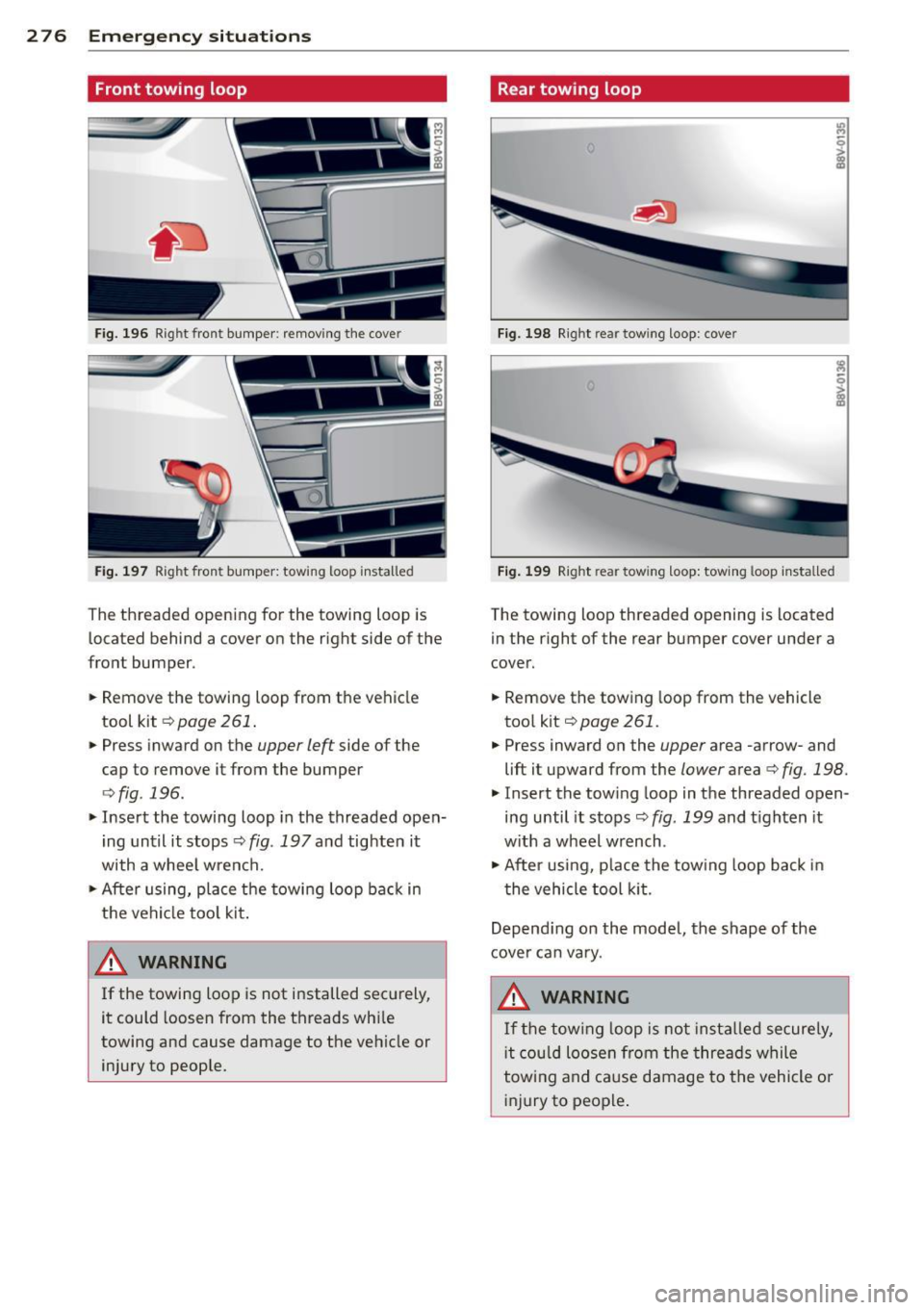
Fig. 196 Right front bumper: removing the cove r
Fig. 197 Right front bumper: towing loop installed
The threaded opening for the towing loop is
located behind a cover on the right side of the
front bumper.
• Remov e the towing loop from the vehicle
tool kit¢
page 261 .
• Press inward on the upper le~ side of the
cap to remove it from the bumper
¢fig . 196.
• Insert the towing loop in the threaded open
ing until it stops¢
fig. 197 and tighten it
with a whee l wrench.
• After using, place the towing loop back in
the vehicle tool kit.
A WARNING
If the towing loop is not installed securely,
it could loosen from the threads while
towing and cause damage to the vehicle or
injury to people.
Rear towing loop
Fig. 198 Righ t rea r towing loop: cover
Fig. 199 Right rea r towing loop: towing loop installed
The towing loop threaded opening is located
in the right of the rear bumper cover under a
cover.
• Remove the towing loop from the vehicle
tool kit¢
page 261 .
• Press inward on the upper area -arrow-and
lift it upward from the
lower area¢ fig. 198.
• Insert the towing loop in the threaded open
ing until it stops ¢
fig. 199 and tighten it
w ith a wheel wrench .
• After using, p lace the towing loop back in
the vehicle tool kit.
Depending on the model, the shape of the
cover can vary .
.&_ WARNING
If the towing loop is not installed securely,
it could loosen from the threads while
towing and cause damage to the vehicle or
injury to people .
Page 284 of 302
282 Consumer Information
Consumer Information
Warranty coverages
You r Audi is covered by the following war
ranties:
- New Vehicle Limited Warranty
- Limited Warranty Against Corrosion Perfo-
ration
- Emissions Control System Warranty
- Emissions Performance Warranty
- California Emissions Control Warranty (USA
vehicles only)
- California Emissions Performance Warranty
(USA vehicles only)
Detailed information regarding your warran
ties can be found in your
Warranty & Mainte
nance booklet .
Operating your vehicle
outside the U.S.A. or
Canada
Government regu lations in the United States
and Canada require that automobiles meet
specific emission regulations and safety
standards. Therefore, veh icles built for the
U.S.A . and Canada differ from vehicles sold in
other countries .
If you p lan to take your vehicle outside the
continental limits of the United States or Can
ada, there is the possibility that:
- unleaded fuels for vehicles with cata lytic
converter may not be available;
- fuel may have a considerably lowe r octane
rating. Improper fuel may cause engine
damage ;
- service may be inadequate due to lack of
proper service facilities, tools or testing
equipment ;
- replacement pa rts may not be readily availa
ble.
- Navigation systems for vehicles built for the
U.S.A. and Canada will not necessar ily work
in Europe, and may not work in other coun
tries outside North America .
(D Note
Audi cannot be responsible for mechanical
damage that could result from inadequate
fuel, service or parts availability.
Audi Service Repair Manuals and Literature
Audi Official Factory Service Manuals and Lit
erature are published as soon as possible after
model introduction. Service manuals and lit
erature are available to order from the Audi
T echnical Literature Ordering Center at:
www.audi.techliterature.com
Maintenance
General
Your vehicle has been designed to help keep
maintenance requirements to a minimum.
However, a certain amount of regular mainte
nance is still necessary to assure your vehicle's
s afety, economy and rel iability. For detailed
vehicle maintenance consult your Warranty &
Maintenance booklet.
Under difficult operating conditions, for ex
ample at extremely low outside temperatures,
i n very dusty regions , when towing a trailer
very frequently, etc., some service work
should be performed between the intervals
specified. This applies particularly to:
- oil changes, and
- cleaning or replacing the air filter .
(® For the sake of the environment
By regularly maintaining your vehicle, you
help make sure that emission standards
are maintained, thus minimizing adverse
effects on the environment.
Important considerations for you and
your vehicle
The increasing use of electronics, sophisticat
ed fuel injection and emission contro l sys-
tems, and the genera lly increasing technical
liJJ,
Page 292 of 302
290 Index
E
ECO mode (automatic climate control sys -
tem) . ..... .. ................ ..... ..
72
Efficiency program . . . . . . . . . . . . . . . . . . . 28
Description .............. .... .. .. .. 28
Fu el economy messages . . . . . . . . . . . . . 29
Other equipment . . . . . . . . . . . . . . . . . . . 29
Electrical accessor ies
refer to Socket . . . . . . . . . . . . . . . . . . . . . 64
Electromechanical parking brake
refer to Parking brake ......... .... .. 82
Electromechanical steering ....... ... . 192
Indicator lights ................... 192
Electronic diffe rent ial loc k ... .. .. .. .. . 188
Indicator light . . . . . . . . . . . . . . . . . . . . . 21
Electronic immobilizer ...... .... .... .. 36
also refer to Immobilizer . . . . . . . . . . . . 31
Electronic speed limiter . . . . . . . . . . . . . . . 30
Electronic stabilization control (ESC)
I ndicator light . . . . . . . . . . . . . . . . . . . . .
21
Sport mode ................ ..... . 189
Electronic Stabilization Control (ESC) . . . 188
Emergency assistance ....... ... .... . 261
Emergency flasher . . . . . . . . . . . . . . . . . . . 50
Emergency flashers
Indicator light . . . . . . . . . . . . . . . . . . . . .
25
Emergency operation
Emergency braking function .... .... ..
84
Front passenger's door ...... .. .. .. . . 37
Luggage compartment lid .. .... .... . 261
Power top . . . . . . . . . . . . . . . . . . . . . . . . . 45
·th ' k
w1 convenience ey . . . . . . . . . . . . . . . . 80
Emergency release
Fuel filler door ........... .........
213
Selector lever . . . . . . . . . . . . . . . . . . . . . 117
Emergency starting ......... ... .... . 273
Emergency towing ... .. .... .. .. .. .. . 275
Energy management ....... .. .. .. .. . 193
Indicator light . . . . . . . . . . . . . . . . . . . . . 20
Engine
Coolant
.. .. ................ ..... . 220
Starting with jumper cables . ..... .. . 273
starting (button) ............. .... .. 78
Starting (driver messages with conven-
ience key) .. ........ ..... .. ........
81
start ing (key) . .. ...... .... ... .. .. .. 76
stopping (button) ............. ..... 79
stopping (key) ... ................ .. 78
Engine compartment
Closing the hood .............. .. ..
216
Open ing the hood ................. 215
Overview . ..... .. ................ . 216
Safety precautions ............. .... 214
Engine control (indicator light) ...... .. . 22
Engine coolant .. .. ............. .... 220
Radiator fan ... .. ... .......... .... 221
Engine oil . ..... .. ................ . 217
adding ....... .. ................ . 218
Changing ........................ 219
Checking the oil level ............... 218
Dipstick. .. .. .. .. ............ 216, 218
Indicator light . .. ... ......... ... .. . 20
Oil consumption .. ..... ..... ... .. .. 217
Specification and viscosity ... .. .. .. .. 217
Use ...... .... ................... 218
Engine speed limitation (indicator light) . 23
Environment
Break-in period . . . . . . . . . . . . . . . . . . . .
196
Catalytic converter ............. .. .. 197
Disposing of your vehicle battery . .. .. 226
Driving at high speeds ............ .. 198
Driving to minimize pollution and noise 198
Fuel economy . ... ....... ...... .. .. 198
Letting the vehicle stand and warm up. 199
Proper disposal of drained brake fluid . 222
Proper disposal of drained eng ine oil .. 219
Unleaded fuel .... ................ . 210
What should I do with an o ld battery? . 226
EPC (engine contro l) . . . . . . . . . . . . . . . . . . 22
ESC
Automatic post-collision braking sys-
tem .. ... ... .. .. .. ...... ....... ..
189
Electronic stabilizat ion control . .. .. .. 188
Sport mode . .. .. ... ....... ... .. .. 189
Event Data Recorder (EDR) . . . . . . . . . . . . 194
Exterior lighting . .. ... .......... ..... 49
Exterior m irrors
Adjusting . . . . . . . . . . . . . . . . . . . . . . . . .
55
D. . 1mming .. .. ...... .. ... ... ... ..... 56
folding ... ................... ..... 55
Heating . .. ................... .... . 55
Page 295 of 302
M N ,....
> co ,...., \!) ..,.,
,...., ..,., ,....,
Locking/unlock ing
by remote contro l
.............. .. .. 33
with the central locking switch .. .. .. .. 35
with the convenience key . . . . . . . . . . . . . 34
wi th the door lock ........ .... .. .. .. 35
L ong -term memory .............. .. .. 27
L ow beam
I ndicator light . . . . . . . . . . . . . . . . . . . . . 24
Low beams .. .... ............. .. .. .. 49
L ower universal anchorages (Canada) . .. 183
L uggage compartment .. .... .. .. .. .. .. 65
Cargo net .................. .... ... 68
I ncreasing the size . . . . . . . . . . . . . . . . . . 66
L oading .. .. ................. .. .... 65
Reversible mat .............. ... .. .. 69
Socket ..... .. .............. ... .... 64
Storage hooks . . . . . . . . . . . . . . . . . . . . . 68
Stowing luggage ......... .. .. .. .. . 132
Tie-downs . . . . . . . . . . . . . . . . . . . . . . . . . 67
L uggage compartment lid
Centra l locking . . . . . . . . . . . . . . . . . . . . . 38
Emergency release ................. 261
L umbar support . . . . . . . . . . . . . . . . . 60, 61
M
Maintenance ............... ... ... .. 282
Maintenance intervals
with driver information system .. .. .. .. 13
Mirror Digital compass switching on and
off ... 57
dimming ... ................ ... .... 56
Vanity mirror . . . . . . . . . . . . . . . . . . . . . . 53
Mirror compass ............ .... .. .... 57
Mirrors Adjusting the exterior mirrors . .. ... ... 55
Monitoring the Advanced Airbag System 158
Motor stopping (driver messages with mechani-
cal ignition key) .............. .... .. 81
Multifunction steering wheel ..... . ... .. 27
On-board computer ........... ... ... 27
N
Natural leather care/cleaning .. .. .. .. . 207
Navigation system
CD-ROM player . . . . . . . . . . . . . . . . . . . . . 65
Index 293
New tires and wheels
NHTSA 248
Contacting .. .. .. ................. 134
Number of seats . .. ................. 138
Number of vehicle keys ............... 31
0
Occupant protection .. .. ......... .. .. . 95
Occupant seating posi tions ....... .. .. 127
Octane rating ..... ................ . 210
Odometer ........ .. ................ 11
Oil Indicator light . .. ............. .... . 23
also refer to Engine oil . . . . . . . . 217, 218
Oil change interval
with driver information system . . . . . . . . 13
On-Boa rd-D iagnost ic System (OBD)
System indicator light (MIL) ..... .. .. . 29
On-board computer . . . . . . . . . . . . . . . . . . 26
Operation (multifunction steer ing
wheel) .. .. .. .. .... ... .. ..... ..... . 27
On-Board Diagnostic System (OBD)
Data Link Connector (DLC) ......... .. . 30
On Board Diagnostic System (OBD)
E lectronic speed limiter .............. 30
Open ing .... .. .. .. .. .. ........... .. . 31
Fuel filler door ... .. ........... .... 212
Hood ..... .. .. .. .... ............. 215
Luggage compartment lid . . . . . . . . . . . . 38
Windows ......................... 38
Open ing/closing
with the centra l locking sw itch ... .. .. . 35
with the conven ience key ........ .. .. . 34
with the door lock ................ .. 35
Operate your vehicle economically and
minimize pollution ..... ......... .. .. 198
Other equipment (efficiency program) .. . 29
Outside temperature disp lay . . . . . . . . . . . 11
Overview (cockpit) . . . . . . . . . . . . . . . . . . . . 8
p
Paint damage
206
Paint No ..... ..... .. .............. . 279
Parking aid Cleaning sensors/came ra lenses .... .. 205
•
•
•