door lock AUDI A3 CABRIOLET 2015 Owner's Manual
[x] Cancel search | Manufacturer: AUDI, Model Year: 2015, Model line: A3 CABRIOLET, Model: AUDI A3 CABRIOLET 2015Pages: 302, PDF Size: 73.83 MB
Page 153 of 302
M N
" > co ,...., \!) ..,.,
,...., ..,., ,....,
detailed information about airbags, safety
belts and child safety in this and the other
chapters that make up the owner's literature.
Please be sure to heed the WARNINGS -they
are ex tremely important for your safety and
the safety of your passengers, especially in
fants and small children .
A WARNING
Never rely on airbags alone for protection.
- Even when they deploy, airbags provide only supplemental protection .
- Airbag work most effectively when used
with properly worn safety belts .
- Therefore, always wear your safety belts
and make sure that everybody in your ve
hicle is properly restrained .
- Always hold the steering wheel with both
hands on the outside of the steering
wheel rim at the 9:00 o'clock and 3:00
o'clock positions to help reduce the risk
of personal injury if the driver's airbag in
flates.
- Never hold the steering wheel at the 12
o'clock position or with your hands any
where inside the steering wheel or on the
steering wheel hub. Holding the steering
wheel the wrong way increases the risk of severe injury to the arms, hands, and
head if the driver airbag deploys .
A WARNING
Objects between you and the airbag will
increase the risk of injury in a crash by in
terfering with the way the airbag unfolds
and/or by being pushed into you as the air
bag inflates.
- Always make sure nothing is in the front
airbag deployment zone that could be
struck by the airbag when it inflates.
- Objects in the zone of a deploying airbag
can become projectiles when the airbag
deploys and cause serious personal in
jury.
- Never hold things in your hands or on
your lap when the vehicle is in use .
-
Airbag system 151
-Never place accessories or other objects
(such as cup holders, telephone brackets,
note pads, navigation systems, or things
that are large, heavy, or bulky) on the
doors; never attach then to the doors or
the windshield; never place them over or
near or attach them to the area marked
,,AIRBAG " on the steering wheel, instru
ment panel or the seat backrests; never
place them between these areas and you
or any other person in the vehicle.
- Never attach objects to the windshield
above the passenger front airbag, such
as accessory GPS navigation units or mu
sic players. Such objects could cause seri
ous injury in a collision, especially when
the airbags inflate.
- Never recline the front passenger seat to transport objects. Items can also move
into the deployment area of the side air
bags or the front airbag during breaking
or in a sudden maneuver . Objects near
the airbags can fly dangerously through
the passenger compartment and cause
injury, particularly when the seat is re
clined and the airbags inflate.
A WARNING
-=
A person on the front passenger seat , es-
pecially infants and small children, will re
ceive serious injuries and can even be kil
led by being too close to the airbag when
it inflates.
- Although the Advanced Airbag System in your vehicle is designed to turn
off the
front passenger airbag if an infant or a
small child is on the front passenger
seat, nobody can absolutely guarantee
that deployment under these special conditions is impossible in all conceiva
ble situations that may happen during
the useful life of your vehicle.
- The Advanced Airbag System can deploy
in accordance with the ,,low risk" option
for 3-and 6-year-old children under the
•
•
•
Page 162 of 302
160 Airbag sys te m
- and i f th e e lec trica l capacitance registered
on the front passenger seat is equal to or
l ess than t he combined capacitance of a ty p
ical 1 year-old infant and one of the rear
ward-facing o r forward-facing child re
stra ints listed in Federal Motor Ve hicle Safe
ty Standard 208 w ith whic h the Adva nce d
Airbag System in your vehicle was ce rtified .
If the front passenger seat is not occupied,
the front airbag will not deploy, and the
PAS
SENGER AIR BAG OFF
li ght w ill stay on . Nev
e r i nsta ll a rearwa rd-fac ing ch ild restra int on
the front passenger seat, the safest place fo r
a child in any kind of child restraint is at o ne
of the seat ing positions on the rear seat
¢ page 148, Child restraints on the front seat
- some important things to know
and
¢ page 169, Child Safety .
If the PASSENGER AIR BAG light comes
on ...
If the PASSENGER AIR BAG OFF light comes
on when one of the cond itions listed above is
met , be sure to check the light regularly to
make certa in that the
PASSENGER AIR BAG
OFF
light stays on cont inuous ly whenever the
ignit io n is on . If t he
PASSENGER AIR BAG
OFF
l ight does not appear on and does not
stay o n all the time, s top as soon as it is safe
to do so a nd
- react ivate the system by turning the ignition
off for more than 4 seconds and then tu rn
i ng it on agai n;
- remove and re install the chi ld restraint.
Make su re that the child res traint is properly
insta lled and that the safety be lt fo r the
fron t passenger seat has been correct ly
ro uted throug h the child restraint as descri
bed in t he chi ld restraint man ufact urer 's in
structions;
- make sure that the convertible locking re
t ractor on the safety belt for the front pas
senger seat has been act ivated and that the
safety belt has been pulled tight.
- ma ke sure that no e lectrica l device (such as
a laptop, CD playe r, electronic games device,
power inverter or seat heater for child seats)
is p laced or used on the front passenger seat
if the dev ice is connected to the 12-volt
socket or the cigarette lighter soc ket;
- ma ke s ure that no seat heater has been ret
rofitted or otherwise added to the front pas
senger seat;
- ma ke s ure that no thing can interfere with
the safety belt buck les an d that they are not
obstructed ;
- make sure that there are no wet objects (such as a wet towe l) and no water or other
liquids on the front passenger seat cushion.
If the PASSENGER AIR BAG light still
does not c ome on ...
If the PASSENGER AIR BAG OFF light still
does not come on and does not stay on con
t in uous ly (when the ignition is switched on),
- t ake the child restraint off the front passen -
ge r seat and install it proper ly at o ne of the
rear seat positions. Have the airbag system
inspected by yo ur Audi dealer immed iately.
- move the child to a rear seat position and
make sure t hat the c hil d is properly restra in
ed in a c hild restra int that is appropriate for
its size and age .
The PASSENGER AIR BAG light should
NOT come on . ..
The PASSENGER AIR BAG OFF light should
NOT come on when the ignit ion is on and an
adult is s itting in a proper seating position on
the front passenger seat. If t he
PASSENGER
AIR BAG OFF
light comes o n and s tays on o r
flashes fo r about S seconds w hile d riving, un
der these circumstances, make sure tha t:
- t he adult on the front passenge r sea t is
prope rly seated on the cente r of the seat
cushion wi th his o r her back up aga inst the
backrest and the backrest is no t re cli ned,
- t he adult is not tak ing we ight o ff the sea t by
holding on to the passenger assis t handle
above the front passenger door or s upport
ing their weight on the armrest ,
- t he sa fe ty belt is be ing properly wo rn and
t ha t the re is not a lot o f slack in the safety
be lt webbing,
- t here are no aftermar ket sea t covers or
cushions or other things (such as blankets) .,..
Page 178 of 302
1 76 Child Safety
& WARNING
Not using a child safety seat, using the
wrong child safety seat or improperly in
stalling a child restraint increases the risk of serious personal injury and death in a
crash .
- Never install rear-facing child safety
seats or infant carriers on the front pas
senger seat - even with an Advanced Air
bag System. A child will be seriously in
jured and can be killed when the inflat
ing airbag hits the child safety seat or in
fant carrier with great force and smashes
the child safety seat and child against
the backrest, door or roof¢
page 148,
Child restraints on the front seat -some
important things to know.
- Always install rear-facing child safety
seats or infant carriers on the rear seat.
- Never install a rear-facing child restraint
in the forward-facing direction . Such re
straints are designed for the special
needs of infants and very small children
and cannot protect them properly if the
seat is forward-facing.
- If you must install a rearward facing
child safety seat on the front passenger
seat because of exceptional circumstan
ces and the
PASSENGER AIR BAG OFF
light does not come on and stay on, im
mediately install the rear-facing child
safety seat in a rear seating position and
have the airbag system inspected by your
Audi dealer.
- Never place or use any electrical device
(such as a laptop, CO player, electronic
games device, power inverter or seat
heater for child seats) on the front pas
senger seat if the device is connected to
the 12-volt socket or the cigarette light
er socket.
- If a seat heater has been retrofitted or
otherwise added to the front passenger
seat, never install any child restraint sys
tem on this seat.
- Make sure that there are no wet objects
(such as a wet towel) and no water or other liquids on the front passenger seat
cushion.
- Never place objects on the seat (such as
a laptop, CO player, electronic games de
vice, power inverter or seat heater for
child seats). These may influence the
electrical capacitance measured by the
capacitive passenger detection system
and can also fly around in an accident
and cause serious personal injury.
- Always read and heed all WARNINGS
whenever using a child restrained in ave
hicle is being used
~page 138, Safety
belts,
~ page 146, Airbag system and
¢ page 169, Important things to know.
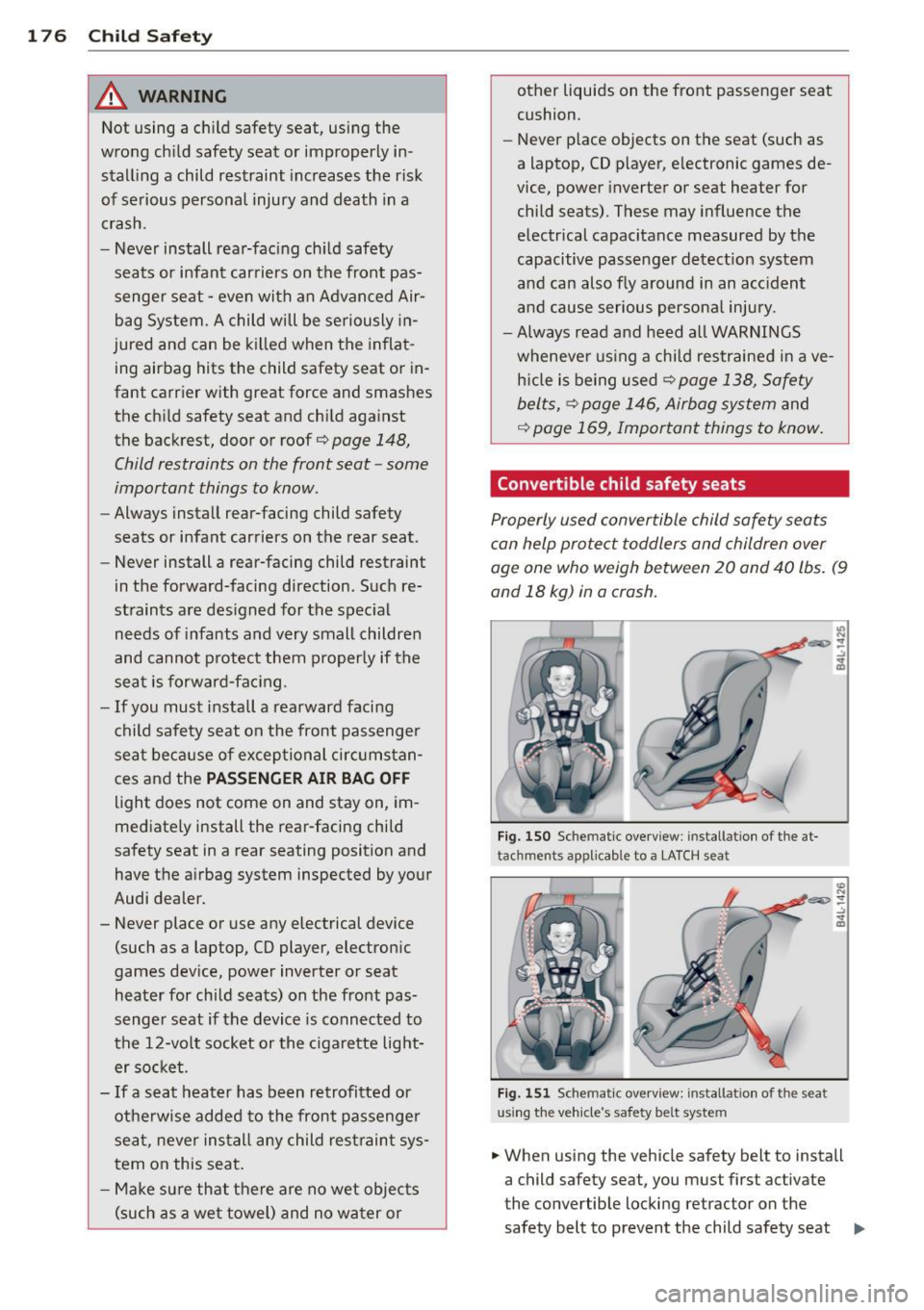
Convertible child safety seats
Properly used convertible child safety seats
can help protect toddlers and children over
age one who weigh between 20 and 40 lbs. (9
and 18 kg) in a crash.
Fig . 150 Sc hema tic overview: installat ion of the at
tachments applicab le to a LATCH seat
Fig. 151 Schemat ic overv iew: inst allation of the seat
u sing the vehicl e's safety belt system
.. When using the vehicle safety belt to install
a child safety seat, you must first activate
the convertib le locking retractor on the
safety belt to prevent the child safety seat ..,_
Page 182 of 302
180 Child Safety
-Always remember that a child leaning
forward, sitting sideways or out of posi
tion in any way during an accident can be
struck by a deploying airbag . This will re
sult in serious personal injury or death .
- If you must install a booster seat on the
front passenger seat because of excep
tional circumstances the
PASSENGER
AIR BAG OFF
light must come on and
stay on, whenever the ignition is switch
ed on.
- If the
PASSENGER AIR BAG OFF light
does not come on and stay on, perform
the checks described¢
page 158, Moni
toring the Advanced Airbag System.
- Take the child restraint off the front pas
senger seat and install it properly at one
of the rear seat positions if the
PASSEN
GER AIR BAG OFF
light does not stay on
whenever the ignition is switched on.
- Always read and heed all WARNINGS
whenever using a child restrained in
ave
hicle is being used¢ page 138, Safety
belts,¢ page 146, Airbag system
and
¢page 169, Important things to know .
Installing a child safety
seat
Securing a child safety seat using a
safety belt
Safety belts for the rear seats and the front
passenger can be locked with the convertible
locking retractor to properly secure child
safety seats.
The safety belts emergency locking retractors
for the rear seats safe ty belts and for the
front passenger's seat safety belt have a con
vertible locking retractor for child restraints.
The safety belt must be locked so that belt
webbing cannot unreel. The retractor can be
activated to lock the safety belt and prevent
the safety belt webbing from loosening up
during normal driving. A child safety seat can
only be properly installed when the safety belt
is locked so that the child and child safety
seat will stay in place. Always
remember: Even though your vehicle is
equipped with an Advanced Airbag system, all
children, especially those 12 years and young
er , should always ride in the back seat proper
ly restrained for their age and si ze.
A WARNING
=
Improperly installed child safety seats in -
crease the risk of serious personal injury
and death in a collision .
- Always make sure that the safety belt re
tractor is locked when installing a child
safety seat. An unlocked safety belt re
tractor cannot hold the child safety seat
in place during normal driving or in a
crash.
- Always buckle the child safety seat firmly
in place even if a child is not sitting in it.
A loose child safety seat can fly around
during a sudden stop or in a collision.
- If the backrest is not securely latched,
the child and the child restraint will be
thrown forward together with the back
rest and will strike parts of the vehicle
interior. The child can be seriously in
jured or killed .
- Never install rear-facing child safety
seats or infant carriers on the front pas
senger seat. A child will be seriously in
jured and can be killed when the passen
ger airbag inflates.
- The inflating airbag will hit the child
safety seat or infant carrier with great
force and will smash the child safety seat and child against the backrest, center
armrest, door or roof.
- Always install rear-facing child safety
seats or infant carriers on the rear seat.
- Forward-facing child safety seats or in
fant carriers installed on the front pas senger's seat may interfere with the de
ployment of the airbag and cause serious
injury to the child.
- It is safer to install a forward-facing
child safety seat on the rear seat.
- Always read and heed all WARNINGS
whenever using a child restrained in ave-
hicle is being used
¢ page 169. Special ..,.
Page 214 of 302
212 Checking and Fill in g
snow blower, etc., be very careful and al
ways observe local and state laws regard ing the use, transportation and storage of
such fuel containers . Make certain the con
tainer meets industry standards (ANSI/
ASTM F852 -86) .
(D Note
Never drive your vehicle until the fuel tank
is completely empty . The irregular supply
of fuel can cause misfiring. Gasoline could
enter the exhaust system and damage the
catalyt ic converter.
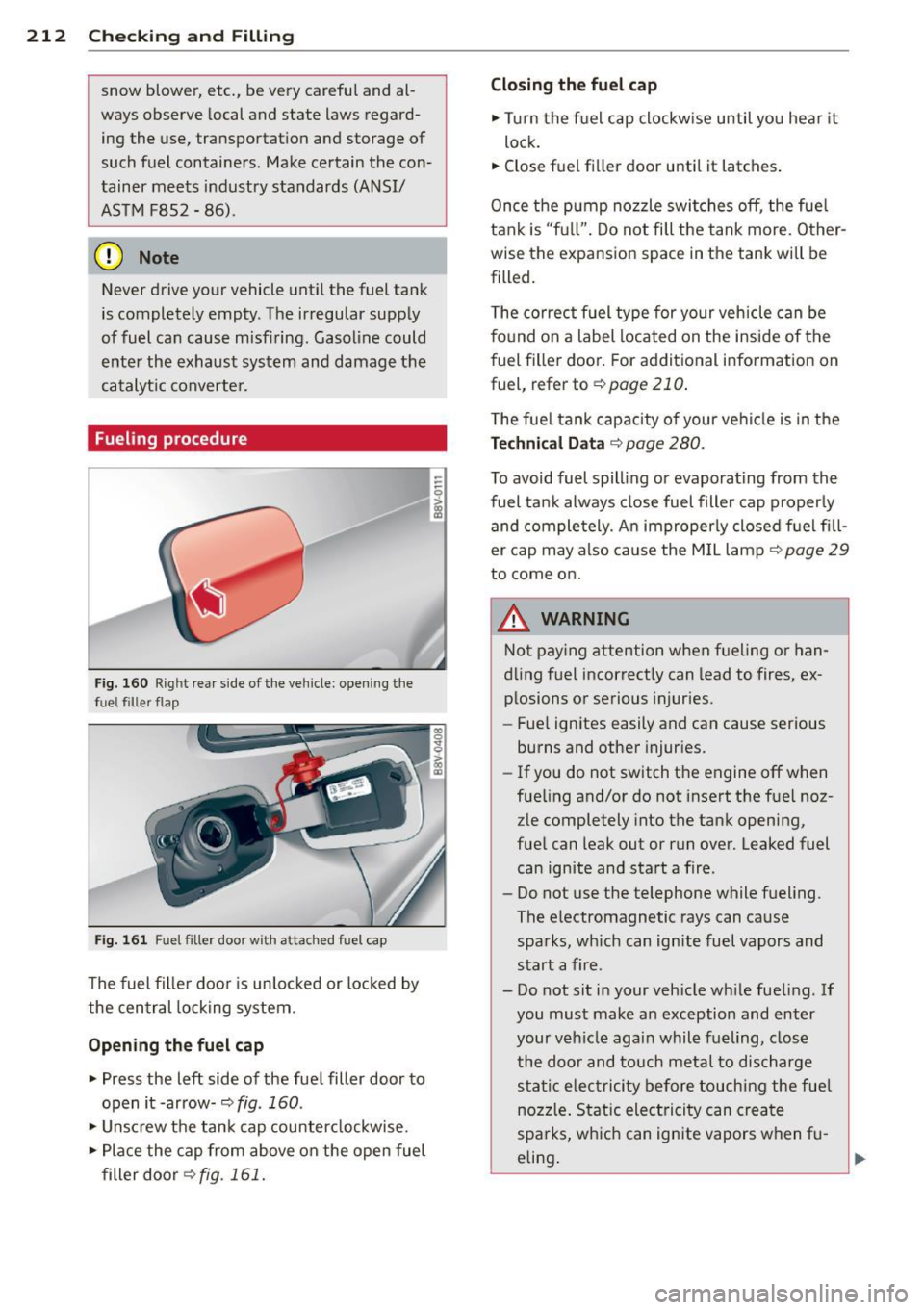
Fueling procedure
Fig. 160 R ig ht rea r side of the veh icle: open ing the
fue l filler f lap
Fig. 161 F u el filler door w ith attached fuel cap
The fuel filler door is unlocked or locked by
the central locking system.
Opening th e fu el cap
.,. Press the left side of the fuel filler door to
open it -arrow-
c::> fig. 160 .
• Unsc rew the tank cap counterclockwise.
• Place the cap from
above on the open fuel
filler door
c::> fig . 161.
Clo sin g th e fu el ca p
.,. Turn the f uel cap clockw ise until you hea r it
lock.
.,. Close f uel fil ler door until it latches .
Once the pump nozzle switches off, the fue l
tank is "fu ll". Do not fill the tank more. Other
wise the expansion space in the tank will be
filled.
The correct fuel type for your vehicle can be
f ound on a label located on the inside of the
fuel filler door. For additional information on
fuel, refer to
c::> page 210 .
The fue l tank capacity of your vehicle is in the
Techni cal D ata c::> page 280.
To avoid fuel spill ing or evaporating from the
fuel tank always close fuel filler cap properly and completely. An improperly closed fuel fi ll
er cap may also cause the M IL lamp
c::> page 29
to come on .
A WARNING
Not paying attention when fueling or han
d ling fuel incorrect ly can lead to fires, ex
plosions or serious injuries.
- Fue l ignites easily and can cause serious
burns and other injuries.
- If you do not switch the engine off when
fue ling and/or do not insert the fuel noz
zle completely into the tank opening ,
fuel can leak out or run over. Leaked fuel can ignite and start a fire .
- Do not use the telephone while fueling.
The electromagnetic rays can cause
sparks, wh ich can ignite fuel vapors and
start a fire.
- Do not sit in your vehicle while fueling . If
you must make an exception and enter
your veh icle again while fueling, close
the door and touch metal to discharge
s tatic electricity before touching the fue l
nozz le . Static electricity can create
sparks, wh ich can ignite vapors when fu-
eling . .,._
Page 215 of 302
....,
N
r--. > co
rl I.O
"' rl
"' rl
-Do not smoke or have an open flame in
the area when fueling your vehicle or fill
ing a fuel container because this
increases the risk of an explosion .
- For your safety, carrying fuel containers
in your vehicle is recommended. Wheth
er full or empty, the container can leak
and cause a fire in the event of an acci
dent .
- If you must make an exception and
transport a fuel container, note the fol
lowing:
- Never f ill the fuel container with fuel
while it is in or on the vehicle. Static
electricity is discharged when filling
which can cause the fuel vapors to ig
nite and increases the risk of an explo
s10n .
- Always place a fuel container on the
ground before filling .
- Always hold the fuel nozzle completely
in the fuel container when filling.
- If the fuel container is made of metal,
the fuel nozzle must always be in con
tact with the container when filling it
with fuel. This prevents static electrici
ty from discharg ing.
- Never sp ill fuel in the vehicle or the
luggage compartment. Evaporated fuel
is exp losive and increases the risk of
serious injury or death .
- Follow legal requirements when using,
storing and transporting fuel contain
ers.
- Make sure the fuel container conforms
to indust ry standards (ANSI/ASTM
F852-86).
(D Note
-Remove spilled fuel from vehicle paint
immediately, because it can damage
paint.
- Never drive until the fuel tank is com
pletely empty. The irregular supply of
fuel that results from that can cause the
engine to misfire. Uncombusted fuel will
enter the exhaust system and increase
Checking and Filling 213
the risk of damage to the catalytic con
verter.
@ For the sake of the environment
- If the fuel nozzle is used correctly , it will
indicate that the tank is full the first
time it switches off automatically. Do
not try to add more fuel, because it can
spill over. Also, the expansion space in
the tank will fill , which can result in fuel
spilling out when it becomes warm and
polluting the environment.
(D Tips
- If the engine is running while fueling, va
pors can escape or the fuel can spill over .
Because of this, the fuel nozzle switches
off before the tank is full.
- Do not fuel the vehicle when the ign ition
is switched on . Otherwise, the fuel
gauge may not show the correct level af
ter fueling the vehicle .
- The fuel filler door on your vehicle does
not lock when you lock the vehicle from
the inside .
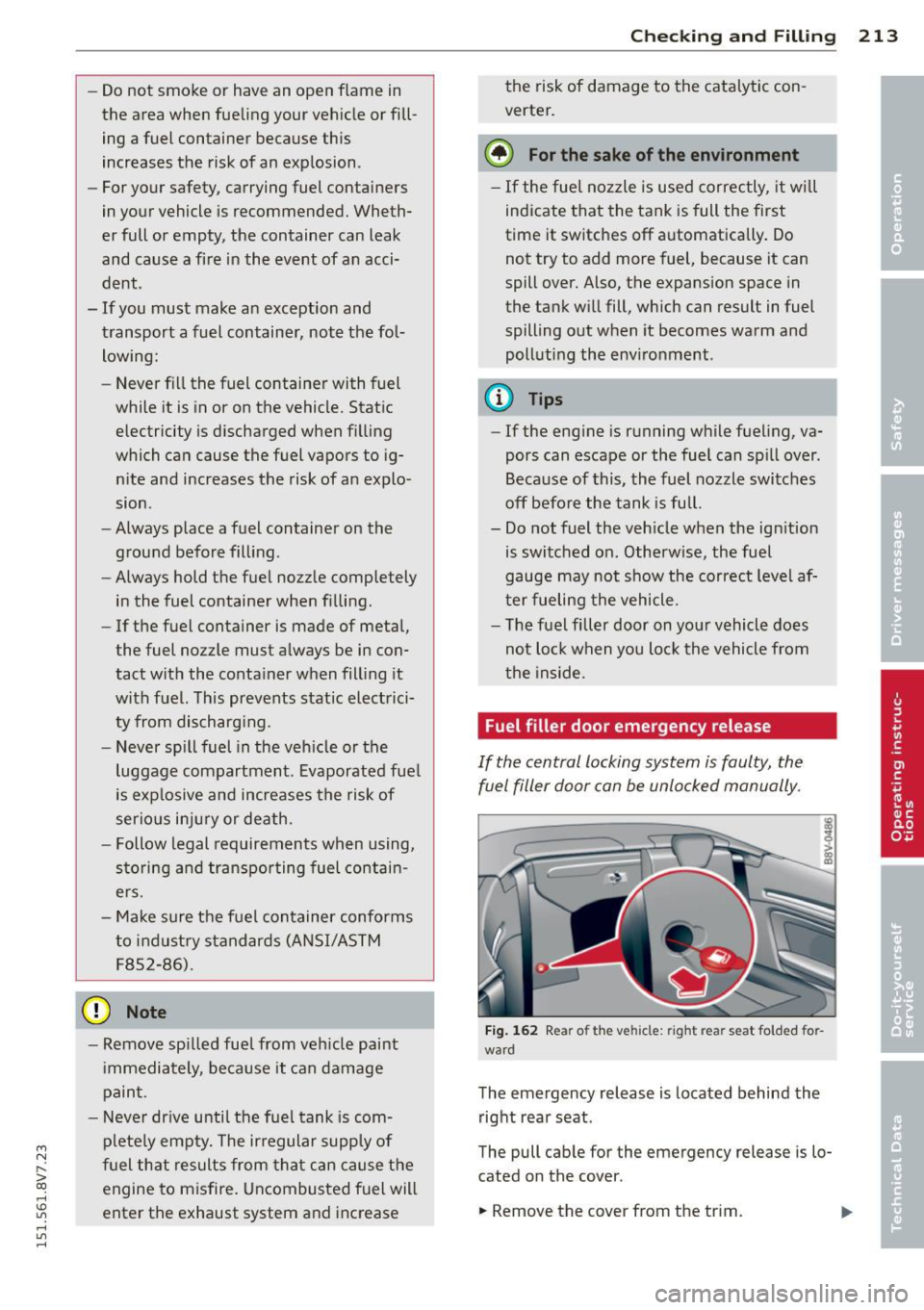
Fuel filler door emergency release
If the central locking system is faulty, the
fuel filler door can be unlocked manually .
Fig. 162 Rear of the vehi cle: ri ght rea r seat folded for
wa rd
The emergency release is located behind the
right rear seat .
The pull cable for the emergency release is lo
cated on the cover .
.,. Remove the cover from the trim.
Page 272 of 302
2 70 Fuses and bulbs
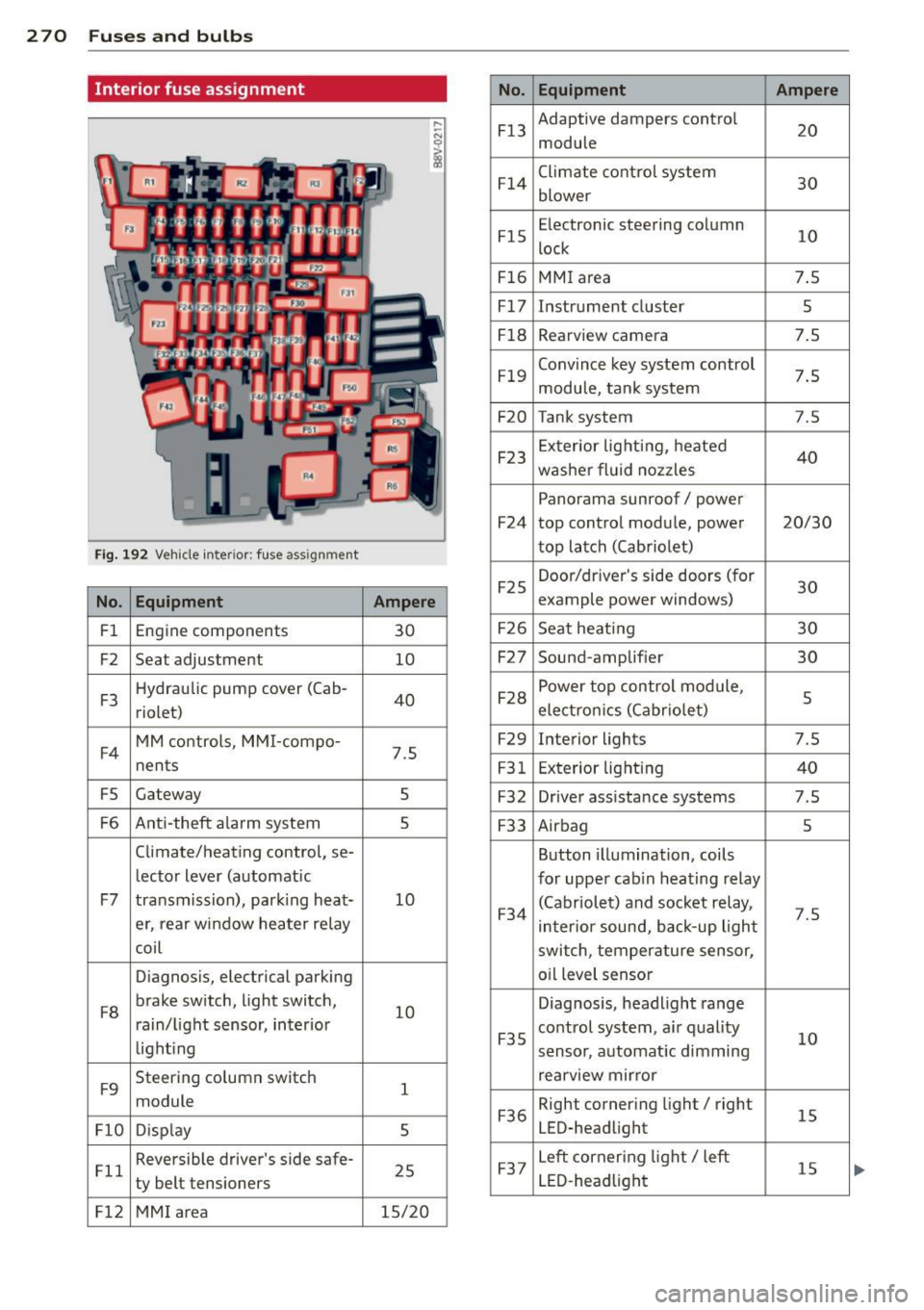
Interior fuse assignment
No. Equipment Ampere
Fl 3 Adaptive dampers contro
l
20
module
Fl4 Climate
control system
30
blower
Fl S E
lectronic steering column
10
lock
Fl6 MM I area 7.5
Fl7 Instrument cluster 5
Fl8 Rearview camera
7.5
F l9 Convince key
system control
7.5
module, tank system
F20 Tank system
7.5
F23 E
xterior lighti ng, heated
40
washe r fl ui d nozzles
Panorama sunroof/ power
F24 top control module, power 20/30
Fig. 192 Vehicle inter ior : fuse assignment top latch (Cabriolet)
No. Equipment Ampere
F25 Door/dr
iver's side doors (for
30
example power windows)
Fl Engine components 30 F26 Seat heat
ing 30
F2 Seat adjustment 10 F27
Sound-amplif
ier
30
F3 Hydraulic pump
cover (Cab-
40
riolet) F28
Power top control module,
5
elect ro ni cs (Cabr io let)
F4 M
M co ntrols, M MI-compo-
7.5
nents F29
Inte
rior lights
7.5
F3 1 E xterior lighting
40
F5 Gateway
5
F32 Driver ass istance systems 7.5
F 6 Anti-theft a
larm system
s F33 Airbag 5
Climate/heating control, se-
Button illumination, coils
lector lever (automatic
for upper cab in heating relay
F7 transmission), park ing heat- 10
er, rear window heater re lay F34 (Cabriolet) and socket relay,
7.5
in ter ior sound, back-up light
coil switch, temperature sensor,
Diagnosis, electrical parking oil level sensor
F 8 brake
switch, light switch,
10
rain/ light sensor, interior
light ing Diagnosis, headlight range
F35 co
ntrol system, a ir quality
10
sensor, a utomat ic dimming
F9 Steering column
switch
1
module
Fl0 D isp lay 5 rearview mir
ror
F36 Right
corner ing light/ right
15
LED-headlight
Fll Reversible driver's
side safe-
25
ty belt tensioners F37
Left corner
ing light/ left
15
L E D- headlight
Fl 2 M MI area 15/20
Page 273 of 302
....,
N
" > co
rl I.O
"' rl
"' rl
No. Equipment Ampere
Door/front passenger's side
F39 doors (for examp le, power
30
windows)
F40 Sockets 20
F41 Reversible front
passenger's
25
side safety belt tensioners
F42 Central locking components,
40
windshield washer system
F43 Headlights, light ing 30
F44 all wheel drive
15
F49 Starte
r, clutch sensor, head-
5
light re lay coil
FS3 Rear window defogger 30
The power seats* are protected v ia
ci rc uit
b reaker s
that automatically sw itch on after a
few seconds after the overload has been re
duced.
(D Tips
Note that the following table was accurate
at the time of print ing and is subject to
change.
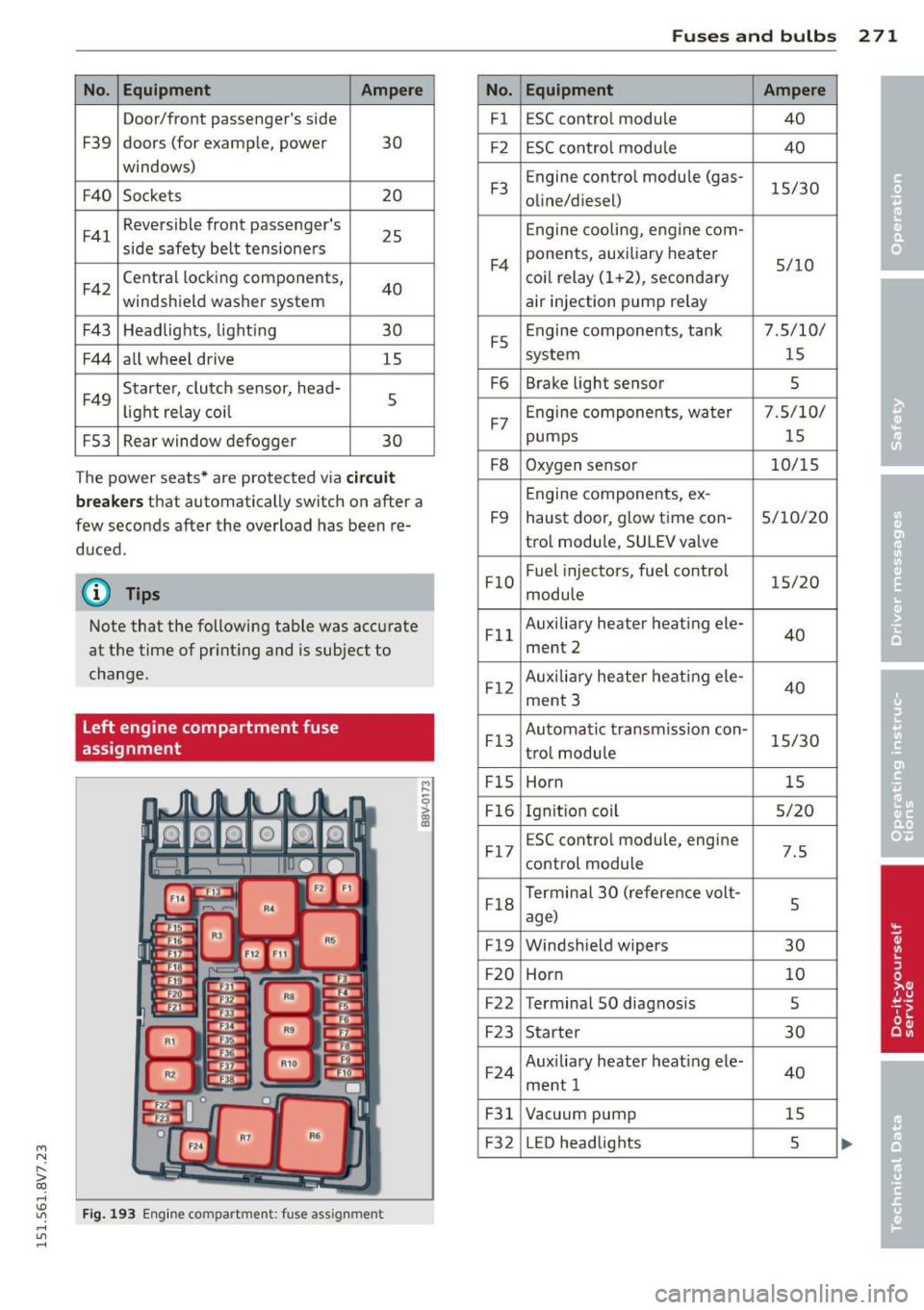
Left engine compartment fuse
assignment
F ig. 193 Engine compartme nt: fuse assignment
No.
Fl
F2
F3
F4
F5
F6
F7
F8
F9
FlO
F ll
F12
Fl3
FlS
F l 6
F l 7
Fl8
F19
F20
F22
F23
F24
F3 1
F32
Fu se s and bulb s 2 71
Equipment Ampere
E5C contro l modu le 40
ESC contro l modu le 40
Engine control module (gas-
15/30
oli ne/d iesel)
Engine cooling, eng ine com-
ponents, auxiliary heater 5/10
coi l relay (1+2), secondary
air injection pump relay
Engine components, tank 7.5/10/
system 15
Brake light sensor 5
Engine components, wa ter 7.5/10/
pumps 15
Oxygen sensor
10/15
Engine compone nts, ex-
haust door, glow time con- 5/10/20
tro l module, SU LEV valve
Fuel injectors, fuel control
15/20
module
Auxiliary heater heating ele- 40
ment 2
Auxilia ry heater heat ing ele-
40
ment 3
Automat ic transmiss ion con-
15/30
t ro l module
Horn 15
Ignit ion coil 5/20
ESC contro l module, engine
7.5
control module
T ermina l 30 (reference volt-
5
age)
Windsh ie ld wipers
30
Horn 10
Termina l 50 diagnosis
5
Starter 30
Auxilia ry heater heat ing ele-
40
ment 1
Vacuum pump 15
L E D head lights 5
Page 290 of 302
288 Index
Centra l indicator light .... .. .. .. .... . . 1 3
Central locking ............. ... .. .... 3 1
Ce ntr al loc king switch ..... .. .. .... .. 35
Conven ience key . . . . . . . . . . . . . . . . . . . . 34
Emergency locking ........ .. .. .. .. .. 37
Folding the exterior mirrors .. .... .. .. 36
Luggage compartment lid .. .. .. .... . . 38
p . d ower win ows ........... ... .... . . 39
Remote control key ....... .. .. .. .. .. 33
Safety central locking . . . . . . . . . . . . . . . 3 7
Setting .. ................. ...... ..
36
Certification ............. ... .. .... . 285
Changing a wheel ................... 263
Changing engine oil ........ .. .. .. .. . 219
Checking
Tire pressure ..... ......... ... .... .
240
Child restra ints
Danger of us ing c hild restra ints in the
front seat . . . . . . . . . . . . . . . . . . . . . . . .
148
Where can I get addit ional information
about child restraints and their use? ..
187
Ch ild restra int system anchors ... .. ... 183
Child safety .... ............. .. .... . 169
Convertible lo cking retractor .. .. .. ... 180
Important safety instructions for using
ch ild safety seats .............. ....
173
Important things to know when driving
with ch ildren .....................
169
Tether anchors .................... 185
Tether straps . ........... .... .... . 185
Child safety lock
Power wi ndows . . . . . . . . . . . . . . . . . . . .
38
Ch ild safety seats ............ .. .. .. . 175
Booster seats ............ .. .. .... . 178
Convertible child seats .......... .. . 176
Convertible locking retractor . . . . . . . . . 180
H ow do I properly install a child safety
seat in my vehicle? ........ .. .. .. .. .
173
Infant seats ...................... 175
Install ing .. .. ... ..... ..... .. .. .. . 180
Installing a child restraint using the
L ATCH system .... ..... ... .. .. .... .
185
LATCH system .. . ...... ... .. .. .... . 185
Lower anchorages ............ .... . 184
Mount ing and releasing the anchorage
hook .. ... ................... ... .
185
Safety instructions . . . . . . . . . . . . . . . . . 173
Unused safety belts on the rea r seat .. 17 5 Cleaning
Cleaning/removing ice from windows
.. .
Cleaning Alcantara . ... .......... .. . .
204
206
207
Cleaning artificial leather ......... .... 20 7
Cleaning carbon parts . . . . . . . . . . 206, 207
Cleaning contro ls .. ... .. ..... ... .. .. 207
Cleaning decorative parts/trim ........ 206
Cleaning displays .. ............. .... 207
Cleaning exhaust tail pipes .... ... .. .. 205
Cleaning plastic pa rts ............... . 206
Cleaning rims ... .. ... .. ..... ... .. .. 205
Cleaning seat covers ............. .. .. 20 7
Cleaning textiles . .. .......... ....... 207
Cleaning the tail lights . .. ..... ... .. .. 205
Cleaning th e wind deflector ........... 206
Climate control system
Key recogni tion . . . . . . . . . . . . . . . . . . . .
70
Climate control system (automatic)
Adjusting air vents . . . . . . . . . . . . . .
73 , 74
Air distrib ution, air vents ..... ... .. .. . 73
Audi drive select .. ... ...... .... .. .. 107
AUTO (climate control system) ....... . 72
B lower ....... .................... 73
Controls . . . . . . . . . . . . . . . . . . . . . . . . . . 72
Defrost ing the windsh ie ld .......... .. 73
Rea r window defogger .......... .... . 74
Recirc ulat ion mode ............ .... . 73
Setting the temperatu re . . . . . . . . . . . . . 73
synchronizing .... .. ... ..... ... .. .. . 73
Climate control system (manual)
Adjusting air vents ... .......... .
71, 7 4
Adjus ting the temperature ........... 71
Air distrib ution, air vents ...... .... .. . 71
B lowe r ... .... .. .. ... ..... ... .. .. . 71
Defrosting windows ..... .... ... .. .. . 71
Operation . . . . . . . . . . . . . . . . . . . . . . . . . 71
Rear window defogger .......... .. .. . 74
Recirculation mode ............ .... . 72
Clock . ... .. .... .. .. ... ..... ... .. .. . 10
Clos ing
Hood . .... .... .. ............. ....
216
Windows . .. .. .. .... ......... .... . 38
Closing/opening
by remote control . . . . . . . . . . . . . . . . . . 33
with the central locking switch ..... .. .
35
with the conven ience key . . . . . . . . . . . . . 34
with the door lock ........... .... .. . 35
Page 291 of 302
M N ,....
> co ,...., \!) 1.1'1 ,...., 1.1'1 ,....,
Cockpit (overview) . . . . . . . . . . . . . . . . . . . . 8
Cold tire inflation pressure ............ 235
Coming home ...... ..... .. .... .. .. .. 51
Compartments ............ .... .. .. .. 64
Compass in the mirror ........... .... . 57
Compliance .. .. .............. ... ... 285
Consumer Information . . . . . . . . . . 134, 282
Consumption (fuel) ........ .. .. .. .. .. 27
Contacting NH TSA ............ ... .. . 134
Convenience key Emergency operation . . . . . . . . . . . . . . . . 80
Indicator light ........... .. .. .. .. .. 81
Starting the engine (START ENGINE ST OP
button) .... .. .............. ... .... 78
Stopping the engine (S TART ENGINE
STOP button) . . . . . . . . . . . . . . . . . . . . . . 79
Switching the ignition on .. .. .. .. .. .. 78
unlocking/locking ........ .. .. .. .. .. 34
Convenience opening/closing
Convertible child safety seats
Convertible locking retractor .
. .. .. .. .. 39
176
Activating .. ................. .. .. . 182
Deactivating . . . . . . . . . . . . . . . . . . . . . . 182
Using to secure a child safety seat l80, 182
Coolant
refer to Engine coolant ....... ... .. . 220
Cool ing mode (automatic climate control
system) . .. .. ................. .. .. .. 72
Cooling mode (manual climate control sys-
tem) .. .. .. .. .. ........ ... .. .. .. .. .. 71
Cooling system Adding coolant ........... .... .. .. . 221
Coolant level checking ..... .. .. .. .. . 221
Coolant temperature indicator .. ... ... 12
Indicator light ... .. ...... .. .. .. .. .. 19
Cornering light . ........... .. .. .. .. .. 50
C rash data recorde r (EDR) 188
Cruise control system Changing speed . . . . . . . . . . . . . . . . . . . . 86
Description ............... ... ... ... 85
Preselecting speed . . . . . . . . . . . . . . . . . . 86
Sw itching off . ........... .. .. .. .. .. 86
switch ing on ............. .... .. .. .. 85
Cup holders . . . . . . . . . . . . . . . . . . . . . . . . . 64
Current consumption . . . . . . . . . . . . . 26, 27
Index 289
D
Data recorder . . . . . . . . . . . . . . . . . 188, 194
Date display . . . . . . . . . . . . . . . . . . . . . . . . 10
Daytime running lights ........... .... . 49
Decla rat ion of compliance
Adaptive cruise control . . . . . . . . . . . . . 28S
Audi side assist .... .............. . 285
Cell phone package . . . . . . . . . . . . . . . . 285
Convenience key .... .............. . 285
Electronic immobilizer .......... .. .. 285
Homelink universal remote control . .. 285
Remote control key . . . . . . . . . . . . . . . . 285
Defective light bulb warning
Indicator light ... .. ................ 24
Defrost ing (windshield)
automat ic climate control system . . . . . 73
manual climate control system ........ 71
DEF (instrument cluster) ... .. .... .... . 11
Deluxe automatic climate control
refer to Climate control system (auto-
ma tic) ...... .. .. .. . ............... 72
Determining correct load limit ....... . 245
Digital compass . .. .. . ............ .. . 57
Dimensions . .. .. .. ................. 280
D imming the rearv iew mirror ..... .. .. . 56
Distance ......... .. ..... ........... 27
Door/rear lid warning 26
Door contact sw itch . . . . . . . . . . . . . . . . . . 52
Driver information system .......... .. . 26
CD/radio display .. .. . .. .. .. .... .... . 26
Door/rear lid warning ............... 26
Driver messages . . . . . . . . . . . . . . . . . . . . 13
Efficiency program . . . . . . . . . . . . . . . . . . 28
Ind icator lights .. .... ......... .... . 13
On-board computer ............ .. .. . 27
Outside temperature display . . . . . . . . . . 26
Service interval display . . . . . . . . . . . . . . 13
Using the mu ltifunction steering wheel . 26
Driver seating position ........... .... 127
Drive select
refer to Audi drive select ............ 107
Driving safely 126
Driving through water .. ......... .. .. 197
Driving time
Dust filter 27
refer to Pollutant
filter ............ .. 70
•
•