oil AUDI A3 CABRIOLET 2015 Owner's Manual
[x] Cancel search | Manufacturer: AUDI, Model Year: 2015, Model line: A3 CABRIOLET, Model: AUDI A3 CABRIOLET 2015Pages: 302, PDF Size: 73.83 MB
Page 224 of 302
222 Checking and Filling
After you switch the engine off, the auxiliary
fan can continue running for up to 10 minutes
- even with the ignition off. It can even switch
on again later by itself
c:> .&. , if
- the temperature of the engine coolant rises
due to the heat build-up from the engine in
the engine compartment, or
- the engine compartment heats up beca use
the vehicle is parked in intense sunlight.
A WARNING
- To reduce the risk of personal injury
nev
er touch the radiator fan.
- The auxiliary electr ic fan is temperature
contro lled and can switch on sudden ly
even when the engine is not running.
- The auxiliary radiator fan switches on au tomatically when the engine coolant
reaches a certain temperature and will
continue to run until the coolant temper
ature drops.
Brake fluid
Checking brake fluid level
N
N
;;;
" 00 co
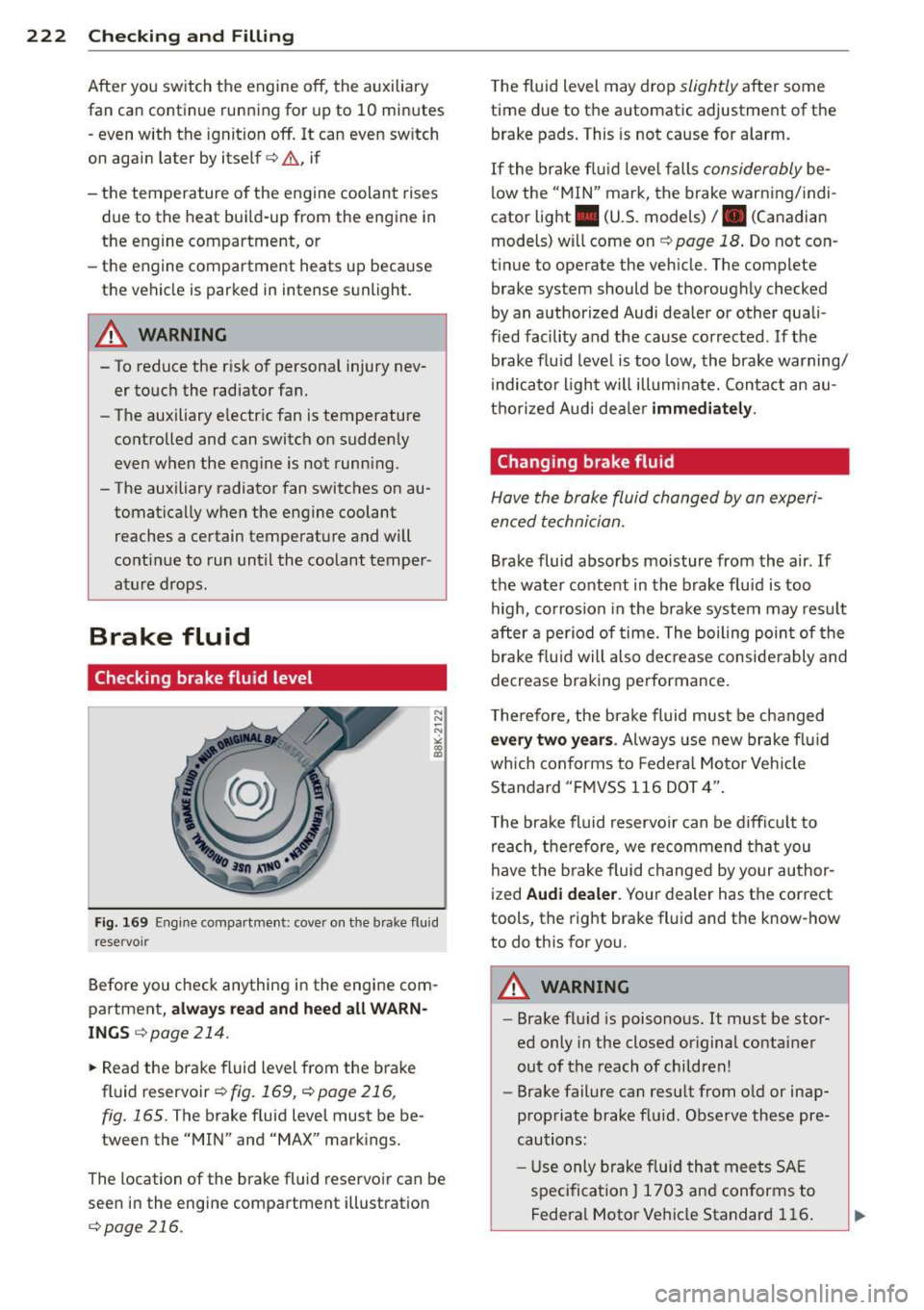
Fig . 169 Engine compartment : cove r on the brake flu id
r eservoir
Before you check anything in the engine com
partment,
always read and heed all WARN ·
INGS c:> page 214.
.. Read the brake fluid level from the brake
fluid reservoir
c:> fig.169, c:>poge216 ,
fig. 165.
The brake f luid level must be be
tween the "MIN" and "MAX" markings.
The location of the brake fluid reservoir can be
seen in the engine compartment illustration
c:> page 216 .
The fluid level may drop slightly after some
time due to the automatic adjustment of the
brake pads . This is not cause for a larm.
If the brake f luid level falls
considerably be
low the "MIN" mark, the brake warning/indi
cator light . (U.S. models)
I. (Canad ian
models) will come on
c:> page 18 . Do not con
tinue to operate the vehicle. The complete brake system should be thoroughly checked
by an authorized Audi dealer or other quali
fied facility and the cause corrected. If the
brake fluid level is too low, the brake warning/
indicator ligh t will illuminate. Contact an au
thorized Audi dea ler
immediately.
Changing brake fluid
Have the broke fluid changed by an experi
enced technician.
Brake fluid absorbs moisture from the air. If
the water content in the brake f luid is too
high, corrosion in the brake system may result
after a period of time. The boiling point of the
brake fluid will also decrease considerably and
decrease braking performance.
T he refo re, the brake fluid must be changed
every two years. Always use new brake fluid
wh ich conforms to Federal Motor Vehicle
Standard "FMVSS 116 DOT 4".
T he brake fluid reservoir can be difficult to
reach, therefore, we recommend that you
have the b rake fluid changed by your author
ized
Audi dealer. Your dealer has the correct
tools, the right brake fluid and the know-how
to do this for you .
A WARNING
---Brake flu id is poisonous. It must be stor
ed only in the closed or iginal container
out of the reach of children!
- Brake failure can resu lt from o ld or inap·
propriate brake flu id. Observe these pre·
cautions:
- Us e only brake fluid that meets SAE
specification
J 1703 and conforms to
Federa l Motor Vehicle Standard 116.
Page 230 of 302
228 Tires an d whee ls
Tires and wheels
Tires
General notes
Tires may be the least appreci
ated and most abused parts of
a motor vehicle.
Ti res may be the least appreci
ated and most abused parts of
a motor vehicle. Tires are, how
ever, one of the most important
parts of a vehicle, particularly
considering the comparatively
small patch of r ubber on each
tire that assures that all-impor
tant contact between you, your
vehicle and the road.
Maintaining the co rrect tire
p ressure, making sure that your
vehicle and its tires do not have
to carry more we ight than they
can safe ly handle, avoiding
damage from road hazards and
regularly inspecting tires for
damage including cuts, s lashes
irregular wear and overall con
d ition are the most important
things that you can do to help
avoid sudden tire failure inc lud
ing tread separation and blow
outs.
Avoiding damage
If you have to drive over a curb
or similar obstacle, drive very
slowly and as close as possible
at a right angle to the curb.
Always keep chemicals includ
ing grease, oil, gasoline and
brake fluid off the tires.
Inspect the tires regularly for
damage (cuts, cracks or blis
ters, etc.). Remove any foreign
bodies embedded in the treads.
Storing tires
Mark tires when you remove
them to indicate the direction
of rotation. This ensures you to be able to mount them correct
ly when you reinstall them.
When removed, the wheels or
tires should be stored in a cool,
dry and preferably dark p lace.
Store tires in a vertical position if they are not mounted on
rims, in a horizontal position if
they are mounted on rims.
New tires
New tires have to be broken in
¢ &.
The tread depth of new tires
may vary, according to the type .,.
Page 233 of 302
M N
" > co ,...., \!) 1.1'1 ,...., 1.1'1 ,....,
Bead
means the part of the tire that
is made of steel wires, wrapped
or reinforced by ply cords and
that is shaped to fit the rim.
Bead separation
means a breakdown of the bond
between components in the
bead.
Cord
means the strands forming the
plies in the tire .
Cold tire inflation pressure
means the tire pressure recom
mended by the vehicle manu
facturer for a tire of a designat
ed size that has not been driven
for more than a couple of miles (kilometers) at low speeds in
the three hour period before
the tire pressure is measured or
adjusted.
Curb weight
means the weight of a motor
vehicle with standard equip
ment including the maximum
capacity of fuel, oil, and cool
ant, air conditioning and addi
tional weight of optional equip
ment.
Tires and wheels 231
Extra load tire
means a tire design to operate
at higher loads and at higher inflation pressures than the
corresponding standard tire. Extra load tires may be identi
fied as "XL", "xl", "EXTRA
LOAD", or "RF" on the sidewall.
Gross Axle Weight Rating ("GAWR")
means the load-carrying capaci
ty of a single axle system,
measured at the tire-ground in
terfaces.
Gross Vehicle Weight Rating ("GVWR")
means the maximum total
loaded weight of the vehicle.
Groove
means the space between two
adjacent tread ribs.
Load rating (code)
means the maximum load that
a tire is rated to carry for a giv
en inflation pressure. You may
not find this information on all
tires because it is not required by law.
' •
•
' •
Page 245 of 302
M N
" > co ,...., \!) 1.1'1 ,...., 1.1'1 ,....,
tire failure and loss of
control.
-Excessive speed and/over loading can cause heat
build -up, sudden tire failure
and loss of control.
-If the tire pressure is too low or too high, the tires
will wear prematurely and
the vehicle will not handle
well.
-If the tire is not flat and you do not have to change a
wheel immediately, drive at
reduced speed to the near
est service station to check
the tire pressure and add air as required.
(D Note
Driving without valve stem
caps can cause damage to
the tire valves. To prevent
this, always make sure that
factory installed valve stem caps on all wheels are secure
ly mounted on the valve.
@ For the sake of the environment
Underinflated tires will also
increase the fuel consump
tion.
Tires and wheels 243
Tires and vehicle load limits
'
There are limits to the amount of load or weight that any vehi
cle and any tire can carry. Ave
hicle that is overloaded will not
handle well and is more diffi
cult to stop. Overloading can
not only lead to loss of vehicle
control, but can also damage important parts of the vehicle
and can lead to sudden tire fail
ure, including a blowout and
sudden deflation that can cause
the vehicle to crash.
Your safety and that of your passengers also depends on
making sure that load limits are
not exceeded. Vehicle load in
cludes everybody and every
thing in and on the vehicle .
These load limits are technical ly referred to as the vehicle's
Gross Vehicle Weight Rating
("GVWR").
The "GVWR" includes the
weight of the basic vehicle, all
factory installed accessories, a
full tank of fuel, oil, coolant and other fluids plus maximum ""
' •
•
' •
Page 250 of 302
248 Tires and wheels
A WARNING
Sudden tire failure can lead
to loss of control, a crash and serious personal injury!
-Never drive a vehicle when the tread on any tire is worn down to the wear indica
tors.
-Worn tires are a safety haz
ard, they do not grip well on
wet roads and increase your risk of "hydroplaning" and
loss of control.
-Always keep chemicals that
can cause tire damage, such
as grease, oil, gasoline and brake fluid away from tires.
-Tires age even if they are
not being used and can fail
suddenly, especially at high
speeds. Tires that are more
than 6 years old can only be used in an emergency and
then with special care and at lower speeds.
-Never mount used tires on your vehicle if you are not sure of their "previous histo
ry." Old used tires may have
been damaged even though
the damage cannot be seen
that can lead to sudden tire
-failure and loss of vehicle control.
New tires and replacing
tires and wheels
New tires and wheels have to
be broken in.
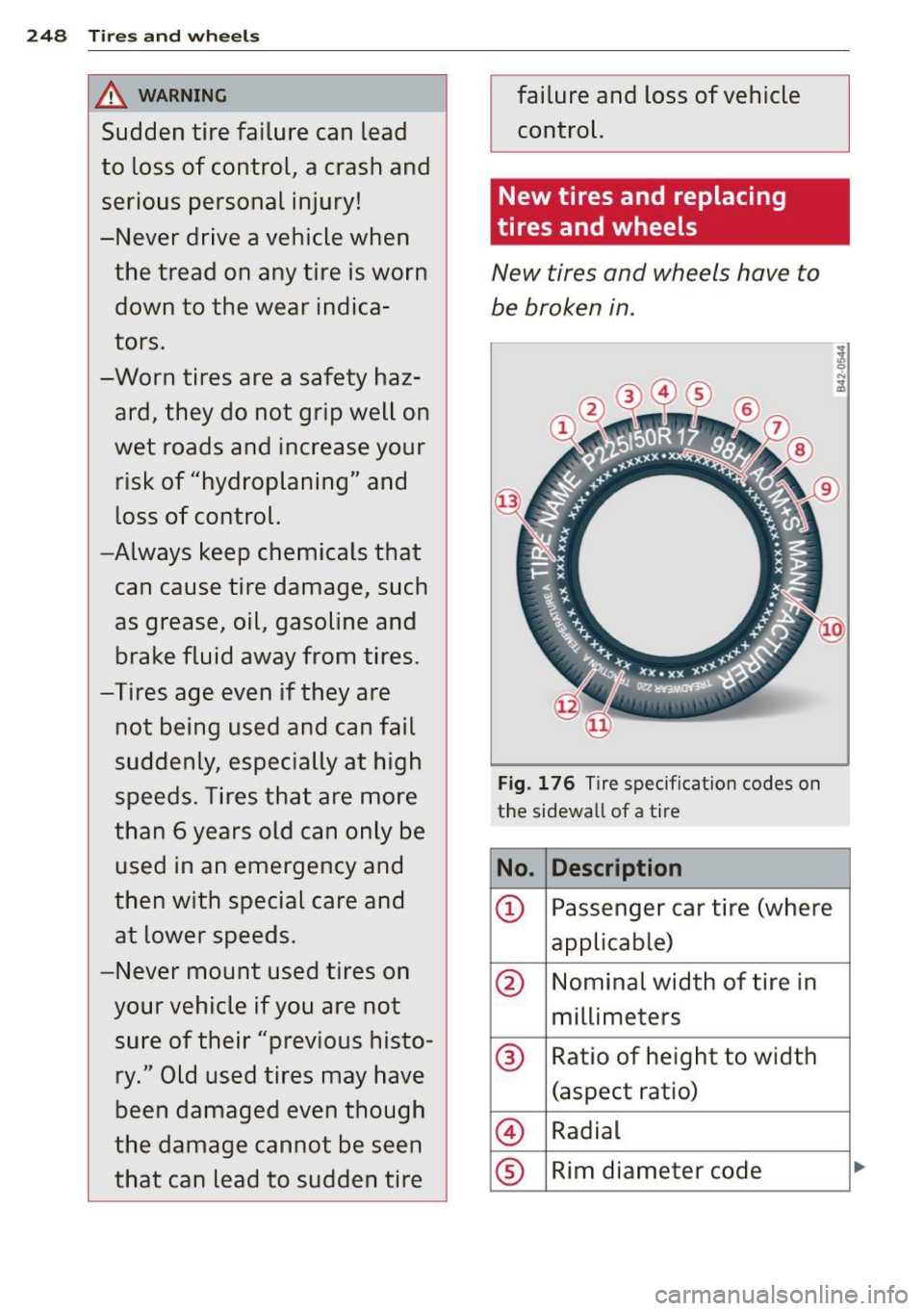
Fig. 176 Tire specification codes on
the sidewall of a tire
No. Description
CD Passenger car tire (where
applicable)
@ Nominal width of tire in
millimeters
® Ratio of height to width
(aspect ratio)
@ Radial
® Rim diameter code
Page 259 of 302
M N ,....
> co ,...., \!) 1.1'1 ,...., 1.1'1 ,....,
In certain circumstances, you may not use
wheel bo lts from a different vehicle -
even if it
i s the same mode l
Qpage 284.
A WARNING
Improperly tightened or maintained wheel
bolts can become loose caus ing loss of
control, a collision and ser ious personal in
jury .
- Always keep the wheel bolts and the
threads in the wheel hubs clean so the
wheel bolts can turn easily and be prop
erly t ightened.
- Never grease or oil the wheel bolts and
the threads in the wheel hubs. They can
become loose w hile d riving if greased or
o iled,
even if tightened to the spec ified
torq ue.
- Only use wheel bo lts that belong to the
rim being ins talled.
- Never use different whee ls bolts on your
vehicle .
- Always maintain the correct tightening
torque fo r the wheel bolts to reduce the
risk of a wheel loss. If the tigh teni ng tor
que of the wheel bolts is too low, they
can loosen and come out when the vehi
cle is moving . If the tightening torque is
too high, the whee l bolts and threads
can be damaged and the wheel ca n be
come loose .
(D Note
The specified torque for the wheel bo lts is
90 ft lb (120 Nm) w ith a tolerance of
± 7,4 ft lb(± 10 Nm). Torque whee l bolts
diagonally. After changing a wheel, the
torque must be checked as soon as possi
b le with a torque wrench -prefe rably by an
author ized Audi dealer or qualified wo rk
shop.
Low aspect ratio tires
Your Audi is factory-equipped with low aspect
ratio tires . These tires have been thorough ly
tested and been selected spec ifically for your
model for the ir superb performance, road feel
Tire s an d wheel s 257
and handling under a variety o f driving condi
tions. Ask your authorized A udi dealer for
more details .
T he low aspec t ratio of these tires is ind icate d
by a numera l of
55 or le ss in the tire's size
designation. The numera l represents the ratio
of the t ire's sidewa ll height in relation to its
tread width expressed in percentage.
Conven
tiona l tires have a he ight/w idth rat io of 60 or
more .
The performance of low-a spect-ratio tire s is
particularl y sens it iv e to improper inflation
pressure. It is therefore important that low
a spect ratio tir es are inflated to the specified
pre ssure and that the inflation pr essure i s
regularly checked and ma intain ed . Tire pr es
s ure s should be checked at lea st on ce a
month and alway s bef ore a long trip
~ page 240 , Checking tire pressure .
A Word about Low Aspect Ratio and High
Performance Ti res
Hig h pe rformance tires are des igned for bet
ter performance and handling in warm cli
mates. When driving in cold, snowy or icy
weather, you sho uld equ ip your vehicle w it h
four all-season or winter tires, which
offer
better traction under those condit ions. We
suggest you use the Audi recommended win
te r or a ll-season tires specified for you r Audi.
High performance tires a lso have a lower as
pect ratio that aids performance and han
dling . Driving over rough or damaged road
surfaces, as well as debr is, cu rbs and other
obstacles can cause serious damage to
whee ls, tires, vehicle body, and suspens ion
parts . B e carefu l to avo id road hazards and re
du ce your speed , espec ia lly if your vehicle is
equipped wi th low prof ile tires .
Please a lso remember when making your se
lection that, wh ile these tires deliver respon
s ive handling, t hey m ay ride less comfo rtably
and make more noise than o thers . Finally,
these tires may wear more quickly than other
c h oices.
IJJ>
•
•
•
Page 272 of 302
2 70 Fuses and bulbs
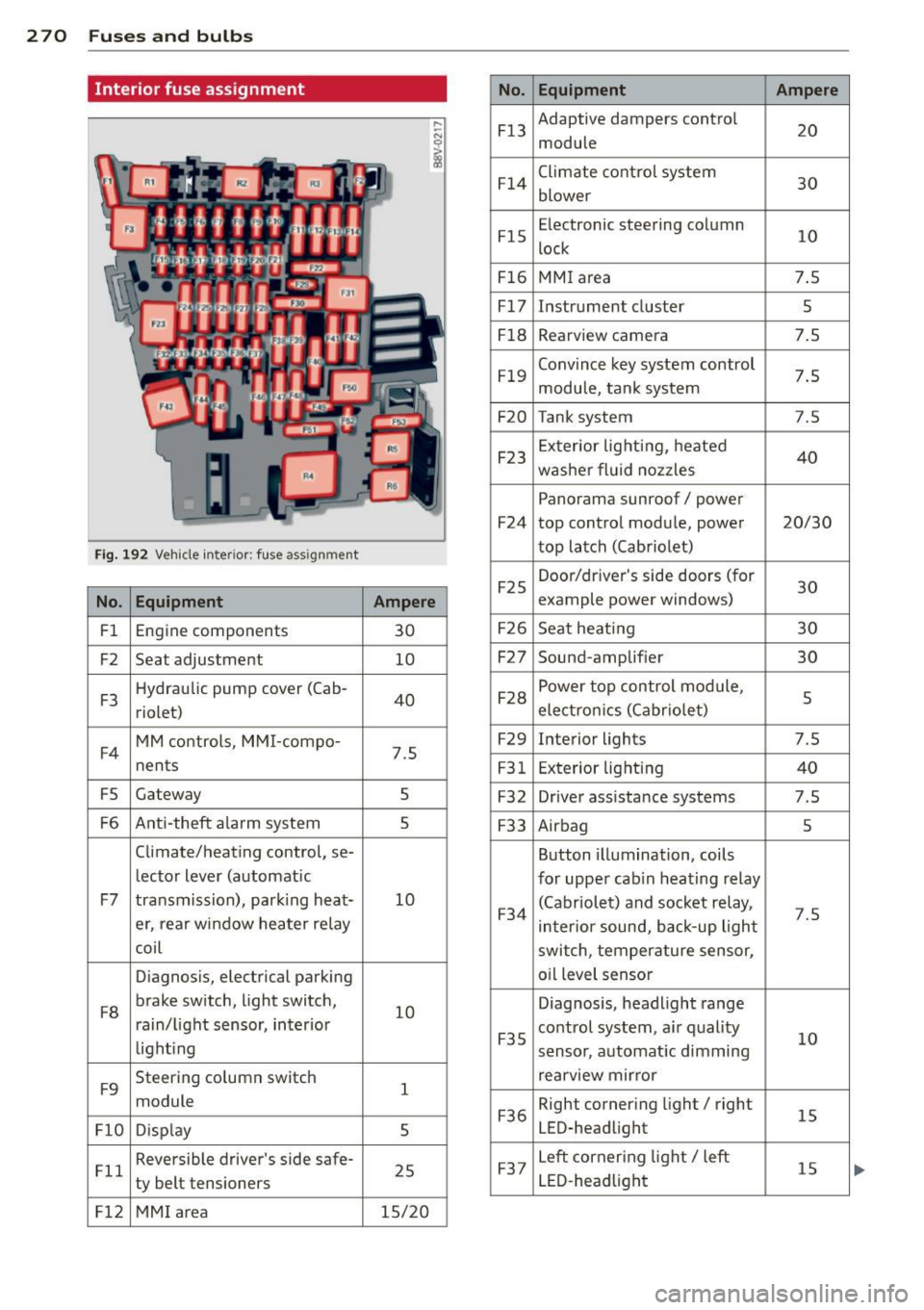
Interior fuse assignment
No. Equipment Ampere
Fl 3 Adaptive dampers contro
l
20
module
Fl4 Climate
control system
30
blower
Fl S E
lectronic steering column
10
lock
Fl6 MM I area 7.5
Fl7 Instrument cluster 5
Fl8 Rearview camera
7.5
F l9 Convince key
system control
7.5
module, tank system
F20 Tank system
7.5
F23 E
xterior lighti ng, heated
40
washe r fl ui d nozzles
Panorama sunroof/ power
F24 top control module, power 20/30
Fig. 192 Vehicle inter ior : fuse assignment top latch (Cabriolet)
No. Equipment Ampere
F25 Door/dr
iver's side doors (for
30
example power windows)
Fl Engine components 30 F26 Seat heat
ing 30
F2 Seat adjustment 10 F27
Sound-amplif
ier
30
F3 Hydraulic pump
cover (Cab-
40
riolet) F28
Power top control module,
5
elect ro ni cs (Cabr io let)
F4 M
M co ntrols, M MI-compo-
7.5
nents F29
Inte
rior lights
7.5
F3 1 E xterior lighting
40
F5 Gateway
5
F32 Driver ass istance systems 7.5
F 6 Anti-theft a
larm system
s F33 Airbag 5
Climate/heating control, se-
Button illumination, coils
lector lever (automatic
for upper cab in heating relay
F7 transmission), park ing heat- 10
er, rear window heater re lay F34 (Cabriolet) and socket relay,
7.5
in ter ior sound, back-up light
coil switch, temperature sensor,
Diagnosis, electrical parking oil level sensor
F 8 brake
switch, light switch,
10
rain/ light sensor, interior
light ing Diagnosis, headlight range
F35 co
ntrol system, a ir quality
10
sensor, a utomat ic dimming
F9 Steering column
switch
1
module
Fl0 D isp lay 5 rearview mir
ror
F36 Right
corner ing light/ right
15
LED-headlight
Fll Reversible driver's
side safe-
25
ty belt tensioners F37
Left corner
ing light/ left
15
L E D- headlight
Fl 2 M MI area 15/20
Page 273 of 302
....,
N
" > co
rl I.O
"' rl
"' rl
No. Equipment Ampere
Door/front passenger's side
F39 doors (for examp le, power
30
windows)
F40 Sockets 20
F41 Reversible front
passenger's
25
side safety belt tensioners
F42 Central locking components,
40
windshield washer system
F43 Headlights, light ing 30
F44 all wheel drive
15
F49 Starte
r, clutch sensor, head-
5
light re lay coil
FS3 Rear window defogger 30
The power seats* are protected v ia
ci rc uit
b reaker s
that automatically sw itch on after a
few seconds after the overload has been re
duced.
(D Tips
Note that the following table was accurate
at the time of print ing and is subject to
change.
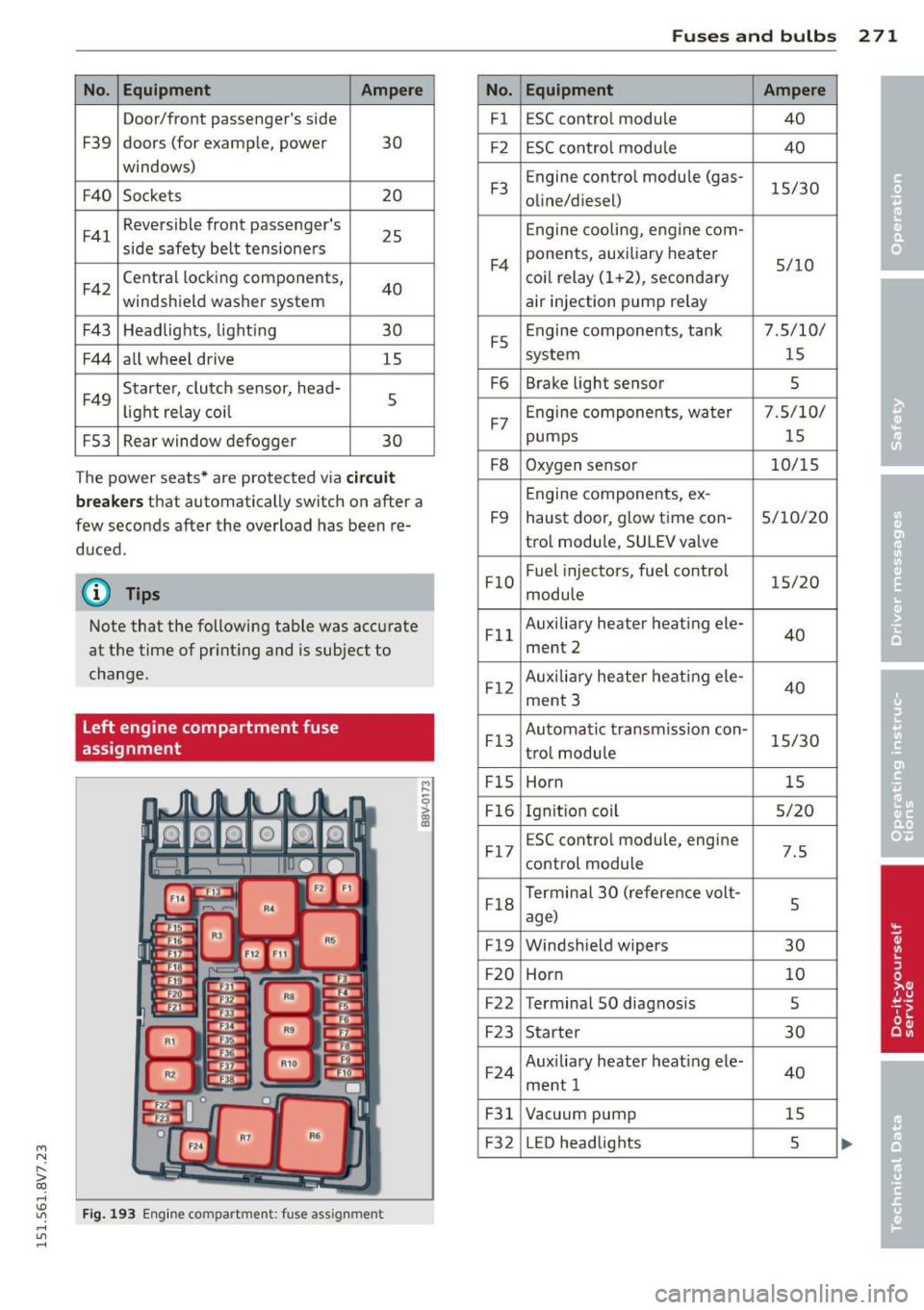
Left engine compartment fuse
assignment
F ig. 193 Engine compartme nt: fuse assignment
No.
Fl
F2
F3
F4
F5
F6
F7
F8
F9
FlO
F ll
F12
Fl3
FlS
F l 6
F l 7
Fl8
F19
F20
F22
F23
F24
F3 1
F32
Fu se s and bulb s 2 71
Equipment Ampere
E5C contro l modu le 40
ESC contro l modu le 40
Engine control module (gas-
15/30
oli ne/d iesel)
Engine cooling, eng ine com-
ponents, auxiliary heater 5/10
coi l relay (1+2), secondary
air injection pump relay
Engine components, tank 7.5/10/
system 15
Brake light sensor 5
Engine components, wa ter 7.5/10/
pumps 15
Oxygen sensor
10/15
Engine compone nts, ex-
haust door, glow time con- 5/10/20
tro l module, SU LEV valve
Fuel injectors, fuel control
15/20
module
Auxiliary heater heating ele- 40
ment 2
Auxilia ry heater heat ing ele-
40
ment 3
Automat ic transmiss ion con-
15/30
t ro l module
Horn 15
Ignit ion coil 5/20
ESC contro l module, engine
7.5
control module
T ermina l 30 (reference volt-
5
age)
Windsh ie ld wipers
30
Horn 10
Termina l 50 diagnosis
5
Starter 30
Auxilia ry heater heat ing ele-
40
ment 1
Vacuum pump 15
L E D head lights 5
Page 280 of 302
2 78 Emergency situations
fa ll from a lift if the re is a change in ve
h icle we ight d istribution and balance.
This might happen, for example, when h eavy components such as the engine
b lock or transmiss io n are removed .
- When removing heavy components like
these, ancho r vehicle to ho ist or add cor
r e spond ing weig hts to ma inta in the cen
te r of g ravity . Othe rwise, the vehicle
m ight tilt o r slip off th e hois t, c aus ing
s er ious pers on al injury.
(D Note
-Be awa re of th e f ollowing poin ts b efo re
li fting th e vehicle:
- The vehicle should never be lifted or
jacked up from underneath the engine oil pan, the transmission housing, the
front or rear axle or the body side members. This could lead to serious
damage .
- To avoid damage to the underbody or
chassis frame, a rubber pad must be
inserted between the floor jack and
the lift points.
- Before driving over a workshop hoist,
check that the vehicle weight does not
exceed the permissible lifting capacity
of the hoist .
- Before driving over a workshop hoist,
ensure that there is sufficient clear
ance between the hoist and low parts
of the vehicle.
Page 282 of 302
28 0 Techni cal data
designated s eating position) and luggage
w eight ¢.&, .
Gross Axle W eight Rating
The Gross Axle Weight Rating is the maximum l oad that can be applied at each axle of the
vehicle ¢Lr!, .
Vehicle cap acit y weight
The vehicle capac ity we ight (max . load) is list
ed either on the dr iver's side B-pilla r or inside
the fuel filler flap.
_& WARNING
- T he actual Gross Axle Weight Rat ing at
the front and rear axles shou ld not ex
ceed the permissible weights, and their
combination must not exceed the Gross
Vehicle Weight Rating .
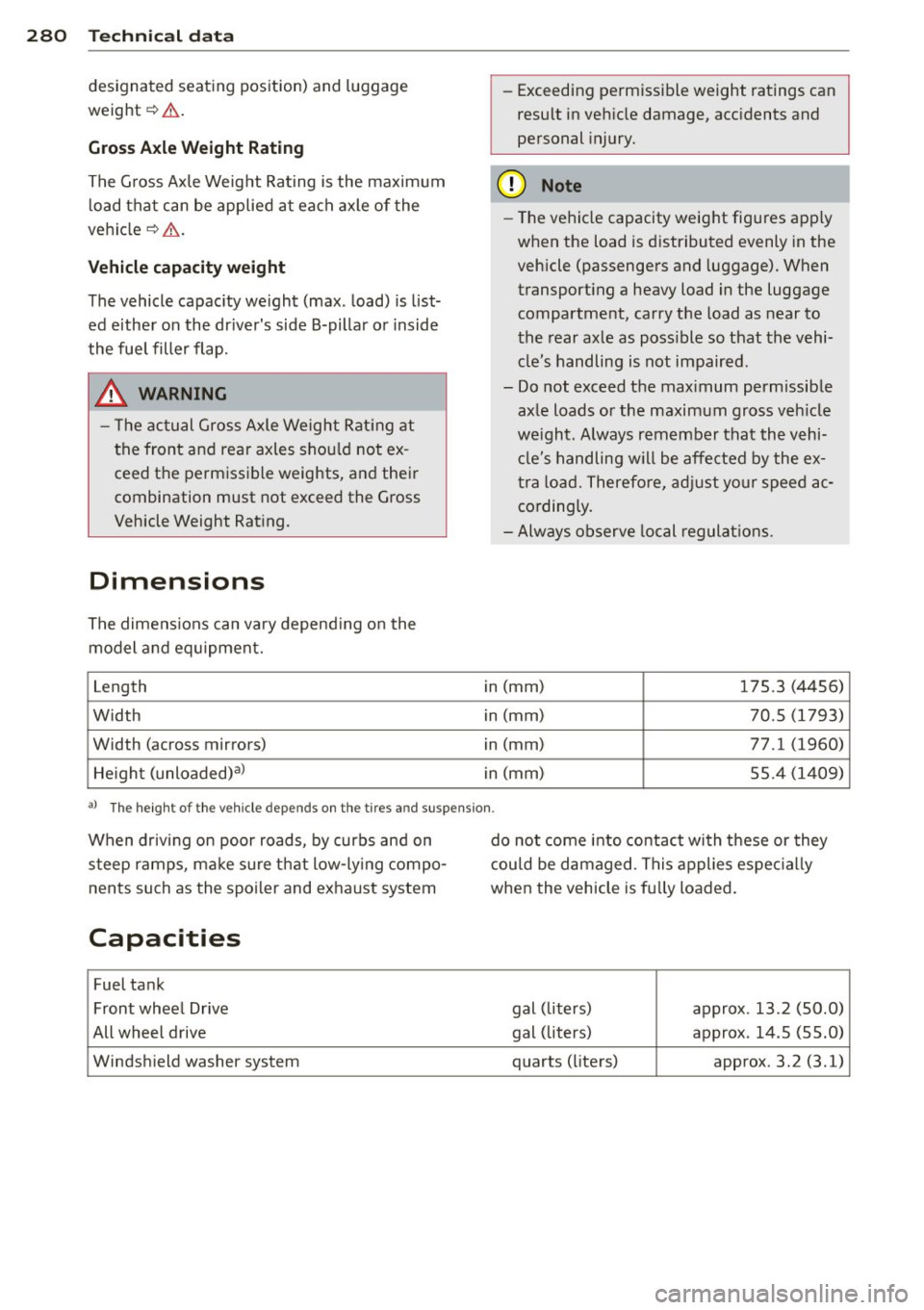
Dimensions
The dimensions can vary depend ing on the
model and eq uipment.
Length
Width
W idth (ac ross m irrors)
He ight (unloaded) a)
-
-Exceeding permissible weight ratings can
result in veh icle damage, acc idents and
personal injury.
(D Note
- The vehicle capacity weight figures apply
when the load is distributed evenly in the
vehicle (passengers and luggage). When
transport ing a heavy load in the luggage
compartment, carry the load as near to
the rear axle as poss ible so that the vehi
cle's handling is not impaired .
- Do not exceed the maximum permissible axle loads or the maximum gross veh icle
we ight. Always remember that the vehi
cle's handling w il l be affected by the ex
tra load. Therefo re, adj ust your speed ac
cordingly.
- Always observe local regulat ions .
in (mm)
175 .3 (4456)
in (mm) 70 .5 (1793)
in (mm) 77 .l (1960)
in (mm) 55 .4 (1409)
a) The h eigh t of the vehicle depen ds on the ti re s and suspension .
When driv ing on poor roads, by curbs and on
steep ramps, make s ure that low-lying compo
nents such as the spoiler and exhaust system
Capacities
F uel ta nk
F ront wheel Drive
All wheel drive
W indsh ield washe r system do not come
into contact with these or they
cou ld be damaged . This applies espec ia lly
when the vehicle is fu lly loaded.
gal (liters) approx.
13.2 (50 .0)
gal (liters) approx. 14.5 (55.0)
quarts (liters) approx. 3.2 (3.1)