oil AUDI A3 CABRIOLET 2015 User Guide
[x] Cancel search | Manufacturer: AUDI, Model Year: 2015, Model line: A3 CABRIOLET, Model: AUDI A3 CABRIOLET 2015Pages: 302, PDF Size: 73.83 MB
Page 201 of 302
M N
" > co ...... \!) 1.1'1
...... 1.1'1 ......
than the posted speed limit and weather con
ditions permit. Reducing unnecessary idling
Even wh en your car is just idling it burns up
fuel.
.,. Shu t the engine off when you a re not dr iv ing
the vehi cle.
... Do not warm up the vehicle by letting the
engine run at idle.
It is effic ient to switch off the eng ine when
stopped at railroad crossings and long red
lights. Turning the engine
off for just 30-40
seconds saves more fu el than is burned by
starting the engine again.
It takes a long time fo r the engine to wa rm up
fu lly when it is running at idle. However , wear
and noxious emissions are especially high
when the engine is wa rming up. So you should
drive away as soon as you start the eng ine and
avoid running at h igh RPM while the engine is
still warm ing up.
Do not leave engine idling unattended af
ter starting. If warning lights should come on to indicate improper operation, they
wou ld go unheeded. Extended idling also
p roduces heat, which cou ld result in over
heating or other damage to the vehicle or
other prope rty .
Regular maintenance
A badly tuned engine unnecessarily wastes a lot of fuel.
.,. Have your vehicle serv iced at regular inter-
vals.
H aving your vehicle regularly serviced by an
author ized Audi dealer helps to ensure that it
runs properly and economically . T he condition
of your vehicle not only affects its safety and
ab ility to hold its value, it also affects fuel
c onsum ption.
Dri ving and the en vironm ent 199
Chec k your oil e ach t ime you fill your tank.
T he amou nt of oi l used is re lated to engine
load a nd speed.
It is normal for the oil consumption of a new
engine to reach its lowest value after a certa in
mileage has bee n driven.
You must drive your veh icle about 3,000 m iles
(5,000 kilometers) before you can properly
assess oil consumpt ion.
This also app lies to fue l consumption and en
gine output .
(D Note
- Have your veh icle ma inta ined properly
and in accordance with the service rec
ommendations in your Warranty
& Ma in
tenance booklet . Lack of proper mainte
nance as well as improper use of the ve
hicle will impair the function of the
em iss ion cont ro l system and cou ld lead
t o damage.
- Do not alter or remove any component of
the Emission Control System unless ap
proved by the manufacture r.
- Do not alter or remove any device, such
as hea t shie lds, switches, ign ition w ires,
valves, which are designed to protect
your vehicle's Emission Control System
and other important vehicle compo
nents.
Fewer short trips
Fuel consumption will always be relatively
high on short trips.
... Try to avoid dr iving sho rt distances with a
cold engine .
T he eng ine and catalytic conve rter have to
reach their optimal operati ng t emperature to
reduce fuel consumption and noxious emis
sions effectively.
Just after starting, a co ld eng ine in a mid-s ize
ca r only achieves a fuel economy of 6 -8 mi les
per gallon (30-40 l/100 km). After about a
half a mile, fuel economy climbs to 12 mpg ..,.
•
•
•
Page 207 of 302
M N
" > co ,...., \!) ..,.,
,...., ..,., ,....,
Care and cleanin g 205
& WARNING
- Only wash the vehicle when the ignition
is off and follow the instructions from
the car wash operato r to reduce the risk
of accidents.
- To reduce the risk of cuts, protect your
self from sharp metal components when
wash ing the underbody or the inside of
the whee l housings.
- After washing the vehicle, the braking ef
fect may be delayed due to mo isture on
the brake rotors or ice in the winter . The
brakes must be dried first with a few
careful brake applicat io ns.
{[) Note
- If you wash th e vehicle in an automatic
ca r wash, yo u m ust fold the exterior m ir
ro rs in to reduce the r isk of damage to
the mirrors . Power foldi ng exterior m ir
r o rs* must o nly be folded in and out us
i ng the power folding function.
- To prevent pa int damage, do not wash
th e veh icle in direc t sun ligh t. -
To reduce the r is k of damage, do no t
wash the powe r top with a pressure
washer.
- To reduce the r is k of damage to the sur
face, do not use i nsect removing spong
es, kitchen sponges or similar items.
- Matte finish painted vehicle compo
nents:
- To reduce the risk of damage to the
surfac e, do not use polishi ng agents or
ha rd wax.
- Neve r use prot ective wax. It can de
stroy the matte fin is h effect.
- Do not place any stickers o r magnet ic
signs on vehicle parts painted w it h
ma tte fi nish pa in t. The pa int cou ld be
da maged whe n the stickers o r m ag nets
ar e removed.
@ For the sake of the environment
Only wash t he ve hicl e in facili ties spe cially
d es igned for th at p urpose . Th is will re duce
the r is k of d irty wate r contam ina ted with
oil from entering t he sewer system.
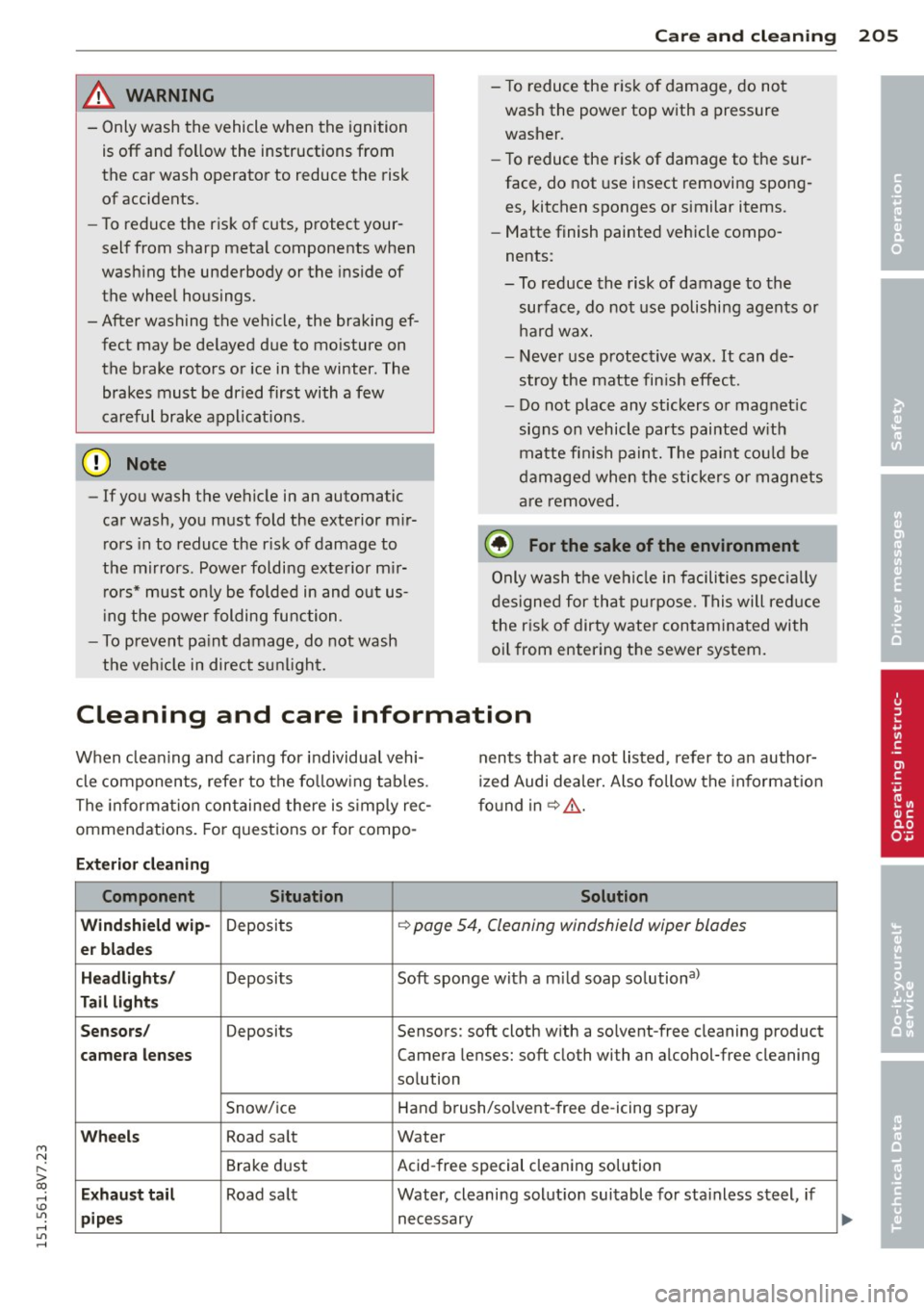
Cleaning and care information
When clea ning and caring for individua l vehi
cle components, refe r to the fo llow ing tab les .
The informa tion contained there is s imp ly rec
ommendations. Fo r quest ions or for compo -n
ents that are not listed , refer to an author
i z ed Audi dea ler. Also follow the info rma tion
fo und in ~ &, .
Exterior cleaning
Component Situation Solution
Wind shield wip-
Deposits ¢ page 54, Cleaning windshield wiper blades
er bl ade s
Headlights /
Deposits Soft sponge with a m ild soap solution3>
Tail lights
Sensors /
Deposits Sensors: soft cloth w ith a so lvent-free cleaning product
camera lenses Camera lenses: soft cloth with an alcohol-free cleaning
so lution
Snow/ ice Hand brush/so
lve nt-free de -icing spray
Wheels Road sa lt Water
Brake dust Acid
-free special cleaning so lu tion
E x haust tail Road sa lt Water, cleaning solut ion suitable for stainless steel, if
pipes necessary •
•
•
Page 209 of 302
M N
" > co ,...., \!) 1.1"1 ,...., 1.1"1 ,....,
Care and cleanin g 207
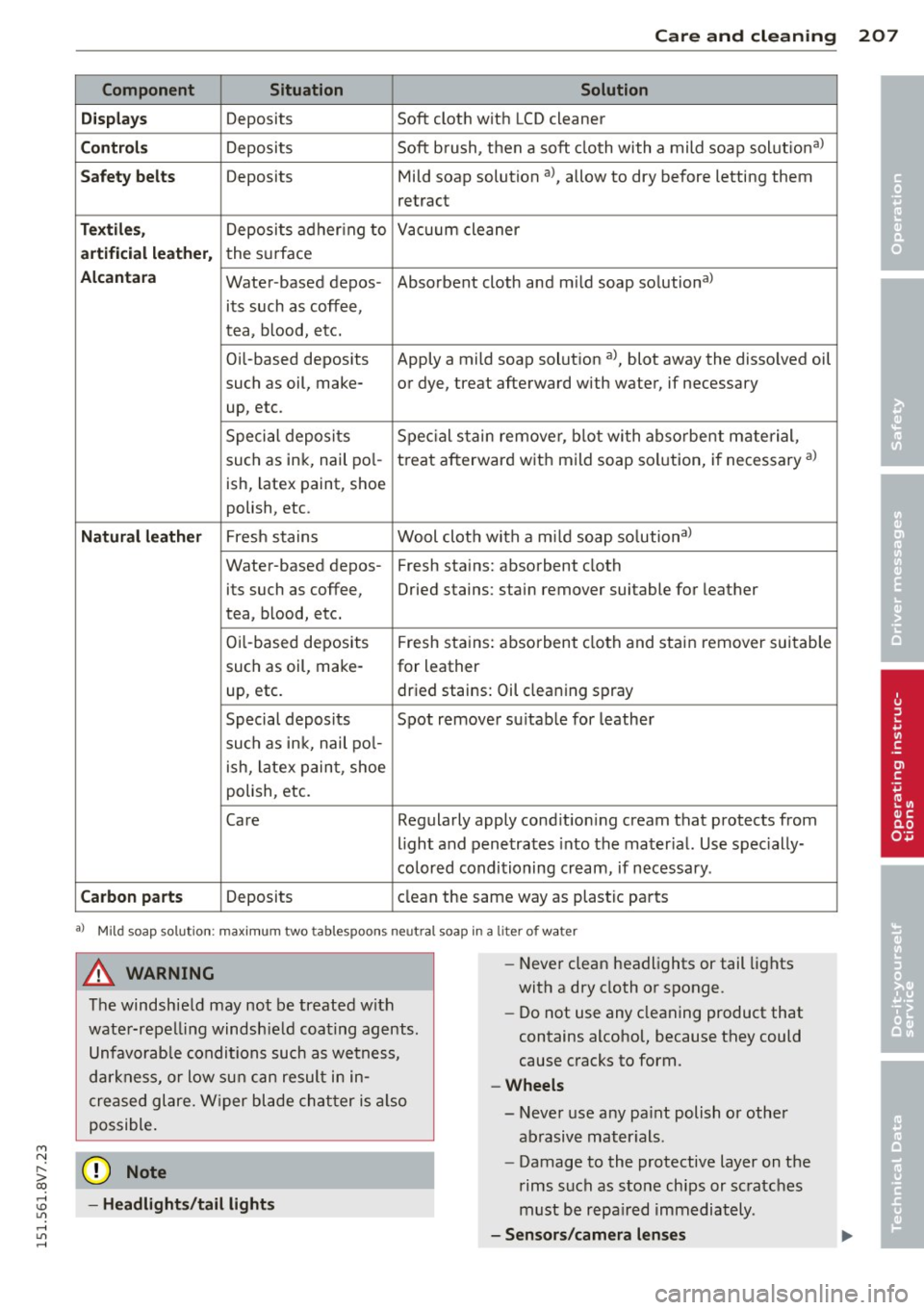
Component Situ ation Solution
D ispl ays
Deposits Soft clotlh with LCD cleaner
Controls Deposits Soft brush, then a soft cloth with a mild soap solutiona>
Sa fet y bel ts Deposits Mild soap solution a>, allow to dry before letting them
retract
Te xtil es, Deposits adher ing to Vacuum cleaner
a rtificial l eather, the surface
Alc ant ara Water-based depos- Absorbernt cloth and mild soap solutional
its such as coffee,
tea, blood, etc.
Oil-based deposits Apply a mild soap solution al, blot away the disso lved oil
such as oil, make- or dye, treat afterward with water, if necessary
up, etc.
Special depos its Spec
ial stain remover, b lot with absorbent material,
such as ink, nail po l- t reat afterward with mild soap solution, if necessary a)
ish, latex paint, shoe
polish, etc.
Natur al le ather Fresh stains Wool cloth with a m
ild soap solutional
Water-based depos- Fresh stains: absorbent cloth
its such as coffee, Dried stains: stain remover suitable for leather
tea, blood, etc.
Oi l-based deposits Fresh stains: absorbent cloth and stain remover suitable
such as oil, make- for leather
up, etc. dried stains: Oil cleaning spray
Special deposits Spot remover suitable for leather
such as ink, nail po l-
ish, latex paint, shoe
polish, etc.
Care Regularly apply condit ioning cream that protects from
l ight and penetrates into the mater ial. Use specially-
colored conditioning cream, if necessary .
Car bon part s Deposits clean the same way as plastic parts
al Mild soap solut ion : max imum two tablespoons neutral soap in a liter of water
A WARNING
The windshield may not be treated with
water-repelling windsh ie ld coating agents.
Unfavorab le conditions such as wetness,
da rkness, or low sun can result in in
creased glare. W iper blade chatter is a lso
possible.
- Headlight s/tail light s
-
-Never clean headlights or tail lights
with a dry cloth or sponge.
- Do not use any cleaning product that
contains alcohol, because they could
cause cracks to form.
-Wheels
- Neve r use any pa int polish or other
abrasive mater ials.
- Damage to the protective layer on the
rims such as stone chips or scratches
must be repa ired immediately .
-Se nsor s/camera l ense s
•
•
•
Page 217 of 302
....,
N
r--. > co
rl I.O
"' rl
"' rl
fan belt or other moving components or do not come into contact w ith hot
components. T ie back long hair before
beginning work and do not wear cloth ing that can hang down into the en
g ine .
- Limit your exposure to exhaust and
chemicals to as short a time as poss ible
c::;, &. .
& WARNING
California P ropos ition 65 Warning:
- Engine exhaust, some of its constituents,
and certain veh icle components conta in
o r emit chemicals known to the State of
Californ ia to cause cancer and b irth de
fec ts and reproduct ive harm . In addition,
certain fluids conta ined in vehicles and
certain products of component wear con
tain or emit chemicals known to the State of California to cause cancer and
birth defects or other reproductive harm.
- Battery posts, terminals and related ac
cessories contain lead and lead com pounds , chemicals known to the State of
Californ ia to cause cancer a nd reproduc
t ive harms . Wash hands after handling .
(D Note
When filling fluids, be sure not to m ix the
fluids up. Othe rwise severe malfunctions
and e ng ine damage will occur .
@ For the sake of the environment
You should regularly check the ground un
der your vehicle in orde r to detect leaks
quickly . If there are visible spots from oil
or other fluids, b ring your veh icle to an au
thori zed Audi dealer or qualified repair fa
cility to be checked .
Checking and Fillin g 215
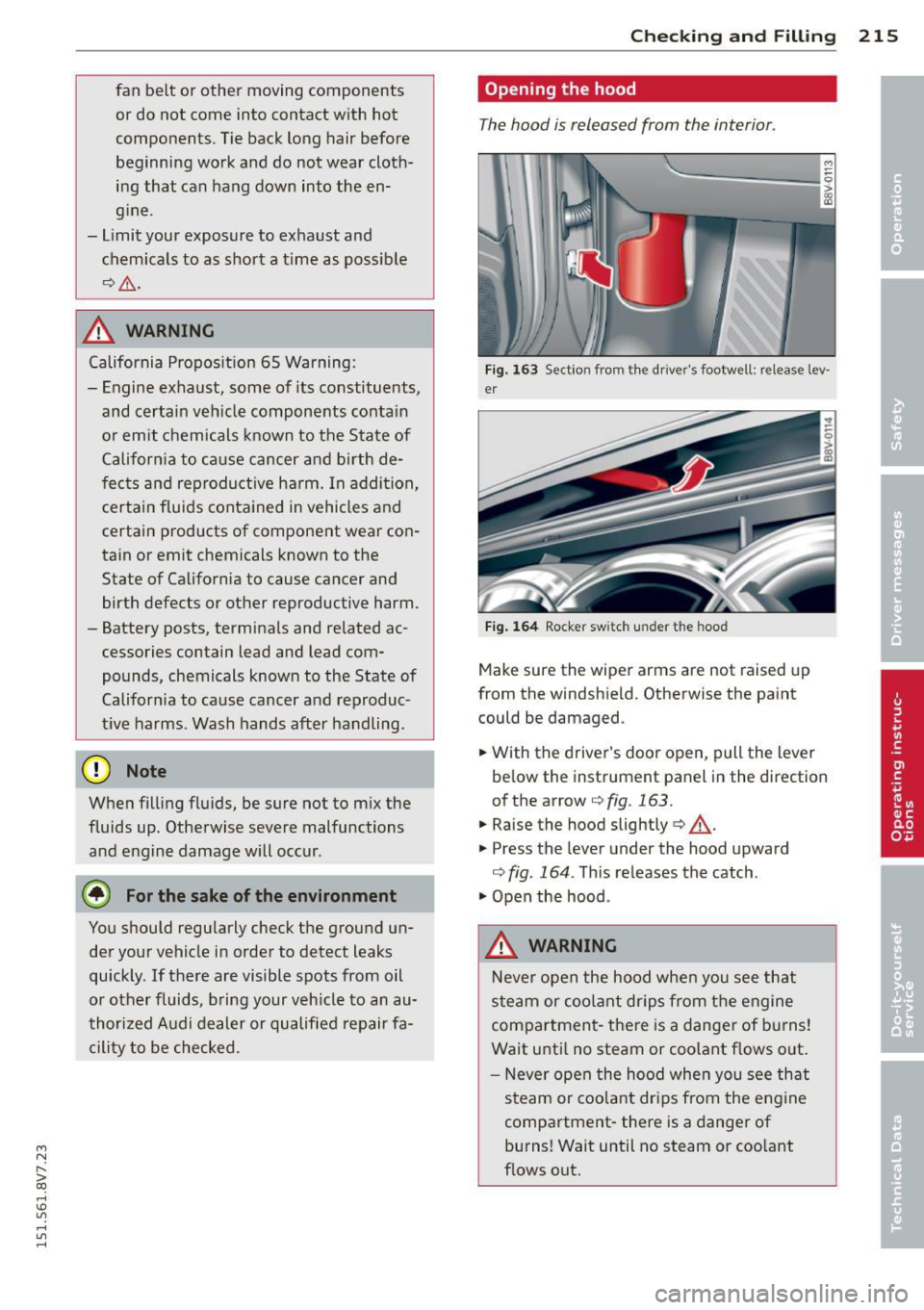
Opening the hood
The hood is released from the interior .
Fig. 163 Se ct io n fro m t he dr iver 's footwell : release Lev ·
er
Fi g. 1 64 Rocke r sw it ch under t he hood
Make sure the wiper arms are not raised up
from the windshield. Otherwise the paint could be damaged .
... With the drive r's door open, pull the lever
be low the instrument panel in the direction
of the arrow
¢ fig. 163.
.,. Raise the hood slightly c::;, ,A .
.,. Press the lever under the hood upward
¢ fig . 164 . This releases the catch .
.,. Open the hood .
& WARNING
Never open the hood whe n you see that
steam or coo lant drips from the engine
compartment -there is a danger of b urns!
Wait unti l no steam or coolant flows o ut.
- Never open the hood when you see that
steam or coolant dr ips from the engine
compartment- there is a danger of burns! Wait until no steam or coo lant
flows out.
-
Page 218 of 302
216 Checking and Filling
Closing the hood
,. Push the hood down until the force of the
strut is overcome.
,. Then lower the hood and let it fall into the
engine hood latch -you do
not have to press
on the hood after it is locked.~
A-
_& WARNING
If the hood is not latched completely, it
could fly up while you are driving and ob
struct your vision .
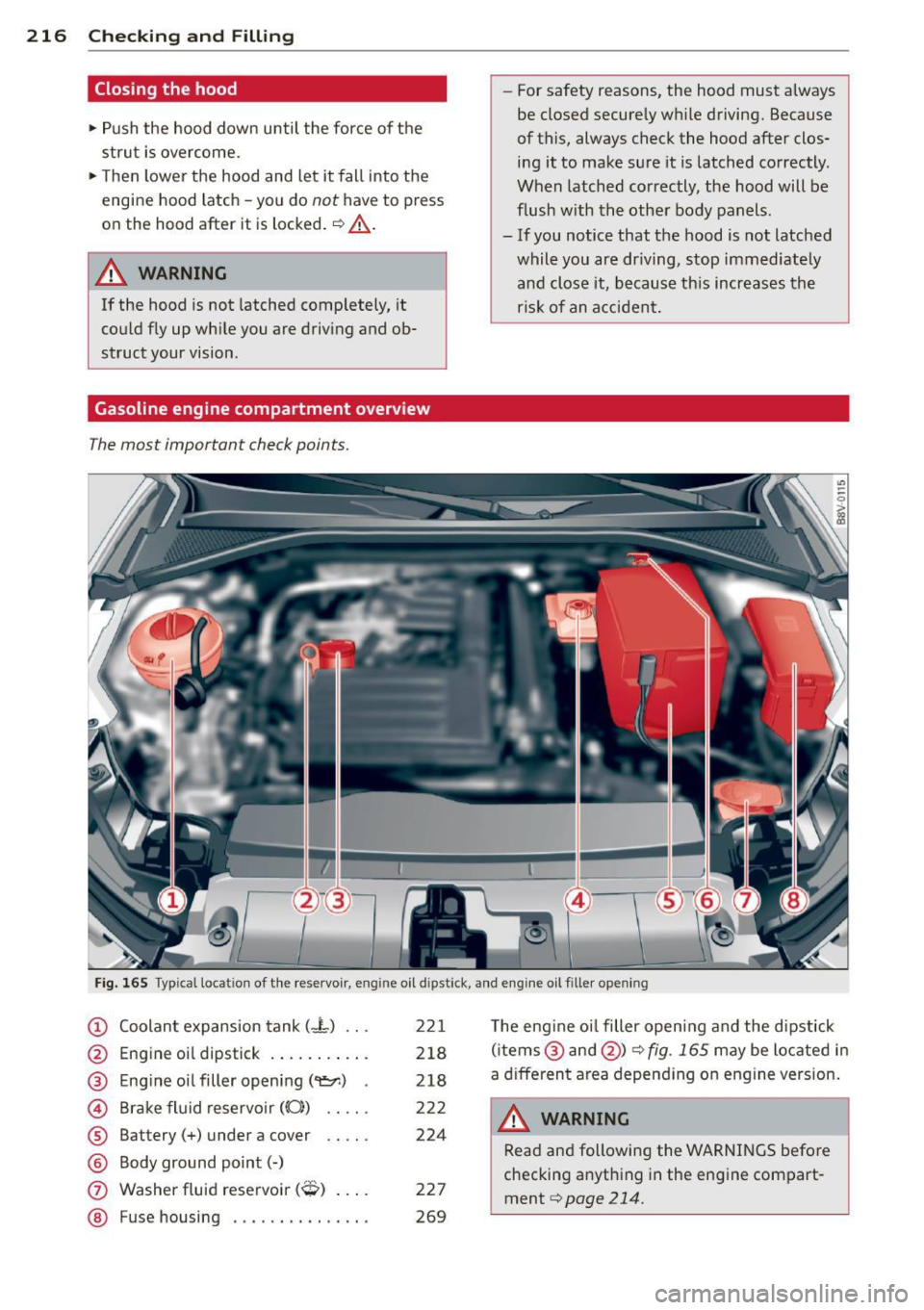
Gasoline engine compartment overview
The most important check points.
-
-For safety reasons , the hood must a lways
be closed secure ly while driving. Because
of this, always check the hood after clos
ing it to make sure it is latched correctly.
When latched correctly , the hood will be
f lush w ith the other body panels.
- If you notice that the hood is not latched
while you are dr iving, stop immediately
and close it, because this increases the
risk of an acciden t.
Fig. 165 Typica l locat ion of the reservoir, engine o il dipst ick, and engine o il filler open ing
@ Coolant expansion tank (- L) .. . 221 The engine oi l filler opening and the dipstick
@ Engine oil dipstick .......
... .
218 (items @ and @) c> fig. 165 may be located in
® Eng ine oil filler opening ('e::r.) 218 a different area depending on engine version.
© Brake fluid reservoir ((0) .. .. . 222 A WARNING
® Battery(+) under a cover .. .. . 224
® Body ground point(-) Read
and following the WARNINGS before
checking anything in the engine compart-
(J) Washer f luid reservoir (0) ... . 227 ment c> page 214.
® Fuse housing .......... .... . 269
Page 219 of 302
M N ,....
> co ,...., \!) 1.1'1 ,...., 1.1'1 ,....,
Engine oil
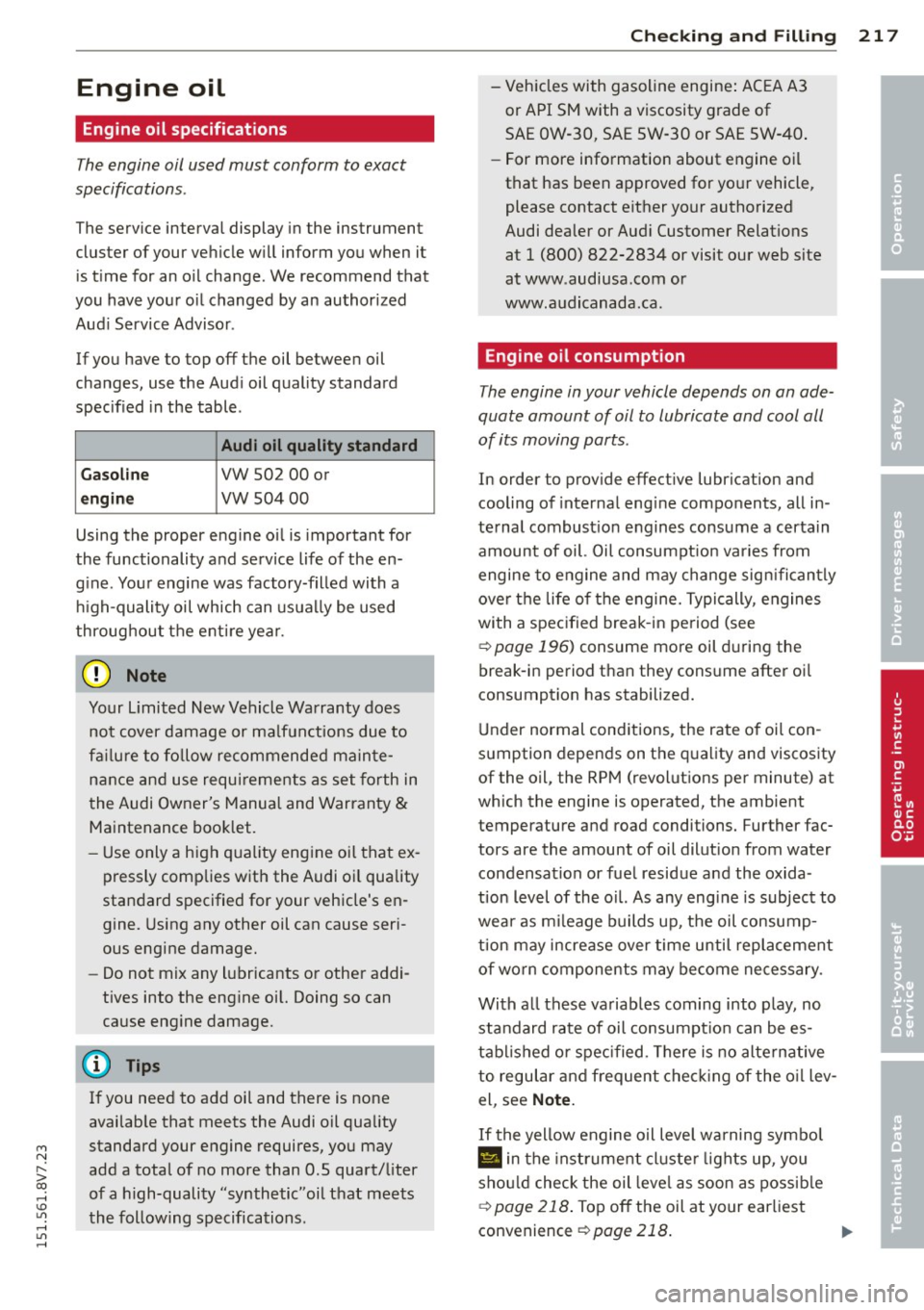
Engine oil specifications
The engine oil used must conform to exact
specifications .
The service interval display in the instrument
cluster of your vehicle w ill inform you when it
is t ime for an oil change. We recommend that
you have your o il changed by an author ized
Aud i Service Advisor .
If you have to top off the oil between oil
changes, use the Aud i oil quality standard
specified in the table .
Audi oil quality standard
G asoline
VW 502 00 or
e ngin e vw 504 00
Using the proper engine o il is important for
the functionality and service life of the en
g ine . Your engine was factory-filled with a
hi gh-quality oil which can usua lly be used
throughout the enti re yea r.
(D Note
Your Limited New Vehicle Warranty does
not cover damage or ma lfun ctions due to
fa ilure to fo llow recommended ma in te
nance and use requ irements as set forth in
the Audi Owner's Manua l and Warranty
&
Maintenance book let.
- U se only a high q uality eng ine oi l that ex
pressly comp lies with the Audi oil quality
standard specified for your vehicle's en
gine. Using any other oil can cause seri
ous engine damage.
- Do not mix any l ubricants or other addi
tives into the eng ine oi l. Doing so can
cause eng ine damage.
(D Tips
I f you need to add oi l and there is none
availab le that meets the Audi oil quality
standard your engine requires, you may
add a total of no more than 0.5 quart/liter
of a high-quality "synthetic"oil that meets
t he follow ing specifica tions.
Checking and Fillin g 217
-Veh icles with gasoline engine : ACEA A3
or AP! SM with a viscosity grade of
SAE O W-30, SAE 5W -30 or SAE SW-40 .
- For more information about engine o il
that has been approved for yo ur vehicle,
please contact either your authorized
Audi dealer or Aud i Customer Relations
at 1 (800) 822-2834 or visit our web site
at www .audiusa.com or
www.a udicanada.ca.
Engine oil consumption
The engine in your vehicle depends on an ade
quate amount of oil to lubricate and cool all
of its moving parts .
In order to provide effective lubrication and
cooling of interna l eng ine components, all in
te rnal combust io n engines consume a certa in
amount of oil. Oil consumpt ion va rie s from
engine to engine and may change sign ifi can tly
ove r th e life of the engine. Typically, engines
wi th a spec ified break -in pe riod (see
¢ page 196) consume more oil during the
break-in pe riod than they cons ume after oi l
consumption has stabilized.
U nder normal cond itions, the rate o f oi l con
s u mption depen ds on the q ual ity and viscos ity
of the oil, the RPM (revolutions per minute) at
which the engine is operated, the ambient
temperature and road conditions. Further fac
tors are the amount of oil dilut ion from water
condensa tion or fuel residue a nd the oxida
tion level of the oil. As any engine is subject to
wea r as m ileage builds up, the oil consump
t ion may incre ase over time until replacement
of wo rn components may be come necessary.
With a ll these va riab les coming into p lay, no
standard rate of oil consumpt io n can be es
tabl is h ed or spec ified. There is no alte rn ative
to regul ar and frequent che cking of the o il lev
el , see
Note.
If the yellow engine o il leve l warning sy mbo l
Ill in the ins trument cl uste r lights up, you
sho uld check the oil leve l as soon as possib le
¢ page 2 18 . Top off the oil at your earliest
convenience
¢ page 218 . ll-
•
•
•
Page 220 of 302
218 Checking and Filling
A WARNING
Bef ore you check anything in the engine
compartme nt, always read and heed all
WARNI NGS ¢
page 214.
(D Note
Dr iving with an insufficient oil level is like
ly to ca use severe damage to the eng ine.
(D Tips
- The oil pressu re warning display. is
not an indicator of the oil level. Do not
rely on it. Instead, chec k the oil level in
your engine at regular intervals, pref
erably each time you refuel, and always
before going on a long trip.
- If you have the imp ress ion your engine
consumes excessive amounts of o il, we
r ecommend that yo u consult an aut hor
iz ed Audi dealer to have the ca use of
you r concern p ro perl y diagnose d. Keep in
mind tha t the ac cura te measurement of
oi l co nsu mption requires great care and
may ta ke some time. An authorized Audi
dealer has instructions about how to
measure oil c onsumpt ion accurately.
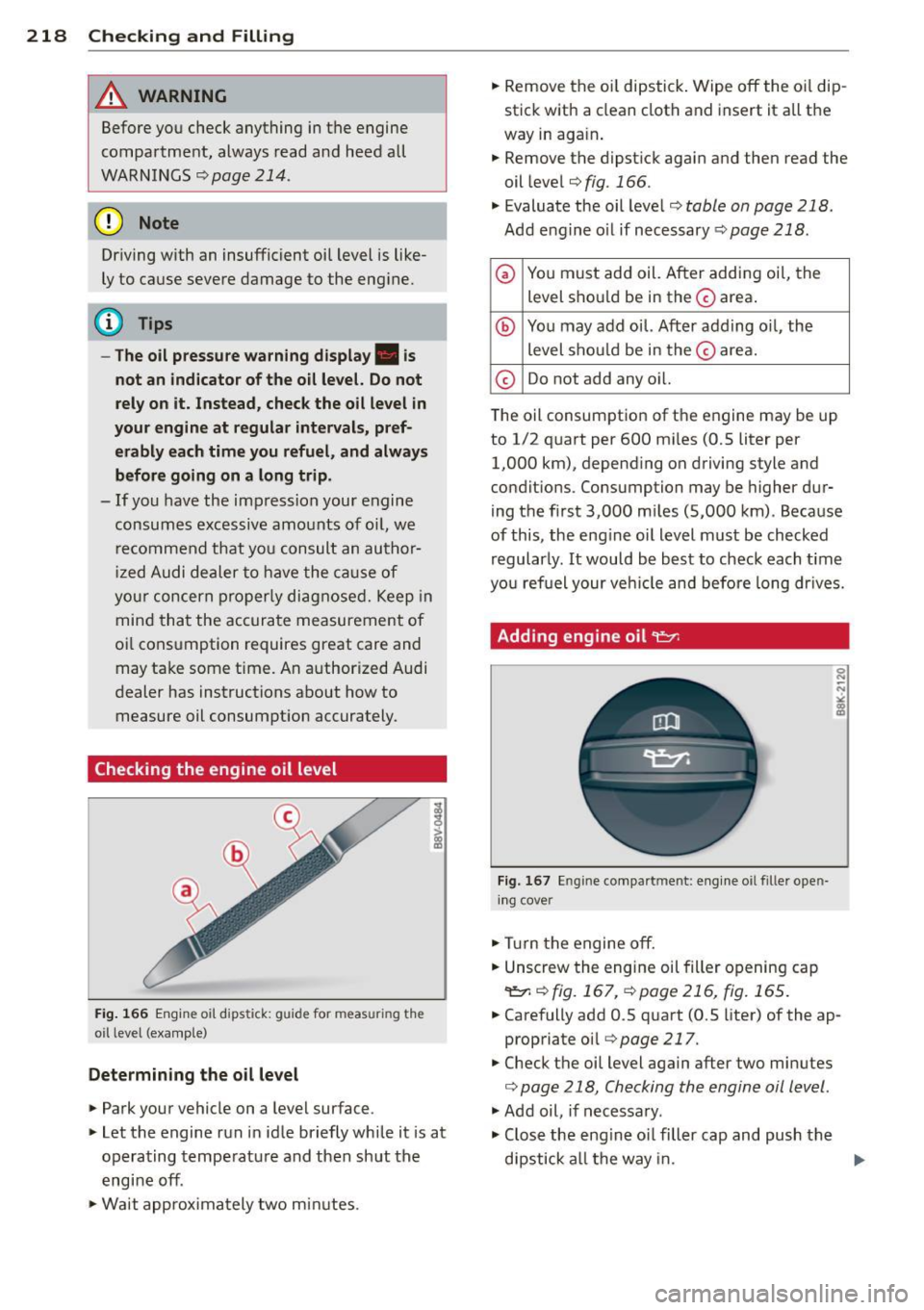
Checking the engine oil level
F ig. 166 Eng ine o il d ip st ick: g uide for meas urin g the
o il level (exa mple)
Determining the oil level
.. Park your vehicle on a level surface .
.. Let the engine run i n idle briefly whi le it is at
operating tempe rature and then shut the
engi ne off .
.,. Wait a pproxima tely two mi nutes . ..
Remove the oil dipstick . Wipe off the o il dip
stick w ith a clean cloth and insert it all the
way in aga in .
.. Remove the dipst ick aga in a nd then read the
oil leve l¢
fig. 166 .
.,. Evaluate the oil leve l r::;, table on page 218.
Add eng ine o il if necessary r::;, page 218.
0 You must add oil. After adding oi l, the
level sho uld be in the
0 area .
@ You may add oil. After add ing o il, the
level shou ld be in the
0 area.
0 Do not add any o il.
The oil consumptio n of the e ngine may be up
to 1/2 q uart per 600 m iles (0.5 liter per
1,000 km), depend ing on driving style and
condit ions . Consumption may be higher du r
ing the fi rst 3 ,000 m iles (5,000 km) . Because
of this, the eng ine oi l level must be checked
r e gularly. It would be b est to che ck each time
yo u ref uel your veh icle and befo re long dr ives.
Adding engine oil~
Fig. 1 67 Eng ine co mpa rtm ent: e ng in e o il fill er ope n
in g cover
.,. Turn t he engine off .
.. Unscrew the engine oil fille r opening cap
'l::71 9 fig. 167, r::;,page 216, fig. 165 .
.. Carefully add 0 .5 q uart (0.5 liter) of the ap
propriate oi l¢
page 217 .
.. Check the oil level aga in after two min utes
r::;, page 218, Checking the engine oil level.
.. Add oil, if necessary .
.,. Close the eng in e oil fill er cap and push the
dipstick a ll the way in. ..,.
Page 221 of 302
M N ,....
> co ,...., \!) 1.1"1 ,...., 1.1"1 ,....,
A WARNING ,~
- When adding oil, do not let oil drip onto
hot engine components. There could be
risk of a fire.
- You must secure the cap on the oil filler
opening correctly so that oil does not
leak out onto the hot engine and exhaust
system when the engine is running, be
cause this is a fire hazard.
-Always clean skin thoroughly if it comes
into contact with engine oil.
(D Note
- The oil level must not be above the G)
range ~page 218, fig. 166, because this
can cause damage to the catalytic con
verter or the engine. Contact your au
thorized Audi dealer or qualified repair
facility to have excess oil extracted if
necessary.
- Do not mix any additional lubricants into
the engine oil. Damage cause by such ad
ditives is not covered by the warranty.
@ For the sake of the environment
- Oil should never enter the sewer system
or come into contact with the ground.
- Pay attention to legal requirements
when disposing of empty oil containers.
Changing the engine oil
We recommend that have your oil changed by
an authorized Audi dealer or a qualified serv
ice station.
Before you check anything in the engine com
partment, always read and heed all WARN
INGS
~ page 214.
The engine oil must be changed according to
the intervals specified in your Warranty
&
Maintenance booklet. This is very important
because the lubricating properties of oil di
minish gradually during normal vehicle use.
Under some circumstances the engine oil
should be changed more frequently . Change
oil more often if you drive mostly short dis-
Checking and Filling 219
tances, operate the vehicle in dusty areas or
under predominantly stop-and-go traffic con
ditions, or have your vehicle where tempera
tures remain below freezing for extended pe riods.
Detergent additives in the oil will make fresh
oil look dark after the engine has been run
ning for a short time. This is normal and is not
a reason to change the oil more often than
recommended .
Because of the problem of proper disposal,
along with the special tools and necessary ex pertise required, we strongly recommend that
you have your oil changed by an authorized
Audi dealer or a qualified service station.
If you choose to change your oil yourself, please note the following important informa
tion:
A WARNING
To reduce the risk of personal injury if you
must change the engine oil in your vehicle
yourself:
- Wear eye protection.
- To reduce the risk of burns from hot en-
gine oil, let the engine cool down to the
touch .
- When removing the oil drain plug with
your fingers, stay as far away as possible. Always keep your forearm parallel to the
ground to help prevent hot oil from run
ning down your arm.
- Drain the oil into a container designed
for this purpose, one large enough to
hold at least the total amount of oil in
your engine.
- Engine oil is poisonous. Keep it well out
of the reach of children.
- Continuous contact with used engine oil
is harmful to your skin. Always protect
your skin by washing oil off thoroughly
with soap and water.
•
•
•
Page 222 of 302
220 Check ing and F illin g
Never mix oil additives with your engine
oil. These additives can damage your en
gine and adversely affect your Audi Limit
ed New Vehicle Warranty.
@) For the sake of the environment
- Before changing your oi l, f irst make sure
you know where you can properly dispose of the used o il.
- Always dispose of used engine oil proper
l y. Do not dump it on garden so il, wood
ed areas, into open streams or down
sewage dra ins.
- Recycle used engine oil by taking it to a
used engine oil collection facility in your
area, or contact a service station .
Cooling system
Coolant
The engine coolant performs two functions: it
keeps the engine from overheating and it pro tects the engine from freezing in the winter.
The cooling system is sea led and generally re
q ui res little attention .
The cooling system has been filled at the fac
tory with a pe rmanent coolant which does not
need to be changed. The coolant consists of a
mixture o f spec ia lly condi tioned water and the
manufacturer's glycol -based coolant addi -
tive G l3 antifreeze with anticorrosion addi
tives (50% for USA models ; 60% for Canadian
models). This mixture both assures the neces
sary frost pro tection and protec ts metal com
ponents in the engine's cooling system from
corrosion and scaling . It also raises the boil
i ng po int of the coo lant .
Do not red uce the concentr ation of the coo l
ant in the summer by adding plain water.
The
proportion of coolant add iti ve mu st be at
least 50 % but not more than 60 %
to main
tain antifreeze protection and cooling efficie n
cy.
If t he coolant frost protect io n is too low,
the coo lant cou ld freeze and damage the veh i
cle heating and engine cooling system. F
or year -ro und driving, antifreeze is added a t
the factory for temperatures down to :
- -31°F(-35°C)USA
- -40°F ( -40°C) Canada.
If you must add coolant, use a mixture of wa
ter and coolant additive . Mix ing the coo lant
additive with distilled water is recommended .
.&, WARNING "---
Before you c hec k anyth ing in the engine
compartment, a lways read and heed a ll
WAR NIN GS ~
page 214.
0 Note
- Before wi nter sets in, have the coo lant
checked to see if the coolant additive in
your vehicle is sufficient to meet the cli
ma te conditions. This is especi ally impo r
tan t if you live in a reg ion where the win
ter is extreme ly cold . If necessary, in
crease the p roportion of coo lant add itive
to 60% .
- Whe n adding coolant additive to yo ur
cooling system, remembe r:
- We recommend us ing on ly coola nt ad
d itive Gl2++ or Gl3 (check the labe l)
fo r your vehicle. This coolant additive is
a va ila ble at au thorize d Au di dea le rs.
Other types of antifreeze can sign ifi
ca ntly reduce corrosion p rotection. The
resu lting corrosion can cause a loss of
coolant and serious engine damage.
- Do not add any type of radiator leak seal
ant to yo ur vehicle's engine coolant .
Add ing radiator repair f luid may adverse
ly affect the function and performance of
your cooling system and cou ld resu lt in
damage not covered by you r New Ve hicle
Limited Warranty.
Page 223 of 302
....,
N
r--. > co
rl I.O
"' rl
"' rl
Adding coolant
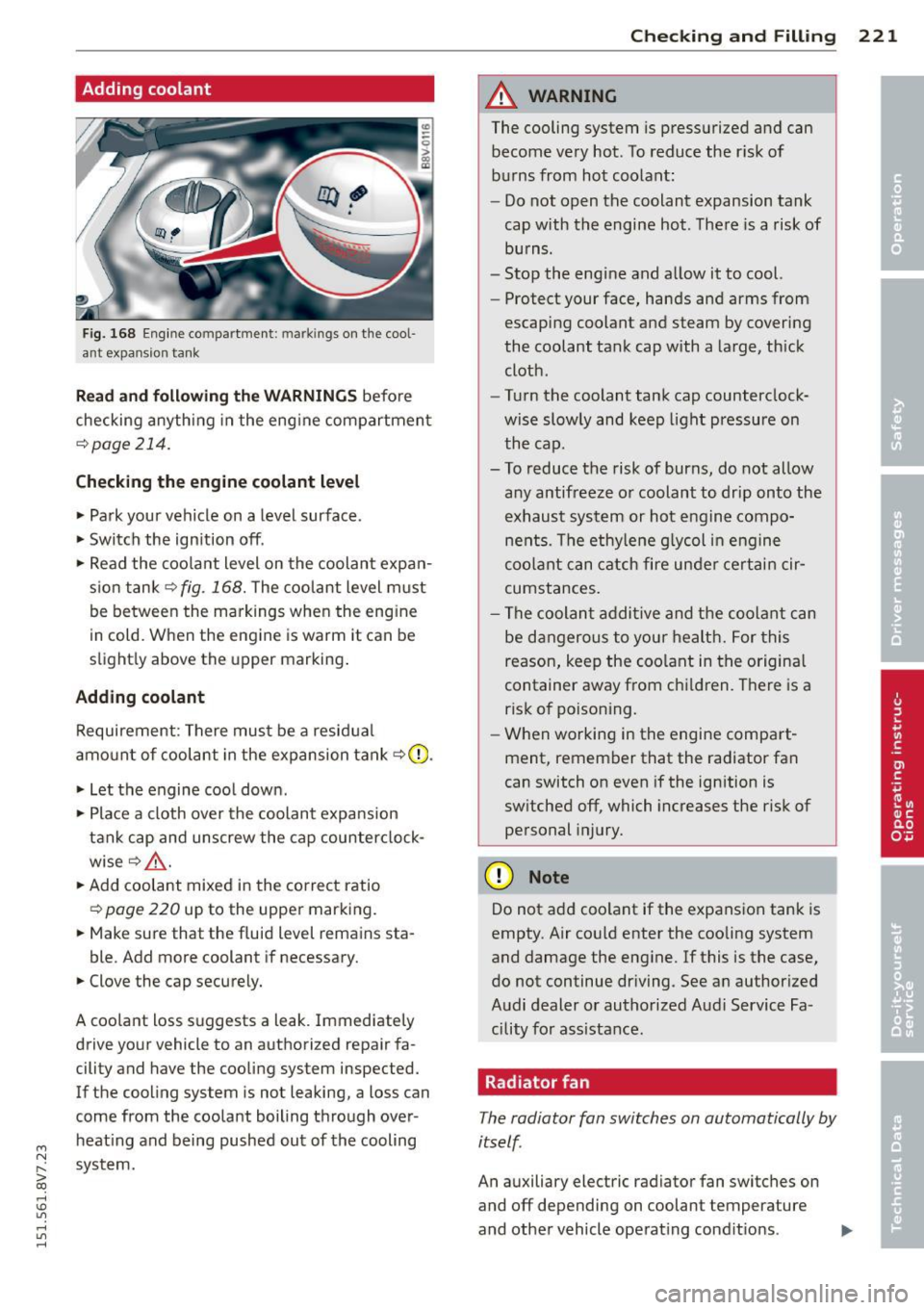
Fig. 168 Eng ine co mpa rtme nt: m ark in gs on the cool
ant expansio n tank
Read and following th e WARNING S before
checking anythi ng in the eng ine compartmen t
c::>page 214.
Checking th e engine coolant leve l
"'Park your vehicle on a level surface .
"' Switch the ign ition off.
"' Read the coo lant level on the coolant expan
s ion tank
c::> fig. 168. The coolant level must
be between the markings whe n the eng ine
in cold. When the eng ine is warm it can be
slight ly above the upper marking .
Adding coolant
Requirement: There must be a residua l
amo unt of coolant in the expansion tank
c::> (D .
"'Let the engine coo l down .
"' Place a cloth over the coolant expa nsion
tank cap and unscrew the cap counter clock
wise <=:>
A.
"'Add coolant mixed in the correct ratio
c::>page 220 up to the upper marking.
"' Make sure that the fluid level remains sta-
ble. Add more coolant if necessary.
"' Clove the cap securely.
A coolant loss suggests a leak. Immediately drive your vehicle to an authorized repair fa
cility and have the cooling system inspected.
If the cooling system is not leaking, a loss can
come from the coolant boiling through over
heat ing and being pushed out of the cooling
system.
Che cking and Fillin g 221
A WARNING
The cooling system is pressurized and can
become very hot. To reduce the r isk of
burns from hot coolant:
- Do not open the coolant expansion tank
cap with the engine hot . The re is a risk of
burns .
- Stop the engine and allow it to cool.
- Protect your face, hands and arms from
escaping coolant and steam by covering
the coolant tank cap with a large, th ick
cloth .
- Tu rn the coolant tank cap counterclock
wise slowly and keep light pressure on
the cap.
- To reduce the risk of burns, do not allow
any antifreeze o r coolant to drip onto the
exhaust system or hot engin e compo
nents . The ethy lene g lycol in eng ine
coo lant can catch fire under certai n cir
cumstances.
- The coolan t addi tive and the coolant can
be dangerous to your health. For this
reason, keep the coo lant in the origina l
container away from ch ildren. There is a
risk of poisoning.
- When working in the engine compart
ment, remember that the radiator fan
can switch on even if the ignition is
sw itched off, which increases the risk of
personal injury.
(D Note
Do not add coolant if the expans ion tank is
empty. Air could enter the cooling system
and damage the eng ine. If this is the case,
do not continue dr iving. See an author ized
Audi dealer or authorized Audi Service Fa
c ility for ass istance.
Radiator fan
The radiator fan switches on automatically by
itself.
An auxiliary electric radiator fan switches on
and off depending on coolant temperature
and other vehicle operat ing condit ions .
IJJ,